EUROPE
9198 articles
USA
12687 articles
DIGITAL
827 articles (à imprimer)
Partitions Digitales
Partitions à imprimer
827 partitions trouvées

1 ....331 346 361 376 391 ....826

Solo voices, piano - Medium - Digital Download SKU: MQ.8497-E Composed by Edwin Penhorwood. Instrument part. 15 pages. E. C. Schirmer Music Company - Digital #8497-E. Published by E. C. Schirmer Music Company - Digital (MQ.8497-E). English.Libretto:Written by Miki LynnScene Synopsis:Four Divas arrive in heaven to learn there is not enough room for all of them in the Heavenly Chorus. St. Peter explains that because too many tenors and basses are in Hell, only one of the sopranos will be allowed into the chorus. The sopranos are appalled that they must audition, and proceed to express their dismay and outrage. Duration: 7:00Synopsis:Four Divas arrive in heaven to learn there is not enough room for all of them in the Heavenly Chorus. Because too many tenors and basses are in Hell, only one of the sopranos will be allowed into the chorus. The sopranos are appalled that they must audition, but submit. After their impressive auditions, St. Peter cannot make a decision. Gabriel therefore mentions the Redemption Clause: If the sopranos go to Hell and do a selfless deed, they can bring back to Heaven as many tenors and basses as needed. To protect them in Hell, St. Peter grants them a special disguise.The Divas, St. Peter, and Gabriel arrive in Hell and listen to the stories of some of the tortured souls there. Just Jeanette meets Nelson Deadly and they fall in love. The Sandman arrives with the stage director, Orson and presents a task to the couple: If they don't fall asleep listening to Orson, they can take back to Heaven as many tenors and basses as they want. They fail the test, but because of a selfless act on their part, they are granted the release of the men. There is general rejoicing and all promise St. Peter they will never sing opera again. Duration: ~ 1 Hour, 20 MinutesRoles:ST. PETERBass-BaritoneDAME DOLEFULMezzo-SopranoMADAME POMPOUSSopranoMISS TITMOUSEColoratura SopranoJUST JEANETTELyric Soprano  The purchase of this scene includes permission to reproduce a maximum number of 7 copies: 1 for each of the vocalists, 1 for the accompanist, and 1 for the conductor. If this will be performed in a concert setting without dramatic elements, it is covered by your organization's ASCAP or BMI license. Please report the concert accordingly. If this will be performed in a staged setting with dramatic elements such as costumes, lighting, etc., please contact the ECS Publishing Copyright Department for a grand rights license. A dramatic production is not covered by ASCAP or BMI.
You Are Not Dying, Madame from Too Many Sopranos (Downloadable)

$50.00 43.04 € PDF SheetMusicPlus

Concert Band - Level 4 - Digital Download SKU: A0.1021844 Composed by Johann Strauss Jr. Arranged by Albert Schwarzmann. Romantic Period. Score and parts. 84 pages. Edition Schwalbe #6497229. Published by Edition Schwalbe (A0.1021844). Johann Strauss jr. wrote this quick polka in 1859 in Pavlovsk, Russia, located 30 kilometers south from St. Petersburg, the capital of the Russian Empire. It was dedicated to Prince Niko Dadiani of Mingrelia, a very appreciated guest at the Russian court. The first performance in Vienna was in November of that year. This transcription was commissioned by Wind Philharmonic Mozarteum Salzburg. A live recording of this piece is included on the CD Von der Donau zur Wolga UMR37, Barcode 9120007611861 available at https://naxosdirekt.de/items/von-der-donau-zur-wolga-557958
Niko Polka, quick polka by Johann Strauss jr.
Orchestre d'harmonie

$88.00 75.75 € Orchestre d'harmonie PDF SheetMusicPlus

String Orchestra - Level 3 - Digital Download SKU: A0.1181395 Composed by Viktor Kosenko. Arranged by Robert Debbaut. 20th Century,Children,Contest,Festival,Multicultural,Romantic Period,World. Score and parts. 10 pages. ROBERT DEBBAUT #781237. Published by ROBERT DEBBAUT (A0.1181395). Ukrainian and Soviet composer, Viktor Kosenko (1896-1938), was a highly regarded concert pianist, concertmaster and educator. Kosenko began his formal training at the St. Petersburg Conservatory as a composition student of Mikhail Sokolovsky. While in school he served as concertmaster of the Marinsky Theatre. Aleksandr Glazunov, the Director the Conservatory, was greatly impressed with Kosenko and spoke highly of his work.  Regarded by his contemporaries as a master of lyricism, his first compositions were markedly influenced by the works of composers such as Rachmaninov, Scriabin, Tchaikovsky and his fellow Ukrainian Mykola Lysenko.  During his short career he composed over 100 works for piano in a total of about 250 musical works. Other works include his symphonic Moldavian poem, choral and folk music arrangements, violin and piano concertos, trios and string quartets. During the 1930s Kosenko became dedicated to writing music for children. His first compositions for children were Four Children’s Pieces for piano (1930; this arranger has scored these four works for violin and piano, flute and piano, and cello and piano, as well as string orchestra). This work is one of five I have scored for as a Second Suite for String Orchestra from the twenty-four piano works for children he composed in 1936 (The First Suite is available from Carl Fischer).  If you purchase contact me about a set of parts and a wav recording at debbaut@gmail.com, subject line Kosenko.
Music for Dancing - Score Only
Orchestre à Cordes

$4.99 4.3 € Orchestre à Cordes PDF SheetMusicPlus

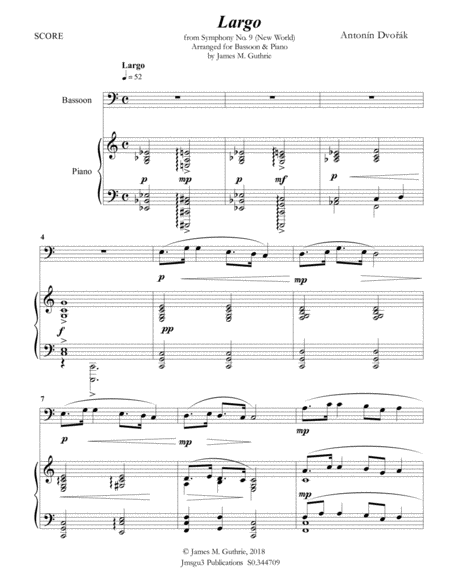
Instrumental Duet Bassoon,Instrumental Duet - Level 2 - Digital Download SKU: A0.549433 Composed by Antonin Dvorak. Arranged by James M. Guthrie, ASCAP. Instructional,Romantic Period,Sacred,Standards. Score and parts. 12 pages. Jmsgu3 #3494213. Published by jmsgu3 (A0.549433). Score: 7 pages, solo part: 2 pages, piano part: 3 pages. Duration: 4:25. Not difficult, but requires sensitivity & dynamic c control. Suitable for recitals, church meditations, or school programs. Dvořák Background Antonín Dvořák (1841 –1904) was, of course, a composer from Czechoslovakia. As a matter of fact, he was among the first Bohemian composers to attain universal recognition. It is important to realize that the late Romantic Nationalist period featured composers who used traditional and folk elements to portray the character of their nation. In particular, we see this in the music of Grieg (Norway), Finland (Sibelius), and Smetana (Bohemia).  Dvořák relied markedly on rhythms and other characteristics of Moravian and Bohemian folk music. Ascent to Fame Dvořák was truly a child musical prodigy on the violin. The premiere performances of his compositions notably occurred in 1872 and 1873. He submitted his First Symphony in particular to a German competition, but it failed to win. Consequently, in 1874 he presented two more symphonies to the Austrian State Prize for Composition. Johannes Brahms was the principal of the jury and was accordingly very impressed. They forthwith awarded the prize to Dvořák in 1874, 1876, and 1877. At this point, Brahms thereupon endorsed Dvořák to the publisher Simrock. Later, the publisher commissioned Dvořák to compose the Slavonic Dances, Op. 46. These became popular overnight and, as a result, Dvořák's worldwide status was launched. International Status Dvořák visited England upon invitation nine times. On each visit, he frequently conducted performances of his own compositions. He conducted concerts of his music, especially in Moscow and St. Petersburg. Eventually, the Prague Conservatory in fact appointed Dvořák as a professor. There, to be sure, he wrote his famous Dumky Trio. United States Consequently, the National Conservatory of Music of America appointed him as director in 1892. As a result, Dvořák composed his two most famous symphonic works: the Symphony No. 9 (From the New World), which spread his name universally, and his Concerto for Cello and Orchestra, one of the most famous of all cello works. Moreover, he wrote his most celebrated American String Quartet during this time. At the same time, because of his growing recognition in Europe and his homesickness for his own country, he left to return to Bohemia in 1895.  
DvoÅ™ák: Largo from the New World Symphony for Bassoon & Piano
2 Bassons (duo)

$32.95 28.36 € 2 Bassons (duo) PDF SheetMusicPlus

String Orchestra - Level 4 - Digital Download SKU: A0.1386062 Composed by Henri Wieniawski. Arranged by Paul Wood. Romantic Period. 65 pages. MyMusicScores.com #970008. Published by MyMusicScores.com (A0.1386062). Henri Wieniawski composed two Polonaises The Polonaise No. 1, Op.4 in D-major, emerges as a youthful endeavor, while the Op.21 in A-major stands as one of his final compositions.Completed in 1870, the Polonaise in A-major debuted with orchestral accompaniment in St. Petersburg, followed by a piano-accompanied performance in Warsaw, showcasing Wieniawski's adaptability. The piece received critical acclaim from its inception, lauded as a magnificent piece, a sentiment echoed in subsequent reviews across Russian and Western European publications.Published by Schott Publishers in Mainz around 1875, the Polonaise in A-major reveals a well-developed concert piece. The solo violin assumes a dominant role, with the orchestra primarily providing harmonic support. The middle fragment introduces contrast through a change in key and tempo, featuring a balanced dialogue between the instruments.The PDF document includes both the score and individual instrument parts.
Wieniawski Polonaise No. 2 Op 21 for Violin and String Orchestra
Orchestre à Cordes

$24.99 21.51 € Orchestre à Cordes PDF SheetMusicPlus

Clarinet - Digital Download SKU: S9.Q583632 Melodische und technische Übungen. Composed by Robert Kietzer. Downloadable. Volume op. 91, Op Heft 3 Schwere Übungen nebst Anleitung zum Transpo. Musikverlag Zimmermann - Digital #Q583632. Published by Musikverlag Zimmermann - Digital (S9.Q583632). German • English • French.1886 wurde der ehemals Königlich Preussische Militärkapellmeister Robert Kietzer, der vermutlich Kornettist war, in die Kaiserlich Russische Militärkapelle in St. Petersburg berufen. Seine Schulen für Kornett, Klarinette, Trompete, Bariton und Bass, Althorn, Tuba und Helikon, Posaune und Trommel waren außerordentlich populär und gehören bis heute zu den Standardwerken der Unterrichtsliteratur. Die Komposition der vorliegenden Etüden fällt in die Zeit um 1892, die Hefte enthalten außerdem einige Etüden von Friedrich Müller und Heinrich Baermann. Bis heute haben sie sich als Standardsammlungen für Klarinettisten bewährt, wogegen Kietzers andere Kompositionen (hauptsächlich russische Militärmärsche und -romanzen) aus dem Gedächtnis verschwunden sind.
Progress in Clarinet Playing
Clarinette

$9.99 8.6 € Clarinette PDF SheetMusicPlus


1 ....331 346 361 376 391 ....826


Partitions Gratuites
Acheter des Partitions Musicales
Acheter des Partitions Digitales à Imprimer
Acheter des Instruments de Musique

© 2000 - 2026

Accueil - Version intégrale