EUROPE
9198 articles
USA
12687 articles
DIGITAL
827 articles (à imprimer)
Partitions Digitales
Partitions à imprimer
827 partitions trouvées

1 ....361 376 391 406 421 ....826

String Orchestra - Level 3 - Digital Download SKU: A0.1181394 Composed by Viktor Kosenko. Arranged by Robert Debbaut. 20th Century,Children,Contest,Festival,Multicultural,Romantic Period,World. Score and parts. 5 pages. ROBERT DEBBAUT #781236. Published by ROBERT DEBBAUT (A0.1181394). Ukrainian and Soviet composer, Viktor Kosenko (1896-1938), was a highly regarded concert pianist, concertmaster and educator. Kosenko began his formal training at the St. Petersburg Conservatory as a composition student of Mikhail Sokolovsky. While in school he served as concertmaster of the Marinsky Theatre. Aleksandr Glazunov, the Director the Conservatory, was greatly impressed with Kosenko and spoke highly of his work.  Regarded by his contemporaries as a master of lyricism, his first compositions were markedly influenced by the works of composers such as Rachmaninov, Scriabin, Tchaikovsky and his fellow Ukrainian Mykola Lysenko.  During his short career he composed over 100 works for piano in a total of about 250 musical works. Other works include his symphonic Moldavian poem, choral and folk music arrangements, violin and piano concertos, trios and string quartets. During the 1930s Kosenko became dedicated to writing music for children. His first compositions for children were Four Children’s Pieces for piano (1930; this arranger has scored these four works for violin and piano, flute and piano, and cello and piano, as well as string orchestra). This work is one of five I have scored for as a Second Suite for String Orchestra from the twenty-four piano works for children he composed in 1936 (The First Suite is available from Carl Fischer).  If you purchase contact me about a set of parts and a wav recording at debbaut@gmail.com, subject line Kosenko.
The Camping Trip - Score Only
Orchestre à Cordes

$4.99 4.3 € Orchestre à Cordes PDF SheetMusicPlus

Piano - Digital Download SKU: BQ.979-0-50179-168-2 Composed by Ossip Gabrilovich. Edited by Stephen Begley. This edition: softcover. Bisel Classics. Score. With Text Language: English / German. Opus 12. 22 pages. Published by Bisel Classics - Digital (BQ.979-0-50179-168-2). ISBN 9790501791682.Remembered principally as the founding conductor of the Detroit Symphony Orchestra, Gabrilovich was a gifted pianist who had studied under Rubinstein at the St. Petersburg Conservatory in his youth. These two pieces for piano are from a relatively small number of works he composed for the instrument but they illustrate a sensitive and formidable technique in turn, especially with the concluding study which was composed for the left hand alone.
Zwei Klavierstucke, Opus 12
Piano seul

$15.95 13.73 € Piano seul PDF SheetMusicPlus

Orchestra - Digital Download SKU: S9.Q40349 Composed by Alexander Borodin. This edition: study score. Ernst Eulenburg - Orchestra - Score. Eulenburg Miniature Scores. Downloadable, Study score. Ernst Eulenburg & Co. GmbH - Digital #Q40349. Published by Ernst Eulenburg & Co. GmbH - Digital (S9.Q40349). Key: B minor. German • English • French.It took Borodin almost five years to write his first symphony, and the composition of 'Symphony No. 2' was to take just as much time. One should not forget, however, that music was mainly a leisure activity for the professor of organic chemistry in St. Petersburg. His work on 'Prince Igor' begun after the world premiere of Symphony No. 1 finished in favour of the second symphony, but part of the musical material found its way into the new composition, and even the extant programme testifies to the critical analysis of the music theatre: the gathering of Russian warriors in the first movement, the Old Slavonic bard in the andante, and the party scene to the sounds of the gusli in the finale.
Symphony No. 2 B minor
Orchestre

$17.99 15.49 € Orchestre PDF SheetMusicPlus

Bass Flute,Instrumental Solo,Piano - Level 2 - Digital Download SKU: A0.549430 Composed by Antonin Dvorak. Arranged by James M. Guthrie, ASCAP. Instructional,Romantic Period,Sacred,Standards. Score and individual part. 12 pages. Jmsgu3 #3494193. Published by jmsgu3 (A0.549430). Score: 7 pages, solo part: 2 pages, piano part: 3 pages. Duration: 4:25 Not difficult, but requires sensitivity & dynamic control. Suitable for recitals, church meditations, or school programs.   Dvořák Background Antonín Dvořák (1841 –1904) was, of course, a composer from Czechoslovakia. As a matter of fact, he was among the first Bohemian composers to attain universal recognition. It is important to realize that the late Romantic Nationalist period featured composers who used traditional and folk elements to portray the character of their nation. In particular, we see this in the music of Grieg (Norway), Finland (Sibelius), and Smetana (Bohemia).  Dvořák relied markedly on rhythms and other characteristics of Moravian and Bohemian folk music. Ascent to Fame Dvořák was truly a child musical prodigy on the violin. The premiere performances of his compositions notably occurred in 1872 and 1873. He submitted his First Symphony in particular to a German competition, but it failed to win. Consequently, in 1874 he presented two more symphonies to the Austrian State Prize for Composition. Johannes Brahms was the principal of the jury and was accordingly very impressed. They forthwith awarded the prize to Dvořák in 1874, 1876, and 1877. At this point, Brahms thereupon endorsed Dvořák to the publisher Simrock. Later, the publisher commissioned Dvořák to compose the Slavonic Dances, Op. 46. These became popular overnight and, as a result, Dvořák's worldwide status was launched. International Status Dvořák visited England upon invitation nine times. On each visit, he frequently conducted performances of his own compositions. He conducted concerts of his music, especially in Moscow and St. Petersburg. Eventually, the Prague Conservatory in fact appointed Dvořák as a professor. There, to be sure, he wrote his famous Dumky Trio. United States Consequently, the National Conservatory of Music of America appointed him as director in 1892. As a result, Dvořák composed his two most famous symphonic works: the Symphony No. 9 (From the New World), which spread his name universally, and his Concerto for Cello and Orchestra, one of the most famous of all cello works. Moreover, he wrote his most celebrated American String Quartet during this time. At the same time, because of his growing recognition in Europe and his homesickness for his own country, he left to return to Bohemia in 1895.
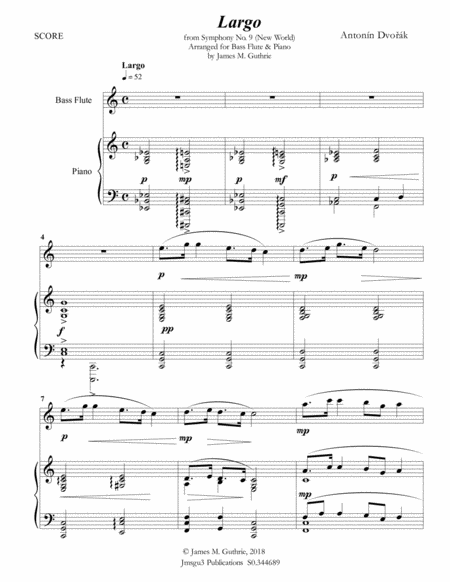
DvoÅ™ák: Largo from the New World Symphony for Bass Flute & Piano

$32.95 28.36 € PDF SheetMusicPlus

Small Ensemble Horn,Organ,Trombone,Trumpet,Tuba - Level 3 - Digital Download SKU: A0.778360 Composed by Nikolay Andreyevich Rimsky-Korsakov. Arranged by Thomas R. Vozzella. Easter,Romantic Period,World. Score and parts. 36 pages. Thomas R. Vozzella #5373055. Published by Thomas R. Vozzella (A0.778360). Russian Easter Festival Overture: Overture on Liturgical Themes, Op. 36, by the Russian composer Nikolai Rimsky-Korsakov between August 1887 and April 1888. The work received its orchestra premiere at a Russian symphony concert in St. Petersburg in late December 1888. This arrangement for brass quintet, tympani and organ uses three themes from the orchestral score making it useful for both sacred settings, schools and recitals.  .
Russian Easter Overture (Brass Quintet, Tympani and Organ)

$14.99 12.9 € PDF SheetMusicPlus

Brass Ensemble Horn,Trombone,Trumpet,Tuba - Level 3 - Digital Download SKU: A0.740257 Composed by Alexander Glazunov. Arranged by Craig Garner. Romantic Period,Wedding. Score and parts. 20 pages. Dorm 40 Music #2949513. Published by Dorm 40 Music (A0.740257). Glazunov was the last of the great Russian nationalist composers. A royal march section is followed by a lyric and romantic trio section, before a reprise of the march. It makes a great concert overture and will transport you back to St. Petersburg. Unique and versatile. Arrangement includes both B-flat and C trumpet parts. Performance time, 5:30. Published by Dorm 40 Music, www.dorm40music.com.
Marche de Noces (A Processional March)
Quatuor de Cuivres : 2 trompettes, trombone, tuba

$12.00 10.33 € Quatuor de Cuivres : 2 trompettes, trombone, tuba PDF SheetMusicPlus

Baritone Saxophone,Piano - Level 2 - Digital Download SKU: A0.549425 Composed by Antonin Dvorak. Arranged by James M. Guthrie, ASCAP. Instructional,Romantic Period,Sacred,Standards. Score and part. 12 pages. Jmsgu3 #3494017. Published by jmsgu3 (A0.549425). Score: 7 pages, solo part: 2 pages, piano part: 3 pages. Duration: 4:25 Not difficult, but requires sensitivity & dynamic control. Suitable for recitals, church meditations, or school programs. Dvořák Background Antonín Dvořák (1841 –1904) was, of course, a composer from Czechoslovakia. As a matter of fact, he was among the first Bohemian composers to attain universal recognition. It is important to realize that the late Romantic Nationalist period featured composers who used traditional and folk elements to portray the character of their nation. In particular, we see this in the music of Grieg (Norway), Finland (Sibelius), and Smetana (Bohemia).  Dvořák relied markedly on rhythms and other characteristics of Moravian and Bohemian folk music. Ascent to Fame Dvořák was truly a child musical prodigy on the violin. The premiere performances of his compositions notably occurred in 1872 and 1873. He submitted his First Symphony in particular to a German competition, but it failed to win. Consequently, in 1874 he presented two more symphonies to the Austrian State Prize for Composition. Johannes Brahms was the principal of the jury and was accordingly very impressed. They forthwith awarded the prize to Dvořák in 1874, 1876, and 1877. At this point, Brahms thereupon endorsed Dvořák to the publisher Simrock. Later, the publisher commissioned Dvořák to compose the Slavonic Dances, Op. 46. These became popular overnight and, as a result, Dvořák's worldwide status was launched. International Status Dvořák visited England upon invitation nine times. On each visit, he frequently conducted performances of his own compositions. He conducted concerts of his music, especially in Moscow and St. Petersburg. Eventually, the Prague Conservatory in fact appointed Dvořák as a professor. There, to be sure, he wrote his famous Dumky Trio. United States Consequently, the National Conservatory of Music of America appointed him as director in 1892. As a result, Dvořák composed his two most famous symphonic works: the Symphony No. 9 (From the New World), which spread his name universally, and his Concerto for Cello and Orchestra, one of the most famous of all cello works. Moreover, he wrote his most celebrated American String Quartet during this time. At the same time, because of his growing recognition in Europe and his homesickness for his own country, he left to return to Bohemia in 1895.  
DvoÅ™ák: Largo from the New World Symphony for Baritone Sax & Piano
Saxophone Baryton, Piano

$32.95 28.36 € Saxophone Baryton, Piano PDF SheetMusicPlus

Brass Quintet Baritone Horn TC,Euphonium,Trombone,Trumpet,Tuba - Level 3 - Digital Download SKU: A0.817101 Composed by Anatole Liadov and Alexander Glazounov. Arranged by Charles Decker. 19th Century,Contest,Festival,Multicultural,Romantic Period,World. 22 pages. Charles Decker Music Press #3530649. Published by Charles Decker Music Press (A0.817101). These five short, elegant fanfares by former students of Nicolai Rimsky-Korsakov were composed for the 1890 concert celebrating his 20 years as professor at the St. Petersburg Conservatory in Russia. Originally scored for an orchestral brass section, the fanfares retain their brilliance as a brass quintet and parts can be doubled to intensify the musical impact. Arranged for a brass quintet of two B-flat trumpets with alternate C trumpet parts, horn in F with alternate substitute parts for horn (B-flat trumpet, treble and bass clef baritone), trombone with a substitute treble clef baritone for trombone part and tuba. This is a very accessible work for student ensembles and less experienced players that will impress audiences and add festive excitement to concerts or ceremonies. The recording is an actual brass quintet performance and not computer playback.See more than 70 mixed brass ensemble publications at Charles Decker Music Press at Sheet Music Plus for inexperienced to advanced musicians with music ranging from the Renaissance to contemporary new works for trios, quartets, quintets, brass choir and brass band. Many of the mixed brass ensemble editions include alternate and substitute parts being alternate C trumpet parts for B-flat trumpet parts, flugelhorn/trumpet substitute for horn, horn substitute for trombone and treble clef euphonium substitute for trombone. See also 50+ homogeneous brass group editions with Charles Decker Music Press at Sheet Music Plus for horn, trumpet and trombone ensembles. Check out the Music of Black Composers Series with Charles Decker Music Press at Sheet Music Plus with 25 arrangements for mixed brass ensembles ranging from early jazz to symphonic works with composers Samuel Coleridge-Taylor, R. Nathaniel Dett, William Grant Still, Will Marion Cook, James Reese Europe, James Johnson and others. All ensemble publications include recordings of the entire edition.  For more of my brass quintet editions use these links to Kendor Music and Cherry Classics Music to see listings of arrangements of music by J.S. Bach, H.L. Clarke, Debussy, Dukas, Elgar, Falla, Holst, Ives, Nestico, Rachmaninoff, Satie, and Tchaikovsky.
Five Fanfares for Rimsky-Korsakov for Brass Quintet
Quintette de Cuivres: 2 trompettes, Cor, trombone, tuba

$11.95 10.29 € Quintette de Cuivres: 2 trompettes, Cor, trombone, tuba PDF SheetMusicPlus


1 ....361 376 391 406 421 ....826


Partitions Gratuites
Acheter des Partitions Musicales
Acheter des Partitions Digitales à Imprimer
Acheter des Instruments de Musique

© 2000 - 2026

Accueil - Version intégrale





