EUROPE
14421 articles
USA
0 articles
DIGITAL
142538 articles (à imprimer)
Partitions Digitales
Partitions à imprimer
142538 partitions trouvées


Contrabassoon,Instrumental Solo,Piano - Level 1 - Digital Download SKU: A0.548727 Composed by Martin Luther. Arranged by James M. Guthrie, ASCAP. Easter,Instructional,Standards. Score and individual part. 4 pages. Jmsgu3 #3411773. Published by jmsgu3 (A0.548727). Out of the Depths I Cry to You by Martin Luther. First verses feature modified counterpoint and harmony proceeding at quarter = 82. The final verse is reharmonized for maximum dramatic effect at a more contemplative tempo such as quarter = 64. Features the entire range of the instrument. Very powerful selection for Lent or Easter. Duration (3 verses) 3:05, 36 ms. Score: 3 pg. Solo part: 1 pg. Piano reads from the score. Out of the Depths Aus tiefer Not schrei ich zu dir (From deep affliction I cry out to you), is, of course, a hymn composed by Martin Luther. Moreover, Luther also wrote the lyrics which are essentially a paraphrase of Psalm 130. First published in 1524, it is also one of eight songs in the original Lutheran hymnal. It appears likewise in many hymnals and in different translations. The lyrics furthermore stimulated compositions from the Renaissance to contemporary. Consequently, composers such as Johann Sebastian Bach built an entire chorale cantata on it. Other composers similarly contributed compositions, such as Felix Mendelssohn and Max Reger. Luther Background Martin Luther, (1483 –1546) was a German professor of theology, composer, priest, and moreover, an influential character in the Protestant Reformation. Luther had a momentous impact on church and society due to his contributions to the musical arts. He wanted to disseminate the gospel among mankind and with this intention thought that the best way to do that was through music. Influence It is important to realize that other musicians, and their descendants, were encouraged by Luther’s songs and wrote their own hymns. Luther, to be sure, had a thorough musical education. For example, he knew secular and sacred songs from an early age. He, in particular, played the lute well and sang in the monastery when he was a monk. That is to say, music was an essential part of his life. He in fact first began writing songs in 1523, sometimes writing the melody as well as the lyrics. Luther was certainly able to evaluate the composers of his time. He thought especially highly of Josquin des and Ludwig Senfl. He was also acquainted, with this in mind, with other composers and their works. Legacy The Lutheran musical ethos soon covered all of Germany and later significantly fashioned Protestant musical culture. Heinrich Schütz and Johann Sebastian Bach are the most compelling evidence of this Protestant musical culture. Additionally, as a point often overlooked, the pedal organ, first refined in northern Germany, became universally prevalent. As a matter of fact, Dieterich Buxtehude established a regular evening organ concert series in Lübeck. Another key point is that this concert series, in turn, spread North German Musical ideas worldwide. Luther was especially convinced that music is a beautiful and exclusive offering of the divine.
Luther: Out of the Depths for Contrabassoon & Piano

$24.95 21.74 € PDF SheetMusicPlus

Piano Solo - Digital Download SKU: A0.938197 Composed by John Bacchus Dykes. Arranged by April Rundquist. Christian,Sacred. Score. 8 pages. April Ann Rundquist #2033633. Published by April Ann Rundquist (A0.938197). This has always been a very visual arrangement for me with a rough narrative. It starts with the trumpets at the end of the world, the sense of quiet expectation. Wind across a field. It drops off into the silence of outer space. The initial theme presented against that impersonal void, knowing that He's out there, somewhere. Some of this is very difficult for me to describe because this is really about the Triune God, the great creative power, the mover in harmony and cooperation with Himself. The second verse is more grand, the love, the sense of story. And then it gets very, very big, in the way that I AM is always in capitals. Who WAS and IS and evermore shall BE! And in my mind that word BE is light, and just explodes against the blackness into a billion sparkles. And we shrink down to the microcosm for a moment, the wonders of His creative power in the tiny worlds, and it fades to the black of space again. Holy, Holy, Holy, though the darkness hide Thee. The Light that we can't see that would outshine all the stars. More beauty, and then we tumble down the waterfall of Living Water from the Throne of God...in Heaven. The golden palaces and the wonder, the unearthliness, the richness of the life. For a moment it's more simple and I'm reminded of an old hymn being sung in a rustic church. Then a vision of the Cosmic Christ from Revelation giving a benediction, and we're plunged into the chorus of Heaven, the new song of the 144,000. (this part sounds really good on an acoustic piano because the sound physically builds on itself) And it ends as it began...
Holy Holy Holy (To Thee We Sing)
Piano seul

$4.99 4.35 € Piano seul PDF SheetMusicPlus

B-Flat Clarinet,Piano - Level 3 - Digital Download SKU: A0.549331 By Barry Manilow. By Bruce Johnston. Arranged by James M. Guthrie, ASCAP. Contemporary,Rock. Score and part. 8 pages. Jmsgu3 #3486239. Published by jmsgu3 (A0.549331). Duration: ca. 3:00, score: 5 pages, solo part: 1 page, piano part: 2 pages.Very famous song suitable for church, recital or nightclub. I Write the Songs is a popular song written by Bruce Johnston in 1975 and made famous by Barry Manilow. Manilow's version reached number one on the Billboard Hot 100 chart in January 1976[2] after spending two weeks atop the Billboard adult contemporary chart in December 1975.[3] It won a Grammy Award for Song of the Year and was nominated for Record of the Year in 1977.[3] Billboard ranked it as the No. 13 song of 1976.[4]The original version was recorded by The Captain & Tennille, who worked with Johnston in the early 1970s with The Beach Boys. It appears on their 1975 album, Love Will Keep Us Together. The first release of I Write the Songs as a single was by then teen-idol David Cassidy from his 1975 solo album The Higher They Climb, which was also produced by Bruce Johnston. Cassidy's version reached #11 on the UK Singles Chart in August of that year.[5]Johnston has stated that, for him, the I in the song is God,[2] and that songs come from the spirit of creativity in all of us. He has said that the song is not about his Beach Boys bandmate Brian Wilson.[6]Manilow was initially reluctant to record the song, stating in his autobiography Sweet Life: The problem with the song was that if you didn't listen carefully to the lyric, you would think that the singer was singing about himself. It could be misinterpreted as a monumental ego trip.[3] After persuasion by Clive Davis, then president of Arista Records, Manilow recorded the song, and his version of I Write the Songs was the first single taken from the album Tryin' to Get the Feeling. It first charted on the Billboard Hot 100 on November 15, 1975, reaching the top of the chart nine weeks later, on January 17, 1976. Wikipedia
I Write The Songs
Clarinette et Piano
Barry Manilow
$39.95 34.81 € Clarinette et Piano PDF SheetMusicPlus

String Ensemble,String Trio - Level 4 - Digital Download SKU: A0.861851 Composed by Mark O'Connor. 20th Century,Contemporary,Folk. Score and parts. 8 pages. Mark O'Connor Musik International #6203887. Published by Mark O'Connor Musik International (A0.861851). In The Summertime (viola part – vln, vla, cel) MO167CViola Part (score and parts available)Music by Mark O’Connor4 pages - 6:00 minutes in length In The Summertime is comprised of two parts, with two distinct messages. The first speaks to the space of wonderment in our lives, where good friends and experiences surround us. A time spent looking forward to the continuing joy and merrymaking of the innocence and purpose that brought us together.We then travel to where agelessness ends, where innocence no longer lingers. The bitterness within a life that begins to be complicated where it wasn¹t before starts to overwhelm the sweetness on the tongue. Still, the B-section of the piece yearns backward and forward at the same time. Tugging at the memory of what came before to find and create meaning farther on.So many of us expect life to continue to deliver its many delights, without realizing that it was the innocence and freedom, the faith in the possible that created the delightful condition of youth. After a playful frolic with the instruments dancing about in the musical forest, the A and B parts return, reminding us that unlike time that moves ever forward, the journey back to the wonder and freedom of childhood awaits us all. Original music printed from the composer’s manuscripts.Music editing, copying and engraving by Mark O’Connorusing Finale on Apple Macintosh 2006 Composed by Mark O’ConnorThe accompanying MP3 is of Mark O’Connor’s Appalachia Waltz Trio (touring ensemble) with Becca Albers and Mike Block, performing live in 2007 at the Aspen Music Festival. Catalogue Number MO167CCopyright © 2006 by Mark O’Connor Music InternationalFor more information on violinist and composer Mark O'Connor, O’Connor String Camps, Touring Ensembles, Discography, Bio, Repertoire and more, please visitwww.markoconnor.com For information on the O’Connor Method – instructional book series for violin, viola, cello and school string orchestra programs:www.oconnormethod.com  
In The Summertime (viola part - vln, vla, cel)

$4.50 3.92 € PDF SheetMusicPlus

Woodwind Ensemble Bassoon - Level 3 - Digital Download SKU: A0.813982 Composed by Franz Xaver Gruber. Arranged by Regis Bookshar. Christmas,Instructional,Multicultural,World. 11 pages. Regis Bookshar #6635897. Published by Regis Bookshar (A0.813982). Bassoon Octet - Intermediate - Digital Download. This arrangement of Silent Night, or in German, Stille Nacht, would be a wonderful addition to any music library and could be performed for Christmas concerts, recitals, and, especially, church services. It is equally suitable for junior and senior high school students and even older musicians. Depending on their ability, younger musicians would also enjoy playing this selection. Included are a score and a complete set of parts (11 pages). This selection is one of the many arrangements from The Regis Bookshar Trumpet Ensemble's extensive music library which are being made available for the first time.Silent Night is probably the most popular Christmas carol ever written. It was composed in 1818 by Franz Xaver Gruber to lyrics by Joseph Mohr and was first performed on Christmas Eve at St. Nicholas parish church in Oberndorf, a small village in present-day Austria. A young Catholic priest, Father Joseph Mohr, had written the poem, Stille Nacht, in 1816 and had gone to Oberndorf in 1817. The melody was composed by Franz Xaver Gruber, schoolmaster and organist in the nearby village of Arnsdorf. On Christmas Eve, 1818, Mohr brought the words to Gruber and asked him to compose a melody and guitar accompaniment for that night's mass, after river flooding had possibly damaged the church organ. The church was eventually destroyed by repeated flooding and has since been replaced with the Silent-Night-Chapel.According to Gruber, Karl Mauracher, an organ builder who serviced the instrument at the Oberndorf church, was enamored with the song, and took the composition home with him to the Ziller Valley in Tyrol, Austria. From there, two traveling families of folk singers, the Strassers and the Rainers, included the tune in their shows. The Rainers were already singing it around Christmas, 1819, and once performed it for an audience that included Franz I of Austria and Alexander I of Russia. They also gave the first performance of the song in the United States in New York City in 1839. By the 1840's, the song was well known and was reported to be a favorite of Frederick William IV of Prussia. During this period, the melody changed slightly to become the version that is commonly heard today. The version of the melody that is generally used today is a slow, meditative lullaby, or pastoral, differing slightly from Gruber's original which has a moderate tempo. The song has been translated into about 140 languages and has been recorded by many singers across many music genres. The version sung by Bing Crosby in 1935, has sold over 10 million copies as a single.In this arrangement of Silent Night, Regis Bookshar has kept the basic form of this familiar Christmas carol, but has also included a descant during the third verse. Also, in addition to this version for a Bassoon Octet, there are other arrangements of Silent Night available for a variety of instrumental ensembles. There are Quintets and Octets readily available for purchase. Please take the time to look for other versions of this composition. You may find something else that might also suit your needs.I would also encourage you to search for other arrangements by Regis Bookshar, as well, as there are numerous arrangements in a wide variety of styles, also available for purchase. You may find something else which might interest you. Please continue to check periodically because new arrangements are being added as often as possible. I'm certain that this wonderful arrangement of Silent Night will continue to entertain both performers and audiences alike for years to come.
Silent Night (Bb) (Bassoon Octet)
Ensemble de Bassons
the 1840's, the song was well known and was reported to be a favorite of Frederick William IV of Prussia During this period, the melody changed slightly to become the version that is commonly heard today
$8.00 6.97 € Ensemble de Bassons PDF SheetMusicPlus

Cello,Double Bass,Viola,Violin - Digital Download SKU: A0.1070245 Composed by Tito Abeleda. Concert,Contemporary. Full Performance. Duration 404. Visionary Quest Records #4767765. Published by Visionary Quest Records (A0.1070245). STRING ORCHESTRA - Cello Solo; Violin Solo; Violin 1, 2, 3; Viola 1, 2, 3; Cello (non-solo) 1, 2; Contrabass 1, 2: Full Score plus parts = 75 pages. Composer: Tito Abeleda (1964 - ) Digital Download. HD CD Quality MP3 recorded at 48,000 hz 320 kbps also available. Level: IntermediateTears from My Eyes: First Movement: Remember Your Feelings (for Full Orchestra with Cello and Oboe solos) Second Movement: Reflection and Contemplation (for Flute Choir with Flute solo) Third Movement: Love Lost: Finding Your Fire Again Fourth Movement: Mourning in the Rain (for Clarinet Choir with Clarinet solo) Fifth Movement: Onward and Upward (for String Orchestra with Cello and Violin solo)A few months ago, I received a call from my parents. My Mother had some sad news to give me. Dad was very ill. My whole life flashed before me. My parents were always 200% supportive of all my artistic endeavors. None of my success would have been possible but for my Dad and Mom. My memories of my Dad and my Mom flooded my mind like a deluge. When I heard the news about how gravely ill he was I thought to myself that so often we give thanks, honor, or show our love when it is too late. Who wants to be that person? I was finally in the unique position to show my gratitude and love to my parents in the most special way that I could - through music from my heart and soul. I got the courage to look deeply within and then I began to write what was to become the first and second songs, respectively Tears from My Eyes: Remember Your Feelings and Tears from My Eyes: Reflection and Contemplation on my Tears from My Eyes: Songs from my Soul album.You will now be able to do just the same for your loved ones with this new music. Your intermediate level to advanced students and even professional musicians should find this to be a welcomed piece to learn and master. It looks deceptively simple but the learning and challenge comes from two smaller sub-ensembles playing together in their own collective units legato con moto while playing together as a whole music ensemble Everyone will enjoy and bathe in the beautiful harmonies that will resonate when the entire music ensemble begins to listen to each while playing together as a group. Your musicians will hone their skills in playing together with just the right balance that this song requires. Your musicians will also hone their skills for subdividing and maintaining an inner beat that is in sync with your conducting because there is no percussion and the notes are freely flowing on and off the down beat yet not sounding heavily syncopated when performed. When will you know when you have achieved the right balance and flow of the music? You will know when, because you will hear it and feel it when it comes into place. But I can help you with all of this with what I have to offer you today. I share with you now the final and 5th movement to Tears from my Eyes - Onward and Upward (for String Orchestra). This particular was created and produced after the Songs from My Soul album was sent for distribution. So, this song has yet to be officially released. All five movements will be released as an album Mourning in the Rain. This 5th movement Onward and Upward has a decisive emotional resolution and conviction in its pathos. The dynamics reflect accordingly ranging from mf to fff indicative of overcoming adversity and grief. Imagine overcoming despair, rising out of grief and depression and finally seeing the light of day - to join the ranks of the living and re-embracing life once again.Contact info: Tito AbeledaVisionary Quest Recordshttps://www.visionaryquestrecordsEmail: tito@visionaryquestrecords.comFollow Tito on Social Media:Facebook: https://www.facebook.com/titoabeledaTwitter: https://twitter.com/titoabeleda
Tears from My Eyes: Onward and Upward (for String Orchestra with Cello and Violin solos)
Orchestre à Cordes

$2.99 2.61 € Orchestre à Cordes PDF SheetMusicPlus

Double Bass,Piano,String Bass - Level 4 - Digital Download SKU: A0.1078887 By Glen Campbell. By Jimmy Webb. Arranged by James M. Guthrie. Country,Jazz,Pop,Standards,Wedding. Score and part. 12 pages. Jmsgu3 #683082. Published by jmsgu3 (A0.1078887). Score: 7 pages. Duration: 2:34Wichita Lineman is a 1968 song by the American singer-songwriter Jimmy Webb. The song has since been praised as one of the most influential and greatest recordings in popular music history. The song has been widely praised by critics and has been called a masterpiece of American music. In 2004, it was ranked number 201 on Rolling Stone's list of The 500 Greatest Songs of All Time. The song has also been praised for its poetic lyrics, as well as its use of electric guitar and strings to create a unique sound. The song has been covered by numerous artists, including Glen Campbell, who recorded a version that reached the top of the US Billboard Hot Country Songs chart in 1968. The song has also been featured in numerous films and television shows and has been referenced in popular culture. Wichita Lineman has been praised for its universal appeal, and its ability to connect with listeners.Wichita Lineman is a timeless classic that has become synonymous with loneliness. The song is about a telephone lineman who is alone in his work and in his life, looking out at the vast landscape in search of something he cannot find. The melancholy and longing of the song evoke the loneliness that many people feel, especially in a society that can often feel disconnected and isolated. Webb's lyrics and Campbell's vocals combine to create a song that is as beautiful as it is heartbreaking. It is a timeless song that captures the loneliness of many, and its enduring popularity over the years is a testament to its power.
Wichita Lineman
Contrebasse, Piano (duo)
Glen Campbell
$149.95 130.66 € Contrebasse, Piano (duo) PDF SheetMusicPlus

Brass Ensemble Horn - Level 3 - Digital Download SKU: A0.813967 Composed by Franz Xaver Gruber. Arranged by Regis Bookshar. Christmas,Instructional,Multicultural,World. Score and parts. 7 pages. Regis Bookshar #6635851. Published by Regis Bookshar (A0.813967). French Horn Quintet - Intermediate - Digital Download. This arrangement of Silent Night, or in German, Stille Nacht, would be a wonderful addition to any music library and could be performed for Christmas concerts, recitals, and, especially, church services. It is equally suitable for junior and senior high school students and even older musicians. Depending on their ability, younger musicians would also enjoy playing this selection. Included are a score and a complete set of parts (7 pages). This selection is one of the many arrangements from The Regis Bookshar Trumpet Ensemble's extensive music library which are being made available for the first time.Silent Night is probably the most popular Christmas carol ever written. It was composed in 1818 by Franz Xaver Gruber to lyrics by Joseph Mohr and was first performed on Christmas Eve at St. Nicholas parish church in Oberndorf, a small village in present-day Austria. A young Catholic priest, Father Joseph Mohr, had written the poem, Stille Nacht, in 1816 and had gone to Oberndorf in 1817. The melody was composed by Franz Xaver Gruber, schoolmaster and organist in the nearby village of Arnsdorf. On Christmas Eve, 1818, Mohr brought the words to Gruber and asked him to compose a melody and guitar accompaniment for that night's mass, after river flooding had possibly damaged the church organ. The church was eventually destroyed by repeated flooding and has since been replaced with the Silent-Night-Chapel.According to Gruber, Karl Mauracher, an organ builder who serviced the instrument at the Oberndorf church, was enamored with the song, and took the composition home with him to the Ziller Valley in Tyrol, Austria. From there, two traveling families of folk singers, the Strassers and the Rainers, included the tune in their shows. The Rainers were already singing it around Christmas, 1819, and once performed it for an audience that included Franz I of Austria and Alexander I of Russia. They also gave the first performance of the song in the United States in New York City in 1839. By the 1840's, the song was well known and was reported to be a favorite of Frederick William IV of Prussia. During this period, the melody changed slightly to become the version that is commonly heard today. The version of the melody that is generally used today is a slow, meditative lullaby, or pastoral, differing slightly from Gruber's original which has a moderate tempo. The song has been translated into about 140 languages and has been recorded by many singers across many music genres. The version sung by Bing Crosby in 1935, has sold over 10 million copies as a single.In this arrangement of Silent Night, Regis Bookshar has kept the basic form of this familiar Christmas carol, but has also included a descant during the third verse. Also, in addition to this version for a French Horn Quintet, there are other arrangements of Silent Night available for a variety of instrumental ensembles. There are Quintets and Octets readily available for purchase. Please take the time to look for other versions of this composition. You may find something else that might also suit your needs.I would also encourage you to search for other arrangements by Regis Bookshar, as well, as there are numerous arrangements in a wide variety of styles, also available for purchase. You may find something else which might interest you. Please continue to check periodically because new arrangements are being added as often as possible. I'm certain that this wonderful arrangement of Silent Night will continue to entertain both performers and audiences alike for years to come.
Silent Night (Bb) (French Horn Quintet)
the 1840's, the song was well known and was reported to be a favorite of Frederick William IV of Prussia During this period, the melody changed slightly to become the version that is commonly heard today
$5.00 4.36 € PDF SheetMusicPlus

Piano Solo - Level 5 - Digital Download SKU: A0.1215199 By Liberace. By Manuel Ponce. Arranged by Timothy Stapay. Film/TV,Folk,Singer/Songwriter,Standards,Traditional. Score. 8 pages. Timothy Stapay #812071. Published by Timothy Stapay (A0.1215199). This is an arrangement of the traditional Mexican folk song, Estrellita as played by piano artist, Liberace.  This is from a very early and rare album called Songs My Mother Taught Me.Tender, romantic, and so elementally lovely that it seems we have carried this melody inside us all our lives — that’s Estrellita, the “little star†that is surely one of the most popular songs in the world. Estrellita was composed by Manuel Ponce, a 20th-century Mexican composer, who grew up in a musical family and received his musical training from his parents. It is the single work for which he is best known.According to widely accepted tradition, the ineffably lovely melody of Estrellita came to Ponce in a burst of romantic inspiration in a quiet moment as he beheld his wife.Lyrics:Little star, of the distant sky,you see my pain, you know my suffering.Come down and tell me if you love me stillbecause sad alone is this heartthat asks for love from you. You are my star, a beacon of love.You alone can give light to the heart.Little star, tell me you still love mebecause sad alone is this heartthat desires love from you.   You are my star, a beacon of love.You alone can give light to the heart.Little star, tell me you still love mebecause sad alone is this heartthat desires love from you.
Estrellita
Piano seul
Liberace
$7.99 6.96 € Piano seul PDF SheetMusicPlus

Woodwind Ensemble,Woodwind Quartet Flute - Level 3 - Digital Download SKU: A0.1509402 By Francesco Leone. By Isaac Albeniz. Arranged by Francesco Leone. Romantic Period. 24 pages. Glissato Edizioni Musicali #1084641. Published by Glissato Edizioni Musicali (A0.1509402). Discover the vibrant rhythms and passionate melodies of Isaac Albéniz's Sevilla in a fresh and compelling arrangement for flute quartet by Francesco Leone. This piece, part of the celebrated Suite Española No. 1, Op. 47, has been skillfully adapted to capture the essence of Spanish music and culture, offering an advanced-level challenge for flute ensembles. Leone's arrangement brings out the color and dynamics of Albéniz's composition, making it a perfect addition to the repertoire of ambitious flute quartets seeking to explore the richness of Spanish classical music.Arrangement Highlights:Instrumentation: This exquisite arrangement is scored for 3 C Soprano Flutes and 1 Bass Flute, creating a balanced blend of bright and deep tones that echo the lively streets and serene landscapes of Spain. The thoughtful distribution of parts ensures that each musician can contribute to the full expression of the piece, from the intricate melodies to the robust, rhythmic undercurrents.Level: Advanced. Designed for flute quartets ready to take on a more challenging repertoire, this arrangement demands precision, control, and a deep understanding of musical expression. It's an opportunity to showcase technical skill and interpretive depth, all while navigating the intricate harmonies and rhythms that define Spanish music.Score and Parts: The e-book includes a full score and individual parts, all clearly notated and meticulously prepared to facilitate a smooth rehearsal process. The arrangement is crafted to ensure that performers can fully engage with the music, allowing for a performance that is both technically sound and emotionally compelling.Exclusive Online Resources:An audio demo of this stunning arrangement is available at www.glissato.it, product code: EG1117. This demo serves as an essential reference for tempo, articulation, and ensemble balance, helping musicians to align their interpretation with the spirited essence of Sevilla. It's a valuable tool for both individual practice and group rehearsals, ensuring that the quartet can achieve a cohesive and dynamic performance.Embrace the Spirit of Sevilla:Francesco Leone's arrangement for flute quartet invites musicians to immerse themselves in the heart of Spanish culture through the lens of Isaac Albéniz's masterful composition. Whether preparing for a performance, competition, or simply exploring the depth of classical repertoire, this piece offers a rich, rewarding experience. Dive into the spirited world of Sevilla and let your flutes sing with the passion and elegance of Spanish tradition.
Sevilla - Flute Quartet score & parts
Quatuor de Flûtes : 4 flûtes
Francesco Leone
$15.00 13.07 € Quatuor de Flûtes : 4 flûtes PDF SheetMusicPlus

String Quartet Cello,String Quartet,Viola,Violin - Level 3 - Digital Download SKU: A0.1208541 Composed by Ludwig van Beethoven (1770 – 1827). Arranged by James M. Guthrie, ASCAP. 19th Century,Chamber,Classical,Contest,Festival,Wedding. 12 pages. Jmsgu3 #806654. Published by jmsgu3 (A0.1208541). 6. Allegretto quasi andante.Beethoven's Bagatelles Op. 33 are quite typical of his early style, retaining many compositional features of the early Classical period.  The first bagatelle in particular is arguably one of Beethoven's most well-known pieces. While they may seem light-hearted and not to be taken too seriously, they are still well-crafted works that embody the younger Beethoven's style. The Bagatelles Op. 33 were composed by Beethoven in 1801-02 and published in 1803. Bagatelles are shorter and less complex than sonatas, often consisting of a single movement. They were intended to be played as light entertainment or as encores at the end of a concert.Bagatelle No. 6 of Beethoven's Op. 33 is a short Allegretto that is characterized by its playful and light-hearted nature. The piece is in the key of D major and is written in a binary form, consisting of two sections that are repeated. The first section is in a brisk andante tempo and features a playful melody that is accompanied by a simple, yet effective, harmonic progression. The second section is more subdued and features a more lyrical melody that is accompanied by a more complex harmonic progression. The piece is notable for its use of syncopation, which adds to its playful character. Overall, Bagatelle No. 6 is a charming and delightful piece that showcases Beethoven's skill as a composer of small-scale works.
Beethoven: Bagatelle Op. 33 No. 6 for String Quartet
Quatuor à cordes: 2 violons, alto, violoncelle

$24.95 21.74 € Quatuor à cordes: 2 violons, alto, violoncelle PDF SheetMusicPlus

Clarinet Quartet,Woodwind Ensemble Bass Clarinet,E-Flat Clarinet - Level 3 - Digital Download SKU: A0.1325229 Composed by Pietro Mascagni. Arranged by Rob Bushnell. Classical,Easter,Film/TV,Opera,Romantic Period. 15 pages. RBMusic #913462. Published by RBMusic (A0.1325229). In 1889, a struggling composer called Pietro Mascagni heard about a sponsored competition for one-act operas, specifically for young Italian composers who had not yet had an opera performed, only two months before the deadline. With little time, he selected the subject for his opera and asked his childhood friend, Giovanni Targioni-Tozzetti (who was helped by Guido Menasci), to write a libretto for him. Mascagni selected a story that he had seen as a play in Milan in early 1884 by realist writer Giovanni Verga, “Rustic Chivalryâ€, or Cavalleria rusticana. A passionate love tragedy featuring seduction, adultery, revenge and murder, it is surprising set on Easter morning.Mascagni received only a few verses at a time from his librettists, but he was not worried because he had the opera clear in his mind: “I identified with the drama to such an extent that I felt it within myself in terms of music.†After two months’ of work, the music for Cavalleria rusticana was finished but he feared the opera would fail and put the music in a draw. Fortunately, his wife sent it off, he unanimously won the competition and was soon the talk of Europe. (At the premiere in May 1890 in Rome, Mascagni received no fewer than 60 curtain calls.) Unfortunately, it was a one-hit wonder with Mascagni unable to repeat its success, saying towards the end of his life that “it is a pity I wrote Cavalleria first for I was crowned before I became king.†He died, penniless, in 1945.Today, few people have heard of Mascagni’s name, and, if they have, it is rarely in relation to anything but one piece from Cavalleria rusticana, the Intermezzo. A short piece of purely orchestral music that is uses to denote the passage of time, the orchestration is very simple but it is such an indulgently beautiful melody (based on a hymn heard earlier in the short opera) that perfectly captures the peace of country living in Sicily against the intense feelings of the main characters and the looming tragedy to come.The piece is so popular that (along with the “Easter Hymn†from the same opera), it is the only reason Mascagni features in the Classic FM’s Hall of Fame.The piece was used in the 1980 film Raging Bull and the 1990 film The Godfather Part III.This arrangement includes alternative parts for clarinet in E-flat and alto clarinet in E-flat. A recording of the original song can be found on YouTube: https://www.youtube.com/watch?v=Kgr-I1y1_2M.Other searchable terms: Italy, Martin Scorsese, Robert De Niro, Joe Pesci, Cathy Moriarty, Nicholas Colasanto, Theresa Saldana, Frank Vincent, Al Pacino, Diane Keaton, Talia Shire, Andy García, Eli Wallach, Joe Mantegna, Bridget Fonda, George Hamilton, Sofia Coppola.
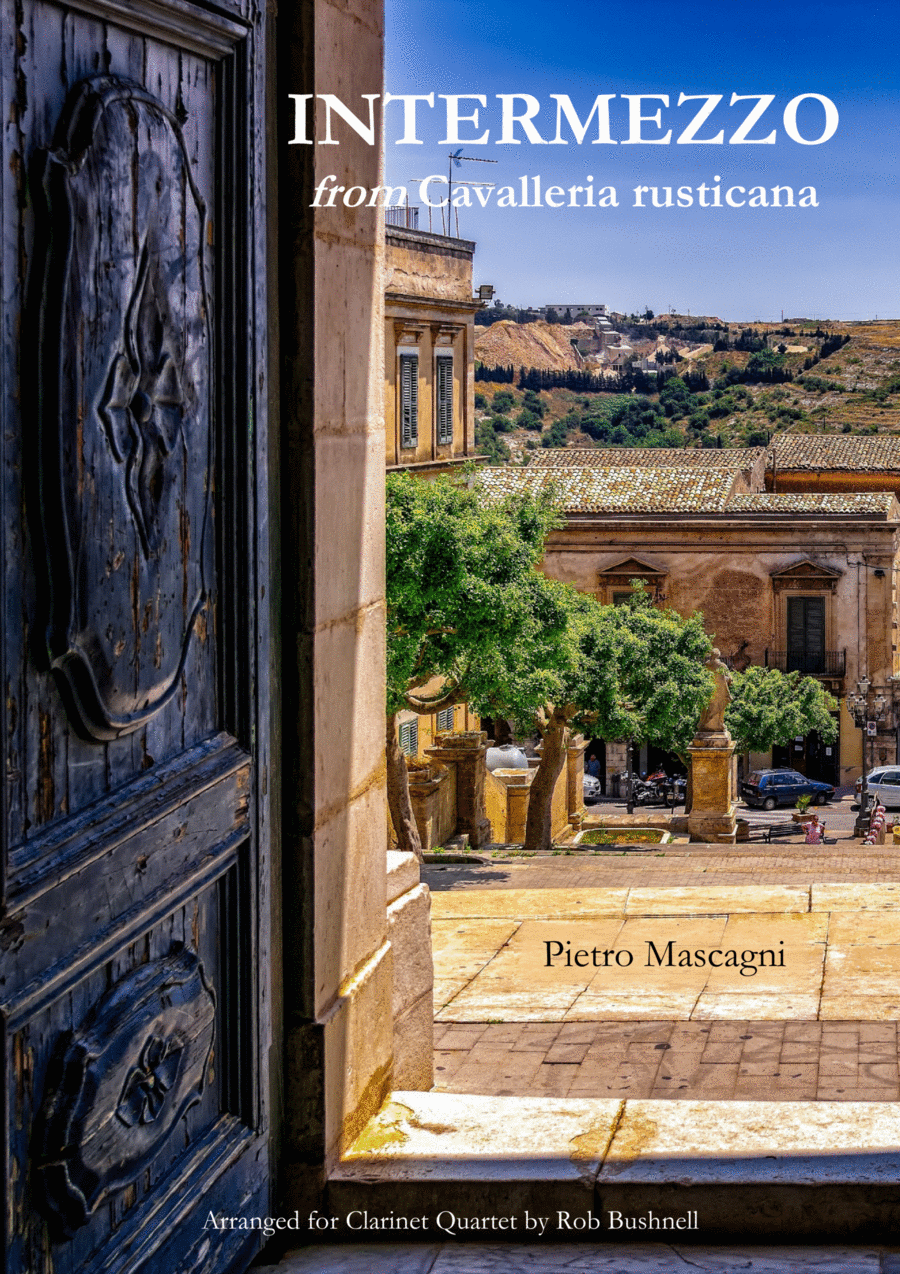
Intermezzo from "Cavalleria rusticana" (Mascagni) - Clarinet Quartet
Quatuor de Clarinettes: 4 clarinettes

$15.99 13.93 € Quatuor de Clarinettes: 4 clarinettes PDF SheetMusicPlus

Easy Piano - Level 2 - Digital Download SKU: A0.911669 By Imagine Dragons. By Ben McKee, Dan Reynolds, Daniel Platzman, Justin Tranter, Mattias Larsson, Robin Fredriksson, and Wayne Sermon. Arranged by Amanda Dills. Contemporary,Film/TV,Rock. Score. 5 pages. Amanda Dills #517649. Published by Amanda Dills (A0.911669). A powerful rock piece, made famous by the band Imagine Dragons, for beginning/intermediate players. About this song (from Wikipedia): In March 2017, Dan Reynolds told People that the song was inspired by his experiences with ankylosing spondylitis in 2015. He said that, The meaning of the song is really reflecting on specific things in my life that were painful, whether it was anxiety and dealing with crowds, feeling overwhelmed by that or the success of the band, disease, going through depression—anything that was a source of pain in my life. And just rising above that, finding a place of perspective where I could be appreciative of the pain in my life and make it my greatest strength..
Believer
Piano Facile
Imagine Dragons
$4.99 4.35 € Piano Facile PDF SheetMusicPlus

Woodwind Ensemble Oboe - Level 3 - Digital Download SKU: A0.813968 Composed by Franz Xaver Gruber. Arranged by Regis Bookshar. Christmas,Instructional,Multicultural,World. 7 pages. Regis Bookshar #6635855. Published by Regis Bookshar (A0.813968). Oboe Quintet - Intermediate - Digital Download. This arrangement of Silent Night, or in German, Stille Nacht, would be a wonderful addition to any music library and could be performed for Christmas concerts, recitals, and, especially, church services. It is equally suitable for junior and senior high school students and even older musicians. Depending on their ability, younger musicians would also enjoy playing this selection. Included are a score and a complete set of parts (7 pages). This selection is one of the many arrangements from The Regis Bookshar Trumpet Ensemble's extensive music library which are being made available for the first time.Silent Night is probably the most popular Christmas carol ever written. It was composed in 1818 by Franz Xaver Gruber to lyrics by Joseph Mohr and was first performed on Christmas Eve at St. Nicholas parish church in Oberndorf, a small village in present-day Austria. A young Catholic priest, Father Joseph Mohr, had written the poem, Stille Nacht, in 1816 and had gone to Oberndorf in 1817. The melody was composed by Franz Xaver Gruber, schoolmaster and organist in the nearby village of Arnsdorf. On Christmas Eve, 1818, Mohr brought the words to Gruber and asked him to compose a melody and guitar accompaniment for that night's mass, after river flooding had possibly damaged the church organ. The church was eventually destroyed by repeated flooding and has since been replaced with the Silent-Night-Chapel.According to Gruber, Karl Mauracher, an organ builder who serviced the instrument at the Oberndorf church, was enamored with the song, and took the composition home with him to the Ziller Valley in Tyrol, Austria. From there, two traveling families of folk singers, the Strassers and the Rainers, included the tune in their shows. The Rainers were already singing it around Christmas, 1819, and once performed it for an audience that included Franz I of Austria and Alexander I of Russia. They also gave the first performance of the song in the United States in New York City in 1839. By the 1840's, the song was well known and was reported to be a favorite of Frederick William IV of Prussia. During this period, the melody changed slightly to become the version that is commonly heard today. The version of the melody that is generally used today is a slow, meditative lullaby, or pastoral, differing slightly from Gruber's original which has a moderate tempo. The song has been translated into about 140 languages and has been recorded by many singers across many music genres. The version sung by Bing Crosby in 1935, has sold over 10 million copies as a single.In this arrangement of Silent Night, Regis Bookshar has kept the basic form of this familiar Christmas carol, but has also included a descant during the third verse. Also, in addition to this version for an Oboe Quintet, there are other arrangements of Silent Night available for a variety of instrumental ensembles. There are Quintets and Octets readily available for purchase. Please take the time to look for other versions of this composition. You may find something else that might also suit your needs.I would also encourage you to search for other arrangements by Regis Bookshar, as well, as there are numerous arrangements in a wide variety of styles, also available for purchase. You may find something else which might interest you. Please continue to check periodically because new arrangements are being added as often as possible. I'm certain that this wonderful arrangement of Silent Night will continue to entertain both performers and audiences alike for years to come.
Silent Night (Bb) (Oboe Quintet)
the 1840's, the song was well known and was reported to be a favorite of Frederick William IV of Prussia During this period, the melody changed slightly to become the version that is commonly heard today
$5.00 4.36 € PDF SheetMusicPlus

Piano Solo - Level 5 - Digital Download SKU: A0.1346315 Composed by David Raksin and Johnny Mercer. Arranged by Timothy Stapay/Liberace. Film/TV,Jazz,Pop,Singer/Songwriter,Standards. Score. 8 pages. Timothy Stapay #931139. Published by Timothy Stapay (A0.1346315). This is a piano solo arrrangement of Laura as performed by piano artist, Liberace, on his emmy award winning t.v. show.  It has been adapted for piano solo.Laura is a 1945 popular song. The music, composed by David Raksin for the 1944 movie film-noir classic Laura, which starred Gene Tierney and Dana Andrews, is heard frequently in the movie.   The song became a jazz standard and has been recorded more than 400 times. Władziu Valentino Liberace (May 16, 1919 – February 4, 1987) was an American pianist, singer, and actor.   He was born in Wisconsin to parents of Italian and Polish origin and enjoyed a career spanning four decades of concerts, recordings, television, motion pictures, and endorsements. At the height of his fame from the 1950s to 1970s, he was the highest-paid entertainer in the world!Lyrics:Laura is the face in the misty lightFootsteps that you hear down the hallThe laugh that floats on a summer nightThat you can never quite recallAnd you see Laura on a train that is passing throughThose eyes how familiar they seemShe gave your very first kiss to youThat was Laura, but she's only a dreamShe gave your very first kiss to youThat was Laura, but she's only a dream.
Laura
Piano seul

$8.99 7.83 € Piano seul PDF SheetMusicPlus


Partitions Gratuites
Acheter des Partitions Musicales
Acheter des Partitions Digitales à Imprimer
Acheter des Instruments de Musique

© 2000 - 2026

Accueil - Version intégrale





