EUROPE
339 articles
USA
0 articles
DIGITAL
1522 articles (à imprimer)
Partitions Digitales
Partitions à imprimer
1522 partitions trouvées

1 ....61 76 91 106 121 ....1516

Flute Quartet,Woodwind Ensemble Alto Flute - Level 3 - Digital Download SKU: A0.559766 Composed by John Dowland. Arranged by Lisa Ochoco. Renaissance. 66 pages. Lisa L Ochoco #4726485. Published by Lisa L Ochoco (A0.559766). John Dowland (1562 – 1626) was a lutenist and singer in the Renaissance Period. The lute was a stringed instrument, most closely related to our guitar. He wrote quite a lot of music that is still played and sung by guitarists and singers today. Although his music was written for stringed instruments in general, many arrangers have adapted his works for wind instruments.This collection of 20 songs from his Third Book of Songs is arranged for flute quartet – 4 C flutes or 3 C flutes and alto. Most of these songs are rather short, so it is recommended that each song is played in its entirety at least twice. I arranged these songs so that the 1st flute always has the melody. To practice fairness in all parts, the parts should be rotated, to give each musician a chance to play the melody. Song list: 1.    Farewell Too Fair 2.    Time Stands Still 3.    Behold a Wonder Here 4.    Daphne Was Not so Chaste 5.    Me, Me, and None but Me 6.    When Phoebus First did Daphne Love 7.    Say Love if Ever Thou Didst Find 8.    Flow Not so Fast Ye Fountains 9.    What if I Never Speed? 10.  Love Stood Amaz’d 11.  Lend Your Ears to My Sorrow 12.  By a Fountain Where I Lay 13.  O What Hath Overwrought 14.  Farewell Unkind 15.  Weep You no More, Sad Fountains 16.  Fie on This Feigning 17.  I Must Complain 18.  It was a Time When Silly Bees 19.  The Lowest Trees Have Tops 20.  What Poor Astronomers are They If each song is played twice in its entirety, you will have almost an hour's worth of music. If you love Renaissance music, this will be a great addition to your repertoire!
The Third Book of Songs for Flute Quartet
Quatuor de Flûtes : 4 flûtes
a Fountain Where I Lay

13   O What Hath Overwrought

14
$12.00 10.46 € Quatuor de Flûtes : 4 flûtes PDF SheetMusicPlus

Horn,Trombone,Trumpet,Tuba - Level 3 - Digital Download SKU: A0.1149129 By John Coltrane. By John Coltrane. Arranged by Keith Terrett. 20th Century,Blues,Jazz,Multicultural,Standards,World. 11 pages. Keith Terrett #749258. Published by Keith Terrett (A0.1149129). An arrangement of John Coltrane's classic Equinox for Brass Quintet with optional drum kit. Equinox is a minor blues jazz standard by American jazz saxophone player and composer John Coltrane. Originally released on Coltrane's Sound[ played in C# minor with a slow swing feel. However, it is usually played in the key of C Minor and often covered on the flute Coltrane’s wife Naima named the song Equinox. The equinox occur twice a year, when the tilt of the Earth’s axis is inclined neither away from nor towards the sun. John Coltrane was born on September 23, 1926, the day of the official autumn equinox of that year. The release of Equinox was delayed until 1964 when Atlantic issued the album Coltrane’s Sound. Before he recorded it, Coltrane performed Equinox several times in live venues, including a session with Miles Davis’ rhythm section and at the 1960 Monterey Jazz Festival. Unfortunately, the other Atlantic recordings of Equinox were lost in the 1978 warehouse fire before they were released.Unlike Naima and My Favorite Things, Equinox would not become part of Coltrane's repertoire. Coltrane's attitude in writing Equinox is described by Dr Lewis Porter as Coltrane was a serious blues player and his blues pieces reflect the desire to get back to a primal mood, and away from the emotionally lighter, harmonically more complicated and complex blues of the boppers. Equinox is introduced by McCoy Tyner and Elvin Jones with a Latin rhythmic passage which shifts into the slower tempo of the theme. The composition evokes a sense of mystery. Coltrane then enters on the horn (a tenor), his playing slow and pensive. The theme is repeated for two choruses and then stating the theme twice. He then proceeds with an improvisation of unusual emotional depth - reminiscent of a preacher exhorting his congregation. Elvin Jones make dramatic use of drum rolls and cymbal crashes throughout the song to maintain the sense of mystery. McCoy Tyner comps with a light feel.
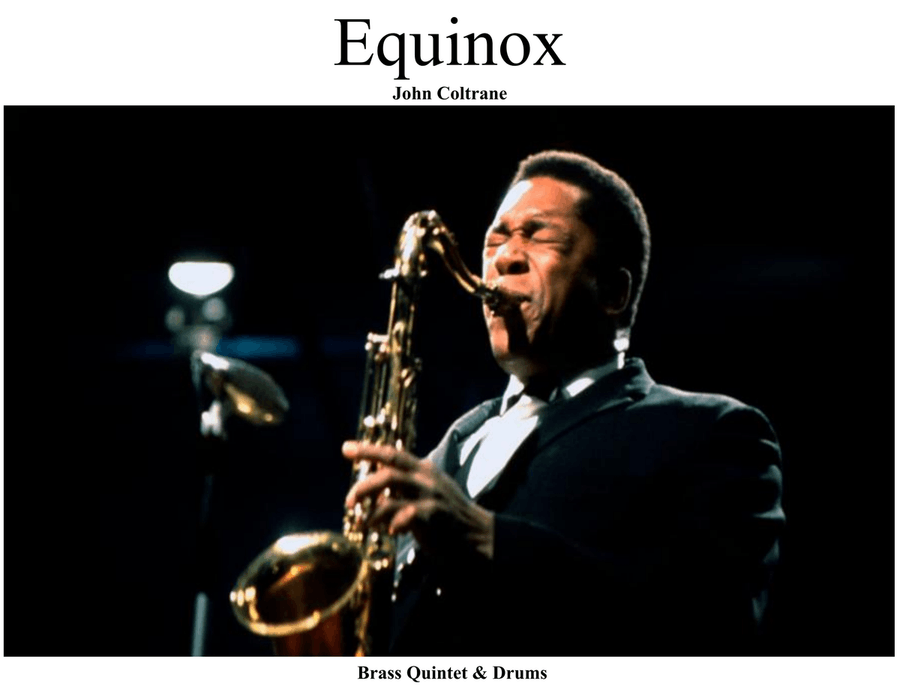
Equinox
Quintette de Cuivres: 2 trompettes, Cor, trombone, tuba
John Coltrane
$14.99 13.06 € Quintette de Cuivres: 2 trompettes, Cor, trombone, tuba PDF SheetMusicPlus

Piano Solo - Level 1 - Digital Download SKU: A0.1110836 Composed by George Frideric Handel. Arranged by Piacere Music Sheets. Baroque,Instructional,Standards. Score. 2 pages. Piacere Music Sheets #713130. Published by Piacere Music Sheets (A0.1110836). Opus/Catalog Number: HWV 494 Key/Tone: G minor Difficulty: Grade 2/12 (Easy) Obs.: This piece has a simple A-A-B-B musical form: Measures 1-8: Phrase A (played twice) in the main key of G minor Measures 9-20: Phrase B (played twice) beginning in the relative key of B flat Major and modulating back to G minor in measure 14 Although originally composed for the harpsichord, this bourrée can very well be played on the piano. In accordance with Baroque performance practice, unslurred quarter notes should be played slightly detached, especially in the left hand. More on less repercussions may be played depending on the player's ability.
Handel - Impertinence in G minor - Easy
Piano seul

$2.95 2.57 € Piano seul PDF SheetMusicPlus

Piano Solo - Level 3 - Digital Download SKU: A0.1108122 Composed by Johann Adolf Hasse. Arranged by Piacere Music Sheets. Baroque,Instructional,Standards. Score. 3 pages. Piacere Music Sheets #710745. Published by Piacere Music Sheets (A0.1108122). Opus/Catalog Number: BWV Anhang 130 Key/Tone: G Major Year/Date of Composition: Included in the 1725 volume of Notebooks for Anna Magdalena Bach (No. 29) Difficulty: Grade 6/12 (Intermediate) Obs.: This Polonaise has a simple A-A-B-B musical form: Measures 1-8: Phrase A (played twice) in the main key of G Major Measures 9-28: Phrase B (played twice) beginning in the dominant key of D Major and modulating back to G Major in measure 18 In accordance with Baroque performance practice, remember that unslurred quarter notes should be played slightly detached, especially in the left hand. Included in this score are suggestions for the realization of ornaments.
Hasse - Polonaise in G Major (BWV 130) - Intermediate
Piano seul

$2.95 2.57 € Piano seul PDF SheetMusicPlus

String Orchestra - Level 4 - Digital Download SKU: A0.1208721 Composed by Ludwig van Beethoven (1770 – 1827). Arranged by James M. Guthrie, ASCAP. 19th Century,Classical,Contest,Festival,Instructional,Traditional. Score and Parts. 19 pages. Jmsgu3 #806801. Published by jmsgu3 (A0.1208721). 2. Scherzo: Allegro.Beethoven's Bagatelles Op. 33 are quite typical of his early style, retaining many compositional features of the early Classical period.  The first bagatelle in particular is arguably one of Beethoven's most well-known pieces. While they may seem light-hearted and not to be taken too seriously, they are still well-crafted works that embody the younger Beethoven's style. The Bagatelles Op. 33 were composed by Beethoven in 1801-02 and published in 1803. Bagatelles are shorter and less complex than sonatas, often consisting of a single movement. They were intended to be played as light entertainment or as encores at the end of a concert.The Bagatelle No. 2 of Op. 33 follows a simple ternary form, with a lively and playful Scherzo character. The piece is in the key of C major and is written in 2/4 time signature. The A section is characterized by a catchy and rhythmic melody that is repeated twice, with slight variations in the second repetition. The B section, in the relative key of A minor, provides a contrast to the A section with a more lyrical and expressive melody. The B section is also repeated twice, with slight variations in the second repetition. The A section returns in its original form to close the piece. The piece is relatively simple in terms of harmony and texture, with a clear melody and accompaniment. However, Beethoven's use of repetition, variation, and elaboration creates a sense of unity and coherence throughout the piece.
Beethoven: Bagatelle Op. 33 No. 2 for String Orchestra
Orchestre à Cordes

$42.95 37.43 € Orchestre à Cordes PDF SheetMusicPlus


1 ....61 76 91 106 121 ....1516


Partitions Gratuites
Acheter des Partitions Musicales
Acheter des Partitions Digitales à Imprimer
Acheter des Instruments de Musique

© 2000 - 2026

Accueil - Version intégrale





