EUROPE
140229 articles
USA
0 articles
DIGITAL
11983 articles (à imprimer)
Partitions Digitales
Partitions à imprimer
11983 partitions trouvées


The Ventures : Hawaï Five-O (Hawaï police d'Etat) - Thème (niveau très facile)
Trombone
Téléchargez la partition Trombone Hawaï Five-O (Hawaï police d…
5.99 € Trombone PDF Tomplay

John Williams : Star Wars - Thème principal (niveau intermédiaire)
Hautbois
Téléchargez la partition Hautbois Star Wars - Thème principal (niveau intermédiaire) de Jo…
5.99 € Hautbois PDF Tomplay

Vangelis : Les Chariots de Feu - Thème (niveau facile/intermédiaire)
Trombone
Téléchargez la partition Trombone Les Chariots de Feu - Thème (niveau…
5.99 € Trombone PDF Tomplay

Martin? : Variace na Rossiniho téma (Variations sur un thème slovaque), H.378
Piano seul
Téléchargez la partition Piano Variace na Rossiniho téma (Variations …
8.99 € Piano seul PDF Tomplay

John Barry : Danse avec les loups - Thème de John Dunbar (niveau facile)
Contre Basse
Téléchargez la partition Contrebasse Danse avec les loups - Thème de John Dunbar (niveau f…
5.99 € Contre Basse PDF Tomplay

Vic Mizzy : La famille Addams - Thème principal (niveau facile)
Clarinette
Téléchargez la partition Clarinette La famille Addams - Thème princip…
4.99 € Clarinette PDF Tomplay

John Williams : Star Wars - Thème principal (niveau facile, piano solo)
Piano seul
Téléchargez la partition Piano Star Wars - Thème principal (niveau facile, piano solo) de …
5.99 € Piano seul PDF Tomplay

Flute Duet Flute - Level 3 - Digital Download SKU: A0.552403 Composed by Leo Delibes (1836-1891). Arranged by James M. Guthrie. Holiday,Romantic Period,Standards,Wedding. Score. 7 pages. Jmsgu3 #6342523. Published by jmsgu3 (A0.552403). Duo of the flowers from Lakme, Act I. A popular wedding selection.Leo Delibes (1836-1891) was a French composer of the Romantic period best known for his ballets and operas. He was a child prodigy and began composing music at the age of seven. He studied at the Paris Conservatoire, where he developed a mastery of the symphonic form and wrote several pieces for the orchestra. His works for the stage are among the most popular and beloved of the Romantic era, including the ballets Coppélia and Sylvia, and the opera Lakmé.Delibes was a pioneer in the use of orchestral color and instrumental effects to enhance the dramatic narrative of his works. His works are often praised for their lyricism, graceful melodies, and colorful orchestrations. His music is considered to be a bridge between the grandiose and romantic works of the French composers before him, such as Gounod and Berlioz, and the more intimate and melodic style of composers like Debussy and Ravel.Delibes’ influence can be heard in the works of later composers such as Stravinsky and Prokofiev, and his music continues to be performed and enjoyed today. His contributions to music history are significant, and his works remain beloved masterpieces of the Romantic era.Léo Delibes' opera Lakmé is an opera in three acts. It was first performed in 1883 at the Théâtre Lyrique in Paris. The libretto was written by Edmond Gondinet and Philippe Gille. The story is set in British-occupied India and tells the story of a young Indian girl, Lakmé, who is in love with a British officer, Gerald. The story follows the couple's romantic journey, as well as the obstacles they face from Lakmé's father and the British military. The opera is best known for its beautiful score, which includes the famous aria The Flower Duet as well as the duet Lakmé! The Bell Song. The opera has been performed in opera houses all over the world and is considered one of Delibes' most popular works.The Duo des Fleurs, composed by French composer Léo Delibes, is a ballet pas de deux from the ballet Lakme, Act I. It is a beloved masterpiece of the Romantic period and is often performed as a standalone piece in many ballet performances. The piece is typically danced by two female ballet dancers and is known for its playful and lighthearted nature. The music consists of a melody that alternates between the two dancers and is often accompanied by a lighthearted waltz. The music has a strong sense of unity and connection between the two dancers, which is enhanced by the use of the same melody. The piece also features a beautiful soaring coda that gives it a sense of grandeur and beauty. The Duo des Fleurs is an exquisite piece of music and an enduring classic of the ballet repertoire.
Delibes: Duo des Fleurs for Flute Duo & Piano
2 Flûtes traversières (duo)

$26.95 23.32 € 2 Flûtes traversières (duo) PDF SheetMusicPlus

Kondo Koji : The Legend of Zelda - Thème principal (niveau difficile, avec orchestre)
Piano seul
Téléchargez la partition Piano The Legend of Zelda - Thème principal …
5.99 € Piano seul PDF Tomplay

Ramin Djawadi : House of the Dragon - Thème principal (niveau très facile)
Batterie
Téléchargez la partition Batterie House of the Dragon - Thème principal (niveau très facil…
5.99 € Batterie PDF Tomplay

Nobuo Uematsu : Final Fantasy VII - Thème de Tifa
Piano seul
Téléchargez la partition Piano Final Fantasy VII - Thème de Tifa de N…
5.99 € Piano seul PDF Tomplay

Piano,Trombone - Level 5 - Digital Download SKU: A0.792416 Composed by Vincent d’Indy. Arranged by Ralph Sauer. 20th Century,Romantic Period. Score and part. 16 pages. Gordon Cherry #4821577. Published by Gordon Cherry (A0.792416). Paul Marie Théodore Vincent d'Indy was born in Paris into an aristocratic family of royalist and Catholic persuasion. He had piano lessons from an early age from his paternal grandmother, who passed him on to Antoine François Marmontel and Louis Diémer. His main influence was Cesar Franck. These three pieces were some of his many works for Piano. Opus 33 was inspired by a trip to Bayreuth, the musical home of Wagner and the Black Forest region. Opus 33 no. 1 from 1889 is titled ? with no explanation of itself. Opus 33 no. 10 is titled Lermoos, which is a delightful skiing village in Austria right on the border with Germany.  Germany's largest mountain is in perfect view, possibly giving the movement its spirit. Opus 28 is a Serenade for Violin and Piano published in 1900. It is lithe, subtle and lyrical.
Three Pieces for Tuba or Bass Trombone & Piano
Trombone et Piano

$20.00 17.31 € Trombone et Piano PDF SheetMusicPlus

Voice and piano (2 songs with violoncello; 1 vocal duet) - Medium - Digital Download SKU: MQ.8491-40E Composed by MeeAe Cecilia Nam and Theodore Gouvy. 4 pages. E. C. Schirmer Music Company - Digital #8491-40E. Published by E. C. Schirmer Music Company - Digital (MQ.8491-40E). French.A French composer, Théodore Gouvy (1819-1898) was one of the most significant composers of 19th Century in Europe. The movement of rediscovering his instrumental music has been increasingly successful in Europe since the 1990s, especially following the birth of L’Institut Gouvy in France. However, his solo vocal music has been waiting to be unveiled to the public. Volume One includes 52 songs of Gouvy.Gouvy traveled widely throughout Europe. He was also a lover of nature. Generally, he spent his winters in Leipzig, but in the summertime, he always returned to Hombourg-Haut, France, to stroll through the woods, to hunt, and to relax. Gouvy was fluent in several languages and had a great appreciation of the Renaissance French Poetry of Pierre de Ronsard whose poetry he had set to music. The fifty-two songs in this volume are largely by Ronsard and other Renaissance poets of La Pléiade.Although Ronsard is approximately 300 years older than Gouvy, they both seem to have the same interest in classical literature, though, admittedly, for different reasons. Celebrated by the French and English courts, Ronsard (1525-1585) was the leader of La Pléiade: a group of seven poets (Joachim Du Bellay (1522-1560), Rémy Belleau (1528-1577), Étienne Jodelle (1532-1573), Pontus de Tyard (1521-1603), Jean–Antoine Baïf (1532-1589), and Jean Daurat (1508-1588), who dedicated their efforts to writing poetry in French rather than in Latin (or Greek) as most of the Romantic poets did. They wished to enrich the French language, and establish a new literature which would be the equal of the other literature of their period, and the equal to poets of the past. French Romantic poetry featured the closeness of the poet to nature, and his ability to communicate with nature by personifying (anthropomorphizing) all of nature’s elements: flowers, the planets, the moon, the breeze, and even the sand upon the shore. As a significant melodist, Gouvy’s treatment of the vocal solo line and his treatment and development of the piano accompaniment places him in the upper echelons as a composer of songs. His diverse cultural life led a rich and significant musical life, interacting with his contemporaries who admired his work, and whom Gouvy knew well, such as Liszt, Brahms, Schumann, Mendelssohn, Berlioz and Gounod. Contents:Six Odes de Ronsard pour ténor et piano, Op. 37 (No. 3 et No. 5 avec violoncelle) Neuf Poésies de Ronsard pour soprano ou ténor et piano, Op. 41 Six Poésies de Ronsard pour soprano ou ténor et piano, Op. 42 Quatre Odes de Ronsard pour baryton et piano, Op. 43 Huit Poésies de Ronsard pour ténor ou soprano et piano, Op. 44 Sept Poésies de Ronsard pour ténor ou soprano et piano, Op. 47.
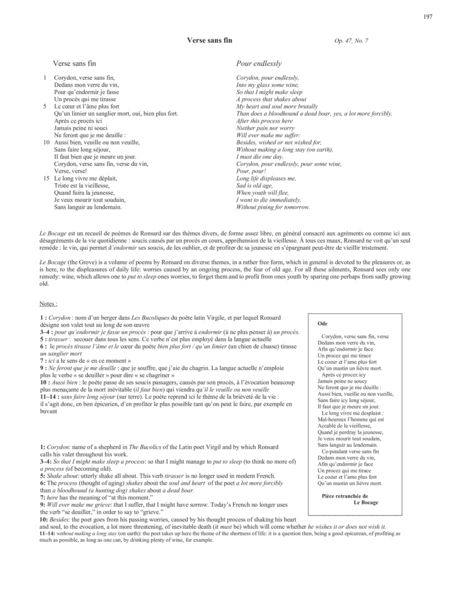
Op. 47, No. 7: Verse sans fin from Songs of Gouvy, V1 (Downloadable)
Piano, Voix

$3.00 2.6 € Piano, Voix PDF SheetMusicPlus


Partitions Gratuites
Acheter des Partitions Musicales
Acheter des Partitions Digitales à Imprimer
Acheter des Instruments de Musique

© 2000 - 2026

Accueil - Version intégrale





