EUROPE
1402 articles
USA
0 articles
DIGITAL
45170 articles (à imprimer)
Partitions Digitales
Partitions à imprimer
45170 partitions trouvées


Cello - Level 3 - Digital Download SKU: A0.549203 Composed by Gabrieli. Arranged by James M. Guthrie, ASCAP. Renaissance,Standards. 58 pages. Jmsgu3 #3461839. Published by jmsgu3 (A0.549203). Instrumentation: 8 Cellos arranged in two choirs. Full Score: 28 pg. Study Score: 14 pg. Parts: 2 pg. ea. Innovations First of all, Gabrieli preferred sacred vocal and certainly instrumental music. Hence, he concentrated on music that consequently took advantage of resonance and likewise reverberation for maximum effect. Seems like Gabrieli may have invented dynamics – or was rather the first to indicate them such as in his Sonata Pian’ e Forte. Consequently, he was also a pioneer in spatial techniques. He therefore developed and used very specific notation to indicate instrumentation. Gabrieli experimented with assembling massive instrumental forces into isolated groups separated by space. In this way, he consequently contributed heavily to the Baroque Concertato style. Polychoral Works Gabrieli probably used the layout of the San Marco church for his experiments. This is because he worked there as a musician and composer. Furthermore, the church had two choir lofts facing each other. He certainly used these to create striking spatial effects between instrumental forces. Certainly, many of his works are composed such that a choir or instrumental group could first be heard on one side, then consequently followed by a response from the group on the other side. Sometimes there was probably a third group positioned near the main altar as well. Spatial Music Above all, Gabrieli studied carefully detailed groups of instruments and singers. Furthermore, it seems like he created precise directions for instrumentation in rather than two groups. The instruments, because they could be appropriately situated, could consequently be heard with perfect clearness at distant locations. As a result, arrangements that seem bizarre on paper, can in contrast sound perfectly in balance. First Works Finally, Gabrieli published his first motets along with his uncle Andrea's compositions in Concerti (1587). These compositions furthermore indicate considerable usage of dialogue and echo effects. Consequently, here we see low and high choirs with the variance between their ranges indicated by instrumental accompaniment. Seems like Gabrieli’s later motets Sacrae Symphoniae (1597) move away from close antiphony. In contrast, he moves towards not simply echoing the material but developing it through sequential choral entrances. Even more, he takes this procedure to the extreme in the Motet Omnes Gentes. Unlike earlier works, here the instruments are certainly an essential part of the presentation. Also, only parts marked: Capella are supposed to be sung. Homophony Hence, after 1605, Gabrieli moves to a much more homophonic style. He writes sections purely for instruments – which calls Sinfonia – and smaller sections for vocal soloists, accompanied by a basso continuo.
Gabrieli: Canzon Septimi Toni Ch 172 for Cello Choir
Violoncelle

$47.95 41.63 € Violoncelle PDF SheetMusicPlus

Brass Ensemble Bass Trombone,Cornet,Horn - Level 3 - Digital Download SKU: A0.1229556 Composed by Giovanni Gabrieli. Arranged by James M. Guthrie, ASCAP. Chamber,Early Music,Renaissance,Traditional,Wedding. 43 pages. Jmsgu3 #825055. Published by jmsgu3 (A0.1229556). Minimum instrumentation: 4 Cornets in Bb, 4 Horns in F, 1 Tenor Trombone & 1 Bass Trombone.InnovationsGabrieli preferred sacred vocal and certainly instrumental music. Hence, he concentrated on music that consequently took advantage of resonance and likewise reverberation for maximum effect. Seems like Gabrieli may have invented dynamics – or was rather the first to indicate them such as in his Sonata Pian’ e Forte. Consequently, he was also a pioneer in spatial techniques. He therefore developed and used very specific notation to indicate instrumentation. Gabrieli experimented with assembling massive instrumental forces into isolated groups separated by space. In this way, he consequently contributed heavily to the Baroque Concertato style.Polychoral WorksGabrieli probably used the layout of the San Marco church for his experiments. This is because he worked there as a musician and composer. Furthermore, the church had two choir lofts facing each other. He certainly used these to create striking spatial effects between instrumental forces. Certainly, many of his works are composed such that a choir or instrumental group could first be heard on one side, then consequently followed by a response from the group on the other side. Sometimes there was probably a third group positioned near the main altar as well.Spatial MusicAbove all, Gabrieli studied carefully detailed groups of instruments and singers. Furthermore, it seems like he created precise directions for instrumentation rather than two groups. The instruments, because they could be appropriately situated, could consequently be heard with perfect clearness at distant locations. As a result, arrangements that seem bizarre on paper, can in contrast sound perfectly in balance.First WorksFinally, Gabrieli published his first motets along with his uncle Andrea's compositions in Concerti (1587). These compositions furthermore indicate considerable usage of dialogue and echo effects. Consequently, here we see low and high choirs with the variance between their ranges indicated by instrumental accompaniment. Seems like Gabrieli’s later motets Sacrae Symphoniae (1597) move away from close antiphony. In contrast, he moves towards not simply echoing the material but developing it through sequential choral entrances. Even more, he takes this procedure to the extreme in the Motet Omnes Gentes. Unlike earlier works, here the instruments are certainly an essential part of the presentation. Also, only parts marked: Capella are supposed to be sung.HomophonyHence, after 1605, Gabrieli moves to a much more homophonic style. He writes sections purely for instruments – which calls Sinfonia – and smaller sections for vocal soloists, accompanied by a basso continuo.
Gabrieli: Canzon per Sonar à 10 Ch. 177 for Brass Choir

$47.95 41.63 € PDF SheetMusicPlus

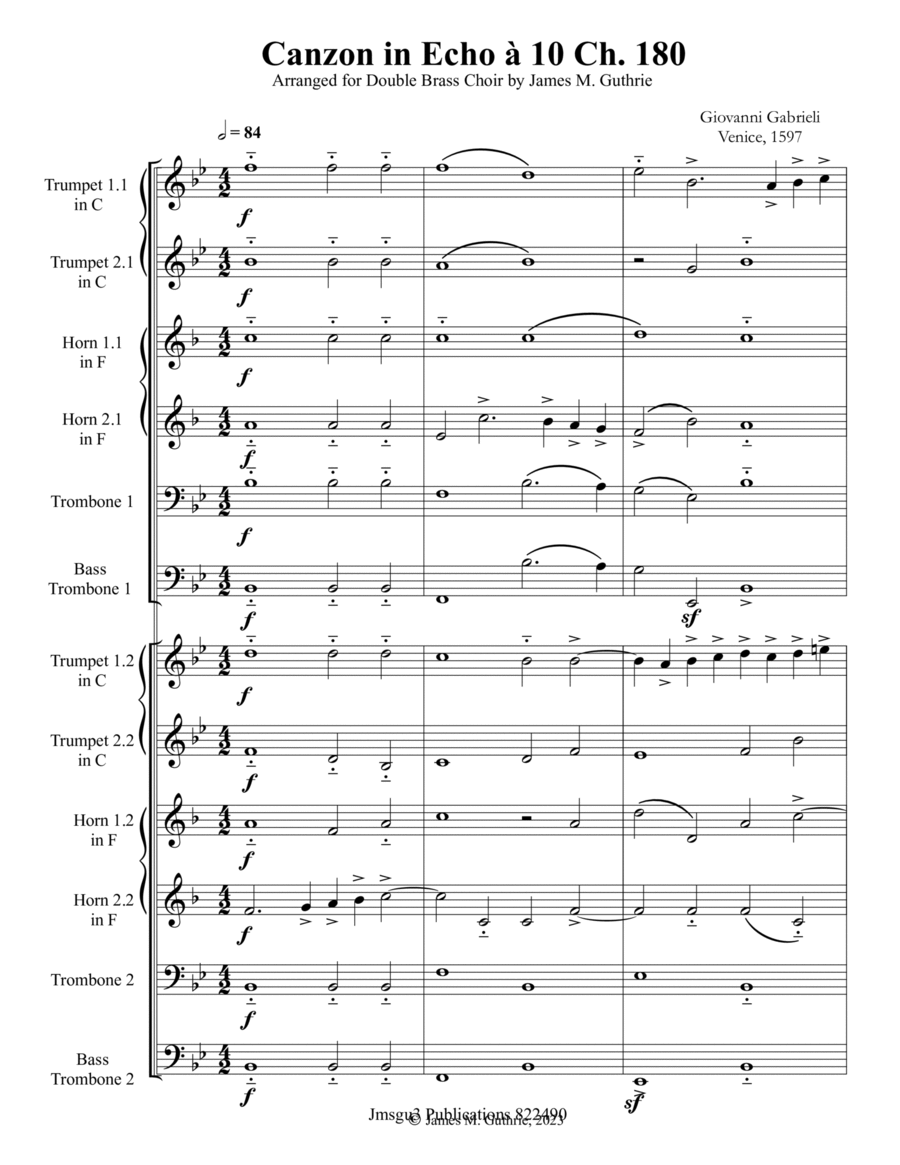
Brass Ensemble Horn,Trombone,Trumpet - Level 3 - Digital Download SKU: A0.1226488 Composed by Giovanni Gabrieli. Arranged by James M. Guthrie, ASCAP. Chamber,Contest,Early Music,Festival,Historic,Renaissance. Score and Parts. 51 pages. Jmsgu3 #822490. Published by jmsgu3 (A0.1226488). Minimum instrumentation: 4 Trumpets (or Cornets), 4 French Horns, 2 Tenor Trombones, and 2 Bass Trombones.InnovationsGabrieli preferred sacred vocal and certainly instrumental music. Hence, he concentrated on music that consequently took advantage of resonance and likewise reverberation for maximum effect. Seems like Gabrieli may have invented dynamics – or was rather the first to indicate them such as in his Sonata Pian’ e Forte. Consequently, he was also a pioneer in spatial techniques. He therefore developed and used very specific notation to indicate instrumentation. Gabrieli experimented with assembling massive instrumental forces into isolated groups separated by space. In this way, he consequently contributed heavily to the Baroque Concertato style.Polychoral WorksGabrieli probably used the layout of the San Marco church for his experiments. This is because he worked there as a musician and composer. Furthermore, the church had two choir lofts facing each other. He certainly used these to create striking spatial effects between instrumental forces. Certainly, many of his works are composed such that a choir or instrumental group could first be heard on one side, then consequently followed by a response from the group on the other side. Sometimes there was probably a third group positioned near the main altar as well.Spatial MusicAbove all, Gabrieli studied carefully detailed groups of instruments and singers. Furthermore, it seems like he created precise directions for instrumentation rather than two groups. The instruments, because they could be appropriately situated, could consequently be heard with perfect clearness at distant locations. As a result, arrangements that seem bizarre on paper, can in contrast sound perfectly in balance.First WorksFinally, Gabrieli published his first motets along with his uncle Andrea's compositions in Concerti (1587). These compositions furthermore indicate considerable usage of dialogue and echo effects. Consequently, here we see low and high choirs with the variance between their ranges indicated by instrumental accompaniment. Seems like Gabrieli’s later motets Sacrae Symphoniae (1597) move away from close antiphony. In contrast, he moves towards not simply echoing the material but developing it through sequential choral entrances. Even more, he takes this procedure to the extreme in the Motet Omnes Gentes. Unlike earlier works, here the instruments are certainly an essential part of the presentation. Also, only parts marked: Capella are supposed to be sung.HomophonyHence, after 1605, Gabrieli moves to a much more homophonic style. He writes sections purely for instruments – which calls Sinfonia – and smaller sections for vocal soloists, accompanied by a basso continuo.

Gabrieli: Canzona in Echo Ch. 180 for Double Brass Choir
Quatuor de Cuivres: 2 trompettes, Cor, trombone

$47.95 41.63 € Quatuor de Cuivres: 2 trompettes, Cor, trombone PDF SheetMusicPlus

Woodwind Ensemble Clarinet - Level 3 - Digital Download SKU: A0.549204 Composed by Gabrieli. Arranged by James M. Guthrie, ASCAP. Renaissance,Standards. 56 pages. Jmsgu3 #3461855. Published by jmsgu3 (A0.549204). Instrumentation: 2 Eb clarinets, 4 Bb clarinets, 2 bass clarinets. Arranged as a double quartet. Includes Full Score: 28 pg. Study Score: 14 pg. and instrumental parts: 2 pg. Duration: ca. 3:00. Innovations First of all, Gabrieli preferred sacred vocal and certainly instrumental music. Hence, he concentrated on music that consequently took advantage of resonance and likewise reverberation for maximum effect. Seems like Gabrieli may have invented dynamics – or was rather the first to indicate them such as in his Sonata Pian’ e Forte. Consequently, he was also a pioneer in spatial techniques. He therefore developed and used very specific notation to indicate instrumentation. Gabrieli experimented with assembling massive instrumental forces into isolated groups separated by space. In this way, he consequently contributed heavily to the Baroque Concertato style. Polychoral Works Gabrieli probably used the layout of the San Marco church for his experiments. This is because he worked there as a musician and composer. Furthermore, the church had two choir lofts facing each other. He certainly used these to create striking spatial effects between instrumental forces. Certainly, many of his works are composed such that a choir or instrumental group could first be heard on one side, then consequently followed by a response from the group on the other side. Sometimes there was probably a third group positioned near the main altar as well. Spatial Music Above all, Gabrieli studied carefully detailed groups of instruments and singers. Furthermore, it seems like he created precise directions for instrumentation in rather more than two groups. The instruments, because they could be appropriately situated, could consequently be heard with perfect clearness at distant locations. As a result, arrangements which seem bizarre on paper, can in contrast sound perfectly in-balance. First Works Finally, Gabrieli published his first motets along with his uncle Andrea's compositions in Concerti (1587). These compositions furthermore indicate considerable usage of dialogue and echo effects. Consequently, here we see low and high choirs with the variance between their ranges indicated by instrumental accompaniment. Seems like Gabrieli’s later motets Sacrae Symphoniae (1597) move away from close antiphony. In contrast, he moves towards not simply echoing the material, but developing it by sequential choral entrances. Even more, he takes this procedure to the extreme in the Motet Omnes Gentes. Unlike earlier works, here the instruments are certainly an essential part of the presentation. Also, only parts marked: Capella are supposed to be sung. Homophony Hence, after 1605, Gabrieli moves to a much more homophonic style. He writes sections purely for instruments – which calls Sinfonia – and smaller sections for vocal soloists, accompanied by a basso continuo.

Gabrieli: Canzon Septimi Toni Ch 172 for Clarinet Choir
Ensemble de Clarinettes

$47.95 41.63 € Ensemble de Clarinettes PDF SheetMusicPlus

Brass Ensemble Cornet,Horn,Trombone - Level 3 - Digital Download SKU: A0.1227819 Composed by Giovanni Gabrieli. Arranged by James M. Guthrie. Chamber,Contest,Early Music,Festival,Renaissance,Traditional. Score and Parts. 44 pages. Jmsgu3 #823781. Published by jmsgu3 (A0.1227819). Minimum instrumentation: 4 cornets in Bb, 4 French Horms in F, 2 Trombones. See also arrangement à 12 which includes 2 Bass Trombones.InnovationsGabrieli preferred sacred vocal and certainly instrumental music. Hence, he concentrated on music that consequently took advantage of resonance and likewise reverberation for maximum effect. Seems like Gabrieli may have invented dynamics – or was rather the first to indicate them such as in his Sonata Pian’ e Forte. Consequently, he was also a pioneer in spatial techniques. He therefore developed and used very specific notation to indicate instrumentation. Gabrieli experimented with assembling massive instrumental forces into isolated groups separated by space. In this way, he consequently contributed heavily to the Baroque Concertato style.Polychoral WorksGabrieli probably used the layout of the San Marco church for his experiments. This is because he worked there as a musician and composer. Furthermore, the church had two choir lofts facing each other. He certainly used these to create striking spatial effects between instrumental forces. Certainly, many of his works are composed such that a choir or instrumental group could first be heard on one side, then consequently followed by a response from the group on the other side. Sometimes there was probably a third group positioned near the main altar as well.Spatial MusicAbove all, Gabrieli studied carefully detailed groups of instruments and singers. Furthermore, it seems like he created precise directions for instrumentation rather than two groups. The instruments, because they could be appropriately situated, could consequently be heard with perfect clearness at distant locations. As a result, arrangements that seem bizarre on paper, can in contrast sound perfectly in balance.First WorksFinally, Gabrieli published his first motets along with his uncle Andrea's compositions in Concerti (1587). These compositions furthermore indicate considerable usage of dialogue and echo effects. Consequently, here we see low and high choirs with the variance between their ranges indicated by instrumental accompaniment. Seems like Gabrieli’s later motets Sacrae Symphoniae (1597) move away from close antiphony. In contrast, he moves towards not simply echoing the material but developing it through sequential choral entrances. Even more, he takes this procedure to the extreme in the Motet Omnes Gentes. Unlike earlier works, here the instruments are certainly an essential part of the presentation. Also, only parts marked: Capella are supposed to be sung.HomophonyHence, after 1605, Gabrieli moves to a much more homophonic style. He writes sections purely for instruments – which calls Sinfonia – and smaller sections for vocal soloists, accompanied by a basso continuo.

Gabrieli: Canzon per Sonar Ch 179 for Double Brass Choir à 10

$47.95 41.63 € PDF SheetMusicPlus

Strings - Level 3 - Digital Download SKU: A0.549209 Composed by Gabrieli. Arranged by James M. Guthrie, ASCAP. Renaissance,Standards. 58 pages. Jmsgu3 #3462323. Published by jmsgu3 (A0.549209). Instrumentation: Two string quartets arranged antiphonally. Full Score: 28 pgs. Study Score: 14 pgs. Instrumental parts: 2 pg. ea. Duration: ca. 3:00. Innovations First of all, Gabrieli preferred sacred vocal and certainly instrumental music. Hence, he concentrated on music that consequently took advantage of resonance and likewise reverberation for maximum effect. Seems like Gabrieli may have invented dynamics – or was rather the first to indicate them such as in his Sonata Pian’ e Forte. Consequently, he was also a pioneer in spatial techniques. He therefore developed and used very specific notation to indicate instrumentation. Gabrieli experimented with assembling massive instrumental forces into isolated groups separated by space. In this way, he consequently contributed heavily to the Baroque Concertato style. Polychoral Works Gabrieli probably used the layout of the San Marco church for his experiments. This is because he worked there as a musician and composer. Furthermore, the church had two choir lofts facing each other. He certainly used these to create striking spatial effects between instrumental forces. Certainly, many of his works are composed such that a choir or instrumental group could first be heard on one side, then consequently followed by a response from the group on the other side. Sometimes there was probably a third group positioned near the main altar as well. Spatial Music Above all, Gabrieli studied carefully detailed groups of instruments and singers. Furthermore, it seems like he created precise directions for instrumentation in rather more than two groups. The instruments, because they could be appropriately situated, could consequently be heard with perfect clearness at distant locations. As a result, arrangements which seem bizarre on paper, can in contrast sound perfectly in-balance. First Works Finally, Gabrieli published his first motets along with his uncle Andrea's compositions in Concerti (1587). These compositions furthermore indicate considerable usage of dialogue and echo effects. Consequently, here we see low and high choirs with the variance between their ranges indicated by instrumental accompaniment. Seems like Gabrieli’s later motets Sacrae Symphoniae (1597) move away from close antiphony. In contrast, he moves towards not simply echoing the material, but developing it by sequential choral entrances. Even more, he takes this procedure to the extreme in the Motet Omnes Gentes. Unlike earlier works, here the instruments are certainly an essential part of the presentation. Also, only parts marked: Capella are supposed to be sung. Homophony Hence, after 1605, Gabrieli moves to a much more homophonic style. He writes sections purely for instruments – which calls Sinfonia – and smaller sections for vocal soloists, accompanied by a basso continuo.  www.jamesguthrie.com.

Gabrieli: Canzon Septimi Toni Ch 172 for Double String Quartet

$47.95 41.63 € PDF SheetMusicPlus

Woodwind Ensemble Flute - Level 3 - Digital Download SKU: A0.549201 Composed by Gabrieli. Arranged by James M. Guthrie, ASCAP. Renaissance,Standards. 58 pages. Jmsgu3 #3460719. Published by jmsgu3 (A0.549201). Instrumentation: 2 piccolos, 3 concert flutes, 1 alto flute, 1 bass flute, 1 cello. Arranged in two antiphonal choirs. Full Score: 28 pg. Study Score: 14 pg. Parts: 2 pg ea. Duration: ca. 3:00 Innovations First of all, Gabrieli preferred sacred vocal and certainly instrumental music. Hence, he concentrated on music that consequently took advantage of resonance and likewise reverberation for maximum effect. Seems like Gabrieli may have invented dynamics – or was rather the first to indicate them such as in his Sonata Pian’ e Forte. Consequently, he was also a pioneer in spatial techniques. He therefore developed and used very specific notation to indicate instrumentation. Gabrieli experimented with assembling massive instrumental forces into isolated groups separated by space. In this way, he consequently contributed heavily to the Baroque Concertato style. Polychoral Works Gabrieli probably used the layout of the San Marco church for his experiments. This is because he worked there as a musician and composer. Furthermore, the church had two choir lofts facing each other. He certainly used these to create striking spatial effects between instrumental forces. Certainly, many of his works are composed such that a choir or instrumental group could first be heard on one side, then consequently followed by a response from the group on the other side. Sometimes there was probably a third group positioned near the main altar as well. Spatial Music Above all, Gabrieli studied carefully detailed groups of instruments and singers. Furthermore, it seems like he created precise directions for instrumentation in rather more than two groups. The instruments, because they could be appropriately situated, could consequently be heard with perfect clearness at distant locations. As a result, arrangements which seem bizarre on paper, can in contrast sound perfectly in-balance. First Works Finally, Gabrieli published his first motets along with his uncle Andrea's compositions in Concerti (1587). These compositions furthermore indicate considerable usage of dialogue and echo effects. Consequently, here we see low and high choirs with the variance between their ranges indicated by instrumental accompaniment. Seems like Gabrieli’s later motets Sacrae Symphoniae (1597) move away from close antiphony. In contrast, he moves towards not simply echoing the material, but developing it by sequential choral entrances. Even more, he takes this procedure to the extreme in the Motet Omnes Gentes. Unlike earlier works, here the instruments are certainly an essential part of the presentation. Also, only parts marked: Capella are supposed to be sung. Homophony Hence, after 1605, Gabrieli moves to a much more homophonic style. He writes sections purely for instruments – which calls Sinfonia – and smaller sections for vocal soloists, accompanied by a basso continuo.

Gabrieli: Canzon Septimi Toni Ch 172 for Flute Choir
Ensemble de Flûtes

$47.95 41.63 € Ensemble de Flûtes PDF SheetMusicPlus

Concert Band - Level 3 - Digital Download SKU: A0.549206 Composed by Gabrieli. Arranged by James M. Guthrie, ASCAP. Renaissance,Standards. Score and Parts. 29 pages. Jmsgu3 #3461981. Published by jmsgu3 (A0.549206). Duration 3:00. Score 9 pg. Parts 2 pg. ea. Instrumentation: small wind band, no percussion. Innovations First of all, Gabrieli preferred sacred vocal and certainly instrumental music. Hence, he concentrated on music that consequently took advantage of resonance and likewise reverberation for maximum effect. Seems like Gabrieli may have invented dynamics – or was rather the first to indicate them such as in his Sonata Pian’ e Forte. Consequently, he was also a pioneer in spatial techniques. He therefore developed and used very specific notation to indicate instrumentation. Gabrieli experimented with assembling massive instrumental forces into isolated groups separated by space. In this way, he consequently contributed heavily to the Baroque Concertato style. Polychoral Works Gabrieli probably used the layout of the San Marco church for his experiments. This is because he worked there as a musician and composer. Furthermore, the church had two choir lofts facing each other. He certainly used these to create striking spatial effects between instrumental forces. Certainly, many of his works are composed such that a choir or instrumental group could first be heard on one side, then consequently followed by a response from the group on the other side. Sometimes there was probably a third group positioned near the main altar as well. Spatial Music Above all, Gabrieli studied carefully detailed groups of instruments and singers. Furthermore, it seems like he created precise directions for instrumentation in rather more than two groups. The instruments, because they could be appropriately situated, could consequently be heard with perfect clearness at distant locations. As a result, arrangements which seem bizarre on paper, can in contrast sound perfectly in-balance. First Works Finally, Gabrieli published his first motets along with his uncle Andrea's compositions in Concerti (1587). These compositions furthermore indicate considerable usage of dialogue and echo effects. Consequently, here we see low and high choirs with the variance between their ranges indicated by instrumental accompaniment. Seems like Gabrieli’s later motets Sacrae Symphoniae (1597) move away from close antiphony. In contrast, he moves towards not simply echoing the material, but developing it by sequential choral entrances. Even more, he takes this procedure to the extreme in the Motet Omnes Gentes. Unlike earlier works, here the instruments are certainly an essential part of the presentation. Also, only parts marked: Capella are supposed to be sung. Homophony Hence, after 1605, Gabrieli moves to a much more homophonic style. He writes sections purely for instruments – which calls Sinfonia – and smaller sections for vocal soloists, accompanied by a basso continuo.

Gabrieli: Canzon Septimi Toni Ch 172 for Concert Band
Orchestre d'harmonie

$47.95 41.63 € Orchestre d'harmonie PDF SheetMusicPlus

Choral Choir,Choral (SATB) - Level 3 - Digital Download SKU: A0.1366089 Composed by Alan Bullard. Christian,Praise & Worship,Religious,Sacred. 8 pages. Colne Edition / BullardMusic #950450. Published by Colne Edition / BullardMusic (A0.1366089). Alan Bullard’s setting of God be in my head matches the well-known traditional text with a flowing, gradually climbing melody and colourful harmonies. The verse appears three times, firstly in unison, then in harmony, and finally with a soprano descant above the unison melody: the final phrase brings the choir together in harmony again, to form a calm and peaceful close. Alan Bullard’s church music is performed and broadcast world-wide, and is in the repertoire of many churches, cathedrals, and chapel choirs. He has a reputation for music that choirs enjoy performing, and which speaks directly to listeners.COLNE EDITION CE133www.colneedition.co.uk.
God be in my head (Anthem for SATB and organ or piano)
Chorale SATB

$1.99 1.73 € Chorale SATB PDF SheetMusicPlus

Chamber Orchestra - Level 2 - Digital Download SKU: A0.750975 Composed by Samuel A. Ward 1895. Arranged by Brendan Elliget MAGA 537. Patriotic. Score and parts. 12 pages. BJE Music #5789233. Published by BJE Music (A0.750975). America the Beautiful is an American patriotic song. The lyrics were written by Katharine Lee Bates, and the music was composed by church organist and choirmaster Samuel A. Ward at Grace Episcopal Church in Newark, New Jersey. The two never met. Bates originally wrote the words as a poem, Pikes Peak, first published in the Fourth of July edition of the church periodical The Congregationalist in 1895. At that time, the poem was titled America for publication. Ward had originally written the music, Materna, for the hymn O Mother dear, Jerusalem in 1882, though it was not first published until 1892. Ward's music combined with the Bates poem was first published in 1910 and titled America the Beautiful. The song is one of the most popular of the many U.S. patriotic songs. [Wikipedia]It has been arranged here for a String Quartet or Group [Key of C] including a Violin 3 which doubles the Viola part with appropriate range changes. There is also an optional Piano Part (Not shown on the score).The MP3 was recorded with NotePerformer 3.Grade = 2.5 Duration = 1:40 mins (2 verses)
America the Beautiful - String Quartet or Group Score and Parts PDF
Orchestre de chambre

$7.50 6.51 € Orchestre de chambre PDF SheetMusicPlus

Piano,Vocal,Voice - Level 2 - Digital Download SKU: A0.993320 Composed by Matthew Yarnell. Christian,Gospel,Praise & Worship,Sacred,Spiritual. Score. 2 pages. Flome the Gnome #3684401. Published by Flome the Gnome (A0.993320). Praise the Lord is a more upbeat song that helps you recall what Jesus has done while at the same time allowing you to sing mightily - Praise the Lord.  This is the short version in that it has four verses whereas the unedited version has five verses. Both versions include the Praise the Lord chorus. If you're looking for a new song that will encourage your congregation to stand up and praise the Lord, then please consider adding this song to your collection.I pray that this song nourishes your soul, your family, and/or your congregation.  Please let others know about my songs; say a prayer for me, my family, and ministry; and consider supporting my ministry financially so that I might have more time to write additional songs and/or serve the Lord.This song would be good for all churches but is probably best suited for those that enjoy more traditional hymns.I can be found online at my website: www.flomethegnome.com and on facebook. You can email me at flomethegnome@gmail.com  You can snail mail me at Matthew Yarnell, 2098 Marble Valley Basin Road, Addy, WA. 99101.  Or, you can call me at 509-675-3420.
Praise the Lord - Short Version
Piano, Voix

$3.99 3.46 € Piano, Voix PDF SheetMusicPlus

Small Ensemble Organ,Piano,Voice - Level 2 - Digital Download SKU: A0.993321 Composed by Matthew Yarnell. Christian,Gospel,Praise & Worship,Sacred,Spiritual. Score and parts. 2 pages. Flome the Gnome #3684399. Published by Flome the Gnome (A0.993321). Praise the Lord is a more upbeat song that helps you recall what Jesus has done while at the same time allowing you to sing mightily - Praise the Lord.  This is the unedited version in that it has five verses whereas the shorter version has four verses. Both versions include the Praise the Lord chorus. If you're looking for a new song that will encourage your congregation to stand up and praise the Lord, then please consider adding this song to your collection.I pray that this song nourishes your soul, your family, and/or your congregation.  Please let others know about my songs; say a prayer for me, my family, and ministry; and consider supporting my ministry financially so that I might have more time to write additional songs and/or serve the Lord.This song would be good for all churches but is probably best suited for those that enjoy more traditional hymns.I can be found online at my website: www.flomethegnome.com and on facebook. You can email me at flomethegnome@gmail.com  You can snail mail me at Matthew Yarnell, 2098 Marble Valley Basin Road, Addy, WA. 99101.  Or, you can call me at 509-675-3420.
Praise the Lord! - Unedited Version

$3.99 3.46 € PDF SheetMusicPlus


Partitions Gratuites
Acheter des Partitions Musicales
Acheter des Partitions Digitales à Imprimer
Acheter des Instruments de Musique

© 2000 - 2026

Accueil - Version intégrale