EUROPE
182 articles
USA
332 articles
DIGITAL
393 articles (à imprimer)
Partitions Digitales
Partitions à imprimer
393 partitions trouvées

1 ....91 106 121 136 151 ....391

Euphonium,Piano - Level 3 - Digital Download SKU: A0.549481 Composed by Alexander Scriabin. Arranged by James M. Guthrie, ASCAP. Concert,Instructional,Romantic Period,Sacred,Standards. Score and part. 12 pages. Jmsgu3 #3500065. Published by jmsgu3 (A0.549481). Alexander Scriabin Op. 11 No. 2. Score: 8 pages, solo part: 2 pages, piano part: 2 pages. Duration: 3:10. An introspective and meditative work with a lot of dynamic and phrasing nuance. Works well for church meditations or recital encores. Background Op.11/2 Alto Clarinet version. First of all, Scriabin composed mostly for the solo piano and also the orchestra. This is probably because he was a gifted pianist and therefore certainly appreciated the piano. Scriabin grew up in the late Romantic period, consequently, he was fond of the great piano masters of the time. As a result, he wrote his first noteworthy compositions in the manner of Chopin and Liszt. Forms Likewise, Scriabin used many of the same forms as Chopin. These certainly include the étude, prelude, nocturne, and even the mazurka. In contrast, as he developed his own sense of style his music became more and more unusual. So, the last five of his Piano Sonatas do not have a key signature and therefore lean towards atonality. Philosophy Scriabin also developed a keen interest in philosophy and likewise poetry. He was above all particularly fascinated by Nietzsche, Delville, and Blavatsky. Consequently, he finally established his own ideas about metaphysics and certainly mysticism. Scriabin consequently advanced theories about the relationship between color and musical keys. Synesthesia He also may have experienced a condition called synesthesia where he could probably sense a response created from a different stimulus. Therefore, it was almost as if he could see music and hear colors. Scriabin, therefore, arranged the colors in a circle similar to the circle-of-fifths and assigned each key area a color. Finally, he assigned the key of C to the color red, while the key of G was orange. Similarly, he assigned D to yellow, A to green, and so forth. Strangely, he did not differentiate between major and minor key colors.  Multimedia Hence, his ability to translate colors into music certainly gave Scriabin a most noteworthy interest in creating multimedia events. Furthermore, He designed his biggest work, the Mysterium, to last an entire week. Even more, Scriabin made plans not only for music, but also colored lights, incense, and dancing. He designed the performance to occur in the foothills of the Himalaya mountains. The Mysterium was never performed, and only sketches of the work remain. Modern Performances In modern times, we often experience performances of Scriabin’s most famous completed works accompanied by colored laser lights and incense. These are the Poem of Ecstasy (completed in 1908) and the Poem of Fire (completed in 1910). The lighting effects for these early performances were accomplished by the clavier à lumiéres. It was a keyboard instrument that projected colored light onto a screen.
Scriabin: Prelude Op. 11 No. 2 for Baritone Horn & Piano
Euphonium, Piano (duo)

$19.95 16.82 € Euphonium, Piano (duo) PDF SheetMusicPlus

Piano,Viola - Level 3 - Digital Download SKU: A0.549462 Composed by Alexander Scriabin. Arranged by James M. Guthrie, ASCAP. Concert,Instructional,Romantic Period,Sacred,Standards. Score and part. 12 pages. Jmsgu3 #3499711. Published by jmsgu3 (A0.549462). Score: 8 pages, solo part: 2 pages, piano part: 2 pages. Duration: 3:10. An introspective and meditative work with a lot of dynamic and phrasing nuance. Works well for church meditations or recital encores. Background Op.11/2 Alto Clarinet version. First of all, Scriabin composed mostly for the solo piano and also the orchestra. This is probably because he was a gifted pianist and therefore certainly appreciated the piano. Scriabin grew up in the late Romantic period, consequently, he was fond of the great piano masters of the time. As a result, he wrote his first noteworthy compositions in the manner of Chopin and Liszt. Forms Likewise, Scriabin used many of the same forms as Chopin. These certainly include the étude, prelude, nocturne, and even the mazurka. In contrast, as he developed his own sense of style his music became more and more unusual. So, the last five of his Piano Sonatas do not have a key signature and therefore lean towards atonality. Philosophy Scriabin also developed a keen interest in philosophy and likewise poetry. He was above all particularly fascinated by Nietzsche, Delville, and Blavatsky. Consequently, he finally established his own ideas about metaphysics and certainly mysticism. Scriabin consequently advanced theories about the relationship between color and musical keys. Synesthesia He also may have experienced a condition called synesthesia where he could probably sense a response created from a different stimulus. Therefore, it was almost as if he could see music and hear colors. Scriabin, therefore, arranged the colors in a circle similar to the circle-of-fifths and assigned each key area a color. Finally, he assigned the key of C to the color red, while the key of G was orange. Similarly, he assigned D to yellow, A to green, and so forth. Strangely, he did not differentiate between major and minor key colors.  Multimedia Hence, his ability to translate colors into music certainly gave Scriabin a most noteworthy interest in creating multimedia events. Furthermore, He designed his biggest work, the Mysterium, to last an entire week. Even more, Scriabin made plans not only for music, but also colored lights, incense, and dancing. He designed the performance to occur in the foothills of the Himalaya mountains. The Mysterium was never performed, and only sketches of the work remain. Modern Performances In modern times, we often experience performances of Scriabin’s most famous completed works accompanied by colored laser lights and incense. These are the Poem of Ecstasy (completed in 1908) and the Poem of Fire (completed in 1910). The lighting effects for these early performances were accomplished by the clavier à lumiéres. It was a keyboard instrument that projected colored light onto a screen.
Scriabin: Prelude Op. 11 No. 2 for Viola & Piano
Alto, Piano

$19.95 16.82 € Alto, Piano PDF SheetMusicPlus

Instrumental Duet Bassoon,Instrumental Duet,Piano - Level 3 - Digital Download SKU: A0.549477 Composed by Alexander Scriabin. Arranged by James M. Guthrie, ASCAP. Concert,Instructional,Romantic Period,Sacred,Standards. Score and parts. 12 pages. Jmsgu3 #3499857. Published by jmsgu3 (A0.549477). Alexander Scriabin Op. 11 No. 2. Score: 8 pages, solo part: 2 pages, piano part: 2 pages. Duration: 3:10. An introspective and meditative work with a lot of dynamic and phrasing nuance. Works well for church meditations or recital encores.Background Op.11/2 Alto Clarinet version. First of all, Scriabin composed mostly for the solo piano and also the orchestra. This is probably because he was a gifted pianist and therefore certainly appreciated the piano. Scriabin grew up in the late Romantic period, consequently, he was fond of the great piano masters of the time. As a result, he wrote his first noteworthy compositions in the manner of Chopin and Liszt. Forms Likewise, Scriabin used many of the same forms as Chopin. These certainly include the étude, prelude, nocturne, and even the mazurka. In contrast, as he developed his own sense of style his music became more and more unusual. So, the last five of his Piano Sonatas do not have a key signature and therefore lean towards atonality. Philosophy Scriabin also developed a keen interest in philosophy and likewise poetry. He was above all particularly fascinated by Nietzsche, Delville, and Blavatsky. Consequently, he finally established his own ideas about metaphysics and certainly mysticism. Scriabin consequently advanced theories about the relationship between color and musical keys. Synesthesia He also may have experienced a condition called synesthesia where he could probably sense a response created from a different stimulus. Therefore, it was almost as if he could see music and hear colors. Scriabin, therefore, arranged the colors in a circle similar to the circle-of-fifths and assigned each key area a color. Finally, he assigned the key of C to the color red, while the key of G was orange. Similarly, he assigned D to yellow, A to green, and so forth. Strangely, he did not differentiate between major and minor key colors.  Multimedia Hence, his ability to translate colors into music certainly gave Scriabin a most noteworthy interest in creating multimedia events. Furthermore, He designed his biggest work, the Mysterium, to last an entire week. Even more, Scriabin made plans not only for music, but also colored lights, incense, and dancing. He designed the performance to occur in the foothills of the Himalaya mountains. The Mysterium was never performed, and only sketches of the work remain. Modern Performances In modern times, we often experience performances of Scriabin’s most famous completed works accompanied by colored laser lights and incense. These are the Poem of Ecstasy (completed in 1908) and the Poem of Fire (completed in 1910). The lighting effects for these early performances were accomplished by the clavier à lumiéres. It was a keyboard instrument that projected colored light onto a screen.

Scriabin: Prelude Op. 11 No. 2 for Bassoon & Piano
Basson, Piano (duo)

$19.95 16.82 € Basson, Piano (duo) PDF SheetMusicPlus

Instrumental Solo,Oboe d'Amore,Piano - Level 3 - Digital Download SKU: A0.549471 Composed by Alexander Scriabin. Arranged by James M. Guthrie, ASCAP. Concert,Instructional,Romantic Period,Sacred,Standards. Score and individual part. 12 pages. Jmsgu3 #3499775. Published by jmsgu3 (A0.549471). Score: 8 pages, solo part: 2 pages, piano part: 2 pages. Duration: 3:10. An introspective and meditative work with a lot of dynamic and phrasing nuance. Works well for church meditations or recital encores.  Background Op.11/2 Alto Clarinet version. First of all, Scriabin composed mostly for the solo piano and also the orchestra. This is probably because he was a gifted pianist and therefore certainly appreciated the piano. Scriabin grew up in the late Romantic period, consequently, he was fond of the great piano masters of the time. As a result, he wrote his first noteworthy compositions in the manner of Chopin and Liszt. Forms Likewise, Scriabin used many of the same forms as Chopin. These certainly include the étude, prelude, nocturne, and even the mazurka. In contrast, as he developed his own sense of style his music became more and more unusual. So, the last five of his Piano Sonatas do not have a key signature and therefore lean towards atonality. Philosophy Scriabin also developed a keen interest in philosophy and likewise poetry. He was above all particularly fascinated by Nietzsche, Delville, and Blavatsky. Consequently, he finally established his own ideas about metaphysics and certainly mysticism. Scriabin consequently advanced theories about the relationship between color and musical keys. Synesthesia He also may have experienced a condition called synesthesia where he could probably sense a response created from a different stimulus. Therefore, it was almost as if he could see music and hear colors. Scriabin, therefore, arranged the colors in a circle similar to the circle-of-fifths and assigned each key area a color. Finally, he assigned the key of C to the color red, while the key of G was orange. Similarly, he assigned D to yellow, A to green, and so forth. Strangely, he did not differentiate between major and minor key colors.  Multimedia Hence, his ability to translate colors into music certainly gave Scriabin a most noteworthy interest in creating multimedia events. Furthermore, He designed his biggest work, the Mysterium, to last an entire week. Even more, Scriabin made plans not only for music, but also colored lights, incense, and dancing. He designed the performance to occur in the foothills of the Himalaya mountains. The Mysterium was never performed, and only sketches of the work remain. Modern Performances In modern times, we often experience performances of Scriabin’s most famous completed works accompanied by colored laser lights and incense. These are the Poem of Ecstasy (completed in 1908) and the Poem of Fire (completed in 1910). The lighting effects for these early performances were accomplished by the clavier à lumiéres. It was a keyboard instrument that projected colored light onto a screen.

Scriabin: Prelude Op. 11 No. 2 for Oboe d'Amore & Piano

$19.95 16.82 € PDF SheetMusicPlus

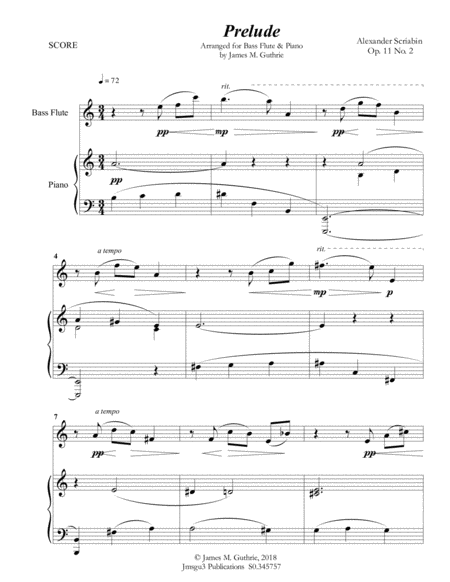
Bass Flute,Instrumental Solo,Piano - Level 3 - Digital Download SKU: A0.549474 Composed by Alexander Scriabin. Arranged by James M. Guthrie, ASCAP. Concert,Instructional,Romantic Period,Sacred,Standards. Score and individual part. 12 pages. Jmsgu3 #3499839. Published by jmsgu3 (A0.549474). Score: 8 pages, solo part: 2 pages, piano part: 2 pages. Duration: 3:10. An introspective and meditative work with a lot of dynamic and phrasing nuance. Works well for church meditations or recital encores. Background Op.11/2 Alto Clarinet version. First of all, Scriabin composed mostly for the solo piano and also the orchestra. This is probably because he was a gifted pianist and therefore certainly appreciated the piano. Scriabin grew up in the late Romantic period, consequently, he was fond of the great piano masters of the time. As a result, he wrote his first noteworthy compositions in the manner of Chopin and Liszt. Forms Likewise, Scriabin used many of the same forms as Chopin. These certainly include the étude, prelude, nocturne, and even the mazurka. In contrast, as he developed his own sense of style his music became more and more unusual. So, the last five of his Piano Sonatas do not have a key signature and therefore lean towards atonality. Philosophy Scriabin also developed a keen interest in philosophy and likewise poetry. He was above all particularly fascinated by Nietzsche, Delville, and Blavatsky. Consequently, he finally established his own ideas about metaphysics and certainly mysticism. Scriabin consequently advanced theories about the relationship between color and musical keys. Synesthesia He also may have experienced a condition called synesthesia where he could probably sense a response created from a different stimulus. Therefore, it was almost as if he could see music and hear colors. Scriabin, therefore, arranged the colors in a circle similar to the circle-of-fifths and assigned each key area a color. Finally, he assigned the key of C to the color red, while the key of G was orange. Similarly, he assigned D to yellow, A to green, and so forth. Strangely, he did not differentiate between major and minor key colors.  Multimedia Hence, his ability to translate colors into music certainly gave Scriabin a most noteworthy interest in creating multimedia events. Furthermore, He designed his biggest work, the Mysterium, to last an entire week. Even more, Scriabin made plans not only for music, but also colored lights, incense, and dancing. He designed the performance to occur in the foothills of the Himalaya mountains. The Mysterium was never performed, and only sketches of the work remain. Modern Performances In modern times, we often experience performances of Scriabin’s most famous completed works accompanied by colored laser lights and incense. These are the Poem of Ecstasy (completed in 1908) and the Poem of Fire (completed in 1910). The lighting effects for these early performances were accomplished by the clavier à lumiéres. It was a keyboard instrument that projected colored light onto a screen.

Scriabin: Prelude Op. 11 No. 2 for Bass Flute & Piano

$19.95 16.82 € PDF SheetMusicPlus

2 voices and piano - intermediate - Digital Download SKU: S9.Q47807 Das Liederspiel. Composed by Engelbert Humperdinck. This edition: single sheet. Singspiel version - fairy tale - Brothers Grimm - folk song - piano reduction - Hansel - Gretel - witch. Downloadable, Separate edition. Duration 55 minutes. Schott Music - Digital #Q47807. Published by Schott Music - Digital (S9.Q47807). German.When Engelbert Humperdinck’s fairy tale opera Hänsel und Gretel was premiered on 23 December 1893 in Weimar conducted by Richard Strauss, the work could look back on an extensive history of origin.Humperdinck’s younger sister Adelheid Wette (born in 1858) had displayed a great interest in literature in her youth and written a variety of poems for special occasions. In 1888, she wrote a fairy tale entitled Schneewittchen [Snow White] and her brother supplied some songs for this piece. Further fairy tale collaborations followed which were customarily performed within the family circle, and the first draft of the Hänsel und Gretel was begun in 1890. Adelheid’s husband would be celebrating his 34th birthday on 16 May of this year and his wife intended to surprise him with a performance of her version of this fairy tale. Her brother was allotted the task of composing the accompanying songs and, a month before the birthday, she wrote a letter to him in Mainz where Engelbert Humperdinck was among other activities working as an editor for the Schott publishing house, ordering a “very pretty folkloric†Tanzlied [Dance song], a Waldlied [Forest song] (or Echolied [Echo song]), a Schlummerlied [Lullaby] and a Kickericki-Lied [Cock-a-doodle-doo song] from her “dear sugar-sweet little brother... Engel-Bärtchen [angel beard]â€. She enclosed the corresponding verses with the letter and “for fun†also provided her own invented melody for the Schlummerlied and rhythmic suggestions for the Tanzlied. Humperdinck went straight to work and, as related in an entry in his diary, was already able to play the songs to the director of the publishing house, Dr Ludwig Strecker, by 19 April.This was the history of origin of the four songs published for the first time edited in form of their original versions in this edition Brüderchen komm’ tanz’ mit mir, Wer ruft mir im Walde doch alles nach, In den Zweigen die Vögelein und Tirelireli! ‘s ist nicht mehr früh “for two children’s voices and piano accompaniment†(see manuscript1). In his reply letter to his sister in which the fair copy of the songs were enclosed, Humperdinck wrote: “As you see, the pitch of the melodies is not too high and I have incorporated your melodies. Let me know soon whether you like the little songs. By the way, the ‘cock-a-doodle-doo’ can also be sung on one note(E flat) instead of on the four notes of the chord.â€The first performance of the song-play was held as planned within the family circle with Wettes’ two eldest daughters in the two principle roles. Spurred on by the success of the family performance, initial plans were forged to adapt the song-play into a singspiel with numerous musical numbers and rhymed dialogues; Hermann Wette participated in a draft of the text. The particell of this singspiel had been completed by Christmas 1890. Hugo Wolf and a few others however advised the composer to extend the singspiel into a through-composed fairy tale opera. Humperdinck followed this advice and worked on what he ironically termed as a “Kinderstubenweihfestspiel“ [sacred festive play for the nursery] during the next two summers in Bayreuth. Tanzliedchen [Dance song] and Morgenweckruf [Cock-a-doodle-doo song] were eventually included in the opera in a modified form.Bevor Engelbert Humperdincks Märchenoper Hänsel und Gretel zum Welterfolg wurde, hatte das Werk bereits eine vielschichtige Entstehungsgeschichte hinter sich. Humperdincks Schwester Adelheid Wette schrieb 1890 ein gereimtes Märchenspiel gleichen Namens, welches sie gemeinsam mit ihren Töchtern im Familienkreis aufführte. Ihr Bruder hatte die entsprechenden vier Lieder dazu beigesteuert. Während Brüderchen, komm tanz mit mir und Tirelireli in veränderter Form auch in die spätere Märchenoper eingingen, existieren das Schlummerliedchen und das Echo im Walde exklusiv in dieser Urfassung von Humperdincks Hänsel und Gretel. Diese Ausgabe umfasst Humperdincks vier ursprüngliche Lieder, die in dieser Fassung erstmals in editierter Form veröffentlicht werden, ebenso wie den vollständigen Text von Adelheid Wettes Liederspiel aus dem Jahr 1890.
Hänsel und Gretel
Voix duo, Piano
the way, the ‘cock-a-doodle-doo’ can also be sung on one note(E flat) instead of on the four notes of the chord â€The first performance of the song-play was held as planned within the family circle with Wettes’ two eldest daughters in the two principle roles
$23.99 20.22 € Voix duo, Piano PDF SheetMusicPlus

String Ensemble - Level 3 - Digital Download SKU: A0.552333 Composed by Georg Philipp Telemann 1681-1767. Arranged by James M. Guthrie. Baroque,Instructional,Standards,Wedding. 31 pages. Jmsgu3 #6327363. Published by jmsgu3 (A0.552333). I. Largo II. Allegro III. Affettuoso IV. VivaceGeorg Philipp Telemann's Sonatas Op. 2, also known as the Six Sonatas for two flutes (or violins), are significant for several reasons. First, they are dedicated to two young music lovers, explicitly appealing to a circle of pupils and music enthusiasts. The pieces foster the ability of musical expression and are characterized by a combination of expansive baroque thematic material and charming galant features in the slow and fast movements, respectively. Telemann was considered one of the leading German composers of his time, and his works, including the Sonatas Op. 2, reflect his significant contribution to the Baroque music era. The Methodical nature of these sonatas, as described when they were published in 1732, is also noteworthy, as they included a second, ornamented version of the simple melodies, showcasing Telemann's innovative approach to composition.Furthermore, Telemann's music, which incorporates French, Italian, and German national styles, remained highly regarded by colleagues and critics alike during his lifetime and the latter half of the 18th century. Numerous theorists and prominent composers cited his works as models, and he influenced pupils of J.S. Bach in Leipzig, such as Wilhelm Friedemann Bach. Therefore, Telemann's Sonatas Op. 2 contributed to the expansion of domestic music-making and influenced other composers and musicians of his time and beyond.
Telemann: Sonata Op. 2 No. 2 for Violin Duo
2 Violons (duo)

$24.95 21.03 € 2 Violons (duo) PDF SheetMusicPlus

Clarinet Duet Clarinet - Level 3 - Digital Download SKU: A0.552347 Composed by Georg Philipp Telemann 1681-1767. Arranged by James M. Guthrie. Baroque,Instructional,Standards,Wedding. 2 scores. 21 pages. Jmsgu3 #6329817. Published by jmsgu3 (A0.552347). I. Dolce II. Allegro III. Largo IV. VivaceGeorg Philipp Telemann's Sonatas Op. 2, also known as the Six Sonatas for two flutes (or violins), are significant for several reasons. First, they are dedicated to two young music lovers, explicitly appealing to a circle of pupils and music enthusiasts. The pieces foster the ability of musical expression and are characterized by a combination of expansive baroque thematic material and charming galant features in the slow and fast movements, respectively. Telemann was considered one of the leading German composers of his time, and his works, including the Sonatas Op. 2, reflect his significant contribution to the Baroque music era. The Methodical nature of these sonatas, as described when they were published in 1732, is also noteworthy, as they included a second, ornamented version of the simple melodies, showcasing Telemann's innovative approach to composition.  Furthermore, Telemann's music, which incorporates French, Italian, and German national styles, remained highly regarded by colleagues and critics alike during his lifetime and the latter half of the 18th century. Numerous theorists and prominent composers cited his works as models, and he influenced pupils of J.S. Bach in Leipzig, such as Wilhelm Friedemann Bach. Therefore, Telemann's Sonatas Op. 2 contributed to the expansion of domestic music-making and influenced other composers and musicians of his time and beyond.
Telemann: Sonata Op. 2 No. 3 for Clarinet Duo
2 Clarinettes (duo)

$32.95 27.78 € 2 Clarinettes (duo) PDF SheetMusicPlus

C Instrument - Level 3 - Digital Download SKU: A0.1289648 By Traditional. By Traditional. Arranged by Martin Hay. 19th Century,Celtic,Irish,Multicultural,Traditional,Wedding,World. Lead Sheet / Fake Book. 2 pages. Martin Hay #880353. Published by Martin Hay (A0.1289648). The Gay Gordons is a lively Scottish country dance that is popular at social gatherings and ceilidhs (traditional Scottish dances). It is a partner dance that involves a combination of skipping steps and waltz-like moves. The dance is typically done in a circular formation with couples facing each other. Here is a basic description of how the Gay Gordons dance is performed:1. **Starting Position:** Couples stand facing each other in a large circle, holding hands. The dance begins with partners side by side, with the man's right hand holding the woman's left hand.2. **Skipping Steps:** The dance starts with a series of skipping steps, where couples move in a circle to the right, taking small skipping steps.3. **Turns:** After a few rounds of skipping, couples will turn 180 degrees to face the opposite direction, still holding hands.4. **Waltz Hold:** Once turned, couples adopt a waltz hold, with the man's right hand around the woman's waist, and the woman's left hand on the man's shoulder. The other hands are joined together.5. **Waltz:** Couples then waltz around the dance floor in a clockwise direction, often taking a few spins.6. **Repeat:** The dance continues with more skipping steps, turns, and waltzing. It is a joyful and energetic dance that is typically danced to traditional Scottish music.The songs in this Gay Gordons set are:**1. The Thistle of Scotland:**The Thistle of Scotland is not a widely recognized or specific song title in Scottish music. Scotland has a rich musical tradition with many songs that celebrate its culture, history, and symbols. The thistle is the national emblem of Scotland, so there may be various songs that reference it indirectly.**2. Mhairi's Wedding:**Mhairi's Wedding is a popular Scottish folk song often played at weddings and celebrations. It tells the story of a wedding celebration and is known for its catchy melody and lyrics that celebrate the joyous occasion of Mhairi's wedding.**3. The Barren Rocks of Aden:**The Barren Rocks of Aden is a famous Scottish military march. It is often played by bagpipe bands and has a distinctive and stirring melody. The tune is associated with the British Army and is a common choice for military processions and parades.**4. Scotland the Brave:**Scotland the Brave is another well-known Scottish patriotic song and march. It is often played at national and sporting events in Scotland. The song celebrates the beauty and spirit of Scotland and is characterized by its uplifting and proud melody. It is a favorite among bagpipers and is often performed with great enthusiasm.These songs are all part of Scotland's rich musical heritage and are played at various occasions to celebrate its culture and history.
Ceilidh Music - Gay Gordons - For Accordion
Instruments en Do
Traditional
$3.99 3.36 € Instruments en Do PDF SheetMusicPlus

Piano Solo - Level 3 - Digital Download SKU: A0.1368469 Composed by Anton Diabelli. Arranged by Jose Valladares. Baroque. Score. 3 pages. Circlesquare Music #952816. Published by Circlesquare Music (A0.1368469). Rondino in C by Antonio Diabelli is a composition that exemplifies Diabelli's skill in creating charming and approachable music for the piano. Diabelli, an Austrian music publisher, editor, and composer, was active during the late Classical and early Romantic periods. His work is characterized by its melodic appeal, clear structure, and pedagogical value.Here are some aspects you might expect from Diabelli's Rondino in C:Rondino Form: A Rondino is a musical form similar to a rondo. It typically features a recurring main theme (the refrain) that alternates with one or more contrasting themes (the episodes). The structure of a rondino promotes a sense of familiarity and unity throughout the piece, as the main theme returns several times, creating a cyclical effect.C Major Key: The key of C Major is known for its clear, bright, and open sound. In the context of a rondino, this key would lend the piece a cheerful and uplifting character, making it appealing and accessible to a wide audience.Melodic Charm: Diabelli's compositions are noted for their tuneful and catchy melodies. Rondino in C would likely feature memorable and engaging themes that are both enjoyable to play and pleasant to listen to.Technical Accessibility: Diabelli's music often caters to pianists of varying skill levels, including students and amateur musicians. Rondino in C is expected to be technically approachable, focusing on musicality and expression rather than virtuosic technical challenges.Pedagogical Value: Given Diabelli's contributions to piano pedagogy, Rondino in C may serve as an excellent teaching piece, helping students to develop their sense of form, melody, and phrasing. It might also provide opportunities to practice balance between the hands and control of dynamics.
Rondino in C
Piano seul

$9.99 8.42 € Piano seul PDF SheetMusicPlus

Piano Solo - Level 1 - Digital Download SKU: A0.1310433 Composed by Bill Walker. Arranged by Bill Walker. Instructional. Score. 201 pages. Bill Walker Music Publishing #899072. Published by Bill Walker Music Publishing (A0.1310433). Mastery of Keys: A Comprehensive Guide of Scales, Arpeggios, and Chords A book for every pianist: student, teacher, and professional!Whether you're just starting your musical journey or seeking to refine your craft, this book is your invaluable companion. With clear, practical exercises, you'll efforlessly navigate the intricate patterns of scales, arpeggios, and chords. From the foundational basics to the most intricate progressions, this book equips you with the tools to unlock your true potential as a pianist.Let's look inside: Section 1: Scales Five Finger Scales Major Scales: One Octave Major Scales: Two Octaves Major Scales: Three Octaves Major Scales: Four Octaves Minor Scales: Natural, Melodic, and Harmonic Major & Harmonic Minor Scales in 3rds Major & Harmonic Minor Scales in 6ths Major & Harmonic Minor Scales in 10th Major & Harmonic Minor Scales in Octaves Chromatic Scales Section 2: Arpeggios Major, Minor, Dominant 7th and Diminished 7th Section 3: Chords Scale-Tone Triads, Cadences, and Inversions 24 Chords Beginning on Each Root Note Section 4: Appendices Appendix A: The Circle of Fifths Diagram Appendix B: Glossary Within these pages, you'll find an approach that embraces all fifteen major and fifteen minor keys, illuminating the keyboard in its entirety. I acknowledge that some keys may seem less trodden in the world of music composition, but their existence justifies the learning of them. Playing in all keys isn't just about mastering notes; it's about enhancing your versatility, shapening your musical ear, and empowering you to tackle any piece of music that comes your way.Let your fingers dance across the keyboard, let the notes resonate with your heart, and let this book be a guiding star on your musical voyage.Happy Playing!
Mastery of Keys: A Comprehensive Guide of Scales, Arpeggios, and Chords
Piano seul

$14.99 12.64 € Piano seul PDF SheetMusicPlus

Elton John : Le Roi lion - Circle of Life (niveau intermédiaire, sax ténor)
Saxophone
Téléchargez la partition Saxophone Le Roi lion - Circle of Life (niveau intermédiaire, sax…
5.99 € Saxophone PDF Tomplay

Elton John : Le Roi lion - Circle of Life (niveau intermédiaire, sax soprano)
Saxophone
Téléchargez la partition Saxophone Le Roi lion - Circle of Life (niveau intermédiaire, sax…
5.99 € Saxophone PDF Tomplay

Elton John : Le Roi lion - Circle of Life (niveau très facile)
Alto seul
Téléchargez la partition Alto Le Roi lion - Circle of Life (niveau très facile) de Elton J…
5.99 € Alto seul PDF Tomplay


1 ....91 106 121 136 151 ....391


Partitions Gratuites
Acheter des Partitions Musicales
Acheter des Partitions Digitales à Imprimer
Acheter des Instruments de Musique

© 2000 - 2026

Accueil - Version intégrale


