EUROPE
6032 articles
USA
22085 articles
DIGITAL
65348 articles (à imprimer)
Partitions Digitales
Partitions à imprimer
65348 partitions trouvées

1 ....61 76 91 106 121 ....9991

Level 3, Level 4 - Digital Download SKU: C7.CGRP56 Composed by Sandra Eithun. General. Bay View Week of Handbells. With with optional flute or violin, drum, chime tree and suspended cymbal. Set of parts. 8 pages. Chorister's Guild - Digital #CGRP56. Published by Chorister's Guild - Digital (C7.CGRP56). The word Michigan originally referred to the lake itself, and is believed to come from the Ojibwe word michi-gami meaning great water. Commissioned for the Bay View Week of Handbells, which is held on the shores of Lake Michigan, composer Sandra Eithun chose to offer an homage to this beautiful lake and its rich history. Tales of the Great Water is comprised of three short stories. Kinship -The Gathering is a tale of friendship conjuring up images of a place where cultures merged, and people from all over gathered. Shoreline Poem is a tale of longing. So many who settled near the shores of the Great Water, once had a life in another place, perhaps in a distant land. Standing on these remote shores, they can only imagine other places or times. Boundless is a tale of sailing. An adventurous romp on the water awaits our hearty sailors in this tale with stories to tell upon their return. The delightful stories are enhanced with optional flute or violin, drum, chime tree and suspended cymbal.
Tales of the Great Water (Set of Instrument Parts)

$11.95 10.29 € PDF SheetMusicPlus

Vocal Solo,Voice - Level 4 - Digital Download SKU: A0.701527 Composed by Kevin G. Pace, Krista Mason Pace. Christian,Praise & Worship,Sacred. 2 pages. Kevin G. Pace #3224905. Published by Kevin G. Pace (A0.701527). An original hymn with text by Krista Mason Pace below.YouTube video: https://youtu.be/c9lVXglYbCoTeaching His children, Jesus spoke softly, Gathering all of His followers there. He taught the kingdom of God on this earth Was as man sewing good seeds in fields with great care. Then, while sleeping at night, an enemy came And sowed the tares among the wheat in shame.   Soon when the wheat grew, showing great promise, Tares also covered the space all around. Knowing the young roots were tender and new, Then the man, in great wisdom, approached his good ground. Let them both grow together. Harvest time waits. The tares and wheat then gathered to their fates.   Now is the harvest. Gather together All the elect  from the quarters of earth. Those who will call on the Savior in faith, And in places of holiness stand with true worth. For the angels are waiting for their command. Come gather close to reach His outstretched hand.
Gathering - an original hymn for SATB voices
Voix seule

$1.99 1.71 € Voix seule PDF SheetMusicPlus

Guitar,Piano,Vocal,Voice - Level 2 - Digital Download SKU: A0.1044425 By Lisa Waites. By Lisa Waites. Arranged by Lisa Waites. Folk,Holiday,Multicultural,Praise & Worship,Sacred,World. Score. 2 pages. Servant Song Music and Ministry #649158. Published by Servant Song Music and Ministry (A0.1044425). I wrote this reconciliation hymn back in 2016, when elders from the Blood Tribe, Metis, Piikani, and Siksika nations of Southern Alberta led the Reconciliation Week events at Medicine Hat College, in Medicine Hat, Alberta. They invited me to write and teach this hymn as part of the sessions at MHC, where I was (then) the ecumenical Chaplain. It has been an honour to participate in this annual tradition of indigenous leaders sharing their distinctive cultural practices, traditions, and values with the public in Medicine Hat (and the surrounding communities) for a decade, now. During the session I was asked to assist with, the Elders were sharing the Seven Grandfathers' Teachings, and so I included these core values into the lyrics of the hymn. The work in Medicine Hat started with expressions of lament and support from a group of local churches and the Medicine Hat College Chaplaincy program while the Truth and Reconciliation Commission was crossing the country. We quickly realized that many non-indigenous Canadians genuinely wanted to learn more about their First Nations, Metis, and Inuit neighbours. Seeing an urgent need for greater awareness about the intergenerational damage that was done by the Indian Residential School system here in Canada, and also identifying these Reconciliation events as a way to decrease racist stereotypes and assumptions about indigenous peoples, we decided to continue offering an annual reconciliation session, which grew, year by year. A decade later, I'm delighted to have seen deeper, healthier relationships being built between indigenous and non-indigenous people. Musically, this hymn loosely imitates the style of the French Canadian Voyageurs, the folk melodies of the 18th and 19th centuries. The lyrics incorporate the Seven Grandfathers' Teachings. This core ethical framework has many different versions, but many First Nations communities have adopted these teachings in some form. (I've heard Elders say that Respect must come first, because it is the foundation that we build on, but for this particular group at Medicine Hat College, Humility was first on the list). I have Metis ancestry myself, and as an adult, I have researched the long-hidden genealogical and cultural treasures of my family tree. Whether you are an indigenous person looking to support other indigenous Christian composers, or whether you are a non-indigenous person who is trying to broaden the repertoire of your congregation, We Must Learn to Walk Together is an upbeat, hope-filled hymn that sings about reconciliation as if it is not only possible in the distant future - but also achievable today, using the concrete steps suggested by the lyrics. The indigenous wisdom of the Seven Grandfathers' Teachings lines up beautifully with the teachings of Christ. Musically, this hymn is highly accessible for congregational singing; the range is moderate and the rhythms provide musical interest without becoming overly complex; to hear the guitar version and melody line of the hymn being played and sung by the composer, please go to the following YouTube link: https://youtu.be/3DpkFCLxgEs. The musical format of the hymn alternates between the chorus and three verses. The piece takes roughly 3:30 to perform. This hymn has been transcribed in the key of C Major, so it is as easy as possible for church accompanists to play and for congregations to sing; guitarists are invited to play in the key of A Major and simply capo 3. Guitar chords are included. I hope and pray that this hymn for reconciliation will help you, your congregation, and the wider community to think about, pray for, and enact the calls to action of the Canadian Truth and Reconciliation Commission in new and deeper ways this year.
We Must Learn to Walk Together
Piano, Voix et Guitare
Lisa Waites
$3.99 3.43 € Piano, Voix et Guitare PDF SheetMusicPlus

Tenor Voice,Vocal Solo - Level 4 - Digital Download SKU: A0.534586 Composed by Gregory Sullivan Isaacs. Concert,Contemporary,Standards. 12 pages. Musik Fabrik Music Publishing #4729123. Published by Musik Fabrik Music Publishing (A0.534586). Part of the AIDS memorial songbook, this melody for tenor voice and piano has an orginal text by the composer: It was still dark.The dawn had not yet arrived.He stood quietly, looking out over the field.,soon to be filled with patches of grief.Monuments to great men,grey against the pre-dawn sky,reminded him of the Great Dream:We are all equal under Law, it promised.We are all equal under Law.He smiled wryly at the thought.The keepers of that Dream still keep it for themselves,only- releasing what little part what group or anothercan wrest away.The unfolding began.Each patch holds the grief of dozens:friends, family.Amercia's children left to die alone.Amercia's children left to diebecause of who they were, who they had to be.Fully open now.Small groups wander here and there.searching, looking,Afraid that the edges wait for them.Afraid that the edges wait for them.Some already gathering scraps of cloth.Finally, he moves at last.Finally with enough courage to go look.His thoughts warmly dwell on him who made it.The one whose devotion was unquestioned.whose love was always present.Having seen it, he was cotent to move on towhatever was to come.His patch was there.
Gregory Sullivan Isaacs: Elegy on the Quilt for tenor voice and piano
Voix Tenor

$10.35 8.91 € Voix Tenor PDF SheetMusicPlus

Brass Quintet Horn,Trombone,Trumpet,Tuba - Level 4 - Digital Download SKU: A0.1446054 Composed by Christoph Willibald Gluck,. Arranged by Keith Terrett. Classical,Contest,Festival,Historic,Instructional,Opera. 16 pages. Keith Terrett #1025876. Published by Keith Terrett (A0.1446054). Orfeo ed Euridice is an opera composed by Christoph Willibald Gluck, based on the myth of Orpheus and set to a libretto by Ranieri de' Calzabigi. It belongs to the genre of the azione teatrale, meaning an opera on a mythological subject with choruses and dancing.The piece was first performed at the Burgtheater in Vienna on 5 October 1762, in the presence of Empress Maria Theresa. Orfeo ed Euridice is the first of Gluck's reform operas, in which he attempted to replace the abstruse plots and overly complex music of opera seria with a noble simplicity in both the music and the drama.The opera is the most popular of Gluck's works, and was one of the most influential on subsequent German operas. Variations on its plot—the underground rescue mission in which the hero must control, or conceal, his emotions—can be found in Mozart's The Magic Flute, Beethoven's Fidelio, and Wagner's Das Rheingold.Though originally set to an Italian libretto, Orfeo ed Euridice owes much to the genre of French opera, particularly in its use of accompanied recitative and a general absence of vocal virtuosity. Indeed, twelve years after the 1762 premiere, Gluck re-adapted the opera to suit the tastes of a Parisian audience at the Académie Royale de Musique with a libretto by Pierre-Louis Moline. This reworking was given the title Orphée et Eurydice, and several alterations were made in vocal casting and orchestration to suit French tastes.Ther picture is Count Francesco Algarotti, an Italian polymath, philosopher, poet, essayist, anglophile, art critic and art collector. He was a man of broad knowledge, an expert in Newtonianism, architecture and opera. He was a friend of Frederick the Great and leading authors of his times: Voltaire, Jean-Baptiste de Boyer, Marquis d'Argens, Pierre-Louis de Maupertuis and the atheist Julien Offray de La Mettrie. Lord Chesterfield, Thomas Gray, George Lyttelton, Thomas Hollis, Metastasio, Benedict XIV and Heinrich von Brühl were among his correspondents.''The Sicilienne and Rigaudon is one of the many pieces that violin virtuoso Fritz Kreisler composed in the style of other composers. When he first presented and published these pieces, he offered them as recently discovered works by those other composers, newly adapted and arranged by himself. In the case of Sicilienne and Rigaudon, it is eighteenth-century French violinist/composer François Francoeur whose name is on the title sheet, though the piece really has nothing to do with Francoeur's style.The piece is a simple and a charming one, however. The Sicilienne is a binary-form miniature that sweeps along on a characteristic dotted rhythm, with a rather melancholy melody. Think old French ballet. The constant 16th notes of the Rigaudon, give it a character quite unlike that of a traditional rigaudon-a cheerful Baroque dance movement in duple meter.
Aria from the Opera Orfeo ed Euridice for Brass Quintet (French Horn solo)
Quintette de Cuivres: 2 trompettes, Cor, trombone, tuba

$8.99 7.74 € Quintette de Cuivres: 2 trompettes, Cor, trombone, tuba PDF SheetMusicPlus

Full Orchestra - Level 4 - Digital Download SKU: A0.995852 Composed by Andrew Strawn. Contemporary,Romantic Period. Score and parts. 125 pages. Andrew Strawn #4726553. Published by Andrew Strawn (A0.995852). Dedicated to the Notre Dame Cathedral in Paris which caught fire during the writing of this piece.  The Great Cathedral is a long-anticipated work. I have had the primary chorale melody for nearly a year prior to the time of publication. So it seems rather overdue to complete it. Being the first large work for orchestra I have composed in a while, it was certainly a challenge. Nevertheless, this piece has come together just as I wanted it to. Written for full orchestra, choir, harp, piano, and organ, The Great Cathedral is a colossal work. It features the principal violinist and travels through a variety of orchestrations. From a French revolution-style march, swelling chorales, fugal expositions, and dissonate sforzandos this piece transforms the primary melody across the score. I am proud to have finally completed this work and I hope you enjoy, The Great Cathedral. In the event a choir is unavailable, choir parts have been cued in the organ. The organ would then play on a reed setting.Includes a legal-sized score and a letter-sized set of parts.
The Great Cathedral
Orchestre

$55.00 47.34 € Orchestre PDF SheetMusicPlus

Choral Choir (SATB) - Level 4 - Digital Download SKU: A0.1076393 Composed by Kevin G. Pace (ASCAP), Mary Ann W. Snowball. Praise & Worship,Sacred,Spiritual. Octavo. 194 pages. Kevin G. Pace #680550. Published by Kevin G. Pace (A0.1076393). Have you ever wondered how to have a really happy life? In Matthew 5-7 in The New Testament and in 3 Nephi 12-14 in The Book of Mormon, Another Testament of Jesus Christ, our Savior teaches us the way to contentment and happy living through The Beatitudes. These gems of Christian living were taught by Jesus as the initial part of the most well-known of his teachings called The Sermon on the Mount. The word “beatitude†comes from the Latin “beatitudo†meaning “blessedness.†Each of the eight beatitudes in this book consists of two phrases: the condition and the result. Together, these illustrate a set of ideals focusing on love and humility, echoing the highest of Jesus’ teachings on spirituality and compassion. Each also promises a future reward, and the themes appear to escalate from beginning to advancing levels of responsibility and spirituality as the Sermon progresses. By the end of the Sermon a recipient would have earned the reward to stand ceremonially in the presence of God, and to ultimately gain the greatest reward of living with Him in heaven. The purpose of this book is to praise our Lord through song and text, rejoicing in the gifts we receive from Him as we do as He suggests. Please enjoy this collection of original solos, SATB choral renditions, and a duet, along with a short text explaining each beatitude in the order our Savior spoke them so many years ago as part of the greatest sermon ever given, our Lord’s Sermon on the Mount! It was a joy to prepare them for you. Happy Living!
The Beatitudes, 24 Sacred Songs Celebrating The Beatitudes Through Music and Narration
Chorale SATB
the end of the Sermon a recipient would have earned the reward to stand ceremonially in the presence of God, and to ultimately gain the greatest reward of living with Him in heaven The purpose of this book is to praise our Lord through song and text, rejoicing in the gifts we receive from Him as we do as He suggests
$10.95 9.43 € Chorale SATB PDF SheetMusicPlus

High voice and piano - Medium - Digital Download SKU: MQ.8318-4E Composed by Gwyneth W. Walker. Secular, 21st century. 9 pages. E. C. Schirmer Music Company - Digital #8318-4E. Published by E. C. Schirmer Music Company - Digital (MQ.8318-4E). The five letters which provide the lyrics for the songs (adapted by the composer) were selected for their range of topics and sentiments. Some portray the wildlife in the mountains (“Glacier Birds...â€). Others extol the beauty of the Sierra (“Mountain Glory,†“Yosemite Fallsâ€). One expresses the whimsical/temperamental personality of the author (“Ice!â€). And the final letter (“Sequoiaâ€) speaks reverently of the great trees, in a language both naturalistic and sacred. They are the “greatest light in the woods, the greatest light in the world.†The musical settings, especially in the piano accompaniment, are quite programmatic. Glacier birds scamper up and down the keyboard in tone clusters. “Icy†glissandi float off. The great trees take root in large, block chords, and waterfalls cascade down in scales.There is personality in the letters. The bond between John Muir and Mrs. Carr (whom he addresses formally) is one of great kinship- a blending of the souls, a “spiritual romance.†As he marvels at the beauty of the wilderness, he writes ardently, “I wish that you could see this...†When he learns that Mrs. Carr, a botanist (whose plants suffer from the frost), dislikes ice, he chides her, and creates a “mock argument†over the value of glacial ice.The songs begin with an ascent into the mountains. They close with the return to the coast, to the magnificent Sequoia trees, where John Muir camps for the night, in the company of a squirrel. Charmingly, he writes “therefore, my Carr, goodnight.â€.
Ice! from Songs from the High Sierra
Voix haute

$7.25 6.24 € Voix haute PDF SheetMusicPlus

Small Ensemble - Level 1 - Digital Download SKU: A0.890779 Composed by Georg Philipp Telemann. Arranged by Sneakwood Editions. Baroque,Folk,Jewish,World. Score and parts. 32 pages. Sneakwood Editions #5799897. Published by Sneakwood Editions (A0.890779). Georg Philipp Telemann – Polish Dances from the Rostock Manuscript TWV 45 (Danse d`Polones / Danse Polonie)Telemann was seduced by Polish music, especially by his dances and popular musicI became acquainted there and also in Krakau with Polish and Moravian music in its true, barbaric beauty […] […] it is impossible to imagine the fantastic musical ideas they presented between dances when the dancers rested and the musicians improvised music together [‘jammed’] to fill out the time. Anyone who paid very close attention could pick up in 8 days sufficient musical ideas to last a lifetime.(Telemann’s autobiography, published in Mattheson’s Ehren-Pforte, Hamburg, 1740)It is easy to understand, through Telemann’s own words, the great influence that Polish music and Polish dances had on Telemann. It was in 1705 when Telemann become Kapellmeister for the court of Count Erdmann II of Promnitz at Sorau (now Å»ary, in Poland), His career there was cut short in early 1706 by the hostilities of the Great Northern War but his contact with Polish music marked him for life.These Polish dances found in Rostock are a reflection of the music that Telemann heard and transcribed. A reflection of that barbaric beauty.The manuscript was discovered in 1986 at the University of Rostock. It consists of two volumes. One of the volumes contains the violin part and the other the bass part.
Telemann – Polish Dances from the Rostock Manuscript TWV 45

$18.00 15.49 € PDF SheetMusicPlus

Level 3 - Digital Download SKU: A0.1488249 Composed by Johann Sebastian Bach. Arranged by Alberto Mandarini. Baroque,Chamber,Classical,Historic,Instructional. 19 pages. Alm@music #1065126. Published by Alm@music (A0.1488249). I transcribed Contrapunctus I from the Art of Fugue by Johann Sebastian Bach, faithfully respecting the work of the Great Maestro, intervening only to distribute the voices when impracticable by the individual instruments and to give some breathing space to the various performers. In fact, from 4 parts, I obtained 5 using a small doubling only in the final part.The choice to use 3 trumpets and 2 trombones, and not the more typical brass quintet (2 trumpets, horn, trombone and tuba), was dictated by the lineup I had available at the time I made the transcription. Luckily, the second trombone part fits perfectly with the original fourth voice (…except for one very brief point…).However, in the future, I don't rule out creating a version for the standard quintet too!On a didactic level, the choice of this piece was certainly ambitious, but the extraordinary thing is that through Bach's music (!!!) it was possible to address an enormous amount of musical nuances. This immediately fascinated my students, both young and old, who did not hesitate to get involved with all their strength and I must say that, at the end of the study path, each of them achieved a clear improvement both technically and, above all, expressive.But then it's no surprise, Bach's music is always extraordinary and surprising!The structure of the transcription is therefore the original one and the duration is around 2 minutes and 45 seconds. To the expected parts I also added that of the horn in F, replacing the 3rd trumpet. At your discretion, of course, decide whether to replace it or double it directly.Also in this case, the audio is made with the synthetic sounds of midi, therefore not particularly captivating, but it should still be useful for getting an idea of ??the arrangement and for studying the individual parts.Good music!am.
Contrapunctus I - From The Art of The Fugue ~ BWV 1080

$4.99 4.3 € PDF SheetMusicPlus

Brass Quintet Cornet,Euphonium,Flugelhorn,Trombone,Trumpet,Tuba - Level 3 - Digital Download SKU: A0.1276031 Composed by James P. Johnson. Arranged by Charles Decker. 20th Century,Broadway,Film/TV,Musical/Show,Pop,Ragtime. 21 pages. Charles Decker Music Press #867780. Published by Charles Decker Music Press (A0.1276031). From the Music of Black Composers Series at Charles Decker Music Press is the “The Charleston†which debuted in James P. Johnson’s Broadway 1923 show “Runnin’ Wild†to become the wildly popular and unofficial anthem of the Roaring 20’s.  An important jazz pianist and composer, Johnson was a major influence on Count Basie, Duke Ellington, Art Tatum, Thelonious Monk, and Fats Waller.  Arranged for a brass quintet of two B-flat trumpets with alternate C trumpet parts, horn in F with a substitute flugelhorn part, trombone or euphonium and tuba, the arrangement uses the original 1923 piano edition and retains the style of the day. The recording is of the entire edition.“The Music of Black Composers Series is a welcome and timely addition to the brass repertoire. Interesting music, expertly arranged, fun to perform, and well received by audiences. These pieces are now permanently in my quintet book and I will be using them with my student groups as well. Highly recommended!â€Â   Wesley Nance, Rochester Philharmonic Orchestra, Eastman School of Music “I was so pleased to see the great works arranged for brass ensemble by Charles Decker Music Press especially the Music of Black Composers’ Series. It was especially rewarding to perform several of these with Summit Brass and with the students attending the Rafael Mendez Brass institute. Please keep these wonderful settings coming. You have provided the brass world with some real gems.â€Â  Joseph Parisi, Director Summit Brass, FountainCity Brass Band, University of Missouri Kansas City Conservatory Wind EnsembleThe Interlochen Arts Academy and the University of Denver have purchased the Music of Black Composer Series with Charles Decker Music Press and the summer Rafael Mendez Brass Institute and Eastman School of Music uses the series arrangements in their chamber and brass ensembles music programs. See 50+ homogeneous brass editions for trumpet, horn and trombone ensembles and 75+ mixed brass ensemble publications with Charles Decker Music Press at Sheet Music Plus for inexperienced to advanced musicians with music ranging from the Renaissance to contemporary new works for trios, quartets, quintets, brass choir and brass band. Many of the mixed brass ensemble editions include alternate and substitute parts being alternate C trumpet parts for B-flat trumpet parts, flugelhorn/trumpet substitute for horn, horn substitute for trombone and treble clef euphonium substitute for trombone. To see our Music of Black Composers Series enter “Black Composers Series†in the search box at Charles Decker Music Press for 25 arrangements for mixed brass ensembles ranging from early jazz to symphonic works with composers Samuel Coleridge-Taylor, R. Nathaniel Dett, William Grant Still, Will Marion Cook, James Reese Europe, James Johnson and others.For more brass quintet editions by Charles Decker use these links to Kendor Music and Cherry Classics Music for listings of my arrangements of music by J.S. Bach, H.L. Clarke, Debussy, Dukas, Elgar, Falla, Holst, Ives, Nestico, Rachmaninoff, Satie, and Tchaikovsky.
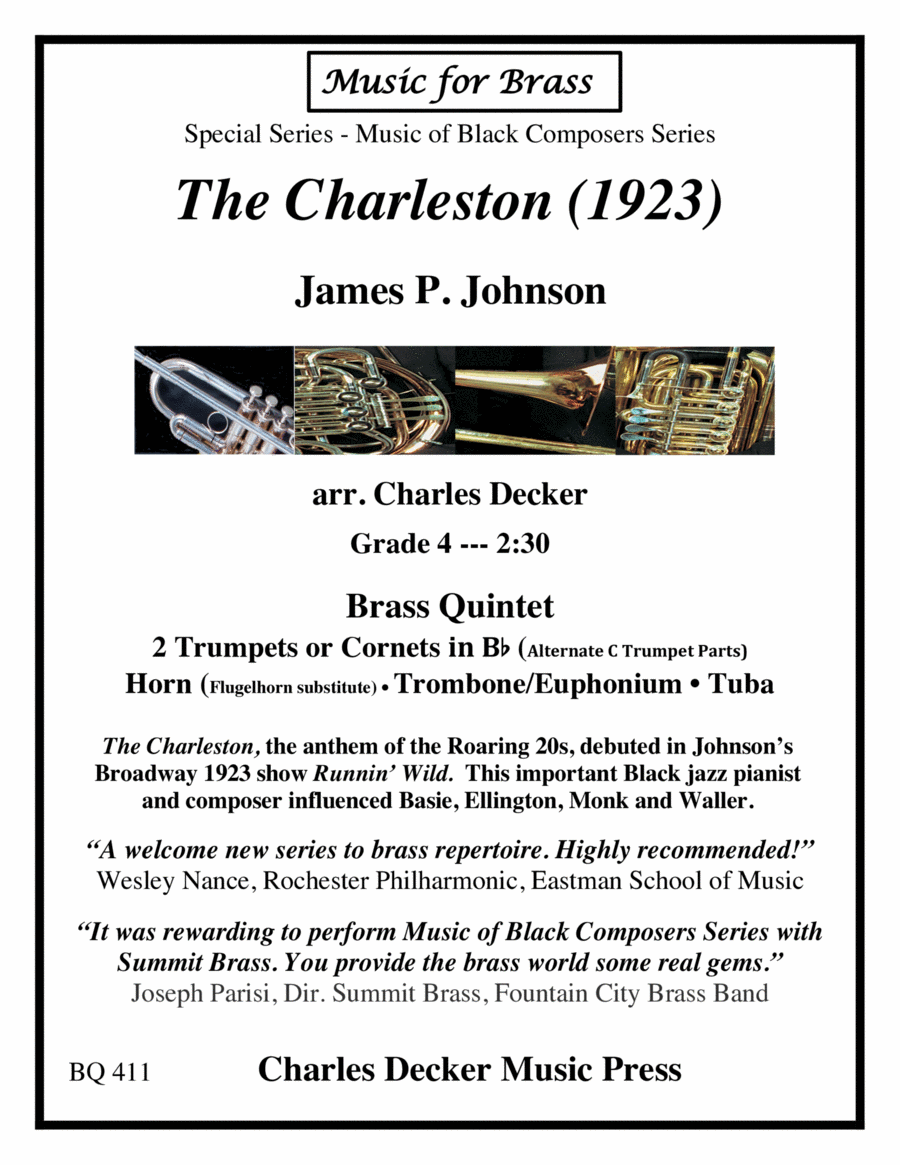
The Charleston (1923) for Brass Quintet
Quintette de Cuivres: 2 trompettes, Cor, trombone, tuba

$9.99 8.6 € Quintette de Cuivres: 2 trompettes, Cor, trombone, tuba PDF SheetMusicPlus

Concert Band - Level 3 - Digital Download SKU: A0.933695 Composed by Frederick M. Lehman. Arranged by Leandro Bizama. Christian,Christmas,Easter,Jewish,Sacred. Score and parts. 44 pages. Leandro Bizama Music #2907105. Published by Leandro Bizama Music (A0.933695). The Love of God, for Concert Band, Grade Level 2.5, dur. 4 mins.The lyrical nature of the tune combined with the powerful poem about God's love make this one of the greatest hymns ever. This arrangement maintains the power of the tune and represents the beauty of the poetry musically. Each verse has its own special setting corresponding to the words of the hymn. Starting in a mysterious, martial and subdued style, The Love of God develops into a strong but respectful to the hymn type of finale, complete with musical representations of the waves of the sea. It is accessible to High School groups but also appropriate for Community or College ensembles. Because of its history (see below) it can appeal to a wide range of faiths and inspire unity and peace. Audiences and performers alike are sure to find it inspiring and uplifting.---A little about the history of the hymn:Could we with ink the ocean fill, and were the skies of parchment made;Were every stalk on earth a quill, and every man a scribe by trade;To write the love of God above would drain the ocean dry;Nor could the scroll contain the whole, though stretched from sky to sky.These timeless words inspired Lehman to write The Love of God after they were found edged on the wall of an asylum patient's room. They are an adaptation and translation of a poem originally written in Aramaic by the Jewish Rabbi of Worms, Germany around the year 1050. This poem in turn is similar to a passage in the Qur'an. What an incredible journey for these great words: an ancient poem that has its roots in the Qur'an, later adapted by a Rabbi, written on the wall of an insane asylum by a patient, and finally taken up by a Christian to be the basis of a beautiful song. Surely God's love and music are the only two things powerful enough in our World to bring unity and respect in the face of pride and violence.For more about the arranger, visitwww.leandrobizama.comSources:http://www.hymnary.org/text/the_love_of_god_is_greater_farhttp://library.timelesstruths.org/music/The_Love_of_God/http://www.tanbible.com/tol_sng/sng_theloveofgod.htm 
The Love of God
Orchestre d'harmonie

$30.00 25.82 € Orchestre d'harmonie PDF SheetMusicPlus

Ukulele - Level 3 - Digital Download SKU: A0.1149540 By Michael P Walker. By Various. Arranged by Michael P Walker. 19th Century,Romantic Period. Score. 168 pages. Michael P Walker #749686. Published by Michael P Walker (A0.1149540). These sixty-six compositions were arranged for the Low G ukulele and represent some of the greatest composers of the 19th Century – The Romantic Era as a movement does not refer to romantic love, though that theme was prevalent in many works composed during this time period. Romanticism describes the expansion of formal structures within a composition, making the pieces more passionate and expressive. The Romantic period contradicted the Classical period by introducing freedom, artistic creativity, and experimentation. Expressing an emotion or an idea was the most important, therefore the melody was the dominant feature Along with this book, there are more than 80 books of arrangements of Renaissance, Baroque, Classical, and Romantic era music for the baritone ukulele and there are more than Sixty-five others with arrangements for the Low G ukulele. You can find them here: https://morgancomusic.com.
ROMANCE! Compositions from the 19th Century Romantic Movement for Low G Ukulele
Ukulele
Michael P Walker
$19.95 17.17 € Ukulele PDF SheetMusicPlus

Choral Choir (SATB) - Level 3 - Digital Download SKU: A0.926671 Composed by Michael A. Morizio. Christian,Sacred. Octavo. 24 pages. M.A. Morizio #3588445. Published by M.A. Morizio (A0.926671). My dear friend, and Pastor Don Colageo and I cut our teeth together with this piece when we decided to dive headlong into this cycle of Seven Anthems to Christ. It was the second song of the (SEVEN ANTHEMS TO CHRIST) cycle that I had composed, but the first using his Greek translation(s). It eventually would become the last piece to grace the cycle of seven in order of my musical presentation sequence. In fact, this known 1st century Hymn to Christ spans 18 verses of the first chapter of the Gospel of John. My setting of the anthem is seven plus minutes long in performance length. The song's length was not on purpose, but the number seven does have Biblical significance (seven days of creation, seven golden lamp stands, etc.) The number seven is also known among Biblical scholars as the number of Holiness and Perfect Creation.  Since this rather long, yet theologically complete Hymn to Christ already existed in the 1st century, it is no wonder the Apostle John opted to begin his Gospel with it, probably quoting the entire text. Consequently, he converted this particular Hymn to Christ’s lyrics into what would later become canonized Scripture. The anthem is composed for SSATB with solo SSA trio, and Solo Soprano and Solo Baritone lines, accompanied by Flute and Bâ™­ Clarinet. The key signature of the anthem is Bâ™­ Major. However, a lot of time is spent weaving and bobbing around the Dominant chord, (F Major).  The Flute and Clarinet introduction play seven different motifs, interweaving with counterpoint, musically connoting the dual natures of Christ--fully God, and fully man. An SSA trio opens the piece recounting the creation story. A bass solo shortly follows, introducing John the baptizer's story and purpose. Soon, the anthem breaks out into full SSATB illustrating Christ's life and purpose for our salvation. The final coda is the great Doxology, sung in 5 parts, accompanied by the Flute and Clarinet, and the entire congregation (or audience) is invited to sing along with the familiar tune. 
IN THE BEGINNING WAS THE WORD (SSATB) – John 1:1-18
Chorale SATB

$2.99 2.57 € Chorale SATB PDF SheetMusicPlus


1 ....61 76 91 106 121 ....9991


Partitions Gratuites
Acheter des Partitions Musicales
Acheter des Partitions Digitales à Imprimer
Acheter des Instruments de Musique

© 2000 - 2026

Accueil - Version intégrale





