EUROPE
11686 articles
USA
0 articles
DIGITAL
135394 articles (à imprimer)
Partitions Digitales
Partitions à imprimer
135394 partitions trouvées


String Orchestra - Level 1 - Digital Download SKU: A0.835568 Composed by Lowell Mason. Arranged by Vincent Vitale. Praise & Worship. Score and parts. 9 pages. Vincent Vitale #5194853. Published by Vincent Vitale (A0.835568). NEARER, MY GOD TO THEE is written for the elementary level by a retired public school instrumental music teacher. This beautiful 19th century Christian hymn is a very easy arrangement keeping all instruments in 1st position and utilizing three part harmony that will benefit ensembles lacking adequate instrumentation. Use it as a warm-up or a concert selection. Music does not have to be difficult to sound good. If you are looking for something playable and full sounding you found it in this string orchestra series for young players.  If this composition appeals to you please consider the many others in this string series by typing VINCENT VITALE in the search bar located on the home page. I hope you and your students enjoy performing this piece and I thank you very much for your consideration and wish you and your students much musical success. …Copyright 2019...
NEARER, MY GOD TO THEE (very easy)
Orchestre à Cordes

$10.00 8.64 € Orchestre à Cordes PDF SheetMusicPlus

String Quartet Cello,String Quartet,Viola,Violin - Level 3 - Digital Download SKU: A0.884025 Composed by Brett Allen, Christopher Kevin Willis, Graham Mcmillan Wilson, Ian Levine, James Todman, John Robinson Reid, Nigel Stock, and Ronald Haryanto. Arranged by Athena Strings. Contemporary. Score and parts. 8 pages. Athena Strings #6353659. Published by Athena Strings (A0.884025). Can You Feel the Love Tonight, from 'The Lion King' by Elton John arr. Athena Strings, this version follows the original structure of the song.Find out more about Athena Strings at http://athenastrings.net or at https://www.facebook.com/athenastrings/
Can You Feel The Love Tonight
Quatuor à cordes: 2 violons, alto, violoncelle

$12.99 11.23 € Quatuor à cordes: 2 violons, alto, violoncelle PDF SheetMusicPlus

Choral Choir,Choral (SATB) - Level 2 - Digital Download SKU: A0.1298965 Composed by Ian Calvert. 21st Century,A Cappella,Christmas,Contemporary,Holiday. 6 pages. Ian Calvert #888815. Published by Ian Calvert (A0.1298965). This is the first publication of a new Christmas song, set for SATB a cappella and ideal for community or professional choirs. The words are those of a poem by Leonard Clark (1905 – 1981). He was an English poet who was raised in The Forest of Dean, in the west of England. The Forest became his great passion and inspiration; much of his poetry reflects that upbringing and often relates to nature. In 1972 he published a slim little book of Christmas poems, of which ‘The Birth’ is one. What I like about this poem is its simplicity and clarity – and its narrative development through the verses. It starts with the poet waking in the pre-dawn. He then realizes that it is Christmas Day and in the stillness of that time his mind turns to the birth of Jesus, as traditionally told; tenors and basses start this verse. Then he steps out of time and space and looks through his bedroom window to contemplate the mystery of incarnation; sopranos and altos begin this third verse. And he finishes at the stable, offering devotion to the newborn Lord. This song is also available in a version for voice and piano. Drawn from the same book of poems there is available another new Christmas song, called Singing in the Streets; that one is set for baritone and piano. Ian Calvert.
The Birth
Chorale SATB

$1.99 1.72 € Chorale SATB PDF SheetMusicPlus

Level 3 - Digital Download SKU: A0.549196 Composed by Giovvanni Gabrieli. Arranged by James M. Guthrie, ASCAP. Easter,Renaissance,Standards. 42 pages. Jmsgu3 #3457617. Published by jmsgu3 (A0.549196). Giovanni Gabrieli: Jubilate Deo (Ch. 136). Instrumentation: 3 trombones, 3 euphoniums & 3 tubas. Duration: 3:00, cut time 4/2 at half-note = 96, 71 ms. Score: 24 pg. parts: 2 pg. Here is a stunningly beautiful example of Renaissance polyphony, and a mesmerizing fast-paced recital number. Program this either at the beginning to set an exciting mood or as an encore to leave the listeners in a jubilant afterglow. The parts are not difficult but plan to rehearse the many subtleties of dynamic contrast between the various sub-groups and the overall articulations. Innovations First of all, Gabrieli preferred sacred vocal and certainly instrumental music. Hence, he concentrated on music that consequently took advantage of resonance and likewise reverberation for maximum effect. Seems like Gabrieli may have invented dynamics – or was rather the first to indicate them such as in his Sonata Pian’ e Forte. Consequently, he was also a pioneer in spatial techniques. He therefore developed and used very specific notation to indicate instrumentation. Gabrieli experimented with assembling massive instrumental forces into isolated groups separated by space. In this way, he consequently contributed heavily to the Baroque Concertato style. Polychoral Works Gabrieli probably used the layout of the San Marco church for his experiments. This is because he worked there as a musician and composer. Furthermore, the church had two choir lofts facing each other. He certainly used these to create striking spatial effects between instrumental forces. Certainly, many of his works are composed such that a choir or instrumental group could first be heard on one side, then consequently followed by a response from the group on the other side. Sometimes there was probably a third group positioned near the main altar as well. Spatial Music Above all, Gabrieli studied carefully detailed groups of instruments and singers. Furthermore, it seems like he created precise directions for instrumentation in rather than two groups. The instruments, because they could be appropriately situated, could consequently be heard with perfect clearness at distant locations. As a result, arrangements that seem bizarre on paper, can in contrast sound perfectly in balance. First Works Finally, Gabrieli published his first motets along with his uncle Andrea's compositions in Concerti (1587). These compositions furthermore indicate considerable usage of dialogue and echo effects. Consequently, here we see low and high choirs with the variance between their ranges indicated by instrumental accompaniment. Seems like Gabrieli’s later motets Sacrae Symphoniae (1597) move away from close antiphony. In contrast, he moves towards not simply echoing the material but developing it through sequential choral entrances. Even more, he takes this procedure to the extreme in the Motet Omnes Gentes. Unlike earlier works, here the instruments are certainly an essential part of the presentation. Also, only parts marked: Capella are supposed to be sung. Homophony Hence, after 1605, Gabrieli moves to a much more homophonic style. He writes sections purely for instruments – which calls Sinfonia – and smaller sections for vocal soloists, accompanied by a basso continuo.
Gabrieli: Jubilate Deo Ch. 136 for Low Brass Choir

$47.95 41.44 € PDF SheetMusicPlus

Woodwind Ensemble Bassoon,English Horn,Oboe - Level 3 - Digital Download SKU: A0.549199 Composed by Giovanni Gabrieli. Arranged by James M. Guthrie, ASCAP. Easter,Renaissance,Standards. 42 pages. Jmsgu3 #3458615. Published by jmsgu3 (A0.549199). Giovanni Gabrieli: Jubilate Deo (Ch. 136). Instrumentation: 4 oboes, 2 English horns, 2 bassoons, 1 contrabassoon (or 3 bassoons). Duration: 3:00, cut time 4/2 at half-note = 96, 71 ms. Score: 24 pg. parts: 2 pg. Here is a stunningly beautiful example of Renaissance polyphony, and a mesmerizing fast-paced recital number. Program this either at the beginning to set an exciting mood or as an encore to leave the listeners in a jubilant afterglow. The parts are not difficult but plan to rehearse the many subtleties of dynamic contrast between the various sub-groups and the overall articulations. Innovations First of all, Gabrieli preferred sacred vocal and certainly instrumental music. Hence, he concentrated on music that consequently took advantage of resonance and likewise reverberation for maximum effect. Seems like Gabrieli may have invented dynamics – or was rather the first to indicate them such as in his Sonata Pian’ e Forte. Consequently, he was also a pioneer in spatial techniques. He therefore developed and used very specific notation to indicate instrumentation. Gabrieli experimented with assembling massive instrumental forces into isolated groups separated by space. In this way, he consequently contributed heavily to the Baroque Concertato style. Polychoral Works Gabrieli probably used the layout of the San Marco church for his experiments. This is because he worked there as a musician and composer. Furthermore, the church had two choir lofts facing each other. He certainly used these to create striking spatial effects between instrumental forces. Certainly, many of his works are composed such that a choir or instrumental group could first be heard on one side, then consequently followed by a response from the group on the other side. Sometimes there was probably a third group positioned near the main altar as well. Spatial Music Above all, Gabrieli studied carefully detailed groups of instruments and singers. Furthermore, it seems like he created precise directions for instrumentation in rather more than two groups. The instruments, because they could be appropriately situated, could consequently be heard with perfect clearness at distant locations. As a result, arrangements which seem bizarre on paper, can in contrast sound perfectly in-balance. First Works Finally, Gabrieli published his first motets along with his uncle Andrea's compositions in Concerti (1587). These compositions furthermore indicate considerable usage of dialogue and echo effects. Consequently, here we see low and high choirs with the variance between their ranges indicated by instrumental accompaniment. Seems like Gabrieli’s later motets Sacrae Symphoniae (1597) move away from close antiphony. In contrast, he moves towards not simply echoing the material, but developing it by sequential choral entrances. Even more, he takes this procedure to the extreme in the Motet Omnes Gentes. Unlike earlier works, here the instruments are certainly an essential part of the presentation. Also, only parts marked: Capella are supposed to be sung. Homophony Hence, after 1605, Gabrieli moves to a much more homophonic style. He writes sections purely for instruments – which calls Sinfonia – and smaller sections for vocal soloists, accompanied by a basso continuo.  Register for free lifetime updates and revisions of this product at www.jamesguthrie.com
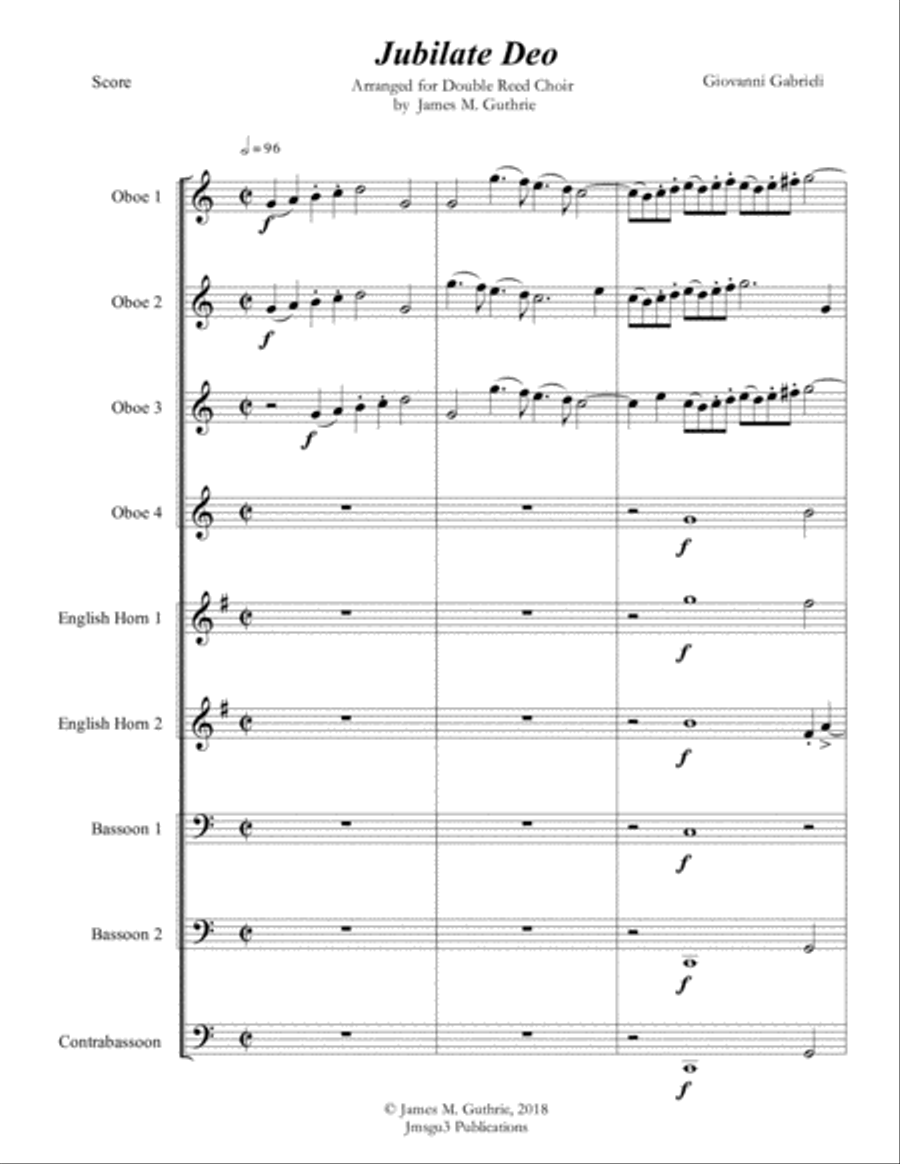
Gabrieli: Jubilate Deo Ch. 136 for Double Reed Choir

$47.95 41.44 € PDF SheetMusicPlus

Violin Solo - Level 2 - Digital Download SKU: A0.773262 Composed by Yoel Epstein. Contemporary,Instructional. 5 pages. Yoel Epstein #57119. Published by Yoel Epstein (A0.773262). When I studied violin, it was strictly a solitary experience. I played by myself, or with my teacher accompanying me; everything I learned – sonatas, concertos, concert pieces – were for solo violin. True, I played in an orchestra, and when I was in high school found my way into a beginning string quartet, but all of my experience with violin pedagogy was solitaire. When I started teaching, I adopted a completely different approach. I believe that music is a social, not a solitary activity. So the first piece my students learn is a duet. And everything thereafter involves playing and learning in groups. These two games are part of a larger work presenting my approach to teaching. It is a work in progress, and I hope to be adding organically to it as my experience grows. If you want to see other teaching materials I have developed, you can find them on this site, by clicking here. If you send me an email at yoelepst@gmail.com, I will keep you informed of new things that I publish. I also have a lot of arrangements for string quartets of American and Israeli folksongs, which you can find on the site.
The composer game: Two games for teaching early violin
Violon

$9.99 8.63 € Violon PDF SheetMusicPlus

Piano,Vocal,Voice - Level 1 - Digital Download SKU: A0.1298966 Composed by Ian Calvert. Christmas,Contemporary,Holiday,Praise & Worship,Religious. Score. 4 pages. Ian Calvert #888816. Published by Ian Calvert (A0.1298966). This is the first publication of a new Christmas song, set for voice and piano. The words are those of a poem by Leonard Clark (1905 – 1981). He was an English poet who was raised in The Forest of Dean, in the west of England. In 1972 he published a slim little book of Christmas poems, of which ‘The Birth’ is one. What I like about this poem is its simplicity and clarity – and its narrative development through the verses. It starts with the poet waking in the pre-dawn. He then realizes that it is Christmas Day and in the stillness of that time his mind turns to the birth of Jesus, as traditionally told. Then he steps out of time and space and looks through his bedroom window to contemplate the mystery of incarnation. And he finishes at the stable, offering devotion to the newborn Lord. This song is also available in a version for SATB a cappella. Drawn from the same book of poems there is available another new Christmas song, called Singing in the Streets; that one is set for baritone and piano. Ian Calvert.
The Birth
Piano, Voix

$2.99 2.58 € Piano, Voix PDF SheetMusicPlus

Easy Piano - Level 1 - Digital Download SKU: A0.1510580 Composed by Andre Previn. Arranged by L. Müller. Children,Contemporary,Film/TV,Pop,Video Game. Score. 4 pages. Müller Publishing company #1085780. Published by Müller Publishing company (A0.1510580). The Legend of Zelda Opening Theme - Sheet Music for Beginner Pianists with Noteheads Awaken the hero within you with the sheet music for The Legend of Zelda Opening Theme. This version is designed with noteheads for both the left and right hands, ensuring clarity and ease for those who are just beginning their piano journey. Delve into the magic of one of the most beloved games of all time with a layout tailored to budding pianists.With simplified notes and an accessible arrangement, beginner pianists can truly immerse themselves in the iconic melody of The Legend of Zelda. Feel the thrill of Link's epic journey beneath your fingertips as you navigate the clear and readable noteheads on the sheet music.Beyond serving as a perfect entry point for novice pianists, this sheet music allows you to tap into the vast community of Zelda enthusiasts. Envision playing the renowned theme for loved ones, evoking shared memories and a love for this legendary game.Seize the chance to own this unique The Legend of Zelda Opening Theme sheet music, specially curated for beginner pianists. Take on the challenge of mastering a tune that has resonated with gamers for decades and embark on a memorable musical adventure. Let the timeless Zelda melody guide your hands and ignite your inner musical hero!
Zelda's Theme
Piano Facile

$4.99 4.31 € Piano Facile PDF SheetMusicPlus

Piano and voice (TTTB chorus) - Digital Download SKU: LV.11678 Composed by Chantal Auber. Arranged by Geo. Kingsley. Beaches, Cliffs, Rowboats, Native dress, Baskets, Fishermen, Castles & palaces. Lester S. Levy Collection. 7 pages. Published by Johns Hopkins University Sheridan Libraries (LV.11678). Away, Away. The Morning of Freshly Breaking. Chorus from Massaniello. Music by Auber. Arranged for his Pupils by Geo. Kingsley. Published 1834 by Chas. Bradlee, 107 Washgn. St. in Boston. Composition of sectional with piano and voice (tttb chorus) instrumentation. Subject headings for this piece include Beaches, Cliffs, Rowboats, Native dress, Baskets, Fishermen, Castles & palaces. First line reads Away, away, the morning freshly breaking, shines o'er the deep.. About The Lester S. Levy CollectionThe Lester S. Levy Collection of Sheet Music consists of over 29,000 pieces of American popular music. Donated to Johns Hopkins University Sheridan Libraries, the collection's strength is its thorough documentation of nineteenth-century American through popular music. This sheet music has been provided by Project Gado, a San Francisco Bay Area startup whose mission is to digitize and share the world's visual history.WARNING: These titles are provided as historical documents. Language and concepts within reflect the opinions and values of the time and may be offensive to some.
Away, Away. The Morning of Freshly Breaking

$5.99 5.18 € PDF SheetMusicPlus


Partitions Gratuites
Acheter des Partitions Musicales
Acheter des Partitions Digitales à Imprimer
Acheter des Instruments de Musique

© 2000 - 2026

Accueil - Version intégrale





