EUROPE
398 articles
USA
946 articles
DIGITAL
7363 articles (à imprimer)
Partitions Digitales
Partitions à imprimer
7363 partitions trouvées

1 ....31 46 61 76 91 ....7351

Viola Duet Viola - Level 2 - Digital Download SKU: A0.1189325 Composed by Ludwig van Beethoven. Arranged by Ander. Classical,Folk,March,Opera,Romantic Period. Score. 6 pages. Woods Only, Arrangements #788957. Published by Woods Only, Arrangements (A0.1189325). This arrangement adapted for viola duo was written keeping the characteristics of the original work, in order to be performed by young music students who want to enter the symphonic music. Besides, it can also be used by professional musicians for recitals, repertoire, academic presentations and didactic material. The transcription remains faithful to the structure, with only one change in tone, so that it is comfortable for all the instruments in the formation, as well as being used as an activity in ensemble practice among musicians of different traditions.Beethoven's Turkish March (Op. 113) is the 4th movement of the operatic work: The Ruins of Athens, a set of incidental pieces written in 1812 by Ludwig van Beethoven, where the melody was originally written in 1809 as Theme with Six Variations for Piano, Op. 76. The work was written to accompany the play of the same name by August von Kotzebue, for the dedication of a new theater in Pest. Perhaps the best known part of the composition is the Marcia alla turca, In Latin America, this movement became known in Jean-Jacques Perrey's version (who titled it The Elephant never Forgets) since it was used as the opening theme of the successful Mexican TV comedy El Chavo del Ocho. The opening and the turkish march are often performed separately, and the other pieces in this set are not often heard.
Turkish March by Beethoven for Viola Duet
2 Altos (duo)

$3.99 3.37 € 2 Altos (duo) PDF SheetMusicPlus

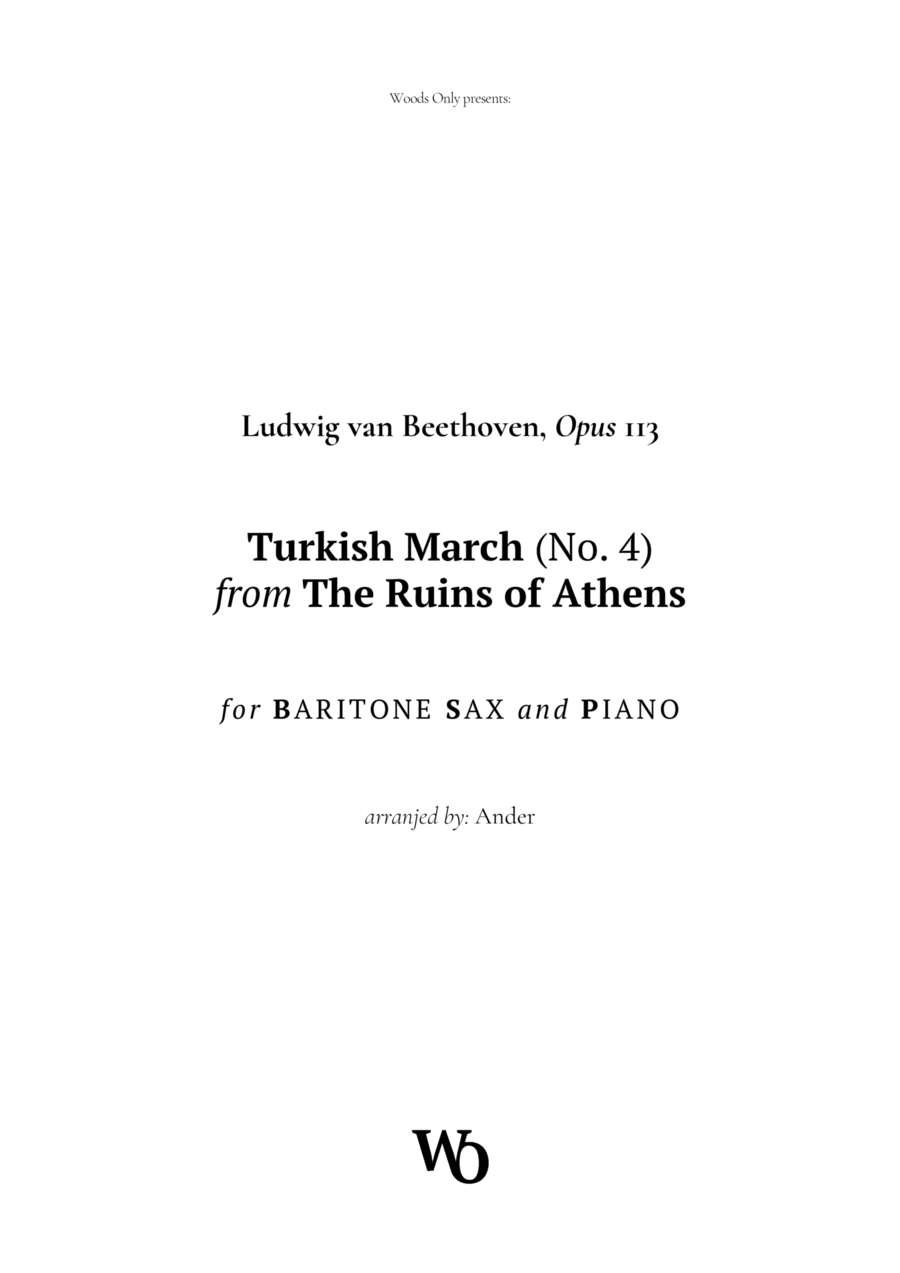
Baritone Saxophone,Piano - Level 2 - Digital Download SKU: A0.1155648 Composed by Ludwig van Beethoven. Arranged by Ander. Classical,Folk,March,Opera,Romantic Period. Score and part. 4 pages. Woods Only, Arrangements #755952. Published by Woods Only, Arrangements (A0.1155648). This arrangement adapted for baritone saxophone and piano was written keeping the characteristics of the original work, in order to be performed by young music students who want to enter the symphonic music. Besides, it can also be used by professional musicians for recitals, repertoire, academic presentations and didactic material. The transcription remains faithful to the structure, with only one change in tone, so that it is comfortable for all the instruments in the formation, as well as being used as an activity in ensemble practice among musicians of different traditions. Beethoven's Turkish March (Op. 113) is the 4th movement of the operatic work: The Ruins of Athens, a set of incidental pieces written in 1812 by Ludwig van Beethoven, where the melody was originally written in 1809 as Theme with Six Variations for Piano, Op. 76. The work was written to accompany the play of the same name by August von Kotzebue, for the dedication of a new theater in Pest. Perhaps the best known part of the composition is the Marcia alla turca, In Latin America, this movement became known in Jean-Jacques Perrey's version (who titled it The Elephant never Forgets) since it was used as the opening theme of the successful Mexican TV comedy El Chavo del Ocho. The opening and the turkish march are often performed separately, and the other pieces in this set are not often heard.
Turkish March by Beethoven for Baritone Sax
Saxophone Baryton, Piano

$1.99 1.68 € Saxophone Baryton, Piano PDF SheetMusicPlus

Saxophone Quartet,Woodwind Ensemble Alto Saxophone - Level 2 - Digital Download SKU: A0.1143530 Composed by Ludwig van Beethoven. Arranged by Ander. Classical,Folk,March,Opera,Romantic Period. 10 pages. Woods Only, Arrangements #743846. Published by Woods Only, Arrangements (A0.1143530). This arrangement adapted for alto sax quartet was written keeping the characteristics of the original work, in order to be performed by young music students who want to enter the symphonic music. Besides, it can also be used by professional musicians for recitals, repertoire, academic presentations and didactic material. The transcription remains faithful to the structure, with only one change in tone, so that it is comfortable for all the instruments in the formation, as well as being used as an activity in ensemble practice among musicians of different traditions. Beethoven's Turkish March (Op. 113) is the 4th movement of the operatic work: The Ruins of Athens, a set of incidental pieces written in 1812 by Ludwig van Beethoven, where the melody was originally written in 1809 as Theme with Six Variations for Piano, Op. 76. The work was written to accompany the play of the same name by August von Kotzebue, for the dedication of a new theater in Pest. Perhaps the best known part of the composition is the Marcia alla turca, In Latin America, this movement became known in Jean-Jacques Perrey's version (who titled it The Elephant never Forgets) since it was used as the opening theme of the successful Mexican TV comedy El Chavo del Ocho. The opening and the turkish march are often performed separately, and the other pieces in this set are not often heard.

Turkish March by Beethoven for Alto Sax Quartet
Quatuor de Saxophones: 4 saxophones

$7.99 6.75 € Quatuor de Saxophones: 4 saxophones PDF SheetMusicPlus

Woodwind Ensemble,Woodwind Quintet Flute - Level 3 - Digital Download SKU: A0.1128136 Composed by Ludwig van Beethoven. Arranged by Ander. Classical,Folk,March,Opera,Romantic Period. 12 pages. Woods Only, Arrangements #728751. Published by Woods Only, Arrangements (A0.1128136). This arrangement adapted for flute quintet was written keeping the characteristics of the original work, in order to be performed by young music students who want to enter the symphonic music. Besides, it can also be used by professional musicians for recitals, repertoire, academic presentations and didactic material. The transcription remains faithful to the structure, with only one change in tone, so that it is comfortable for all the instruments in the formation, as well as being used as an activity in ensemble practice among musicians of different traditions. Beethoven's Turkish March (Op. 113) is the 4th movement of the operatic work: The Ruins of Athens, a set of incidental pieces written in 1812 by Ludwig van Beethoven, where the melody was originally written in 1809 as Theme with Six Variations for Piano, Op. 76. The work was written to accompany the play of the same name by August von Kotzebue, for the dedication of a new theater in Pest. Perhaps the best known part of the composition is the Marcia alla turca, In Latin America, this movement became known in Jean-Jacques Perrey's version (who titled it The Elephant never Forgets) since it was used as the opening theme of the successful Mexican TV comedy El Chavo del Ocho. The opening and the turkish march are often performed separately, and the other pieces in this set are not often heard.

Turkish March by Beethoven for Flute Quintet
Quintette de Flûte : 5 flûtes

$9.99 8.43 € Quintette de Flûte : 5 flûtes PDF SheetMusicPlus

Brass Quintet - Level 3 - Digital Download SKU: A0.1243611 Composed by Ludwig van Beethoven. Arranged by Ander. Classical,Folk,March,Opera,Romantic Period. 11 pages. Woods Only, Arrangements #838578. Published by Woods Only, Arrangements (A0.1243611). This arrangement adapted for brass quintet was written keeping the characteristics of the original work, in order to be performed by young music students who want to enter the symphonic music. Besides, it can also be used by professional musicians for recitals, repertoire, academic presentations and didactic material. The transcription remains faithful to the structure, with only one change in tone, so that it is comfortable for all the instruments in the formation, as well as being used as an activity in ensemble practice among musicians of different traditions.Beethoven's Turkish March (Op. 113) is the 4th movement of the operatic work: The Ruins of Athens, a set of incidental pieces written in 1812 by Ludwig van Beethoven, where the melody was originally written in 1809 as Theme with Six Variations for Piano, Op. 76. The work was written to accompany the play of the same name by August von Kotzebue, for the dedication of a new theater in Pest. Perhaps the best known part of the composition is the Marcia alla turca, In Latin America, this movement became known in Jean-Jacques Perrey's version (who titled it The Elephant never Forgets) since it was used as the opening theme of the successful Mexican TV comedy El Chavo del Ocho. The opening and the turkish march are often performed separately, and the other pieces in this set are not often heard.

Turkish March by Beethoven for Brass Quintet
Quintette de Cuivres: 2 trompettes, Cor, trombone, tuba

$9.99 8.43 € Quintette de Cuivres: 2 trompettes, Cor, trombone, tuba PDF SheetMusicPlus

Alto Saxophone,Piano - Level 2 - Digital Download SKU: A0.1155646 Composed by Ludwig van Beethoven. Arranged by Ander. Classical,Folk,March,Opera,Romantic Period. Score and part. 4 pages. Woods Only, Arrangements #755950. Published by Woods Only, Arrangements (A0.1155646). This arrangement adapted for alto saxophone and piano was written keeping the characteristics of the original work, in order to be performed by young music students who want to enter the symphonic music. Besides, it can also be used by professional musicians for recitals, repertoire, academic presentations and didactic material. The transcription remains faithful to the structure, with only one change in tone, so that it is comfortable for all the instruments in the formation, as well as being used as an activity in ensemble practice among musicians of different traditions. Beethoven's Turkish March (Op. 113) is the 4th movement of the operatic work: The Ruins of Athens, a set of incidental pieces written in 1812 by Ludwig van Beethoven, where the melody was originally written in 1809 as Theme with Six Variations for Piano, Op. 76. The work was written to accompany the play of the same name by August von Kotzebue, for the dedication of a new theater in Pest. Perhaps the best known part of the composition is the Marcia alla turca, In Latin America, this movement became known in Jean-Jacques Perrey's version (who titled it The Elephant never Forgets) since it was used as the opening theme of the successful Mexican TV comedy El Chavo del Ocho. The opening and the turkish march are often performed separately, and the other pieces in this set are not often heard.

Turkish March by Beethoven for Alto Sax
Saxophone Alto et Piano

$1.99 1.68 € Saxophone Alto et Piano PDF SheetMusicPlus

Saxophone Trio,Woodwind Ensemble - Level 2 - Digital Download SKU: A0.1146913 Composed by Ludwig van Beethoven. Arranged by Ander. Classical,Folk,March,Opera,Romantic Period. 8 pages. Woods Only, Arrangements #747111. Published by Woods Only, Arrangements (A0.1146913). This arrangement adapted for sax trio was written keeping the characteristics of the original work, in order to be performed by young music students who want to enter the symphonic music. Besides, it can also be used by professional musicians for recitals, repertoire, academic presentations and didactic material. The transcription remains faithful to the structure, with only one change in tone, so that it is comfortable for all the instruments in the formation, as well as being used as an activity in ensemble practice among musicians of different traditions. Beethoven's Turkish March (Op. 113) is the 4th movement of the operatic work: The Ruins of Athens, a set of incidental pieces written in 1812 by Ludwig van Beethoven, where the melody was originally written in 1809 as Theme with Six Variations for Piano, Op. 76. The work was written to accompany the play of the same name by August von Kotzebue, for the dedication of a new theater in Pest. Perhaps the best known part of the composition is the Marcia alla turca, In Latin America, this movement became known in Jean-Jacques Perrey's version (who titled it The Elephant never Forgets) since it was used as the opening theme of the successful Mexican TV comedy El Chavo del Ocho. The opening and the turkish march are often performed separately, and the other pieces in this set are not often heard.

Turkish March by Beethoven for Saxophone Trio
3 Saxophones (trio)

$5.99 5.06 € 3 Saxophones (trio) PDF SheetMusicPlus

String Trio Cello - Level 2 - Digital Download SKU: A0.1184412 Composed by Ludwig van Beethoven. Arranged by Ander. Classical,Folk,March,Opera,Romantic Period. 8 pages. Woods Only, Arrangements #784140. Published by Woods Only, Arrangements (A0.1184412). This arrangement adapted for violoncello trio was written keeping the characteristics of the original work, in order to be performed by young music students who want to enter the symphonic music. Besides, it can also be used by professional musicians for recitals, repertoire, academic presentations and didactic material. The transcription remains faithful to the structure, with only one change in tone, so that it is comfortable for all the instruments in the formation, as well as being used as an activity in ensemble practice among musicians of different traditions.Beethoven's Turkish March (Op. 113) is the 4th movement of the operatic work: The Ruins of Athens, a set of incidental pieces written in 1812 by Ludwig van Beethoven, where the melody was originally written in 1809 as Theme with Six Variations for Piano, Op. 76. The work was written to accompany the play of the same name by August von Kotzebue, for the dedication of a new theater in Pest. Perhaps the best known part of the composition is the Marcia alla turca, In Latin America, this movement became known in Jean-Jacques Perrey's version (who titled it The Elephant never Forgets) since it was used as the opening theme of the successful Mexican TV comedy El Chavo del Ocho. The opening and the turkish march are often performed separately, and the other pieces in this set are not often heard.

Turkish March by Beethoven for Cello Trio
Trio à Cordes: 3 violoncelles

$5.99 5.06 € Trio à Cordes: 3 violoncelles PDF SheetMusicPlus

String Quintet Cello - Level 2 - Digital Download SKU: A0.1164266 Composed by Ludwig van Beethoven. Arranged by Ander. Classical,Folk,March,Opera,Romantic Period. 12 pages. Woods Only, Arrangements #764613. Published by Woods Only, Arrangements (A0.1164266). This arrangement adapted for violoncello quintet was written keeping the characteristics of the original work, in order to be performed by young music students who want to enter the symphonic music. Besides, it can also be used by professional musicians for recitals, repertoire, academic presentations and didactic material. The transcription remains faithful to the structure, with only one change in tone, so that it is comfortable for all the instruments in the formation, as well as being used as an activity in ensemble practice among musicians of different traditions.Beethoven's Turkish March (Op. 113) is the 4th movement of the operatic work: The Ruins of Athens, a set of incidental pieces written in 1812 by Ludwig van Beethoven, where the melody was originally written in 1809 as Theme with Six Variations for Piano, Op. 76. The work was written to accompany the play of the same name by August von Kotzebue, for the dedication of a new theater in Pest. Perhaps the best known part of the composition is the Marcia alla turca, In Latin America, this movement became known in Jean-Jacques Perrey's version (who titled it The Elephant never Forgets) since it was used as the opening theme of the successful Mexican TV comedy El Chavo del Ocho. The opening and the turkish march are often performed separately, and the other pieces in this set are not often heard.
Turkish March by Beethoven for Cello Quintet

$9.99 8.43 € PDF SheetMusicPlus

Piano,Tenor Saxophone - Level 2 - Digital Download SKU: A0.1155647 Composed by Ludwig van Beethoven. Arranged by Ander. Classical,Folk,March,Opera,Romantic Period. Score and part. 4 pages. Woods Only, Arrangements #755951. Published by Woods Only, Arrangements (A0.1155647). This arrangement adapted for tenor saxophone and piano was written keeping the characteristics of the original work, in order to be performed by young music students who want to enter the symphonic music. Besides, it can also be used by professional musicians for recitals, repertoire, academic presentations and didactic material. The transcription remains faithful to the structure, with only one change in tone, so that it is comfortable for all the instruments in the formation, as well as being used as an activity in ensemble practice among musicians of different traditions. Beethoven's Turkish March (Op. 113) is the 4th movement of the operatic work: The Ruins of Athens, a set of incidental pieces written in 1812 by Ludwig van Beethoven, where the melody was originally written in 1809 as Theme with Six Variations for Piano, Op. 76. The work was written to accompany the play of the same name by August von Kotzebue, for the dedication of a new theater in Pest. Perhaps the best known part of the composition is the Marcia alla turca, In Latin America, this movement became known in Jean-Jacques Perrey's version (who titled it The Elephant never Forgets) since it was used as the opening theme of the successful Mexican TV comedy El Chavo del Ocho. The opening and the turkish march are often performed separately, and the other pieces in this set are not often heard.
Turkish March by Beethoven for Tenor Sax
Saxophone Tenor et Piano

$1.99 1.68 € Saxophone Tenor et Piano PDF SheetMusicPlus

Cello,Piano - Level 2 - Digital Download SKU: A0.1239670 Composed by Ludwig van Beethoven. Arranged by Ander. Classical,Folk,March,Opera,Romantic Period. Score and part. 3 pages. Woods Only, Arrangements #835061. Published by Woods Only, Arrangements (A0.1239670). This arrangement adapted for violoncello and piano was written keeping the characteristics of the original work, in order to be performed by young music students who want to enter the symphonic music. Besides, it can also be used by professional musicians for recitals, repertoire, academic presentations and didactic material. The transcription remains faithful to the structure, with only one change in tone, so that it is comfortable for all the instruments in the formation, as well as being used as an activity in ensemble practice among musicians of different traditions.Beethoven's Turkish March (Op. 113) is the 4th movement of the operatic work: The Ruins of Athens, a set of incidental pieces written in 1812 by Ludwig van Beethoven, where the melody was originally written in 1809 as Theme with Six Variations for Piano, Op. 76. The work was written to accompany the play of the same name by August von Kotzebue, for the dedication of a new theater in Pest. Perhaps the best known part of the composition is the Marcia alla turca, In Latin America, this movement became known in Jean-Jacques Perrey's version (who titled it The Elephant never Forgets) since it was used as the opening theme of the successful Mexican TV comedy El Chavo del Ocho. The opening and the turkish march are often performed separately, and the other pieces in this set are not often heard.
Turkish March by Beethoven for Cello and Piano
Violoncelle, Piano

$1.99 1.68 € Violoncelle, Piano PDF SheetMusicPlus

Baritone Saxophone,Tenor Saxophone - Level 2 - Digital Download SKU: A0.1150448 Composed by Ludwig van Beethoven. Arranged by Ander. Classical,Folk,March,Opera,Romantic Period. Saxophone Duet. 6 pages. Woods Only, Arrangements #750623. Published by Woods Only, Arrangements (A0.1150448). This arrangement adapted for low sax duo was written keeping the characteristics of the original work, in order to be performed by young music students who want to enter the symphonic music. Besides, it can also be used by professional musicians for recitals, repertoire, academic presentations and didactic material. The transcription remains faithful to the structure, with only one change in tone, so that it is comfortable for all the instruments in the formation, as well as being used as an activity in ensemble practice among musicians of different traditions. Beethoven's Turkish March (Op. 113) is the 4th movement of the operatic work: The Ruins of Athens, a set of incidental pieces written in 1812 by Ludwig van Beethoven, where the melody was originally written in 1809 as Theme with Six Variations for Piano, Op. 76. The work was written to accompany the play of the same name by August von Kotzebue, for the dedication of a new theater in Pest. Perhaps the best known part of the composition is the Marcia alla turca, In Latin America, this movement became known in Jean-Jacques Perrey's version (who titled it The Elephant never Forgets) since it was used as the opening theme of the successful Mexican TV comedy El Chavo del Ocho. The opening and the turkish march are often performed separately, and the other pieces in this set are not often heard.
Turkish March by Beethoven for Low Saxophone Duet
2 Saxophones (duo)

$3.99 3.37 € 2 Saxophones (duo) PDF SheetMusicPlus

Trombone Quintet - Level 3 - Digital Download SKU: A0.1243616 Composed by Ludwig van Beethoven. Arranged by Ander. Classical,Folk,March,Opera,Romantic Period. 11 pages. Woods Only, Arrangements #838584. Published by Woods Only, Arrangements (A0.1243616). This arrangement adapted for trombone quintet was written keeping the characteristics of the original work, in order to be performed by young music students who want to enter the symphonic music. Besides, it can also be used by professional musicians for recitals, repertoire, academic presentations and didactic material. The transcription remains faithful to the structure, with only one change in tone, so that it is comfortable for all the instruments in the formation, as well as being used as an activity in ensemble practice among musicians of different traditions.Beethoven's Turkish March (Op. 113) is the 4th movement of the operatic work: The Ruins of Athens, a set of incidental pieces written in 1812 by Ludwig van Beethoven, where the melody was originally written in 1809 as Theme with Six Variations for Piano, Op. 76. The work was written to accompany the play of the same name by August von Kotzebue, for the dedication of a new theater in Pest. Perhaps the best known part of the composition is the Marcia alla turca, In Latin America, this movement became known in Jean-Jacques Perrey's version (who titled it The Elephant never Forgets) since it was used as the opening theme of the successful Mexican TV comedy El Chavo del Ocho. The opening and the turkish march are often performed separately, and the other pieces in this set are not often heard.
Turkish March by Beethoven for Trombone Quintet

$9.99 8.43 € PDF SheetMusicPlus

String Quartet String Quartet,Violin - Level 2 - Digital Download SKU: A0.1172125 Composed by Ludwig van Beethoven. Arranged by Ander. Classical,Folk,March,Opera,Romantic Period. 10 pages. Woods Only, Arrangements #772390. Published by Woods Only, Arrangements (A0.1172125). This arrangement adapted for violin quartet was written keeping the characteristics of the original work, in order to be performed by young music students who want to enter the symphonic music. Besides, it can also be used by professional musicians for recitals, repertoire, academic presentations and didactic material. The transcription remains faithful to the structure, with only one change in tone, so that it is comfortable for all the instruments in the formation, as well as being used as an activity in ensemble practice among musicians of different traditions.Beethoven's Turkish March (Op. 113) is the 4th movement of the operatic work: The Ruins of Athens, a set of incidental pieces written in 1812 by Ludwig van Beethoven, where the melody was originally written in 1809 as Theme with Six Variations for Piano, Op. 76. The work was written to accompany the play of the same name by August von Kotzebue, for the dedication of a new theater in Pest. Perhaps the best known part of the composition is the Marcia alla turca, In Latin America, this movement became known in Jean-Jacques Perrey's version (who titled it The Elephant never Forgets) since it was used as the opening theme of the successful Mexican TV comedy El Chavo del Ocho. The opening and the turkish march are often performed separately, and the other pieces in this set are not often heard.
Turkish March by Beethoven for Violin Quartet
Quatuor à cordes: 4 violons

$7.99 6.75 € Quatuor à cordes: 4 violons PDF SheetMusicPlus

Woodwind Ensemble,Woodwind Quintet - Level 2 - Digital Download SKU: A0.1126471 Composed by Ludwig van Beethoven. Arranged by Ander. Classical,Folk,March,Opera,Romantic Period. 12 pages. Woods Only, Arrangements #727146. Published by Woods Only, Arrangements (A0.1126471). This arrangement adapted for woodwind quintet was written keeping the characteristics of the original work, in order to be performed by young music students who want to enter the symphonic music. Besides, it can also be used by professional musicians for recitals, repertoire, academic presentations and didactic material. The transcription remains faithful to the structure, with only one change in tone, so that it is comfortable for all the instruments in the formation, as well as being used as an activity in ensemble practice among musicians of different traditions. Beethoven's Turkish March (Op. 113) is the 4th movement of the operatic work: The Ruins of Athens, a set of incidental pieces written in 1812 by Ludwig van Beethoven, where the melody was originally written in 1809 as Theme with Six Variations for Piano, Op. 76. The work was written to accompany the play of the same name by August von Kotzebue, for the dedication of a new theater in Pest. Perhaps the best known part of the composition is the Marcia alla turca, In Latin America, this movement became known in Jean-Jacques Perrey's version (who titled it The Elephant never Forgets) since it was used as the opening theme of the successful Mexican TV comedy El Chavo del Ocho. The opening and the turkish march are often performed separately, and the other pieces in this set are not often heard.
Turkish March by Beethoven for Woodwind Quintet
Quintette à Vent: flûte, Hautbois, basson, clarinette, Cor

$9.99 8.43 € Quintette à Vent: flûte, Hautbois, basson, clarinette, Cor PDF SheetMusicPlus


1 ....31 46 61 76 91 ....7351


Partitions Gratuites
Acheter des Partitions Musicales
Acheter des Partitions Digitales à Imprimer
Acheter des Instruments de Musique

© 2000 - 2026

Accueil - Version intégrale