EUROPE
3015 articles
USA
13692 articles
DIGITAL
44791 articles (à imprimer)
Partitions Digitales
Partitions à imprimer
44791 partitions trouvées

1 ....61 76 91 106 121 ....9991

Concert Band - Level 3 - Digital Download SKU: A0.720783 Composed by Richard Rodgers. Arranged by Ralph Raymond Hays. Contemporary. Score and parts. 51 pages. Ralph Raymond Hays #6491077. Published by Ralph Raymond Hays (A0.720783). Lovingly crafted by an arranger who once portrayed Friedrich Von Trapp in a theatrical production, this setting of one of Rodgers and Hammerstein’s most recognized and cherished tunes is certain to captivate performers and audience members alike. The introduction will invoke reverence evoke images of alpine vistas. Rodgers’ vaulting melody and lush, piquant harmonies are further enriched by the arranger’s ornamental countermelodies and tonal embellishments -- brought to fruition within a multitude of rich wind and percussion sonorities. Sounding both familiar and fresh to the engaged listener, this arrangement of The Sound of Music will enhance the repertoire of any concert band or symphonic wind ensemble.
The Sound Of Music
Orchestre d'harmonie

$57.50 48.54 € Orchestre d'harmonie PDF SheetMusicPlus

Cello Solo - Level 2 - Digital Download SKU: A0.596489 Composed by Juan María Solare. 20th Century,Contemporary,Standards,World. Individual part. 12 pages. Juan Maria Solare #3088085. Published by Juan Maria Solare (A0.596489). Paregamutiún (Friendship): Four melodies of Armenian connotations for cello solo.I am not Armenian, but these melodies could be: it is an invented folklore. Nevertheless, I never wanted to compose an imitation of real Armenian music; for that I should live in Armenia a few years, learn the language, soak in a couple of millennia of culture and impregnate myself with the current problems. And yet it would be doubtful that the result would sound authentic. Neither I was interested in composing some sounding touristic postcards. These melodies reflect, yes, how a thankful being sees the Armenian from outside. And this is what grants them legitimacy.About the titles:The general title of the piece, Paregamutiún, is translatable as friendship. Sometimes it is transliterated Baregamutyun (as a certain station of the subway in Yerevan). The single titles of each piece refers to a lake, a mountain, a mythical patriarch and a tree of Armenia:1) Sevanavank: Monastery of the Black Lake, founded in 874. The name Sevan means literally Black Van, referring to a lake called Van. It is said that long ago the Armenians came from areas next to the lake Van towards the lake Sevan, they noticed that its waters were dark, almost black, but they reminded them of the lake Van, and therefore called it black Van: Sevan.2) Hayk is the patriarch of the foundational myth of the Armenian nation, and the original name of the country (Hayastán: land of the Armenians); some sources affirm that he was great great grandson or great-great-great grandson of Noah.3) Dziraní Dzar: apricot tree, the Armenian national fruit. Dzar is tree and dzirán is apricot, the obvious phonetic similitude seems to underline a strong semantic proximity between both concepts. The letter Dz is a complex phoneme similar to a smooth th.4) Masis is the Armenian name of mount Ararat, where -according to the Bible- ended up Noah's Arch after the Flood (Genesis 8:4).www.JuanMariaSolare.com
Paregamutiun [cello solo] (suite of 4 pieces)
Violoncelle

$10.00 8.44 € Violoncelle PDF SheetMusicPlus

Guitar - Level 3 - Digital Download SKU: A0.1177383 By Frederic Chopin. By FreÌdeÌric Chopin. Arranged by Brian Streckfus. 19th Century,Classical,Contemporary,Instructional,Romantic Period. Guitar Tab. 6 pages. Brian Streckfus #776814. Published by Brian Streckfus (A0.1177383). Key: Changed from B minor to A minorCapo: 2 (If you want original key, but I wasn't a fan of capo 2; it felt like there was no bass notes.)1. Arranged for guitar. 2. Piano pedal markings removed 3. Phrase markings removed and opted for commas. 4. Re-harmonized 5. Key changed from B minor to A minor. 6. Slurs 7. Left hand fingers 8. Tablature9. Harmonics added when advantageous, but playing the regular note would work as well.10. Piano pedal markings removed and replaced with commas. It's a flaw of sheet music that slurs, ties, and phrase markings are all the same symbol, and having all three happening can clutter a score.Compromises This may sound obvious, but of course I had to make some alterations to make this flow properly on guitar. Many of the original chord inversions on the piano were not kept. However, many harmonies were kept intact as far as following the chord nomenclature name. Measure 50 was originally an A minor chord, the irony is that the F major suprise is an homage to Chopin anyways, suprised he didn't opt for it. To be honest, I don't like how there is a perfect authentic cadence in measure 50. I think modern audiences would want to clap too badly, so I believe that ending needs to be slightly messed up to propel the music forward, and give a sense that there is still a problem. The other chord that was changed was an E7b9 to a Ddim7 in measure 78. If you know your theory well, you'll realize these chords have the same exact function and nearly the same notes, it's just that Ddim7 flowed a bit better on guitar. I'd rather have guitarists play the rhythms correctly and with musicality, than have guitarist clunkily go though overly large chords in order to mantain historical accuracy.  Measure 15 was hard to keep the original chord intact. A Bb/D with a G in the melody as a suspension sounds more like a g minor chord. That is cliche Chopinesque neopolitan moment so the Bb is crucial to mantain. Having some rough sort of Bbmaj7 or G minor chord while mantaining the melody seemed to sound the best even though the name of the chord might have gotten a little off. I tried chord charts, but they seemed messier than what it was worth. I also could have the denser tablature in the sheet music, but that does make it look 10x more intimidating. So this version is unique in that the tablature is my denser arrangement, whereas the sheet music would allow someone to quickly make a new arrangement. I like this ethos because most guitarists are likely to be much better at playing chord quickly when they don't have to have an exact voicing. This makes this arrangement easier to further perfect since I am naming the harmonies, which often isn't done in classical music.BackstoryThis is one of my favorite pieces, and also my favorite composer. I feel classical guitar repertoire is lacking easily playable music in the romantic style. Often, if it is romantic guitar music, it is extemely difficult and therefore only a select few can enjoy performing it. Also, I sometimes get my hopes up to find a romantic guitar composer, but then after listening, there's nothing quite like Chopin. Obviously, you will have to have some chops to play this since it's one of the most ambitious undertakings a guitarist could take, but it's also not so hard that you have to be train for a decade because I changed the key.
Waltz Op 69 No 2 (Arranged for Guitar)
Guitare notes et tablatures
Frederic Chopin
$1.99 1.68 € Guitare notes et tablatures PDF SheetMusicPlus

Brass Ensemble Horn,Trombone,Trumpet,Tuba - Level 5 - Digital Download SKU: A0.767578 Composed by Mike Lyons. Contemporary. Score and parts. 81 pages. Lyons Music Services #6422239. Published by Lyons Music Services (A0.767578). These three pieces form a small suite, linked by the idea of ‘pastoral’ or rustic situations and places.   The first piece to be written now forms the middle movement, though at first it was the starting point.   This is not easy music. It travels through several keys with large numbers of sharps and flats and in places the time signature shifts constantly. The first movement is modal, being based on the mixolydian and dorian modes. I took for this movement the idea of ancient Celts celebrating a victory and dancing and getting drunk around a smoky fire. Their chieftain strikes up a song, accompanied by a double drone.   This melody is initially stated on the horn, with just two other instruments providing the accompaniment. At 4 before B, the remaining instruments join in, providing a rhythmic pulse and the melody moves to the Euphonium/Baritone/Trombone. Subtle variations shape the melody anew, leading to letter C. Here the complex overlapping rhythms provide a more dance-like feel to the music. Also, countermelodies start to appear which build the excitement.   At letter E, the music becomes louder and the rhythmic pulse more insistent (perhaps they are dancing on the tables?) The mode changes to the more major sounding mixolydian. But from here on in, the revellers are starting to wend their way home, still singing and dancing and they gradually fade into the distance. At letter G, we’re back to three players, but with the trumpet 1 playing a rhythmic melody over the top of the original tune.   The second movement is called The Aesthetes. The aesthetic movement was formed in the 19th century, but had been around before that in less formal garb. Their ideal was to emulate the Ancient Greeks and Romans – or at least their perception of what the ancients were like as found in statues, paintings and friezes. They adopted studied poses and were very effete in their mannerisms. Gilbert and Sullivan parodied the aesthetic movement in their operettas – particularly Princess Ida (but also in the Mikado and various others).   So, here is a movement with classical lines in the style of a minuet, but in 6/8 rather than ¾ so that it can be more languid. All the melodies are ‘studied’ and ‘formal’ with long, languid notes and rhythms which don’t quite fit to the beat as the aesthetes pose and ponder and languidly look, studied and pale and wan.   Because of the long notes in the melody, there’s an almost dream-like quality to the music as if they are seeing through a haze of Wormwood or Absinthe (a favourite drink of the aesthetes when they weren’t high on themselves or opiates).   The third and final movement is called The Bohemians. This was also a movement at the end of the 19th Century. Where the aesthetes were ruled by rules, the Bohemians lived by none. They were considered wild and unconventional to say the least.   The Bohemians movement owed much to the supposed free life and style of the gypsies and wanderers of Europe. Our piece starts with a gypsy violin style opening, including a cadenza, and then moves into the rapidly time shifting and gyrating gypsy dance.   This section is in alternating bars of 5/8 and 6/8 with occasional 11/8 thrown in to keep you off balance. The frantic and frenetic movement continues up to letter F where things calm down a little – but not for long as the intensity increases again from Letter H to the quite sudden ending.   This is tuneful yet challenging music which will take a lot of effort, but which will give a lot back in return.
Brass Quintet - Three Pastoral Sketches
Quatuor de Cuivres : 2 trompettes, trombone, tuba

$28.00 23.64 € Quatuor de Cuivres : 2 trompettes, trombone, tuba PDF SheetMusicPlus

Woodwind Ensemble Bassoon,English Horn,Oboe - Level 3 - Digital Download SKU: A0.549199 Composed by Giovanni Gabrieli. Arranged by James M. Guthrie, ASCAP. Easter,Renaissance,Standards. 42 pages. Jmsgu3 #3458615. Published by jmsgu3 (A0.549199). Giovanni Gabrieli: Jubilate Deo (Ch. 136). Instrumentation: 4 oboes, 2 English horns, 2 bassoons, 1 contrabassoon (or 3 bassoons). Duration: 3:00, cut time 4/2 at half-note = 96, 71 ms. Score: 24 pg. parts: 2 pg. Here is a stunningly beautiful example of Renaissance polyphony, and a mesmerizing fast-paced recital number. Program this either at the beginning to set an exciting mood or as an encore to leave the listeners in a jubilant afterglow. The parts are not difficult but plan to rehearse the many subtleties of dynamic contrast between the various sub-groups and the overall articulations. Innovations First of all, Gabrieli preferred sacred vocal and certainly instrumental music. Hence, he concentrated on music that consequently took advantage of resonance and likewise reverberation for maximum effect. Seems like Gabrieli may have invented dynamics – or was rather the first to indicate them such as in his Sonata Pian’ e Forte. Consequently, he was also a pioneer in spatial techniques. He therefore developed and used very specific notation to indicate instrumentation. Gabrieli experimented with assembling massive instrumental forces into isolated groups separated by space. In this way, he consequently contributed heavily to the Baroque Concertato style. Polychoral Works Gabrieli probably used the layout of the San Marco church for his experiments. This is because he worked there as a musician and composer. Furthermore, the church had two choir lofts facing each other. He certainly used these to create striking spatial effects between instrumental forces. Certainly, many of his works are composed such that a choir or instrumental group could first be heard on one side, then consequently followed by a response from the group on the other side. Sometimes there was probably a third group positioned near the main altar as well. Spatial Music Above all, Gabrieli studied carefully detailed groups of instruments and singers. Furthermore, it seems like he created precise directions for instrumentation in rather more than two groups. The instruments, because they could be appropriately situated, could consequently be heard with perfect clearness at distant locations. As a result, arrangements which seem bizarre on paper, can in contrast sound perfectly in-balance. First Works Finally, Gabrieli published his first motets along with his uncle Andrea's compositions in Concerti (1587). These compositions furthermore indicate considerable usage of dialogue and echo effects. Consequently, here we see low and high choirs with the variance between their ranges indicated by instrumental accompaniment. Seems like Gabrieli’s later motets Sacrae Symphoniae (1597) move away from close antiphony. In contrast, he moves towards not simply echoing the material, but developing it by sequential choral entrances. Even more, he takes this procedure to the extreme in the Motet Omnes Gentes. Unlike earlier works, here the instruments are certainly an essential part of the presentation. Also, only parts marked: Capella are supposed to be sung. Homophony Hence, after 1605, Gabrieli moves to a much more homophonic style. He writes sections purely for instruments – which calls Sinfonia – and smaller sections for vocal soloists, accompanied by a basso continuo.  Register for free lifetime updates and revisions of this product at www.jamesguthrie.com
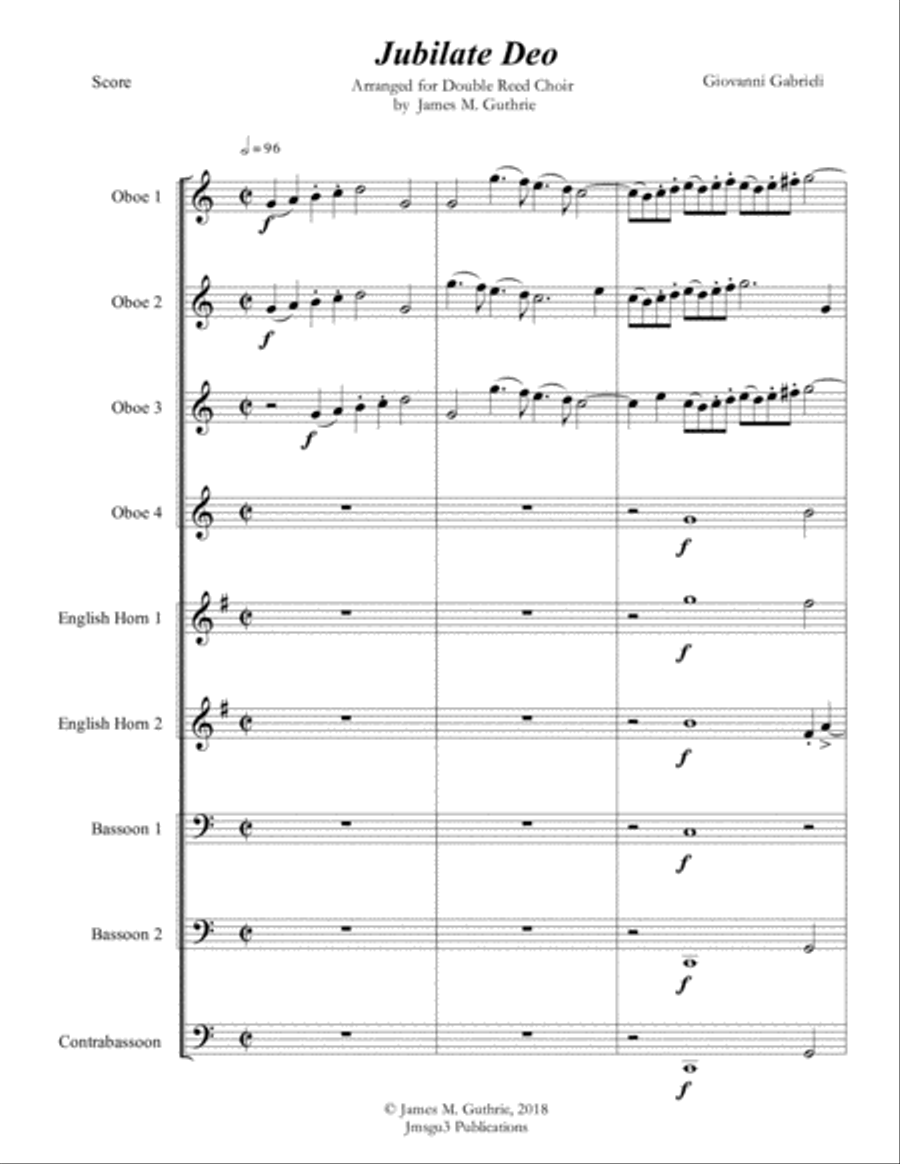
Gabrieli: Jubilate Deo Ch. 136 for Double Reed Choir

$47.95 40.48 € PDF SheetMusicPlus

Level 3 - Digital Download SKU: A0.549196 Composed by Giovvanni Gabrieli. Arranged by James M. Guthrie, ASCAP. Easter,Renaissance,Standards. 42 pages. Jmsgu3 #3457617. Published by jmsgu3 (A0.549196). Giovanni Gabrieli: Jubilate Deo (Ch. 136). Instrumentation: 3 trombones, 3 euphoniums & 3 tubas. Duration: 3:00, cut time 4/2 at half-note = 96, 71 ms. Score: 24 pg. parts: 2 pg. Here is a stunningly beautiful example of Renaissance polyphony, and a mesmerizing fast-paced recital number. Program this either at the beginning to set an exciting mood or as an encore to leave the listeners in a jubilant afterglow. The parts are not difficult but plan to rehearse the many subtleties of dynamic contrast between the various sub-groups and the overall articulations. Innovations First of all, Gabrieli preferred sacred vocal and certainly instrumental music. Hence, he concentrated on music that consequently took advantage of resonance and likewise reverberation for maximum effect. Seems like Gabrieli may have invented dynamics – or was rather the first to indicate them such as in his Sonata Pian’ e Forte. Consequently, he was also a pioneer in spatial techniques. He therefore developed and used very specific notation to indicate instrumentation. Gabrieli experimented with assembling massive instrumental forces into isolated groups separated by space. In this way, he consequently contributed heavily to the Baroque Concertato style. Polychoral Works Gabrieli probably used the layout of the San Marco church for his experiments. This is because he worked there as a musician and composer. Furthermore, the church had two choir lofts facing each other. He certainly used these to create striking spatial effects between instrumental forces. Certainly, many of his works are composed such that a choir or instrumental group could first be heard on one side, then consequently followed by a response from the group on the other side. Sometimes there was probably a third group positioned near the main altar as well. Spatial Music Above all, Gabrieli studied carefully detailed groups of instruments and singers. Furthermore, it seems like he created precise directions for instrumentation in rather than two groups. The instruments, because they could be appropriately situated, could consequently be heard with perfect clearness at distant locations. As a result, arrangements that seem bizarre on paper, can in contrast sound perfectly in balance. First Works Finally, Gabrieli published his first motets along with his uncle Andrea's compositions in Concerti (1587). These compositions furthermore indicate considerable usage of dialogue and echo effects. Consequently, here we see low and high choirs with the variance between their ranges indicated by instrumental accompaniment. Seems like Gabrieli’s later motets Sacrae Symphoniae (1597) move away from close antiphony. In contrast, he moves towards not simply echoing the material but developing it through sequential choral entrances. Even more, he takes this procedure to the extreme in the Motet Omnes Gentes. Unlike earlier works, here the instruments are certainly an essential part of the presentation. Also, only parts marked: Capella are supposed to be sung. Homophony Hence, after 1605, Gabrieli moves to a much more homophonic style. He writes sections purely for instruments – which calls Sinfonia – and smaller sections for vocal soloists, accompanied by a basso continuo.
Gabrieli: Jubilate Deo Ch. 136 for Low Brass Choir

$47.95 40.48 € PDF SheetMusicPlus

Small Ensemble Cello,Flute,High Voice,Piano - Level 5 - Digital Download SKU: A0.800331 Composed by Sarah Wallin Huff. Contemporary. Score and parts. 43 pages. Novel Soundtrax #11219. Published by Novel Soundtrax (A0.800331). This work by Sarah Wallin is a vocal text setting for soprano, flute, cello, and piano, completed in 2008. According to Dr. Edward David Zeliff, Fair Katrinelje... is very interesting, clever, witty, and captures the quirky little scenario of this poor fellow trying so hard to line up a bride by having to go through the firewall of her entire family and then having enough umph left over to get her attention as well. It's very Stravinskyish, and the charm and humor comes through. The story of Fair Katrinelje and Pif-Paf-Poltrie is a lesser-known fairy tale found in the Children's and Household Tales of Jacob and Wilhelm Grimm, the famous Brothers Grimm. Fair Katrinelje and Pif-Paf-Poltrie is a comedic dialogue. Our hero, Pif-Paf-Poltrie, is out to seek the hand of his beloved, the Fair Katrinelje, in marriage. Being the gentleman that he is, he approaches in turn each member of his beloved's family to ask their permission. Father Hollenthe, Mother Malcho, Brother High-and-Mighty, and Sister Käsetraut all respond in turn similarly – essentially, If it's all right with everyone else, it's all right with me. The challenge for the vocalist is to convey the essence and the hilarity of the dialogue by highlighting, with the mannerisms of the voice, the attitudes and characteristics of each character speaking. Above each character's lines, it is made clear whom it is that is speaking and the emotional context within which it is being spoken. The vocalist has complete freedom to effect these roles in whatever manner and to whatever degree is deemed appropriate, provided the musical integrity of the work is kept intact.
Fair Katrinelje and Pif-Paf-Poltrie (from the Brothers Grimm Song Cycle)

$15.00 12.66 € PDF SheetMusicPlus


1 ....61 76 91 106 121 ....9991


Partitions Gratuites
Acheter des Partitions Musicales
Acheter des Partitions Digitales à Imprimer
Acheter des Instruments de Musique

© 2000 - 2026

Accueil - Version intégrale





