EUROPE
3015 articles
USA
0 articles
DIGITAL
44789 articles (à imprimer)
Partitions Digitales
Partitions à imprimer
44789 partitions trouvées


Voice, recorder and percussion - Digital Download SKU: S9.Q53825 Major: Dominant and Subdominant Triads. Arranged by Margaret Murray. This edition: score for voice and/or instruments. Orchestration - Orff Schulwerk - keys. Orff-Schulwerk. Downloadable, Vocal and performing score. Op. 3. Schott Music - Digital #Q53825. Published by Schott Music - Digital (S9.Q53825). English.Carl Orff devoted much of his life to the development of a philosophy of Music for Children, based on his belief that music is the natural outcome of speech, rhythm and movement. His ideas and pioneering work have had a major influence on music and dance education throughout the world and today that work continues under the guidance of leading teachers and educators in many countries. The five basic German volumes of Music for Children by Carl Orff and Gunild Keetman were published between 1950 and 1954. Editions have since been published in Bolivia, Brazil, Canada, Czechoslovakia, Denmark, Estonia, France, Ghana, Great Britain (including a special Welsh edition), Greece, Italy, Japan, Korea, Latin-America, the Netherlands, Portugal, Spain, Sweden, Taiwan and the USA. In 1952 the first edition in translation appeared an English language adaptation by Doreen Hall and Arnold Walter for their Canadian and American students. A few years later, Margaret Murray independently developed a version (1957-1966), essentially to fulfil the needs of United Kingdom teachers. Inevitably the considerable growth of Orff-Schulwerk in the United States led to the publication of the American Edition (1977) to satisfy the requirements of a different educational system and national heritage. Orff-Schulwerk: Music for Children has proved itself to be a stimulating source of material for music teaching. Carl Orff's fundamental educational ideas have revitalized music education in nursery schools, at all levels of primary and secondary education and in special music schools, based on the concepts that: - music, dance and language are inter-related and animated through rhythm. - when children discover, invent, improvise and compose, their experience of music is intensified. These creative activities are complementary to those of interpreting and listening to music. - all who take part are encouraged to contribute, not only vocally but also instrumentally. - the Orff approach to music education is many sided; it is concerned with practical music-making, it provides fundamental experiences and it lays the foundation for a comprehensive musical training. - movement games and activities for body awareness in space, time and flow, lead to movement improvisation and dance forms. - music and dance have been notated in many different ways in history. Various ways of writing down sounds and music, as well as playing from and interpreting different kinds of sources are being explored. Today, countless teachers and institutions are using these ideas. More and more teachers look for ways of involving their students in active music making. In particular, they seek to challenge their pupils' creativity by the use of music, dance and speech - as media of human expression - as a foundation of all education. A prerequisite for work in Orff-Schulwerk is the artistic and pedagogical training of teachers. The Orff Institute was founded in 1961 as a Department of the 'Mozarteum', in Salzburg, Austria. Training offered includes a four-year diploma course, a two-year post-graduate course, and a one-year-course in English. At the opening of the Orff Institute in Salzburg in 1963, Carl Orff ended his speech with a quotation from Schiller: 'I have done my part, now do yours.' That challenge has been taken up by teachers worldwide. Murray Edition English adaption, with additional material, by Margaret Murray. Besed on, and containing all the rhythmic and instrumental material from the main five volumes of the original German edition. Contents of this third volume: The instrumentation and range of keys are inceased. The settings include the chords on the fourth and fifth notes of the major scale.
Music for Children

$21.99 18.89 € PDF SheetMusicPlus

Voice, recorder and percussion - Digital Download SKU: S9.Q47192 Minor: Drone Bass-Triads. Arranged by Margaret Murray. This edition: score for voice and/or instruments. Songs - Orff Schulwerk - pieces. Orff-Schulwerk. Downloadable, Vocal and performing score. Op. 4. Schott Music - Digital #Q47192. Published by Schott Music - Digital (S9.Q47192). English.Carl Orff devoted much of his life to the development of a philosophy of Music for Children, based on his belief that music is the natural outcome of speech, rhythm and movement. His ideas and pioneering work have had a major influence on music and dance education throughout the world and today that work continues under the guidance of leading teachers and educators in many countries. The five basic German volumes of Music for Children by Carl Orff and Gunild Keetman were published between 1950 and 1954. Editions have since been published in Bolivia, Brazil, Canada, Czechoslovakia, Denmark, Estonia, France, Ghana, Great Britain (including a special Welsh edition), Greece, Italy, Japan, Korea, Latin-America, the Netherlands, Portugal, Spain, Sweden, Taiwan and the USA. In 1952 the first edition in translation appeared an English language adaptation by Doreen Hall and Arnold Walter for their Canadian and American students. A few years later, Margaret Murray independently developed a version (1957-1966), essentially to fulfil the needs of United Kingdom teachers. Inevitably the considerable growth of Orff-Schulwerk in the United States led to the publication of the American Edition (1977) to satisfy the requirements of a different educational system and national heritage. Orff-Schulwerk: Music for Children has proved itself to be a stimulating source of material for music teaching. Carl Orff's fundamental educational ideas have revitalized music education in nursery schools, at all levels of primary and secondary education and in special music schools, based on the concepts that: - music, dance and language are inter-related and animated through rhythm. - when children discover, invent, improvise and compose, their experience of music is intensified. These creative activities are complementary to those of interpreting and listening to music. - all who take part are encouraged to contribute, not only vocally but also instrumentally. - the Orff approach to music education is many sided; it is concerned with practical music-making, it provides fundamental experiences and it lays the foundation for a comprehensive musical training. - movement games and activities for body awareness in space, time and flow, lead to movement improvisation and dance forms. - music and dance have been notated in many different ways in history. Various ways of writing down sounds and music, as well as playing from and interpreting different kinds of sources are being explored. Today, countless teachers and institutions are using these ideas. More and more teachers look for ways of involving their students in active music making. In particular, they seek to challenge their pupils' creativity by the use of music, dance and speech - as media of human expression - as a foundation of all education. A prerequisite for work in Orff-Schulwerk is the artistic and pedagogical training of teachers. The Orff Institute was founded in 1961 as a Department of the 'Mozarteum', in Salzburg, Austria. Training offered includes a four-year diploma course, a two-year post-graduate course, and a one-year-course in English. At the opening of the Orff Institute in Salzburg in 1963, Carl Orff ended his speech with a quotation from Schiller: 'I have done my part, now do yours.' That challenge has been taken up by teachers worldwide. Murray Edition English adaption, with additional material, by Margaret Murray. Besed on, and containing all the rhythmic and instrumental material from the main five volumes of the original German edition. Contents of this fourth volume: Songs and pieces using the full range of the aeolian, dorian and phrygian modes. Accompaniements are founded on drone bass with the later addition of simple chords.
Music for Children

$21.99 18.89 € PDF SheetMusicPlus

Voice, recorder and percussion - Digital Download SKU: S9.Q47388 Major: Drone Bass-Triads. Arranged by Margaret Murray. This edition: score for voice and/or instruments. Songs - Orff Schulwerk - pieces. Orff-Schulwerk. Downloadable, Vocal and performing score. Op. 2. Schott Music - Digital #Q47388. Published by Schott Music - Digital (S9.Q47388). English.Carl Orff devoted much of his life to the development of a philosophy of Music for Children, based on his belief that music is the natural outcome of speech, rhythm and movement. His ideas and pioneering work have had a major influence on music and dance education throughout the world and today that work continues under the guidance of leading teachers and educators in many countries. The five basic German volumes of Music for Children by Carl Orff and Gunild Keetman were published between 1950 and 1954. Editions have since been published in Bolivia, Brazil, Canada, Czechoslovakia, Denmark, Estonia, France, Ghana, Great Britain (including a special Welsh edition), Greece, Italy, Japan, Korea, Latin-America, the Netherlands, Portugal, Spain, Sweden, Taiwan and the USA. In 1952 the first edition in translation appeared an English language adaptation by Doreen Hall and Arnold Walter for their Canadian and American students. A few years later, Margaret Murray independently developed a version (1957-1966), essentially to fulfil the needs of United Kingdom teachers. Inevitably the considerable growth of Orff-Schulwerk in the United States led to the publication of the American Edition (1977) to satisfy the requirements of a different educational system and national heritage. Orff-Schulwerk: Music for Children has proved itself to be a stimulating source of material for music teaching. Carl Orff's fundamental educational ideas have revitalized music education in nursery schools, at all levels of primary and secondary education and in special music schools, based on the concepts that: - music, dance and language are inter-related and animated through rhythm. - when children discover, invent, improvise and compose, their experience of music is intensified. These creative activities are complementary to those of interpreting and listening to music. - all who take part are encouraged to contribute, not only vocally but also instrumentally. - the Orff approach to music education is many sided; it is concerned with practical music-making, it provides fundamental experiences and it lays the foundation for a comprehensive musical training. - movement games and activities for body awareness in space, time and flow, lead to movement improvisation and dance forms. - music and dance have been notated in many different ways in history. Various ways of writing down sounds and music, as well as playing from and interpreting different kinds of sources are being explored. Today, countless teachers and institutions are using these ideas. More and more teachers look for ways of involving their students in active music making. In particular, they seek to challenge their pupils' creativity by the use of music, dance and speech - as media of human expression - as a foundation of all education. A prerequisite for work in Orff-Schulwerk is the artistic and pedagogical training of teachers. The Orff Institute was founded in 1961 as a Department of the 'Mozarteum', in Salzburg, Austria. Training offered includes a four-year diploma course, a two-year post-graduate course, and a one-year-course in English. At the opening of the Orff Institute in Salzburg in 1963, Carl Orff ended his speech with a quotation from Schiller: 'I have done my part, now do yours.' That challenge has been taken up by teachers worldwide. Murray Edition English adaption, with additional material, by Margaret Murray. Besed on, and containing all the rhythmic and instrumental material from the main five volumes of the original German edition. Contents of this second volume: Songs and pieces using the full major scale. Accompaniments are founded on drone bass with the later addition of simple chords.
Music for Children

$21.99 18.89 € PDF SheetMusicPlus

Voice, recorder and percussion - Digital Download SKU: S9.Q42466 Pentatonic. Arranged by Margaret Murray. This edition: score for voice and/or instruments. Orff-Schulwerk - Rhythmusübungen - Kinderreime. Orff-Schulwerk. Downloadable, Vocal and performing score. Op. 1. Schott Music - Digital #Q42466. Published by Schott Music - Digital (S9.Q42466). English.Carl Orff devoted much of his life to the development of a philosophy of Music for Children, based on his belief that music is the natural outcome of speech, rhythm and movement. His ideas and pioneering work have had a major influence on music and dance education throughout the world and today that work continues under the guidance of leading teachers and educators in many countries. The five basic German volumes of Music for Children by Carl Orff and Gunild Keetman were published between 1950 and 1954. Editions have since been published in Bolivia, Brazil, Canada, Czechoslovakia, Denmark, Estonia, France, Ghana, Great Britain (including a special Welsh edition), Greece, Italy, Japan, Korea, Latin-America, the Netherlands, Portugal, Spain, Sweden, Taiwan and the USA. In 1952 the first edition in translation appeared an English language adaptation by Doreen Hall and Arnold Walter for their Canadian and American students. A few years later, Margaret Murray independently developed a version (1957-1966), essentially to fulfil the needs of United Kingdom teachers. Inevitably the considerable growth of Orff-Schulwerk in the United States led to the publication of the American Edition (1977) to satisfy the requirements of a different educational system and national heritage. Orff-Schulwerk: Music for Children has proved itself to be a stimulating source of material for music teaching. Carl Orff's fundamental educational ideas have revitalized music education in nursery schools, at all levels of primary and secondary education and in special music schools, based on the concepts that: - music, dance and language are inter-related and animated through rhythm. - when children discover, invent, improvise and compose, their experience of music is intensified. These creative activities are complementary to those of interpreting and listening to music. - all who take part are encouraged to contribute, not only vocally but also instrumentally. - the Orff approach to music education is many sided; it is concerned with practical music-making, it provides fundamental experiences and it lays the foundation for a comprehensive musical training. - movement games and activities for body awareness in space, time and flow, lead to movement improvisation and dance forms. - music and dance have been notated in many different ways in history. Various ways of writing down sounds and music, as well as playing from and interpreting different kinds of sources are being explored. Today, countless teachers and institutions are using these ideas. More and more teachers look for ways of involving their students in active music making. In particular, they seek to challenge their pupils' creativity by the use of music, dance and speech - as media of human expression - as a foundation of all education. A prerequisite for work in Orff-Schulwerk is the artistic and pedagogical training of teachers. The Orff Institute was founded in 1961 as a Department of the 'Mozarteum', in Salzburg, Austria. Training offered includes a four-year diploma course, a two-year post-graduate course, and a one-year-course in English. At the opening of the Orff Institute in Salzburg in 1963, Carl Orff ended his speech with a quotation from Schiller: 'I have done my part, now do yours.' That challenge has been taken up by teachers worldwide. Murray Edition English adaption, with additional material, by Margaret Murray. Besed on, and containing all the rhythmic and instrumental material from the main five volumes of the original German edition. Contents of this first volume: speech and rhythmic exercises, nursery rhymes, songs, instrumental pieces and melodic exercises using only the five note scale, with instructions and notes. Illustrated.
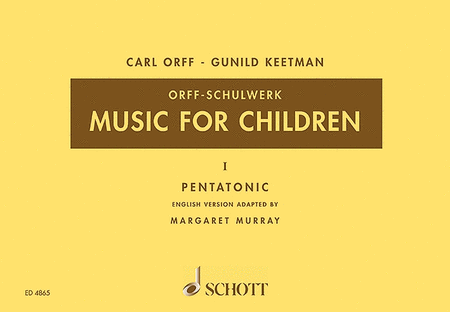
Music for Children

$21.99 18.89 € PDF SheetMusicPlus

Voice, recorder and percussion - Digital Download SKU: S9.Q2433 Minor: Bordun. Composed by Carl Orff and Gunild Keetman. Arranged by Arnold Walter and Doreen Hall. This edition: score for voice and/or instruments. Orff-Schulwerk. Downloadable, Vocal and performing score. Op. 4. Schott Music - Digital #Q2433. Published by Schott Music - Digital (S9.Q2433). English.Carl Orff devoted much of his life to the development of a philosophy of Music for Children, based on his belief that music is the natural outcome of speech, rhythm and movement. His ideas and pioneering work have had a major influence on music and dance education throughout the world and today that work continues under the guidance of leading teachers and educators in many countries. The five basic German volumes of Music for Children by Carl Orff and Gunild Keetman were published between 1950 and 1954. Edition have since been published in Bolivia, Brazil, Canada, Czechoslovakia, Denmark, Estonia, France, Ghana, Great Britain (including a special Welsh edition), Greece, Italy, Japan, Korea, Latin-America, the Netherlands, Portugal, Spain, Sweden, Taiwan and the USA. In 1952 the first edition in translation appeared, an English language adaptation by Doreen Hall and Arnold Walter for their Canadian and American students. A few years later, Margaret Murray independently developed a version (1957-1966), essentially to fulfil the needs of United Kingdom teachers. Inevitably the considerable growth of Orff-Schulwerk in the United States led to the publication of the American Edition (1977) to satisfy the requirements of a different educational system and national heritage. Orff-Schulwerk: Music for Children has proved itself to be a stimulating source of material for music teaching. Carl Orff's fundamental educational ideas have revitalized music education in nursery schools, at all levels of primary and secondary education and in special music schools, based on the concepts that: - music, dance and language are inter-related and animated through rhythm. - when children discover, invent, improvise and compose, their experience of music is intensified. These creative activities are complementary to those of interpreting and listening to music. - all who take part are encouraged to contribute, not only vocally but also instrumentally. - the Orff approach to music education is many sided; it is concerned with practical music-making, it provides fundamental experiences and it lays the foundation for a comprehensive musical training. - movement games and activities for body awareness in space, time and flow, lead to movement improvisation and dance forms. - music and dance have been notated in many different ways in history. Various ways of writing down sounds and music, as well as playing from and interpreting different kinds of sources are being explored. Today, countless teachers and institutions are using these ideas. More and more teachers look for ways of invovling their students in active music making. In particular, they seek to challenge their pupils' creativity by the use of music, dance and speech - as media of human expression - as a foundation of all education. A prerequisite for work in Orff-Schulwerk is the artistic and pedagogical training of teachers. The Orff Institute was founded in 1961 as a Department of the 'Mozarteum', in Salzburg, Austria. Training offered includes a four-year diploma course, a two-year post-graduate course, and a one-year-course in English. At the opening of the Orff Institute in Salzburg in 1963, Carl Orff ended his speech with a quotation from Schiller: 'I have done my part, now do yours.' That challenge has been taken up by teachers worldwide. Hall/Walter Edition Based on Volumes 1, 2 and 4 of the original German Edition musik für Kinder, english adaption with additional material by Doreen Hall and Arnold Walter.
Music for Children

$11.99 10.3 € PDF SheetMusicPlus

Voice, recorder and percussion - Digital Download SKU: S9.Q25928 Pentatonic. Composed by Carl Orff and Gunild Keetman. Arranged by Arnold Walter and Doreen Hall. This edition: score for voice and/or instruments. Orff-Schulwerk. Downloadable, Vocal and performing score. Op. 1. Schott Music - Digital #Q25928. Published by Schott Music - Digital (S9.Q25928). English.Carl Orff devoted much of his life to the development of a philosophy of Music for Children, based on his belief that music is the natural outcome of speech, rhythm and movement. His ideas and pioneering work have had a major influence on music and dance education throughout the world and today that work continues under the guidance of leading teachers and educators in many countries. The five basic German volumes of Music for Children by Carl Orff and Gunild Keetman were published between 1950 and 1954. Edition have since been published in Bolivia, Brazil, Canada, Czechoslovakia, Denmark, Estonia, France, Ghana, Great Britain (including a special Welsh edition), Greece, Italy, Japan, Korea, Latin-America, the Netherlands, Portugal, Spain, Sweden, Taiwan and the USA. In 1952 the first edition in translation appeared, an English language adaptation by Doreen Hall and Arnold Walter for their Canadian and American students. A few years later, Margaret Murray independently developed a version (1957-1966), essentially to fulfil the needs of United Kingdom teachers. Inevitably the considerable growth of Orff-Schulwerk in the United States led to the publication of the American Edition (1977) to satisfy the requirements of a different educational system and national heritage. Orff-Schulwerk: Music for Children has proved itself to be a stimulating source of material for music teaching. Carl Orff's fundamental educational ideas have revitalized music education in nursery schools, at all levels of primary and secondary education and in special music schools, based on the concepts that: - music, dance and language are inter-related and animated through rhythm. - when children discover, invent, improvise and compose, their experience of music is intensified. These creative activities are complementary to those of interpreting and listening to music. - all who take part are encouraged to contribute, not only vocally but also instrumentally. - the Orff approach to music education is many sided; it is concerned with practical music-making, it provides fundamental experiences and it lays the foundation for a comprehensive musical training. - movement games and activities for body awareness in space, time and flow, lead to movement improvisation and dance forms. - music and dance have been notated in many different ways in history. Various ways of writing down sounds and music, as well as playing from and interpreting different kinds of sources are being explored. Today, countless teachers and institutions are using these ideas. More and more teachers look for ways of invovling their students in active music making. In particular, they seek to challenge their pupils' creativity by the use of music, dance and speech - as media of human expression - as a foundation of all education. A prerequisite for work in Orff-Schulwerk is the artistic and pedagogical training of teachers. The Orff Institute was founded in 1961 as a Department of the 'Mozarteum', in Salzburg, Austria. Training offered includes a four-year diploma course, a two-year post-graduate course, and a one-year-course in English. At the opening of the Orff Institute in Salzburg in 1963, Carl Orff ended his speech with a quotation from Schiller: 'I have done my part, now do yours.' That challenge has been taken up by teachers worldwide. Hall/Walter Edition Based on Volumes 1, 2 and 4 of the original German Edition musik für Kinder, english adaption with additional material by Doreen Hall and Arnold Walter.
Music for Children

$10.99 9.44 € PDF SheetMusicPlus

Boomwhackers,Piano Accompaniment,Voice - Level 2 - Digital Download SKU: A0.565097 By Sharon Wilson. By Isaac Watts. Arranged by Sharon Wilson. Children,Instructional,Praise & Worship,Sacred,Traditional. 10 pages. Sharon Wilson #3409393. Published by Sharon Wilson (A0.565097). This arrangement is for voice (either solo or unison group singing) with chord accompaniment using 8-note (C major diatonic scale) Boomwhackers® and an optional easy Piano accompaniment. The following pages provide several options for learning, teaching, and enjoying this timeless hymn. This packet includes the following pages: * chord chart using colored noteheads corresponding to the Boomwhackers® color system* 2-page combined score with the melody (for voice with the lyrics for one verse) on the top staff and Boomwhackers® 3-note chords on the bottom staff* 1-page melody staff with lyrics and chord names (referring to the chord chart, follow the chord names above the staff to whack out the 3 beats in each measure using the corresponding Boomwhackers®* 1-page with lyrics and chords for 3 verses divided into beats (referring to the chord chart, whack out the beat using the corresponding chord indicated above each syllable, word, or phrase); this page is most useful once the melody and rhythm have been learned* 1-page piano accompaniment score (the right hand plays the melody, especially helpful if the melody is unfamiliar)This arrangement is one of the hymns in a series of Timeless Hymns for Voice and Boomwhackers®. These hymn arrangements provide an excellent teaching tool for families, schools, churches, and other children's ministries. Children will enjoy learning the lyrics and tunes of these classic hymns while accompanying themselves by whacking out chords with the Boomwhackers®. Frequent use of these songs will store the hymns' messages in their memory which they will cherish throughout their lifetime. Other suggestions and uses: * have the melody played by other instruments with a chromatic scale range of middle C to the second D above such as 20-note handbells, xylophones, or recorders; alternate singing one verse with playing an instrument on the melody for a second verse* use multiple sets of Boomwhackers® to amplify the sound and allow more people to enjoy whacking the tubes* use as part of the music education for children at school, home, or church* these colorful, inexpensive instruments can be enjoyed by all ages and add a fun, unique element to activities and programs: senior centers, family reunions, church retreats, home school groups, just to name a few Permission is granted to make as many copies as needed for one family, church, or other group. Boomwhackers® is a registered trademark of Rhythm Band Instruments, LLC. Used by permission. Visit Sharon Wilson's website: www.SharonWilsonMusic.comSubscribe to her YouTube Channel: www.youtube.com/user/SharonWilsonMusic
I Sing the Mighty Power of God (for Voice and 8-note Boomwhackers®)
Sharon Wilson
$5.99 5.15 € PDF SheetMusicPlus

Boomwhackers,Piano Accompaniment,Voice - Level 1 - Digital Download SKU: A0.565093 By Sharon Wilson. By Robert Robinson. Arranged by Sharon Wilson. Children,Folk,Holiday,Instructional,Sacred. 10 pages. Sharon Wilson #3408941. Published by Sharon Wilson (A0.565093). This arrangement is for voice (either solo or unison group singing) with chord accompaniment using 8-note (C major diatonic scale) Boomwhackers® and an optional easy Piano accompaniment. The following pages provide several options for learning, teaching, and enjoying this timeless hymn. This packet includes the following pages: *  chord chart using colored noteheads corresponding to the Boomwhackers® color system*  2-page combined score with the melody (for voice with the lyrics for one verse) on the top staff and Boomwhackers® 3-note chords on the bottom staff*  1-page melody staff with lyrics and chord names (referring to the chord chart, follow the chord names above the staff to whack out the 3 beats in each measure using the corresponding Boomwhackers®*  1-page with lyrics and chords for 3 verses divided into beats (referring to the chord chart, whack out the beat using the corresponding chord indicated above each syllable, word, or phrase); this page is most useful once the melody and rhythm have been learned*  1-page piano accompaniment score (the right hand plays the melody, especially helpful if the melody is unfamiliar)This arrangement is one of the hymns in a series of Timeless Hymns for Voice and Boomwhackers®. These hymn arrangements provide an excellent teaching tool for families, schools, churches, and other children's ministries. Children will enjoy learning the lyrics and tunes of these classic hymns while accompanying themselves by whacking out chords with the Boomwhackers®. Frequent use of these songs will store the hymns' messages in their memory which they will cherish throughout their lifetime. Other suggestions and uses: *  have the melody played by other 8-note instruments such as handbells, xylophones, glockenspiels, or recorders; alternate singing one verse with playing an instrument on the melody for a second verse*  use multiple sets of Boomwhackers® to amplify the sound and allow more people to enjoy whacking the tubes*  use as part of the music education for children at school, home, or church*  these colorful, inexpensive instruments can be enjoyed by all ages and add a fun, unique element to activities and programs: senior centers, family reunions, church retreats, home school groups, just to name a few Permission is granted to make as many copies as needed for one family, church, or other group. Boomwhackers® is a registered trademark of Rhythm Band Instruments, LLC. Used by permission. Visit Sharon Wilson's website: www.SharonWilsonMusic.comSubscribe to her YouTube Channel: www.youtube.com/user/SharonWilsonMusic
Come Thou Fount of Every Blessing (for Voice and 8-note Boomwhackers®)
Sharon Wilson
$5.99 5.15 € PDF SheetMusicPlus


Partitions Gratuites
Acheter des Partitions Musicales
Acheter des Partitions Digitales à Imprimer
Acheter des Instruments de Musique

© 2000 - 2026

Accueil - Version intégrale





