EUROPE
7294 articles
USA
0 articles
DIGITAL
6275 articles (à imprimer)
Partitions Digitales
Partitions à imprimer
6275 partitions trouvées


Brass Ensemble - Level 4 - Digital Download SKU: A0.792711 Composed by John Bacchus Dykes. Arranged by Scott Pappal. Christian,Gospel,Praise & Worship,Sacred,Spiritual. Score and parts. 9 pages. Gordon Cherry #5953941. Published by Gordon Cherry (A0.792711). Eternal Father is a popular hymn sung by members of the U.S., British and French Navies and is often called The Navy Hymn. The work was written in 1860/61 by two English clergymen, Rev. John Bacchus Dykes and the lyrics by Rev. William Whiting with inspiration from the Old and New Testaments. The Navy Hymn is also known as Melita. This noble music was a favorite of President Theodore Roosevelt and Franklin D. Roosevelt and was performed at the funeral of John F. Kennedy. Scott Pappal has beautifully arranged this moving work for brass quintet. It can be performed by moderately advanced performers and would be a very nice addition to a service.
Eternal Father, Strong to Save for Brass Quintet
Quintette de Cuivres: 2 trompettes, Cor, trombone, tuba

$17.50 15.23 € Quintette de Cuivres: 2 trompettes, Cor, trombone, tuba PDF SheetMusicPlus

Piano Solo - Level 4 - Digital Download SKU: A0.1456161 Composed by Abe Holzmann. Arranged by Keith Terrett. 20th Century,Contest,Festival,Historic,Instructional,Multicultural,World. Score. 9 pages. Keith Terrett #1035313. Published by Keith Terrett (A0.1456161). Abe Holzmann wrote some very fine marches, but here's one inspired by a book. Herbert Kaufman's 1910 book The Winning Fight inspired this winning march (it's a book about self-mastery and fostering a can-do attitude). Tiis march was published by Leo Feist in New York City in 1911.Arrangement of a March by Abe Holzmann (1874-1939),  writthn in 1911. He also wrote what is probably his best known march Blaze Away''.Blaze Away! is a 1901 march by the German-American composer Abe Holzmann. It was his greatest success.Holzmann was inspired by the Battle of Manila Bay during the Spanish–American War, when a command to American sailors to open fire on the Spanish fleet was reputedly met with the response Well boys, let's blaze away by the gunners. Building on the war fever in the United States, the cover of the sheet music featured an image resembling Theodore Roosevelt charging at San Juan Hill. Very popular as a two-step, its success outlasted the war and it became a repertoire piece amongst military bands around the world.Abraham Holzmann (19 August 1874 – 16 January 1939) was an American composer, famous for his march Blaze-Away! Abraham Holzmann was born in New York City. His parents were Jacob Holzmann, a Hungarian-Jewish immigrant and Isabella Holzmann, a native of Louisiana. The young Holzmann learned music in Germany. A review originally published by the New York Herald on Sunday, 13 January 1901, entitled German Composer who Writes American Cakewalk Music describes [h]is knowledge of bass and counterpoint is thorough, and his standard compositions bear the stamp of harmonic lore, which makes his proclivity for the writing of the popular style of music the more remarkable. Abe married Isabelle Fishblatt around 1908, and he became the manager of the Orchestra Department at Jerome Remick & Company, music publisher in New York. He was an early member (1923) of the American Society of Composers, Authors and Publishers (ASCAP). He earned his livelihood as composer/arranger for Tin Pan Alley publishers, including Leo Feist. He later was advertising manager for the American Federation of Musicians publication, International Musician. He was a member of Freemasonry, the Elks, and Knights of Pythias, all in New York City. Holzmann died in East Orange, New Jersey at age 64. He was survived by his widow, a daughter Natalie Holzmann, three half-brothers, and four sisters. His music was especially revered by ragtime enthusiasts, although he composed marches, waltzes, and other light music. His 1899 composition Smokey Mokes was briefly featured in the 1936 movie San Francisco.
Winning Fight March for Pianoforte
Piano seul

$4.99 4.34 € Piano seul PDF SheetMusicPlus

Voice and piano (2 songs with violoncello; 1 vocal duet) - Medium - Digital Download SKU: MQ.8491-04E Composed by MeeAe Cecilia Nam and Theodore Gouvy. 5 pages. E. C. Schirmer Music Company - Digital #8491-04E. Published by E. C. Schirmer Music Company - Digital (MQ.8491-04E). French.A French composer, Théodore Gouvy (1819-1898) was one of the most significant composers of 19th Century in Europe. The movement of rediscovering his instrumental music has been increasingly successful in Europe since the 1990s, especially following the birth of L’Institut Gouvy in France. However, his solo vocal music has been waiting to be unveiled to the public. Volume One includes 52 songs of Gouvy.Gouvy traveled widely throughout Europe. He was also a lover of nature. Generally, he spent his winters in Leipzig, but in the summertime, he always returned to Hombourg-Haut, France, to stroll through the woods, to hunt, and to relax. Gouvy was fluent in several languages and had a great appreciation of the Renaissance French Poetry of Pierre de Ronsard whose poetry he had set to music. The fifty-two songs in this volume are largely by Ronsard and other Renaissance poets of La Pléiade.Although Ronsard is approximately 300 years older than Gouvy, they both seem to have the same interest in classical literature, though, admittedly, for different reasons. Celebrated by the French and English courts, Ronsard (1525-1585) was the leader of La Pléiade: a group of seven poets (Joachim Du Bellay (1522-1560), Rémy Belleau (1528-1577), Étienne Jodelle (1532-1573), Pontus de Tyard (1521-1603), Jean–Antoine Baïf (1532-1589), and Jean Daurat (1508-1588), who dedicated their efforts to writing poetry in French rather than in Latin (or Greek) as most of the Romantic poets did. They wished to enrich the French language, and establish a new literature which would be the equal of the other literature of their period, and the equal to poets of the past. French Romantic poetry featured the closeness of the poet to nature, and his ability to communicate with nature by personifying (anthropomorphizing) all of nature’s elements: flowers, the planets, the moon, the breeze, and even the sand upon the shore. As a significant melodist, Gouvy’s treatment of the vocal solo line and his treatment and development of the piano accompaniment places him in the upper echelons as a composer of songs. His diverse cultural life led a rich and significant musical life, interacting with his contemporaries who admired his work, and whom Gouvy knew well, such as Liszt, Brahms, Schumann, Mendelssohn, Berlioz and Gounod. Contents:Six Odes de Ronsard pour ténor et piano, Op. 37 (No. 3 et No. 5 avec violoncelle) Neuf Poésies de Ronsard pour soprano ou ténor et piano, Op. 41 Six Poésies de Ronsard pour soprano ou ténor et piano, Op. 42 Quatre Odes de Ronsard pour baryton et piano, Op. 43 Huit Poésies de Ronsard pour ténor ou soprano et piano, Op. 44 Sept Poésies de Ronsard pour ténor ou soprano et piano, Op. 47.
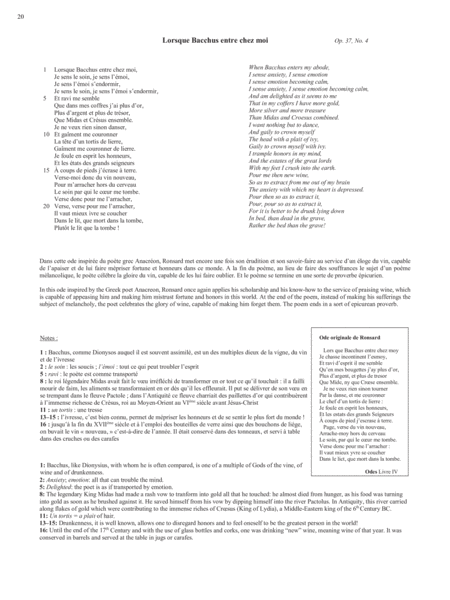
Op. 37, No. 4: Lorsque Bacchus entre chez moi from Songs of Gouvy, V1 (Downloadable)
Piano, Voix

$3.00 2.61 € Piano, Voix PDF SheetMusicPlus

Piano,Violin - Level 2 - Digital Download SKU: A0.565954 By Sharon Wilson. By Gustav Holst. Arranged by Sharon Wilson. Christmas,Folk,Multicultural,Sacred,Standards,World. 6 pages. Sharon Wilson #6602403. Published by Sharon Wilson (A0.565954). Here is an easy instrumental duet arrangement (for VIOLIN solo with PIANO accompaniment) of the classic Christmas tune CRANHAM by Gustav Theodore Holst generally associated with the lyrics from Christina Georgina Rossetti’s poem In the Bleak Midwinter. The VIOLIN plays the melody throughout for two verses. The first verse is in the key of D major and then during a short piano interlude, the song transition to the key of G major for the second verse.All notes for the VIOLIN are playable in the first position making this arrangement an excellent choice for early-intermediate string players. The PIANO accompaniment is written for an intermediate player. The purchase price includes a 4-page combined score with both VIOLIN and PIANO parts on each page plus a separate 1-staff score for the VIOLIN (1 page). Visit Sharon Wilson’s website: www.SharonWilsonMusic.comSubscribe to her YouTube Channel: www.youtube.com/user/SharonWilsonMusic
In the Bleak Midwinter (Easy Violin Solo with Piano Accompaniment)
Violon et Piano
Sharon Wilson
$4.99 4.34 € Violon et Piano PDF SheetMusicPlus

Guitar,Piano,Vocal,Voice - Digital Download SKU: A0.900434 Composed by Richard Rodgers. Arranged by Sir Nyukuri Edwin. Broadway,Film/TV. Score. 5 pages. SIR NYUKURI EDWIN #3368029. Published by SIR NYUKURI EDWIN (A0.900434). Edelweiss is a show tune from the 1959 Rodgers and Hammerstein musical The Sound of Music. It is named after the edelweiss, a white flower found high in the Alps (Leontopodium alpinum). It was created for the 1959 Broadway production of The Sound of Music in the role originated by performer Theodore Bikel as a song for the character of Captain Georg Ludwig von Trapp. In the musical, Captain von Trapp and his family sing this song during the concert near the end of Act II as a statement of Austrian patriotism in the face of the pressure put upon him to join the navy of Nazi Germany following the Anschluss. It is also Captain von Trapp's subliminal goodbye to his beloved homeland, using the flower as a symbol of his loyalty to Austria. In the 1965 film adaptation, the song is also sung by the Captain earlier in the film when he rediscovers music with his children.
Edelweiss
Piano, Voix et Guitare

$5.00 4.35 € Piano, Voix et Guitare PDF SheetMusicPlus

Voice and piano (2 songs with violoncello; 1 vocal duet) - Medium - Digital Download SKU: MQ.8491-21E Composed by MeeAe Cecilia Nam and Theodore Gouvy. 7 pages. E. C. Schirmer Music Company - Digital #8491-21E. Published by E. C. Schirmer Music Company - Digital (MQ.8491-21E). French.A French composer, Théodore Gouvy (1819-1898) was one of the most significant composers of 19th Century in Europe. The movement of rediscovering his instrumental music has been increasingly successful in Europe since the 1990s, especially following the birth of L’Institut Gouvy in France. However, his solo vocal music has been waiting to be unveiled to the public. Volume One includes 52 songs of Gouvy.Gouvy traveled widely throughout Europe. He was also a lover of nature. Generally, he spent his winters in Leipzig, but in the summertime, he always returned to Hombourg-Haut, France, to stroll through the woods, to hunt, and to relax. Gouvy was fluent in several languages and had a great appreciation of the Renaissance French Poetry of Pierre de Ronsard whose poetry he had set to music. The fifty-two songs in this volume are largely by Ronsard and other Renaissance poets of La Pléiade.Although Ronsard is approximately 300 years older than Gouvy, they both seem to have the same interest in classical literature, though, admittedly, for different reasons. Celebrated by the French and English courts, Ronsard (1525-1585) was the leader of La Pléiade: a group of seven poets (Joachim Du Bellay (1522-1560), Rémy Belleau (1528-1577), Étienne Jodelle (1532-1573), Pontus de Tyard (1521-1603), Jean–Antoine Baïf (1532-1589), and Jean Daurat (1508-1588), who dedicated their efforts to writing poetry in French rather than in Latin (or Greek) as most of the Romantic poets did. They wished to enrich the French language, and establish a new literature which would be the equal of the other literature of their period, and the equal to poets of the past. French Romantic poetry featured the closeness of the poet to nature, and his ability to communicate with nature by personifying (anthropomorphizing) all of nature’s elements: flowers, the planets, the moon, the breeze, and even the sand upon the shore. As a significant melodist, Gouvy’s treatment of the vocal solo line and his treatment and development of the piano accompaniment places him in the upper echelons as a composer of songs. His diverse cultural life led a rich and significant musical life, interacting with his contemporaries who admired his work, and whom Gouvy knew well, such as Liszt, Brahms, Schumann, Mendelssohn, Berlioz and Gounod. Contents:Six Odes de Ronsard pour ténor et piano, Op. 37 (No. 3 et No. 5 avec violoncelle) Neuf Poésies de Ronsard pour soprano ou ténor et piano, Op. 41 Six Poésies de Ronsard pour soprano ou ténor et piano, Op. 42 Quatre Odes de Ronsard pour baryton et piano, Op. 43 Huit Poésies de Ronsard pour ténor ou soprano et piano, Op. 44 Sept Poésies de Ronsard pour ténor ou soprano et piano, Op. 47.
Op. 42, No. 6: Chanson from Songs of Gouvy, V1 (Downloadable)
Piano, Voix

$3.00 2.61 € Piano, Voix PDF SheetMusicPlus


Partitions Gratuites
Acheter des Partitions Musicales
Acheter des Partitions Digitales à Imprimer
Acheter des Instruments de Musique

© 2000 - 2026

Accueil - Version intégrale





