EUROPE
7294 articles
USA
0 articles
DIGITAL
6276 articles (à imprimer)
Partitions Digitales
Partitions à imprimer
6276 partitions trouvées


TomSolfège : Niveau 7 : 06. Mesures ternaires, Résumé niveau 6
Formation musicale - Solfège
Téléchargez la partition Solfège Niveau 7 : 06. Mesures ternaires, R&…
0.00 € Formation musicale - Solfège PDF Tomplay

Piano,Tenor Saxophone - Level 3 - Digital Download SKU: A0.549752 Composed by Peter Ilyich Tchaikovsky. Arranged by James M. Guthrie, ASCAP. Children,Christmas,Romantic Period,Standards. Score and part. 17 pages. Jmsgu3 #3532705. Published by jmsgu3 (A0.549752). Duration: ca. 3:15 Score: 10 pages, solo part: 2 pages, piano part: 4 pages. Tchaikovsky paints a very mysterious mood in this favorite masterpiece from the Nutcracker Suite. It is also a traditional Christmas favorite. Pyotr Ilyich Tchaikovsky Tchaikovsky is probably the most popular of the great composers in America. His music certainly appeals to musicians. Likewise, it appeals even to folks who don’t normally listen to serious music. This is probably because of his most noteworthy melodies. Above all, he writes with great emotion. This certainly makes a most noteworthy if not an unforgettable impact. Education First of all, He attended classes at the Russian Musical Society. Even more, He also attended the St. Petersburg Conservatory. There he studied music theory with Nikolai Zaremba. He also consequently studied composition with Anton Rubenstein. It seems like Rubenstein came under criticism from a group of Russian composers known as the Five. The Five The Five certainly rejected Western musical influences. They rather sought to use elements from Russian music. They furthermore wanted to use more exotic musical materials. Western Techniques More than other Russian composers, Tchaikovsky studied modern Western music. He certainly develops his music like the European masters. So, rather than repeating a motive, he moves to a new key. He then introduces a different theme in the new key. Hence, he maintained his independence from the Five. Even more, he became the first Russian composer of international stature. Influences Tchaikovsky was probably influenced in his ballet scoring by Léo Delibes. Richard Wagner influenced his symphonic writing. Tchaikovsky’s most famous works include the 1812 Overture, The Nutcracker Suite, and Swan Lake. Also famous are the Violin Concerto in D and the six symphonies. The greatest of the six symphonies may be No. 6, the Pathétique. Nutcracker Suite, Op. 71a The Nutcracker Suite is a ballet that was performed for the first time in December 1892 in St. Petersburg. To begin with, the original ballet failed to attract a positive reception. However, the ballet suite became probably one of the most popular of all of Tchaikovsky’s works. The ballet suite became even more famous in the 1960s. It is now performed all over the world, particularly during the Christmas season.
Tchaikovsky: Arabian Dance from Nutcracker Suite for Tenor Sax & Piano
Saxophone Tenor et Piano

$32.95 28.71 € Saxophone Tenor et Piano PDF SheetMusicPlus

Piano Quintet Cello,Piano,Viola,Violin - Level 5 - Digital Download SKU: A0.1129014 Composed by Igor Korneitchouk. 20th Century,Chamber,Contemporary. 57 pages. Studio at the Post #729537. Published by Studio at the Post (A0.1129014). Parts only (see A729534 for Score) Duration: 8 minutes, 5 Parts (2 violins, viola, cello, piano) with individual directions, parts averaging 5 – 7 pp. Description: When John Cage first invented the concept of prepared piano it was an invention born of necessity. (To realize his ideas Cage needed a percussion ensemble to accompany the dance troupe with which he worked. His solution to the impracticability of this was to create various percussion-like timbres from the studio piano which all dance spaces have.) In Heisenberg... all the instruments are engaged in a music made up of sound effects and unusual timbres; but because all the effects, in the case of the string instruments, must come from a limited number of strings, the preparation of these instruments are mutable — throughout the piece the performers are constantly preparing and un-preparing their instruments. This principle of mutable preparation has been carried over to the piano as well and thus the performance takes on the characteristic of an alien dance as a great deal of the work involves the logistics of setting up each succeeding phrase. Werner Heisenberg's great contribution to modern science is the Uncertainty Principle — the realization, expressed mathematically, that even in the hard sciences of physics and chemistry one could never be sure of anything. (According to The New Columbia Encyclopedia) “Werner Heisenberg — German physicist. One of the founders of the quantum theory, he is best known for his uncertainty principle, or indeterminacy principle, which states that it is impossible to determine with arbitrarily high accuracy both the position and momentum (essentially velocity) of a subatomic particle like the electron. The effect of this principle is to convert the laws of physics into statements about relative probabilities instead of absolute certainties.†(He won the Nobel Prize in Physics in 1932.).
Heisenberg was looking for a raison d'être (Parts only)
Piano Quintette: piano, 2 violons, alto, violoncelle

$5.02 4.37 € Piano Quintette: piano, 2 violons, alto, violoncelle PDF SheetMusicPlus

TomSolfège : Niveau 6 : 02. Mesures binaires, Le quart de soupir
Formation musicale - Solfège
Téléchargez la partition Solfège Niveau 6 : 02. Mesures binaires, Le …
0.00 € Formation musicale - Solfège PDF Tomplay

Cello,Piano - Level 1 - Digital Download SKU: A0.548509 Composed by Wade. Arranged by James M. Guthrie, ASCAP. Christian,Christmas. Score and part. 4 pages. Jmsgu3 #3388103. Published by jmsgu3 (A0.548509). O Come All Ye Faithful arranged with new harmony for the final verse. Score: 3 pages, part: 1 page. O Come, All Ye Faithful O Come, All Ye Faithful is an English translation of the Latin Christmas carol Adeste Fideles. No one knows exactly who wrote it, but one theory is that it was originally composed by King John IV of Portugal (1604–1656) and revised by John F. Wade and John Reading. Nowadays, we usually attribute it to John Wade. The oldest manuscript from 1751, is owned by Stonyhurst College in Lancashire. Lyrics The English translation O Come, All Ye Faithful was certainly written by Frederick Oakeley, a Catholic priest in 1841. This translation is the most common in English speaking states. To begin with, the hymn had only four verses. Later, the verses grew to eight. Often, various verses are omitted because otherwise, the song is just too long. Some believe the first Latin lyrics were written by St. Bonaventure (13th century) or King John IV of Portugal in the 17th.  Though others think it was written by the Cistercian monks.   King John IV King John IV of Portugal was called The Musician King. He became king in 1640. In addition to performing the duties of a king, he was also a composer and music journalist. King John built a very large music library. Unfortunately, the library was ruined in 1755 because of the massive earthquake of Lisbon. In addition to his library, the king started a Music School that produced many accomplished musicians. The king also worked diligently to get instrumental music approved by the Vatican for use in his churches. Aside from his authorship of Adeste Fideles, he is famous for another popular choral setting of the Crux Fidelis, a prevalent Lenten hymn. Performance in Context As mentioned above, verses are sometimes left out because all eight verses would take too long to perform. More to the point though, some of the verses may be unsuitable for whatever of the church calendar they are intended. The eighth verse deals with the Epiphany, so it makes sense to sing this on Epiphany Sunday, but not other Sundays. Similarly, other verses are used according to whether the event is Midnight Mass or regular daytime Mass.  Register for free lifetime updates and revisions at www.jamesguthrie.com
O Come All Ye Faithful for Cello & Piano
Violoncelle, Piano

$24.95 21.74 € Violoncelle, Piano PDF SheetMusicPlus

Piano Solo - Level 3 - Digital Download SKU: A0.1048900 By Andrew D. Gordon. By Andrew D. Gordon. Arranged by Andrew D. Gordon. Blues,Country,Instructional,Pop,Rock. Score. 3 pages. A.D.G. Productions #653180. Published by A.D.G. Productions (A0.1048900). Page 1 and 2 of this Rock Piano Practice Session 7 takes a 4 measure Country/Rock ballad through all 12 keys around the cycle of 4th.s. This progression is in the style of Desperado by The Eagles. Page 3 shows the 8 measure progression, the 1st. 4 measures in the key of F transposing up to Bb. The audio file that accompanies the sheet music is split into 4 sections, Part 1 consists of the piano playing along with the rhythm backing tracks in all 12 keys. Part 2 consists of the rhythm backing tracks in all 12 keys for practicing purposes. Part 3 consists of the piano playing along with the rhythm backing tracks in the 8 measure progression. Part 4 consists of the rhythm backing tracks in the 8 measure progression to practice along with. Optional MIDI files are available separately for a fee, contact sales@adgproductions.com With using software such as the free programs Musescore or Garage Band you will be able to do the following with the MIDI files: 1. Slow the tempo down to your skill level. 2. Change the key, allowing you the option of transposing the patterns into keys other than the written key. 3. Use the loop function to practice difficult measures repeatedly. 4. Use these patterns for ear training exercises by slowing the tempo down and looping a certain section repeatedly, try to play the correct notes using your ear rather than reading the music. Check out the various Blues piano books that I have authored at the publishers website A.D.G. Productions http://www.adgproductions.com and http://www.sheetmusicplus.com I have authored over 120 music instructional books for different instruments and numerous contemporary styles. Blues piano titles include: 100 Ultimate Blues Riffs for Piano/Keyboards Volume 1 and 2 12 Bar Blues Bible for Piano/Keyboards The Blues Play-A-Long and Solos Collection for Piano/Keyboards The Blues Scale for Piano/Keyboards Blues Bass Lines for Piano/Keyboards The Bluesier Side of Jazz for Piano/Keyboards Boogie Woogie and The Blues 100 Ultimate Blues Riffs for Piano/Keyboards Beginners Series Best Beginner Blues Exercises for Piano/Keyboards Online Music Lessons and Consultations for Beginner to Advanced Students As the author of over 120 music instructional books for piano/keyboards, guitar, sax and flute I am available to teach music students from around the world in their home via the Internet using skype or facetime in many areas of music, Some of the areas of music that I have expertise in teaching for most instruments: Music styles: blues, jazz, rock, country, gospel, pop, funk, r&b. Learning how to improvise in all the above styles Piano/keyboard playing, music production, songwriting and composing, music career development, learning computer music software, how to play in a band, Music,theory and ear training, History of Rock and Roll All levels of students are welcome, from beginner to advanced. Most of the students have been people who have purchased my books and are interested in taking their music education to another level. I can be contacted at musiclessons@adgproductions.com.
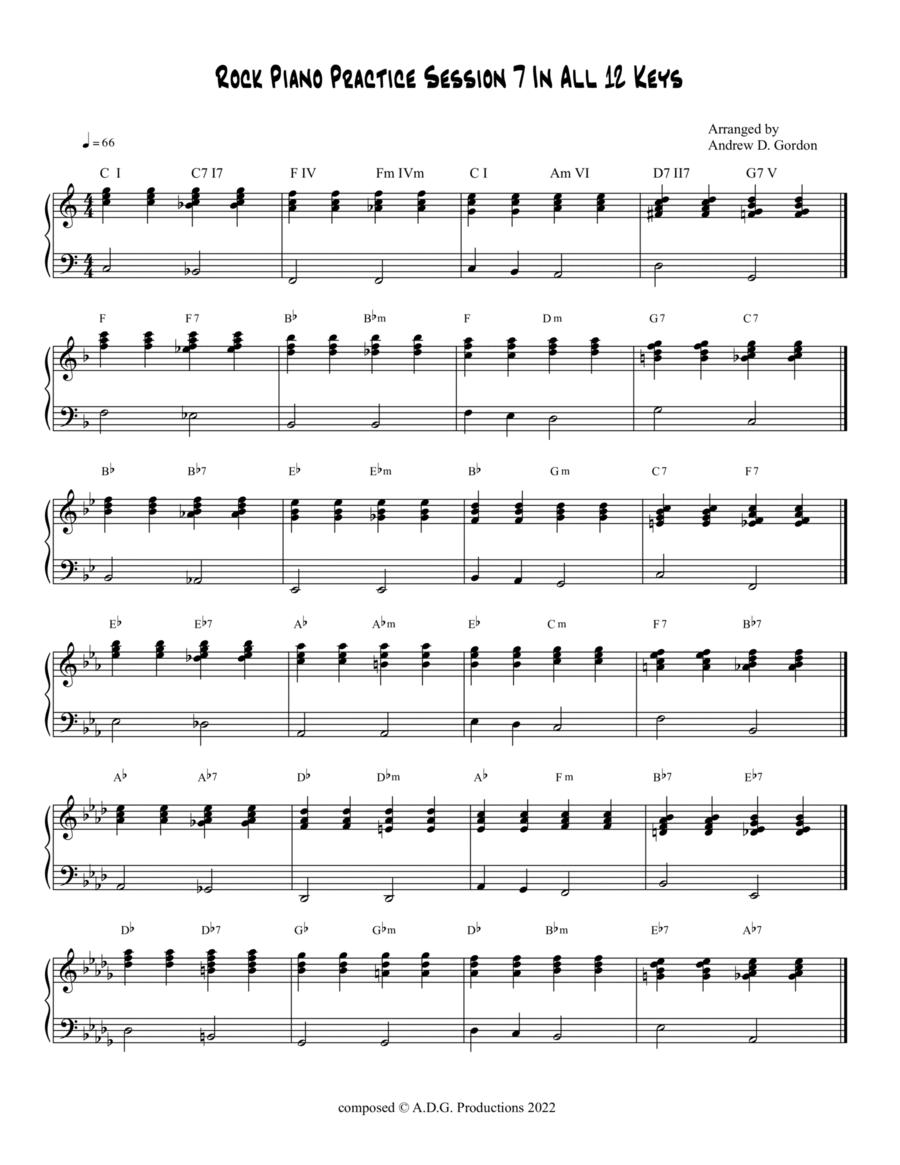
Rock Piano Practice Session 7 In All 12 Keys
Piano seul
Andrew D Gordon
$2.95 2.57 € Piano seul PDF SheetMusicPlus

Woodwind Ensemble,Woodwind Quartet - Level 2 - Digital Download SKU: A0.1199583 Composed by George Frideric Handel. Arranged by Langanho. Baroque,Easter,Religious,Sacred,Traditional. 9 pages. Avery Lynn Jordan #798651. Published by Avery Lynn Jordan (A0.1199583). Introducing the simplified and reduced arrangement of Handel's Hallelujah for Woodwind Quartet with Chords, perfect for students, music teachers, and parents who want to inspire their children to play this timeless piece. This versatile score is an essential addition to any music classroom or practice space, allowing for easy and accessible learning of this iconic composition. Ideal for recitals, concerts, and holiday performances, this arrangement of Hallelujah is sure to impress and captivate audiences. Its simplified format makes it an excellent tool for teaching the fundamentals of music theory, while its reduced size makes it easy to carry and transport. Whether you're a beginner or an experienced musician, this score is a must-have for anyone looking to add a touch of classical elegance to their repertoire. Order your copy today and start playing Handel's Hallelujah like a pro!
Hallelujah by Handel for Woodwind Quartet
Flûte, Hautbois, Clarinette, Basson

$9.99 8.7 € Flûte, Hautbois, Clarinette, Basson PDF SheetMusicPlus

TomSolfège : Niveau 8 : 05. Mesures ternaires
Formation musicale - Solfège
Téléchargez la partition Solfège Niveau 8 : 05. Mesures ternaires de …
0.00 € Formation musicale - Solfège PDF Tomplay

Bass Flute,Instrumental Solo,Piano - Level 3 - Digital Download SKU: A0.549665 Composed by Peter Ilyich Tchaikovsky. Arranged by James M. Guthrie, ASCAP. Children,Christmas,Romantic Period,Standards. Score and individual part. 20 pages. Jmsgu3 #3518975. Published by jmsgu3 (A0.549665). Score: 10 pages: solo part: 3 pages, piano part: 6 pages. Duration: 2:22. This famous selection from the Nutcracker Suite is a classic Christmas program favorite. Pyotr Ilyich Tchaikovsky Tchaikovsky is probably the most popular of the great composers in America. His music certainly appeals to musicians. Likewise, it appeals even to folks who don’t normally listen to serious music. This is probably because of his most noteworthy melodies. Above all, he writes with great emotion. This certainly makes a most noteworthy if not an unforgettable impact. Education First of all, He attended classes at the Russian Musical Society. Even more, He also attended the St. Petersburg Conservatory. There he studied music theory with Nikolai Zaremba. He also consequently studied composition with Anton Rubenstein. It seems like Rubenstein came under criticism from a group of Russian composers known as the Five. The Five The Five certainly rejected Western musical influences. They rather sought to use elements from Russian music. They furthermore wanted to use more exotic musical materials. Western Techniques More than other Russian composers, Tchaikovsky studied modern Western music. He certainly develops his music like the European masters. So, rather than repeating a motive, he moves to a new key. He then introduces a different theme in the new key. Hence, he maintained his independence from the Five. Even more, he became the first Russian composer of international stature. Influences Tchaikovsky was probably influenced in his ballet scoring by Léo Delibes. Richard Wagner influenced his symphonic writing. Tchaikovsky’s most famous works include the 1812 Overture, The Nutcracker Suite, and Swan Lake. Also famous are the Violin Concerto in D and the six symphonies. The greatest of the six symphonies may be No. 6, the Pathétique. Nutcracker Suite, Op. 71a The Nutcracker Suite is a ballet that was performed for the first time in December 1892 in St. Petersburg. To begin with, the original ballet failed to attract a positive reception. However, the ballet suite became probably one of the most popular of all of Tchaikovsky’s works. The ballet suite became even more famous in the 1960s. It is now performed all over the world, particularly during the Christmas season. 
Tchaikovsky: March from Nutcracker Suite for Bass Flute & Piano
Flûte traversière et Piano

$32.95 28.71 € Flûte traversière et Piano PDF SheetMusicPlus


Partitions Gratuites
Acheter des Partitions Musicales
Acheter des Partitions Digitales à Imprimer
Acheter des Instruments de Musique

© 2000 - 2026

Accueil - Version intégrale





