EUROPE
4770 articles
USA
11325 articles
DIGITAL
1894 articles (à imprimer)
Partitions Digitales
Partitions à imprimer
1894 partitions trouvées


Voice and piano - Medium - Digital Download SKU: MQ.8492-32E Composed by MeeAe Cecilia Nam and Theodore Gouvy. Instrument part. 8 pages. E. C. Schirmer Music Company - Digital #8492-32E. Published by E. C. Schirmer Music Company - Digital (MQ.8492-32E). French.Gouvy was known for writing some of the most beautiful melodies of the Romantic period. His style is a combination of German forms and an early French romantic harmonic structure. His writing for the piano in the songs is totally unified in mood and description with the voice, just as the piano is in Schubert’s songs. The equal partnership of the vocal line and piano interact closely to bring the poetry vividly into life with unimaginable artistic heights and unbridled passion.This volume includes Gouvy songs set to 18 poems of Philippe Desportes (1546–1606), and 18 poems of Moritz Hartmann (1821–1872). The elements of Romantic love poetry, such as enchanting love and its pain, and the personifying of nature, are fluently described with a great sensitivity in both voice and piano. Gouvy’s melody stir up the imagination because of his special treatment of words through a distinguishable and melodious vocal line, and his story telling and poetic treatment and development of the piano accompaniment. His compositional artistry places him in the upper echelons of art-song composers. One should note that Gouvy had a special fondness for the 16th Century poetry of La Pléiade (a group of Renaissance French poets, led by Pièrre de Ronsard (1524–1585). Desportes was truly the heir to Ronsard; however his work, when compared to that of Ronsard, is filled with greater abstraction and greater fluidity. Desportes seems to avoid any of the passionate anger that is occasionally characteristic of La Pléiade. This may be an indication that Desportes lived in a less distressed time. It also seems necessary to point out that he learned much in his early career by copying and studying the earlier works of La Pléiade. This has led some scholars to label him as a plagiarist, but it is important to realize that all the members of La Pléiade copied from each other when they wished to learn something new, and truly understand the style of the other poets in the group. Gouvy’s only choice of poems from his contemporaries, were the works of Moritz Hartmann (1821–1872), a good friend of Gouvy’s. Much of his poetry was strongly political in support of freedom of the individual. He traveled to Leipzig in 1845, but when the authorities discovered a volume of patriotic poems entitled Kelch und Schwert (Chalice and Sword), he fled to Belgium and France. It is at this time that he possibly met Théodore Gouvy. Eighteen poems of Hartmann were translated from German to French by the French poet, Adolph Larmande, of whom very little is known. Pierre Toussaint Adolphe Larmande seems to have been a rather obscure poet and musician. We know that he taught music theory at the Paris Conservatory at the same time Anton Reicha and Michele Carafa were on the faculty. We also know that in 1847 he married an English woman by the name of Marie Caroline Bradley. There are random documents, such as a Certificate of Arrival in London, England, in 1837, but there are no birth and death dates given, and that includes his obituary notice. Contents:18 Sonnets et Chansons de Desportes pour ténor ou soprano et piano, Op. 45 Six poésies allemandes de Moritz Hartmann pour baryton et piano, Op. 21 Douze poésies allemandes de Moritz Hartmann pour ténor et piano, Op. 26 (Poésies françaises d’Adolphe Larmande).
Op. 1, No. 8: Illusions perdues from Songs of Gouvy, V2 (Downloadable)
Piano, Voix

$3.00 2.52 € Piano, Voix PDF SheetMusicPlus

Voice and piano (2 songs with violoncello; 1 vocal duet) - Medium - Digital Download SKU: MQ.8491-07E Composed by MeeAe Cecilia Nam and Theodore Gouvy. 5 pages. E. C. Schirmer Music Company - Digital #8491-07E. Published by E. C. Schirmer Music Company - Digital (MQ.8491-07E). French.A French composer, Théodore Gouvy (1819-1898) was one of the most significant composers of 19th Century in Europe. The movement of rediscovering his instrumental music has been increasingly successful in Europe since the 1990s, especially following the birth of L’Institut Gouvy in France. However, his solo vocal music has been waiting to be unveiled to the public. Volume One includes 52 songs of Gouvy.Gouvy traveled widely throughout Europe. He was also a lover of nature. Generally, he spent his winters in Leipzig, but in the summertime, he always returned to Hombourg-Haut, France, to stroll through the woods, to hunt, and to relax. Gouvy was fluent in several languages and had a great appreciation of the Renaissance French Poetry of Pierre de Ronsard whose poetry he had set to music. The fifty-two songs in this volume are largely by Ronsard and other Renaissance poets of La Pléiade.Although Ronsard is approximately 300 years older than Gouvy, they both seem to have the same interest in classical literature, though, admittedly, for different reasons. Celebrated by the French and English courts, Ronsard (1525-1585) was the leader of La Pléiade: a group of seven poets (Joachim Du Bellay (1522-1560), Rémy Belleau (1528-1577), Étienne Jodelle (1532-1573), Pontus de Tyard (1521-1603), Jean–Antoine Baïf (1532-1589), and Jean Daurat (1508-1588), who dedicated their efforts to writing poetry in French rather than in Latin (or Greek) as most of the Romantic poets did. They wished to enrich the French language, and establish a new literature which would be the equal of the other literature of their period, and the equal to poets of the past. French Romantic poetry featured the closeness of the poet to nature, and his ability to communicate with nature by personifying (anthropomorphizing) all of nature’s elements: flowers, the planets, the moon, the breeze, and even the sand upon the shore. As a significant melodist, Gouvy’s treatment of the vocal solo line and his treatment and development of the piano accompaniment places him in the upper echelons as a composer of songs. His diverse cultural life led a rich and significant musical life, interacting with his contemporaries who admired his work, and whom Gouvy knew well, such as Liszt, Brahms, Schumann, Mendelssohn, Berlioz and Gounod. Contents:Six Odes de Ronsard pour ténor et piano, Op. 37 (No. 3 et No. 5 avec violoncelle) Neuf Poésies de Ronsard pour soprano ou ténor et piano, Op. 41 Six Poésies de Ronsard pour soprano ou ténor et piano, Op. 42 Quatre Odes de Ronsard pour baryton et piano, Op. 43 Huit Poésies de Ronsard pour ténor ou soprano et piano, Op. 44 Sept Poésies de Ronsard pour ténor ou soprano et piano, Op. 47.
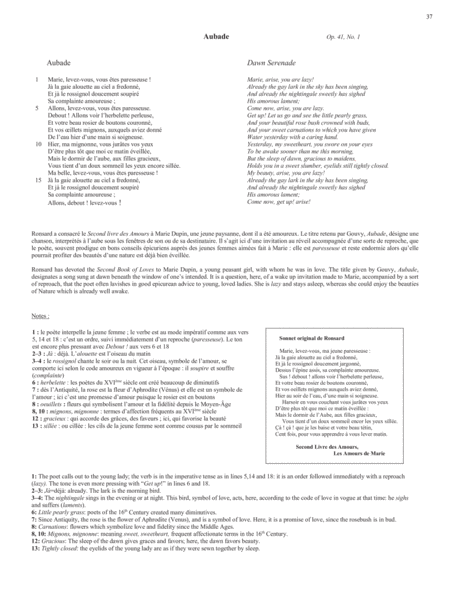
Op. 41, No. 1: Aubade from Songs of Gouvy, V1 (Downloadable)
Piano, Voix

$3.00 2.52 € Piano, Voix PDF SheetMusicPlus

Concert band - Digital Download SKU: IZ.CBW205 Composed by Judith Katz. Score and Parts. 65 pages. Imagine Music - Digital #CBW205. Published by Imagine Music - Digital (IZ.CBW205). 9 x 12 in inches.Long before the tragic sinking of the Medusa, was the sinking of the French ship, The Medusa. The frigate Medusa was completed in 1806, launched in 1810, and saw action in the Napoleonic wars. In 1816, it set sail from French to its ultimate location in Senegal to repossess it from the British. Along with cargo, there were almost 400 people on board. What no one knew, however, was that there was an incompetent captain on board with dubious skills.The ship was caught in a storm off the coast of Mauritania. After being damaged from hitting rocks and multiple attempts to relaunch it, it couldn't move. Soon, it was discovered that there was a shortage of lifeboats. Most of the crew and some of the passengers made their way to the lifeboats, saving about 250 people. That left about 149 others on board. Crew members left on board scrambled to build a raft for the others. The raft was launched and tied to one of the lifeboats. The hope was that everyone would make it to land, almost 60 miles away. The horror came, when the captain ordered the raft to be cut loose, claiming, that it was slowing everyone else down. That left the raft survivors to their own devices.Multiple days at sea brought on starvation, death and disease. People starved to death, and acts of desperation came about, such as the weak, but alive, being thrown overboard, and even cannibalism. Many days later, when survivors were finally rescued, there were only 15 people left alive, with 5 of them dying soon afterwards. News of the disaster quickly reached France, where both the government and the people were thoroughly outraged. Newspapers covered the disaster, and eventually there were trials prosecuting the captain and the crew for negligence. This can be considered as the first documented sea disaster. In 1818, 27 year- old Theodore Gericault was so moved by this disaster, that he painted his masterpiece, The Raft of The Medusa. To this day, the painting, which is enormous in size and almost the size of the raft itself, hangs in the Louvre. This is my first attempt at program music. It was my hope that I captured the mood, the feeling, and above all, in all good program music, that my composition told the story.
The Raft of the Medusa
Orchestre d'harmonie

$60.00 50.34 € Orchestre d'harmonie PDF SheetMusicPlus


Partitions Gratuites
Acheter des Partitions Musicales
Acheter des Partitions Digitales à Imprimer
Acheter des Instruments de Musique

© 2000 - 2026

Accueil - Version intégrale





