EUROPE
1679 articles
USA
0 articles
DIGITAL
11891 articles (à imprimer)
Partitions Digitales
Partitions à imprimer
11891 partitions trouvées


Instrumental Duet,Tenor Trombone,Tuba - Level 3 - Digital Download SKU: A0.1074311 Composed by Josquin des Prez. Arranged by James M. Guthrie. Contest,Festival,Instructional,Renaissance,Traditional,Wedding. 50 pages. Jmsgu3 #678601. Published by jmsgu3 (A0.1074311). Josquin des Prez (c.1450-1521) was a composer of the Renaissance period, widely regarded as one of the greatest composers of all time. His compositions set the standard for polyphonic music and are considered a high point in the history of music. He wrote a wide range of works, including masses, motets, and chansons, and was the first composer to set popular secular tunes as mass movements. His influence can be seen in the works of many later composers, including Johann Sebastian Bach, Antonio Vivaldi, and George Frideric Handel.Josquin des Prez was a prolific composer of chamber music and duets during the Renaissance period. He wrote several types of chamber music and duets, including madrigals, chansons, and motets. His compositions are characterized by their intricate counterpoint, as well as their harmonic richness and emotional expressiveness. His works often featured two voices in harmony, and he was known to use imitation and complex canonic techniques to create interesting musical textures. Josquin's chamber music and duets are renowned for their complexity and beauty, and they remain some of the most influential and admired works from the Renaissance period. Josquin Desprez is widely regarded as one of the most influential composers of the Renaissance period. His innovative use of counterpoint and canon helped to revolutionize the musical landscape of the time. Counterpoint is a technique of combining two or more independent melodies in a way that creates harmony and a cohesive musical texture. Josquin was a master of this technique, often combining multiple voices in complex contrapuntal textures. His use of canon, or round, was also highly influential. Canon involves two or more voices repeating the same melody in different registers and often with different rhythms. Josquin wrote canons in various styles and forms, including the popular “circular canon†and the more complex “strict canon.†He was also an early adopter of the “inverted canon†form, in which the same melody is repeated but in an inverted form. Josquin’s use of counterpoint and canon had a lasting impact on the development of Western music and helped to establish the foundation for many of the musical forms and techniques still used today.Contents: I. Duo from the Augsberger LiederbuchII. Agnus Dei II from Missa De Beata Virgine III. Duo from the Hör Organ tablatureIV. Agnus Dei II from Missa Ave maris stellaV. Benedictus from Missa GaudeamusVI. Agnus Dei II from Missa GaudeamusVII. Pleni sunt coeli from the Sanctus of Missa Hercules dux Ferrarie VIII. Agnus Dei II from Missa La sol fa re mi IX. Benedictus from Missa L'homme armé super voces musicalesX. Benedictus from Missa L'homme armé Sexti Toni XI. Pleni sunt coeli from Missa Malheur me bat XII. Pleni sunt from Missa Mater patris (canon at the major second)XIII. Benedictus from Missa Mater patris XIV. Agnus Dei II from Missa Mater patris (canon at the unison)XV. Pleni sunt caeli from Missa Pange lingua XVI. Benedictus from Missa Pange lingua XVII. Agnus Dei II from Missa Pange lingua XVIII. Pleni sunt from Missa sine nomine XIX. Domine non secundum peccata nostra XX. Ave verum and Cuius latus XXI. In principio erat verbum from Motet Verbum caro factus est XXII. Per illud ave prolatum - Secunda pars of motet Benedicta es caelorum regina.
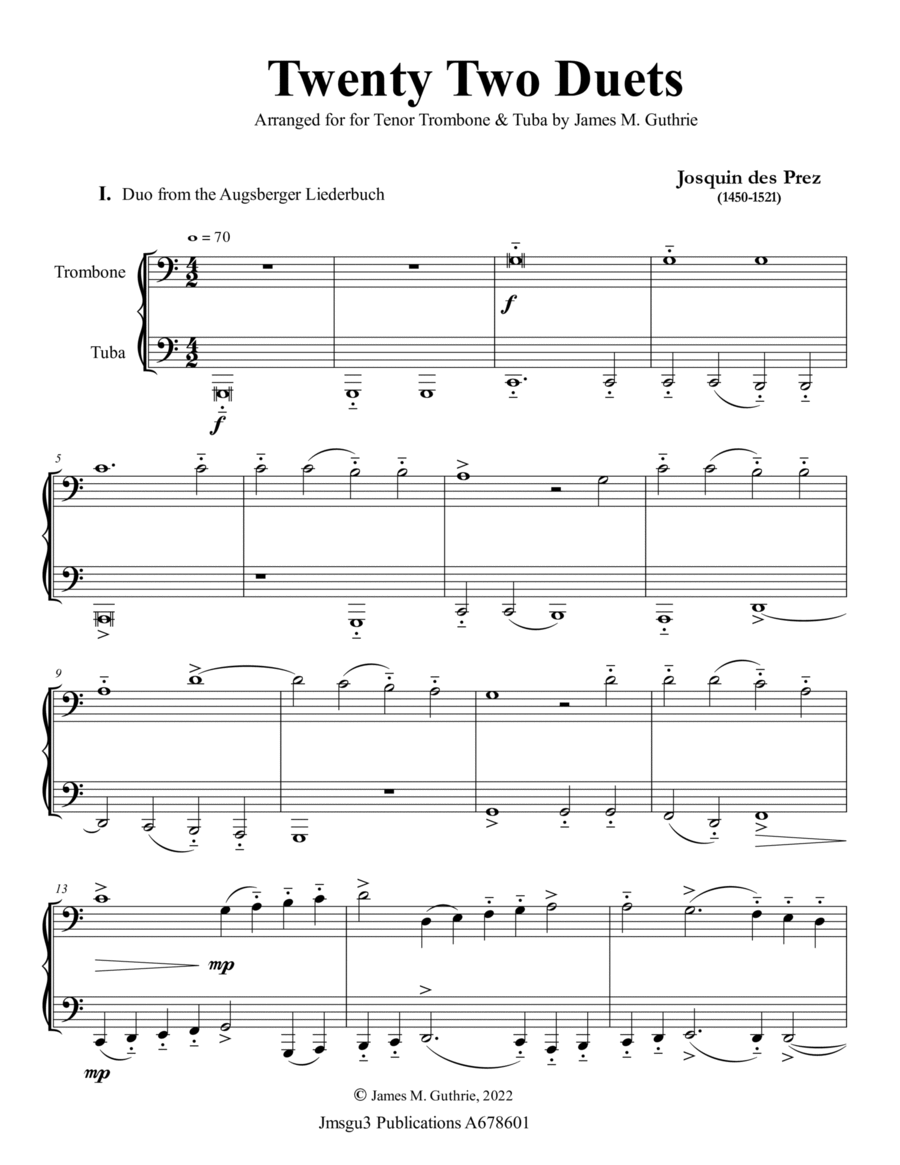
Josquin: 22 Duets for Trombone & Tuba

$32.95 28.71 € PDF SheetMusicPlus

Alto Saxophone,Instrumental Duet,Soprano Saxophone - Level 2 - Digital Download SKU: A0.1074047 Composed by Josquin des Prez. Arranged by James M. Guthrie. Contest,Festival,Instructional,Renaissance,Standards,Wedding. 50 pages. Jmsgu3 #678317. Published by jmsgu3 (A0.1074047). Josquin des Prez (c.1450-1521) was a composer of the Renaissance period, widely regarded as one of the greatest composers of all time. His compositions set the standard for polyphonic music and are considered a high point in the history of music. He wrote a wide range of works, including masses, motets, and chansons, and was the first composer to set popular secular tunes as mass movements. His influence can be seen in the works of many later composers, including Johann Sebastian Bach, Antonio Vivaldi, and George Frideric Handel.Josquin des Prez was a prolific composer of chamber music and duets during the Renaissance period. He wrote several types of chamber music and duets, including madrigals, chansons, and motets. His compositions are characterized by their intricate counterpoint, as well as their harmonic richness and emotional expressiveness. His works often featured two voices in harmony, and he was known to use imitation and complex canonic techniques to create interesting musical textures. Josquin's chamber music and duets are renowned for their complexity and beauty, and they remain some of the most influential and admired works from the Renaissance period.Josquin Desprez is widely regarded as one of the most influential composers of the Renaissance period. His innovative use of counterpoint and canon helped to revolutionize the musical landscape of the time. Counterpoint is a technique of combining two or more independent melodies in a way that creates harmony and a cohesive musical texture. Josquin was a master of this technique, often combining multiple voices in complex contrapuntal textures. His use of canon, or round, was also highly influential. Canon involves two or more voices repeating the same melody in different registers and often with different rhythms. Josquin wrote canons in various styles and forms, including the popular “circular canon†and the more complex “strict canon.†He was also an early adopter of the “inverted canon†form, in which the same melody is repeated but in an inverted form. Josquin’s use of counterpoint and canon had a lasting impact on the development of Western music and helped to establish the foundation for many of the musical forms and techniques still used today.Contents: I. Duo from the Augsberger LiederbuchII. Agnus Dei II from Missa De Beata Virgine III. Duo from the Hör Organ tablatureIV. Agnus Dei II from Missa Ave maris stellaV. Benedictus from Missa GaudeamusVI. Agnus Dei II from Missa GaudeamusVII. Pleni sunt coeli from the Sanctus of Missa Hercules dux Ferrarie VIII. Agnus Dei II from Missa La sol fa re mi IX. Benedictus from Missa L'homme armé super voces musicalesX. Benedictus from Missa L'homme armé Sexti Toni XI. Pleni sunt coeli from Missa Malheur me bat XII. Pleni sunt from Missa Mater patris (canon at the major second)XIII. Benedictus from Missa Mater patris XIV. Agnus Dei II from Missa Mater patris (canon at the unison)XV. Pleni sunt caeli from Missa Pange lingua XVI. Benedictus from Missa Pange lingua XVII. Agnus Dei II from Missa Pange lingua XVIII. Pleni sunt from Missa sine nomine XIX. Domine non secundum peccata nostra XX. Ave verum and Cuius latus XXI. In principio erat verbum from Motet Verbum caro factus est XXII. Per illud ave prolatum - Secunda pars of motet Benedicta es caelorum regina.
Josquin: 22 Duets for Soprano & Alto Sax
2 Saxophones (duo)

$32.95 28.71 € 2 Saxophones (duo) PDF SheetMusicPlus

Cello,Instrumental Duet,Violin - Level 2 - Digital Download SKU: A0.1073996 Composed by Josquin des Prez. Arranged by James M. Guthrie. Contest,Festival,Instructional,Renaissance,Wedding. 50 pages. Jmsgu3 #678264. Published by jmsgu3 (A0.1073996). Josquin des Prez (c.1450-1521) was a composer of the Renaissance period, widely regarded as one of the greatest composers of all time. His compositions set the standard for polyphonic music and are considered a high point in the history of music. He wrote a wide range of works, including masses, motets, and chansons, and was the first composer to set popular secular tunes as mass movements. His influence can be seen in the works of many later composers, including Johann Sebastian Bach, Antonio Vivaldi, and George Frideric Handel.Josquin des Prez was a prolific composer of chamber music and duets during the Renaissance period. He wrote several types of chamber music and duets, including madrigals, chansons, and motets. His compositions are characterized by their intricate counterpoint, as well as their harmonic richness and emotional expressiveness. His works often featured two voices in harmony, and he was known to use imitation and complex canonic techniques to create interesting musical textures. Josquin's chamber music and duets are renowned for their complexity and beauty, and they remain some of the most influential and admired works from the Renaissance period.Josquin Desprez is widely regarded as one of the most influential composers of the Renaissance period. His innovative use of counterpoint and canon helped to revolutionize the musical landscape of the time. Counterpoint is a technique of combining two or more independent melodies in a way that creates harmony and a cohesive musical texture. Josquin was a master of this technique, often combining multiple voices in complex contrapuntal textures. His use of canon, or round, was also highly influential. Canon involves two or more voices repeating the same melody in different registers and often with different rhythms. Josquin wrote canons in various styles and forms, including the popular “circular canon†and the more complex “strict canon.†He was also an early adopter of the “inverted canon†form, in which the same melody is repeated but in an inverted form. Josquin’s use of counterpoint and canon had a lasting impact on the development of Western music and helped to establish the foundation for many of the musical forms and techniques still used today.Contents: I. Duo from the Augsberger LiederbuchII. Agnus Dei II from Missa De Beata Virgine III. Duo from the Hör Organ tablatureIV. Agnus Dei II from Missa Ave maris stellaV. Benedictus from Missa GaudeamusVI. Agnus Dei II from Missa GaudeamusVII. Pleni sunt coeli from the Sanctus of Missa Hercules dux Ferrarie VIII. Agnus Dei II from Missa La sol fa re mi IX. Benedictus from Missa L'homme armé super voces musicalesX. Benedictus from Missa L'homme armé Sexti Toni XI. Pleni sunt coeli from Missa Malheur me bat XII. Pleni sunt from Missa Mater patris (canon at the major second)XIII. Benedictus from Missa Mater patris XIV. Agnus Dei II from Missa Mater patris (canon at the unison)XV. Pleni sunt caeli from Missa Pange lingua XVI. Benedictus from Missa Pange lingua XVII. Agnus Dei II from Missa Pange lingua XVIII. Pleni sunt from Missa sine nomine XIX. Domine non secundum peccata nostra XX. Ave verum and Cuius latus XXI. In principio erat verbum from Motet Verbum caro factus est XXII. Per illud ave prolatum - Secunda pars of motet Benedicta es caelorum regina.

Josquin: 22 Duets for Violin & Cello
Violon, Violoncelle (duo)

$32.95 28.71 € Violon, Violoncelle (duo) PDF SheetMusicPlus

Bassoon,Instrumental Duet,Oboe d'Amore - Level 2 - Digital Download SKU: A0.1073999 Composed by Josquin des Prez. Arranged by James M. Guthrie. Contest,Festival,Instructional,Renaissance,Wedding. 50 pages. Jmsgu3 #678267. Published by jmsgu3 (A0.1073999). Josquin des Prez (c.1450-1521) was a composer of the Renaissance period, widely regarded as one of the greatest composers of all time. His compositions set the standard for polyphonic music and are considered a high point in the history of music. He wrote a wide range of works, including masses, motets, and chansons, and was the first composer to set popular secular tunes as mass movements. His influence can be seen in the works of many later composers, including Johann Sebastian Bach, Antonio Vivaldi, and George Frideric Handel.Josquin des Prez was a prolific composer of chamber music and duets during the Renaissance period. He wrote several types of chamber music and duets, including madrigals, chansons, and motets. His compositions are characterized by their intricate counterpoint, as well as their harmonic richness and emotional expressiveness. His works often featured two voices in harmony, and he was known to use imitation and complex canonic techniques to create interesting musical textures. Josquin's chamber music and duets are renowned for their complexity and beauty, and they remain some of the most influential and admired works from the Renaissance period.Josquin Desprez is widely regarded as one of the most influential composers of the Renaissance period. His innovative use of counterpoint and canon helped to revolutionize the musical landscape of the time. Counterpoint is a technique of combining two or more independent melodies in a way that creates harmony and a cohesive musical texture. Josquin was a master of this technique, often combining multiple voices in complex contrapuntal textures. His use of canon, or round, was also highly influential. Canon involves two or more voices repeating the same melody in different registers and often with different rhythms. Josquin wrote canons in various styles and forms, including the popular “circular canon†and the more complex “strict canon.†He was also an early adopter of the “inverted canon†form, in which the same melody is repeated but in an inverted form. Josquin’s use of counterpoint and canon had a lasting impact on the development of Western music and helped to establish the foundation for many of the musical forms and techniques still used today.Contents: I. Duo from the Augsberger LiederbuchII. Agnus Dei II from Missa De Beata Virgine III. Duo from the Hör Organ tablatureIV. Agnus Dei II from Missa Ave maris stellaV. Benedictus from Missa GaudeamusVI. Agnus Dei II from Missa GaudeamusVII. Pleni sunt coeli from the Sanctus of Missa Hercules dux Ferrarie VIII. Agnus Dei II from Missa La sol fa re mi IX. Benedictus from Missa L'homme armé super voces musicalesX. Benedictus from Missa L'homme armé Sexti Toni XI. Pleni sunt coeli from Missa Malheur me bat XII. Pleni sunt from Missa Mater patris (canon at the major second)XIII. Benedictus from Missa Mater patris XIV. Agnus Dei II from Missa Mater patris (canon at the unison)XV. Pleni sunt caeli from Missa Pange lingua XVI. Benedictus from Missa Pange lingua XVII. Agnus Dei II from Missa Pange lingua XVIII. Pleni sunt from Missa sine nomine XIX. Domine non secundum peccata nostra XX. Ave verum and Cuius latus XXI. In principio erat verbum from Motet Verbum caro factus est XXII. Per illud ave prolatum - Secunda pars of motet Benedicta es caelorum regina.

Josquin: 22 Duets for Oboe d'Amore & Bassoon

$32.95 28.71 € PDF SheetMusicPlus

Cello,Instrumental Duet,Oboe - Level 2 - Digital Download SKU: A0.1074014 Composed by Josquin des Prez. Arranged by James M. Guthrie. Contest,Festival,Instructional,Renaissance,Traditional,Wedding. 50 pages. Jmsgu3 #678282. Published by jmsgu3 (A0.1074014). Josquin des Prez (c.1450-1521) was a composer of the Renaissance period, widely regarded as one of the greatest composers of all time. His compositions set the standard for polyphonic music and are considered a high point in the history of music. He wrote a wide range of works, including masses, motets, and chansons, and was the first composer to set popular secular tunes as mass movements. His influence can be seen in the works of many later composers, including Johann Sebastian Bach, Antonio Vivaldi, and George Frideric Handel.Josquin des Prez was a prolific composer of chamber music and duets during the Renaissance period. He wrote several types of chamber music and duets, including madrigals, chansons, and motets. His compositions are characterized by their intricate counterpoint, as well as their harmonic richness and emotional expressiveness. His works often featured two voices in harmony, and he was known to use imitation and complex canonic techniques to create interesting musical textures. Josquin's chamber music and duets are renowned for their complexity and beauty, and they remain some of the most influential and admired works from the Renaissance period.Josquin Desprez is widely regarded as one of the most influential composers of the Renaissance period. His innovative use of counterpoint and canon helped to revolutionize the musical landscape of the time. Counterpoint is a technique of combining two or more independent melodies in a way that creates harmony and a cohesive musical texture. Josquin was a master of this technique, often combining multiple voices in complex contrapuntal textures. His use of canon, or round, was also highly influential. Canon involves two or more voices repeating the same melody in different registers and often with different rhythms. Josquin wrote canons in various styles and forms, including the popular “circular canon†and the more complex “strict canon.†He was also an early adopter of the “inverted canon†form, in which the same melody is repeated but in an inverted form. Josquin’s use of counterpoint and canon had a lasting impact on the development of Western music and helped to establish the foundation for many of the musical forms and techniques still used today.Contents: I. Duo from the Augsberger LiederbuchII. Agnus Dei II from Missa De Beata Virgine III. Duo from the Hör Organ tablatureIV. Agnus Dei II from Missa Ave maris stellaV. Benedictus from Missa GaudeamusVI. Agnus Dei II from Missa GaudeamusVII. Pleni sunt coeli from the Sanctus of Missa Hercules dux Ferrarie VIII. Agnus Dei II from Missa La sol fa re mi IX. Benedictus from Missa L'homme armé super voces musicalesX. Benedictus from Missa L'homme armé Sexti Toni XI. Pleni sunt coeli from Missa Malheur me bat XII. Pleni sunt from Missa Mater patris (canon at the major second)XIII. Benedictus from Missa Mater patris XIV. Agnus Dei II from Missa Mater patris (canon at the unison)XV. Pleni sunt caeli from Missa Pange lingua XVI. Benedictus from Missa Pange lingua XVII. Agnus Dei II from Missa Pange lingua XVIII. Pleni sunt from Missa sine nomine XIX. Domine non secundum peccata nostra XX. Ave verum and Cuius latus XXI. In principio erat verbum from Motet Verbum caro factus est XXII. Per illud ave prolatum - Secunda pars of motet Benedicta es caelorum regina.

Josquin: 22 Duets for Oboe & Cello
Hautbois, Violoncelle

$32.95 28.71 € Hautbois, Violoncelle PDF SheetMusicPlus

Contrabassoon,Instrumental Duet - Level 2 - Digital Download SKU: A0.1074025 Composed by Josquin des Prez. Arranged by James M. Guthrie. Contest,Festival,Instructional,Renaissance,Traditional,Wedding. 50 pages. Jmsgu3 #678293. Published by jmsgu3 (A0.1074025). Josquin des Prez (c.1450-1521) was a composer of the Renaissance period, widely regarded as one of the greatest composers of all time. His compositions set the standard for polyphonic music and are considered a high point in the history of music. He wrote a wide range of works, including masses, motets, and chansons, and was the first composer to set popular secular tunes as mass movements. His influence can be seen in the works of many later composers, including Johann Sebastian Bach, Antonio Vivaldi, and George Frideric Handel.Josquin des Prez was a prolific composer of chamber music and duets during the Renaissance period. He wrote several types of chamber music and duets, including madrigals, chansons, and motets. His compositions are characterized by their intricate counterpoint, as well as their harmonic richness and emotional expressiveness. His works often featured two voices in harmony, and he was known to use imitation and complex canonic techniques to create interesting musical textures. Josquin's chamber music and duets are renowned for their complexity and beauty, and they remain some of the most influential and admired works from the Renaissance period.Josquin Desprez is widely regarded as one of the most influential composers of the Renaissance period. His innovative use of counterpoint and canon helped to revolutionize the musical landscape of the time. Counterpoint is a technique of combining two or more independent melodies in a way that creates harmony and a cohesive musical texture. Josquin was a master of this technique, often combining multiple voices in complex contrapuntal textures. His use of canon, or round, was also highly influential. Canon involves two or more voices repeating the same melody in different registers and often with different rhythms. Josquin wrote canons in various styles and forms, including the popular “circular canon†and the more complex “strict canon.†He was also an early adopter of the “inverted canon†form, in which the same melody is repeated but in an inverted form. Josquin’s use of counterpoint and canon had a lasting impact on the development of Western music and helped to establish the foundation for many of the musical forms and techniques still used today.Contents: I. Duo from the Augsberger LiederbuchII. Agnus Dei II from Missa De Beata Virgine III. Duo from the Hör Organ tablatureIV. Agnus Dei II from Missa Ave maris stellaV. Benedictus from Missa GaudeamusVI. Agnus Dei II from Missa GaudeamusVII. Pleni sunt coeli from the Sanctus of Missa Hercules dux Ferrarie VIII. Agnus Dei II from Missa La sol fa re mi IX. Benedictus from Missa L'homme armé super voces musicalesX. Benedictus from Missa L'homme armé Sexti Toni XI. Pleni sunt coeli from Missa Malheur me bat XII. Pleni sunt from Missa Mater patris (canon at the major second)XIII. Benedictus from Missa Mater patris XIV. Agnus Dei II from Missa Mater patris (canon at the unison)XV. Pleni sunt caeli from Missa Pange lingua XVI. Benedictus from Missa Pange lingua XVII. Agnus Dei II from Missa Pange lingua XVIII. Pleni sunt from Missa sine nomine XIX. Domine non secundum peccata nostra XX. Ave verum and Cuius latus XXI. In principio erat verbum from Motet Verbum caro factus est XXII. Per illud ave prolatum - Secunda pars of motet Benedicta es caelorum regina.

Josquin: 22 Duets for Bassoon & Contrabassoon

$32.95 28.71 € PDF SheetMusicPlus

Baritone Horn TC,Bass Trombone,Instrumental Duet - Level 3 - Digital Download SKU: A0.1074280 Composed by Josquin des Prez. Arranged by James M. Guthrie. Contest,Festival,Instructional,Renaissance,Traditional,Wedding. 50 pages. Jmsgu3 #678573. Published by jmsgu3 (A0.1074280). Josquin des Prez (c.1450-1521) was a composer of the Renaissance period, widely regarded as one of the greatest composers of all time. His compositions set the standard for polyphonic music and are considered a high point in the history of music. He wrote a wide range of works, including masses, motets, and chansons, and was the first composer to set popular secular tunes as mass movements. His influence can be seen in the works of many later composers, including Johann Sebastian Bach, Antonio Vivaldi, and George Frideric Handel.Josquin des Prez was a prolific composer of chamber music and duets during the Renaissance period. He wrote several types of chamber music and duets, including madrigals, chansons, and motets. His compositions are characterized by their intricate counterpoint, as well as their harmonic richness and emotional expressiveness. His works often featured two voices in harmony, and he was known to use imitation and complex canonic techniques to create interesting musical textures. Josquin's chamber music and duets are renowned for their complexity and beauty, and they remain some of the most influential and admired works from the Renaissance period.Josquin Desprez is widely regarded as one of the most influential composers of the Renaissance period. His innovative use of counterpoint and canon helped to revolutionize the musical landscape of the time. Counterpoint is a technique of combining two or more independent melodies in a way that creates harmony and a cohesive musical texture. Josquin was a master of this technique, often combining multiple voices in complex contrapuntal textures. His use of canon, or round, was also highly influential. Canon involves two or more voices repeating the same melody in different registers and often with different rhythms. Josquin wrote canons in various styles and forms, including the popular “circular canon†and the more complex “strict canon.†He was also an early adopter of the “inverted canon†form, in which the same melody is repeated but in an inverted form. Josquin’s use of counterpoint and canon had a lasting impact on the development of Western music and helped to establish the foundation for many of the musical forms and techniques still used today.Contents: I. Duo from the Augsberger LiederbuchII. Agnus Dei II from Missa De Beata Virgine III. Duo from the Hör Organ tablatureIV. Agnus Dei II from Missa Ave maris stellaV. Benedictus from Missa GaudeamusVI. Agnus Dei II from Missa GaudeamusVII. Pleni sunt coeli from the Sanctus of Missa Hercules dux Ferrarie VIII. Agnus Dei II from Missa La sol fa re mi IX. Benedictus from Missa L'homme armé super voces musicalesX. Benedictus from Missa L'homme armé Sexti Toni XI. Pleni sunt coeli from Missa Malheur me bat XII. Pleni sunt from Missa Mater patris (canon at the major second)XIII. Benedictus from Missa Mater patris XIV. Agnus Dei II from Missa Mater patris (canon at the unison)XV. Pleni sunt caeli from Missa Pange lingua XVI. Benedictus from Missa Pange lingua XVII. Agnus Dei II from Missa Pange lingua XVIII. Pleni sunt from Missa sine nomine XIX. Domine non secundum peccata nostra XX. Ave verum and Cuius latus XXI. In principio erat verbum from Motet Verbum caro factus est XXII. Per illud ave prolatum - Secunda pars of motet Benedicta es caelorum regina.

Josquin: 22 Duets for Baritone Horn & Bass Trombone

$32.95 28.71 € PDF SheetMusicPlus

B-Flat Clarinet,Cello,Instrumental Duet - Level 2 - Digital Download SKU: A0.1074010 Composed by Josquin des Prez. Arranged by James M. Guthrie. Contest,Festival,Instructional,Renaissance,Traditional,Wedding. 50 pages. Jmsgu3 #678278. Published by jmsgu3 (A0.1074010). Josquin des Prez (c.1450-1521) was a composer of the Renaissance period, widely regarded as one of the greatest composers of all time. His compositions set the standard for polyphonic music and are considered a high point in the history of music. He wrote a wide range of works, including masses, motets, and chansons, and was the first composer to set popular secular tunes as mass movements. His influence can be seen in the works of many later composers, including Johann Sebastian Bach, Antonio Vivaldi, and George Frideric Handel.Josquin des Prez was a prolific composer of chamber music and duets during the Renaissance period. He wrote several types of chamber music and duets, including madrigals, chansons, and motets. His compositions are characterized by their intricate counterpoint, as well as their harmonic richness and emotional expressiveness. His works often featured two voices in harmony, and he was known to use imitation and complex canonic techniques to create interesting musical textures. Josquin's chamber music and duets are renowned for their complexity and beauty, and they remain some of the most influential and admired works from the Renaissance period.Josquin Desprez is widely regarded as one of the most influential composers of the Renaissance period. His innovative use of counterpoint and canon helped to revolutionize the musical landscape of the time. Counterpoint is a technique of combining two or more independent melodies in a way that creates harmony and a cohesive musical texture. Josquin was a master of this technique, often combining multiple voices in complex contrapuntal textures. His use of canon, or round, was also highly influential. Canon involves two or more voices repeating the same melody in different registers and often with different rhythms. Josquin wrote canons in various styles and forms, including the popular “circular canon†and the more complex “strict canon.†He was also an early adopter of the “inverted canon†form, in which the same melody is repeated but in an inverted form. Josquin’s use of counterpoint and canon had a lasting impact on the development of Western music and helped to establish the foundation for many of the musical forms and techniques still used today.Contents: I. Duo from the Augsberger LiederbuchII. Agnus Dei II from Missa De Beata Virgine III. Duo from the Hör Organ tablatureIV. Agnus Dei II from Missa Ave maris stellaV. Benedictus from Missa GaudeamusVI. Agnus Dei II from Missa GaudeamusVII. Pleni sunt coeli from the Sanctus of Missa Hercules dux Ferrarie VIII. Agnus Dei II from Missa La sol fa re mi IX. Benedictus from Missa L'homme armé super voces musicalesX. Benedictus from Missa L'homme armé Sexti Toni XI. Pleni sunt coeli from Missa Malheur me bat XII. Pleni sunt from Missa Mater patris (canon at the major second)XIII. Benedictus from Missa Mater patris XIV. Agnus Dei II from Missa Mater patris (canon at the unison)XV. Pleni sunt caeli from Missa Pange lingua XVI. Benedictus from Missa Pange lingua XVII. Agnus Dei II from Missa Pange lingua XVIII. Pleni sunt from Missa sine nomine XIX. Domine non secundum peccata nostra XX. Ave verum and Cuius latus XXI. In principio erat verbum from Motet Verbum caro factus est XXII. Per illud ave prolatum - Secunda pars of motet Benedicta es caelorum regina.

Josquin: 22 Duets for Clarinet & Cello
Clarinette, Violoncelle (duo)

$32.95 28.71 € Clarinette, Violoncelle (duo) PDF SheetMusicPlus

Bassoon,Instrumental Duet,Oboe - Level 2 - Digital Download SKU: A0.1073981 Composed by Josquin des Prez. Arranged by James M. Guthrie. Contest,Festival,Instructional,Renaissance,Wedding. 50 pages. Jmsgu3 #678247. Published by jmsgu3 (A0.1073981). Josquin des Prez (c.1450-1521) was a composer of the Renaissance period, widely regarded as one of the greatest composers of all time. His compositions set the standard for polyphonic music and are considered a high point in the history of music. He wrote a wide range of works, including masses, motets, and chansons, and was the first composer to set popular secular tunes as mass movements. His influence can be seen in the works of many later composers, including Johann Sebastian Bach, Antonio Vivaldi, and George Frideric Handel.Josquin des Prez was a prolific composer of chamber music and duets during the Renaissance period. He wrote several types of chamber music and duets, including madrigals, chansons, and motets. His compositions are characterized by their intricate counterpoint, as well as their harmonic richness and emotional expressiveness. His works often featured two voices in harmony, and he was known to use imitation and complex canonic techniques to create interesting musical textures. Josquin's chamber music and duets are renowned for their complexity and beauty, and they remain some of the most influential and admired works from the Renaissance period.Josquin Desprez is widely regarded as one of the most influential composers of the Renaissance period. His innovative use of counterpoint and canon helped to revolutionize the musical landscape of the time. Counterpoint is a technique of combining two or more independent melodies in a way that creates harmony and a cohesive musical texture. Josquin was a master of this technique, often combining multiple voices in complex contrapuntal textures. His use of canon, or round, was also highly influential. Canon involves two or more voices repeating the same melody in different registers and often with different rhythms. Josquin wrote canons in various styles and forms, including the popular “circular canon†and the more complex “strict canon.†He was also an early adopter of the “inverted canon†form, in which the same melody is repeated but in an inverted form. Josquin’s use of counterpoint and canon had a lasting impact on the development of Western music and helped to establish the foundation for many of the musical forms and techniques still used today.Contents: I. Duo from the Augsberger LiederbuchII. Agnus Dei II from Missa De Beata Virgine III. Duo from the Hör Organ tablatureIV. Agnus Dei II from Missa Ave maris stellaV. Benedictus from Missa GaudeamusVI. Agnus Dei II from Missa GaudeamusVII. Pleni sunt coeli from the Sanctus of Missa Hercules dux Ferrarie VIII. Agnus Dei II from Missa La sol fa re mi IX. Benedictus from Missa L'homme armé super voces musicalesX. Benedictus from Missa L'homme armé Sexti Toni XI. Pleni sunt coeli from Missa Malheur me bat XII. Pleni sunt from Missa Mater patris (canon at the major second)XIII. Benedictus from Missa Mater patris XIV. Agnus Dei II from Missa Mater patris (canon at the unison)XV. Pleni sunt caeli from Missa Pange lingua XVI. Benedictus from Missa Pange lingua XVII. Agnus Dei II from Missa Pange lingua XVIII. Pleni sunt from Missa sine nomine XIX. Domine non secundum peccata nostra XX. Ave verum and Cuius latus XXI. In principio erat verbum from Motet Verbum caro factus est XXII. Per illud ave prolatum - Secunda pars of motet Benedicta es caelorum regina.
Josquin: 22 Duets for Oboe & Bassoon
Hautbois, Basson (duo)

$32.95 28.71 € Hautbois, Basson (duo) PDF SheetMusicPlus

Bass Trombone,Horn,Instrumental Duet - Level 3 - Digital Download SKU: A0.1074291 Composed by Josquin des Prez. Arranged by James M. Guthrie. Contest,Festival,Instructional,Renaissance,Traditional,Wedding. 50 pages. Jmsgu3 #678587. Published by jmsgu3 (A0.1074291). Josquin des Prez (c.1450-1521) was a composer of the Renaissance period, widely regarded as one of the greatest composers of all time. His compositions set the standard for polyphonic music and are considered a high point in the history of music. He wrote a wide range of works, including masses, motets, and chansons, and was the first composer to set popular secular tunes as mass movements. His influence can be seen in the works of many later composers, including Johann Sebastian Bach, Antonio Vivaldi, and George Frideric Handel.Josquin des Prez was a prolific composer of chamber music and duets during the Renaissance period. He wrote several types of chamber music and duets, including madrigals, chansons, and motets. His compositions are characterized by their intricate counterpoint, as well as their harmonic richness and emotional expressiveness. His works often featured two voices in harmony, and he was known to use imitation and complex canonic techniques to create interesting musical textures. Josquin's chamber music and duets are renowned for their complexity and beauty, and they remain some of the most influential and admired works from the Renaissance period.Josquin Desprez is widely regarded as one of the most influential composers of the Renaissance period. His innovative use of counterpoint and canon helped to revolutionize the musical landscape of the time. Counterpoint is a technique of combining two or more independent melodies in a way that creates harmony and a cohesive musical texture. Josquin was a master of this technique, often combining multiple voices in complex contrapuntal textures. His use of canon, or round, was also highly influential. Canon involves two or more voices repeating the same melody in different registers and often with different rhythms. Josquin wrote canons in various styles and forms, including the popular “circular canon†and the more complex “strict canon.†He was also an early adopter of the “inverted canon†form, in which the same melody is repeated but in an inverted form. Josquin’s use of counterpoint and canon had a lasting impact on the development of Western music and helped to establish the foundation for many of the musical forms and techniques still used today.Contents: I. Duo from the Augsberger LiederbuchII. Agnus Dei II from Missa De Beata Virgine III. Duo from the Hör Organ tablatureIV. Agnus Dei II from Missa Ave maris stellaV. Benedictus from Missa GaudeamusVI. Agnus Dei II from Missa GaudeamusVII. Pleni sunt coeli from the Sanctus of Missa Hercules dux Ferrarie VIII. Agnus Dei II from Missa La sol fa re mi IX. Benedictus from Missa L'homme armé super voces musicalesX. Benedictus from Missa L'homme armé Sexti Toni XI. Pleni sunt coeli from Missa Malheur me bat XII. Pleni sunt from Missa Mater patris (canon at the major second)XIII. Benedictus from Missa Mater patris XIV. Agnus Dei II from Missa Mater patris (canon at the unison)XV. Pleni sunt caeli from Missa Pange lingua XVI. Benedictus from Missa Pange lingua XVII. Agnus Dei II from Missa Pange lingua XVIII. Pleni sunt from Missa sine nomine XIX. Domine non secundum peccata nostra XX. Ave verum and Cuius latus XXI. In principio erat verbum from Motet Verbum caro factus est XXII. Per illud ave prolatum - Secunda pars of motet Benedicta es caelorum regina.
Josquin: 22 Duets for French Horn & Bass Trombone

$32.95 28.71 € PDF SheetMusicPlus

Clarinet Duet Bass Clarinet - Level 2 - Digital Download SKU: A0.1074017 Composed by Josquin des Prez. Arranged by James M. Guthrie. Contest,Festival,Instructional,Renaissance,Traditional,Wedding. 2 scores. 50 pages. Jmsgu3 #678286. Published by jmsgu3 (A0.1074017). Josquin des Prez (c.1450-1521) was a composer of the Renaissance period, widely regarded as one of the greatest composers of all time. His compositions set the standard for polyphonic music and are considered a high point in the history of music. He wrote a wide range of works, including masses, motets, and chansons, and was the first composer to set popular secular tunes as mass movements. His influence can be seen in the works of many later composers, including Johann Sebastian Bach, Antonio Vivaldi, and George Frideric Handel.Josquin des Prez was a prolific composer of chamber music and duets during the Renaissance period. He wrote several types of chamber music and duets, including madrigals, chansons, and motets. His compositions are characterized by their intricate counterpoint, as well as their harmonic richness and emotional expressiveness. His works often featured two voices in harmony, and he was known to use imitation and complex canonic techniques to create interesting musical textures. Josquin's chamber music and duets are renowned for their complexity and beauty, and they remain some of the most influential and admired works from the Renaissance period.Josquin Desprez is widely regarded as one of the most influential composers of the Renaissance period. His innovative use of counterpoint and canon helped to revolutionize the musical landscape of the time. Counterpoint is a technique of combining two or more independent melodies in a way that creates harmony and a cohesive musical texture. Josquin was a master of this technique, often combining multiple voices in complex contrapuntal textures. His use of canon, or round, was also highly influential. Canon involves two or more voices repeating the same melody in different registers and often with different rhythms. Josquin wrote canons in various styles and forms, including the popular “circular canon†and the more complex “strict canon.†He was also an early adopter of the “inverted canon†form, in which the same melody is repeated but in an inverted form. Josquin’s use of counterpoint and canon had a lasting impact on the development of Western music and helped to establish the foundation for many of the musical forms and techniques still used today.Contents: I. Duo from the Augsberger LiederbuchII. Agnus Dei II from Missa De Beata Virgine III. Duo from the Hör Organ tablatureIV. Agnus Dei II from Missa Ave maris stellaV. Benedictus from Missa GaudeamusVI. Agnus Dei II from Missa GaudeamusVII. Pleni sunt coeli from the Sanctus of Missa Hercules dux Ferrarie VIII. Agnus Dei II from Missa La sol fa re mi IX. Benedictus from Missa L'homme armé super voces musicalesX. Benedictus from Missa L'homme armé Sexti Toni XI. Pleni sunt coeli from Missa Malheur me bat XII. Pleni sunt from Missa Mater patris (canon at the major second)XIII. Benedictus from Missa Mater patris XIV. Agnus Dei II from Missa Mater patris (canon at the unison)XV. Pleni sunt caeli from Missa Pange lingua XVI. Benedictus from Missa Pange lingua XVII. Agnus Dei II from Missa Pange lingua XVIII. Pleni sunt from Missa sine nomine XIX. Domine non secundum peccata nostra XX. Ave verum and Cuius latus XXI. In principio erat verbum from Motet Verbum caro factus est XXII. Per illud ave prolatum - Secunda pars of motet Benedicta es caelorum regina.
Josquin: 22 Duets for Clarinet & Bass Clarinet
2 Clarinettes (duo)

$32.95 28.71 € 2 Clarinettes (duo) PDF SheetMusicPlus

Descant recorder - Digital Download SKU: S9.Q50450 A comprehensive method for group, individual and self tuition. This edition: student's book. Book. Op. Vol. 2. Schott Music - Digital #Q50450. Published by Schott Music - Digital (S9.Q50450). English.The best way to learn any instrument is to have lessons from a good, experienced teacher. Although, happily, the number of such teachers is constantly growing, the recorder is still frequently taught by enthusiastic but inexperienced teachers and many players start by teaching themselves. This series of books sets out to help learners of all ages in all three situations. Experienced teachers, who may choose to disregard much of the text as personal demonstration is always clearer than the written word, will find exercises and fine tunes a-plenty to support their own method at each stage. The less experienced will benefit from many valuable teaching hints culled from long experience and may rely on the books to lead to a sound playing technique and a mastery of simple notation. Those learning by themselves - and I started in this way - are urged to work carefully and systematically through the books, taking plenty of time to assimilate each point before moving on. For them, without the personal model provided by a live teacher, it is vitally important to listen as often as possible to fine players, in person or on record, so that they have in their mind's ear a clear notion of the kind of sound they would like to produce. But however they start, I can only wish that all who use these books will derive as much pleasure and musical satisfaction and gain as many lasting and valued friendships as I have through this most subtle, delightful and sociable of instruments. (Brian Bonsor) “...this work is likely to become a standard work very quickly and is to be recommended to all schools where recorder studies are undertaken“ (Oliver James, Contact Magazine) Descant Tutors provide a sound-playing technique, a mastery of simple notation and contain 570 tunes including concert pieces by Bonsor, carols, attractive rounds, and melodies by 'early music' composers. Clear line drawings greatly assist the pupil, making them especially suitable for self-instruction.
Enjoy the Recorder
Flûte à bec Soprano

$15.99 13.93 € Flûte à bec Soprano PDF SheetMusicPlus


Partitions Gratuites
Acheter des Partitions Musicales
Acheter des Partitions Digitales à Imprimer
Acheter des Instruments de Musique

© 2000 - 2026

Accueil - Version intégrale