EUROPE
951 articles
USA
0 articles
DIGITAL
3841 articles (à imprimer)
Partitions Digitales
Partitions à imprimer
3841 partitions trouvées


Piano Solo - Level 4 - Digital Download SKU: A0.499760 Composed by S. G. Potts. 20th Century,Contemporary,Romantic Period,Standards. Score. 18 pages. S. G. Potts #3512109. Published by S. G. Potts (A0.499760). The Raymond Variations for Piano (Set 1),  received its world premiere on 2nd December 2015 at the 1901 Arts Club London,  performed by Lorraine Womack-Banning as part of a memorial tribute concert to  her late husband Raymond Banning (former professor of pianoforte at Trinity  College London). The Variations  are based on the three Andantino themes which form a central part of the ‘Raymond  Overture’ written in 1851 by French composer Ambroise Thomas: 1811-1896. There are nine piano variations in total; these include a  mix of both full and short partial variations (including a very short  declamatory two chord introductory variation). The variations are not numbered  or set-apart in a conventional manner, rather they form part of a continuous  whole, and are separated only by bridge passages and/or cadence points; they last  a little under eight minutes in duration, and strongly exploit the passionate  elements of Thomas’s themes. They have been written for the most part in an  accessible tonal style (with a passing nod to Messrs. Beethoven and J.S. Bach) and  are based predominately in the home key of D minor, but they do also take  advantage of many 20th and 21st century harmonic techniques where deemed appropriate: e.g. added note chords; cluster chords; percussive chords, and melodic  deflection. In particular, the interval of the major 7th and its enharmonic  equivalent(s) (the most distinctive interval in the main andantino theme from   the overture) is heard in various different guises throughout the variations:  this includes its inversion the minor 2nd which has a very distinctive sharp  dissonant quality. Much play is made of these intervals – to somewhat humorous  effect in variation 8 (the joker in the pack) heard some three quarters into  the set, here the dissonant interval is pounded out double forte before hastily  leading into some boisterous cluster harmonic instability; then quietly begins  variation 9 which duly brings the set to a close. Look out for the sting in the tail!
The Raymond Variations for Piano (Set 1)
Piano seul

$9.99 8.67 € Piano seul PDF SheetMusicPlus

String Trio Cello,Viola,Violin - Level 3 - Digital Download SKU: A0.1488228 Composed by William Shield. Arranged by Robert Hoskins. Classical. 27 pages. Artaria Editions #1065115. Published by Artaria Editions (A0.1488228). Shield's Trios, written for a continental audience, are seminal works in the composer's output and mark a new level of compositional attainment in the English chamber music repertory. Technically, they contain a wide variety of ideas which are developed with great ingenuity through a wide range of keys, dynamic contrasts and timbral effects. Aesthetically, they blend 'popular' and 'learned' taste along with 'orchestral' splendour and 18th century notions of beauty. The Trios present a dazzling range of moods and style with each work demonstrating Shield's mastery of the idiom, both in his treatment of individual instruments and in the handling of textures. While there is no shortage of melody and accompaniment, in which the violin takes the lead, there are many memorable solos for the viola and the cello in its high register. The wide range of textures includes melodic decoration, dialogue, contrast of high and low register, legato and staccato, powerful unison and double octaves. Shield's ability to incorporate arioso-like melody, the prevailing 'symphonic' style and folk elements was largely achieved through the cross-generic requirements of English comic opera (a form to which Shield devoted himself during the whole of his creative career). In general, Shield's technique results in a firm control of the way music moves - with sometimes a surprising degree of stylistic restlessness and sometimes of unexpected plainness and simplicity. The trios Shield selected for publication were issued by Longman and Broderip, London, in January 1796 under the inspection of the composer. No autograph of these works survives and Longman and Broderip's printing, a copy of which is preserved in the Bodleian Library, Oxford, under the call number Mus.Instr.I 214(15), is the only source of this edition. The title page, with its dedicatory inscription, reads: Six / TRIOS / FOR / Violin, Tenor and Violoncello, / Composed / And Inscribed to the Memory of / Jacob More Esqr. / By / Wm. SHIELD./ (Musician in Ordinary to His Majesty) / Entd. At Statn. Hall [rule] Price 10/6 / ADVERTISEMENT / These Trios were Composed chiefly for the abovementioned Celebrated Landscape Painter (in Rome) / And are Dedicated to his Memory as a Token of Gratitude for the Services he rendered the Author / during his Residence in that City. The movements which are written in the uncommon Time / of 5/4 have amused some of the most distinguished Professors both in England & Italy which / induces the Author to hope they will not be disagreeable to the Public at Large / Goodge Street, Jany. 1st 1796 / [rule] / London, Printed for the Author by Longman & Broderip, No.26, Cheapside & No.13, Haymarket. Shield's three previously unpublished string trios are preserved in autograph score in the British Library under the call number Ms.Add.51015; they provide the only source for this edition. This present edition presents as faithfully as possible the intentions of these sources. The style and notation of articulation and dynamic markings have been standardised throughout and, where missing, markings have been reconstructed from parallel passages. The notation of appoggiature has also been standardised to minimise confusion. Obvious wrong notes have been corrected without comment; editorial emendations with no authority from the source are placed within brackets. Robert Hoskins.
String Trio No. 3 in A major
Trio à Cordes: violon, alto, violoncelle
/ Wm SHIELD
$49.00 42.55 € Trio à Cordes: violon, alto, violoncelle PDF SheetMusicPlus

Trombone Solo - Level 3 - Digital Download SKU: A0.811087 Composed by Tom Ervin. Arranged by Marco Bordogni. Classical,Instructional,Opera,Romantic Period. Individual part. 26 pages. Gordon Cherry #5009439. Published by Gordon Cherry (A0.811087). The Rochut editions of Bordogni’s vocalises have become the most widly used etudes in American trombone pedigogy. They are prized for their lyric beauty, and also for their development of endurance, upper range, legato technique, styling and more. Other bass clef instrumentalists use Rochut. These Twenty Counterparts may be practiced and played as etudes alone. They are similar in style to the Bordogni; some are harder and some are easier than the Bordogni originals. But the primary intent was for recreational duet playing and for the trombone studio. Duets are fun and more, contributing to sightreading, intonation, ensemble, style-matching, confidence, independence, etc. As with the piano accompaniments, the duet parts also enhance the original melodies. Read what these famous trombonists have to say about this new contribution to the trombone literature …indisputably one of the most invaluable additions to appear in a very long time. Understanding lyricism is much easier when hearing this second voice. Joseph Alessi, Principal Trombone, New York Philharmonic …fantastic and beautiful. What a great idea! They will give the student a wonderful sense of music-making. Henry Charles Smith, Arizona State University …absolutely ingenious….they capture the essential character of each piece and cleverly expand and enhance the original material. Can be ‘stand alone’ material in its own right. I have already used them successfully on trombone, euphonium, and tuba. Loren Marsteller, Los Angeles An enjoyable new way to play the old favorites. Perform them with friends; record one part and play the other; play them alone…a great idea. Ralph Sauer, Principal Trombone Los Angeles Philharmonic A great book and a great idea! Really valuable; I am using it in my teaching. Jay Friedman, Principal Trombone, Chicago Symphony Orchestra Excellent studies, challenging in all registers, rewarding to play. Ned Meredith, formerly San Francisco Symphony Orchestra A very insightful and fresh approach to the trombone’s most important collection of etudes…destined to become a standard in the trombone literature. An absolute must! Michael Davis, jazz recording artist, New York City The unexpected harmonic progressions are a delight. They work great for euphoniums and for trombone and tuba R. Winston Morris, Tennessee Technological University …similar to the Rochut yet contains challenging rhythmic independence and contrast, increasing the value of ensemble experience. As an aid to duet performance, the measure, staff and page format is arranged the same as Rochut’s Fischer edition. Glenn P. Smith, Professor Emeritus University of Michigan A fine addition to the lyrical literature Charles Vernon, Bass Trombone Chicago Symphony Orchestra They’re not only enjoyable to play, but add some ‘zip’, harmonically, melodically, and rhythmically, to the original melodies. Buddy Baker University of Northern Colorado Compositionally, very interesting, not just a duet in thirds…stylistically appropriate…a great way to begin a lesson. Vern Kagarice, University of North Texas An outstanding idea, very valuable Keith Brown, Indiana University I enjoy the book with my students and then also change parts Carsten Svanberg, Danish National Symphony Orchestra Bravo! They serve a great purpose, very musical and playable. Will become a part of the standard trombone repertoire in a very short time…already part of mine. Jiggs Whigham, Professor of Trombone and Jazz, Cologne Germany
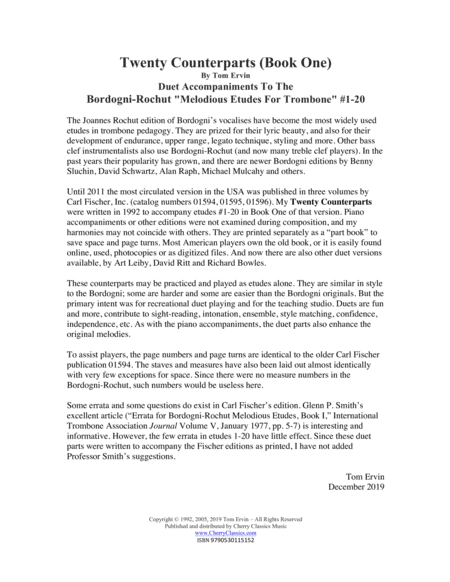
20 Counterparts from Book 1 Rochut Bordogni Duet Accompaniments for Trombones 1-20
Trombone

$25.00 21.71 € Trombone PDF SheetMusicPlus

Flute and piano - intermediate - Digital Download SKU: S9.Q11428 A five-course birthday dinner. Composed by Claus-Dieter Ludwig. This edition: Sheet music. Downloadable. Duration 10 minutes. Schott Music - Digital #Q11428. Published by Schott Music - Digital (S9.Q11428). Most well-known and generally popular - that's what the Happy Birthday meals served by Claus-Dieter Ludwig are. Meanwhile, they are available in various instrumentations (for violin and piano, piano solo and piano duet, accordion duo, string quartet, piano trio, wind trio, etc.). Now, it's the flutists' turn to be invited to the buffet – we beg your pardon, to come into their own as gourmets! Enjoy five entertaining variations on the famous birthday song: 'Andante festivo e culinario', 'Lento lasagne e lambrusco', 'Marcia marsala e mozzarella', 'Valzero vongole e vaniglia', and the crowning dessert, 'Tango tartufo e tagliatelle'! A rewarding encore piece that should be a delight to the performers and audience alike.
Happy Birthday
Flûte traversière et Piano

$15.99 13.88 € Flûte traversière et Piano PDF SheetMusicPlus

Wind quintet (Querflute, oboe, clarinet, horn and bassoon) - intermediate - Digital Download SKU: S9.Q11714 A five-course birthday dinner. Composed by Claus-Dieter Ludwig. Arranged by Andreas N. Tarkmann. This edition: score and parts. Downloadable, Score and parts. Duration 10 minutes. Schott Music - Digital #Q11714. Published by Schott Music - Digital (S9.Q11714). Most well-known and generally popular - that's what the Happy Birthday meals served by Claus-Dieter Ludwig are. Meanwhile, they are available in various instrumentations (for piano solo and piano duet, accordion duo, string quartet, piano trio). Now, Andreas Tarkmann has rearranged the work, and it's the wind instrument players' turn to be invited to the buffet – we beg your pardon, to come into their own as gourmets! Flute, oboe, clarinet, horn and bassoon enjoy five entertaining variations on the famous birthday song into which other music titles have been sneaked as well: 'Andante festivo e culinario', 'Lento lasagne e lambrusco', 'Marcia marsala e mozzarella', 'Valzero vongole e vaniglia', and the crowning dessert, a fiery 'Tango tartufo e tagliatelle'!
Happy Birthday

$30.99 26.91 € PDF SheetMusicPlus

Clarinet in Bb and piano - intermediate - Digital Download SKU: S9.Q7284 A five-course Birthday dinner. Composed by Claus-Dieter Ludwig. This edition: Sheet music. Downloadable. Duration 10 minutes. Schott Music - Digital #Q7284. Published by Schott Music - Digital (S9.Q7284). Most well-known and generally popular - that's what the Happy Birthday meals served by Claus-Dieter Ludwig are. Meanwhile, they are available in various instrumentations (for violin and piano, piano solo and piano duet, accordion duo, string quartet, piano trio, wind trio, etc.). Now, it's the clarinettists' turn to be invited to the buffet – we beg your pardon, to come into their own as gourmets! Enjoy five entertaining variations on the famous birthday song: 'Andante festivo e culinario', 'Lento lasagne e lambrusco', 'Marcia marsala e mozzarella', 'Valzero vongole e vaniglia', and the crowning dessert, 'Czárdás ciabatta e cioccolata'! A rewarding encore piece that should be a delight to the performers and audience alike.
Happy Birthday
Clarinette

$15.99 13.88 € Clarinette PDF SheetMusicPlus

Alto Saxophone Solo - Level 5 - Digital Download SKU: A0.755094 Composed by Sy Brandon. 20th Century,Concert,Contemporary. Individual part. 10 pages. Sy Brandon #3381815. Published by Sy Brandon (A0.755094). Based on Jules Verne’s 20,000 Leagues Under the Sea I. A Shifting Reef – This movement depicts the Nautilus as an unknown phenomenon that is a threat to navigation. Some mariners thought it was a sea monster and others thought it was a shifting reef. No one could conceive that it was a boat capable of traveling under water. The music is ever changing throughout this movement. It constantly shifts tonality, melodic ideas, and rhythmic placement of motives. Although some ideas repeat, they are transformed by combining them in different patterns with other previously stated ideas. II. A Walk at the Bottom of the Sea Through a Submarine Forest – Circular breathing is used at the beginning and the end of this movement to represent an undersea walk. The musical material appears in reverse at the end representing a return to the Nautilus. The lighter middle section represents walking over a more rocky terrain. The multiphonics symbolize the wonders of the submarine forest. III. The Giant Squids – The giant squids have surrounded the Nautilus and have caused the propeller to jam. In order to free themselves, Captain Nemo, his crew, Professor Aronnax, Conseil, and Ned Land do battle with the squids. This energetic scherzo reflects on the dangers of the battle. Several screams are heard as the squids entangle Ned Land and other crewmembers. The short multiphonics and syncopations represent the men chopping away and the arms of the squid. At the end, the Nautilus finally frees itself after the loss of one life. IV. Trapped Near the South Pole – After discovering the South Pole, the Nautilus is returning to open waters when it is caught between the polar icecap and iceberg that flips over. The tremolos reflect the doom of the Nautilus as only two days of air supply remain. The only means of escape is to chop through the ice below the Nautilus. The staccato notes represent the crew members hacking away at the ice. When that fails, Captain Nemo tries to melt the ice by expelling hot water from the Nautilus. This is represented by the saxophonist blowing air through the saxophone and wiggling the keys. A sense of doom returns that is followed by a final attempt of the Nautilus to crash through the remaining ice. A triumphant ending reflects the success of this attempt. V. The Maelstrom – As Professor Aronnax, Conseil, and Ned Land attempt their escape from the Nautilus, the ship enters the feared maelstrom, a vortex off the coast of Norway where no ship has escaped. The swirling waters are represented by the triplet passages and the escape by the duplet passages. An epilogue using the doom music of the previous movement suggests the end of the Nautilus but a brief return to a slower version of the Shifting Reef motive perhaps suggests otherwise
20,000
Saxophone Alto

$4.99 4.33 € Saxophone Alto PDF SheetMusicPlus

Brass Ensemble - Level 4 - Digital Download SKU: A0.755275 Composed by Sy Brandon. 20th Century,Concert,Contemporary. Score and parts. 32 pages. Sy Brandon #4632265. Published by Sy Brandon (A0.755275). Euphony can be defined as the use of words and phrases that are distinguished as having a wide range of noteworthy melody or loveliness in the sounds they create. It gives pleasing and soothing effects to the ear due to repeated vowels and smooth consonants. Euphony was chosen as the title of this composition because each movement has a title beginning with Euph and the music is descriptive of the movement titles. The first movement is titled Euphenism. A euphenism is a polite word or phrase that is substituted for a word or phrase that has a harsher meaning. The music of this movement begins gentler than the way it ends, therefore the beginning can be considered an euphenism for the end. Euphrates is the title of the second movement. This mighty river that flows from Turkey through Syria and Iran was an important river in ancient times for its extensive irrigation of the Mesopotanian Valley. This movement is both flowing and expansive. Euphorbia, the title of the third movement, is a genus of flowering plants. It is also caused Spurge as it tends to appear where it is not wanted. This movement is a pretty waltz that is constantly interrupted by a dissonant motif. This motif represents the invasive quality of Spurge. The last movement is called Euphoria. It sparkles with its driving rhythms, fast tempo, and syncopation, all representing unbridled joy.
Euphony for Euphonium Quartet
Ensemble de cuivres

$9.99 8.67 € Ensemble de cuivres PDF SheetMusicPlus

Piano Quartet,String Ensemble Cello,Piano,Viola,Violin - Level 4 - Digital Download SKU: A0.755009 Composed by Sy Brandon. 20th Century,Contemporary. Score and parts. 49 pages. Sy Brandon #3239669. Published by Sy Brandon (A0.755009). In The Land of Wonder-Wander attempts to capture the essence of both Maxfield Parrish’s illustration and Eugene Fields’ poem The Dinkey-Bird. Both the painting and the poem create the feeling of a magical place where beauty, joy and pleasure abound. It is a mysterious place, perhaps as occurring in a dream, yet a place where one does not wish to leave. In The Land of Wonder-Wander begins quietly with vague tonality and sparse instrumentation as it transports the listener into this mystical land. As the tempo becomes stricter and the instrumentation fuller, the beauty of this place is apparent. A change to a triple meter and a faster tempo creates a joyous and wondrous section as there are many sweet treats growing to satisfy the soul. Children scampering and playing are represented by an allegro section with playful melodies and slight dissonance. The Dinkey Bird becomes the focus of the next section, which uses a staccato motif surrounded by rapid scales and arpeggios. These ideas build in intensity, expressing the wonder and beauty of this far away land, until they begin to fade away as the land recedes into the sea. A last flourish occurs as if one is trying to hold on to the experience before one wakes up from this marvelous dream.
In The Land of Wonder-Wander for Piano Quartet
Piano Quatuor: piano, violon, alto, violoncelle

$9.99 8.67 € Piano Quatuor: piano, violon, alto, violoncelle PDF SheetMusicPlus

Percussion Ensemble - Level 4 - Digital Download SKU: A0.912929 Composed by Brandon Nelson. Concert,Contemporary. Score and parts. 8 pages. Brandon Nelson #2907437. Published by Brandon Nelson (A0.912929). For percussion duo.  Required instruments:  bells, vibraphone, xylophone, temple blocks, suspended cymbals (3 sizes).  General programming.  Advanced Intermediate level.Commissioned by Chris Nadeau for CAn-Duo.  Premiered at Colorado State University, October 16, 2016.It is common knowledge that the universe we see is composed of tiny particles known as atoms. For much of scientific history, it was thought that atoms were made up of three indivisible particles: protons, neutrons, and electrons.Thanks to contemporary advances in physics, we now know that these particles are, in fact, made up of much smaller particles and that these constituents sometimes behave in ways that confound what we thought we knew of the physical universe.In this piece, I have portrayed one type of these subatomic particles, the quark. There are six types (or flavors) of quark: up, down, charm, strange, top, and bottom. These are differentiated by the type of charge they carry and their masses.The first movement is Strange Quark. This flavor has a negative charge and is relatively light. Much like the particle, this movement often behaves in unusual ways.Top Quark, the second movement, portrays the quark flavor that is by far the heaviest. Slow and massive, this particle allowed for the study of the famous Higgs boson.The final movement, Up Quark, is light and decays quickly, much like this particle that contributes to both protons and neutrons.The universe is indeed a wonder to behold and its scale is hardly comprehensible to the human mind. And yet, it is becoming increasingly apparent that there exists an entire universe yet to uncover in the most infinitesimal pieces of matter. It is my hope that the wonder and mystery this inspires be conveyed through this piece of music.
What Universe Lies Within
Ensemble de Percussions

$9.99 8.67 € Ensemble de Percussions PDF SheetMusicPlus

Instrumental Duet - Level 4 - Digital Download SKU: A0.1244850 By George Edward Brandon. By George Edward Brandon. Arranged by George Edward Brandon. 21st Century,Holiday. 3 pages. Blue Unity Music #839773. Published by Blue Unity Music (A0.1244850). This piece is a short and sprightly celebration of the anniversary of the date on which the last enslaved African Americans learned that the War between the States had concluded, slavery had been abolished and they had become free people. This was in Galveston, Texas on June 17, 1865. Another version of this piece, called Juneteenth Call for GR, exists for flute and clarinet, and there is also a third but slightly different version of it for saxophone quartet.  A video of the flute and harp version was recorded by Castle of Our Skin and appears on their youtube channel as the Black Composer Challenge #2.
Juneteenth Call for Flute and Harp
George Edward Brandon
$4.50 3.91 € PDF SheetMusicPlus

Woodwind Ensemble Bassoon - Level 5 - Digital Download SKU: A0.755244 Composed by Sy Brandon. 20th Century,Contemporary. 47 pages. Sy Brandon #3590241. Published by Sy Brandon (A0.755244). Cycles for bassoon quartet honors those who lost loved ones in the March 2011 earthquake and tsunami in Japan. The title reflects both the living earth upon which we live and the fortitude of humanity.             The first movement depicts serenity interrupted by bombastic resemblances of earthquakes and tsunamis. The movement is called The Living Earth as our planet is still evolving by constantly building up pressure and releasing that pressure. The opening serene section uses key clicks and wind sounds in the serenity section. Pitch bends in the melody are designed to resemble a shakuhachi. Syncopated explosions that use polytonal pentatonic scales represent the earthquake. Rapid ascending and descending scale patterns depict the resultant tsunami.             The second movement is a hymn song for the souls of the dead. It is called Ashes to Ashes as it represents a different cycle, one of death and rebirth. Pentatonic scales abound once again but this time they modulate gently from one tonality to another instead of being used simultaneously.             A song of redemption and hope for the survivors is the theme for the third and final movement, Resiliency of the Spirit. It depicts the strength of the human spirit and it is the cycle of joy growing out of sorrow. Taiko drumming is the major influence in this movement. It begins with a foot stomp followed by the drummers warming up. A staccato rhythmic section that imitates the drums follows this. A hymn-like theme in pentatonic is interpolated over this rhythmic drumming bringing the movement and the piece to a hopeful conclusion.
Cycles for Bassoon Quartet
4 Bassons

$14.99 13.02 € 4 Bassons PDF SheetMusicPlus


Partitions Gratuites
Acheter des Partitions Musicales
Acheter des Partitions Digitales à Imprimer
Acheter des Instruments de Musique

© 2000 - 2026

Accueil - Version intégrale





