EUROPE
54 articles
USA
0 articles
DIGITAL
123 articles (à imprimer)
Partitions Digitales
Partitions à imprimer
123 partitions trouvées

1 16 31 46 61 ....121

Easy Piano - Level 1 - Digital Download SKU: A0.1180746 By Dirk Quinn Band. By Charles Borrelli and Roger Courtland. Arranged by Marcony Carvalho. 20th Century,Classical,Historic,Patriotic,Pop. Score. 1 pages. Zedas Couve #780613. Published by Zedas Couve (A0.1180746). The Eagles' Victory Song was the creation of Charles Borrelli and Richard Courtland Harrison, a Washington, D.C. music teacher and arranger for jazz guitarist Charlie Byrd. The song was mistakenly credited to R. Courtland by the Copyright office and in various editions of Eagles programs from the late 1950s through the 1960s.In 1963, Jerry Wolman purchased the Philadelphia Eagles. Wolman was a sports fan growing up and loved hearing the Washington Redskins' fight song Hail to the Redskins at games. Spawning from his admiration for the Redskins' song, Wolman searched for musicians to implement a team song for the Eagles, and founded The Philadelphia Eagles' Sound of Brass band in 1964. The group included 200 musicians and dancers, and was led by Arlen Saylor, who was appointed as the Eagles' entertainment director in 1966 and is credited with penning an arrangement of the fight song that the band played at home games during halftime in the 1960s. Wolman's push to popularize the fight song flew under the radar, however, and in 1969 the Sound of Brass band was discontinued.The song came back into light in 1997, when Bobby Mansure, founder of an unofficial Eagles pep band, asked team management to allow the band to play in the parking lot during home games. Management gave Mansure's pep band an audition, allowing them to play at two preseason games to gauge fan reaction. The song went over so well that Mansure and the band retained a permanent position as the official Philadelphia Eagles Pep Band.In 1998, following Mansure's reintroduction of the song, Eagles management attempted to rebuild its popularity among fans by changing some aspects of the song: they modified the key, changed the opening lyric from Fight, Eagles Fight to Fly, Eagles Fly, and re-marketed the song with that as the title. In addition, they appended the popular E-A-G-L-E-S chant—which had emerged in the 1980s—to the end of the song. While management planned to play the song throughout the 1998 season, the Eagles' poor performance that year caused them to hold off reintroducing the song until the following year. The Eagles fared better during their 1999 season, and subsequently, the fight song was played after every score.
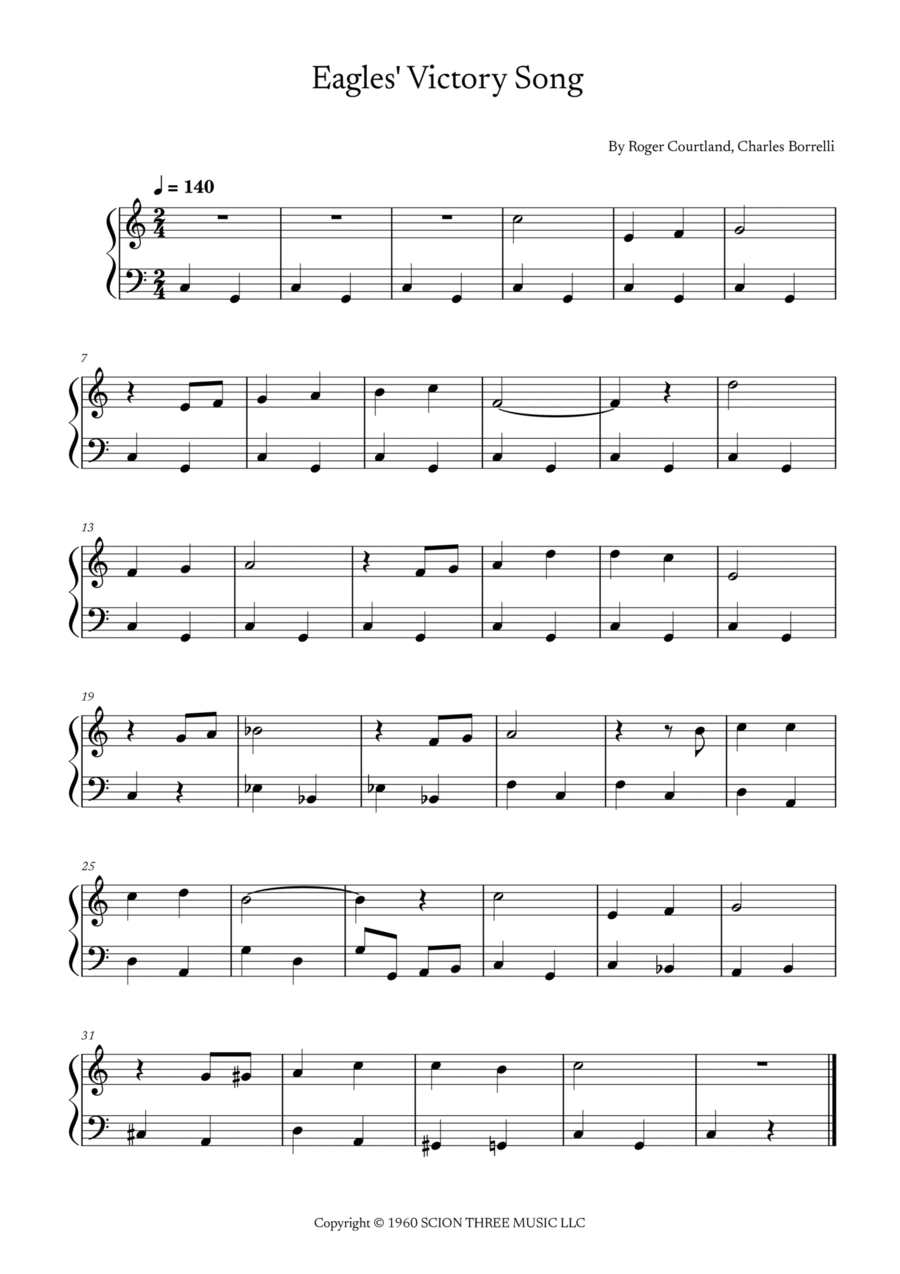
Eagles' Victory Song
Piano Facile
Dirk Quinn Band
$4.99 4.32 € Piano Facile PDF SheetMusicPlus

Piano,Trombone - Level 1 - Digital Download SKU: A0.1182600 By Dirk Quinn Band. By Charles Borrelli and Roger Courtland. Arranged by Marcony Carvalho. 20th Century,March,Patriotic,Traditional. Score and part. 2 pages. Zedas Couve #782346. Published by Zedas Couve (A0.1182600). The Eagles' Victory Song was the creation of Charles Borrelli and Richard Courtland Harrison, a Washington, D.C. music teacher and arranger for jazz guitarist Charlie Byrd. The song was mistakenly credited to R. Courtland by the Copyright office and in various editions of Eagles programs from the late 1950s through the 1960s.In 1963, Jerry Wolman purchased the Philadelphia Eagles. Wolman was a sports fan growing up and loved hearing the Washington Redskins' fight song Hail to the Redskins at games. Spawning from his admiration for the Redskins' song, Wolman searched for musicians to implement a team song for the Eagles, and founded The Philadelphia Eagles' Sound of Brass band in 1964. The group included 200 musicians and dancers, and was led by Arlen Saylor, who was appointed as the Eagles' entertainment director in 1966 and is credited with penning an arrangement of the fight song that the band played at home games during halftime in the 1960s. Wolman's push to popularize the fight song flew under the radar, however, and in 1969 the Sound of Brass band was discontinued.The song came back into light in 1997, when Bobby Mansure, founder of an unofficial Eagles pep band, asked team management to allow the band to play in the parking lot during home games. Management gave Mansure's pep band an audition, allowing them to play at two preseason games to gauge fan reaction. The song went over so well that Mansure and the band retained a permanent position as the official Philadelphia Eagles Pep Band.In 1998, following Mansure's reintroduction of the song, Eagles management attempted to rebuild its popularity among fans by changing some aspects of the song: they modified the key, changed the opening lyric from Fight, Eagles Fight to Fly, Eagles Fly, and re-marketed the song with that as the title. In addition, they appended the popular E-A-G-L-E-S chant—which had emerged in the 1980s—to the end of the song. While management planned to play the song throughout the 1998 season, the Eagles' poor performance that year caused them to hold off reintroducing the song until the following year. The Eagles fared better during their 1999 season, and subsequently, the fight song was played after every score.
Eagles' Victory Song
Trombone et Piano
Dirk Quinn Band
$4.99 4.32 € Trombone et Piano PDF SheetMusicPlus

Piano,Soprano Saxophone - Level 1 - Digital Download SKU: A0.1182615 By Dirk Quinn Band. By Charles Borrelli and Roger Courtland. Arranged by Marcony Carvalho. 20th Century,March,Patriotic,Traditional. Score and part. 2 pages. Zedas Couve #782360. Published by Zedas Couve (A0.1182615). The Eagles' Victory Song was the creation of Charles Borrelli and Richard Courtland Harrison, a Washington, D.C. music teacher and arranger for jazz guitarist Charlie Byrd. The song was mistakenly credited to R. Courtland by the Copyright office and in various editions of Eagles programs from the late 1950s through the 1960s.In 1963, Jerry Wolman purchased the Philadelphia Eagles. Wolman was a sports fan growing up and loved hearing the Washington Redskins' fight song Hail to the Redskins at games. Spawning from his admiration for the Redskins' song, Wolman searched for musicians to implement a team song for the Eagles, and founded The Philadelphia Eagles' Sound of Brass band in 1964. The group included 200 musicians and dancers, and was led by Arlen Saylor, who was appointed as the Eagles' entertainment director in 1966 and is credited with penning an arrangement of the fight song that the band played at home games during halftime in the 1960s. Wolman's push to popularize the fight song flew under the radar, however, and in 1969 the Sound of Brass band was discontinued.The song came back into light in 1997, when Bobby Mansure, founder of an unofficial Eagles pep band, asked team management to allow the band to play in the parking lot during home games. Management gave Mansure's pep band an audition, allowing them to play at two preseason games to gauge fan reaction. The song went over so well that Mansure and the band retained a permanent position as the official Philadelphia Eagles Pep Band.In 1998, following Mansure's reintroduction of the song, Eagles management attempted to rebuild its popularity among fans by changing some aspects of the song: they modified the key, changed the opening lyric from Fight, Eagles Fight to Fly, Eagles Fly, and re-marketed the song with that as the title. In addition, they appended the popular E-A-G-L-E-S chant—which had emerged in the 1980s—to the end of the song. While management planned to play the song throughout the 1998 season, the Eagles' poor performance that year caused them to hold off reintroducing the song until the following year. The Eagles fared better during their 1999 season, and subsequently, the fight song was played after every score.

Eagles' Victory Song
Saxophone Soprano et Piano
Dirk Quinn Band
$4.99 4.32 € Saxophone Soprano et Piano PDF SheetMusicPlus

Oboe Solo - Level 1 - Digital Download SKU: A0.1183101 By Dirk Quinn Band. By Charles Borrelli and Roger Courtland. Arranged by Marcony Carvalho. 20th Century,March,Traditional. Individual part. 1 pages. Zedas Couve #782821. Published by Zedas Couve (A0.1183101). The Eagles' Victory Song was the creation of Charles Borrelli and Richard Courtland Harrison, a Washington, D.C. music teacher and arranger for jazz guitarist Charlie Byrd. The song was mistakenly credited to R. Courtland by the Copyright office and in various editions of Eagles programs from the late 1950s through the 1960s.In 1963, Jerry Wolman purchased the Philadelphia Eagles. Wolman was a sports fan growing up and loved hearing the Washington Redskins' fight song Hail to the Redskins at games. Spawning from his admiration for the Redskins' song, Wolman searched for musicians to implement a team song for the Eagles, and founded The Philadelphia Eagles' Sound of Brass band in 1964. The group included 200 musicians and dancers, and was led by Arlen Saylor, who was appointed as the Eagles' entertainment director in 1966 and is credited with penning an arrangement of the fight song that the band played at home games during halftime in the 1960s. Wolman's push to popularize the fight song flew under the radar, however, and in 1969 the Sound of Brass band was discontinued.The song came back into light in 1997, when Bobby Mansure, founder of an unofficial Eagles pep band, asked team management to allow the band to play in the parking lot during home games. Management gave Mansure's pep band an audition, allowing them to play at two preseason games to gauge fan reaction. The song went over so well that Mansure and the band retained a permanent position as the official Philadelphia Eagles Pep Band.In 1998, following Mansure's reintroduction of the song, Eagles management attempted to rebuild its popularity among fans by changing some aspects of the song: they modified the key, changed the opening lyric from Fight, Eagles Fight to Fly, Eagles Fly, and re-marketed the song with that as the title. In addition, they appended the popular E-A-G-L-E-S chant—which had emerged in the 1980s—to the end of the song. While management planned to play the song throughout the 1998 season, the Eagles' poor performance that year caused them to hold off reintroducing the song until the following year. The Eagles fared better during their 1999 season, and subsequently, the fight song was played after every score.

Eagles' Victory Song
Hautbois (partie séparée)
Dirk Quinn Band
$4.99 4.32 € Hautbois (partie séparée) PDF SheetMusicPlus

B-Flat Trumpet,Piano - Level 1 - Digital Download SKU: A0.1182594 By Dirk Quinn Band. By Charles Borrelli and Roger Courtland. Arranged by Marcony Carvalho. 20th Century,Classical,March. Score and part. 2 pages. Zedas Couve #782339. Published by Zedas Couve (A0.1182594). The Eagles' Victory Song was the creation of Charles Borrelli and Richard Courtland Harrison, a Washington, D.C. music teacher and arranger for jazz guitarist Charlie Byrd. The song was mistakenly credited to R. Courtland by the Copyright office and in various editions of Eagles programs from the late 1950s through the 1960s.In 1963, Jerry Wolman purchased the Philadelphia Eagles. Wolman was a sports fan growing up and loved hearing the Washington Redskins' fight song Hail to the Redskins at games. Spawning from his admiration for the Redskins' song, Wolman searched for musicians to implement a team song for the Eagles, and founded The Philadelphia Eagles' Sound of Brass band in 1964. The group included 200 musicians and dancers, and was led by Arlen Saylor, who was appointed as the Eagles' entertainment director in 1966 and is credited with penning an arrangement of the fight song that the band played at home games during halftime in the 1960s. Wolman's push to popularize the fight song flew under the radar, however, and in 1969 the Sound of Brass band was discontinued.The song came back into light in 1997, when Bobby Mansure, founder of an unofficial Eagles pep band, asked team management to allow the band to play in the parking lot during home games. Management gave Mansure's pep band an audition, allowing them to play at two preseason games to gauge fan reaction. The song went over so well that Mansure and the band retained a permanent position as the official Philadelphia Eagles Pep Band.In 1998, following Mansure's reintroduction of the song, Eagles management attempted to rebuild its popularity among fans by changing some aspects of the song: they modified the key, changed the opening lyric from Fight, Eagles Fight to Fly, Eagles Fly, and re-marketed the song with that as the title. In addition, they appended the popular E-A-G-L-E-S chant—which had emerged in the 1980s—to the end of the song. While management planned to play the song throughout the 1998 season, the Eagles' poor performance that year caused them to hold off reintroducing the song until the following year. The Eagles fared better during their 1999 season, and subsequently, the fight song was played after every score.

Eagles' Victory Song
Trompette, Piano
Dirk Quinn Band
$4.99 4.32 € Trompette, Piano PDF SheetMusicPlus

Bassoon,Piano - Level 1 - Digital Download SKU: A0.1182609 By Dirk Quinn Band. By Charles Borrelli and Roger Courtland. Arranged by Marcony Carvalho. 20th Century,March,Patriotic,Traditional. Score and part. 2 pages. Zedas Couve #782354. Published by Zedas Couve (A0.1182609). The Eagles' Victory Song was the creation of Charles Borrelli and Richard Courtland Harrison, a Washington, D.C. music teacher and arranger for jazz guitarist Charlie Byrd. The song was mistakenly credited to R. Courtland by the Copyright office and in various editions of Eagles programs from the late 1950s through the 1960s.In 1963, Jerry Wolman purchased the Philadelphia Eagles. Wolman was a sports fan growing up and loved hearing the Washington Redskins' fight song Hail to the Redskins at games. Spawning from his admiration for the Redskins' song, Wolman searched for musicians to implement a team song for the Eagles, and founded The Philadelphia Eagles' Sound of Brass band in 1964. The group included 200 musicians and dancers, and was led by Arlen Saylor, who was appointed as the Eagles' entertainment director in 1966 and is credited with penning an arrangement of the fight song that the band played at home games during halftime in the 1960s. Wolman's push to popularize the fight song flew under the radar, however, and in 1969 the Sound of Brass band was discontinued.The song came back into light in 1997, when Bobby Mansure, founder of an unofficial Eagles pep band, asked team management to allow the band to play in the parking lot during home games. Management gave Mansure's pep band an audition, allowing them to play at two preseason games to gauge fan reaction. The song went over so well that Mansure and the band retained a permanent position as the official Philadelphia Eagles Pep Band.In 1998, following Mansure's reintroduction of the song, Eagles management attempted to rebuild its popularity among fans by changing some aspects of the song: they modified the key, changed the opening lyric from Fight, Eagles Fight to Fly, Eagles Fly, and re-marketed the song with that as the title. In addition, they appended the popular E-A-G-L-E-S chant—which had emerged in the 1980s—to the end of the song. While management planned to play the song throughout the 1998 season, the Eagles' poor performance that year caused them to hold off reintroducing the song until the following year. The Eagles fared better during their 1999 season, and subsequently, the fight song was played after every score.

Eagles' Victory Song
Basson, Piano (duo)
Dirk Quinn Band
$4.99 4.32 € Basson, Piano (duo) PDF SheetMusicPlus

Soprano Saxophone Solo - Level 1 - Digital Download SKU: A0.1183091 By Dirk Quinn Band. By Charles Borrelli and Roger Courtland. Arranged by Marcony Carvalho. 20th Century,March,Traditional. Individual part. 1 pages. Zedas Couve #782816. Published by Zedas Couve (A0.1183091). The Eagles' Victory Song was the creation of Charles Borrelli and Richard Courtland Harrison, a Washington, D.C. music teacher and arranger for jazz guitarist Charlie Byrd. The song was mistakenly credited to R. Courtland by the Copyright office and in various editions of Eagles programs from the late 1950s through the 1960s.In 1963, Jerry Wolman purchased the Philadelphia Eagles. Wolman was a sports fan growing up and loved hearing the Washington Redskins' fight song Hail to the Redskins at games. Spawning from his admiration for the Redskins' song, Wolman searched for musicians to implement a team song for the Eagles, and founded The Philadelphia Eagles' Sound of Brass band in 1964. The group included 200 musicians and dancers, and was led by Arlen Saylor, who was appointed as the Eagles' entertainment director in 1966 and is credited with penning an arrangement of the fight song that the band played at home games during halftime in the 1960s. Wolman's push to popularize the fight song flew under the radar, however, and in 1969 the Sound of Brass band was discontinued.The song came back into light in 1997, when Bobby Mansure, founder of an unofficial Eagles pep band, asked team management to allow the band to play in the parking lot during home games. Management gave Mansure's pep band an audition, allowing them to play at two preseason games to gauge fan reaction. The song went over so well that Mansure and the band retained a permanent position as the official Philadelphia Eagles Pep Band.In 1998, following Mansure's reintroduction of the song, Eagles management attempted to rebuild its popularity among fans by changing some aspects of the song: they modified the key, changed the opening lyric from Fight, Eagles Fight to Fly, Eagles Fly, and re-marketed the song with that as the title. In addition, they appended the popular E-A-G-L-E-S chant—which had emerged in the 1980s—to the end of the song. While management planned to play the song throughout the 1998 season, the Eagles' poor performance that year caused them to hold off reintroducing the song until the following year. The Eagles fared better during their 1999 season, and subsequently, the fight song was played after every score.

Eagles' Victory Song
Saxophone (partie séparée)
Dirk Quinn Band
$4.99 4.32 € Saxophone (partie séparée) PDF SheetMusicPlus

Choral Choir (TTBB) - Level 4 - Digital Download SKU: A0.888994 Composed by Quinn McMath. 20th Century,Contemporary. Octavo. 16 pages. Quinn McMath #6130747. Published by Quinn McMath (A0.888994). 6.75 x 10.5 inchesA Bridge Between an Ocean is an experimental contemporary piece that deals with the elusive and sometimes damaging transition away from childhood. The premise behind the piece is that the first tenor represents a boy realizing that his childhood is fleeting away. The other sections represent his collective internal self in the form of past, present, and future, offering consoling words towards the boy. This piece is to be driven with passion and emotion, as the premise is something most listeners will find connections to in their own lives. A Bridge Between an Ocean is a great piece for an advanced men's group and would work well in any classical contemporary performance setting. This piece may also be appropriate for advanced high school and collegiate level groups. It is suggested that a pianist sit in rehearsals (not for performance) to help the members of the choir learn their parts.
A Bridge Between an Ocean
Chorale TTBB

$3.50 3.03 € Chorale TTBB PDF SheetMusicPlus

Choral Choir (SATB) - Level 4 - Digital Download SKU: A0.888995 Composed by Quinn McMath, Levale Walker. 20th Century,Contemporary. Octavo. 12 pages. Quinn McMath #6130757. Published by Quinn McMath (A0.888995). 6.75 x 10.5 inchesSigh is a piece for choir, with piano accompaniment and a baritone voice solo. This piece would be a great concert piece for high school and collegiate level ensembles.Sigh was born out of the pain and turmoil of witnessing and experiencing the daily racism and systemic discrimination of minority groups in this world and in the United States. Sometimes it is difficult to express the intense trauma that comes with being a minority, and Sigh follows the journey of an individual holding in their feelings to a point where those feelings can no longer be contained. During the birth of this piece, stories of black deaths were nearly unavoidable and took a heavy toll on the black community. Sigh is a representation of the release that the community so desperately needs. It is important to note that this piece is driven by the hardships of racial minorities, thus it is preferred that the soloist be a person of color to better reflect the purpose of this piece. 
Sigh
Chorale SATB

$3.50 3.03 € Chorale SATB PDF SheetMusicPlus

Organ - Level 2 - Digital Download SKU: A0.1249801 By Snow Patrol. By Gary Lightbody, Jonathan Quinn, Nathan Connolly, Paul Wilson, and Tom Simpson. Arranged by Jonathan Selimovic (a.k.a. Jonny Music). Rock. Score. 7 pages. Jonny Music #844197. Published by Jonny Music (A0.1249801). Chasing Cars, performed by Snow Patrol, arranged for the King of Instruments (Organ).Duration: 4:23This score is mainly suitable for full-sized 61-key manual and 32-note pedal Pipe, Grand, Drawbar (Hammond) and Theatre Organs, and is optimized for Concert performances (Paper size: 9 in x 12 in).Arranger Contact Info and Social MediaYouTube: https://goo.gl/vu9ifuFacebook: https://goo.gl/dBz3TwTwitter: https://goo.gl/2PxpzVInstagram: https://goo.gl/q1dqJFWebsite: https://goo.gl/zyYa8t.
Chasing Cars
Orgue
Snow Patrol
$7.99 6.91 € Orgue PDF SheetMusicPlus

Baritone Saxophone,Bass Guitar,Drum Set,Organ,Piano,Trumpet,Voice - Digital Download SKU: A0.1072570 Composed by Dwight Leroy Quinn. Blues,R & B. Full Performance. Duration 330. D.L. Quinn Music Publishing Company #4580371. Published by D.L. Quinn Music Publishing Company (A0.1072570). Who threw that,ROCK in my BLUES, well it looks like Oliver Johnson did. The guy that brought the trumpet to soul, he have kicked 2019 off to a hot-rock start with his new CD Single Two Wrongs Don't A Right written and composed by Dwight Quinn. Oliver has for long time been wanting to do a Hot Bluesy Rock style song like ,Two Wrongs Don't A Right ,Oliver soon found a little time off from his busy touring schedule last year 2018,and he got with Dwight and they made it happen.Oliver has enjoyed an awesome career growth on his big hit,Daydreaming Again. Two Wrongs Don't A Right will be Oliver's 9th album on the Quinn Records TM Label.
Two Wrongs Don't Make A Right by Oliver Johnson

$1.99 1.72 € PDF SheetMusicPlus


1 16 31 46 61 ....121


Partitions Gratuites
Acheter des Partitions Musicales
Acheter des Partitions Digitales à Imprimer
Acheter des Instruments de Musique

© 2000 - 2026

Accueil - Version intégrale
