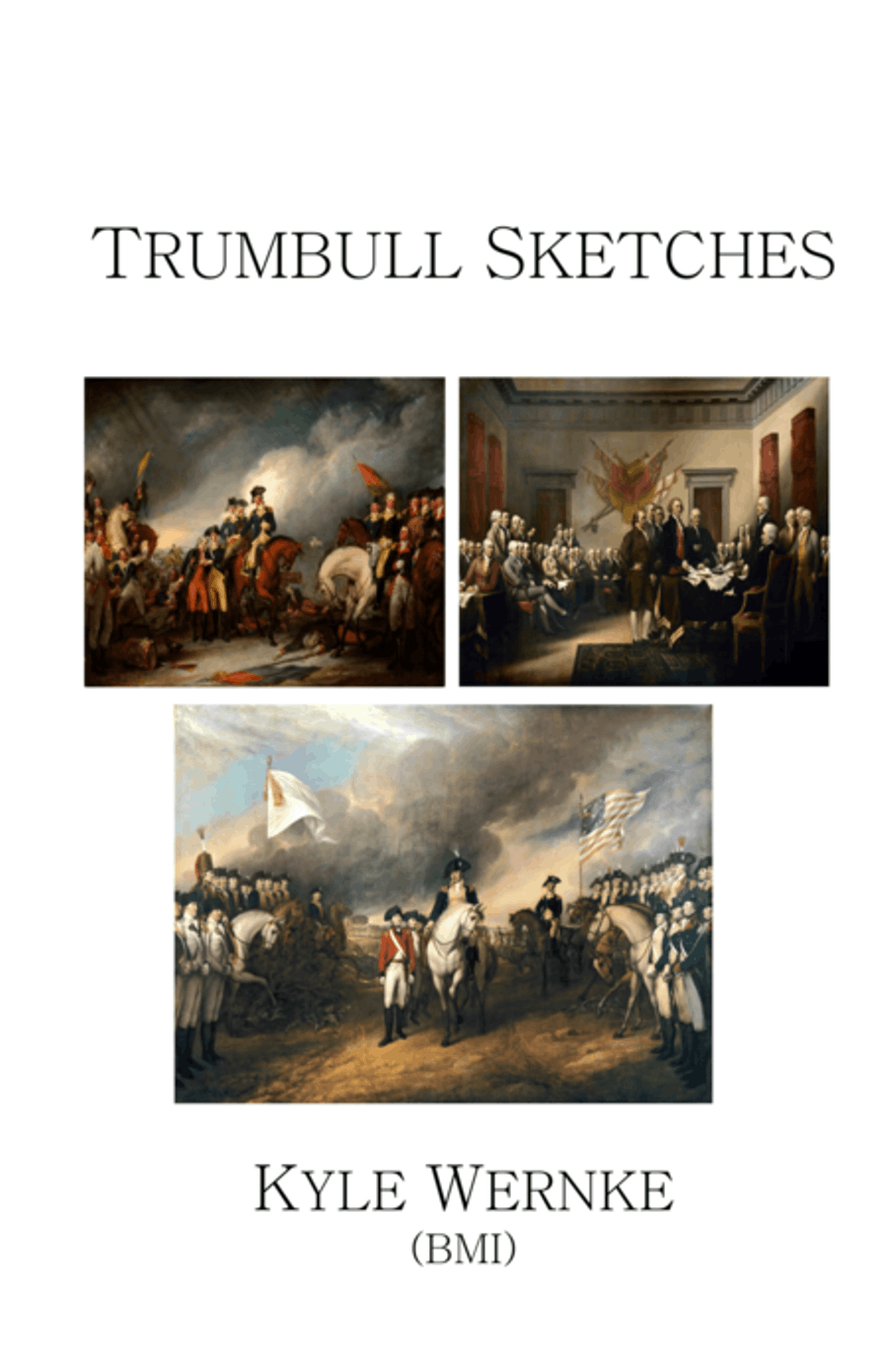
Full Orchestra - Level 4 - Digital Download SKU: A0.1023992 Composed by Kyle Wernke. Contemporary,Folk,Holiday,Patriotic. Score and parts. 109 pages. Kyle Wernke Publishing #2121501. Published by Kyle Wernke Publishing (A0.1023992). Commissioned by the Fort Smith Symphony - John Jeter, Conductor John Trumbull (June 6, 1756 - November 10, 1843) is perhaps the most overlooked of the Founding Fathers of The United States. Born and raised in Connecticut, John Trumbull was the son of Jonathan Trumbull (October 12, 1710 - August 17, 1785), Governor of Connecticut from 1769 to 1784, the only Royal Governor to side with the Americans during the Revolutionary War. Trumbull fought in the revolution, witnessing Bunker Hill and using his artistic abilities to sketch the British Works at Boston. Later, he was appointed second personal aide to General Washington, and in June 1776 he served as deputy adjutant-general to General Horatio Gates. Trumbull resigned from the army in 1777 over a dispute about the dating of his commission. In 1780 Trumbull traveled to London to study under Benjamin West: It was West who urged Trumbull to paint small pictures of the War of Independence, the works which would make him famous (he painted around 250 during his lifetime). In September of 1780, Continental troops captured British agent Major John Andre, after news of this reached Great Britain, Trumbull was arrested in retaliation. He was imprisoned for seven months. After the War, Trumbull again traveled to London, and then to Paris. It was here that Trumbull began work on two of the works depicted in this piece. He made sketches for the Surrender of Lord Cornwallis and, with the help of Thomas Jefferson, the US minister to France, he began working on The Declaration of Independence. In addition to paintings depicting the revolution, Trumbull painted numerous portraits, including those of George Washington, George Clinton (Governor of New York), Alexander Hamilton (the source of the $10 bill), and John Adams. I was tasked with composing a piece which would be educational for the students in attendance. I ended up writing a piece that would have educational material both in its musical construction and its subject matter. Trumbull's use of color, especially darker hues, and the structure of his paintings informed the construction of the piece. Three specific paintings influenced the work: The Capture of the Hessisans at the Battle of Trenton, The Declaration of Independence, and The Surrender of Lord Cornwallis. A recurring theme in the work of Trumbull is how the central act is always depicted at the center, with opposing groups on either side. The piece derives its form from this trait, casting the two large battle sections on the outsides, with the central act of the Revolutionary War in the center (The Declaration of Independence). The only percussion in the piece are drums, lending a certain militaristic feeling to the work, and evoking images of marching armies. Extended techniques are used repeatedly, casting a shade of uncertainty around the military campaigns (Washington's famous crossing of the Delaware and the seige at Yorktown), while The Declaration of Independence is scored in strict time and with more traditional harmonies, solidifying the event as the central moment of American history.