EUROPE
954 articles
USA
0 articles
DIGITAL
474 articles (à imprimer)
Partitions Digitales
Partitions à imprimer
474 partitions trouvées

1 ....301 316 331 346 361 ....466

Organ - Level 4 - Digital Download SKU: A0.908187 Composed by Rebecca Maughan Cook. 20th Century,Baroque,Blues,Contemporary. Score. 12 pages. Rebecca Maughan Cook #6873205. Published by Rebecca Maughan Cook (A0.908187). In 2021 I wrote this entry for an Organ Composition competition.  We were required to use the pitches associated with RC MADER.   I wrote this set of Miniatures exploring ideas associated with that.  Movement 1 is a Fanfare and Hymn setting.  Movement 2 is the only time the Pitches are played in entirety and I turned it into a Theme of Love.  It's one of my favorite movements from this set.   Movement 3 is a Blues with almost all the notes using the given pitches.   Movement 4 is such a quirky little piece!   It's a March and all the notes are from RC Mader.  It was very fun to write.  Movement 5 is a Toccata and in order to meet the requirement I placed some chords in inversion for the pedals and picked up the root on the LH.  It's busy and beautiful.  It's my other favorite movement.     I'm uploading a midi recording of this.  The first four movements are pretty accessible, but the 5th movement is more challenging.   Have fun!
MADER 5 Organ Miniatures
Orgue

$4.99 4.35 € Orgue PDF SheetMusicPlus

Piano Solo - Level 3 - Digital Download SKU: A0.1096204 Composed by Johann Pachelbel. Arranged by James M. Guthrie. Baroque,Classical,Standards,Traditional,Wedding. Score. 4 pages. Jmsgu3 #700167. Published by jmsgu3 (A0.1096204). Score: 4 pages. Duration: 2:27. The famous Pachelbel Canon arranged for Solo Piano. A great choice for weddings & receptions! Pachelbel's Canon Pachelbel's Canon is, in fact, the traditional title for a composition by the German composer Johann Pachelbel. Other names for the work include namely: Canon and Gigue for 3 violins and basso continuo, Canon and Gigue in D, and of course Canon in D. We do not know when or why in particular it was written. The oldest copy is surprisingly from the 19th century. It is important to realize that it was a common routine for organists to practice improvisation on the chord progression underlying the canon. Pachelbel originally scored the Canon notably for three violins and continuo. He also in fact paired the Canon with a gigue. The movements are homotonal, to clarify, both are in the key of D major. History In due time, Pachelbel's Canon went out of style and remained in virtual oblivion for centuries. The Jean-François Paillard chamber orchestra, however, recorded an arrangement of it in 1968. As a result, it gained approval. Many ensembles began likewise to record the piece in the 1970s and by the 1980s became ubiquitous as background music. From the 1970s to the early 2000s, pop songs correspondingly used elements of the piece. The chord progression, in particular, was used this way. Also, since the 1980s, it has been not only wildly popular for weddings, but also for funeral ceremonies in the USA and Europe. Pachelbel Background Johann Pachelbel (1653 –1706) was a German composer, as well as an organist. He was furthermore instrumental in bringing the south German organ school to its apex. He wrote a large body of music, both sacred and, equally important, secular. In particular, he uniquely helped develop the chorale prelude and fugue. For this, he has, in fact, earned a rightful place in the company of the most significant composers of the mid-Baroque period. Works Pachelbel's music was certainly popular. With this in mind, he also consequently had many pupils. His music expressly developed into a model for south German composers. Nowadays, Pachelbel is most famous, particularly for the Canon in D, as well as the F minor Chaconne, the Toccata in E minor, and of course the Hexachordum Apollinis, a set of variations for the keyboard. Influences Johann Jakob Froberger and Johann Caspar Kerll were south German composers who significantly influenced Pachelbel. Furthermore, he was especially influenced by Italians such as Frescobaldi and Poglietti. He frequently preferred an articulate, simple contrapuntal style that highlighted clarity. His music is markedly less extravagant and harmonically adventurous than that of Dieterich Buxtehude. However, as a point often overlooked, like Buxtehude, Pachelbel experimented with different instrumental combinations in his chamber music. Legacy All in all, Pachelbel was most famous as a composer for the keyboard. He composed over two hundred pieces specifically for the instrument. Pachelbel was also surprisingly a prolific composer of vocal music. All in all, about a hundred vocal works survive, including 40 or so large-scale works.
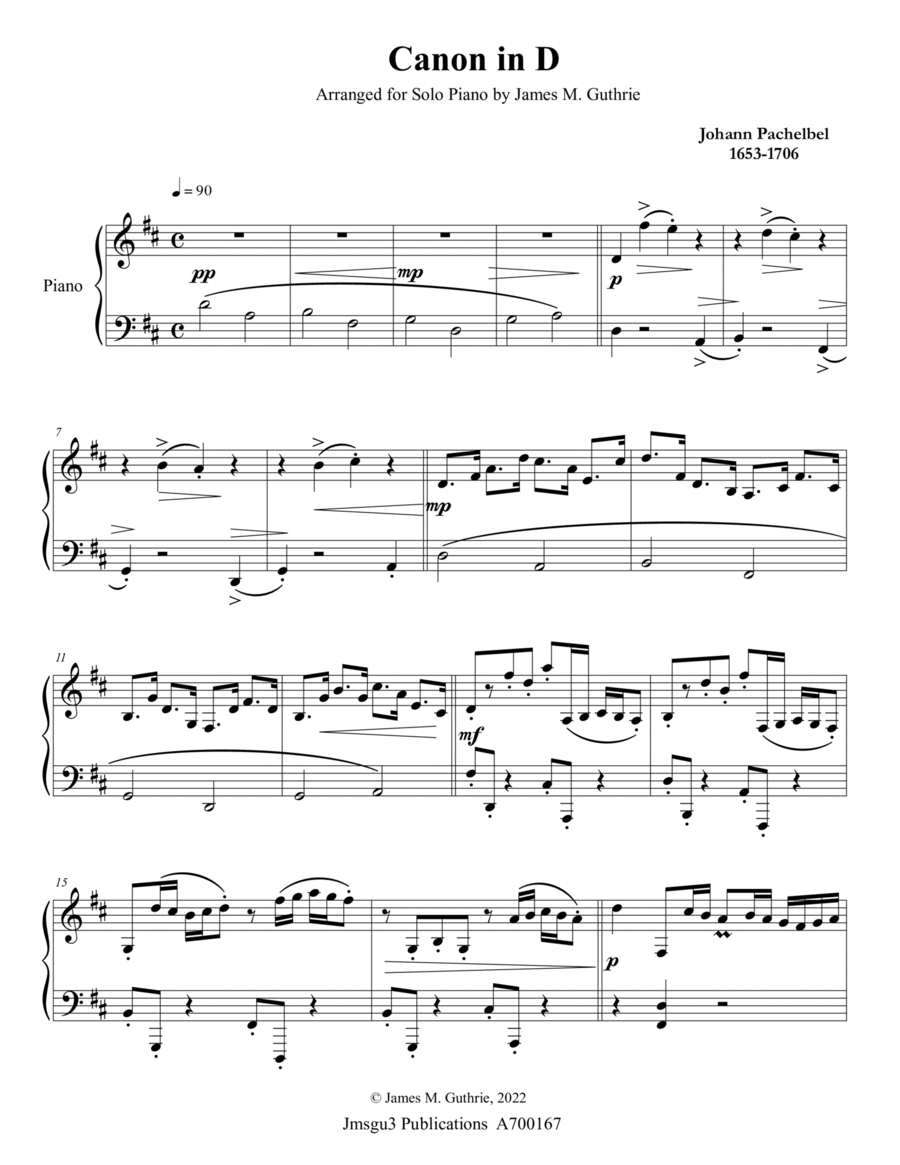
Pachelbel: Canon in D for Solo Piano
Piano seul

$32.95 28.71 € Piano seul PDF SheetMusicPlus

Easy Piano - Level 1 - Digital Download SKU: A0.1298410 Composed by Purcell,, Saint Saens, Grieg, Mussorgsky, Wagner, Dukas, Bach, Kullak. Arranged by SilverTonalities. 19th Century,20th Century,Baroque,Classical,Romantic Period. Score. 38 pages. SilverTonalities #888399. Published by SilverTonalities (A0.1298410). In the Hall of the Mountain King Halloween Classics for Easy PianoA delightful and whimsical collection of spooky Classics for Easy Piano, capturing both the playful spirit of Halloween and the rich history of Classical Music8 Classical Arrangements for Beginner and Novice Pianists by SilverTonalities!From Bach to Mussorgsky, each piece brings a touch of eerie elegance to Halloween Festivities Preview, pages 1-2Dance for the Followers of the Night from Purcell’s Fairy Queen, pages 3-6Danse Macabre by Camille Saint Saens, pages 7-12In the Hall of the Mountain King from Grieg’s Peer Gynt Suite, pages 13-16A Night on Bald Mountain by Mussorgsky, pages 17-19Ride of the Valkyries by Wagner, pages 20-22Sorcerer’s Apprentice by Dukas, pages 23-26Toccata and Fugue by Bach, pages 27-34Witches Dance, Opus 4 Number 2 by Kullak, pages 35-38.
In the Hall of the Mountain King Halloween Classics for Easy Piano
Piano Facile

$12.99 11.32 € Piano Facile PDF SheetMusicPlus

B-Flat Clarinet,Piano - Level 3 - Digital Download SKU: A0.548466 Composed by Johann Pachelbel. Arranged by James M. Guthrie, ASCAP. Wedding. Score and part. 8 pages. Jmsgu3 #3386285. Published by jmsgu3 (A0.548466). The famous Pachelbel Canon arranged for clarinet in Bb and piano. Great choice for weddings & receptions! Pachelbel's Canon Pachelbel's Canon is, in fact, the traditional title for a composition by the German composer Johann Pachelbel. Other names for the work include namely: Canon and Gigue for 3 violins and basso continuo, Canon and Gigue in D, and of course Canon in D. We do not know when or why in particular it was written. The oldest copy is surprisingly from the 19th century. It is important to realize that it was a common routine for organists to practice improvisation on the chord progression underlying the canon. Pachelbel originally scored the Canon notably for three violins and continuo. He also in fact paired the Canon with a gigue. The movements are homotonal, to clarify, both are in the key of D major. History In due time, Pachelbel's Canon went out of style and remained in virtual oblivion for centuries. The Jean-François Paillard chamber orchestra, however, recorded an arrangement of it in 1968. As a result, it gained approval.  Many ensembles began likewise to record the piece in the 1970s and by the 1980s became ubiquitous as background music. From the 1970s to the early 2000s, pop songs correspondingly used elements of the piece. The chord progression, in particular, was used this way. Also, since the 1980s, it has been not only wildly popular for weddings, but also for funeral ceremonies in the USA and Europe. Pachelbel Background Johann Pachelbel (1653 –1706) was a German composer, as well as an organist. He was furthermore instrumental in bringing the south German organ school to its apex. He wrote a large body of music, both sacred and, equally important, secular. In particular, he uniquely helped develop the chorale prelude and fugue. For this, he has, in fact, earned a rightful place in the company of the most significant composers of the mid-Baroque period. Works Pachelbel's music was certainly popular. With this in mind, he also consequently had many pupils. His music expressly developed into a model for the south German composers. Nowadays, Pachelbel is most famous particularly for the Canon in D, as well as the F minor Chaconne, the Toccata in E minor, and of course the Hexachordum Apollinis, a set of variations for the keyboard. Influences Johann Jakob Froberger and Johann Caspar Kerll were south German composers who significantly influenced Pachelbel. Furthermore, he was especially influenced by Italians such as Frescobaldi and Poglietti. He frequently preferred an articulate, simple contrapuntal style that highlighted clarity. His music is markedly less extravagant and harmonically adventurous than that of Dieterich Buxtehude. However, as a point often overlooked, like Buxtehude, Pachelbel experimented with different instrumental combinations in his chamber music. Legacy All in all, Pachelbel was most famous as a composer for the keyboard. He composed over two hundred pieces specifically for the instrument. Pachelbel was also surprisingly a prolific composer of vocal music. All in all, about a hundred vocal works survive, including 40 or so large-scale works. .
Pachelbel: Canon for Clarinet & Piano
Clarinette et Piano

$32.95 28.71 € Clarinette et Piano PDF SheetMusicPlus

Piano,Tenor Saxophone - Level 3 - Digital Download SKU: A0.548470 Composed by Johann Pachelbel. Arranged by James M. Guthrie, ASCAP. Baroque,Instructional,Standards,Wedding. Score and part. 8 pages. Jmsgu3 #3386301. Published by jmsgu3 (A0.548470). The famous Pachelbel Canon arranged for Tenor Sax & Piano. Great choice for weddings & receptions! Pachelbel's Canon Pachelbel's Canon is, in fact, the traditional title for a composition by the German composer Johann Pachelbel. Other names for the work include namely: Canon and Gigue for 3 violins and basso continuo, Canon and Gigue in D, and of course Canon in D. We do not know when or why in particular it was written. The oldest copy is surprisingly from the 19th century. It is important to realize that it was a common routine for organists to practice improvisation on the chord progression underlying the canon. Pachelbel originally scored the Canon notably for three violins and continuo. He also in fact paired the Canon with a gigue. The movements are homotonal, to clarify, both are in the key of D major. History In due time, Pachelbel's Canon went out of style and remained in virtual oblivion for centuries. The Jean-François Paillard chamber orchestra, however, recorded an arrangement of it in 1968. As a result, it gained approval.  Many ensembles began likewise to record the piece in the 1970s and by the 1980s became ubiquitous as background music. From the 1970s to the early 2000s, pop songs correspondingly used elements of the piece. The chord progression, in particular, was used this way. Also, since the 1980s, it has been not only wildly popular for weddings, but also for funeral ceremonies in the USA and Europe. Pachelbel Background Johann Pachelbel (1653 –1706) was a German composer, as well as an organist. He was furthermore instrumental in bringing the south German organ school to its apex. He wrote a large body of music, both sacred and, equally important, secular. In particular, he uniquely helped develop the chorale prelude and fugue. For this, he has, in fact, earned a rightful place in the company of the most significant composers of the mid-Baroque period. Works Pachelbel's music was certainly popular. With this in mind, he also consequently had many pupils. His music expressly developed into a model for the south German composers. Nowadays, Pachelbel is most famous particularly for the Canon in D, as well as the F minor Chaconne, the Toccata in E minor, and of course the Hexachordum Apollinis, a set of variations for the keyboard. Influences Johann Jakob Froberger and Johann Caspar Kerll were south German composers who significantly influenced Pachelbel. Furthermore, he was especially influenced by Italians such as Frescobaldi and Poglietti. He frequently preferred an articulate, simple contrapuntal style that highlighted clarity. His music is markedly less extravagant and harmonically adventurous than that of Dieterich Buxtehude. However, as a point often overlooked, like Buxtehude, Pachelbel experimented with different instrumental combinations in his chamber music. Legacy All in all, Pachelbel was most famous as a composer for the keyboard. He composed over two hundred pieces specifically for the instrument. Pachelbel was also surprisingly a prolific composer of vocal music. All in all, about a hundred vocal works survive, including 40 or so large-scale works. 

Pachelbel: Canon for Tenor Sax & Piano
Saxophone Tenor et Piano

$32.95 28.71 € Saxophone Tenor et Piano PDF SheetMusicPlus

Instrumental Duet,Piano Double Bass,Flute,Instrumental Duet,Piano - Level 5 - Digital Download SKU: A0.886670 Composed by Panagiotis Theodossiou. Concert,Contemporary,Jazz. Score and parts. 64 pages. Panagiotis Theodossiou #3068583. Published by Panagiotis Theodossiou (A0.886670). Jazz Trio Suite, for flute, piano and double bass (2014)Based on - and adapted from - older compositions (Music and Vision for various ensembles, Little Studies for piano, Hellenic Suite for viola and piano, Suite from Ancient Greece for piano) especially for the alternative ensemble Baroque & Blue (Nikos Katritzidakis - flute, Vyni Founta - piano, Giannis Harbilas - el. bass, Giannis Lelloudas - drums).I. FugueII.JazzyIII.GnomeIV.Seven Times TwelveV.NocturneVI,Fire DanceVII.ToccataIts concertante style derives from progressive jazz idiom. Composer's intention is to give a sequel to Claude Bolling's jazz piano trio suites (already in the ensemble's repertoire). The work is dedicated to the members of Baroque & Blue who performed it at General State Archives, Greece in 2014 and at Attikon Odeion Concert Hall in 2015 (Ichnos Quartet). Transcription availiable for violin, baritone saxophone and piano, dedicated to Mediterranean Trio (2015)https://www.youtube.com/watch?v=XLoPrDrvy5w  https://www.youtube.com/watch?v=K6jQj9IULAk  https://www.youtube.com/watch?v=kp7yJjV5u6k  https://www.youtube.com/watch?v=N_WmJ-ULKlg
Jazz Trio Suite

$29.00 25.27 € PDF SheetMusicPlus

Concert Band - Level 3 - Digital Download SKU: A0.1498364 Composed by Leon Boellmann. Arranged by John Ivor Holland. 19th Century,Classical,Religious. 49 pages. John Ivor Holland #1074704. Published by John Ivor Holland (A0.1498364). Léon Boëllmann (1862 –1897) was a French composer, born in Alsace. An admirer of Saint-Saëns, he composed around 160 works until his early death at the age of 35, probably from tuberculosis. His best-known composition is ‘Suite Gothique’ (1895), now a staple of the organ repertoire. The third movement 'Prière à Notre-Dame' is probably the most famous movement (along with the concluding 'Toccata') and has been arranged for many ensembles over the years; this fresh version for full concert band includes additional parts for percussion and alternative transpositions to allow greater flexibility for smaller ensembles and is sensitively cross-cued throughout, whilst still retaining the essential 'organ' sound as much as possible.
Prière à Notre-Dame (from 'Suite Gothique')
Orchestre d'harmonie

$59.99 52.27 € Orchestre d'harmonie PDF SheetMusicPlus


1 ....301 316 331 346 361 ....466


Partitions Gratuites
Acheter des Partitions Musicales
Acheter des Partitions Digitales à Imprimer
Acheter des Instruments de Musique

© 2000 - 2026

Accueil - Version intégrale




