EUROPE
954 articles
USA
0 articles
DIGITAL
473 articles (à imprimer)
Partitions Digitales
Partitions à imprimer
473 partitions trouvées

1 ....361 376 391 406 421 ....466

Concert Band - Level 3 - Digital Download SKU: A0.1498364 Composed by Leon Boellmann. Arranged by John Ivor Holland. 19th Century,Classical,Religious. 49 pages. John Ivor Holland #1074704. Published by John Ivor Holland (A0.1498364). Léon Boëllmann (1862 –1897) was a French composer, born in Alsace. An admirer of Saint-Saëns, he composed around 160 works until his early death at the age of 35, probably from tuberculosis. His best-known composition is ‘Suite Gothique’ (1895), now a staple of the organ repertoire. The third movement 'Prière à Notre-Dame' is probably the most famous movement (along with the concluding 'Toccata') and has been arranged for many ensembles over the years; this fresh version for full concert band includes additional parts for percussion and alternative transpositions to allow greater flexibility for smaller ensembles and is sensitively cross-cued throughout, whilst still retaining the essential 'organ' sound as much as possible.
Prière à Notre-Dame (from 'Suite Gothique')
Orchestre d'harmonie

$59.99 52.27 € Orchestre d'harmonie PDF SheetMusicPlus

Instrumental Duet Bass Flute,Harp,Instrumental Duet - Digital Download SKU: A0.1098499 Composed by Johann Pachelbel. Arranged by James M. Guthrie. Baroque,Classical,Standards,Traditional,Wedding. Score and parts. 11 pages. Jmsgu3 #702355. Published by jmsgu3 (A0.1098499). Score: 6 pages. Duration: ca. 2:30. The famous Pachelbel Canon arranged for Bass Flute & Harp. A great choice for weddings & receptions! Pachelbel's Canon Pachelbel's Canon is, in fact, the traditional title for a composition by the German composer Johann Pachelbel. Other names for the work include namely: Canon and Gigue for 3 violins and basso continuo, Canon and Gigue in D, and of course Canon in D. We do not know when or why in particular it was written. The oldest copy is surprisingly from the 19th century. It is important to realize that it was a common routine for organists to practice improvisation on the chord progression underlying the canon. Pachelbel originally scored the Canon notably for three violins and continuo. He also in fact paired the Canon with a gigue. The movements are homotonal, to clarify, both are in the key of D major. History In due time, Pachelbel's Canon went out of style and remained in virtual oblivion for centuries. The Jean-François Paillard chamber orchestra, however, recorded an arrangement of it in 1968. As a result, it gained approval. Many ensembles began likewise to record the piece in the 1970s and by the 1980s became ubiquitous as background music. From the 1970s to the early 2000s, pop songs correspondingly used elements of the piece. The chord progression, in particular, was used this way. Also, since the 1980s, it has been not only wildly popular for weddings, but also for funeral ceremonies in the USA and Europe. Pachelbel Background Johann Pachelbel (1653 –1706) was a German composer, as well as an organist. He was furthermore instrumental in bringing the south German organ school to its apex. He wrote a large body of music, both sacred and, equally important, secular. In particular, he uniquely helped develop the chorale prelude and fugue. For this, he has, in fact, earned a rightful place in the company of the most significant composers of the mid-Baroque period. Works Pachelbel's music was certainly popular. With this in mind, he also consequently had many pupils. His music expressly developed into a model for south German composers. Nowadays, Pachelbel is most famous, particularly for the Canon in D, as well as the F minor Chaconne, the Toccata in E minor, and of course the Hexachordum Apollinis, a set of variations for the keyboard. Influences Johann Jakob Froberger and Johann Caspar Kerll were south German composers who significantly influenced Pachelbel. Furthermore, he was especially influenced by Italians such as Frescobaldi and Poglietti. He frequently preferred an articulate, simple contrapuntal style that highlighted clarity. His music is markedly less extravagant and harmonically adventurous than that of Dieterich Buxtehude. However, as a point often overlooked, like Buxtehude, Pachelbel experimented with different instrumental combinations in his chamber music. Legacy All in all, Pachelbel was most famous as a composer for the keyboard. He composed over two hundred pieces specifically for the instrument. Pachelbel was also surprisingly a prolific composer of vocal music. All in all, about a hundred vocal works survive, including 40 or so large-scale works.
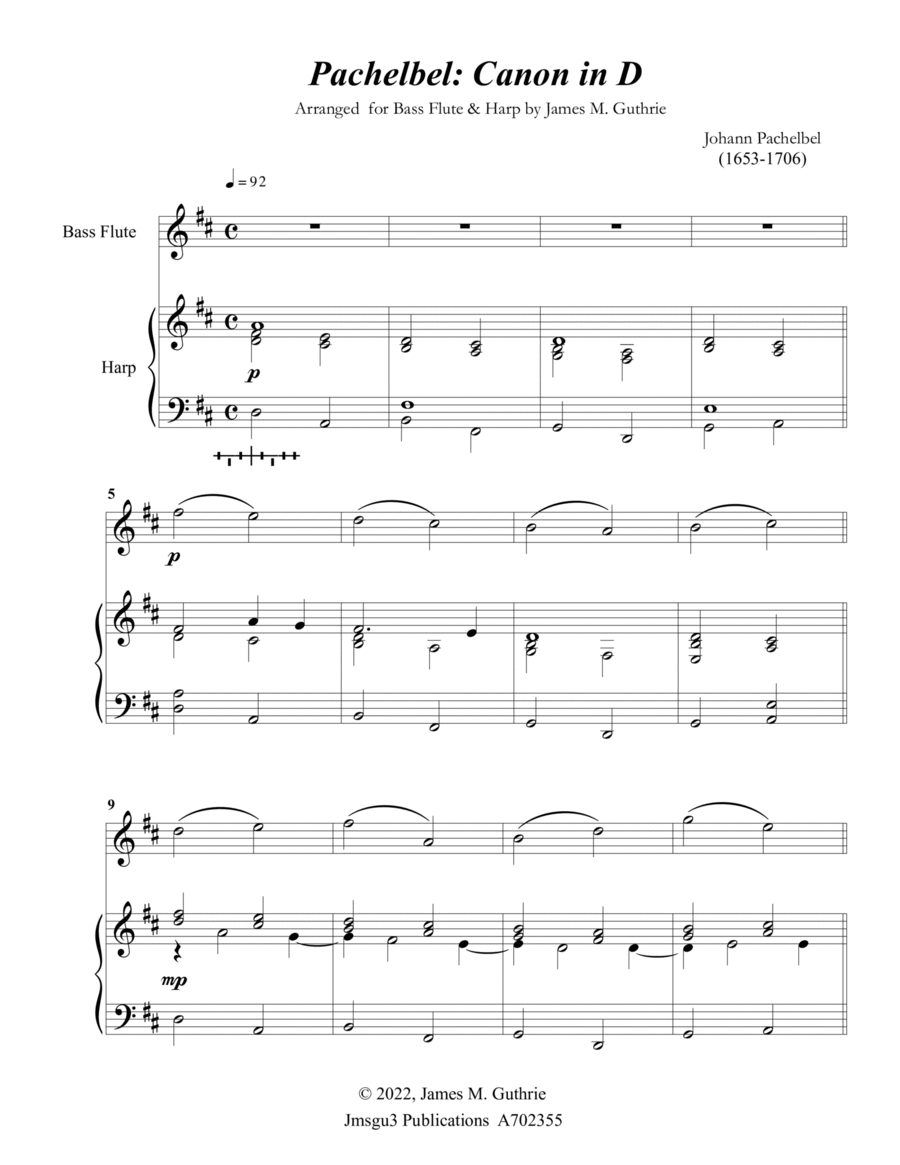
Pachelbel: Canon in D for Bass Flute & Harp
Harpe, Flûte (duo)

$32.95 28.71 € Harpe, Flûte (duo) PDF SheetMusicPlus

Easy Piano - Level 1 - Digital Download SKU: A0.983384 Composed by David Paul Mesler. Baroque,Concert,Contemporary,Instructional. Score. 4 pages. David Paul Mesler #3685907. Published by David Paul Mesler (A0.983384). * Exciting, baroque-flavored toccata in cut time for beginning pianists* Level 2 to Level 3* Both hands in D minor pentascales much of the time* Simple octave leaps* Simple rhythmic values and similar rhythms throughout* Call and response effects* Surprising accents* Strong, satisfying finish* Great for sight reading as well as preparing for a recital* Appeals to both young and old* From the 9-suite volume Daydreaming by award-winning pianist and composer   David Paul MeslerCAN BE USED FOR* Early coordination* A study in rhythmic values* Understanding the minor pentascale* Discussing pattern, repetition and form* Working on the pianist's internal clock and finger strength* Developing smoothly flowing 8ths* Developing flair and showmanship
Miles' Dream
Piano Facile

$1.99 1.73 € Piano Facile PDF SheetMusicPlus

Flute,Piano - Level 3 - Digital Download SKU: A0.548462 Composed by Johann Pachelbel. Arranged by James M. Guthrie, ASCAP. Wedding. Score and part. 8 pages. Jmsgu3 #3386271. Published by jmsgu3 (A0.548462). Pachelbel's Canon arranged for alto flute & piano. Great for weddings & receptions. Pachelbel's Canon Pachelbel's Canon is, in fact, the traditional title for a composition by the German composer Johann Pachelbel. Other names for the work include namely: Canon and Gigue for 3 violins and basso continuo, Canon and Gigue in D, and of course Canon in D. We do not know when or why in particular it was written. The oldest copy is surprisingly from the 19th century. It is important to realize that it was a common routine for organists to practice improvisation on the chord progression underlying the canon. Pachelbel originally scored the Canon notably for three violins and continuo. He also in fact paired the Canon with a gigue. The movements are homotonal, to clarify, both are in the key of D major. History In due time, Pachelbel's Canon went out of style and remained in virtual oblivion for centuries. The Jean-François Paillard chamber orchestra, however, recorded an arrangement of it in 1968. As a result, it gained approval.  Many ensembles began likewise to record the piece in the 1970s and by the 1980s became ubiquitous as background music. From the 1970s to the early 2000s, pop songs correspondingly used elements of the piece. The chord progression, in particular, was used this way. Also, since the 1980s, it has been not only wildly popular for weddings, but also for funeral ceremonies in the USA and Europe. Pachelbel Background Johann Pachelbel (1653 –1706) was a German composer, as well as an organist. He was furthermore instrumental in bringing the south German organ school to its apex. He wrote a large body of music, both sacred and, equally important, secular. In particular, he uniquely helped develop the chorale prelude and fugue. For this, he has, in fact, earned a rightful place in the company of the most significant composers of the mid-Baroque period. Works Pachelbel's music was certainly popular. With this in mind, he also consequently had many pupils. His music expressly developed into a model for the south German composers. Nowadays, Pachelbel is most famous particularly for the Canon in D, as well as the F minor Chaconne, the Toccata in E minor, and of course the Hexachordum Apollinis, a set of variations for the keyboard. Influences Johann Jakob Froberger and Johann Caspar Kerll were south German composers who significantly influenced Pachelbel. Furthermore, he was especially influenced by Italians such as Frescobaldi and Poglietti. He frequently preferred an articulate, simple contrapuntal style that highlighted clarity. His music is markedly less extravagant and harmonically adventurous than that of Dieterich Buxtehude. However, as a point often overlooked, like Buxtehude, Pachelbel experimented with different instrumental combinations in his chamber music. Legacy All in all, Pachelbel was most famous as a composer for the keyboard. He composed over two hundred pieces specifically for the instrument. Pachelbel was also surprisingly a prolific composer of vocal music. All in all, about a hundred vocal works survive, including 40 or so large-scale works. 
Pachelbel: Canon for Alto Flute & Piano
Flûte traversière et Piano

$26.95 23.48 € Flûte traversière et Piano PDF SheetMusicPlus

String Orchestra - Level 5 - Digital Download SKU: A0.533700 Composed by Carson Cooman. Baroque,Contemporary,Standards. Score and parts. 38 pages. Musik Fabrik Music Publishing #3038895. Published by Musik Fabrik Music Publishing (A0.533700). Concerto for Portatif Organ and Strings (2006) was commissioned by the HarvardBaroque Chamber Orchestra and its director, Robert Mealy. The work is dedicatedto organist Nancy Granert, for whom the solo part was written. The work wascommissioned in celebration of the von Clemm Chamber Organ at The MemorialChurch, Harvard University, built in 2006 by Klop Organ Builders.As with many of my works, relationships between old and new musical concepts areexplored. In this piece, musical aspects of the Baroque organ concerto tradition(and Baroque style string playing) co-exist with more contemporary musicalelements. In particular, the directness of expression found in many Baroqueconcertante works is present throughout. Musical material is shared between themovements in a motivic fashion.The title of the first movement, Bricolage, is defined as “something made or puttogether using whatever materials happen to be available.†Thus, the musicalmaterial for the movement is of varying characters; these elements are assembledtogether in ways that allow them to comment on and inform each other. Some ofthese musical elements include: a traditional “overture†texture, a Basse deTrompette texture (with an organ reed stop in the left hand) common in FrenchBaroque organ music, and the French keyboard toccata style.The second movement, Elegia, is dark and searching in tone. It begins with arageful roar before quieting down to introduce its basic musical material – a simple“lament†theme in a folk-inflected style. This material is used for further explorations,building to passionate climaxes. Finally, the opening music returns, but this timewith a whisper. The movement winds down to a sad conclusion.After the soul-searching of the second movement, the third movement, Rondeau, issprightly and energetic. The basic material is a set of Baroque and Classical-stylefigurations (with a few American gospel inflections thrown in), firmly grounded in Gmajor. After minor diversions, the original material continues to return and ends thework with unfettered joy.This item is the score only.  The score and complete parts are available for sale as another item.
Carson Cooman: Concerto for Portatif Organ and Strings, score only
Orchestre à Cordes

$25.95 22.61 € Orchestre à Cordes PDF SheetMusicPlus

Easy Piano - Level 2 - Digital Download SKU: A0.1326457 By Johann Sebastian Bach. By Johann Sebastian Bach. Arranged by Darek. Baroque,Classical,Early Music,Religious. Score. 56 pages. Darek #914599. Published by Darek (A0.1326457). BEST OF BACH (20 TUNES) - Sheet Music Collection [EASY PIANO]Sheet music for piano or keyboard in easy arrangements for beginner pianists. Johann Sebastian Bach and 20 of the composer's most famous works. Easy sheet music | Baroque | Classical Music | Easy Sheet Music Collection | Piano | Keyboard | Grand Piano | Easy version for pianists | Beginner Version | Easy Piano Sheet Music | Arrangement for Beginners Included: Articulation, Dynamics, Fingering and a simplified Youtube tutorial. Song List:1.  Adagio from Oboe Concerto in D Minor (BWV 974)2.  Air on the G String from Suite No. 3 (BWV 1068)3.  Ave Maria (Prelude in C major, BWV 846) (Bach/Gounod)4.  Badinerie from Orchestral Suite No. 2 in B Minor (BWV 1067)5.  Bourrée in E Minor (BWV 996)6.  Brandenburg Concerto No. 3 in G Major, First Movement (BWV 1048)7.  Cantata: Jesu, Joy of Man’s Desiring (BWV 147)8.  Cello Suite No. 1, Prelude (BWV 1007)9.  Goldberg Variations, Aria (BWV 988)10.  Invention No. 1 in C Major (BWV 772)11.  Invention No. 8 in F Major (BWV 779)12.   Italian Concerto in F Major, First Movement (BWV 971)13.  Minuet in G Major (BWV Anh. 114)14.  Minuet in G Minor (BWV Anh. 115)15.  Minuet in G Major (BWV Anh. 116)16.   Musette in D Major (BWV Anh. 126)17.   Partita No. 2 in C Minor, I. Sinfonia (BWV 826)18.   Passacaglia in C Minor (BWV 582)19.   Prelude in C (BWV 846)20.   Toccata and Fugue in D Minor (BWV 565).
BEST OF BACH (20 TUNES) - Sheet Music Collection [EASY PIANO]
Piano Facile
Johann Sebastian Bach
$20.00 17.43 € Piano Facile PDF SheetMusicPlus

Bass Voice,Vocal Solo - Level 3 - Digital Download SKU: A0.533416 Composed by Ange Flégier. Concert,Romantic Period,Standards. 12 pages. Musik Fabrik Music Publishing #2913395. Published by Musik Fabrik Music Publishing (A0.533416). A setting of a poem by Charles Baudelaire. Edited by Jared Schwartz and Mary Dibbern.Recorded on Ange Flégier: Mélodies for Bass Voice and Piano.Toccata Classics, 2016. In C sharp minor Duration: aprox. 4 minutes 30 secondsHomme libre, toujours tu chériras la mer !La mer est ton miroir ; tu contemples ton âmeDans le déroulement infini de sa lame,Et ton esprit n’est pas un gouffre moins amer.Tu te plais à plonger au sein de ton image ;Tu l’embrasses des yeux et des bras, et ton coeurSe distrait quelquefois de sa propre rumeurAu bruit de cette plainte indomptable et sauvage.Vous êtes tous les deux ténébreux et discrets :Homme, nul n’a sondé le fond de tes abîmes ;Ô mer, nul ne connaît tes richesses intimes,Tant vous êtes jaloux de garder vos secrets !Et cependant voilà des siècles innombrablesQue vous vous combattez sans pitié ni remords,Tellement vous aimez le carnage et la mort,Ô lutteurs éternels, ô frères implacables !
Ange Flégier: L'Homme et La Mer for bass voice and piano
Voix basse, Piano

$10.35 9.02 € Voix basse, Piano PDF SheetMusicPlus

Euphonium,Piano - Level 2 - Digital Download SKU: A0.549899 Composed by Johann Pachelbel. Arranged by James M. Guthrie, ASCAP. Baroque,Standards,Wedding. Score and part. 7 pages. Jmsgu3 #3627117. Published by jmsgu3 (A0.549899). BARITONE HORN (T.C.) and PIANO. The famous Pachelbel Canon arranged for Baritone Horn & Piano. Great choice for weddings & receptions! Pachelbel's Canon Pachelbel's Canon is, in fact, the traditional title for a composition by the German composer Johann Pachelbel. Other names for the work include namely: Canon and Gigue for 3 violins and basso continuo, Canon and Gigue in D, and of course Canon in D. We do not know when or why in particular it was written. The oldest copy is surprisingly from the 19th century. It is important to realize that it was a common routine for organists to practice improvisation on the chord progression underlying the canon. Pachelbel originally scored the Canon notably for three violins and continuo. He also in fact paired the Canon with a gigue. The movements are homotonal, to clarify, both are in the key of D major. History In due time, Pachelbel's Canon went out of style and remained in virtual oblivion for centuries. The Jean-François Paillard chamber orchestra, however, recorded an arrangement of it in 1968. As a result, it gained approval.  Many ensembles began likewise to record the piece in the 1970s and by the 1980s became ubiquitous as background music. From the 1970s to the early 2000s, pop songs correspondingly used elements of the piece. The chord progression, in particular, was used this way. Also, since the 1980s, it has been not only wildly popular for weddings, but also for funeral ceremonies in the USA and Europe. Pachelbel Background Johann Pachelbel (1653 –1706) was a German composer, as well as an organist. He was furthermore instrumental in bringing the south German organ school to its apex. He wrote a large body of music, both sacred and, equally important, secular. In particular, he uniquely helped develop the chorale prelude and fugue. For this, he has, in fact, earned a rightful place in the company of the most significant composers of the mid-Baroque period. Works Pachelbel's music was certainly popular. With this in mind, he also consequently had many pupils. His music expressly developed into a model for the south German composers. Nowadays, Pachelbel is most famous particularly for the Canon in D, as well as the F minor Chaconne, the Toccata in E minor, and of course the Hexachordum Apollinis, a set of variations for the keyboard. Influences Johann Jakob Froberger and Johann Caspar Kerll were south German composers who significantly influenced Pachelbel. Furthermore, he was especially influenced by Italians such as Frescobaldi and Poglietti. He frequently preferred an articulate, simple contrapuntal style that highlighted clarity. His music is markedly less extravagant and harmonically adventurous than that of Dieterich Buxtehude. However, as a point often overlooked, like Buxtehude, Pachelbel experimented with different instrumental combinations in his chamber music. LegacyAll in all, Pachelbel was most famous as a composer for the keyboard. He composed over two hundred pieces specifically for the instrument. Pachelbel was also surprisingly a prolific composer of vocal music. All in all, about a hundred vocal works survive, including 40 or so large-scale works.

Pachelbel: Canon for Baritone Horn & Piano
Euphonium, Piano (duo)

$28.95 25.23 € Euphonium, Piano (duo) PDF SheetMusicPlus


1 ....361 376 391 406 421 ....466


Partitions Gratuites
Acheter des Partitions Musicales
Acheter des Partitions Digitales à Imprimer
Acheter des Instruments de Musique

© 2000 - 2026

Accueil - Version intégrale




