EUROPE
954 articles
USA
0 articles
DIGITAL
473 articles (à imprimer)
Partitions Digitales
Partitions à imprimer
473 partitions trouvées


Piano,Tenor Saxophone - Level 3 - Digital Download SKU: A0.548470 Composed by Johann Pachelbel. Arranged by James M. Guthrie, ASCAP. Baroque,Instructional,Standards,Wedding. Score and part. 8 pages. Jmsgu3 #3386301. Published by jmsgu3 (A0.548470). The famous Pachelbel Canon arranged for Tenor Sax & Piano. Great choice for weddings & receptions! Pachelbel's Canon Pachelbel's Canon is, in fact, the traditional title for a composition by the German composer Johann Pachelbel. Other names for the work include namely: Canon and Gigue for 3 violins and basso continuo, Canon and Gigue in D, and of course Canon in D. We do not know when or why in particular it was written. The oldest copy is surprisingly from the 19th century. It is important to realize that it was a common routine for organists to practice improvisation on the chord progression underlying the canon. Pachelbel originally scored the Canon notably for three violins and continuo. He also in fact paired the Canon with a gigue. The movements are homotonal, to clarify, both are in the key of D major. History In due time, Pachelbel's Canon went out of style and remained in virtual oblivion for centuries. The Jean-François Paillard chamber orchestra, however, recorded an arrangement of it in 1968. As a result, it gained approval.  Many ensembles began likewise to record the piece in the 1970s and by the 1980s became ubiquitous as background music. From the 1970s to the early 2000s, pop songs correspondingly used elements of the piece. The chord progression, in particular, was used this way. Also, since the 1980s, it has been not only wildly popular for weddings, but also for funeral ceremonies in the USA and Europe. Pachelbel Background Johann Pachelbel (1653 –1706) was a German composer, as well as an organist. He was furthermore instrumental in bringing the south German organ school to its apex. He wrote a large body of music, both sacred and, equally important, secular. In particular, he uniquely helped develop the chorale prelude and fugue. For this, he has, in fact, earned a rightful place in the company of the most significant composers of the mid-Baroque period. Works Pachelbel's music was certainly popular. With this in mind, he also consequently had many pupils. His music expressly developed into a model for the south German composers. Nowadays, Pachelbel is most famous particularly for the Canon in D, as well as the F minor Chaconne, the Toccata in E minor, and of course the Hexachordum Apollinis, a set of variations for the keyboard. Influences Johann Jakob Froberger and Johann Caspar Kerll were south German composers who significantly influenced Pachelbel. Furthermore, he was especially influenced by Italians such as Frescobaldi and Poglietti. He frequently preferred an articulate, simple contrapuntal style that highlighted clarity. His music is markedly less extravagant and harmonically adventurous than that of Dieterich Buxtehude. However, as a point often overlooked, like Buxtehude, Pachelbel experimented with different instrumental combinations in his chamber music. Legacy All in all, Pachelbel was most famous as a composer for the keyboard. He composed over two hundred pieces specifically for the instrument. Pachelbel was also surprisingly a prolific composer of vocal music. All in all, about a hundred vocal works survive, including 40 or so large-scale works. 
Pachelbel: Canon for Tenor Sax & Piano
Saxophone Tenor et Piano

$32.95 28.71 € Saxophone Tenor et Piano PDF SheetMusicPlus

Instrumental Duet English Horn,Harp,Instrumental Duet - Level 2 - Digital Download SKU: A0.1098849 Composed by Johann Pachelbel. Arranged by James M. Guthrie. Baroque,Classical,Standards,Traditional,Wedding. Score and parts. 11 pages. Jmsgu3 #702692. Published by jmsgu3 (A0.1098849). Score: 6 pages. Duration: ca. 2:30. The famous Pachelbel Canon arranged for English Horn & Harp. A great choice for weddings & receptions! Pachelbel's Canon Pachelbel's Canon is, in fact, the traditional title for a composition by the German composer Johann Pachelbel. Other names for the work include namely: Canon and Gigue for 3 violins and basso continuo, Canon and Gigue in D, and of course Canon in D. We do not know when or why in particular it was written. The oldest copy is surprisingly from the 19th century. It is important to realize that it was a common routine for organists to practice improvisation on the chord progression underlying the canon. Pachelbel originally scored the Canon notably for three violins and continuo. He also in fact paired the Canon with a gigue. The movements are homotonal, to clarify, both are in the key of D major. History In due time, Pachelbel's Canon went out of style and remained in virtual oblivion for centuries. The Jean-François Paillard chamber orchestra, however, recorded an arrangement of it in 1968. As a result, it gained approval. Many ensembles began likewise to record the piece in the 1970s and by the 1980s became ubiquitous as background music. From the 1970s to the early 2000s, pop songs correspondingly used elements of the piece. The chord progression, in particular, was used this way. Also, since the 1980s, it has been not only wildly popular for weddings, but also for funeral ceremonies in the USA and Europe. Pachelbel Background Johann Pachelbel (1653 –1706) was a German composer, as well as an organist. He was furthermore instrumental in bringing the south German organ school to its apex. He wrote a large body of music, both sacred and, equally important, secular. In particular, he uniquely helped develop the chorale prelude and fugue. For this, he has, in fact, earned a rightful place in the company of the most significant composers of the mid-Baroque period. Works Pachelbel's music was certainly popular. With this in mind, he also consequently had many pupils. His music expressly developed into a model for south German composers. Nowadays, Pachelbel is most famous, particularly for the Canon in D, as well as the F minor Chaconne, the Toccata in E minor, and of course the Hexachordum Apollinis, a set of variations for the keyboard. Influences Johann Jakob Froberger and Johann Caspar Kerll were south German composers who significantly influenced Pachelbel. Furthermore, he was especially influenced by Italians such as Frescobaldi and Poglietti. He frequently preferred an articulate, simple contrapuntal style that highlighted clarity. His music is markedly less extravagant and harmonically adventurous than that of Dieterich Buxtehude. However, as a point often overlooked, like Buxtehude, Pachelbel experimented with different instrumental combinations in his chamber music. Legacy All in all, Pachelbel was most famous as a composer for the keyboard. He composed over two hundred pieces specifically for the instrument. Pachelbel was also surprisingly a prolific composer of vocal music. All in all, about a hundred vocal works survive, including 40 or so large-scale works.
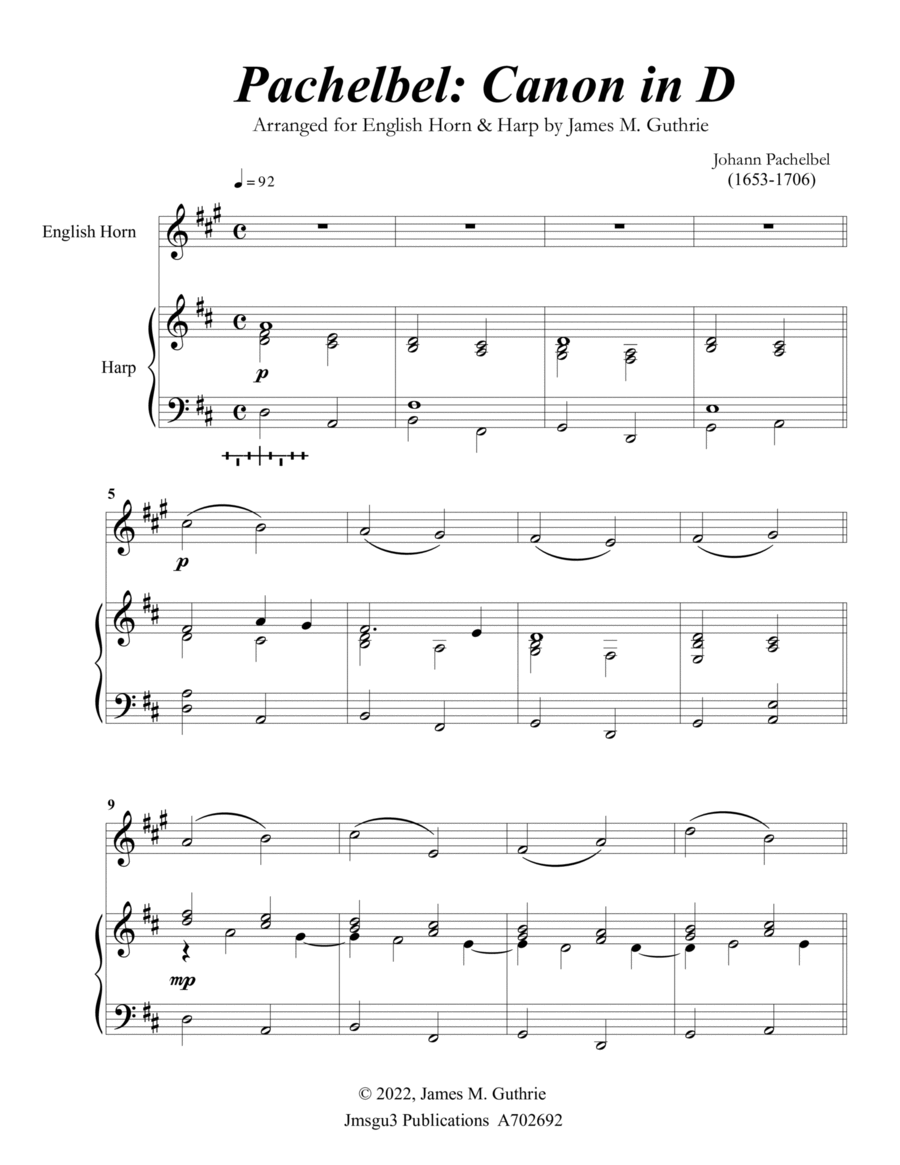
Pachelbel: Canon in D for English Horn & Harp
Cor anglais et Harpe (duo)

$32.95 28.71 € Cor anglais et Harpe (duo) PDF SheetMusicPlus

String Ensemble,String Trio Cello - Level 3 - Digital Download SKU: A0.552065 Composed by Johann Pachelbel. Arranged by James M. Guthrie. Baroque,Instructional,Standards,Wedding. Score and parts. 16 pages. Jmsgu3 #6105689. Published by jmsgu3 (A0.552065). Score: 9 pagesDuration: 2:40. The famous Pachelbel Canon arranged for Piano Trio. A great choice for weddings & receptions! Pachelbel's Canon Pachelbel's Canon is, in fact, the traditional title for a composition by the German composer Johann Pachelbel. Other names for the work include namely: Canon and Gigue for 3 violins and basso continuo, Canon and Gigue in D, and of course Canon in D. We do not know when or why in particular it was written. The oldest copy is surprisingly from the 19th century. It is important to realize that it was a common routine for organists to practice improvisation on the chord progression underlying the canon. Pachelbel originally scored the Canon notably for three violins and continuo. He also in fact paired the Canon with a gigue. The movements are homotonal, to clarify, both are in the key of D major. History In due time, Pachelbel's Canon went out of style and remained in virtual oblivion for centuries. The Jean-François Paillard chamber orchestra, however, recorded an arrangement of it in 1968. As a result, it gained approval. Many ensembles began likewise to record the piece in the 1970s and by the 1980s became ubiquitous as background music. From the 1970s to the early 2000s, pop songs correspondingly used elements of the piece. The chord progression, in particular, was used this way. Also, since the 1980s, it has been not only wildly popular for weddings, but also for funeral ceremonies in the USA and Europe. Pachelbel Background Johann Pachelbel (1653 –1706) was a German composer, as well as an organist. He was furthermore instrumental in bringing the south German organ school to its apex. He wrote a large body of music, both sacred and, equally important, secular. In particular, he uniquely helped develop the chorale prelude and fugue. For this, he has, in fact, earned a rightful place in the company of the most significant composers of the mid-Baroque period. Works Pachelbel's music was certainly popular. With this in mind, he also consequently had many pupils. His music expressly developed into a model for south German composers. Nowadays, Pachelbel is most famous, particularly for the Canon in D, as well as the F minor Chaconne, the Toccata in E minor, and of course the Hexachordum Apollinis, a set of variations for the keyboard. Influences Johann Jakob Froberger and Johann Caspar Kerll were south German composers who significantly influenced Pachelbel. Furthermore, he was especially influenced by Italians such as Frescobaldi and Poglietti. He frequently preferred an articulate, simple contrapuntal style that highlighted clarity. His music is markedly less extravagant and harmonically adventurous than that of Dieterich Buxtehude. However, as a point often overlooked, like Buxtehude, Pachelbel experimented with different instrumental combinations in his chamber music. Legacy All in all, Pachelbel was most famous as a composer for the keyboard. He composed over two hundred pieces specifically for the instrument. Pachelbel was also surprisingly a prolific composer of vocal music. All in all, about a hundred vocal works survive, including 40 or so large-scale works.
Pachelbel: Canon in D for Piano Trio
Trio à Cordes: 3 violoncelles

$36.95 32.2 € Trio à Cordes: 3 violoncelles PDF SheetMusicPlus

Large Ensemble A Clarinet,Bassoon,Double Bass,Flute,Oboe/English Horn - Level 4 - Digital Download SKU: A0.1496456 Composed by Maurice Ravel. Arranged by Ray Thompson. 20th Century. 38 pages. RayThompsonMusic #1072981. Published by RayThompsonMusic (A0.1496456). Le Tombeau de Couperin is a suite for solo piano by Maurice Ravel, composed between 1914 and 1917. The piece is in six movements, based on those of a traditional Baroque suite. Each movement is dedicated to the memory of a friend of the composer (or in one case, two brothers) who had died fighting in World War I.The six movements are:Prélude. Vif (E minor)Fugue. Allegro moderato (E minor)Forlane. Allegretto (E minor)Rigaudon. Assez vif (C major)Menuet. Allegro moderato (G major)Toccata. Vif (E minor) Ravel also produced an orchestral version of the work in 1919, although this omitted two of the original movements.The movements used were Nos.1, 3, 5 and 4 in that order.The word tombeau in the title is a musical term popular from the 17th century, meaning a piece written as a memorial. The specific Couperin, among a family noted as musicians for about two centuries, that Ravel intended to evoke is thought to be François Couperin the Great (1668–1733).Ravel stated that his intention was to pay homage more generally to the sensibilities of the Baroque French keyboard suite, not necessarily to imitate or pay tribute to Couperin himself in particular. This is reflected in the piece's structure, which imitates a Baroque dance suite.Arranged double wind quintet/bass:Oboe 2 is mostly cor anglais, some bars of oboe.Clarinet parts are for Clarinet in A.
Ravel: Le Tombeau de Couperin No.II Forlane - symphonic wind

$14.95 13.03 € PDF SheetMusicPlus

Bass Voice,Vocal Solo - Level 3 - Digital Download SKU: A0.533418 Composed by Ange Flégier. Concert,Romantic Period,Standards. 10 pages. Musik Fabrik Music Publishing #2913407. Published by Musik Fabrik Music Publishing (A0.533418). A setting of a poem by Paul-Armand Silvestre. Edited by Jared Schwartz and Mary Dibbern.Recorded on Ange Flégier: Mélodies for Bass Voice and Piano.Toccata Classics, 2016. In g minor Duration: aprox. 5 minutes 30 secondsAutomne au ciel brumeux, aux horizons navrants,Aux rapides couchants, aux aurores pâlies,Je regarde couler, avec l’eau des torrents,Tes jours faits de mélancolies.Sur l’aile du regret mes esprits emportés,Comme s’il se pouvait que notre âge renaisse,Parcourent, en rêvant, les coteaux enchantésOù, jadis, sourit ma jeunesse.Je sens, au clair soleil du souvenir vainqueur,Refleurir en bouquet les roses deliéesEt monter à mes yeux des larmes, qu’en mon coeur,Mes vingt ans avaient oubliées!
Ange Flégier: Chant d'Automne for bass voice and piano
Voix basse, Piano

$9.10 7.93 € Voix basse, Piano PDF SheetMusicPlus

Woodwind Ensemble,Woodwind Quartet Flute - Level 4 - Digital Download SKU: A0.837477 Composed by Brett L. Wery. Concert,Contemporary. 87 pages. Sonata Grendel Publishing #3113489. Published by Sonata Grendel Publishing (A0.837477). sunrise on Patriots’ Day an unnatural silence a public test of private will: Toccata and Chorale a tough and resilient town is written in honor of the city of Boston, Massachusetts and the victims of the 2013 bombing at the Boston Marathon finish line. The work is challenging, moving, and ultimately uplifting. The first movement depicts the celebratory morning of the race. The second movement depicts the shock of disbelief in the moments immediately following the explosion that killed three and wounded more that 260. The third movement honors the fierce will and determination of the people of Boston as they fought to reclaim their city and as they worked together in the aftermath of the bombing.
a tough and resilient town
Quatuor de Flûtes : 4 flûtes

$24.99 21.78 € Quatuor de Flûtes : 4 flûtes PDF SheetMusicPlus


Partitions Gratuites
Acheter des Partitions Musicales
Acheter des Partitions Digitales à Imprimer
Acheter des Instruments de Musique

© 2000 - 2026

Accueil - Version intégrale





