EUROPE
5106 articles
USA
0 articles
DIGITAL
172173 articles (à imprimer)
Partitions Digitales
Partitions à imprimer
172173 partitions trouvées


Choral Choir (TTBB) - Level 4 - Digital Download SKU: A0.1272741 By Traditional. By Stephanie K. Andrews. 21st Century,A Cappella,Chamber,Classical,Sacred. Octavo. 7 pages. Stephanie K Andrews #864937. Published by Stephanie K Andrews (A0.1272741). O Salutaris Hostia was composed in late summer 2019 as a companion piece to O Sacrum Convivium, which Dr. Andrews wrote for treble voices in the spring of 2019. The text of O Salutaris Hostia was written by St. Thomas Aquinas in the 13th century and is the last two stanzas of a larger hymn that St. Thomas wrote about Christ's institution of the Eucharist at the Last Supper. Traditionally, this text is sung during Eucharistic services.It is my prayer that, as with O Sacrum Convivium, those who hear this work may find respite, grace, and peace in the midst of a troubled world.
O Salutaris Hostia
Chorale TTBB
Traditional
$2.00 1.73 € Chorale TTBB PDF SheetMusicPlus

Woodwind Ensemble,Woodwind Quartet - Level 2 - Digital Download SKU: A0.1137818 Composed by Christian Petzold, Johann Sebastian Bach, and Martin Luther. Arranged by Ander. Baroque,Easter,Renaissance,Sacred,Wedding. 44 pages. Woods Only, Arrangements #738076. Published by Woods Only, Arrangements (A0.1137818). This album contains 5 of Johann Sebastian Bach's most famous and versatile pieces for woodwind quartet, all very well suited for the beginners who want to get to know the baroque repertoire. They are also suitable for performances at events such as: weddings, Christian and church ceremonies, Easter, and academic recitals or concerts. They can be used in music institutions and by teachers as repertoire material and study methods, either for performance or instrumental technique. This collection includes a totally free bonus for you to enjoy: Martin Luther's A Mighty Fortress is Our God, a Renaissance sacred song for choir, which has been adapted for this set. 1: Air on the G String - The original piece is part of Johann Sebastian Bach's Suite No. 3 for orchestra, in D Major, BWV 1068, written for Prince Leopold of Anhalt. The so-called Air on the G String dates from one of these latter employments. In the service of the Prince of Cöthen, Bach composed not only the famous Brandenburg Concertos, but also several orchestral suites, from the third of which comes the Air on the G String. This curious title derives from a later arrangement of this piece for violin solo, in which the melody is played entirely on the lower, higher string of the instrument. 2: Arioso - The Cantata 156 (BWV 156) was written for the third Sunday after Epiphany in 1729, and was first performed on January 23 of that year. The text is by Picander, one of Bach's favorite librettists. Of the four cantatas written by Bach for the feast, it was the last and only one scored for solo voice. This is a choral cantata, employing a choral melody in several movements. Cantata 156, in fact, employs two different choral melodies and texts in the second and sixth movements. A cantata is a sung symphony consisting of several parts, one of which is the Arioso, which is the initial instrumental part. 3: Jesu, joy of man's desiring - This is one of Bach's most beautiful cantatas, made famous by the Jesus the Joy of Men chorus. It was originally composed for Advent 1716 in Weimar. Years later, already in Leipzig, Advent was tempus clausum, there was no music in the churches. Bach then reworked it for the Feast of Mary's Visitation. It is the final chorale of the cantata Herz und Mund und Tat und Leben. Although it is the 32nd cantata composed by Bach, of those that have survived, it was given BWV 147 in the complete catalog of his works. 4: O Jesulein süss, o Jesulein mild - The Jesulein süß, the Jesulein mild is an original traditional German choral melody for voice and continuous bass arranged by Johann Sebastian Bach around 1735. With lyrics by Valentin Thilo, O Jesulein süss is a sacred melody adapted and catalogued as BWV 493. The first translation is by Dirk van Hogendorp, who made it more of a song for the time of suffering. 5: Minuet in G major - This famous piece has traditionally been attributed to Johann Sebastian Bach, as it appears in the Notebook for Anna Magdalena , a notebook that Bach gave to his wife Anna Magdalena in 1725 and which was to be filled with the favorite selections of Bach family members. However, recent research has concluded that this minuet, sometimes referred to as BWV Anhang 114. was probably composed by Christian Petzold, a German composer and organist contemporary with Bach. Bonus: A Mighty Fortress is Our God, by Martin Luther - Ein feste Burg ist unser Gott is a hymn written by Martin Luther probably before 1529. The melody was also considered his work for a long time, but it was created at least with the collaboration of Johann Walter. The song is of great symbolic power for Protestantism, where it is also known as Deus noster refugium et virtus. Considered one of the most important hymns in the history of Christianity, it was considered by the Christian poet Johann Heirich Heine (1797-1856) to be the Marseillaise of the Reformation, in an allusion to the French national anthem.
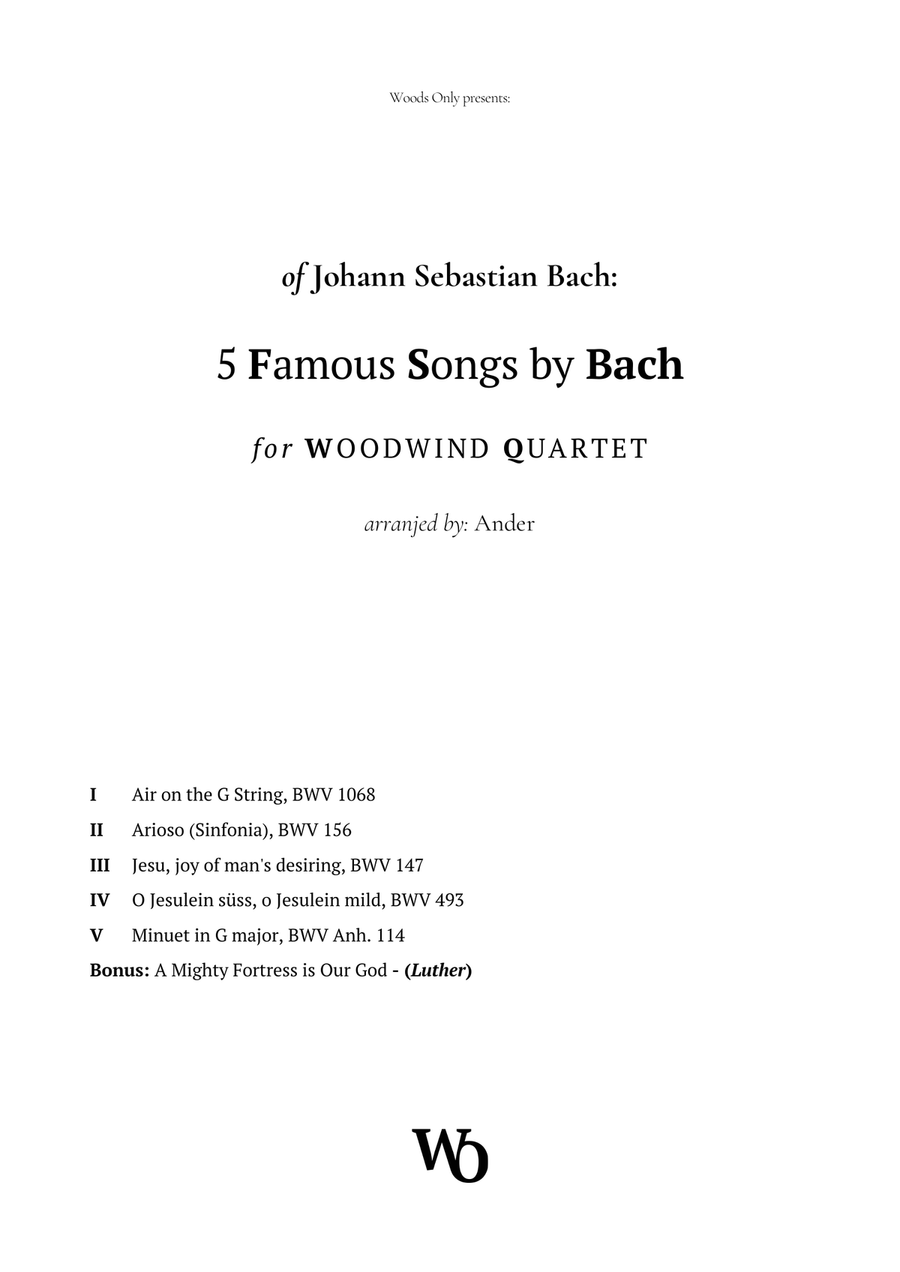
5 Famous Songs by Bach for Woodwind Quartet
Flûte, Hautbois, Clarinette, Basson

$31.99 27.68 € Flûte, Hautbois, Clarinette, Basson PDF SheetMusicPlus

Woodwind Ensemble,Woodwind Quintet - Level 1 - Digital Download SKU: A0.957290 Composed by Bach, Martin Luther. Arranged by Ander. Baroque,Easter,Renaissance,Sacred,Wedding. 51 pages. Woods Only, Arrangements #6748233. Published by Woods Only, Arrangements (A0.957290). This album contains 5 of Johann Sebastian Bach's most famous and versatile pieces for english horn quintet, all very well suited for the beginners who want to get to know the baroque repertoire. They are also suitable for performances at events such as: weddings, Christian and church ceremonies, Easter, and academic recitals or concerts. They can be used in music institutions and by teachers as repertoire material and study methods, either for performance or instrumental technique. This collection includes a totally free bonus for you to enjoy: Martin Luther's A Mighty Fortress is Our God, a Renaissance sacred song for choir, which has been adapted for this set. You can also buy each one individually by checking right at the end of each description of each work.1: Air on the G String - The original piece is part of Johann Sebastian Bach's Suite No. 3 for orchestra, in D Major, BWV 1068, written for Prince Leopold of Anhalt. The so-called Air on the G String dates from one of these latter employments. In the service of the Prince of Cöthen, Bach composed not only the famous Brandenburg Concertos, but also several orchestral suites, from the third of which comes the Air on the G String. This curious title derives from a later arrangement of this piece for violin solo, in which the melody is played entirely on the lower, higher string of the instrument. ID: S0.11897512: Arioso - The Cantata 156 (BWV 156) was written for the third Sunday after Epiphany in 1729, and was first performed on January 23 of that year. The text is by Picander, one of Bach's favorite librettists. Of the four cantatas written by Bach for the feast, it was the last and only one scored for solo voice. This is a choral cantata, employing a choral melody in several movements. Cantata 156, in fact, employs two different choral melodies and texts in the second and sixth movements. A cantata is a sung symphony consisting of several parts, one of which is the Arioso, which is the initial instrumental part. ID: S0.11899713: Jesu, joy of man's desiring - This is one of Bach's most beautiful cantatas, made famous by the Jesus the Joy of Men chorus. It was originally composed for Advent 1716 in Weimar. Years later, already in Leipzig, Advent was tempus clausum, there was no music in the churches. Bach then reworked it for the Feast of Mary's Visitation. It is the final chorale of the cantata Herz und Mund und Tat und Leben. Although it is the 32nd cantata composed by Bach, of those that have survived, it was given BWV 147 in the complete catalog of his works. ID: S0.11900214: O Jesulein süss, o Jesulein mild - The Jesulein süß, the Jesulein mild is an original traditional German choral melody for voice and continuous bass arranged by Johann Sebastian Bach around 1735. With lyrics by Valentin Thilo, O Jesulein süss is a sacred melody adapted and catalogued as BWV 493. The first translation is by Dirk van Hogendorp, who made it more of a song for the time of suffering. ID: S0.11901435: Minuet in G major - This famous piece has traditionally been attributed to Johann Sebastian Bach, as it appears in the Notebook for Anna Magdalena , a notebook that Bach gave to his wife Anna Magdalena in 1725 and which was to be filled with the favorite selections of Bach family members. However, recent research has concluded that this minuet, sometimes referred to as BWV Anhang 114. was probably composed by Christian Petzold, a German composer and organist contemporary with Bach. ID: S0.1190361Bonuses: A Mighty Fortress is Our God, by Martin Luther - Ein feste Burg ist unser Gott is a hymn written by Martin Luther probably before 1529. The melody was also considered his work for a long time, but it was created at least with the collaboration of Johann Walter. The song is of great symbolic power for Protestant.
5 Famous Songs by Bach for English Horn Quintet
Quintette à Vent: flûte, Hautbois, basson, clarinette, Cor

$39.99 34.61 € Quintette à Vent: flûte, Hautbois, basson, clarinette, Cor PDF SheetMusicPlus

Trombone - Level 2 - Digital Download SKU: A0.1112600 Composed by John Bacchus Dykes. Arranged by Michele Galvagno. 19th Century,Christian,Patriotic,Sacred,Traditional. 14 pages. Artistic Score Engraving di Galvagno Michele #714610. Published by Artistic Score Engraving di Galvagno Michele (A0.1112600). Eternal Father, Strong to Save is a British hymn traditionally associated with seafarers, and was first written in 1860 by William Whiting (1825—1878), an Anglican churchman from Winchester. According to his recount, Whiting grew up near the ocean and, at the age of thirty-five, had felt his life spared by God when a violent storm nearly claimed the ship he was travelling on. This instilled in him a belief in God's command over the rage and calm of the sea. The music associated with it was written by John B. Dykes (1823—1876), another Anglican clergymen and composer of the music for nearly three hundred hymns. This edition comes in several arrangements for multiple ensembles. At the moment of the first edition it contains the original choir version (with the 1861 lyrics), a voice and piano version, and arrangements for string, cello, trombone, horn, woodwind, brass, and saxophone quartets. The cello, trombone, and horn quartet versions are slightly more elaborated. Additional versions will be created upon request, contact me to know more. This arrangement is dedicated to Martin Smith.
Eternal Father, Strong to Save - for Trombone Quartet
Quatuor de cuivres: 4 trombones

$5.50 4.76 € Quatuor de cuivres: 4 trombones PDF SheetMusicPlus

Woodwind Ensemble,Woodwind Trio Baritone Saxophone - Level 2 - Digital Download SKU: A0.1035528 Composed by Christian Petzold and Johann Sebastian Bach. Arranged by Ander. Baroque,Classical,Renaissance,Traditional. 6 pages. Woods Only, Arrangements #640745. Published by Woods Only, Arrangements (A0.1035528). This easy arrangement for baritone sax trio has been adapted to be simple to perform and understand the period minuet form of the original work for various levels of musical knowledge. It can be freely played by beginning students due to the ease built into the piece in relation to the author's suggested interpretation. Recommended for performance in academic recitals, and public festivals, it also serves as a study of Baroque repertoire. This famous piece has traditionally been attributed to Johann Sebastian Bach, as it appears in the Notebook for Anna Magdalena , a notebook that Bach gave to his wife Anna Magdalena in 1725 and which was to be filled with the favorite selections of Bach family members. However, recent research has concluded that this minuet, sometimes referred to as BWV Anhang 114. was probably composed by Christian Petzold, a German composer and organist contemporary with Bach.
Minuet in G major by Bach for Baritone Sax Trio

$5.99 5.18 € PDF SheetMusicPlus

Baritone Saxophone,Piano - Level 1 - Digital Download SKU: A0.1073314 Composed by Christian Petzold and Johann Sebastian Bach. Arranged by Ander. Baroque,Easter,Renaissance,Traditional. Score and part. 4 pages. Woods Only, Arrangements #677582. Published by Woods Only, Arrangements (A0.1073314). This easy arrangement for baritone sax and piano has been adapted to be simple to perform and understand the period minuet form of the original work for various levels of musical knowledge. It can be freely played by beginning students due to the ease built into the piece in relation to the author's suggested interpretation. Recommended for performance in academic recitals, and public festivals, it also serves as a study of Baroque repertoire. This famous piece has traditionally been attributed to Johann Sebastian Bach, as it appears in the Notebook for Anna Magdalena , a notebook that Bach gave to his wife Anna Magdalena in 1725 and which was to be filled with the favorite selections of Bach family members. However, recent research has concluded that this minuet, sometimes referred to as BWV Anhang 114. was probably composed by Christian Petzold, a German composer and organist contemporary with Bach.
Minuet in G major by Bach for Baritone Sax and Piano
Saxophone Baryton, Piano

$1.99 1.72 € Saxophone Baryton, Piano PDF SheetMusicPlus

Instrumental Duet Alto Saxophone,Instrumental Duet,Tenor Saxophone - Level 3 - Digital Download SKU: A0.588436 Composed by Traditional. Arranged by David McKeown. Jewish,Wedding,World. Score and parts. 4 pages. David McKeown #6020759. Published by David McKeown (A0.588436). Hava Nagila is a Hebrew Folk tune, often performed by Klezmer musicians. This version is arranged as a duet for one Alto and one Tenor Saxophone.Hava Nagila was originally a Nigun melody thought to have originated in the Ukraine. In 1918 a professor and musicologist at the Hebrew University in Jerusalem, Abraham Zevi Idelsohn, set the tune to words adapted from Psalm 118. Hava Nagila was first performed at celebrations at the end of the Great War and quickly spread throughout the Jewish diaspora. In the fifties and sixties, performances by singers as diverse as Harry Belafonte and Bob Dylan popularised the song far beyond its original Jewish audience. Hava Nagila remains one of the best-known and loved Klezmer standards today, traditionally performed at Jewish celebrations.Hava Nagila is simply arranged in a key and range best suited to the instruments. After a steady beginning, the melody gradually increases in tempo, with constant variations in the accompaniment. Hava Nagila is suitable for players at an intermediate level and above. With a performance time of around two and a half minutes, this version of Hava Nagila is perfect for celebrations, weddings and concert performances, both formal and informal. Click the link above to listen to a full Youtube performance of the Clarinet version of this duet.There are many more top quality arrangements and compositions by David McKeown for you to browse at http://www.sheetmusicplus.com/publishers/david-mckeown/6203 
Hava Nagila, Klezmer tune for Alto and Tenor Saxophone Duet
2 Saxophones (duo)

$3.99 3.45 € 2 Saxophones (duo) PDF SheetMusicPlus

Violin Duet Violin - Level 3 - Digital Download SKU: A0.589297 Composed by Traditional. Arranged by David McKeown. Jewish,Multicultural,Wedding,World. 4 pages. David McKeown #6020793. Published by David McKeown (A0.589297). Hava Nagila is a Hebrew Folk tune, often performed by Klezmer musicians. This version is arranged as a duet for two Violins. Hava Nagila was originally a Nigun melody thought to have originated in the Ukraine. In 1918 a professor and musicologist at the Hebrew University in Jerusalem, Abraham Zevi Idelsohn, set the tune to words adapted from Psalm 118. Hava Nagila was first performed at celebrations at the end of the Great War and quickly spread throughout the Jewish diaspora. In the fifties and sixties, performances by singers as diverse as Harry Belafonte and Bob Dylan popularised the song far beyond its original Jewish audience. Hava Nagila remains one of the best-known and loved Klezmer standards today, traditionally performed at Jewish celebrations.Hava Nagila is simply arranged in a key and range best suited to the instruments. After a steady beginning, the melody gradually increases in tempo, with constant variations in the accompaniment. Hava Nagila is suitable for players at an intermediate level and above. With a performance time of around two and a half minutes, this version of Hava Nagila is perfect for celebrations, weddings and concert performances, both formal and informal. Click the link above to listen to a full Youtube performance of the Clarinet version of this duet.There are many more top quality arrangements and compositions by David McKeown for you to browse at http://www.sheetmusicplus.com/publishers/david-mckeown/6203 
Hava Nagila, Klezmer tune for Violin Duet
2 Violons (duo)

$3.99 3.45 € 2 Violons (duo) PDF SheetMusicPlus

Piano,Vocal,Voice - Level 3 - Digital Download SKU: A0.1465127 By The computer. By John Philip Sousa. Arranged by Manuela Rosa. 19th Century,Folk,Instructional,Patriotic,Traditional. Score. 7 pages. Manuela #1043821. Published by Manuela (A0.1465127). Das berühmte Lied von Sousa, die inoffizielle 2. Hymne der USAAudiobeispiel wurde computergeneriertgesetzt mit LilypondWarum Lilypond? Die modernen, mit Computerprogrammen gesetzten Noten wirken irgendwie steril. Lilypond bringt die Ästhetik der historischen Notendruckkunst auf den Computer.inofficial national anthem of USAaudio sample generated by computerWhy engrave with Lilypond? Computer engraved music looks somehow sterile.LilyPond is a music engraving program, devoted to producing the highest-quality sheet music possible. It brings the aesthetics of traditionally engraved music to computer printouts. LilyPond is free software.
The Stars and Stripes Forever
Piano, Voix
The computer
$2.22 1.92 € Piano, Voix PDF SheetMusicPlus

Woodwind Ensemble,Woodwind Trio Flute - Level 2 - Digital Download SKU: A0.1138510 Composed by Christian Petzold, Johann Sebastian Bach, and Martin Luther. Arranged by Ander. Baroque,Early Music,Renaissance,Sacred,Wedding. 38 pages. Woods Only, Arrangements #738850. Published by Woods Only, Arrangements (A0.1138510). This album contains 5 of Johann Sebastian Bach's most famous and versatile pieces for flute trio, all very well suited for the beginners who want to get to know the baroque repertoire. They are also suitable for performances at events such as: weddings, Christian and church ceremonies, Easter, and academic recitals or concerts. They can be used in music institutions and by teachers as repertoire material and study methods, either for performance or instrumental technique. This collection includes a totally free bonus for you to enjoy: Martin Luther's A Mighty Fortress is Our God, a Renaissance sacred song for choir, which has been adapted for this set. 1: Air on the G String - The original piece is part of Johann Sebastian Bach's Suite No. 3 for orchestra, in D Major, BWV 1068, written for Prince Leopold of Anhalt. The so-called Air on the G String dates from one of these latter employments. In the service of the Prince of Cöthen, Bach composed not only the famous Brandenburg Concertos, but also several orchestral suites, from the third of which comes the Air on the G String. This curious title derives from a later arrangement of this piece for violin solo, in which the melody is played entirely on the lower, higher string of the instrument. 2: Arioso - The Cantata 156 (BWV 156) was written for the third Sunday after Epiphany in 1729, and was first performed on January 23 of that year. The text is by Picander, one of Bach's favorite librettists. Of the four cantatas written by Bach for the feast, it was the last and only one scored for solo voice. This is a choral cantata, employing a choral melody in several movements. Cantata 156, in fact, employs two different choral melodies and texts in the second and sixth movements. A cantata is a sung symphony consisting of several parts, one of which is the Arioso, which is the initial instrumental part. 3: Jesu, joy of man's desiring - This is one of Bach's most beautiful cantatas, made famous by the Jesus the Joy of Men chorus. It was originally composed for Advent 1716 in Weimar. Years later, already in Leipzig, Advent was tempus clausum, there was no music in the churches. Bach then reworked it for the Feast of Mary's Visitation. It is the final chorale of the cantata Herz und Mund und Tat und Leben. Although it is the 32nd cantata composed by Bach, of those that have survived, it was given BWV 147 in the complete catalog of his works. 4: O Jesulein süss, o Jesulein mild - The Jesulein süß, the Jesulein mild is an original traditional German choral melody for voice and continuous bass arranged by Johann Sebastian Bach around 1735. With lyrics by Valentin Thilo, O Jesulein süss is a sacred melody adapted and catalogued as BWV 493. The first translation is by Dirk van Hogendorp, who made it more of a song for the time of suffering. 5: Minuet in G major - This famous piece has traditionally been attributed to Johann Sebastian Bach, as it appears in the Notebook for Anna Magdalena , a notebook that Bach gave to his wife Anna Magdalena in 1725 and which was to be filled with the favorite selections of Bach family members. However, recent research has concluded that this minuet, sometimes referred to as BWV Anhang 114. was probably composed by Christian Petzold, a German composer and organist contemporary with Bach. Bonus: A Mighty Fortress is Our God, by Martin Luther - Ein feste Burg ist unser Gott is a hymn written by Martin Luther probably before 1529. The melody was also considered his work for a long time, but it was created at least with the collaboration of Johann Walter. The song is of great symbolic power for Protestantism, where it is also known as Deus noster refugium et virtus. Considered one of the most important hymns in the history of Christianity, it was considered by the Christian poet Johann Heirich Heine (1797-1856) to be the Marseillaise of the Reformation, in an allusion to the French national anthem.
5 Famous Songs by Bach for Flute Trio
Trio de Flûtes: 3 flûtes

$23.99 20.76 € Trio de Flûtes: 3 flûtes PDF SheetMusicPlus

Woodwind Ensemble,Woodwind Quintet - Level 1 - Digital Download SKU: A0.957295 Composed by Bach, Martin Luther. Arranged by Ander. Baroque,Easter,Renaissance,Sacred,Wedding. 51 pages. Woods Only, Arrangements #6748247. Published by Woods Only, Arrangements (A0.957295). This album contains 5 of Johann Sebastian Bach's most famous and versatile pieces for tenor sax quintet, all very well suited for the beginners who want to get to know the baroque repertoire. They are also suitable for performances at events such as: weddings, Christian and church ceremonies, Easter, and academic recitals or concerts. They can be used in music institutions and by teachers as repertoire material and study methods, either for performance or instrumental technique. This collection includes a totally free bonus for you to enjoy: Martin Luther's A Mighty Fortress is Our God, a Renaissance sacred song for choir, which has been adapted for this set. You can also buy each one individually by checking right at the end of each description of each work.1: Air on the G String - The original piece is part of Johann Sebastian Bach's Suite No. 3 for orchestra, in D Major, BWV 1068, written for Prince Leopold of Anhalt. The so-called Air on the G String dates from one of these latter employments. In the service of the Prince of Cöthen, Bach composed not only the famous Brandenburg Concertos, but also several orchestral suites, from the third of which comes the Air on the G String. This curious title derives from a later arrangement of this piece for violin solo, in which the melody is played entirely on the lower, higher string of the instrument. ID: S0.11897712: Arioso - The Cantata 156 (BWV 156) was written for the third Sunday after Epiphany in 1729, and was first performed on January 23 of that year. The text is by Picander, one of Bach's favorite librettists. Of the four cantatas written by Bach for the feast, it was the last and only one scored for solo voice. This is a choral cantata, employing a choral melody in several movements. Cantata 156, in fact, employs two different choral melodies and texts in the second and sixth movements. A cantata is a sung symphony consisting of several parts, one of which is the Arioso, which is the initial instrumental part. ID: S0.11899813: Jesu, joy of man's desiring - This is one of Bach's most beautiful cantatas, made famous by the Jesus the Joy of Men chorus. It was originally composed for Advent 1716 in Weimar. Years later, already in Leipzig, Advent was tempus clausum, there was no music in the churches. Bach then reworked it for the Feast of Mary's Visitation. It is the final chorale of the cantata Herz und Mund und Tat und Leben. Although it is the 32nd cantata composed by Bach, of those that have survived, it was given BWV 147 in the complete catalog of his works. ID: S0.11900334: O Jesulein süss, o Jesulein mild - The Jesulein süß, the Jesulein mild is an original traditional German choral melody for voice and continuous bass arranged by Johann Sebastian Bach around 1735. With lyrics by Valentin Thilo, O Jesulein süss is a sacred melody adapted and catalogued as BWV 493. The first translation is by Dirk van Hogendorp, who made it more of a song for the time of suffering. ID: S0.11901655: Minuet in G major - This famous piece has traditionally been attributed to Johann Sebastian Bach, as it appears in the Notebook for Anna Magdalena , a notebook that Bach gave to his wife Anna Magdalena in 1725 and which was to be filled with the favorite selections of Bach family members. However, recent research has concluded that this minuet, sometimes referred to as BWV Anhang 114. was probably composed by Christian Petzold, a German composer and organist contemporary with Bach. ID: S0.1190373Bonuses: A Mighty Fortress is Our God, by Martin Luther - Ein feste Burg ist unser Gott is a hymn written by Martin Luther probably before 1529. The melody was also considered his work for a long time, but it was created at least with the collaboration of Johann Walter. The song is of great symbolic power for Protestantism.
5 Famous Songs by Bach for Tenor Sax Quintet
Quintette à Vent: flûte, Hautbois, basson, clarinette, Cor

$39.99 34.61 € Quintette à Vent: flûte, Hautbois, basson, clarinette, Cor PDF SheetMusicPlus

Woodwind Ensemble,Woodwind Quintet Clarinet - Level 1 - Digital Download SKU: A0.957291 Composed by Bach, Martin Luther. Arranged by Ander. Baroque,Easter,Renaissance,Sacred,Wedding. 51 pages. Woods Only, Arrangements #6748235. Published by Woods Only, Arrangements (A0.957291). This album contains 5 of Johann Sebastian Bach's most famous and versatile pieces for clarinet quintet, all very well suited for the beginners who want to get to know the baroque repertoire. They are also suitable for performances at events such as: weddings, Christian and church ceremonies, Easter, and academic recitals or concerts. They can be used in music institutions and by teachers as repertoire material and study methods, either for performance or instrumental technique. This collection includes a totally free bonus for you to enjoy: Martin Luther's A Mighty Fortress is Our God, a Renaissance sacred song for choir, which has been adapted for this set. You can also buy each one individually by checking right at the end of each description of each work.1: Air on the G String - The original piece is part of Johann Sebastian Bach's Suite No. 3 for orchestra, in D Major, BWV 1068, written for Prince Leopold of Anhalt. The so-called Air on the G String dates from one of these latter employments. In the service of the Prince of Cöthen, Bach composed not only the famous Brandenburg Concertos, but also several orchestral suites, from the third of which comes the Air on the G String. This curious title derives from a later arrangement of this piece for violin solo, in which the melody is played entirely on the lower, higher string of the instrument. ID: S0.11897532: Arioso - The Cantata 156 (BWV 156) was written for the third Sunday after Epiphany in 1729, and was first performed on January 23 of that year. The text is by Picander, one of Bach's favorite librettists. Of the four cantatas written by Bach for the feast, it was the last and only one scored for solo voice. This is a choral cantata, employing a choral melody in several movements. Cantata 156, in fact, employs two different choral melodies and texts in the second and sixth movements. A cantata is a sung symphony consisting of several parts, one of which is the Arioso, which is the initial instrumental part. ID: S0.11899733: Jesu, joy of man's desiring - This is one of Bach's most beautiful cantatas, made famous by the Jesus the Joy of Men chorus. It was originally composed for Advent 1716 in Weimar. Years later, already in Leipzig, Advent was tempus clausum, there was no music in the churches. Bach then reworked it for the Feast of Mary's Visitation. It is the final chorale of the cantata Herz und Mund und Tat und Leben. Although it is the 32nd cantata composed by Bach, of those that have survived, it was given BWV 147 in the complete catalog of his works. ID: S0.11900234: O Jesulein süss, o Jesulein mild - The Jesulein süß, the Jesulein mild is an original traditional German choral melody for voice and continuous bass arranged by Johann Sebastian Bach around 1735. With lyrics by Valentin Thilo, O Jesulein süss is a sacred melody adapted and catalogued as BWV 493. The first translation is by Dirk van Hogendorp, who made it more of a song for the time of suffering. ID: S0.11901475: Minuet in G major - This famous piece has traditionally been attributed to Johann Sebastian Bach, as it appears in the Notebook for Anna Magdalena , a notebook that Bach gave to his wife Anna Magdalena in 1725 and which was to be filled with the favorite selections of Bach family members. However, recent research has concluded that this minuet, sometimes referred to as BWV Anhang 114. was probably composed by Christian Petzold, a German composer and organist contemporary with Bach. ID: S0.1190363Bonuses: A Mighty Fortress is Our God, by Martin Luther - Ein feste Burg ist unser Gott is a hymn written by Martin Luther probably before 1529. The melody was also considered his work for a long time, but it was created at least with the collaboration of Johann Walter. The song is of great symbolic power for Protestantism;.
5 Famous Songs by Bach for Clarinet Quintet
Quintette de Clarinettes: 5 clarinettes

$39.99 34.61 € Quintette de Clarinettes: 5 clarinettes PDF SheetMusicPlus


Partitions Gratuites
Acheter des Partitions Musicales
Acheter des Partitions Digitales à Imprimer
Acheter des Instruments de Musique

© 2000 - 2026

Accueil - Version intégrale





