EUROPE
5079 articles
USA
0 articles
DIGITAL
172049 articles (à imprimer)
Partitions Digitales
Partitions à imprimer
172049 partitions trouvées


Concert Band - Digital Download SKU: AX.00-PC-0002130_WPTN1TC (wp) 1st B-flat Trombone T.C.. Arranged by Robert W. Smith. Instructional. World Part. 2 pages. Alfred Music - Digital Sheet Music #00-PC-0002130_wpTN1TC. Published by Alfred Music - Digital Sheet Music (AX.00-PC-0002130_WPTN1TC). UPC: 654979185666.Subtitled A Holiday Prism for Band, this work can be presented in a theater-in-the-round format or more traditionally on the concert stage. Following a broad introduction, each family of the band presents their independent carol. Carols include The Ukrainian Bell Carol, Silent Night, What Child Is This? Jingle Bells, Joy to the World, Deck the Halls, We Wish You a Merry Christmas, and God Rest Ye Merry Gentlemen. Prepare the introduction and the finale then let the sections prepare their own carol. Include them all or not. Traditional, contemporary, humorous, and stately, each choir brings a unique facet to this holiday prism. A valuable contribution to the holiday literature.
Christmas in the Round: (wp) 1st B-flat Trombone T.C.
Orchestre d'harmonie

$3.00 2.61 € Orchestre d'harmonie PDF SheetMusicPlus

Easy Piano - Level 1 - Digital Download SKU: A0.1466687 By John Nichols Wilder. By Henry Tucker. Arranged by Manuela Rosa. 19th Century,Folk,Instructional,Patriotic,Traditional. Score. 6 pages. Manuela #1045232. Published by Manuela (A0.1466687). Ein weiteres patriotisches Lied des Komponisten von  Weeping, sad and lonely (When this cruel war is over)transponiert nach B Dur; leicht gesetzt für KlavierAudiobeispiel wurde computergeneriertgesetzt mit LilypondWarum Lilypond? Die modernen, mit Computerprogrammen gesetzten Noten wirken irgendwie steril. Lilypond bringt die Ästhetik der historischen Notendruckkunst auf den Computer.a patriotic song by the composer of Weeping, sad and lonely (When this cruel war is over)transposed to Bb major; easy piano versionaudio sample generated by computerWhy engrave with Lilypond? Computer engraved music looks somehow sterile.LilyPond is a music engraving program, devoted to producing the highest-quality sheet music possible. It brings the aesthetics of traditionally engraved music to computer printouts. LilyPond is free software.
Stand by the Flag (easy piano version; Bb Major)
Piano Facile
John Nichols Wilder
$2.00 1.74 € Piano Facile PDF SheetMusicPlus

Instrumental Duet Instrumental Duet,Oboe,Violin - Level 3 - Digital Download SKU: A0.588931 Composed by Traditional. Arranged by David McKeown. Jewish,Wedding,World. Score and parts. 4 pages. David McKeown #6020755. Published by David McKeown (A0.588931). Hava Nagila is a Hebrew Folk tune, often performed by Klezmer musicians. This version is arranged as a duet for one Oboe and one Violin.Hava Nagila was originally a Nigun melody thought to have originated in the Ukraine. In 1918 a professor and musicologist at the Hebrew University in Jerusalem, Abraham Zevi Idelsohn, set the tune to words adapted from Psalm 118. Hava Nagila was first performed at celebrations at the end of the Great War and quickly spread throughout the Jewish diaspora. In the fifties and sixties, performances by singers as diverse as Harry Belafonte and Bob Dylan popularised the song far beyond its original Jewish audience. Hava Nagila remains one of the best-known and loved Klezmer standards today, traditionally performed at Jewish celebrations.Hava Nagila is simply arranged in a key and range best suited to the instruments. After a steady beginning, the melody gradually increases in tempo, with constant variations in the accompaniment. Hava Nagila is suitable for players at an intermediate level and above. With a performance time of around two and a half minutes, this version of Hava Nagila is perfect for celebrations, weddings and concert performances, both formal and informal. Click the link above to listen to a full Youtube performance of the Clarinet version of this duet.There are many more top quality arrangements and compositions by David McKeown for you to browse at http://www.sheetmusicplus.com/publishers/david-mckeown/6203
Hava Nagila, Klezmer tune for Oboe and Violin Duet

$3.99 3.47 € PDF SheetMusicPlus

Saxophone Quartet,Woodwind Ensemble Tenor Saxophone - Level 2 - Digital Download SKU: A0.1137878 Composed by Christian Petzold, Johann Sebastian Bach, and Martin Luther. Arranged by Ander. Baroque,Easter,Renaissance,Sacred,Wedding. 44 pages. Woods Only, Arrangements #738132. Published by Woods Only, Arrangements (A0.1137878). This album contains 5 of Johann Sebastian Bach's most famous and versatile pieces for tenor sax quartet, all very well suited for the beginners who want to get to know the baroque repertoire. They are also suitable for performances at events such as: weddings, Christian and church ceremonies, Easter, and academic recitals or concerts. They can be used in music institutions and by teachers as repertoire material and study methods, either for performance or instrumental technique. This collection includes a totally free bonus for you to enjoy: Martin Luther's A Mighty Fortress is Our God, a Renaissance sacred song for choir, which has been adapted for this set. 1: Air on the G String - The original piece is part of Johann Sebastian Bach's Suite No. 3 for orchestra, in D Major, BWV 1068, written for Prince Leopold of Anhalt. The so-called Air on the G String dates from one of these latter employments. In the service of the Prince of Cöthen, Bach composed not only the famous Brandenburg Concertos, but also several orchestral suites, from the third of which comes the Air on the G String. This curious title derives from a later arrangement of this piece for violin solo, in which the melody is played entirely on the lower, higher string of the instrument. 2: Arioso - The Cantata 156 (BWV 156) was written for the third Sunday after Epiphany in 1729, and was first performed on January 23 of that year. The text is by Picander, one of Bach's favorite librettists. Of the four cantatas written by Bach for the feast, it was the last and only one scored for solo voice. This is a choral cantata, employing a choral melody in several movements. Cantata 156, in fact, employs two different choral melodies and texts in the second and sixth movements. A cantata is a sung symphony consisting of several parts, one of which is the Arioso, which is the initial instrumental part. 3: Jesu, joy of man's desiring - This is one of Bach's most beautiful cantatas, made famous by the Jesus the Joy of Men chorus. It was originally composed for Advent 1716 in Weimar. Years later, already in Leipzig, Advent was tempus clausum, there was no music in the churches. Bach then reworked it for the Feast of Mary's Visitation. It is the final chorale of the cantata Herz und Mund und Tat und Leben. Although it is the 32nd cantata composed by Bach, of those that have survived, it was given BWV 147 in the complete catalog of his works. 4: O Jesulein süss, o Jesulein mild - The Jesulein süß, the Jesulein mild is an original traditional German choral melody for voice and continuous bass arranged by Johann Sebastian Bach around 1735. With lyrics by Valentin Thilo, O Jesulein süss is a sacred melody adapted and catalogued as BWV 493. The first translation is by Dirk van Hogendorp, who made it more of a song for the time of suffering. 5: Minuet in G major - This famous piece has traditionally been attributed to Johann Sebastian Bach, as it appears in the Notebook for Anna Magdalena , a notebook that Bach gave to his wife Anna Magdalena in 1725 and which was to be filled with the favorite selections of Bach family members. However, recent research has concluded that this minuet, sometimes referred to as BWV Anhang 114. was probably composed by Christian Petzold, a German composer and organist contemporary with Bach. Bonus: A Mighty Fortress is Our God, by Martin Luther - Ein feste Burg ist unser Gott is a hymn written by Martin Luther probably before 1529. The melody was also considered his work for a long time, but it was created at least with the collaboration of Johann Walter. The song is of great symbolic power for Protestantism, where it is also known as Deus noster refugium et virtus. Considered one of the most important hymns in the history of Christianity, it was considered by the Christian poet Johann Heirich Heine (1797-1856) to be the Marseillaise of the Reformation, in an allusion to the French national anthem.
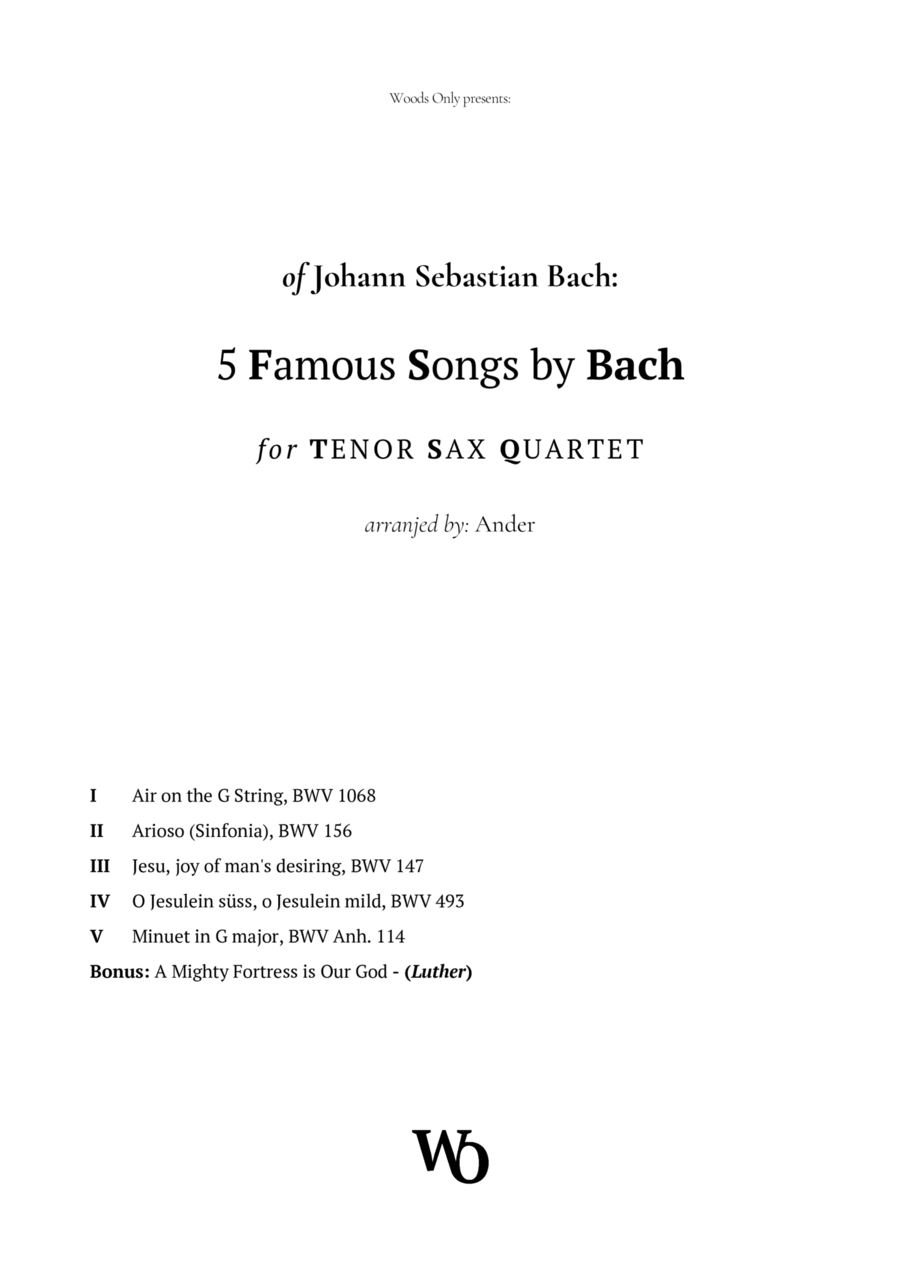
5 Famous Songs by Bach for Tenor Sax Quartet
Quatuor de Saxophones: 4 saxophones

$31.99 27.86 € Quatuor de Saxophones: 4 saxophones PDF SheetMusicPlus

Alto Recorder,Recorder Solo - Level 1 - Digital Download SKU: A0.1050875 Composed by Johann Sebastian Bach. Arranged by Ander. Baroque,Renaissance,Traditional,Wedding. Individual part. 4 pages. Woods Only, Arrangements #655212. Published by Woods Only, Arrangements (A0.1050875). This easy arrangement for alto recorder and piano has been adapted to be simple to perform and understand the period minuet form of the original work for various levels of musical knowledge. It can be freely played by beginning students due to the ease built into the piece in relation to the author's suggested interpretation. Recommended for performance in academic recitals, and public festivals, it also serves as a study of Baroque repertoire. This famous piece has traditionally been attributed to Johann Sebastian Bach, as it appears in the Notebook for Anna Magdalena , a notebook that Bach gave to his wife Anna Magdalena in 1725 and which was to be filled with the favorite selections of Bach family members. However, recent research has concluded that this minuet, sometimes referred to as BWV Anhang 114. was probably composed by Christian Petzold, a German composer and organist contemporary with Bach.
Minuet in G major by Bach for Alto Recorder and Piano
Flûte à bec Alto

$1.99 1.73 € Flûte à bec Alto PDF SheetMusicPlus

Saxophone Trio,Woodwind Ensemble Alto Saxophone - Level 2 - Digital Download SKU: A0.1138515 Composed by Christian Petzold, Johann Sebastian Bach, and Martin Luther. Arranged by Ander. Baroque,Easter,Renaissance,Sacred,Wedding. 38 pages. Woods Only, Arrangements #738855. Published by Woods Only, Arrangements (A0.1138515). This album contains 5 of Johann Sebastian Bach's most famous and versatile pieces for alto saxophone trio, all very well suited for the beginners who want to get to know the baroque repertoire. They are also suitable for performances at events such as: weddings, Christian and church ceremonies, Easter, and academic recitals or concerts. They can be used in music institutions and by teachers as repertoire material and study methods, either for performance or instrumental technique. This collection includes a totally free bonus for you to enjoy: Martin Luther's A Mighty Fortress is Our God, a Renaissance sacred song for choir, which has been adapted for this set. 1: Air on the G String - The original piece is part of Johann Sebastian Bach's Suite No. 3 for orchestra, in D Major, BWV 1068, written for Prince Leopold of Anhalt. The so-called Air on the G String dates from one of these latter employments. In the service of the Prince of Cöthen, Bach composed not only the famous Brandenburg Concertos, but also several orchestral suites, from the third of which comes the Air on the G String. This curious title derives from a later arrangement of this piece for violin solo, in which the melody is played entirely on the lower, higher string of the instrument. 2: Arioso - The Cantata 156 (BWV 156) was written for the third Sunday after Epiphany in 1729, and was first performed on January 23 of that year. The text is by Picander, one of Bach's favorite librettists. Of the four cantatas written by Bach for the feast, it was the last and only one scored for solo voice. This is a choral cantata, employing a choral melody in several movements. Cantata 156, in fact, employs two different choral melodies and texts in the second and sixth movements. A cantata is a sung symphony consisting of several parts, one of which is the Arioso, which is the initial instrumental part. 3: Jesu, joy of man's desiring - This is one of Bach's most beautiful cantatas, made famous by the Jesus the Joy of Men chorus. It was originally composed for Advent 1716 in Weimar. Years later, already in Leipzig, Advent was tempus clausum, there was no music in the churches. Bach then reworked it for the Feast of Mary's Visitation. It is the final chorale of the cantata Herz und Mund und Tat und Leben. Although it is the 32nd cantata composed by Bach, of those that have survived, it was given BWV 147 in the complete catalog of his works. 4: O Jesulein süss, o Jesulein mild - The Jesulein süß, the Jesulein mild is an original traditional German choral melody for voice and continuous bass arranged by Johann Sebastian Bach around 1735. With lyrics by Valentin Thilo, O Jesulein süss is a sacred melody adapted and catalogued as BWV 493. The first translation is by Dirk van Hogendorp, who made it more of a song for the time of suffering. 5: Minuet in G major - This famous piece has traditionally been attributed to Johann Sebastian Bach, as it appears in the Notebook for Anna Magdalena , a notebook that Bach gave to his wife Anna Magdalena in 1725 and which was to be filled with the favorite selections of Bach family members. However, recent research has concluded that this minuet, sometimes referred to as BWV Anhang 114. was probably composed by Christian Petzold, a German composer and organist contemporary with Bach. Bonus: A Mighty Fortress is Our God, by Martin Luther - Ein feste Burg ist unser Gott is a hymn written by Martin Luther probably before 1529. The melody was also considered his work for a long time, but it was created at least with the collaboration of Johann Walter. The song is of great symbolic power for Protestantism, where it is also known as Deus noster refugium et virtus. Considered one of the most important hymns in the history of Christianity, it was considered by the Christian poet Johann Heirich Heine (1797-1856) to be the Marseillaise of the Reformation, in an allusion to the French national anthem.
5 Famous Songs by Bach for Alto Sax Trio
3 Saxophones (trio)

$23.99 20.89 € 3 Saxophones (trio) PDF SheetMusicPlus

Woodwind Ensemble,Woodwind Quintet Soprano Saxophone - Level 1 - Digital Download SKU: A0.957293 Composed by Bach, Martin Luther. Arranged by Ander. Baroque,Easter,Renaissance,Sacred,Wedding. 51 pages. Woods Only, Arrangements #6748243. Published by Woods Only, Arrangements (A0.957293). This album contains 5 of Johann Sebastian Bach's most famous and versatile pieces for soprano sax quintet, all very well suited for the beginners who want to get to know the baroque repertoire. They are also suitable for performances at events such as: weddings, Christian and church ceremonies, Easter, and academic recitals or concerts. They can be used in music institutions and by teachers as repertoire material and study methods, either for performance or instrumental technique. This collection includes a totally free bonus for you to enjoy: Martin Luther's A Mighty Fortress is Our God, a Renaissance sacred song for choir, which has been adapted for this set. You can also buy each one individually by checking right at the end of each description of each work.1: Air on the G String - The original piece is part of Johann Sebastian Bach's Suite No. 3 for orchestra, in D Major, BWV 1068, written for Prince Leopold of Anhalt. The so-called Air on the G String dates from one of these latter employments. In the service of the Prince of Cöthen, Bach composed not only the famous Brandenburg Concertos, but also several orchestral suites, from the third of which comes the Air on the G String. This curious title derives from a later arrangement of this piece for violin solo, in which the melody is played entirely on the lower, higher string of the instrument. ID: S0.11897592: Arioso - The Cantata 156 (BWV 156) was written for the third Sunday after Epiphany in 1729, and was first performed on January 23 of that year. The text is by Picander, one of Bach's favorite librettists. Of the four cantatas written by Bach for the feast, it was the last and only one scored for solo voice. This is a choral cantata, employing a choral melody in several movements. Cantata 156, in fact, employs two different choral melodies and texts in the second and sixth movements. A cantata is a sung symphony consisting of several parts, one of which is the Arioso, which is the initial instrumental part. ID: S0.11899773: Jesu, joy of man's desiring - This is one of Bach's most beautiful cantatas, made famous by the Jesus the Joy of Men chorus. It was originally composed for Advent 1716 in Weimar. Years later, already in Leipzig, Advent was tempus clausum, there was no music in the churches. Bach then reworked it for the Feast of Mary's Visitation. It is the final chorale of the cantata Herz und Mund und Tat und Leben. Although it is the 32nd cantata composed by Bach, of those that have survived, it was given BWV 147 in the complete catalog of his works. ID: S0.11900274: O Jesulein süss, o Jesulein mild - The Jesulein süß, the Jesulein mild is an original traditional German choral melody for voice and continuous bass arranged by Johann Sebastian Bach around 1735. With lyrics by Valentin Thilo, O Jesulein süss is a sacred melody adapted and catalogued as BWV 493. The first translation is by Dirk van Hogendorp, who made it more of a song for the time of suffering. ID: S0.11901555: Minuet in G major - This famous piece has traditionally been attributed to Johann Sebastian Bach, as it appears in the Notebook for Anna Magdalena , a notebook that Bach gave to his wife Anna Magdalena in 1725 and which was to be filled with the favorite selections of Bach family members. However, recent research has concluded that this minuet, sometimes referred to as BWV Anhang 114. was probably composed by Christian Petzold, a German composer and organist contemporary with Bach. ID: S0.1190369Bonuses: A Mighty Fortress is Our God, by Martin Luther - Ein feste Burg ist unser Gott is a hymn written by Martin Luther probably before 1529. The melody was also considered his work for a long time, but it was created at least with the collaboration of Johann Walter. The song is of great symbolic power for Protestanti.
5 Famous Songs by Bach for Soprano Sax Quintet
Quintette de Saxophone: 5 saxophones

$39.99 34.82 € Quintette de Saxophone: 5 saxophones PDF SheetMusicPlus

Full Orchestra - Level 5 - Digital Download SKU: A0.1277133 Composed by Adrian Gagiu. 21st Century,Christian,Classical,Latin. 128 pages. Adrian Gagiu #868819. Published by Adrian Gagiu (A0.1277133). Missa Solemnis in B major, op. 27 (conductor's score). Based on its Neo-classical style, this setting of the Roman Catholic mass text could possibly work as a festive mass (missa solemnis) with trumpets and timpani, and its duration would fit such a solemn service. However, its intense and sometimes dramatic treatment and universal addressability due to its well-known and rather concentrated text, yet also due to eliminating the „Filioque†(which would still fit the rhythm of the repeated „qui ex Patreâ€, should any Catholics ever wish to perform this as a mass) make it rather a „liturgical oratorio for all nationsâ€, more appropriate in the concert hall. The work has had a long gestation: imagined in 1984 after the composer’s first contact with Beethoven’s masterpiece, then sketched first in 1987-1989, and many of its themes date back from those years. Its working out is quite polyphonic, discretely modal and cyclical, and also full of centuries-old musical symbols traditionally associated with the setting of the mass text: e.g. unisons for the more dogmatical parts, Baroque dotted rhythms at the Nativity (the first coming of the  King of Kings), „rex caelestis†and also at his Passion (whose setting is discretely inspired by folkloric Romanian laments), the „anabasis†gesture at „Gloria in excelsis Deoâ€, „et ascendit in caelisâ€, „in remissionem peccatorum†and the resurrection, a flute trill standing for the Holy Spirit who has come ’like a dove’ at „et incarnatus estâ€, a cross-shaped texture at „crucifixusâ€, and some word-painting (hushed sonorities at „et invisibiliumâ€, anticipations between orchestra and chorus at „et exspecto†etc.). Moreover, certain symbolic roles are assigned to the instrumental groups when alone (the organ represents God the Father and transcendence, the winds and/or solo voices represent God the Son and humanity, and the strings represent the Holy Spirit). „Kyrie†is restrained and soft, besides the powerful chords opening the respective sections of its tripartite, simple structure, and it leans towards Palestrina’s serene modality and counterpoint. „Gloria†begins with a colorful orchestral introduction depicting discretely the shepherds who kept watch over their flocks right before the Nativity, and then gradually the bright revelation. „Credo†has an orchestral introduction as well, but powerful, recurring and based on the beginning of the plainchant hymn „Pange linguaâ€, made famous by Mozart’s last symphony and by other Classical composers. Both „Gloria†and „Credo†end with extended, powerful and elaborate fugues („in gloria Dei Patris†and „et vitam venturi saeculiâ€, respectively) with dramatic modulations and sometimes with enthusiastic syncopations at odds with the words’ accents, a la Stravinsky. The same sections plus „Agnus Dei†end with soft quartal harmonies suggesting transcendent appeasement (similar harmonies appear powerfully at the beginning of „Sanctusâ€). „Judicare†quotes the beginning of the well-known „Dies irae†plainchant tune, and the Consecration between the „Sanctus†and „Benedictus†sections is represented by a contemplative prelude for solo organ, quoting Lutheran chorales, too. Another long orchestral introduction, suggesting the Last Judgment and based on traditional Byzantine hymns, opens „Agnus Deiâ€, which includes another quotation (the famous ’Dresden Amen’ at „qui tollis peccata mundi†and „dona nobis pacemâ€). In the final section, with its refined simplicity, the choral voices enter in descending order, and the „Kyrie eleison†theme is briefly remembered, then it ends softly and peacefully. Total duration: 50 min. Performing Rights Organization: SOCAN. The mp3 audio clip is Kyrie.
Missa Solemnis, op. 27 - Score Only
Orchestre

$100.00 87.08 € Orchestre PDF SheetMusicPlus

Woodwind Ensemble,Woodwind Quintet Alto Saxophone,Baritone Saxophone,Soprano Saxophone,Tenor Saxophone - Level 1 - Digital Download SKU: A0.957297 Composed by Bach, Martin Luther. Arranged by Ander. Baroque,Easter,Renaissance,Sacred,Wedding. 51 pages. Woods Only, Arrangements #6748253. Published by Woods Only, Arrangements (A0.957297). This album contains 5 of Johann Sebastian Bach's most famous and versatile pieces for saxophone choir quintet, all very well suited for the beginners who want to get to know the baroque repertoire. They are also suitable for performances at events such as: weddings, Christian and church ceremonies, Easter, and academic recitals or concerts. They can be used in music institutions and by teachers as repertoire material and study methods, either for performance or instrumental technique. This collection includes a totally free bonus for you to enjoy: Martin Luther's A Mighty Fortress is Our God, a Renaissance sacred song for choir, which has been adapted for this set. You can also buy each one individually by checking right at the end of each description of each work.1: Air on the G String - The original piece is part of Johann Sebastian Bach's Suite No. 3 for orchestra, in D Major, BWV 1068, written for Prince Leopold of Anhalt. The so-called Air on the G String dates from one of these latter employments. In the service of the Prince of Cöthen, Bach composed not only the famous Brandenburg Concertos, but also several orchestral suites, from the third of which comes the Air on the G String. This curious title derives from a later arrangement of this piece for violin solo, in which the melody is played entirely on the lower, higher string of the instrument. ID: S0.11897852: Arioso - The Cantata 156 (BWV 156) was written for the third Sunday after Epiphany in 1729, and was first performed on January 23 of that year. The text is by Picander, one of Bach's favorite librettists. Of the four cantatas written by Bach for the feast, it was the last and only one scored for solo voice. This is a choral cantata, employing a choral melody in several movements. Cantata 156, in fact, employs two different choral melodies and texts in the second and sixth movements. A cantata is a sung symphony consisting of several parts, one of which is the Arioso, which is the initial instrumental part. ID: S0.11899873: Jesu, joy of man's desiring - This is one of Bach's most beautiful cantatas, made famous by the Jesus the Joy of Men chorus. It was originally composed for Advent 1716 in Weimar. Years later, already in Leipzig, Advent was tempus clausum, there was no music in the churches. Bach then reworked it for the Feast of Mary's Visitation. It is the final chorale of the cantata Herz und Mund und Tat und Leben. Although it is the 32nd cantata composed by Bach, of those that have survived, it was given BWV 147 in the complete catalog of his works. ID: S0.11900434: O Jesulein süss, o Jesulein mild - The Jesulein süß, the Jesulein mild is an original traditional German choral melody for voice and continuous bass arranged by Johann Sebastian Bach around 1735. With lyrics by Valentin Thilo, O Jesulein süss is a sacred melody adapted and catalogued as BWV 493. The first translation is by Dirk van Hogendorp, who made it more of a song for the time of suffering. ID: S0.11901835: Minuet in G major - This famous piece has traditionally been attributed to Johann Sebastian Bach, as it appears in the Notebook for Anna Magdalena , a notebook that Bach gave to his wife Anna Magdalena in 1725 and which was to be filled with the favorite selections of Bach family members. However, recent research has concluded that this minuet, sometimes referred to as BWV Anhang 114. was probably composed by Christian Petzold, a German composer and organist contemporary with Bach. ID: S0.1190379Bonuses: A Mighty Fortress is Our God, by Martin Luther - Ein feste Burg ist unser Gott is a hymn written by Martin Luther probably before 1529. The melody was also considered his work for a long time, but it was created at least with the collaboration of Johann Walter. The song is of great symbolic power for Protest.
5 Famous Songs by Bach for Saxophone Choir Quintet
Quintette de Saxophone: 5 saxophones

$39.99 34.82 € Quintette de Saxophone: 5 saxophones PDF SheetMusicPlus

Instrumental Duet Flute,Instrumental Duet,Violin - Level 3 - Digital Download SKU: A0.588844 Composed by Traditional. Arranged by David McKeown. Jewish,Wedding,World. Score and parts. 4 pages. David McKeown #6020747. Published by David McKeown (A0.588844). Hava Nagila is a Hebrew Folk tune, often performed by Klezmer musicians. This version is arranged as a duet for one Flute and one Violin.Hava Nagila was originally a Nigun melody thought to have originated in the Ukraine. In 1918 a professor and musicologist at the Hebrew University in Jerusalem, Abraham Zevi Idelsohn, set the tune to words adapted from Psalm 118. Hava Nagila was first performed at celebrations at the end of the Great War and quickly spread throughout the Jewish diaspora. In the fifties and sixties, performances by singers as diverse as Harry Belafonte and Bob Dylan popularised the song far beyond its original Jewish audience. Hava Nagila remains one of the best-known and loved Klezmer standards today, traditionally performed at Jewish celebrations.Hava Nagila is simply arranged in a key and range best suited to the instruments. After a steady beginning, the melody gradually increases in tempo, with constant variations in the accompaniment. Hava Nagila is suitable for players at an intermediate level and above. With a performance time of around two and a half minutes, this version of Hava Nagila is perfect for celebrations, weddings and concert performances, both formal and informal. Click the link above to listen to a full Youtube performance of the Clarinet version of this duet.There are many more top quality arrangements and compositions by David McKeown for you to browse at http://www.sheetmusicplus.com/publishers/david-mckeown/6203
Hava Nagila, Klezmer tune for Flute and Violin Duet
Flûte, Violon

$3.99 3.47 € Flûte, Violon PDF SheetMusicPlus

String Quartet String Quartet - Level 4 - Digital Download SKU: A0.773330 Composed by Various. Arranged by Yoel Epstein. Christian,Contemporary,Jewish,World. Score and parts. 37 pages. Yoel Epstein #4285845. Published by Yoel Epstein (A0.773330). These six songs have become icons of remembrance of the six million Jews who died in the Holocaust. They are traditionally played on Holocaust Day, which is on the 28th day of the Hebrew month of Nissan in Israel, or January 27th in the rest of the world. Unter Dyne Vyse Shteren (Under the Starry Sky) was written by Avraham Sutskover, a leading Yiddish poet, while trapped in the ghetto of Vilna, in July 1943. Days before the ghetto was destroyed and all the Jews murdered, Sutskover escaped to the forest with his wife. He reached Russia, and in 1947 moved to Palestine. He died in Israel in 2010 at the age of 96. The poem was set to music by Avraham Brodna, a simple laborer in the Vilna ghetto who died in a concentration camp. Ani Maamin (I Believe): The words to this simple song are of the Jewish prayer I believe with perfect faith in the coming of the Messiah. The tune is attributed to Azriel David Festig, a leading Warsaw hazzan (cantor) who died in the Holocaust. The song was performed after the war by Rabbi Shaul Yedidia Eliezer Taub, the Admor (Rabbinical leader) of the Modzitz Hassidic sect, and has become the iconic song of the remembrance in the Hassidic community. Shtiller Shtiller (Hush Hush) was written by Alexander Volkovitzky, then a 12-year-old boy, in the Vilna Ghetto in the spring of 1943. Volkovitzky, who wrote the melody for a song contest organized to encourage the cultural life of the ghetto, eventually came to Israel where he (under the name Alexander Tamir) became a leading pianist and music educator. The words are by Shmerke Kacserginsky, a leading poet of Vilna, who later escaped the Holocaust and migrated to South America. Papirossen (Cigarettes) actually predates the Holocaust by 15 years. It was written by Yiddish actor and composer Herman Yablokoff in 1922 in Grodno, Poland. Yablokoff later immigrated to America, where he produced a musical Papirossen that incorporated the song. It was later made famous by the Barry Sisters, a Yiddish popular music group. Donna Donna was written by Shalom Secunda, with words by Aaron Zeitlin for the Yiddish musical Esterke in 1940. Though the song originally related to the 600-year-old legend of a Polish king who married a Jewess, it quickly became associated with the Holocaust because of its haunting message. The song has entered the popular folk repertoire, with canonical renditions by Joan Baez, Theodore Bikel, and many others.  Hatikva (the Hope) is Israel's national anthem. The words are by Naftali Zvi Imber, and the tune is a traditional eastern European tune.  You are welcome to try some of my other arrangements. In addition to the songs offered on this site (you can see them at http://www.sheetmusicplus.com/search?Ntt=Yoel+Epstein ), I have arranged three songs from the Holocaust, which I arranged and distribute for free on IMSLP. You can find them at http://imslp.org/wiki/Category:Ravpapa. If you need arrangements of any of these songs for special combinations of instruments, feel free to contact me, and I will try to accommodate. Write me at yoelepst@gmail.com. Hope you enjoy.  
Six Songs of the Holocaust, arranged for string quartet
Quatuor à cordes: 2 violons, alto, violoncelle

$1.99 1.73 € Quatuor à cordes: 2 violons, alto, violoncelle PDF SheetMusicPlus


Partitions Gratuites
Acheter des Partitions Musicales
Acheter des Partitions Digitales à Imprimer
Acheter des Instruments de Musique

© 2000 - 2026

Accueil - Version intégrale





