EUROPE
4226 articles
USA
7479 articles
DIGITAL
5811 articles (à imprimer)
Partitions Digitales
Partitions à imprimer
5811 partitions trouvées


Cello,Cembalo,Violin - Level 4 - Digital Download SKU: A0.1224544 Composed by Jose Bravo. Baroque,Chamber,Classical,Early Music. 107 pages. Jose Bravo #820650. Published by Jose Bravo (A0.1224544). From the Composer:I committed last year (2022) to review my musical works that have been in digital storage, complete them as necessary, and release them for the world to hear. I finally finished my first work on this list, one that's been on my hard drive in one version or another since 1999 (that's 24 whole years!).Las Follias de España (which despite its name, originally came from Portugal) is a chord progression usually in either D minor or G minor in the form of i-V-i-VII-III-VII-i-V. Composers for the last 500 years have used this chord progression to come up with some fantastic theme and variations, ranging from unaccompanied works, trio sonatas, to even full orchestral implementations. You can spend a looooong time listening to all the beautiful compositions that composers have made over the centuries highlighting this very captivating set of chords.I humbly submit my own version of La Folia in D minor for String Trio and Cembalo (harpsichord). I wrote my first version of this in my senior year of High School as a challenge to myself to write music in a genre I loved. I made updates here and there over the years, but its sat on a hard drive the entire time. It's taken me months to essentially rework it to my satisfaction and has been submitted for copyright. I have uploaded it to YouTube to share with others.BIG SHOUT OUTS to the three composers that inspired me in this work:Corelli: - His version of La Folia is probably the most popular for violinists, especially those that play out of the Suzuki books. I included a modified version of his Folia (Variation 9) in my work (with all other parts being vastly different from his interpretation) as an homage to his work.J.S. Bach - He showed me that music can be as intelligent as it is beautiful. I have two variations inspired by his work. Variation 8 is one that I wrote this year (2023) which I wanted to write for a long time is a variation that showcases the Harpsichord. Bach's keyboard works and unaccompanied violin works inspired me here. Second, Variation 14 I feel has Bach's inspiration all over it. The violin parts are each playing separate distinct melodies in double counterpoint which trade parts on the repeat. The bass line follows a pattern that Bach has employed for the bass on a number of Violin concertos and lastly, the Harpsichord treble part is a mensuration canon based on one of the violin parts, with the keyboard part playing the melody 4x as fast with variations. Lastly on a play of numbers, number 14 was a very special number for Bach, and as a tribute, I've made this the 14th variation in my work. This was also a new variation I added this year (2023) as well.Vivaldi - My first musical love. I feel that I captured a little bit of his musical DNA in all my works and this piece showcases this. Vivaldi's works is what made me fall in love with Baroque music and I am indebted to him for the profound impact his works have had on my life.So here you go. 413 measures. My longest individual work to date. And because I love playing with numbers, I decided to release this to the world on my 41st Year, 3rd month. Enjoy!-  Jose Bravo.
La Folia in D Minor

$5.00 4.3 € PDF SheetMusicPlus

Organ - Level 5 - Digital Download SKU: A0.890713 Composed by John Pitts. Baroque,Christian,Contemporary,Sacred. Score. 20 pages. Intensely Pleasant Music #3424723. Published by Intensely Pleasant Music (A0.890713). Passacaglia (2000-2012) for Organ - 6 minutes  This piece exists in versions for organ (this one - the original version in 2000) and orchestra (performed by Bristol University Symphony Orchestra under the baton of John Pickard in 2001), and finally a piano duet version completed in 2012.   The theme is based on the ground bass from Bach’s stonking Passacaglia in C minor for organ. However, the implied harmonies of Bach’s original ground bass are treated to some twisted harmonies – where each chord is altered using a system of harmonic substitution - swapping each chord implication for a newly chosen one (Cm=C, Fm=F#, G=A, Dm=A¨, Eb=F and on it goes around the 12 chromatic notes).  Each key therefore has a ‘dominant’ and ‘subdominant’ that are not the actual chords V and IV in that key, so the traditional cadences and chord relationships are supplanted by 12 individual 3-chord relationships – one set of three chords for each of the 12 (now almost exclusively major) keys. In an attempt to recreate the pulls of the traditional tonic-dominant-subdominant relationships, each key then also has a particular mode/scale with particular added notes that are designed to recreate the sense of moving away from and back towards the home chord of that key. This results in a lot of rich added harmonies and some idiomatic voice-leading. Bach’s original theme in Cm is: C G - E¨ F - G A¨  - F G - D E¨ - B C -   F G   - C, and in the opening statement of the ground bass this has become: C A - E F# - A B¨ - F# A - D# E - C# C - F# A - C. There are then 21 variations which modulate through a range of keys, during which the ground bass is constantly re-adjusted to fit the new harmonic areas. It starts in C major, then goes through ‘closely’ related keys (eg A major and A¨ major), and then back to C in variations 6, 9 and 11. This kind of arch then happens again but going through more distant keys before returning to C in variations 18, 19 and the final climactic variation 21. Leaving aside the structural and tonal nuts and bolts, my aim was to compose a piece that attempts to recapture some of the nobility and beauty of Bach's Passacaglia, with rich added note harmonies, and exuding an exuberant joy.
Passacaglia in C (Organ)
Orgue

$7.99 6.88 € Orgue PDF SheetMusicPlus

Instrumental Duet Instrumental Duet,Piano - Level 5 - Digital Download SKU: A0.890701 Composed by John Pitts. Baroque,Contemporary. Score and parts. 36 pages. Intensely Pleasant Music #3424663. Published by Intensely Pleasant Music (A0.890701). Passacaglia (2000-2012) duet 6 minutes This piece also exists in versions for organ (my original version in 2000) and orchestra (performed by Bristol University Symphony Orchestra under the baton of John Pickard in 2001). The piano duet version was finally completed in 2012.  The theme is based on the ground bass from Bach’s stonking Passacaglia in C minor for organ. However, the implied harmonies of Bach’s original ground bass are treated to some twisted harmonies – where each chord is altered using a system of harmonic substitution - swapping each chord implication for a newly chosen one (Cm=C, Fm=F#, G=A, Dm=A¨, Eb=F and on it goes around the 12 chromatic notes).  Each key therefore has a ‘dominant’ and ‘subdominant’ that are not the actual chords V and IV in that key, so the traditional cadences and chord relationships are supplanted by 12 individual 3-chord relationships – one set of three chords for each of the 12 (now almost exclusively major) keys. In an attempt to recreate the pulls of the traditional tonic-dominant-subdominant relationships, each key then also has a particular mode/scale with particular added notes that are designed to recreate the sense of moving away from and back towards the home chord of that key. This results in a lot of rich added harmonies and some idiomatic voice-leading. Bach’s original theme in Cm is: C G - E¨ F - G A¨  - F G - D E¨ - B C -   F G   - C, and in the opening statement of the ground bass this has become: C A - E F# - A B¨ - F# A - D# E - C# C - F# A - C. There are then 21 variations which modulate through a range of keys, during which the ground bass is constantly re-adjusted to fit the new harmonic areas. It starts in C major, then goes through ‘closely’ related keys (eg A major and A¨ major), and then back to C in variations 6, 9 and 11. This kind of arch then happens again but going through more distant keys before returning to C in variations 18, 19 and the final climactic variation 21. Leaving aside the structural and tonal nuts and bolts, my aim was to compose a piece that attempts to recapture some of the nobility and beauty of Bach's Passacaglia, with rich added note harmonies, and exuding an exuberant joy.
Passacaglia in C (piano duet)
1 Piano, 4 mains

$9.99 8.6 € 1 Piano, 4 mains PDF SheetMusicPlus

Piano Solo - Level 3 - Digital Download SKU: A0.996704 Composed by Brian Lamb. 20th Century,Contemporary. Score. 9 pages. Brian Lamb #5019665. Published by Brian Lamb (A0.996704). These Variations were originally composed for a eurhythmist, Noor Elffers  in Holland, hence the alternative titles in Dutch, who wanted a composition for euthythmy based on the planets and their qualities for school students to move to using the choreography methods based on the philosophy of Rudolf Steiner. However the Variations have been performed as a piano solo to great acclaim and do not have to be used exclusively for dance and movement classes. The technical level is aimed at intermediate and higher level players and the performance time c.5-6 mins. The virtuosity of the player in the faster variations determining the speed.
The Planets
Piano seul

$4.99 4.3 € Piano seul PDF SheetMusicPlus

Instrumental Duet Harpsichord,Instrumental Duet,Piano - Digital Download SKU: A0.924285 Composed by attrib. Robert Bremner (c.1713 - 1789). Arranged by Ed., by Z.M. Barnes, and with new variations. 20th Century,Baroque,Celtic,Concert. Score and parts. 9 pages. ©Z.M. Barnes & Rising Lark Music #4731873. Published by ©Z.M. Barnes & Rising Lark Music (A0.924285). Capture your audience with a musical surprise.  This piece recollects  musical life in the American colonies and pictures harpsichord playing at Mount Vernon. Maggie Lauder is a catchy, lively Scottish tune, with a humorous set of verses about Maggie's dancing to the piping of a famous Scot bagpiper.It was a very popular tune for singing or dancing in the American colonies. In fact, the tune took on a new name, Cornwallis Burgoynd, with new words to poke fun at the defeated British general Cornwallis after his troops surrendered to end the American Revolution.     As a harpsichord piece, with variations, it was published by Scots musician Robert Bremner.  The family of George Washington at Mount Vernon owned this music, which was probably played by his granddaughter Nelly Custis.    New variations have been added. An interesting addition to any harpsichord program, esp. on patriotic occasions.  4 pp.  About 4 min. .
"Maggie Lauder"
Piano seul

$4.99 4.3 € Piano seul PDF SheetMusicPlus

Piano Solo - Level 3 - Digital Download SKU: A0.1391208 By Henrietta Atkin. By Llanfair, Orientis Partibus, Noel Nouvelet. Arranged by Henrietta Atkin. Christian,Easter,Religious,Sacred. Score. 14 pages. Henrietta Atkin #974738. Published by Henrietta Atkin (A0.1391208). Three well-known Easter hymns have been arranged in modern settings and Baroque partitas and variations. You can use these arrangements for Easter Sunday or for any of the liturgies of the great fifty days.Christ the Lord is Risen Today (Orientis Partibus) is a five-part partita. You can use these spritely pieces at any point during your services as each of the movements stands alone. Listen for this piece in the accompanying mp3.Now the Green Blade Rises is a suite of dance-like variations. No Easter is complete without hearing this joyful melody. Listen to this piece by finding it as a single on Sheet Music Plus, and checking out the accompanying mp3.Christ the Lord is Risen Today with alleluias has been arranged as a joyful three part set of variations.  The setting is typical of the Baroque era preludes of Walther, Zachow, or Pachelbel. The mp3 is available to listen to on Sheet Music Plus if you search for this arrangement as a single.
Three Preludes for Easter
Piano seul
Henrietta Atkin
$10.99 9.46 € Piano seul PDF SheetMusicPlus

Piano Solo - Level 5 - Digital Download SKU: A0.1335536 Composed by Juan María Solare. 20th Century,21st Century,Classical,Contemporary,Contest,Festival. Score. 19 pages. Juan Maria Solare #921371. Published by Juan Maria Solare (A0.1335536). Hommage to Ursula is a piano piece in memory of Ursula Görsch (1932-2023). The piece is based on the six sounding letters of her last name (GERSCH, where the O is omitted, the R represents RE - the D note in Spanish, Italian, or Turkish - and the S represents the E flat, 'Es' in German), as well as on the remaining six notes of the total chromatic scale (C#, F, F#, Ab, A, B). Both Pitch Class Sets are identical from an intervallic perspective - transposed by a tritone. Such coincidences confirm to me that I am on the right path, at least musically.The reference to Turkey is not coincidental, as Ursula taught in Istanbul for many years.The initial texture of the piece - a kind of toccata with many repeated notes - is a purely musical homage to Ursula: she used this texture in some passages of her compositions. Besides that, this piece contains no direct quotation from Ursula's music.The work Hommage an Ursula is based on a series of 12 notes. The original version (Prime) and the inverted version (Inversed) alternate. From these 24 versions of the series, 24 sections result. I add a final section based on the original series ('Das Ende im Anfange'*); thus, there are 25 sections.To order the 5 motivic elements, I generate a Latin square. The 5 elements do not rotate, but, in each of the 5 main sections, the initial motive is always the same (A), and the order of the other four (BCDE) changes, permutating according to the following Latin square:A BCDEA CEBDA DBECA EDCBA BCDEThis work can then be considered as a derivation of the 'theme and variations' structure, with the peculiarity that there are five sub-themes that are rearranged in each of the variations.This piece lasts about 11 minutes. The premiere, performed by the composer (that is, by myself), took place on November 26, 2023, at the Konzertsaal of the Hochschule für Künste in Bremen, during the concert 'Gedenkkonzert Ursula Görsch und Harald Kruse', as part of the 73rd Hausmusikwoche, organized by the DTKV (German Association of Sound Artists) in cooperation with the ABK (Circle of Composers in Bremen).This is not an easy piece to listen to. It is absolutely consistent but perhaps monotonous. During the premiere, the yawns of someone in the audience prompted me to briefly interrupt the performance to inform them that the end was near. After the concert, one of the organizers suggested to me that the piece was too 'anstrengend' (demanding, exhausting). It is up to the gentle pianists to risk experiencing the same as me.* 'Das Ende im Anfange' reads the legend that can be read in the circle of tonalities reproduced by Johann Friedrich Michael Wiedeburg in his treatise Der sich selbst informirende Clavierspieler (Leipzig and Halle, 1765-1775, Verlag der Buchhandlung des Waisenhauses).Juan María SolareBremen, September & December 2023.
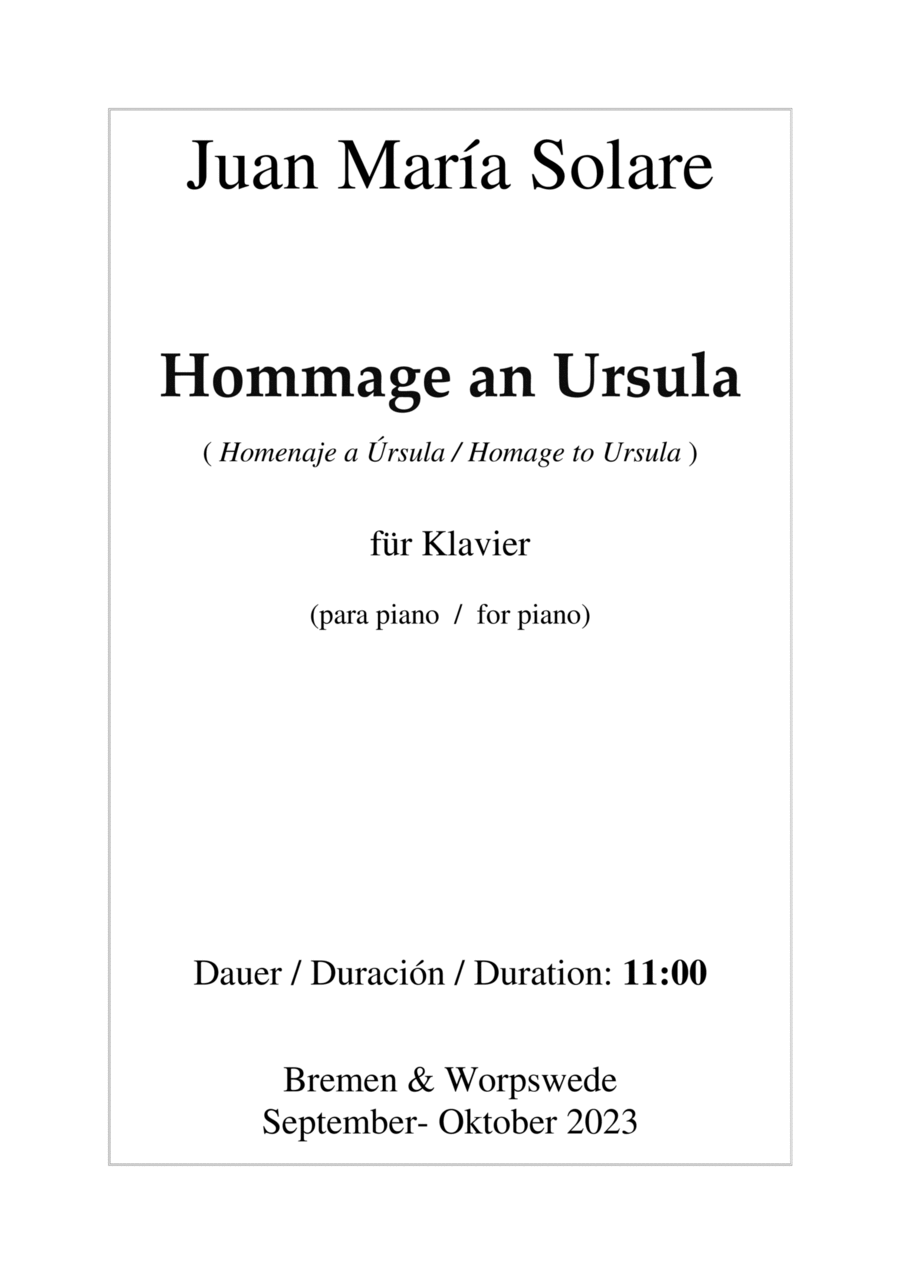
Hommage an Ursula [piano solo]
Piano seul

$4.00 3.44 € Piano seul PDF SheetMusicPlus

Cellos - Level 3 - Digital Download SKU: A0.1042144 Composed by Johann Justus Friedrich Dotzauer. Arranged by Carl Hüllweck. Children,Classical,Instructional,Romantic Period. Educational Exercises. 112 pages. Artistic Score Engraving di Galvagno Michele #646942. Published by Artistic Score Engraving di Galvagno Michele (A0.1042144). The Twenty-four Exercises for Two Cellos, Op. 159, by Johann Justus Friedrich Dotzauer, continue and conclude the series dedicated to the neck positions. These, alongside the just published Twelve Original Pieces, Op. 58, cover the first four positions in all possible variations, using an incredible richness of forms, melody, harmony, and rhythm. After these thirty-six little gems, your students will be able to face much greater challenges with renewed strength and assertiveness. While Op. 58 focused mostly on Theme with Variations, Op. 159’s most used form is the rounded binary one, while no less than three full-fledged fugues enrich the practicing landscape. Due to the lack of the original manuscript, lost during Steiner & Bell’s acquisition of Augener & Co., this edition is based on two surviving editions, by Carl Hüllweck and Johannes Klingenberg, both published in the first decade of the XX century, about 40 years after Dotzauer’s passing. To provide you with the greatest flexibility and choice possibilities, this edition comes in several versions (only C available here, others available on Gumroad): - A: a score only one, based on Hüllweck; - B: two separate sets of parts, one per editor; - C: a score & parts bundle, based once more on Hüllweck; - D: finally, a Collector’s Edition, containing all this, plus a long chapter comparing all differences between Hüllweck’s and Klingenberg’s versions, and an interactive PDF where, at the press of a button, you will be able to switch to the other version of the current part! All PDFs have been optimised to be of the highest Press Quality and lightweight. I truly hope you are going to enjoy this beautiful music and that your cello playing will reach new heights thanks to it!
Twenty-four Exercises for Two Cellos, Op. 159
2 Violoncelles (duo)

$34.95 30.09 € 2 Violoncelles (duo) PDF SheetMusicPlus


Partitions Gratuites
Acheter des Partitions Musicales
Acheter des Partitions Digitales à Imprimer
Acheter des Instruments de Musique

© 2000 - 2026

Accueil - Version intégrale





