EUROPE
4225 articles
USA
7479 articles
DIGITAL
5811 articles (à imprimer)
Partitions Digitales
Partitions à imprimer
5811 partitions trouvées


Brass Ensemble Horn,Trombone,Trumpet,Tuba - Level 5 - Digital Download SKU: A0.767578 Composed by Mike Lyons. Contemporary. Score and parts. 81 pages. Lyons Music Services #6422239. Published by Lyons Music Services (A0.767578). These three pieces form a small suite, linked by the idea of ‘pastoral’ or rustic situations and places.   The first piece to be written now forms the middle movement, though at first it was the starting point.   This is not easy music. It travels through several keys with large numbers of sharps and flats and in places the time signature shifts constantly. The first movement is modal, being based on the mixolydian and dorian modes. I took for this movement the idea of ancient Celts celebrating a victory and dancing and getting drunk around a smoky fire. Their chieftain strikes up a song, accompanied by a double drone.   This melody is initially stated on the horn, with just two other instruments providing the accompaniment. At 4 before B, the remaining instruments join in, providing a rhythmic pulse and the melody moves to the Euphonium/Baritone/Trombone. Subtle variations shape the melody anew, leading to letter C. Here the complex overlapping rhythms provide a more dance-like feel to the music. Also, countermelodies start to appear which build the excitement.   At letter E, the music becomes louder and the rhythmic pulse more insistent (perhaps they are dancing on the tables?) The mode changes to the more major sounding mixolydian. But from here on in, the revellers are starting to wend their way home, still singing and dancing and they gradually fade into the distance. At letter G, we’re back to three players, but with the trumpet 1 playing a rhythmic melody over the top of the original tune.   The second movement is called The Aesthetes. The aesthetic movement was formed in the 19th century, but had been around before that in less formal garb. Their ideal was to emulate the Ancient Greeks and Romans – or at least their perception of what the ancients were like as found in statues, paintings and friezes. They adopted studied poses and were very effete in their mannerisms. Gilbert and Sullivan parodied the aesthetic movement in their operettas – particularly Princess Ida (but also in the Mikado and various others).   So, here is a movement with classical lines in the style of a minuet, but in 6/8 rather than ¾ so that it can be more languid. All the melodies are ‘studied’ and ‘formal’ with long, languid notes and rhythms which don’t quite fit to the beat as the aesthetes pose and ponder and languidly look, studied and pale and wan.   Because of the long notes in the melody, there’s an almost dream-like quality to the music as if they are seeing through a haze of Wormwood or Absinthe (a favourite drink of the aesthetes when they weren’t high on themselves or opiates).   The third and final movement is called The Bohemians. This was also a movement at the end of the 19th Century. Where the aesthetes were ruled by rules, the Bohemians lived by none. They were considered wild and unconventional to say the least.   The Bohemians movement owed much to the supposed free life and style of the gypsies and wanderers of Europe. Our piece starts with a gypsy violin style opening, including a cadenza, and then moves into the rapidly time shifting and gyrating gypsy dance.   This section is in alternating bars of 5/8 and 6/8 with occasional 11/8 thrown in to keep you off balance. The frantic and frenetic movement continues up to letter F where things calm down a little – but not for long as the intensity increases again from Letter H to the quite sudden ending.   This is tuneful yet challenging music which will take a lot of effort, but which will give a lot back in return.
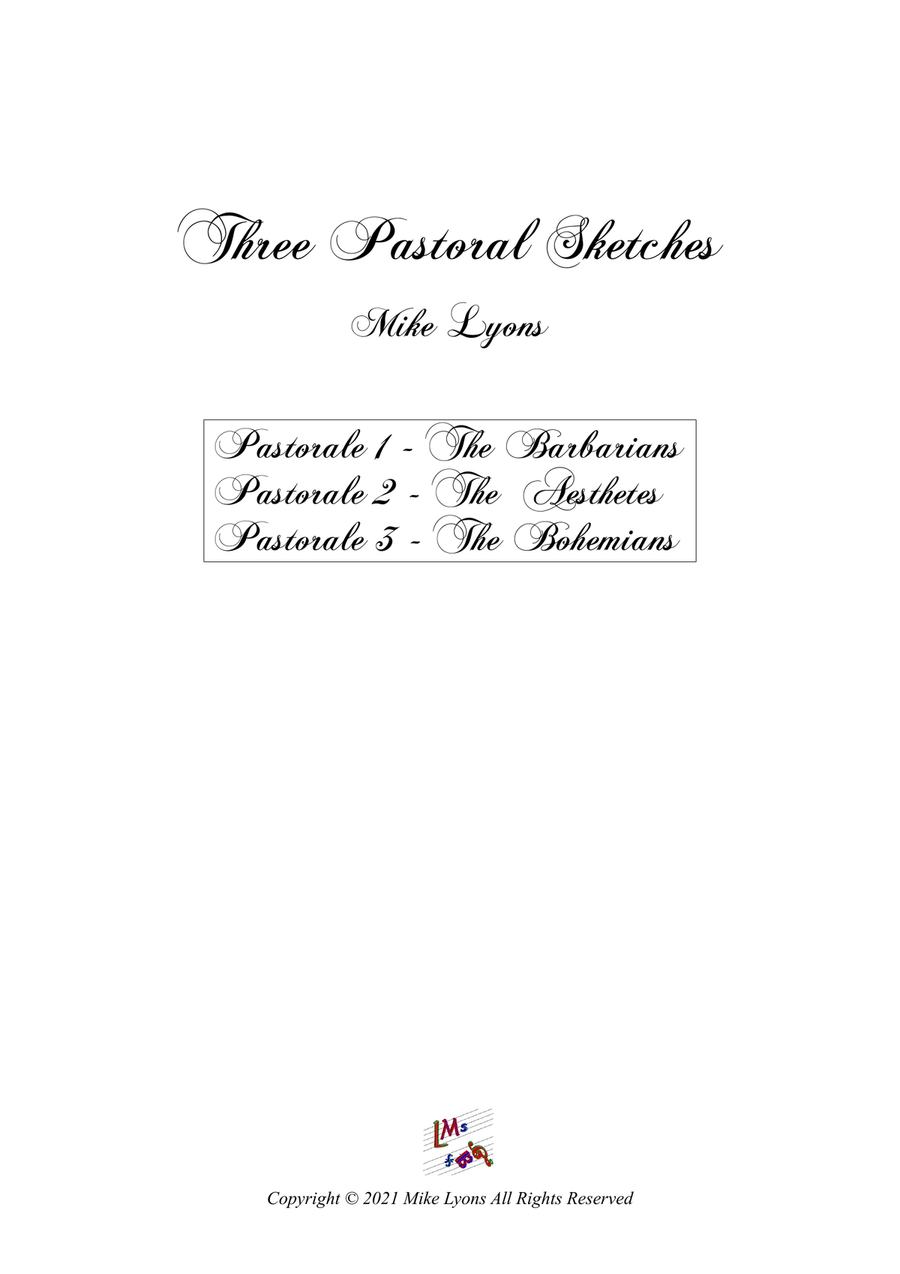
Brass Quintet - Three Pastoral Sketches
Quatuor de Cuivres : 2 trompettes, trombone, tuba

$28.00 24.1 € Quatuor de Cuivres : 2 trompettes, trombone, tuba PDF SheetMusicPlus

Small Ensemble - Level 3 - Digital Download SKU: A0.784348 Composed by Joshua Hauser. Instructional. Score and parts. 74 pages. Slide Ride #5288731. Published by Slide Ride (A0.784348). 1 Octave Scale Studies in 15+ keys for 4-part ensembles of like or mixed instrumentsIf this is your first exposure to these scale studies, you are in for a treat! Donuts, if you make a mistake!The initial incarnation of these studies were written for trombone quartet and we would play them in the Tennessee Tech Trombone Choir with the challenge that whomever made the first mistake had to buy donuts for the rest of the ensemble. Since then I have brought that version to several clinics and warm up sessions. One time before I got to explain the title, a fellow trombone professor said, Oh, I get it! Don’t step in the holes!I only wish I had thought of that myself... Since we have one of the best donut shops in TN here in Cookeville, treating the studio to sugar coated goodies was always my intent.As with those initial exercises, you can vary these as much as you’d like.·     Choose a tempo.·     Choose a dynamic.·     Choose an articulation/style.One way I like to play these is to have one person be the model, playing the entire scale over and over while everyone else plays the fragmented versions. That helps everyone to keep on track and stay in time. Double or triple up the parts for ensemble cohesion with a larger group.Practice one key, gradually speeding it up to improve fluidity, or choose a variation and take it through all keys, playing version A, B, C, or D then skipping to play the same set in a new key.If you want an additional challenge, play them in different octaves or change the key. Play the F Major set in f minor (all forms), different modes, etc. Players really have to be on their toes to remember if they are playing melodic minor in the ascending or descending form! For jazz players, try swinging them in dorian or mixolydian modes.The variations are endless!If you are using these with transposing instruments, 1) is F Major in Concert Pitch, 2) is Bb Major in Concert pitch, and so on. When you reach a scale that is enharmonic for another key (Db/C#, Gb/F#, or Cb/B), they are presented in both keys for each instrument so Trumpets can play in Eb while the Flutes are playing in C# with similar examples for all keys.All Donut Etudes with the same volume number are compatible so you can play them in mixed quartets or large ensembles with one or more instruments/people on part 1 and a different instrument on part 2, etc. Since the quartets are all identical, conductors/coaches can use any of the scores to tell which part should be playing at what time. Once you have played a scale with one set of parts, everyone can rotate to a different part and play the same scales again!Enjoy!
Donut Etudes vol. 3: Don’t Step in the Holes! – Tuba Quartet (Tuba/Euphonium)

$7.50 6.46 € PDF SheetMusicPlus

Concert Band - Level 3 - Digital Download SKU: A0.1284633 Composed by Various. Arranged by Helmut Kogler. 19th Century,Advent,Christian,Christmas,Traditional. 100 pages. Pentharmonics #875808. Published by Pentharmonics (A0.1284633). Christmas Carols - Grade 3 - Total duration: approx. 8:10 minThe Silent Trilogy is a compilation of three traditional European Advent and Christmas carols arranged for various quintet ensembles (brass-, saxophone- and horn-quintet) and finally also for wind band. The trilogy consists of the songs Alle Jahre wieder, Es wird scho 'glei' dumpa and Stille Nacht. The colorful arrangements represent harmonic variations around the ever-present melody of the original songs.Alle Jahre wieder (Every year again, Audio-Demo from the beginning) is a well-known Christmas carol from the German-speaking area. The melody comes from Friedrich Silcher, the text was written by Wilhelm Hey in 1837.Es wird scho 'glei' dumpa (It will be dark soon, Audio-Demo from 2:15) is an Austrian nativity scene song based on the melody of a traditional Marian song. The text was written by Anton Reidinger in relation to a historical nativity play in Bad Ischl and published around 1884.Stille Nacht (Silent Night, Audio-Demo from 4:55) is one of the most famous Christmas carols. It was performed for the first time on December 24, 1818 with the melody by Franz Xaver Gruber and the text by Joseph Mohr in Salzburg. Since then, the song has been translated into countless languages and sung all over the world.The PDF contains the Score and all parts, already multiplied accordingly for a common number of musicians in a concert band. No duplication of parts necessary - so, just print and go. The paper layout is actually designed for European A4 paper, but printing on 8.5 x 11 inches format has no effect on readability.More about the arranger: www.helmut-kogler.comMore music by Helmut Kogler: www.pentharmonics.com
Stille Trilogie
Orchestre d'harmonie

$89.99 77.46 € Orchestre d'harmonie PDF SheetMusicPlus

Piano Solo - Level 3 - Digital Download SKU: A0.1245160 Composed by Erik Satie. Arranged by Samuel Sequeira. 19th Century,Classical. Score. 4 pages. Samuel Sequeira #840066. Published by Samuel Sequeira (A0.1245160). Gymnopedie No. 1 - Erik Satie - PianoPlay it at home, with friends, on class, for your teacher or studentPlay it on a public presentation.I present to you a captivating arrangement for piano of Gymnopédie No. 1 by Erik Satie.In this arrangement, the piano takes center stage, capturing the ethereal and contemplative essence of Satie's iconic composition. The piece is characterized by its slow tempo, haunting melodies, and subtle harmonies, creating a sense of introspection and tranquility.The arrangement begins with the delicate and sparse opening chords, setting a calm and introspective mood. As the piece progresses, the pianist explores the beautiful melodic lines, carefully shaping each phrase to evoke a sense of longing and introspection.The arrangement preserves the simplicity and elegance of Satie's original composition while adding depth and complexity through nuanced phrasing and dynamic variations. The pianist weaves delicate arpeggios and rich harmonies, creating a tapestry of sound that captivates the listener.Throughout the piece, the pianist maintains a delicate balance between restraint and expressiveness, allowing the music to breathe and resonate with the listener. The arrangement showcases the piano's ability to convey the subtle nuances and emotional depth of Satie's composition.Gymnopédie No. 1 is a timeless piece that has captivated audiences for over a century. This arrangement for piano brings new life to the music, inviting listeners to immerse themselves in its contemplative beauty and experience the introspective journey it offers.You can find me on:Instagram: @SamuelseqYouTube: @SamuelSeqMore arrangements on: Sam'S arrangementsThanks for listening, and happy playing!
Gymnopedie No. 1
Piano seul

$4.99 4.3 € Piano seul PDF SheetMusicPlus

Carillon,Instrumental Solo - Level 3 - Digital Download SKU: A0.823680 Composed by Musicalisches Handbuch arr. by William H. Havergal. Arranged by John R. Knox & Richard Giszczak. Christmas,Easter,Praise & Worship,Sacred. Individual part. 3 pages. Singing Winds Music Company #6326101. Published by Singing Winds Music Company (A0.823680). This arrangement is set for Carillon, however it may also be played on piano, organ, or electronic keyboard or adapted to other instruments. It is comprised of a short introduction, a full statement of the theme, 3 variations, and a coda.The hymn tune name is WINCHESTER NEW. The words Ride on! Ride on in Majesty are associated with Palm Sunday.  The words On Jordan's Bank the Baptist's Cry are associated with Advent.  The arrangement is by John R. Knox with verse 1 and introduction added by Richard Giszczak.
WINCHESTER NEW

$2.00 1.72 € PDF SheetMusicPlus

Solo Guitar - Level 4 - Digital Download SKU: A0.1202804 Composed by Richard Hirsch. 20th Century,Contemporary,New Age. Individual part. 9 pages. Richard Hirsch #801568. Published by Richard Hirsch (A0.1202804). I offer an original composition for solo acoustic guitar that I have carried with me over several decades and through several changes in living situation. I started working with the piece already back in the 1970s when I was living in Frankfurt/Main, Germany and kept developing it when I moved to Stockholm and from there to Gothenburg, Sweden. A first recording of the composition was made in a private studio just outside Gothenburg in 1987. I have only recently been able to transmit the piece to musical notation in preparation for publication.The piece has a relaxed nature and contains many repetitions of simple themes that are meant to evoke a sense of monotonous spaciousness. One musician who listened to the first recording said he thought it sounded minimalistic, which I thought was a good description, although at the time I was unaware that minimalism was a term used to describe a whole style of music. The piece has a rather meditative character in the first part, turning more rhythmic in the second part. The third part is a swing version of the first part and the piece ends with a return to the meditative straight first part. The piece is meant to be primitive in the sense of primordial and goes in something resembling a pentatonic scale based on A. The rhythmic second part should be played so that the guitar starts to hum an A tone, the humming carrying over into and through the more melodic sections. The composition has an organic development with slight variations in the basic themes as the piece progresses.Depending on the mood of the interpreting performer, the repetitions might be played in a different order or a different number of times. I seldom play the composition exactly the same every time myself. The piece has also worked as a basis for jam sessions with accompaniment of drums and a base, although the guitar had to have some sort of amplification. The piece can be played on either steel string or nylon string acoustic guitars, or electric guitars. I chose the title Big Drum because of the recurring base A that is a dominant feature of the piece, reminding me of the big drums played by people all over the world. The piece has a participatory character, especially in the more rhythmic and swing parts, inviting the listeners to clap, stamp their feet, or drum on whatever is available,As the notation is accompanied by tablature, I refrain from giving left hand fingering. The right hand fingering consists basically of base notes played by the thumb and treble notes played by alternating index and middle fingers in combination with the ring finger.
Big Drum
Guitare

$4.99 4.3 € Guitare PDF SheetMusicPlus

Horn Quintet - Level 4 - Digital Download SKU: A0.1254282 Composed by Various. Arranged by Helmut Kogler. 19th Century,Advent,Christian,Christmas,Traditional. 34 pages. Pentharmonics #847855. Published by Pentharmonics (A0.1254282). Christmas Carols - Version for French Horn Grade 3.5 - Total Duration 8:10 min.The Silent Trilogy is a compilation of three traditional European Advent and Christmas carols arranged for various quintet ensembles (brass-, saxophone- and horn-quintet) and finally also for wind band. The trilogy consists of the songs Alle Jahre wieder, Es wird scho 'glei' dumpa and Stille Nacht. The colorful arrangements represent harmonic variations around the ever-present melody of the original songs.Compared to the versions for brass- and saxophone quintett, the version for horn is more advanced, in particular in the first and the fifth horn due to the range of notes. The parts are provided for F and for E flat horns.Alle Jahre wieder (Every year again, Audio-Demo from the beginning) is a well-known Christmas carol from the German-speaking area. The melody comes from Friedrich Silcher, the text was written by Wilhelm Hey in 1837.Es wird scho 'glei' dumpa (It will be dark soon, Audio-Demo from minute 2:15) is an Austrian nativity scene song based on the melody of a traditional Marian song. The text was written by Anton Reidinger in relation to a historical nativity play in Bad Ischl and published around 1884.Stille Nacht (Silent Night, Audio-Demo from minute 4:55) is one of the most famous Christmas carols. It was performed for the first time on December 24, 1818 with the melody by Franz Xaver Gruber and the text by Joseph Mohr in Salzburg. Since then, the song has been translated into countless languages and sung all over the world.The PDF contains the score and all parts. The paper layout is actually designed for European A4 paper, but printing on 8.5 x 11 inches format has no effect on readability.More about the arranger: www.helmut-kogler.comMore music by Helmut Kogler: www.pentharmonics.com
Stille Trilogie

$24.99 21.51 € PDF SheetMusicPlus

Saxophone Quintet,Woodwind Ensemble Alto Saxophone,Baritone Saxophone,Tenor Saxophone - Level 3 - Digital Download SKU: A0.1253185 Composed by Various. Arranged by Helmut Kogler. 19th Century,Advent,Christian,Christmas,Traditional. 20 pages. Pentharmonics #846939. Published by Pentharmonics (A0.1253185). Christmas Carols - Grade 3 - Total duration: 8:10 min.The Silent Trilogy is a compilation of three traditional European Advent and Christmas carols arranged for various quintet ensembles (brass-, saxophone- and horn-quintet) and finally also for wind band. The trilogy consists of the songs Alle Jahre wieder, Es wird scho 'glei' dumpa and Stille Nacht. The colorful arrangements represent harmonic variations around the ever-present melody of the original songs.Alle Jahre wieder (Every year again, Audio-Demo from beginning) is a well-known Christmas carol from the German-speaking area. The melody comes from Friedrich Silcher, the text was written by Wilhelm Hey in 1837.Es wird scho 'glei' dumpa (It will be dark soon, Audio-Demo from minute 2:15) is an Austrian nativity scene song based on the melody of a traditional Marian song. The text was written by Anton Reidinger in relation to a historical nativity play in Bad Ischl and published around 1884.Stille Nacht (Silent Night, Audio-Demo from minute 4:55) is one of the most famous Christmas carols. It was performed for the first time on December 24, 1818 with the melody by Franz Xaver Gruber and the text by Joseph Mohr in Salzburg. Since then, the song has been translated into countless languages and sung all over the world.The PDF contains the score and all parts. The paper layout is actually designed for European A4 paper, but printing on 8.5 x 11 inches format has no effect on readability.More about the arranger: www.helmut-kogler.comMore music by Helmut Kogler: www.pentharmonics.com
Stille Trilogie
Quintette de Saxophone: 5 saxophones

$24.99 21.51 € Quintette de Saxophone: 5 saxophones PDF SheetMusicPlus

Viola Solo - Level 5 - Digital Download SKU: A0.912917 Composed by Brandon Nelson. Concert,Contemporary. Individual part. 7 pages. Brandon Nelson #1998627. Published by Brandon Nelson (A0.912917). A set of intriguing, contrasting miniatures for unaccompanied viola. Aimed at higher level players, this piece is ideal for any concert or recital setting. The first in this set, from darkness, rising, is a lyric caprice which gradually moves from darker modes to brighter modes (locrian to lydian). The next selection, Eidólons, has a veiled, mysterious quality. In this piece, I explore variations based on rhythmic alteration. An eidólon is a spirit or phantasm; the term was a favorite of American poet Walt Whitman. The third entry, Homeostatic, is built upon a concept I refer to as biofeedback music. In this case, I took regularly-spaced readings of my pulse rate and blood oxygen saturation percentage and performed basic arithmetic operations on these figures, the results of which I used to determine a number of musical facets (most notably the essential constituents of the rhythmic gestures). The final piece, Sapta Bodhyanga, I built on a wedge concept (in this case, seven intervals, each becoming larger, ending with the octave). The number seven also features prominently in the design of the rhythmic motives (with chance procedures used in the deployment of these figures). Given the concentration on this number and the use of aleatoric methods, I titled this piece after the Zen Buddhist concept sapta-bodhyang, or seven degrees of enlightenment.
Four Episodes (for viola)
Alto seul

$8.99 7.74 € Alto seul PDF SheetMusicPlus

Brass Quintet Horn,Trombone,Trumpet,Tuba - Level 3 - Digital Download SKU: A0.1252444 Composed by Various. Arranged by Helmut Kogler. 19th Century,Advent,Christian,Christmas,Traditional. 20 pages. Pentharmonics #846416. Published by Pentharmonics (A0.1252444). Christmas Carols - Grade 3 - Total duration 8:10 min.The Silent Trilogy is a compilation of three traditional European Advent and Christmas carols arranged for various quintet ensembles (brass-, saxophone- and horn-quintet) and finally also for wind band. The trilogy consists of the songs Alle Jahre wieder, Es wird scho 'glei' dumpa and Stille Nacht. The colorful arrangements represent harmonic variations around the ever-present melody of the original songs.Alle Jahre wieder (Every year again, Audio-Demo from the beginning) is a well-known Christmas carol from the German-speaking area. The melody comes from Friedrich Silcher, the text was written by Wilhelm Hey in 1837.Es wird scho 'glei' dumpa (It will be dark soon, Audio-Demo from minute 2:15) is an Austrian nativity scene song based on the melody of a traditional Marian song. The text was written by Anton Reidinger in relation to a historical nativity play in Bad Ischl and published around 1884.Stille Nacht (Silent Night, Audio-Demo from minute 4:55) is one of the most famous Christmas carols. It was performed for the first time on December 24, 1818 with the melody by Franz Xaver Gruber and the text by Joseph Mohr in Salzburg. Since then, the song has been translated into countless languages and sung all over the world.The PDF contains the score and all parts. The paper layout is actually designed for European A4 paper, but printing on 8.5 x 11 inches format has no effect on readability.More about the arranger: www.helmut-kogler.comMore music by Helmut Kogler: www.pentharmonics.com
Stille Trilogie
Quintette de Cuivres: 2 trompettes, Cor, trombone, tuba

$24.99 21.51 € Quintette de Cuivres: 2 trompettes, Cor, trombone, tuba PDF SheetMusicPlus

Tenor Saxophone Solo - Level 5 - Digital Download SKU: A0.912916 Composed by Brandon Nelson. Concert,Contemporary. Individual part. 7 pages. Brandon Nelson #1998629. Published by Brandon Nelson (A0.912916). An ideal piece to showcase high level playing with intriguing, colorful music. Appropriate for any concert or recital setting. The first in this set, from darkness, rising, is a lyric caprice which gradually moves from darker modes to brighter modes (locrian to lydian). The next selection, Eidólons, has a veiled, mysterious quality. In this piece, I explore variations based on rhythmic alteration. An eidólon is a spirit or phantasm; the term was a favorite of American poet Walt Whitman. The third entry, Homeostatic, is built upon a concept I refer to as biofeedback music. In this case, I took regularly-spaced readings of my pulse rate and blood oxygen saturation percentage and performed basic arithmetic operations on these figures, the results of which I used to determine a number of musical facets (most notably the essential constituents of the rhythmic gestures). The final piece, Sapta Bodhyanga, I built on a wedge concept (in this case, seven intervals, each becoming larger, ending with the octave). The number seven also features prominently in the design of the rhythmic motives (with chance procedures used in the deployment of these figures). Given the concentration on this number and the use of aleatoric methods, I titled this piece after the Zen Buddhist concept sapta-bodhyang, or seven degrees of enlightenment. Learn more about me at bnelsonmusic.wordpress.com.
Four Episodes (solo tenor sax)
Saxophone Tenor

$8.99 7.74 € Saxophone Tenor PDF SheetMusicPlus

Violin Duet Violin - Level 3 - Digital Download SKU: A0.889440 Composed by Wolfgang Amadeus Mozart. Arranged by Luis Anjos Teixeira. Baroque,Christmas,Concert,Standards. 35 pages. Luis Anjos Teixeira #4758249. Published by Luis Anjos Teixeira (A0.889440). Wolfgang Amadeus Mozart, is probably the most beloved artist that ever existed in this World. His work is without any doubt amongst the highest cultural achievements of the Human Being. To understand his cultural environment and musical practices I would advise you to read among others also the following books:  „A Treatise on the Fundamental Principles of Violin Playing  „Versuch einer gründlichen Violinschule from Leopold Mozart and from David D. Boyden A History of Violin Playing from its Origins to 1761. Also the biography righten by Jean et Brigite Massin gives us a deep view and idea of this times. Mozart wrote in Wien at 27.07.1786 this 12 duets for 2 basset horns K. 487, for his very Dear Friends „the Jacquin Family.  This arrangement for 2 violin proposes an intime relation with the original work, but allows us to perform it also with modern instruments and to apply todays standards of musical literature praxis.  No changes where made on the original composition, only the presentation of the score has been adjusted to contemporary violin music literature. It is also perfect adjusted for the use of baroque violins.  I transposed it for the violin and introduced interpretation symbols to shorten some notes and induce loudness variations. The bowing is adjusted to violin performance but very much compromised with the ones in the original scores in wish they also meant a musical legato. I advise you to adjust much of the bowing to your taste and interpretation. Fingering is also relative to taste and school practices and is left to the artists choice. In order to leave the original notation as much untouched as possible I shortened the length of some notes with the „Staccato symbol to originate silence in between them.  You are also free to further shorten even many more notes.  As Mozart said - „The music is not in the notes but in the silent in between.  In the arrangement, instead of repetitions, the performers interchange their parts so each of them will get to play as first and second violin player along each piece. This was common practice in chamber music when both musicians where at the same level. Very Human, this work comes from the hand of a musical Genius no other than Mozart.  I tried to do an arrangement that would bring us as close as possible to the musical intention of the original work. This music demands accuracy and a very lively sensitive approach, it is a refined work of art, totally appropriate for serious „concert halls, for advanced students and great performers. Very useful of course for the music classroom on a wide range of various practices with students and also little concerts or presentations. It was righten for close friends and it should be practiced and performed with a heart full of Love and compassion. You should feel Free to apply in this piece the Art and technic that expresses entirely your individual skills, Your taste and Soul. Have fun! It is a piece that can be used in many different kinds of situations, from the serious concert hall to a funeral, in Easter or even Christmas celebrations and all other kinds of Spiritual events or even joyful social meetings. When performed Live It will give you back a great  feedback from the public, you will always want to have it in your repertoire. The score was written on Finale. The sound file was produced with samplers from Garritan and conceived merely as an audio support for the presentation of this score. Thank you very much for taking your time to read this text and to listen to the file. I hope you have a lot of fun and enjoy the music. Sheers! Luis Anjos Tei.
Mozart Violin Duets
2 Violons (duo)

$17.56 15.12 € 2 Violons (duo) PDF SheetMusicPlus


Partitions Gratuites
Acheter des Partitions Musicales
Acheter des Partitions Digitales à Imprimer
Acheter des Instruments de Musique

© 2000 - 2026

Accueil - Version intégrale





