EUROPE
4225 articles
USA
7479 articles
DIGITAL
5811 articles (à imprimer)
Partitions Digitales
Partitions à imprimer
5811 partitions trouvées


Concert Band - Digital Download SKU: AX.00-PC-0017533_H1 1st F Horn. Composed by Michael Story. Multicultural. Part. 1 pages. Alfred Music - Digital Sheet Music #00-PC-0017533_H1. Published by Alfred Music - Digital Sheet Music (AX.00-PC-0017533_H1). UPC: 654979188735.Tribal War Chant is based on authentic Native American war dances. These culturally symbolic dances consisted of human voices accompanied by drums, bells, and rattles. The thematic material is meaningfully staged over driving traditional rhythms with intense stylistic variations. Before a war, men danced to attain spirit and power; after a war, they danced to celebrate a victory. This exciting composition is a must on your next program. (4:00).
Tribal War Chant: 1st F Horn
Orchestre d'harmonie

$3.00 2.58 € Orchestre d'harmonie PDF SheetMusicPlus

Easy Piano - Level 3 - Digital Download SKU: A0.1371184 Composed by Alan Menken and Jack Feldman. Arranged by RIS. Broadway,Contemporary,Film/TV,Folk,Jazz,Musical/Show. Score. 4 pages. RISsounds #955436. Published by RISsounds (A0.1371184). 🎵 Dive into the world of Newsies with our exclusive sheet music for Carrying the Banner – crafted with both beginners and advanced players in mind! 🎹✨🌟 Key Features:Beginner-Friendly Right Hand: The melody is expertly notated on the staff, making it easy for beginners to follow along and play the iconic tune effortlessly.Room for Creativity: The left hand is intentionally left open for improvisation, allowing more advanced players to showcase their personal flair and style. Experiment with chords, arpeggios, or rhythmic variations to make the piece uniquely yours.Visual Clarity: Our meticulously arranged sheet music ensures visual clarity, with clear notation that facilitates a smooth learning experience for pianists at all levels.🎹 Why Choose Our Sheet Music?Accessible for Beginners: Beginners can build their confidence by focusing on the melody, gradually incorporating the left hand as they progress.Challenge for Advanced Players: More experienced pianists can enjoy the freedom to improvise and add their artistic touch to the arrangement.Perfect for Practice or Performance: Whether you're practicing in the comfort of your home or preparing for a public performance, our sheet music provides a versatile and engaging musical experience.📈 Elevate your piano journey with our Carrying the Banner sheet music, where the beauty of Newsies meets the joy of playing. Download, play, and let your creativity shine! 🌈🎶🎹 Check out our YouTube channel, Easy Piano Tutorials, for a video tutorial that complements this sheet music perfectly! 🎥✨.
Carrying The Banner
Piano Facile

$7.99 6.88 € Piano Facile PDF SheetMusicPlus

Oboe, clarinet, bassoon - Digital Download SKU: IZ.BCMS171 Composed by Sy Brandon. BCMCC (Bassoon Chamber Music Composition Competition). Score and Parts. 69 pages. Imagine Music - Digital #BCMS171. Published by Imagine Music - Digital (IZ.BCMS171). 9 x 12 in inches.Divertimento is in three movements. The first movement, Frolic, has three main thematic ideas. The first contains dotted rhythms, staccato articulation, and meter change. The second thematic idea is related to the first in that it also uses dotted rhythms and meter change, but is more legato and begins with more sustained notes. The third thematic section is thinner in texture, more playful, and has a legato theme over a staccato background. The motivic material in each of these sections has similarities. Contrast is primarily obtained through change of style and mood. These thematic ideas develop throughout the movement by varying key, instrumentation, and melodic material. There are several sections of imitation that are very energetic.The second movement, Ballad, is lyrical at an Andante tempo. The form of the movement is through-composed as the motives develop into new variations instead of having clearly distinguished themes. There is however a recapitulation that brings the listen back to the opening material. The main motives that develop are a sixteenth note pattern that is arpeggiated and also stepwise, a dotted quarter and eighth note idea that is often on weak beats as well as appearing on strong beats, and scalewise eighth note lines.All of these interweave among the parts with frequent counterpoint and some imitation. The harmony is lush with seventh chords used frequently.The last movement, Tarantella, is in a lively tempo. The form of this movement is a large ABA(Scherzo, Trio, Scherzo). The A sections are in triple meter while the B section is in duple. The A section is in three parts, forming an ABA within the large A. The material for the first part is motivically derived. The first motive is a dotted eighth, sixteenth, eighth note followed by even eighth notes. The second motive is four chromatic sixteenth notes followed by an eighth note. This motive appears both ascending and descending. The B section within this large A consists of a slurred melodic line that has both stepwise motion and leaps. It is accompanied by staccato chromatic eighth notes. The large B section is folksong-like and is in a recognizable binary form that repeats in a new key. The large A serves as a recapitulation of the opening section and it ends lightly and playfully in keeping with the Divertimento title that means to divert or amuse.
Divertimento

$32.00 27.55 € PDF SheetMusicPlus

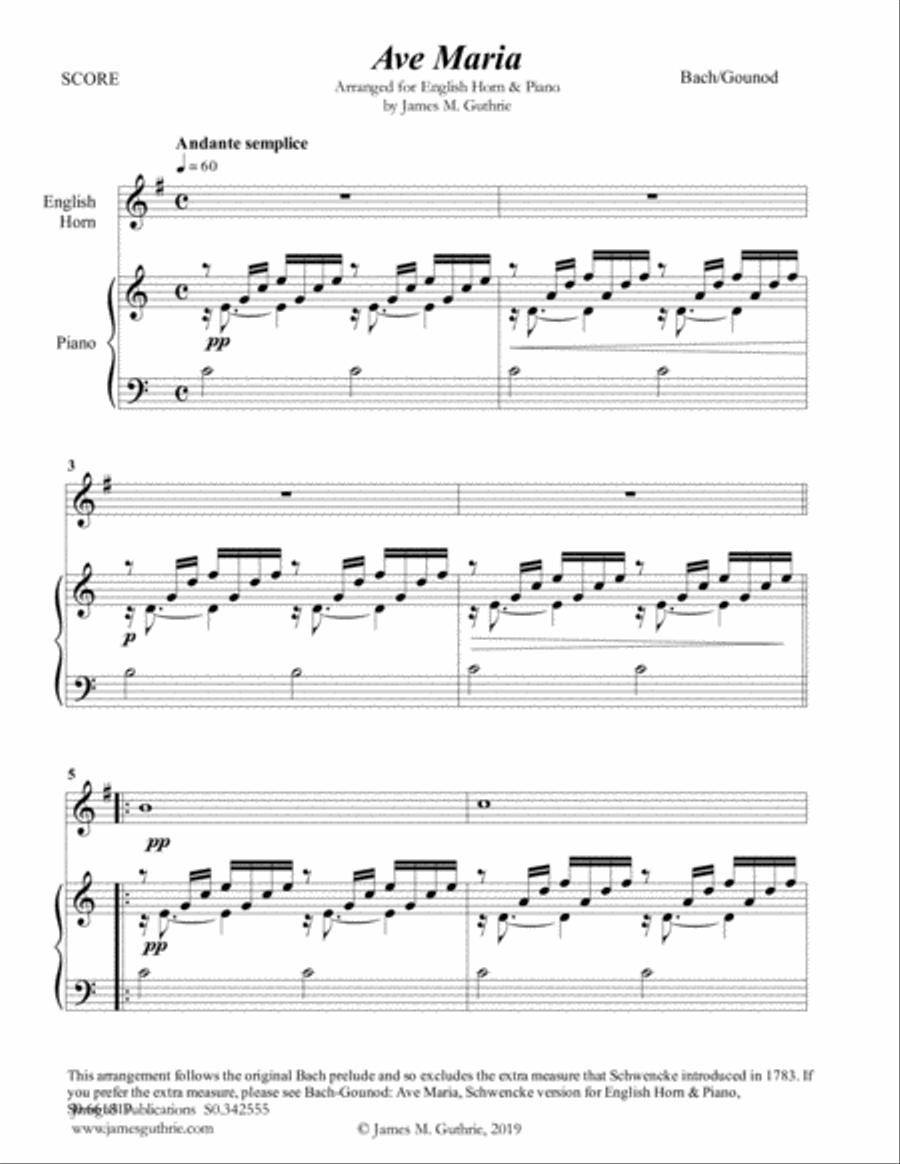
English Horn,Piano - Level 2 - Digital Download SKU: A0.549361 Composed by Bach-Gounod. Arranged by James M. Guthrie, ASCAP. Christmas,Contemporary,Easter,Wedding. Score and part. 11 pages. Jmsgu3 #3490119. Published by jmsgu3 (A0.549361). This arrangement follows the original Bach prelude and so excludes the extra measure that Schwencke introduced in 1783. If you prefer the extra measure, please see Bach-Gounod: Ave Maria, Schwencke version for English Horn & Piano, S0.661819. The convenient 1st & 2nd endings provide an option for extended performance with minimal page turns for the accompanist. The duration with repeat is about 4:50. Score: 6 pages. Solo part: 1 page, piano part: 4 pages. Based on Prelude #1 in C Major from the Well-Tempered Clavier, Book 1. Well suited for church meditations or school programs or recital encores. Ave Maria Ave Maria is a Catholic prayer that consequently asks for the mother of Jesus (Mary) to intercede. Charles Gounod composed a famous version of the Ave Maria. He was a French Romantic composer who overlaid a new melody on an existing Bach chord progression. The progression is from Bach’s Prelude No. 1 from Well-Tempered Clavier I. This version, as well as Schubert’s version, have become essential items at weddings, masses, and funerals. Bach Overview First of all, Johann Sebastian Bach is maybe the greatest composer in music history. Certainly, he was prolific. As a result, everyone has heard of his works. Furthermore, these works number well over a thousand. It seems like people are probably most familiar with instrumental works such as the Brandenburg Concertos, and the Goldberg Variations. But, similarly famous are such noteworthy works as the Well-Tempered Clavier, the Musical Offering, and the Art of Fugue. Seems like his most famous vocal works include the most noteworthy Mass in B Minor. Also, most noteworthy, though, are the St. John Passion, and certainly the Christmas Oratorio.  History Bach came from a long line of musicians and above all, composers. Consequently, he, first of all, pursued a career as a church organist. So as a result, he gained employment in various Protestant churches in Germany. For a while, he worked as a court musician in Weimar and Köthen. Here he probably developed his organ style and likewise his chamber music style. Eventually, he gained an appointment as Cantor of St. Thomas in Leipzig. Here he worked until difficulties with his employer ultimately drove him away. The King of Poland finally appointed him as court composer.  Style It seems like Bach created an engaging new international style. He synthesized elements of the most noteworthy European music ideas into his new style. Even more, this new style was probably his synthesis of European musical rhythm and form. Furthermore, he demonstrated a complete mastery of counterpoint and motivic development. His sense of harmonic organization probably propelled him to the top. Revival               Mendelssohn conducted a Bach revival in the nineteenth century. His effort probably helped to re-familiarize the public with the magnitude of Bach’s works. During this period, scholars published many noteworthy Bach biographies. Moreover, Wolfgang Schmieder published the BWV (Bach Werke Verzeichnis). As a result, this is now the official catalog of his entire artistic output. The BWV number allows us to locate a work in the catalog. Sometimes scholars will simply use an S (Schmieder) as an abbreviation for BWV.  
Bach-Gounod: Ave Maria for English Horn & Piano
Cor anglais, Piano

$32.95 28.36 € Cor anglais, Piano PDF SheetMusicPlus

Instrumental Duet English Horn,Instrumental Duet,Oboe - Level 3 - Digital Download SKU: A0.594391 By Barbra Streisand. By Marvin Hamlisch. Arranged by David McKeown. Broadway,Contemporary,Film/TV,Musical/Show,Pop. Score and parts. 3 pages. David McKeown #6607961. Published by David McKeown (A0.594391). The Way We Were is one of the best known and best loved songs performed by Barbra Streisland during her long and successful career. The song was written by Alan Bergman, Marilyn Bergman and Marvin Hamlisch for the 1973 film of the same name. It was the top selling single of the year in the US and won two Academy awards for its writers. This version is arranged as a duet for one Oboe and one Cor Anglais (or English Horn).  Click on the YouTube link above to listen to a full performances of this arrangement played on Clarinet.This version of The Way We Were is faithful to the Streisland version, with her rhythmic variations. The music is arranged in a key and range best suited to the instruments and is ideal for musicians at an intermediate level and above. Total performance time is around three minutes. Teachers will enjoy using this arrangement as a fun way to approach expressive playing and control at a slow tempo. There are many more top quality arrangements and compositions by David McKeown for you to browse at http://www.sheetmusicplus.com/publishers/david-mckeown/6203
The Way We Were
Barbra Streisand
$5.99 5.16 € PDF SheetMusicPlus

Full Orchestra - Digital Download SKU: A0.746748 Composed by Keith Terrett. Contemporary,World. 33 pages. Keith Terrett #3129265. Published by Keith Terrett (A0.746748). ere at last is my ’’Elegy sentimentale’’ for orchestra, and my first original composition (opus 1), for full symphony orchestra.I hope it makes an excellent piece for amateur and professional orchestras alike; with some challenging and interesting string, woodwind and brass writing for all.I envisage the ’’Elegy’’ eventually making a good piece of film music, and in consequence any directors or producers looking for a movie theme; please feel free to contact me!Elegy Sentimenatle is a mournful & melancholic work, suited for performances on the concert platform.A Supreme Work of Art!The Elegy Sentimentale opens impressively. Keith Terrett plants a C deep in virgin soil; orchestrated brilliantly for bassoon, harp and delineated by pizzicato double basses this bass line is a tree of a forest; and we are at once held by the strength of the roots. The tonality is immediately clear, and there is a grand feeling of space and power in the wide layout of the score. A lone solo clarinet high in the tessitura accompanied by a solo cello with a counter subject state the opening eight bar theme which embodies the seeds of two ideas, which supplies the generating force for the slightly agitated Piu Mosso which follows. The counter subject given by the solo cello at the beginning is now reiterated by the plaintive voice of a solo oboe and a third motif makes an appearance in the solo clarinet; oboe and clarinet duet beautifully over arpeggiated rhythmic impulses in the harp. A new subject of an accompanying nature, derived from all the material thus far presented now comes off at a tangent on the strings cascading downwards and accompanying woodwind who, play the chief melodic subject while horns cry in anguish. This first section is then repeated; I found the whole experience spiritual, detached and wondering, intensified by the breath-taking stillness. Mr Terrett in the middle section that follows now uses his full orchestral forces; after a key change the emotional charge that follows is cataclysmic in its cry of anguish; the main theme is stated in a full dress orchestral tutti, which is then repeated. The music ebbs and flows with slight variations in the woodwind recalling the main ideas; at the very end high strings bring consolation and finally peace. Keith Terrett shows an admirable command of orchestration and melodic construction and combines these qualities with rare imagination and insight.Gerald Manning
Elegy Sentimentale for Orchestra
Orchestre

$30.00 25.82 € Orchestre PDF SheetMusicPlus

Instrumental Duet Clarinet,Guitar,Instrumental Duet - Level 4 - Digital Download SKU: A0.576598 Composed by David Warin Solomons. 20th Century,Contemporary,Jazz. Score and parts. 12 pages. David Warin Solomons #38753. Published by David Warin Solomons (A0.576598). This jaunty number in swing time was originally a satirical song for alto and piano or alto and guitar (Looking just looking at the personal ads) - which is also available on this site. I decided that the music on its own without words (but with a few variations) would also work well... so here is Springtime jaunt. Versions are available for clarinet and piano, clarinet and guitar, flute and piano and flute and guitar The pdf file contains score and separate part The sound sample is an electronic preview.
A Springtime Jaunt for clarinet and guitar
Clarinette, Guitare (duo)

$9.00 7.75 € Clarinette, Guitare (duo) PDF SheetMusicPlus

String Orchestra - Level 2 - Digital Download SKU: A0.1292762 Composed by Dr. John Bull. Arranged by James M. Guthrie. Contest,Early Music,Festival,Historic,Renaissance,Traditional. 5 pages. Jmsgu3 #883325. Published by jmsgu3 (A0.1292762). John Bull was an English composer, organist, virginalist, and organ builder who lived from 1562/63 to 1628. He was educated as a chorister of the Chapel Royal in London and later became a Doctor of Music at both Oxford and Cambridge Universities. Bull was one of the most famous composers of keyboard music of the early 17th century, and most of his compositions were written for the virginal, a keyboard instrument popular in the Renaissance period. He was known for his outstanding technical ability and keyboard virtuosity, and his music is distinguished by unfailing resourcefulness in devising new musical ideas. Bull's reputation rests on his extensive compositions for virginals and organ, some 150 extant pieces published in Musica Britannica. He was also one of the contributors to Parthenia, a collection of keyboard music published in 1611. Bull wrote an anthem, God the Father, God the Son, for the 1613 wedding of the princess and the Elector Palatine, in addition to his keyboard compositions, verse anthems, canons, and other works. Bull's music ranked among the foremost composers along with Byrd, Gibbons, and Tomkins.John Bull had several contemporaries who were also prominent composers during the Renaissance period. Some of these composers include:William Byrd: Byrd was an English composer and one of the most influential figures in English Renaissance music. He was a contemporary of John Bull and is considered one of the greatest composers of his time. Byrd's compositions include sacred choral music, keyboard works, and consort music.Orlando Gibbons: Gibbons was an English composer and organist who lived during the same period as John Bull. He was known for his sacred choral music, particularly his anthems and verse anthems. Gibbons' compositions are characterized by their expressive harmonies and intricate counterpoint.Thomas Tomkins: Tomkins was another English composer who was active during the same time as John Bull. He was known for his sacred choral music, including anthems and services. Tomkins' compositions are notable for their rich harmonies and expressive melodies.Jan Pieterszoon Sweelinck: Sweelinck was a Dutch composer and organist who was highly regarded during the Renaissance period. He was known for his keyboard music, particularly his variations and fantasias. Sweelinck's compositions had a significant influence on Bull and other composers of the time.These composers, along with John Bull, were influential figures in the development of Renaissance music and significantly contributed to the repertoire of keyboard and choral music during that era.
Bull: A Gigge - Doctor Bull's my selfe for String Orchestra - Score Only
Orchestre à Cordes

$32.95 28.36 € Orchestre à Cordes PDF SheetMusicPlus

String Quartet String Quartet - Level 3 - Digital Download SKU: A0.1291365 Composed by Dr. John Bull. Arranged by James M. Guthrie. Chamber,Christian,Historic,Religious,Renaissance. 15 pages. Jmsgu3 #882016. Published by jmsgu3 (A0.1291365). John Bull was an English composer, organist, virginalist, and organ builder who lived from 1562/63 to 1628. He was educated as a chorister of the Chapel Royal in London and later became a Doctor of Music at both Oxford and Cambridge Universities. Bull was one of the most famous composers of keyboard music of the early 17th century, and most of his compositions were written for the virginal, a keyboard instrument popular in the Renaissance period. He was known for his outstanding technical ability and keyboard virtuosity, and his music is distinguished by unfailing resourcefulness in devising new musical ideas. Bull's reputation rests on his extensive compositions for virginals and organ, some 150 extant pieces published in Musica Britannica. He was also one of the contributors to Parthenia, a collection of keyboard music published in 1611. Bull wrote an anthem, God the Father, God the Son, for the 1613 wedding of the princess and the Elector Palatine, in addition to his keyboard compositions, verse anthems, canons, and other works. Bull's music ranked among the foremost composers along with Byrd, Gibbons, and Tomkins.John Bull had several contemporaries who were also prominent composers during the Renaissance period. Some of these composers include:William Byrd: Byrd was an English composer and one of the most influential figures in English Renaissance music. He was a contemporary of John Bull and is considered one of the greatest composers of his time. Byrd's compositions include sacred choral music, keyboard works, and consort music.Orlando Gibbons: Gibbons was an English composer and organist who lived during the same period as John Bull. He was known for his sacred choral music, particularly his anthems and verse anthems. Gibbons' compositions are characterized by their expressive harmonies and intricate counterpoint.Thomas Tomkins: Tomkins was another English composer who was active during the same time as John Bull. He was known for his sacred choral music, including anthems and services. Tomkins' compositions are notable for their rich harmonies and expressive melodies.Jan Pieterszoon Sweelinck: Sweelinck was a Dutch composer and organist who was highly regarded during the Renaissance period. He was known for his keyboard music, particularly his variations and fantasias. Sweelinck's compositions had a significant influence on Bull and other composers of the time.These composers, along with John Bull, were influential figures in the development of Renaissance music and significantly contributed to the repertoire of keyboard and choral music during that era.
Bull: Salvator mundi for String Quartet - Score Only
Quatuor à cordes: 2 violons, alto, violoncelle

$24.95 21.48 € Quatuor à cordes: 2 violons, alto, violoncelle PDF SheetMusicPlus

Oboe,Piano - Level 2 - Digital Download SKU: A0.549359 Composed by Bach-Gounod. Arranged by James M. Guthrie, ASCAP. Christmas,Contemporary,Easter,Wedding. Score and part. 11 pages. Jmsgu3 #3490099. Published by jmsgu3 (A0.549359). This arrangement follows the original Bach prelude and so excludes the extra measure that Schwencke introduced in 1783. If you prefer the extra measure, please see Bach-Gounod: Ave Maria, Schwencke version for Oboe & Piano - S0.661853. The convenient 1st & 2nd endings provide an option for extended performance with minimal page turns for the accompanist. The duration with repeat is about 4:50. Score: 6 pages. Solo part: 1 page, piano part: 4 pages. Based on Prelude #1 in C Major from the Well-Tempered Clavier, Book 1. Well suited for church meditations or school programs or recital encores. Ave Maria Ave Maria is a Catholic prayer that consequently asks for the mother of Jesus (Mary) to intercede. Charles Gounod composed a famous version of the Ave Maria. He was a French Romantic composer who overlaid a new melody on an existing Bach chord progression. The progression is from Bach’s Prelude No. 1 from Well-Tempered Clavier I. This version, as well as Schubert’s version, have become essential items at weddings, masses, and funerals. Bach Overview First of all, Johann Sebastian Bach is maybe the greatest composer in music history. Certainly, he was prolific. As a result, everyone has heard of his works. Furthermore, these works number well over a thousand. It seems like people are probably most familiar with instrumental works such as the Brandenburg Concertos, and the Goldberg Variations. But, similarly famous are such noteworthy works as the Well-Tempered Clavier, the Musical Offering, and the Art of Fugue. Seems like his most famous vocal works include the most noteworthy Mass in B Minor. Also, most noteworthy, though, are the St. John Passion, and certainly the Christmas Oratorio.  History Bach came from a long line of musicians and above all, composers. Consequently, he, first of all, pursued a career as a church organist. So as a result, he gained employment in various Protestant churches in Germany. For a while, he worked as a court musician in Weimar and Köthen. Here he probably developed his organ style and likewise his chamber music style. Eventually, he gained an appointment as Cantor of St. Thomas in Leipzig. Here he worked until difficulties with his employer ultimately drove him away. The King of Poland finally appointed him as court composer.  Style It seems like Bach created an engaging new international style. He synthesized elements of the most noteworthy European music ideas into his new style. Even more, this new style was probably his synthesis of European musical rhythm and form. Furthermore, he demonstrated a complete mastery of counterpoint and motivic development. His sense of harmonic organization probably propelled him to the top. Revival               Mendelssohn conducted a Bach revival in the nineteenth century. His effort probably helped to re-familiarize the public with the magnitude of Bach’s works. During this period, scholars published many noteworthy Bach biographies. Moreover, Wolfgang Schmieder published the BWV (Bach Werke Verzeichnis). As a result, this is now the official catalog of his entire artistic output. The BWV number allows us to locate a work in the catalog. Sometimes scholars will simply use an S (Schmieder) as an abbreviation for BWV.  
Bach-Gounod: Ave Maria for Oboe & Piano
Hautbois, Piano (duo)

$32.95 28.36 € Hautbois, Piano (duo) PDF SheetMusicPlus

Bass Clarinet,Piano - Level 2 - Digital Download SKU: A0.549358 Composed by Bach-Gounod. Arranged by James M. Guthrie, ASCAP. Christmas,Contemporary,Easter,Wedding. Score and part. 11 pages. Jmsgu3 #3490039. Published by jmsgu3 (A0.549358). This arrangement follows the original Bach prelude and so excludes the extra measure that Schwencke introduced in 1783. If you prefer the extra measure, please see Bach-Gounod: Ave Maria, Schwencke version for Bass Clarinet & Piano, S0.661771. The convenient 1st & 2nd endings provide an option for extended performance with minimal page turns for the accompanist. The duration with repeat is about 4:50. Score: 6 pages. Solo part: 1 page, piano part: 4 pages. Based on Prelude #1 in C Major from the Well-Tempered Clavier, Book 1. Well suited for church meditations or school programs or recital encores. Ave Maria Ave Maria is a Catholic prayer that consequently asks for the mother of Jesus (Mary) to intercede. Charles Gounod composed a famous version of the Ave Maria. He was a French Romantic composer who overlaid a new melody on an existing Bach chord progression. The progression is from Bach’s Prelude No. 1 from Well-Tempered Clavier I. This version, as well as Schubert’s version, have become essential items at weddings, masses, and funerals. Bach Overview First of all, Johann Sebastian Bach is maybe the greatest composer in music history. Certainly, he was prolific. As a result, everyone has heard of his works. Furthermore, these works number well over a thousand. It seems like people are probably most familiar with instrumental works such as the Brandenburg Concertos, and the Goldberg Variations. But, similarly famous are such noteworthy works as the Well-Tempered Clavier, the Musical Offering, and the Art of Fugue. Seems like his most famous vocal works include the most noteworthy Mass in B Minor. Also, most noteworthy, though, are the St. John Passion, and certainly the Christmas Oratorio.  History Bach came from a long line of musicians and above all, composers. Consequently, he, first of all, pursued a career as a church organist. So as a result, he gained employment in various Protestant churches in Germany. For a while, he worked as a court musician in Weimar and Köthen. Here he probably developed his organ style and likewise his chamber music style. Eventually, he gained an appointment as Cantor of St. Thomas in Leipzig. Here he worked until difficulties with his employer ultimately drove him away. The King of Poland finally appointed him as court composer.  Style It seems like Bach created an engaging new international style. He synthesized elements of the most noteworthy European music ideas into his new style. Even more, this new style was probably his synthesis of European musical rhythm and form. Furthermore, he demonstrated a complete mastery of counterpoint and motivic development. His sense of harmonic organization probably propelled him to the top. Revival               Mendelssohn conducted a Bach revival in the nineteenth century. His effort probably helped to re-familiarize the public with the magnitude of Bach’s works. During this period, scholars published many noteworthy Bach biographies. Moreover, Wolfgang Schmieder published the BWV (Bach Werke Verzeichnis). As a result, this is now the official catalog of his entire artistic output. The BWV number allows us to locate a work in the catalog. Sometimes scholars will simply use an S (Schmieder) as an abbreviation for BWV.  
Bach-Gounod: Ave Maria for Bass Clarinet & Piano
Clarinette Basse, Piano

$32.95 28.36 € Clarinette Basse, Piano PDF SheetMusicPlus

Concert Band - Digital Download SKU: AX.00-PC-0017533_TN1 1st Trombone. Composed by Michael Story. Multicultural. Part. 1 pages. Alfred Music - Digital Sheet Music #00-PC-0017533_TN1. Published by Alfred Music - Digital Sheet Music (AX.00-PC-0017533_TN1). UPC: 654979188735.Tribal War Chant is based on authentic Native American war dances. These culturally symbolic dances consisted of human voices accompanied by drums, bells, and rattles. The thematic material is meaningfully staged over driving traditional rhythms with intense stylistic variations. Before a war, men danced to attain spirit and power; after a war, they danced to celebrate a victory. This exciting composition is a must on your next program. (4:00).
Tribal War Chant: 1st Trombone
Orchestre d'harmonie

$3.00 2.58 € Orchestre d'harmonie PDF SheetMusicPlus


Partitions Gratuites
Acheter des Partitions Musicales
Acheter des Partitions Digitales à Imprimer
Acheter des Instruments de Musique

© 2000 - 2026

Accueil - Version intégrale