EUROPE
4225 articles
USA
7479 articles
DIGITAL
5813 articles (à imprimer)
Partitions Digitales
Partitions à imprimer
5813 partitions trouvées


Organ - Digital Download SKU: A0.828694 Composed by Johann Speth. Arranged by Guido Menestrina. Baroque. Score. 6 pages. Guido Menestrina #115545. Published by Guido Menestrina (A0.828694). Johann Speth (1664-1719) - Toccata Prima oder erstes musikalishes Blumen-Feld Transcribed by Guido Menestrina - youtube https://www.youtube.com/watch?v=8huOtZ9bQak From Wikipedia: Johann (Johannes) Speth (9 November 1664 – after 1719) was a German organist and composer. He was born in Speinshart, some 150 km from Nuremberg, but spent most of his life in Augsburg, where he worked as cathedral organist for two years. His only surviving music is a 1693 collection, Ars Magna Consoni et Dissoni, which includes toccatas, Magnificat versets and variations in south German style. Speth was born in Speinshart, Bavaria, to teacher Heinrich Speth and his wife Margareta (née Vichtl). Past scholars established that Speth must have received music lessons from the abbot of the Premonstratensian monastery at Speinshart, one Dominikus Lieblein, however, this has recently been disproven. Nothing is known about his life before 1692, when he applied for the position of organist of Augsburg Cathedral. The application, which contained Speth's compositions, was accepted, and he was appointed organist on 4 November 1692. The music he supplied with the application was published the next year in Augsburg as Ars magna Consoni et Dissoni. In the files of the cathedral administration there is a note from 1705 showing that Speth had also to work in the office of the cathedral chapter. The exact date of Speth's death is unknown, but there is a document that shows that in 1719, he still lived with his wife and a maidservant in Augsburg. The composer's only surviving work is the collection published in 1693 in Augsburg, Ars magna Consoni et Dissoni. The title may be a reference to Athanasius Kircher's famous book, Musurgia universalis, sive ars magna consoni et dissoni (1650). An early description of the work was included by Johann Gottfried Walther in his Musikalisches Lexicon; Walther claimed Speth only compiled the pieces but did not compose. This hypothesis is now generally considered false. Ars Magna contains music intended for organ or clavichord: 10 toccatas (subtitled Musicalische Blumen-Felder), 8 Magnificat settings, and three variation sets. The music has clearly traceable Italian influences, with direct borrowings: one of the variation sets is built on a theme by Bernardo Pasquini, there is also a passage from Bernardo Storace in the Spangioletta variation set, and a verset by Alessandro Poglietti (quinti toni no. 3). The influence of contemporary southern organists is also apparent, particularly that of Georg Muffat and Johann Caspar Ferdinand Fischer. The toccatas are unusually short for the genre; most consist of three (toccata-fugue-toccata) sections. There are some interesting features such as dynamic indications in Toccata quarta. The Magnificat settings are, like similar pieces by Johann Kaspar Kerll and others, short versets for alternatim practice.
Johann Speth - Toccata Prima - Transcription by Guido Menestrina
Orgue

$3.99 3.43 € Orgue PDF SheetMusicPlus

Guitar,Piano,Vocal,Voice - Level 3 - Digital Download SKU: A0.1475302 By Shaboozey. By Chibueze Collins Obinna, Collins Obinna Chibueze, Jerrell Jones, Joe Anthony Kent, Mark Allen Williams, Nevin Sastry, and Sean Cook. Arranged by Barry McCormick. Country,Pop,Singer/Songwriter. Score. 7 pages. B. McCormick #1052845. Published by B. McCormick (A0.1475302). “A Bar Song (Tipsy)” Piano/Vocal/Guitar Arrangement About the Song and Artist: “A Bar Song (Tipsy)” is a lively, feel-good track by Shaboozey. With its catchy melody and playful lyrics, it captures the carefree spirit of a night out with friends. Shaboozey’s blend of acoustic guitar, vocals, and infectious rhythm makes this song a crowd favorite. Key Features: Vocal Clarity and Chord Symbols: The vocal line is clearly notated, allowing singers to express the playful lyrics. Above, you’ll find simplified chord symbols for guitarists to strum along. Harmonic Simplicity: The song’s heart lies in its four recurring chords. We’ve captured that simplicity, making it accessible for beginners and seasoned players alike. Rhythmic Feel: The arrangement mirrors the guitar’s rhythmic vibe, emphasizing the left-hand bass part. Harmonic rhythm variations between sections add interest and progression. Violin/Fiddle Melody: The piano part weaves in the captivating violin/fiddle melody from the recording, elevating the overall experience. Difficulty Levels: Guitarists: Beginner-friendly, with the challenge of an F#m barre chord. Simplify further by using a regular E chord or employing a capo (we also have lead sheeat with a Guitar Chord Sheet you can also purchase). Vocalists: The melody’s modest range suits most voices. Transposition may be necessary for specific vocal registers. Pianists: Intermediate level—simple yet engaging accompaniment. Not recommended for absolute beginners. Who is this for? 1. Musicians and Singers: Solo Performers: Singer-songwriters, acoustic guitarists, and pianists looking for an engaging piece to perform. Small Ensembles: Duos or trios (vocals, guitar, and piano) seeking a fun addition to their repertoire. Educators and Students: Music Teachers: Ideal for teaching chord progressions, rhythm, and vocal expression. Classroom Settings: Suitable for music classes, workshops, or school performances. Content Creators: YouTube Channels: Musicians sharing covers or tutorials. Podcasts: Add a musical interlude or theme. Where you can use this: Open Mic Nights at Cafés or Bars: Perform “A Bar Song (Tipsy)” in an intimate setting, capturing the song’s laid-back vibe. Engage with the audience and encourage sing-alongs. Music Schools and Workshops: Use this arrangement as a teaching tool for chord transitions, strumming patterns, and vocal dynamics. Discuss the song’s structure and how it reflects the carefree spirit of a night out. House Concerts and Gatherings: Host a cozy gathering with friends and family. Invite a vocalist, guitarist, and pianist to collaborate on this arrangement. Online Platforms: Share a video performance on YouTube or social media. “Raise your glass to ‘A Bar Song (Tipsy)’! Explore our sheet music and bring this lively tune to life. Cheers!”
A Bar Song (Tipsy)
Piano, Voix et Guitare
Shaboozey
$4.99 4.3 € Piano, Voix et Guitare PDF SheetMusicPlus

Concert Band - Digital Download SKU: AX.00-PC-0017533_T1 1st B-flat Trumpet. Composed by Michael Story. Multicultural. Part. 1 pages. Alfred Music - Digital Sheet Music #00-PC-0017533_T1. Published by Alfred Music - Digital Sheet Music (AX.00-PC-0017533_T1). UPC: 654979188735.Tribal War Chant is based on authentic Native American war dances. These culturally symbolic dances consisted of human voices accompanied by drums, bells, and rattles. The thematic material is meaningfully staged over driving traditional rhythms with intense stylistic variations. Before a war, men danced to attain spirit and power; after a war, they danced to celebrate a victory. This exciting composition is a must on your next program. (4:00).
Tribal War Chant: 1st B-flat Trumpet
Orchestre d'harmonie

$3.00 2.58 € Orchestre d'harmonie PDF SheetMusicPlus

Easy Piano - Level 2 - Digital Download SKU: A0.910397 Composed by Roger Evernden. 20th Century,Contemporary,New Age. Score. 5 pages. Roger Brian Evernden #5314429. Published by Roger Brian Evernden (A0.910397). I wrote For Planet Earth at a time when bush fires were raging out of control in Australia. I was worried for family and friends living there, and I was concerned at the damage we were causing to our home planet. In times of climate change, an increasing divide between the rich and poor, and the squandering of precious resources I wanted to write something to remind us of the beauty and fragility of life on this awesome planet where we are privileged to live.The piece is a simple waltz in 3/4 time. The initial melody is repeated in two variations, then repeated again followed by the 2nd variation.When you play it, please think of our planet and how we must do everything we can to protect and cherish all of the life on it.
For Planet Earth
Piano Facile

$3.99 3.43 € Piano Facile PDF SheetMusicPlus

Instrumental Duet Instrumental Duet,Oboe,Violin - Level 3 - Digital Download SKU: A0.594392 By Barbra Streisand. By Marvin Hamlisch. Arranged by David McKeown. Broadway,Contemporary,Film/TV,Musical/Show,Pop. Score and parts. 3 pages. David McKeown #6607963. Published by David McKeown (A0.594392). The Way We Were is one of the best known and best loved songs performed by Barbra Streisland during her long and successful career. The song was written by Alan Bergman, Marilyn Bergman and Marvin Hamlisch for the 1973 film of the same name. It was the top selling single of the year in the US and won two Academy awards for its writers. This version is arranged as a duet for one Oboe and one Violin.  Click on the YouTube link above to listen to a full performances of this arrangement played on Clarinet.This version of The Way We Were is faithful to the Streisland version, with her rhythmic variations. The music is arranged in a key and range best suited to the instruments and is ideal for musicians at an intermediate level and above. Total performance time is around three minutes. Teachers will enjoy using this arrangement as a fun way to approach expressive playing and control at a slow tempo. There are many more top quality arrangements and compositions by David McKeown for you to browse at http://www.sheetmusicplus.com/publishers/david-mckeown/6203
The Way We Were
Barbra Streisand
$5.99 5.16 € PDF SheetMusicPlus

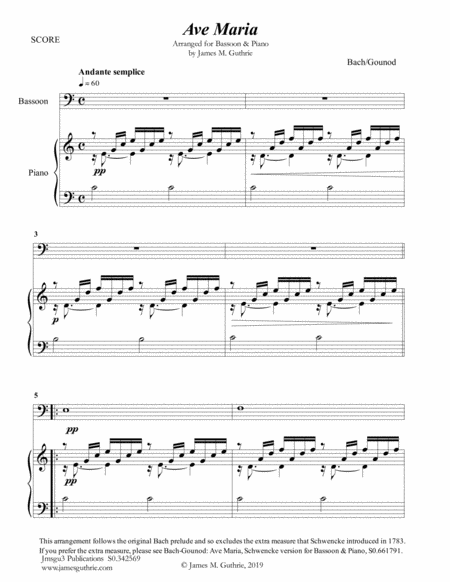
Instrumental Duet Bassoon,Instrumental Duet - Level 2 - Digital Download SKU: A0.549363 Composed by Bach-Gounod. Arranged by James M. Guthrie, ASCAP. Christmas,Contemporary,Easter,Wedding. Score and parts. 11 pages. Jmsgu3 #3490133. Published by jmsgu3 (A0.549363). This arrangement follows the original Bach prelude and so excludes the extra measure that Schwencke introduced in 1783. If you prefer the extra measure, please see Bach-Gounod: Ave Maria, Schwencke version for Bassoon & Piano, S0.661791. The convenient 1st & 2nd endings provide an option for extended performance with minimal page turns for the accompanist. The duration with repeat is about 4:50. Score: 6 pages. Solo part: 1 page, piano part: 4 pages. Based on Prelude #1 in C Major from the Well-Tempered Clavier, Book 1. Well suited for church meditations or school programs or recital encores. Ave Maria Ave Maria is a Catholic prayer that consequently asks for the mother of Jesus (Mary) to intercede. Charles Gounod composed a famous version of the Ave Maria. He was a French Romantic composer who overlaid a new melody on an existing Bach chord progression. The progression is from Bach’s Prelude No. 1 from Well-Tempered Clavier I. This version, as well as Schubert’s version, have become essential items at weddings, masses, and funerals. Bach Overview First of all, Johann Sebastian Bach is maybe the greatest composer in music history. Certainly, he was prolific. As a result, everyone has heard of his works. Furthermore, these works number well over a thousand. It seems like people are probably most familiar with instrumental works such as the Brandenburg Concertos, and the Goldberg Variations. But, similarly famous are such noteworthy works as the Well-Tempered Clavier, the Musical Offering, and the Art of Fugue. Seems like his most famous vocal works include the most noteworthy Mass in B Minor. Also, most noteworthy, though, are the St. John Passion, and certainly the Christmas Oratorio.  History Bach came from a long line of musicians and above all, composers. Consequently, he, first of all, pursued a career as a church organist. So as a result, he gained employment in various Protestant churches in Germany. For a while, he worked as a court musician in Weimar and Köthen. Here he probably developed his organ style and likewise his chamber music style. Eventually, he gained an appointment as Cantor of St. Thomas in Leipzig. Here he worked until difficulties with his employer ultimately drove him away. The King of Poland finally appointed him as court composer.  Style It seems like Bach created an engaging new international style. He synthesized elements of the most noteworthy European music ideas into his new style. Even more, this new style was probably his synthesis of European musical rhythm and form. Furthermore, he demonstrated a complete mastery of counterpoint and motivic development. His sense of harmonic organization probably propelled him to the top. Revival               Mendelssohn conducted a Bach revival in the nineteenth century. His effort probably helped to re-familiarize the public with the magnitude of Bach’s works. During this period, scholars published many noteworthy Bach biographies. Moreover, Wolfgang Schmieder published the BWV (Bach Werke Verzeichnis). As a result, this is now the official catalog of his entire artistic output. The BWV number allows us to locate a work in the catalog. Sometimes scholars will simply use an S (Schmieder) as an abbreviation for BWV.  
Bach-Gounod: Ave Maria for Bassoon & Piano
2 Bassons (duo)

$32.95 28.36 € 2 Bassons (duo) PDF SheetMusicPlus

String Orchestra - Level 1 - Digital Download SKU: A0.1317709 Composed by Traditional. Arranged by Lauri Hämäläinen. Chamber,Children,Classical,Instructional,Traditional. 28 pages. Suomi Music #906389. Published by Suomi Music (A0.1317709). 11 CHILDREN’S SONGS FOR STRING AND PIANO:Part FOR 2.ND VIOLINAre you ready to ignite your child’s musical journey and foster a sense of camaraderie through the joy of playing? Join the Vibrant VIOLIN FRIENDS Community! 11 Children’s Songs for Strings And Piano brings young musicians the opportunity to delve into rhythmical variations of beloved melodies. From timeless tunes like “Itsy Bitsy Spider,†“Samba Lele,†“Old McDonald,†“Pippi Longstocking,†“Mary Had a Little Lamb,†to the multicultural medley of “Potpourri†and the delightful charm of “Frère Jacques,†each song brings a new dimension of excitement and creativity. The string parts are thoughtfully written in the first position, ensuring accessibility for all skill levels. The versatility of this music set allows for performances with a string orchestra and piano soloists or a traditional string quartet or piano quintet, empowering your child to explore various musical collaborations. The part for the 3rd violin can seamlessly substitute the violas, ensuring that no aspiring musician is left behind. 11 CHILDREN’S SONGS FOR STRINGS AND PIANO supports building thriving string communities where inclusivity and a shared love for music unite children from all backgrounds. The individual parts can be accompanied by another string instrument, the piano, string quartet, or string orchestra. All Violin Friends music is easily learnable with the help of play-along videos on the Violin Friends YouTube Channel and mp3 backing tracks on SoundCloud and the Violin Friends homepage www.violinfriends.com.
11 CHILDREN’S SONGS FOR STRING AND PIANO: PART FOR 2.ND VIOLIN
Orchestre à Cordes

$19.90 17.13 € Orchestre à Cordes PDF SheetMusicPlus

Organ - Level 3 - Digital Download SKU: A0.1416935 Composed by Phil Lehenbauer. Arranged by Phil Lehenbauer. Christian,Classical,Contemporary,Sacred,Traditional. Score. 13 pages. Phil Lehenbauer #998524. Published by Phil Lehenbauer (A0.1416935). The hymn tune Wondrous Love was first set in the 1840 publication Southern Harmony.  For this set of variations, I used the text at the end of the first phrase in the four verses found in most hymnals.  It was written on a two manual instrument, but with more manuals has many more chances for wonderful registrations!  The first performance of this work was by Carson Cooman at The Memorial Church, Harvard University on April 10, 2024.   I hope you enjoy playing it!
Moments of "Wondrous Love", organ work by Phil Lehenbauer
Orgue

$7.50 6.46 € Orgue PDF SheetMusicPlus

Woodwind Ensemble,Woodwind Quintet Bassoon,Clarinet,Flute,Horn,Oboe - Level 4 - Digital Download SKU: A0.553726 Composed by Charles Hubert Hastings Parry. Arranged by Ray Thompson. 20th Century. 8 pages. RayThompsonMusic #3578839. Published by RayThompsonMusic (A0.553726). Sir Charles Hubert Hastings Parry, 1st Baronet (27 February 1848 – 7 October 1918) was an English composer, teacher and historian of music.Parry's first major works appeared in 1880. As a composer he is best known for the choral song Jerusalem, his 1902 setting for the coronation anthem I was glad, the choral and orchestral ode Blest Pair of Sirens, and the hymn tune Repton, which sets the words Dear Lord and Father of Mankind. His orchestral works include five symphonies and a set of Symphonic Variations.The following is taken from All Music....Helen, Countess of Rador was the wife of the Fifth Earl of Longford Castle, Salisbury and was a close personal friend of Hubert Parry. She was unique in many ways, but perhaps the most intriguing aspect of her personality was her insistence upon doing things not normally viewed as acceptable ways for a proper Victorian Lady to entertain herself. One of these activities was commissioning works for a seventy-two piece chamber orchestra which she then conducted in a public performance in London. The Lady Radnor Suite is one such work, and Lady Radnor and her chamber orchestra gave the first performance June 29, 1894 at St. James Hall. Parry patterned the work on the early classical orchestral suite of dance movements, and the six movements all demonstrate the influence of antiquity. Each traditional dance style is preserved with great care, while Parry's own particularly English harmonic language marks them as more contemporary.This movt. is arranged for wind quintet.I have also arrangements of another suite by Parry on this site: The English Suite
Parry: Lady Radnor's Suite II. Allemande - wind quintet
Quintette à Vent: flûte, Hautbois, basson, clarinette, Cor

$6.95 5.98 € Quintette à Vent: flûte, Hautbois, basson, clarinette, Cor PDF SheetMusicPlus

Concert Band - Digital Download SKU: A0.746749 Composed by Keith Terrett. Contemporary,World. 39 pages. Keith Terrett #3129275. Published by Keith Terrett (A0.746749). Here at last is my ’’Elegy sentimentale’’ for Concert Band, and an original composition.I hope it makes an excellent piece for amateur and professional bands alike; with some challenging and interesting woodwind and brass writing for all.I envisage the ’’Elegy’’ eventually making a good piece of film music, and in consequence any directors or producers looking for a movie theme; please feel free to contact me!Elegy Sentimenatle is a mournful & melancholic work, suited for performances on the concert platform.A Supreme Work of Art!The Elegy Sentimentale opens impressively. Keith Terrett plants a C deep in virgin soil; orchestrated brilliantly for bassoon, harp and delineated by pizzicato double basses this bass line is a tree of a forest; and we are at once held by the strength of the roots. The tonality is immediately clear, and there is a grand feeling of space and power in the wide layout of the score. A lone solo clarinet high in the tessitura accompanied by a solo cello with a counter subject state the opening eight bar theme which embodies the seeds of two ideas, which supplies the generating force for the slightly agitated Piu Mosso which follows. The counter subject given by the solo cello at the beginning is now reiterated by the plaintive voice of a solo oboe and a third motif makes an appearance in the solo clarinet; oboe and clarinet duet beautifully over arpeggiated rhythmic impulses in the harp. A new subject of an accompanying nature, derived from all the material thus far presented now comes off at a tangent on the strings cascading downwards and accompanying woodwind who, play the chief melodic subject while horns cry in anguish. This first section is then repeated; I found the whole experience spiritual, detached and wondering, intensified by the breath-taking stillness. Mr Terrett in the middle section that follows now uses his full orchestral forces; after a key change the emotional charge that follows is cataclysmic in its cry of anguish; the main theme is stated in a full dress orchestral tutti, which is then repeated. The music ebbs and flows with slight variations in the woodwind recalling the main ideas; at the very end high strings bring consolation and finally peace. Keith Terrett shows an admirable command of orchestration and melodic construction and combines these qualities with rare imagination and insight.Gerald Manning
Elegy Sentimentale for Concert Band
Orchestre d'harmonie

$30.00 25.82 € Orchestre d'harmonie PDF SheetMusicPlus

String Quartet String Quartet - Level 4 - Digital Download SKU: A0.938383 Composed by Colin Bayliss. 20th Century,Contemporary. Score and parts. 30 pages. Colin Bayliss #6121. Published by Colin Bayliss (A0.938383). (B33) was first written as Piano Sonata No.1 [B12] in late 1981. It was revised into a string quartet in January 1990. There are four movements, and all the thematic material, whether tonal, atonal or serial is derived from the music of the first seven bars. After this opening, the first movement is written in a straightforward sonata form, using a mixture of tonal and serial themes in constantly changing rhythms. The second movement Adagio also contrasts tonal and serial themes, while the third movement is a short scherzo and trio, with an atonal motif in the scherzo being treated in simple rhythms. A lyrical variation of the main theme of the slow movement is used for the trio, and develops further into a simple diatonic tune. The last movement is a kaleidoscopic treatment of the preceding thematic material, together with further variations and short contrapuntal passages, to give the effect of a rondo. The motif from the beginning of the whole work then returns as a coda to unify the quartet. The Score and Parts are available on this site as separate downloads The sound sample is the second movement - performed by the Lochrian Ensemble The complete 6 string quartets performed by the Lochrian Ensemble are available on itunes: see: http://www.dwsolo.com/colinbayliss/ and for this particular quartet: https://itunes.apple.com/us/album/colin-bayliss-string-quartet/id573541672.
String Quartet No 2 (Score)
Quatuor à cordes: 2 violons, alto, violoncelle

$8.00 6.89 € Quatuor à cordes: 2 violons, alto, violoncelle PDF SheetMusicPlus

String Orchestra - Level 1 - Digital Download SKU: A0.1317692 Composed by Traditional. Arranged by Lauri Hamalainen. Chamber,Children,Classical,Instructional,Traditional. 28 pages. Suomi Music #906371. Published by Suomi Music (A0.1317692). 11 CHILDREN’S SONGS FOR STRING AND PIANO: PART FOR 1. VIOLINAre you ready to ignite your child’s musical journey and foster a sense of camaraderie through the joy of playing? Join the Vibrant VIOLIN FRIENDS Community! 11 Children’s Songs for Strings And Piano brings young musicians the opportunity to delve into rhythmical variations of beloved melodies. From timeless tunes like “Itsy Bitsy Spider,†“Samba Lele,†“Old McDonald,†“Pippi Longstocking,†“Mary Had a Little Lamb,†to the multicultural medley of “Potpourri†and the delightful charm of “Frère Jacques,†each song brings a new dimension of excitement and creativity. The string parts are thoughtfully written in the first position, ensuring accessibility for all skill levels. The versatility of this music set allows for performances with a string orchestra and piano soloists or a traditional string quartet or piano quintet, empowering your child to explore various musical collaborations. The part for the 3rd violin can seamlessly substitute the violas, ensuring that no aspiring musician is left behind. 11 CHILDREN’S SONGS FOR STRINGS AND PIANO supports building thriving string communities where inclusivity and a shared love for music unite children from all backgrounds. The individual parts can be accompanied by another string instrument, the piano, string quartet, or string orchestra. All Violin Friends music is easily learnable with the help of play-along videos on the Violin Friends YouTube Channel and mp3 backing tracks on SoundCloud and the Violin Friends homepage www.violinfriends.com.
11 Children's Songs for Strings and Piano: Part for 1. Violin
Orchestre à Cordes

$19.90 17.13 € Orchestre à Cordes PDF SheetMusicPlus

Oboe, clarinet, bassoon - Digital Download SKU: IZ.BCMS171 Composed by Sy Brandon. BCMCC (Bassoon Chamber Music Composition Competition). Score and Parts. 69 pages. Imagine Music - Digital #BCMS171. Published by Imagine Music - Digital (IZ.BCMS171). 9 x 12 in inches.Divertimento is in three movements. The first movement, Frolic, has three main thematic ideas. The first contains dotted rhythms, staccato articulation, and meter change. The second thematic idea is related to the first in that it also uses dotted rhythms and meter change, but is more legato and begins with more sustained notes. The third thematic section is thinner in texture, more playful, and has a legato theme over a staccato background. The motivic material in each of these sections has similarities. Contrast is primarily obtained through change of style and mood. These thematic ideas develop throughout the movement by varying key, instrumentation, and melodic material. There are several sections of imitation that are very energetic.The second movement, Ballad, is lyrical at an Andante tempo. The form of the movement is through-composed as the motives develop into new variations instead of having clearly distinguished themes. There is however a recapitulation that brings the listen back to the opening material. The main motives that develop are a sixteenth note pattern that is arpeggiated and also stepwise, a dotted quarter and eighth note idea that is often on weak beats as well as appearing on strong beats, and scalewise eighth note lines.All of these interweave among the parts with frequent counterpoint and some imitation. The harmony is lush with seventh chords used frequently.The last movement, Tarantella, is in a lively tempo. The form of this movement is a large ABA(Scherzo, Trio, Scherzo). The A sections are in triple meter while the B section is in duple. The A section is in three parts, forming an ABA within the large A. The material for the first part is motivically derived. The first motive is a dotted eighth, sixteenth, eighth note followed by even eighth notes. The second motive is four chromatic sixteenth notes followed by an eighth note. This motive appears both ascending and descending. The B section within this large A consists of a slurred melodic line that has both stepwise motion and leaps. It is accompanied by staccato chromatic eighth notes. The large B section is folksong-like and is in a recognizable binary form that repeats in a new key. The large A serves as a recapitulation of the opening section and it ends lightly and playfully in keeping with the Divertimento title that means to divert or amuse.
Divertimento

$32.00 27.55 € PDF SheetMusicPlus

String Ensemble,String Trio Cello,Viola,Violin - Level 3 - Digital Download SKU: A0.697724 Composed by John Henry Hopkins Jr. Arranged by Sandy McIntire. Christmas,Holiday,Instructional,Sacred,Traditional. Score and parts. 17 pages. Sandy McIntire #6527051. Published by Sandy McIntire (A0.697724). We Three Kings, also known as The Quest of the Magi, was composed by Hopkins in 1857 for a Christmas pageant in New York City featuring three tenors each representing a king and singing a verse. This arrangement by McIntire for an Intermediate String Trio (Violin I and II and Cello) emphasizes the oriental origin of the Magi using modal variations of the tune. Each instrument is featured on a verse. Separate sheet music is provided for each instrument. The second violin part may be played on a viola.Although appropriate year round, this carol is particularly appropriate for Epiphany or Theophany which commemorates the visit of the Magi to the Christ Child.
We Three Kings
Trio à Cordes: violon, alto, violoncelle

$8.99 7.74 € Trio à Cordes: violon, alto, violoncelle PDF SheetMusicPlus


Partitions Gratuites
Acheter des Partitions Musicales
Acheter des Partitions Digitales à Imprimer
Acheter des Instruments de Musique

© 2000 - 2026

Accueil - Version intégrale