EUROPE
3654 articles
USA
0 articles
DIGITAL
15146 articles (à imprimer)
Partitions Digitales
Partitions à imprimer
15146 partitions trouvées


Piano,Vocal,Voice - Level 4 - Digital Download SKU: A0.1222066 By Chris Stapleton. By Dean Dillon and Linda Hargrove. Arranged by Arabella Berman and Sam LaGrego. Country. Score. 10 pages. Arabella's Voice Studio #818350. Published by Arabella's Voice Studio (A0.1222066). Piano and vocal arrangement of Tennessee Whiskey sung by Chris Stapleton. Arranged for Arabella's Voice Studio, Boston MA, for use in Piano for the Vocalist classes. Piano for the Vocalist is a revolutionary way to learn to play all of your favorite songs, no matter your current ability level. This format is designed to get you playing music right away and to teach you music fundamentals while you play. Piano for the Vocalist was inspired by the scaffolding and leveling provided in yoga classes. Yogis understand that muscles can be developed and that leveling can allow everyone to enjoy an activity, regardless of what they can do on any given day. Like yoga, this arrangement will provide you with a basic suggestion for starting the piece. These initial recommendations will help you play the entire song while you sing. As you progress through each song, suggestions will be offered to increase the complexity of the accompaniment. You can choose which suggestions work for you, as you build your musical skills. Arabella's Voice Studio: arabella@arabellavoicestudio.com, 617-468-6461Sam LaGrego:  samlagregomusic@gmail.com.
Tennessee Whiskey
Piano, Voix
Chris Stapleton
$4.99 4.33 € Piano, Voix PDF SheetMusicPlus

Piano,Vocal,Voice - Level 3 - Digital Download SKU: A0.1186657 By Marvin Gaye. By Barrett Strong and Norman Whitfield. Arranged by Arabella Berman and Sam LaGrego. Funk,Hip-Hop,Instructional,R & B. Score. 10 pages. Arabella's Voice Studio #786297. Published by Arabella's Voice Studio (A0.1186657). Piano and vocal arrangement of I Heard it Through the Grapevine sung by Marvin Gaye. Arranged for Arabella's Voice Studio, Boston MA, for use in Piano for the Vocalist classes. Piano for the Vocalist is a revolutionary way to learn to play all of your favorite songs, no matter your current ability level. This format is designed to get you playing music right away and to teach you music fundamentals while you play. Piano for the Vocalist was inspired by the scaffolding and leveling provided in yoga classes. Yogis understand that muscles can be developed and that leveling can allow everyone to enjoy an activity, regardless of what they can do on any given day. Like yoga, this arrangement will provide you with a basic suggestion for starting the piece. These initial recommendations will help you play the entire song while you sing. As you progress through each song, suggestions will be offered to increase the complexity of the accompaniment. You can choose which suggestions work for you, as you build your musical skills. Arabella's Voice Studio: arabella@arabellavoicestudio.com, 617-468-6461Sam LaGrego:  samlagregomusic@gmail.com.
I Heard It Through The Grapevine
Piano, Voix
Marvin Gaye
$6.99 6.07 € Piano, Voix PDF SheetMusicPlus

Piano,Vocal,Voice - Level 3 - Digital Download SKU: A0.918178 Composed by Christy L'Esperance. Christian,Contemporary,Sacred,Wedding. Score. 7 pages. Christy L'Esperance #6612075. Published by Christy L'Esperance (A0.918178). Song of Seikolos is the oldest surviving complete composition, dating to ancient (200BC) Greece. The melody of Song of Seikolos is used as a framework for this setting of Psalm 148:1-2, 3-4, 9-10, 11-13a, 13c-14a. Appropriate for Catholic wedding ceremonies as well as other sacred celebrations, this purchase includes the piece in a key suited for higher voices (G mixolydian) as well as a transposition down a fourth for lower voices.Text: Psalm 148:1-2, 3-4, 9-10, 11-13a, 13c-14aR. (13a) Let all praise the name of the Lord.Praise the Lord from the heavens,praise him in the heights;Praise him, all you his angels,praise him, all you his hosts.R. Let all praise the name of the Lord.Praise him, sun and moon;praise him, all you shining stars.Praise him, you highest heavens,and you waters above the heavens.R. Let all praise the name of the Lord.Mountains and all hills,fruit trees and all cedars;beasts, both wild and tame,creeping things and birds on the wing.R. Let all praise the name of the Lord.Kings of the earth and all peoples,princes and all judges of the earth,young men and maidens as well,the old and the young together.Let them praise the name of the Lord,for his name alone is exalted.R. Let all praise the name of the Lord.His splendor above earth and heaven.He exalts the strength of his people.R. Let all praise the name of the Lord.
Psalm 148 Let All Praise the Name of the Lord
Piano, Voix

$5.00 4.34 € Piano, Voix PDF SheetMusicPlus

High voice and piano - Moderately Difficult - Digital Download SKU: MQ.8454-2E Composed by David Conte. Secular, 21st century. Instrument part. 6 pages. E. C. Schirmer Music Company - Digital #8454-2E. Published by E. C. Schirmer Music Company - Digital (MQ.8454-2E). English.American Death Ballads was composed especially for tenor Brian Thorsett. We have been frequent collaborators since 2011, when he premiered the complete set of my Three Settings of W. B. Yeats for string quartet and tenor. At his urging, I transcribed and published my Three Poems of Christina Rossetti (originally for medium voice) for high voice, which he premiered at the San Francisco Conservatory in 2014. American Death Ballads was premiered by him at the San Francisco Conservatory, November 1, 2015, with pianist John Churchwell, and at the National Association of Teachers of Singing (NATS) Conference in Chicago, July 10, 2016, with pianist Warren Jones.The choice of texts for my American Death Ballads was inspired partly by Copland’s Old American Songs, which I deeply admire, but more by my dear friend and colleague the late Conrad Susa’s Two Murder Ballads. The ingenuity of Susa’s accompaniments for his ballads in imagining anew the original source material owes a great deal to Copland’s accompaniment for his songs. Though the content of my songs is completely original and not based on preexisting melodies, I have tried to expand on this further, as the texts are much longer, and go through many different moods and characters. The four texts I chose include stories about murder, death, and dying. Though two of the texts were written in England, they traveled to the colonies almost immediately. The subjects of the texts had spent time in America, and their stories were well known to Americans.Wicked Polly is a cautionary tale. Polly has lived a dissolute and immoral life, saying, 'I'll turn to God when I grow old.' Suddenly taken ill, she realizes that it is too late to repent. She dies in agony and is presumably sent to hell; young people are advised to heed. My musical setting is stately and preacherly in character for the narrator; for Polly it becomes pleading and remorseful. The Unquiet Grave was brought to the attention of Alan Lomax, the great American field collector of folk music, by English folk singer Shirley Collins. The text is taken from an English folk song dating from 1400. In The Unquiet Grave, a young man mourns his dead lover too fervently and prevents her from obtaining peace. The dead woman complains that his weeping is keeping her from peaceful rest. He begs a kiss; she tells him it would kill him. When he persists, wanting to join her in death, she explains that once they were both dead their hearts would simply decay, and that he should enjoy life while he has it. My setting is in a flowing Andante with a rocking accompaniment. Three voices are delineated here: the narrator, the mournful lover, and the dead lover speaking from the grave. The Dying Californian first appeared in the New England Diadem in 1854. Its lyrics are based on a letter from a New Englander’s sailor to his brother who is dying at sea while on the way to California to seek his fortune in the California gold fields. He implores his brother to impart his message to his father, mother, wife, and children. My setting opens with the singer alone in a moderate dirge tempo, then, joined by the piano, moves through many tonalities and moods before ending with supreme confidence as the speaker 'gained a port called Heaven/Where the gold will never rust.'Captain Kidd was a Scottish sailor who was tried and executed for piracy and murder in 1701. The American connection to this ballad is that Kidd escaped to America and for a time lived in New York and Boston, though he was a wanted criminal by the British authorities and was extradited to Britain, where he was hung at 'Executioner’s Dock.' The lyric was printed in Britain in 1701, traveling to the colonies almost immediately. Though the didactic tone of the text is similar to Wicked Polly, it expresses no regret until the final lines: 'Take warning now by me, and shun bad company, / Lest you come to hell with me, for I must die.' My setting is fast and spirited, expressing the confidence of a man who lived life as he wanted. -David Conte.
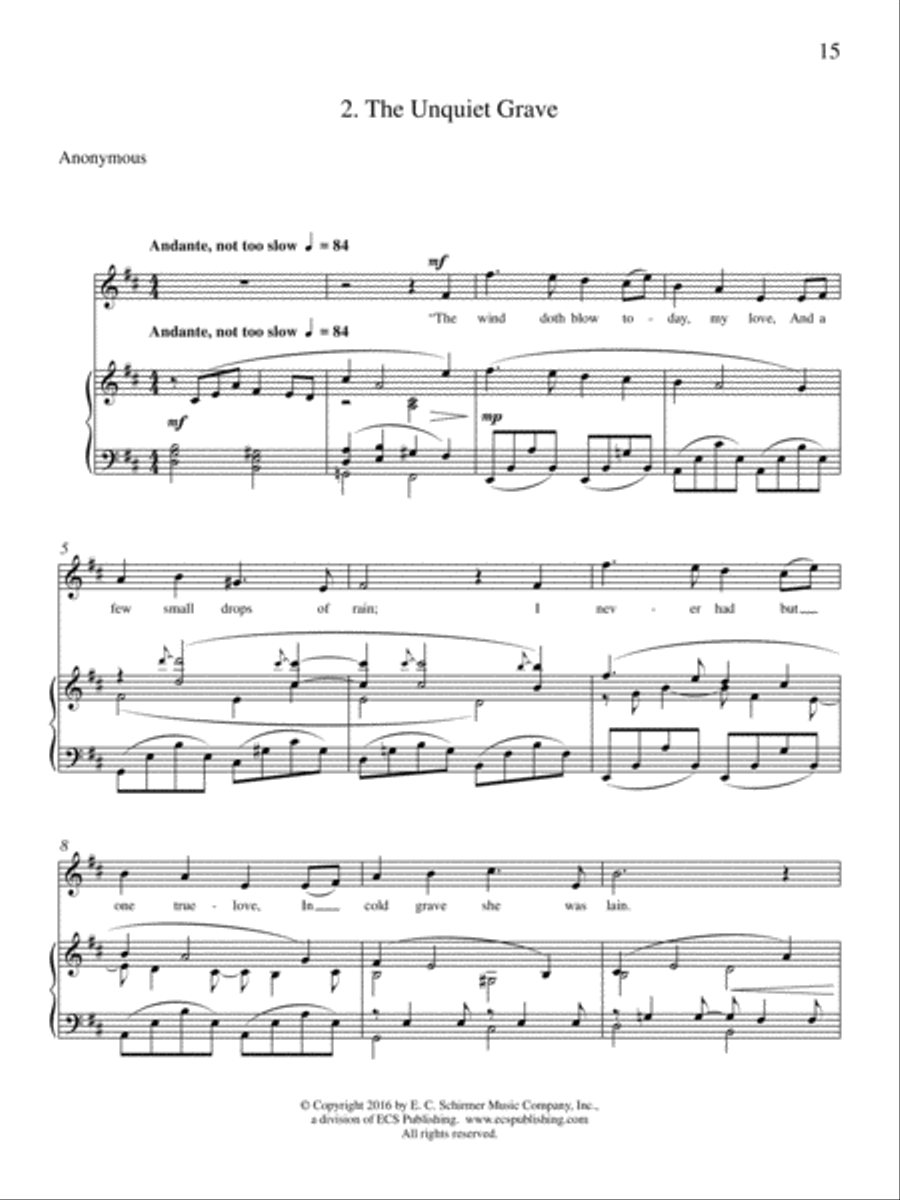
The Unquiet Grave from American Death Ballads (Downloadable)
Voix haute

$3.50 3.04 € Voix haute PDF SheetMusicPlus


Partitions Gratuites
Acheter des Partitions Musicales
Acheter des Partitions Digitales à Imprimer
Acheter des Instruments de Musique

© 2000 - 2026

Accueil - Version intégrale





