EUROPE
6272 articles
USA
15943 articles
DIGITAL
13833 articles (à imprimer)
Partitions Digitales
Partitions à imprimer
13833 partitions trouvées


Small Ensemble Flute,Piano,Voice - Digital Download SKU: A0.1027978 Composed by Scott Carr, Jr. Music. Contemporary. Score and parts. 4 pages. Scott Carr, Jr. Music #5802379. Published by Scott Carr, Jr. Music (A0.1027978). Omnia Sol Temperat came out of an assignment from Professor David Bryant to create mood music, also called photoplay music, a common genre of film music during the silent era. When the accompaniment for films was performed live, the performers used books of stock music conveying various emotions, any of which could be selected to fit the scene. The studio provided the performers with a cue sheet for the film, describing each scene along with suggestions for what music would accompany it best. Omnia Sol Temperat is intended to accompany a romantic scene, not a young innocent love, but a relationship that has faced numerous struggles and has grown-up. The text is in Latin, and originates from the Carmina Burana manuscripts. It can be translated: Love me faithfully, Taking heed of my loyalty, With all your heart, With all your mind. I am closest to you When I am far away; Whoever loves like this Rides on the wheel (of Fortune)..
Omnia Sol Temperat Op. 4

$4.99 4.23 € PDF SheetMusicPlus

Piano,Vocal,Voice - Level 2 - Digital Download SKU: A0.1262253 Composed by Amy Morales. Christian,Praise & Worship. Score. 4 pages. Amy J Morales #855286. Published by Amy J Morales (A0.1262253). A song of comfort about God's abiding care. There's never been a friend so dear than He Who conquers all my fears.A friend Who's constant and so near - He's always there, He's always there.When my faith seems small and weak, then His promises I'll seek.And through His Word, I'll hear Him speak.He's always there. He's always there. For every hour of every day, He'll walk beside you all the way. For every minute that passes by, throughout your life, He will abide.There's not a moment that He's not there to guide your steps and show His care.So take it to the Lord in prayer, He's always there. He's always there.Oh, how wonderful to know that my Father loves me so.No matter where on earth I go, He's always there, He's always there.And when my journey here's complete, I'll worship at my Savior's feet. Forever in that land so sweet. He's always there. He's always there.  For every hour of every day, He'll walk beside you all the way. For every minute that passes by, throughout your life, He will abide.There's not a moment that He's not there to guide your steps and show His care.So take it to the Lord in prayer, He's always there. He's always there.
He's Always There - SSA
Piano, Voix

$2.50 2.12 € Piano, Voix PDF SheetMusicPlus

Solo Guitar - Level 4 - Digital Download SKU: A0.1202804 Composed by Richard Hirsch. 20th Century,Contemporary,New Age. Individual part. 9 pages. Richard Hirsch #801568. Published by Richard Hirsch (A0.1202804). I offer an original composition for solo acoustic guitar that I have carried with me over several decades and through several changes in living situation. I started working with the piece already back in the 1970s when I was living in Frankfurt/Main, Germany and kept developing it when I moved to Stockholm and from there to Gothenburg, Sweden. A first recording of the composition was made in a private studio just outside Gothenburg in 1987. I have only recently been able to transmit the piece to musical notation in preparation for publication.The piece has a relaxed nature and contains many repetitions of simple themes that are meant to evoke a sense of monotonous spaciousness. One musician who listened to the first recording said he thought it sounded minimalistic, which I thought was a good description, although at the time I was unaware that minimalism was a term used to describe a whole style of music. The piece has a rather meditative character in the first part, turning more rhythmic in the second part. The third part is a swing version of the first part and the piece ends with a return to the meditative straight first part. The piece is meant to be primitive in the sense of primordial and goes in something resembling a pentatonic scale based on A. The rhythmic second part should be played so that the guitar starts to hum an A tone, the humming carrying over into and through the more melodic sections. The composition has an organic development with slight variations in the basic themes as the piece progresses.Depending on the mood of the interpreting performer, the repetitions might be played in a different order or a different number of times. I seldom play the composition exactly the same every time myself. The piece has also worked as a basis for jam sessions with accompaniment of drums and a base, although the guitar had to have some sort of amplification. The piece can be played on either steel string or nylon string acoustic guitars, or electric guitars. I chose the title Big Drum because of the recurring base A that is a dominant feature of the piece, reminding me of the big drums played by people all over the world. The piece has a participatory character, especially in the more rhythmic and swing parts, inviting the listeners to clap, stamp their feet, or drum on whatever is available,As the notation is accompanied by tablature, I refrain from giving left hand fingering. The right hand fingering consists basically of base notes played by the thumb and treble notes played by alternating index and middle fingers in combination with the ring finger.
Big Drum
Guitare

$4.99 4.23 € Guitare PDF SheetMusicPlus

Piano - Digital Download SKU: A0.1066521 Composed by THEMIS KOUTRAS. Christian,Gospel,Praise & Worship,Sacred. Full Performance. Duration 153. THEMIS KOUTRAS #4762731. Published by THEMIS KOUTRAS (A0.1066521). This is about the time when a cripple man lived in Solomon porch near a pool that a Angel came time day steering the water and the 1st one in that pool was healed from any problem but the cripple man had no one to put him in the pool each time he tried to get in someone would beet him in there so JESUS CHRIST saw him had grace mercy for him and healed him completely (read it in the gospel) anyway it is about today also that all water comes from the sky by rain when GOD rains i have prayed and anywhere found water anywhere everyone now can be healed by going in there not just the 1st one in but all who go in for a healing can now be healed by praying to GOD JEHOVAH TRINITY HOLY CREATOR OF LIFE so this song now means for today's times also for the future times also all now can be healed as we pray
I slept at solomons portch
Piano seul

$3.99 3.38 € Piano seul PDF SheetMusicPlus

Choral Choir (Unison) - Level 3 - Digital Download SKU: A0.972975 Composed by John W. Fisher. Christian,Jewish,Praise & Worship,Sacred,Spiritual. Octavo. 8 pages. John Fisher #4625135. Published by John Fisher (A0.972975). In some places of worship,  some parishioners rise when the Scripture is read.  When I first observed that, I asked one who was standing why he did that and he said it came from the Book of Nehemiah. After further research, I composed this baritone solo to preach out a lesson.  I asked another member of the church if she knew anything of this practice, and she told me some do it but others do not want visitors to stand out. With an Old Time hymn sing accompaniment, this makes for good summer fill in music while the choir is on vacation.
Nehemiah 8:5, is Why I Stand
Chorale Unison

$5.00 4.24 € Chorale Unison PDF SheetMusicPlus

Chamber Orchestra - Level 5 - Digital Download SKU: A0.533672 Composed by Carson Cooman. Contemporary,Sacred. Score and parts. 54 pages. Musik Fabrik Music Publishing #3037097. Published by Musik Fabrik Music Publishing (A0.533672). Symphony No. 3, “Ave Maris Stella†(2005) was written for the Duquesne ContemporaryEnsemble and is dedicated to composer David Stock. Throughout his career, Stock has beena tireless and generous advocate on behalf of new music and living composers. This work isdedicated to him in tribute – as both an important American composer and a significantcontributor to America’s contemporary musical life.The work’s basic source material is the plainchant Ave maris stella (“Hail, star of the seaâ€) –appropriate because of Duquesne’s standing and history as a Catholic university. When thecomposition of this work first began, the original plan was for a celebratory and vibrant piece.As the planning progressed, however, personal circumstances intervened and began to changethe work’s tone – becoming substantially bleaker and more obsessive.The title of the first movement, Pentimento, is defined as “an underlying image in a painting,as an earlier painting, that shows through when the top layer of paint has become transparentwith age.†The melodic and harmonic material for the movement is entirely drawn from theplainchant source, although it is completely transformed and covered up – as in a pentimento.At various points, one can begin to hear the original plainchant “peek out†in subtle ways.The opening section of the movement obsesses again and again on what sounds like a“beginning†– as though it is trying to begin again and again. After a brief bassoon cadenza, afast and driving section starts, marked “sinister.†After driving through a series oftransformations on the plainchant material, a bridge passage leads to further attempts at the“beginning†again. Finally, these attempts are given up, and the plainchant material (theunderlying layer) begins to show through quietly – in preparation for the next movement.In the second movement, Interrupted Motet, the plainchant theme is used in a morestraightforward fashion. After the opening declamatory statements, the following sectionsmove between more free developmental techniques, based on the first movement’stransformations, and “motet†sections – using cantus firmus methods and textures fromRenaissance music. The tone and palate is, however, much darker and more obsessive.There is a brooding ponderousness to these contrapuntal developments. The final motetsection ends in a rageful shout, the plainchant material is presented again in full force, and thepent-up energy dissipates to the close.FluteOboeClarinet in BbBass Clarinet in BbBassoonHorn in F/BbTrumpet in CTrombonePercussion (1 player):tubular bells, vibraphone(Percussionist needs one rosined bow for vibraphone.)PianoViolin IViolin IIViolaCelloContrabass(single strings)This is the score only.  The complete parts and each seperate part are also available as seperate items.
Carson Cooman: Symphony No. 3, “Ave Maris Stella” (2005) for chamber orchestra, score only
Orchestre de chambre

$25.95 22 € Orchestre de chambre PDF SheetMusicPlus

Choral Choir (SATB) - Level 3 - Digital Download SKU: A0.1251667 Composed by St. Alfonso Maria de' Liguori (traditional Neapolitan tune). Arranged by Scott S. Stewart. Christmas,Classical,Renaissance,Sacred,Traditional. Octavo. 14 pages. Scott S. Stewart #845928. Published by Scott S. Stewart (A0.1251667). Giuseppe Verdi was quoted to say: There is no Christmas without ‘Tu scendi dalle stelle’. This ‘canto di Natale’ is truly a ‘native’ seasonal pastoral, and was probably a popular Neaploitan folk tune of his time, when St. Alfonso Maria de’ Liguori composed his ‘Tu scendi dalle stelle’ in 1732.  This tune evolved when Pope Pius IX gave it its current Italian text.  This traditional Christmas tune is arranged for 4-part SATB ensemble with piano accompaniment.  It uses the original Italian text of Pope Piius IX.  Performance time: 5:00+-.
Tu scendi dalle stelle (Descending from the Heavens)

$2.99 2.53 € PDF SheetMusicPlus

String Quartet String Quartet - Level 4 - Digital Download SKU: A0.1011813 Composed by Jairo Ouma Jura. Christian,Holiday,Instructional,New Age. Score and parts. 20 pages. Jairo Ouma Jura #3480601. Published by Jairo Ouma Jura (A0.1011813). This is a wonderful wellness classical music ballet that, to me, describes various facets of the journey of life. It is soothing and captivating. You cannot get bored listening to it even while driving or relaxing at home; or even when you are walking along in those quiet moments when people reflect much about new ideas or their life experiences. This is a great piece of music, fresh from me, the composer.
Make Haste and Deliver me, O God! "2018 Chamber Music Contest Entry"
Quatuor à cordes: 2 violons, alto, violoncelle

$20.00 16.95 € Quatuor à cordes: 2 violons, alto, violoncelle PDF SheetMusicPlus

String Quartet String Quartet,Violin - Level 3 - Digital Download SKU: A0.1092495 Composed by Francesco Durante. Arranged by Regis Bookshar. Baroque,Instructional,Sacred. Score and parts. 7 pages. Regis Bookshar #696587. Published by Regis Bookshar (A0.1092495). Kyrie - by Francesco Durante; Violin Quartet – Intermediate – Digital Download. “Kyrieâ€, originally written for a four-part vocal ensemble by Francesco Durante, has now been transcribed, edited and arranged by Regis Bookshar, for a Violin Quartet. It would be a welcomed addition to any music library. This short composition, which lasts less than two minutes, will provide students with the opportunity to continue to develop good intonation because many of the phrases cadence on a unison note. This selection could be performed for concerts, recitals and church services. It is suitable for high school and college students but professional musicians would also enjoy playing this selection. Included are a score and a complete set of parts (7 pages). This selection is one of the many arrangements from the Regis Bookshar Trumpet Ensemble’s extensive music library which are being made available for the first time. We have performed the Trumpet Quartet version of this composition for many church services, especially funerals, when we were asked to supply something more somber and introspective rather than the louder, more festive music which many people come to expect from a Trumpet Ensemble. Francesco Durante was an Italian composer who was born on March 31, 1684 at Frattamaggiore, in the Kingdom of Naples. At an early age he entered the Conservatorio dei poveri di Gesu Cristo, in Naples, where he received lessons from Gaetano Greco. Later he became a pupil of Alessandro Scarlatti at the Conservatorio di Sant’Onofrio. He is said to have succeeded Scarlatti in 1725 at Sant’Onofrio and to have remained there until 1742, when he succeeded Nicola Porpora as head of the Conservatorio di Santa Maria de Loreto, also in Naples. He held this post for thirteen years, until his death on September 30, 1755. His fame as a teacher was considerable, and, unlike his Neapolitan contemporaries, who attracted international notice with their operas, Francesco Durante achieved recognition through his church music, along with some vocal chamber and instrumental works. His concern was not quantity. A complete collection of Durante’s works, consisting almost exclusively of sacred music, was presented by Gaspare Selveggi, a Neapolitan art collector and music theorist, to the Bibliotheque Nationale in Paris. The imperial library of Vienna also preserves a valuable collection of Durante’s manuscripts. The fact that Durante never composed for the stage brought him an exaggerated reputation as a composer of sacred music. He was considered one of the best church composers of his style and period. In his masses, requiems, litanies and Lamentations, he could provide strong expressive moments, as he does in this “Kyrieâ€. In addition to this arrangement for a Violin Quartet, Regis Bookshar has also made other arrangements of this selection. There are Quartets readily available for a wide variety of instrumental ensembles. Please take the time to look for other versions of this composition. You may find something else that may also suit your needs. I would also encourage you to search for other arrangements by Regis Bookshar, as well, as there are numerous arrangements in a variety of styles, also available for purchase. You may find something else which might interest you. Please continue to check periodically because new arrangements are being added as often as possible. I’m certain that this beautiful arrangement of Francesco Durante’s “Kyrie†will continue to entertain both performers and audiences alike for years to come.
Kyrie (Durante) (Violin Quartet)
Quatuor à cordes: 4 violons

$10.00 8.48 € Quatuor à cordes: 4 violons PDF SheetMusicPlus

Organ - Level 3 - Digital Download SKU: A0.909305 Composed by Vidas Pinkevicius. Contemporary. Score. 2 pages. Vidas Pinkevicius #3557503. Published by Vidas Pinkevicius (A0.909305). I don't know why, I don't know how but the only melody that I heard in my head last night was Kyrie eleyson from Orbis Factor Gregorian chant mass.So I literally didn't have a choice when I wanted to dedicate a piece to my friend Swedish organist and organ expert Göran Grahn on the occasion of him visiting Vilnius.It's a free paraphrase of the chant. It will sound nice with the dialogue between the Cornet and the pedal stops on your organ.PDF score. 2 pages. Duration - 2 minutes. Intermediate level.When you create, miracles happen!
Kyrie Orbis Factor, Op. 58 (2018) for solo organ
Orgue

$4.99 4.23 € Orgue PDF SheetMusicPlus

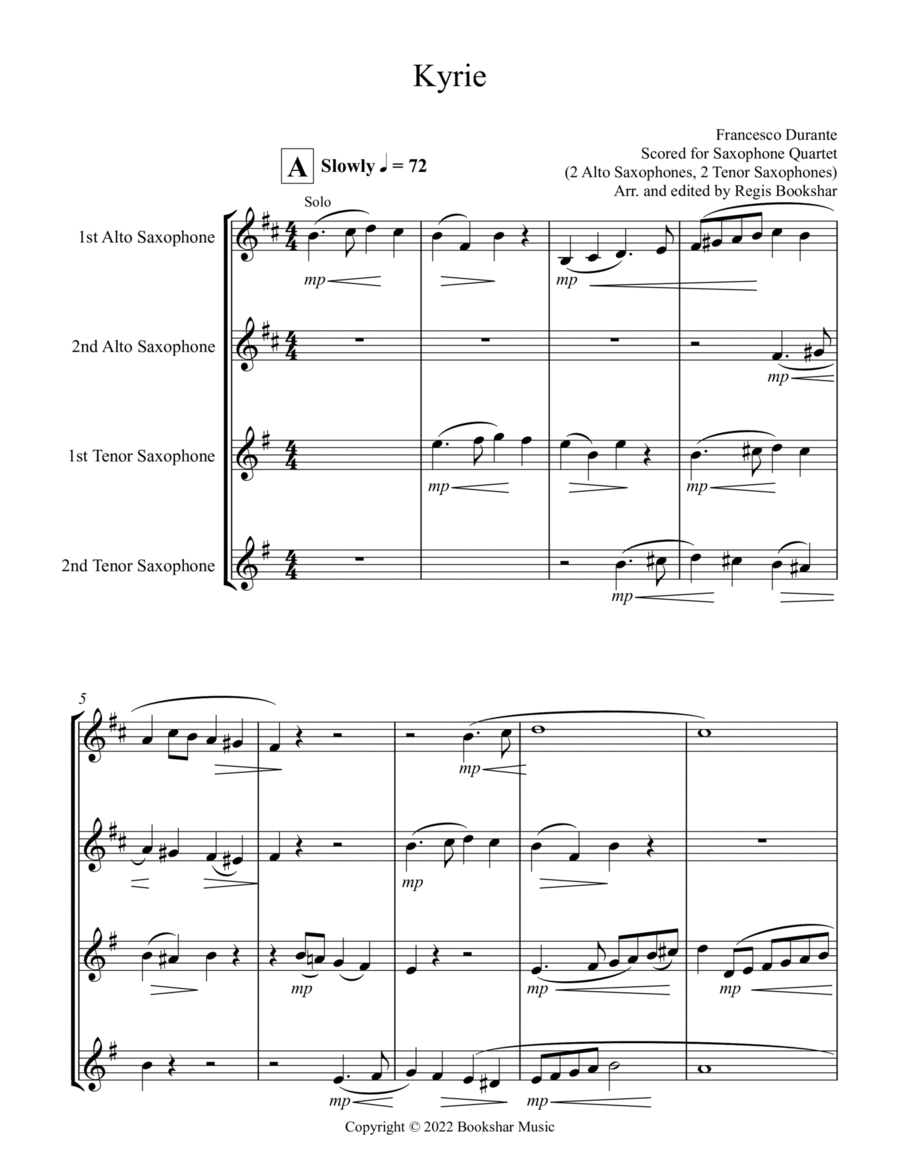
Saxophone Quartet,Woodwind Ensemble Alto Saxophone,Tenor Saxophone - Level 3 - Digital Download SKU: A0.1092467 Composed by Francesco Durante. Arranged by Regis Bookshar. Baroque,Instructional,Sacred. 8 pages. Regis Bookshar #696560. Published by Regis Bookshar (A0.1092467). Kyrie - by Francesco Durante; Saxophone Quartet – Intermediate – Digital Download. “Kyrieâ€, originally written for a four-part vocal ensemble by Francesco Durante, has now been transcribed, edited and arranged by Regis Bookshar, for a Saxophone Quartet, consisting of 2 Alto Saxophones and 2 Tenor Saxophones. It would be a welcomed addition to any music library. This short composition, which lasts less than two minutes, will provide many students with the opportunity to practice breath control because of its long phrases, and to help them to continue to develop good intonation because many of the phrases cadence on a unison note. This selection could be performed for concerts, recitals and church services. It is suitable for high school and college students but professional musicians would also enjoy playing this selection. Included are a score and a complete set of parts (8 pages). This selection is one of the many arrangements from the Regis Bookshar Trumpet Ensemble’s extensive music library which are being made available for the first time. We have performed the Trumpet Quartet version of this composition for many church services, especially funerals, when we were asked to supply something more somber and introspective rather than the louder, more festive music which many people come to expect from a Trumpet Ensemble. Francesco Durante was an Italian composer who was born on March 31, 1684 at Frattamaggiore, in the Kingdom of Naples. At an early age he entered the Conservatorio dei poveri di Gesu Cristo, in Naples, where he received lessons from Gaetano Greco. Later he became a pupil of Alessandro Scarlatti at the Conservatorio di Sant’Onofrio. He is said to have succeeded Scarlatti in 1725 at Sant’Onofrio and to have remained there until 1742, when he succeeded Nicola Porpora as head of the Conservatorio di Santa Maria de Loreto, also in Naples. He held this post for thirteen years, until his death on September 30, 1755. His fame as a teacher was considerable, and, unlike his Neapolitan contemporaries, who attracted international notice with their operas, Francesco Durante achieved recognition through his church music, along with some vocal chamber and instrumental works. His concern was not quantity. A complete collection of Durante’s works, consisting almost exclusively of sacred music, was presented by Gaspare Selveggi, a Neapolitan art collector and music theorist, to the Bibliotheque Nationale in Paris. The imperial library of Vienna also preserves a valuable collection of Durante’s manuscripts. The fact that Durante never composed for the stage brought him an exaggerated reputation as a composer of sacred music. He was considered one of the best church composers of his style and period. In his masses, requiems, litanies and Lamentations, he could provide strong expressive moments, as he does in this “Kyrieâ€. In addition to this arrangement for a Saxophone Quartet, Regis Bookshar has also made other arrangements of this selection. There are Quartets readily available for a wide variety of instrumental ensembles. Please take the time to look for other versions of this composition. You may find something else that may also suit your needs. I would also encourage you to search for other arrangements by Regis Bookshar, as well, as there are numerous arrangements in a variety of styles, also available for purchase. You may find something else which might interest you. Please continue to check periodically because new arrangements are being added as often as possible. I’m certain that this beautiful arrangement of Francesco Durante’s “Kyrie†will continue to entertain both performers and audiences alike for years to come.
Kyrie (Durante) (Saxophone Quartet - 2 Alto, 2 Tenor)
Quatuor de Saxophones: 4 saxophones

$10.00 8.48 € Quatuor de Saxophones: 4 saxophones PDF SheetMusicPlus

Choral Choir,Choral (SATB) - Level 4 - Digital Download SKU: A0.1365987 Composed by Franz Schubert. Arranged by Edward Berden. Classical,Romantic Period. 9 pages. Edward Berden #950330. Published by Edward Berden (A0.1365987). Schubert wrote Winterreise in 1827, about a year before his death.The texts are poems by Wilhelm Müller who died in the year that Schubert wrote Winterreise.Schubert found the first twelve poems under the title Wanderlieder von Wilhelm Müller. Die Winterreise in 12 Liedern in an almanack (Urania. Taschenbuch auf das Jahr 1823) published in Leipzig in 1823. It was after he set these, in February 1827, that he discovered the full series of poems in Müller's book of 1824, Poems from the posthumous papers of a travelling horn-player, dedicated to the composer Carl Maria von Weber, as a pledge of his friendship and admiration. Weber died in 1826. On 4 March 1827, Schubert invited a group of friends to his lodgings intending to sing the first group of songs, but he was out when they arrived, and the event was postponed until later in the year, when the full performance was given.This arrangement is made for SATB and can be sung with the original accompaniment by Schubert but there is also a set of parts for Wind-instruments. (English Horn, 2 Clarinets in Bb, Bassoon, French HornI hope you enjoy it.Edward Berden.
Die Krähe from “Winterreise” op 89. Arr. for SATB and Piano and Winds ad.lib Vocal Score
Chorale SATB

$2.20 1.86 € Chorale SATB PDF SheetMusicPlus

Choral Choir,Choral (TB) - Level 3 - Digital Download SKU: A0.1346467 Composed by Franz Schubert. Arranged by D. Jason Bishop. 19th Century,Classical,Instructional,Romantic Period. 8 pages. Tully Road Music #931253. Published by Tully Road Music (A0.1346467). Die Forelle (D. 550, Op. 32) is among Schubert’s early contributions to the genre of the Lied, a 19th-century German art song for solo voice and piano. Schubert composed over 600 Lieder, and although many of them became popular, Die Forelle was – and still is – one of the most widely recognized and performed. Composed in 1817, Die Forelle takes its text from a 1783 poem of the same name by Christian Friedrich Daniel Schubart. In it, a casual observer stands on the banks of a tranquil stream, admiring the movements of a “frisky†fish as it darts below the surface. The tone of the music changes when, to the observer’s horror, a fisherman puts an end to both his and the trout’s merriment by snagging the fish on his hook and reeling him in. In a final stanza which Schubert omits from his setting, we learn that Schubart’s poem is actually a metaphorical story intended to warn young women against the trickery of their young male suitors. As in Gretchen am Spinnrade and many other Lieder, Schubert “characterizes†the piano accompaniment, in this case through both the upward-winding sixteenth-note triplets representing the wriggling movements of a fish, and the abrupt shift towards agitated rhythms in measure 33 when the fish is hooked. The song gained such swift popularity that only two years after its composition in 1817, Schubert was commissioned to write an instrumental chamber work incorporating music from Die Forelle. The result was his Trout Quintet of 1819 (Piano Quintet in A Major, D. 667), the fourth movement of which is a set of variations on the Die Forelle tune.This arrangement is also available for 3-part treble (SSA) voices published by Hal Leonard Corporation, 10500871.
Die Forelle
Chorale 2 parties

$2.50 2.12 € Chorale 2 parties PDF SheetMusicPlus

Choral Choir (SATB) - Level 4 - Digital Download SKU: A0.1016698 Composed by Franz Schubert. Arranged by Edward Berden. Romantic Period. Octavo. 18 pages. Edward Berden #5771095. Published by Edward Berden (A0.1016698). Schubert wrote Winterreise in 1827, about a year before his death.The text are poems by Wilhelm Müller who died in the year that Schubert wrote Winterreise.Schubert found the first twelve poems under the title Wanderlieder von Wilhelm Müller. Die Winterreise. In 12 Liedern in an almanack (Urania. Taschenbuch auf das Jahr 1823) published in Leipzig in 1823. It was after he set these, in February 1827, that he discovered the full series of poems in Müller's book of 1824, Poems from the posthumous papers of a travelling horn-player, dedicated to the composer Carl Maria von Weber, as a pledge of his friendship and admiration. Weber died in 1826. On 4 March 1827, Schubert invited a group of friends to his lodgings intending to sing the first group of songs, but he was out when they arrived, and the event was postponed until later in the year, when the full performance was given.This arrangement is made for SATB and can be sung with the original accompaniment by Schubert but there is also a set of parts for Wind-instruments. (English Horn, 2 Clarinets in Bb, Bassoon, French HornI hope you enjoy it.Edward Berden
Schubert, Gute Nacht from Winterreise. Arranged for SATB and Piano with Wind-Instruments ad lib. Sco
Chorale SATB

$5.00 4.24 € Chorale SATB PDF SheetMusicPlus

Choral Choir (SATB) - Level 4 - Digital Download SKU: A0.1016697 Composed by Franz Schubert. Arranged by Edward Berden. Romantic Period. Octavo. 16 pages. Edward Berden #5771085. Published by Edward Berden (A0.1016697). Schubert wrote Winterreise in 1827, about a year before his death. The text are poems by Wilhelm Müller who died in the year that Schubert wrote Winterreise. Schubert found the first twelve poems under the title Wanderlieder von Wilhelm Müller. Die Winterreise. In 12 Liedern in an almanack (Urania. Taschenbuch auf das Jahr 1823) published in Leipzig in 1823. It was after he set these, in February 1827, that he discovered the full series of poems in Müller's book of 1824, Poems from the posthumous papers of a travelling horn-player, dedicated to the composer Carl Maria von Weber, as a pledge of his friendship and admiration. Weber died in 1826. On 4 March 1827, Schubert invited a group of friends to his lodgings intending to sing the first group of songs, but he was out when they arrived, and the event was postponed until later in the year, when the full performance was given. This arrangement is made for SATB and can be sung with the original accompaniment by Schubert but there is also a set of parts for Wind-instruments. (English Horn, 2 Clarinets in Bb, Bassoon, French Horn I hope you enjoy it. Edward Berden
Schubert, Gute Nacht from Winterreise. Arranged for SATB and Piano with Wind-Instruments ad lib. Voc
Chorale SATB

$2.20 1.86 € Chorale SATB PDF SheetMusicPlus


Partitions Gratuites
Acheter des Partitions Musicales
Acheter des Partitions Digitales à Imprimer
Acheter des Instruments de Musique

© 2000 - 2026

Accueil - Version intégrale





