EUROPE
6272 articles
USA
0 articles
DIGITAL
13834 articles (à imprimer)
Partitions Digitales
Partitions à imprimer
13834 partitions trouvées


Solo Guitar - Level 1 - Digital Download SKU: A0.1171119 Composed by Scott Joplin. Arranged by Brian Streckfus. 20th Century,Barbershop,Blues,Folk,Ragtime. Individual part. 2 pages. Brian Streckfus #771449. Published by Brian Streckfus (A0.1171119). 1. 2 page arrangement for guitar. I'm sorry to say this is not the full version, but a 16 page version is long winded for my purposes.2. Guitar Tab added. 3. Slurs and slides added. 4. Re-harmonized to be idiomatic for guitar, be less cliche,  and to emphasize the main melody more. 5. Some composers indications added when really necessary.  6. Left hand fingerings added.7. Chord nomenclature added.8. Overly excessive ties removed.9. Some octaves changes to better suit guitar.Tips:1. Be very careful of the difference between slurs and ties! Sometimes I don't show slurs on the tab, but this time I had to.2. The rests are real and they are suggested because they lead to a jazzier rag time sound. I feel like it goes without saying that sustain is ultimately up to the performer, which is why I removed a lot of pedantic ties; they seem to add confusion half the time. 3. The D7 is a slight key change because it has an F# in the chord. It's a secodary dominace chord, V7/V, and often a vii7b5 can replace it. In other words, the F# goes gravitates into the next chord, a G Major chord.4. G6 is really just the 3 thinnest strings of the guitar open. It's a great transition chord.5. The D# is part of the C major blues scale.6. Adding more 7th chords than originally there is almost always an interesting pursuit. Going from G to G7 can certainly aid in helping things sound more goofy.
The Entertainer (Excerpt)
Guitare

$1.99 1.72 € Guitare PDF SheetMusicPlus

String Ensemble,String Quintet - Level 3 - Digital Download SKU: A0.813778 Composed by Gustav Holst. Arranged by Regis Bookshar. 20th Century,Contemporary,Sacred,Standards,Wedding. Score and parts. 9 pages. Regis Bookshar #6476697. Published by Regis Bookshar (A0.813778). Thaxted (Bb) (String Quintet) - Intermediate - Digital Download. This marvelous arrangement of Thaxted, a hymn tune based on the Andante Maestoso section from Jupiter, the Bringer of Jollity from Gustav Holst's The Planets, would be a fabulous addition to any music library and could be performed for church services, especially Weddings and Funerals, but would be appropriate any time during the church year. However, if you are looking to perform this selection for concerts or recitals, I would suggest you look for the arrangement of Jupiter (Andante Maestoso from Jupiter, the Bringer of Jollity from The Planets), also by Regis Bookshar. These arrangements are suitable for high school and college students but professional musicians would also enjoy playing these selections as well. Included are a score and a complete set of parts (9 pages). This selection is one of the many arrangements from The Regis Bookshar Trumpet Ensemble's extensive music library which are being made available for the first time. We have performed the Trumpet Quintet version of this composition quite often for numerous weddings and other special occasions.The Planets, written between 1914 and 1917 by the English composer Gustav Holst, premiered at the Queen's Hall in London, on September 29, 1918 for an invited audience of about 250 people. In the fourth movement, Jupiter, the Bringer of Jollity, Holst portrays Jupiter's supposedly characteristic abundance of life and vitality. Nobility and generosity are allegedly characteristics of those born under Jupiter, and in the slower, middle section marked Andante Maestoso, perhaps the most well-known theme from The Planets (and the theme on which this arrangement is based), Holst provides a broad tune embodying these traits. In 1921, Holst adapted the theme to fit the patriotic poem I Vow to Thee, My Country by Cecil Spring Rice, and was written as a unison song with orchestra. It did not appear as the hymn tune until 1926, when Holst harmonized this melody, named Thaxted, named after the English village where he had lived for many years. Holst's friend Ralph Vaughan Williams included it in Songs of Praise. It has since been performed at numerous occasions, most notably for the wedding of Prince Charles and Diana, Princess of Wales in 1981, and also at the funerals of Princess Diana in 1997, Margaret Thatcher in 2013 and Senator John McCain where it was performed at the Washington National Cathedral on September 1, 2018. In addition to being used as the melody for the solemn, patriotic hymn I Vow to Thee, My Country, other settings of this hymn tune also include O God, Beyond All Praising, by Michael Perry in 1982, O Spirit All Embracing by Delores Dufner in 1995 and We Praise You and Acknowledge You, O God, a paraphrase of the Te Deum Laudemus by Stephen P. Starke in 1999.Regis Bookshar thought that it would be wonderful if other instrumentalists could have the opportunity to play this beautiful melody, so, in addition to the Trumpet Quintet version and this version for a String Quintet, consisting of 2 Violins, 1 Viola, 1 Violoncello (which has the lead) and 1 Double Bass, he has made quite a few other arrangements of this selection. There are Quintets readily available for a wide variety of instrumental ensembles. Please take the time to look for other versions of this composition. You may find something else that may also suit your needs. I would also encourage you to search for other arrangements by Regis Bookshar, as well, as there are numerous arrangements in a variety of styles, also available for purchase. You may find something else which might interest you. Please continue to check periodically because new arrangements are added as often as possible. I'm certain that this beautiful arrangement of Thaxted based on the Andante Maestoso section from Jupiter, the Bringer of Jollity from Gustav Holst's The Planets, wil.
Thaxted (hymn tune based on excerpt from "Jupiter" from The Planets) (Bb) (String Quintet - 2 Violin

$10.00 8.65 € PDF SheetMusicPlus

Brass Ensemble Euphonium - Level 3 - Digital Download SKU: A0.813709 Composed by Gustav Holst. Arranged by Regis Bookshar. 20th Century,Contemporary,Standards,Wedding. Score and parts. 9 pages. Regis Bookshar #6474539. Published by Regis Bookshar (A0.813709). Jupiter (Andante Maestoso from Jupiter, the Bringer of Jollity from The Planets) (Euphonium Quintet) - Intermediate - Digital Download. This marvelous arrangement of the Andante Maestoso section from Jupiter, the Bringer of Jollity from Gustav Holst's The Planets, would be a fabulous addition to any music library and could be performed for concerts and recitals but if you are considering using this selection for church services in which a congregation may sing along, I would suggest that you look for the arrangements of either I Vow to Thee, My Country, O God, Beyond All Praising, O Spirit All Embracing or Thaxted, also by Regis Bookshar. They are all based on the same excerpt from Jupiter, the Bringer of Jollity from The Planets. These arrangements are suitable for high school and college students but professional musicians would also enjoy playing these selections as well. Included are a score and a complete set of parts (9 pages). This selection is one of the many arrangements from The Regis Bookshar Trumpet Ensemble's extensive music library which are being made available for the first time. We have performed the Trumpet Quintet version of this composition quite often for numerous weddings and other special occasions.The Planets, written between 1914 and 1917 by the English composer Gustav Holst, premiered at the Queen's Hall in London, on September 29, 1918 for an invited audience of about 250 people. In the fourth movement, Jupiter, the Bringer of Jollity, Holst portrays Jupiter's supposedly characteristic abundance of life and vitality. Nobility and generosity are allegedly characteristics of those born under Jupiter, and in the slower, middle section marked Andante Maestoso, perhaps the most well-known theme from The Planets (and the theme on which this arrangement is based), Holst provides a broad tune embodying these traits. In 1921, Holst adapted the theme to fit the patriotic poem I Vow to Thee, My Country by Cecil Spring Rice, and was written as a unison song with orchestra. It did not appear as the hymn tune until 1926, when Holst harmonized this melody, named Thaxted, named after the English village where he had lived for many years. Holst's friend Ralph Vaughan Williams included it in Songs of Praise. It has since been performed at numerous occasions, most notably for the wedding of Prince Charles and Diana, Princess of Wales in 1981, and also at the funerals of Princess Diana in 1997, Margaret Thatcher in 2013 and Senator John McCain where it was performed at the Washington National Cathedral on September 1, 2018. In addition to being used as the melody for the solemn, patriotic hymn I Vow to Thee, My Country, other settings of this hymn tune also include O God, Beyond All Praising, by Michael Perry in 1982, O Spirit All Embracing by Delores Dufner in 1995 and We Praise You and Acknowledge You, O God, a paraphrase of the Te Deum Laudemus by Stephen P. Starke in 1999.Regis Bookshar thought that it would be wonderful if other instrumentalists could have the opportunity to play this beautiful melody, so, in addition to the Trumpet Quintet version and this version for a Euphonium Quintet, written in Treble Clef, he has made quite a few other arrangements of this selection. There is also a version for a Euphonium Quintet written in Bass Clef, if you would prefer. There are Quintets readily available for a wide variety of instrumental ensembles. Please take the time to look for other versions of this composition. You may find something else that may also suit your needs. I would also encourage you to search for other arrangements by Regis Bookshar, as well, as there are numerous arrangements in a variety of styles, also available for purchase. You may find something else which might interest you. Please continue to check periodically because new arrangements are added as often as possible. I'm certain that this beautif.
Jupiter (Andante Maestoso from "Jupiter, the Bringer of Jollity" from The Planets) (Bb) (Euphonium Q

$12.00 10.39 € PDF SheetMusicPlus

Piano Quintet Cello,Piano,Viola,Violin - Level 5 - Digital Download SKU: A0.1312666 By Cello - Will Mace, Robert Aston - Piano, Viola - Zoe Greenhalgh, and Violins - Matthew Chadbond and James Warburton. By Geraldine (Denny) Green. 21st Century,Chamber,Classical,Contemporary. 222 pages. Geraldine (Denny) Green at Oakmountmusic #901515. Published by Geraldine (Denny) Green at Oakmountmusic (A0.1312666). ALL PURCHASES COME WITH SCORE AND PARTSIn 4 movements – total duration 35 minutes.Quincie was written between July 2018 and January 2019. I had just begun receiving the main ideas for it when a pianist I know locally, Robert Aston, happened to ask me if I had written anything for piano and string quartet. I believe that Quincie “heard†this and that was the trigger and the door unlocking. Because the next thing I knew I was absolutely engulfed in the writing of this work for the next six months.Like all my works, this one is an emotional journey, and my own nickname for it is Quincie, The Comic Healer. Each movement tells a progressive story of the different stages of a journey through a long period of grief, illness, depression and chronic anxiety. The overall mood of the whole piece is extremely energetic, loving, warm, compassionate and audience friendly, and while there is some heart ache in the middle of the first movement, the work is also extremely comical and hilarious in its third and fourth movements. It has a great sense of slapstick humour alongside the deep ache of grief and unfathomable sadness. It is completely tonal and in a highly Romantic style.It has enjoyed the following performances:April 27th 2019 at the Triangle Church, Bolton BL1 5QP 7.30pm by the Pennine QuintetJune 1st 2019 at the Victoria Hall, Knowsley St. Bolton BL1 2AS at 1pm Lunchtime concert, by the Pennine QuintetJuly 7th 2019 at the Horwich Community Centre, Beaumont Rd, BL6 7BG at 2.45pm as part of the Horwich Music Festival.A great start for a brand new work! My gratitude to the Pennine Quintet and concert organizers is immense and not something I will ever forget. Thank you. The following performance was recorded and filmed at the Horwich Music Festival on July 7th 2019 and added to YouTube with permission of the Pennine Ensemble. Many many thanks.Very sadly, in June 2020, the pianist, Robert Aston, passed away from cancer. Without his wonderful support and encouragement this work never would have had even one performance let alone FOUR! Therefore, I have now fully dedicated this piece to Robert as the least I could do to thank him for all the wonderful music he gave so freely to Bolton, UK, over his lifetime. Thank you, Robert. You were FAB!!!
"Quincie", Quintet For Two Violins, Viola, Cello And Piano
Piano Quintette: piano, 2 violons, alto, violoncelle
Cello - Will Mace, Robert Aston - Piano, Viola - Zoe Greenhalgh, and Violins - Matthew Chadbond and James Warburton
$75.00 64.91 € Piano Quintette: piano, 2 violons, alto, violoncelle PDF SheetMusicPlus

Brass Ensemble Horn,Trombone,Trumpet,Tuba - Level 3 - Digital Download SKU: A0.813673 Composed by Gustav Holst. Arranged by Regis Bookshar. 20th Century,Contemporary,Multicultural,Standards,Wedding,World. Score and parts. 9 pages. Regis Bookshar #6473839. Published by Regis Bookshar (A0.813673). I Vow to Thee, My Country (Thaxted) (Bb) (Brass Quintet) - Intermediate - Digital Download. This marvelous arrangement of I Vow to Thee, My Country, a hymn tune based on the Andante Maestoso section from Jupiter, the Bringer of Jollity from Gustav Holst's The Planets, would be a fabulous addition to any music library and could be performed for church services, especially Weddings and Funerals, but would be appropriate any time during the church year. However, if you are looking to perform this selection for concerts or recitals, I would suggest you look for the arrangement of Jupiter (Andante Maestoso from Jupiter, the Bringer of Jollity from The Planets), also by Regis Bookshar. These arrangements are suitable for high school and college students but professional musicians would also enjoy playing these selections as well. Included are a score and a complete set of parts (9 pages). This selection is one of the many arrangements from The Regis Bookshar Trumpet Ensemble's extensive music library which are being made available for the first time. We have performed the Trumpet Quintet version of this composition quite often for numerous weddings and other special occasions.The Planets, written between 1914 and 1917 by the English composer Gustav Holst, premiered at the Queen's Hall in London, on September 29, 1918 for an invited audience of about 250 people. In the fourth movement, Jupiter, the Bringer of Jollity, Holst portrays Jupiter's supposedly characteristic abundance of life and vitality. Nobility and generosity are allegedly characteristics of those born under Jupiter, and in the slower, middle section marked Andante Maestoso, perhaps the most well-known theme from The Planets (and the theme on which this arrangement is based), Holst provides a broad tune embodying these traits. In 1921, Holst adapted the theme to fit the patriotic poem I Vow to Thee, My Country by Cecil Spring Rice, and was written as a unison song with orchestra. It did not appear as the hymn tune until 1926, when Holst harmonized this melody, named Thaxted, named after the English village where he had lived for many years. Holst's friend Ralph Vaughan Williams included it in Songs of Praise. It has since been performed at numerous occasions, most notably for the wedding of Prince Charles and Diana, Princess of Wales in 1981, and also at the funerals of Princess Diana in 1997, Margaret Thatcher in 2013 and Senator John McCain where it was performed at the Washington National Cathedral on September 1, 2018. In addition to being used as the melody for the solemn, patriotic hymn I Vow to Thee, My Country, other settings of this hymn tune also include O God, Beyond All Praising, by Michael Perry in 1982, O Spirit All Embracing by Delores Dufner in 1995 and We Praise You and Acknowledge You, O God, a paraphrase of the Te Deum Laudemus by Stephen P. Starke in 1999.Regis Bookshar thought that it would be wonderful if other instrumentalists could have the opportunity to play this beautiful melody, so, in addition to the Trumpet Quintet version and this version for a Brass Quintet, consisting of 2 Trumpets, 1 French Horn (which has the lead), 1 Trombone and 1 Tuba, he has made quite a few other arrangements of this selection. There are Quintets readily available for a wide variety of instrumental ensembles. Please take the time to look for other versions of this composition. You may find something else that may also suit your needs. I would also encourage you to search for other arrangements by Regis Bookshar, as well, as there are numerous arrangements in a variety of styles, also available for purchase. You may find something else which might interest you. Please continue to check periodically because new arrangements are added as often as possible. I'm certain that this beautiful arrangement of I Vow to Thee, My Country based on the Andante Maestoso section from Jupiter, the Bri.
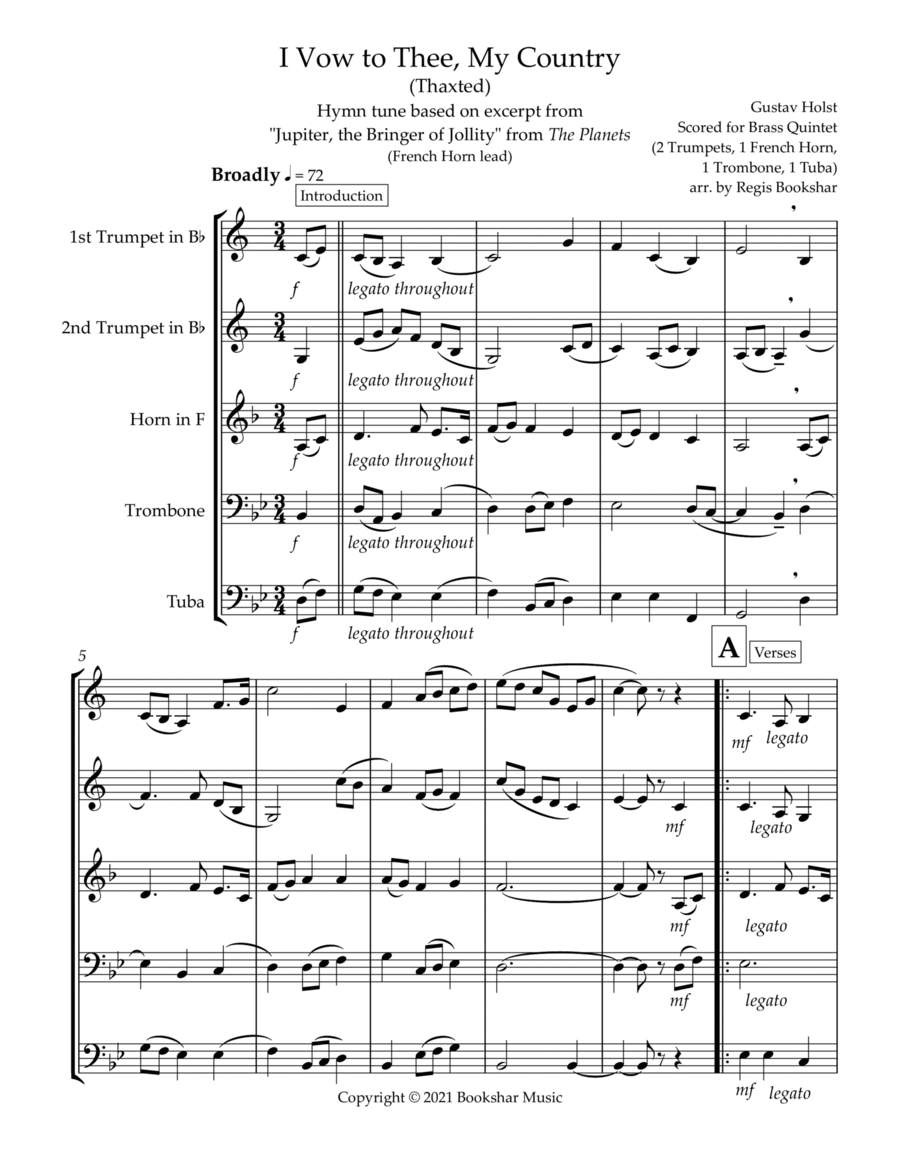
I Vow to Thee, My Country (Thaxted) (Bb) (Brass Quintet - 2 Trp, 1 Hrn, 1 Trb, 1 Tuba) (French Horn
Quatuor de Cuivres : 2 trompettes, trombone, tuba

$10.00 8.65 € Quatuor de Cuivres : 2 trompettes, trombone, tuba PDF SheetMusicPlus

Violin Duet Violin - Level 3 - Digital Download SKU: A0.785780 Composed by Grant Horsley. Multicultural,Standards,Wedding,World. 26 pages. Grant Horsley #6265503. Published by Grant Horsley (A0.785780). Salento is a Modern Tarantella.Tarantella is a lively dance in 6/8 time featuring quick steps originating in Taranto Italy. The dance was originally a flirtation one where couples danced in a manner to entice courtship, however it is more known as a dance of hysteria for when a victim was bitten by a spider (tarantula), it was believed that dancing furiously with tambourines would cure them.This Tarantella is in ternary form and in A minor and the most complicated note value is a quaver and the highest note is top E. I have kept both instrumental parts fairly equal throughout avoiding a number 1 and number 2  I have left the bowing to the performer and I have placed it at Intermediate level, but the youtube link has the whole score for you to assess the suitability.It is ideal as a showpiece, useful for concerts, recitals or simply something a little different to play. It is 2 mins 45 in length and the price is for the score and parts.Flute, Trumpet and Clarinet Duets are also availableThe piano accompaniment track is also available separately.
"Salento" A Modern Tarantella for Violin Duet and Piano- Intermediate
2 Violons (duo)

$5.99 5.18 € 2 Violons (duo) PDF SheetMusicPlus

Level 2 - Digital Download SKU: A0.1126622 By BUD LEECH. By BUD LEECH. Arranged by Stephen Oliver. Blues,Jazz,Latin,Singer/Songwriter,Standards. Accompaniment. Duration 162. BUD LEECH #727255. Published by BUD LEECH (A0.1126622). A FULL BAND INCLUDING A JAZZ SINGER WOULD ENHANCE THE APPEAL OF THIS SONG .,..,....,., ......,,.,... WHERE HAVE YOU BEEN LOVE WHERE HAVE YOU BEEN IT WOULD SEEM YOU HAVE LEFT ME I'M BEREFT AND SO LONELY I THINK ABOUT YOU CAN'T LIVE WITHOUT YOU OH BABY WHERE HAVE YOU BEEN MAYBE YOU'LL COME BACK TO ME AND THEN WE'LL SEE. HOW HAPPY WE COULD BE MY DEAR IT'S QUITE CLEAR YOU'VE FOUND ANOTHER LOVER AND I WONDER WHETHER HE'S ONE WHO'S AS SINCERE IT'S TRUE WE'VE BEEN THROUGH SOME WONDERFUL TIMES TOGETHER YOU MUST NEVER FORGET IT CAN GET EVEN BETTER SWEETHEART OH WHERE HAVE YOU BEEN WHEN WE ARE APART MY WORLD IS EMPTY BELIEVE ME BUT IF YOU COME BACK TO ME MY LIFE WOULD BE HEAVENLY HONEY IT ISN'T FUNNY WITHOUT YOU OH WHERE HAVE YOU BEEN.
WHERE HAVE YOU BEEN LOVE
BUD LEECH
$3.33 2.88 € PDF SheetMusicPlus

Choral Choir,Choral (SATB divisi) - Level 3 - Digital Download SKU: A0.835422 Composed by Stuart Brown. Contemporary,Sacred. 8 pages. Stuart Brown Music #9697. Published by Stuart Brown Music (A0.835422). Possibly unique: an Easter (or more properly Good Friday) hymn for six-part choir, in which the choir is actually the accompaniment for a piano solo of almost hyponotic dissonance in comparison. The result of superimposing these elements is strangely beautiful. The composer offers the following commentary: I guess most people seeing a piece with a choir and a piano would think of it – not unreasonably – as a choir accompanied by a piano. This piece is subtly different: the way in which I can best explain what was in my mind when I composed it would be to describe it as a piano solo accompanied by choir. While the choir sings music that feels like a slow pavane the pianist plays a series of arpeggios and cluster chords around another relatively simple but unlinked melody. The combined effect is almost hypnotic and if the singers think of the pianist as their accompanist they will almost certainly lose the plot of what they are singing! On first hearing it may appear that the piano and the choir have little in common but the concept is simple enough. Both choir and pianist are meditating on the same theme, but coming at it from totally different directions. There is no formula to the way in which we approach the cross of Christ. We come as we are, seeking forgiveness and reconciliation, meeting at the foot of the cross. The juxtaposition of choir and piano represents that meeting and the cluster chords that the pianist plays reinforce a sense of brokenness that is essential to a proper understanding of the music. I have dedicated this to Canon Andrew White and the Christians of Iraq, knowing that their situation seems impossible in the face of the evil that walks that land, but trusting in the God and Father of the Lord Jesus Christ to do right even if from our earthly perspective we are unable to discern what right is.
On That Cross
Chorale SATB

$3.50 3.03 € Chorale SATB PDF SheetMusicPlus

Saxophone Quintet,Woodwind Ensemble Alto Saxophone,Baritone Saxophone,Tenor Saxophone - Level 3 - Digital Download SKU: A0.813744 Composed by Gustav Holst. Arranged by Regis Bookshar. 20th Century,Contemporary,Sacred,Standards,Wedding. 9 pages. Regis Bookshar #6475091. Published by Regis Bookshar (A0.813744). O God, Beyond All Praising (Thaxted) (Bb) (Saxophone Quintet) - Intermediate - Digital Download. This marvelous arrangement of O God, Beyond All Praising, a hymn tune based on the Andante Maestoso section from Jupiter, the Bringer of Jollity from Gustav Holst's The Planets, would be a fabulous addition to any music library and could be performed for church services, especially Weddings and Funerals, but would be appropriate any time during the church year. However, if you are looking to perform this selection for concerts or recitals, I would suggest you look for the arrangement of Jupiter (Andante Maestoso from Jupiter, the Bringer of Jollity from The Planets), also by Regis Bookshar. These arrangements are suitable for high school and college students but professional musicians would also enjoy playing these selections as well. Included are a score and a complete set of parts (9 pages). This selection is one of the many arrangements from The Regis Bookshar Trumpet Ensemble's extensive music library which are being made available for the first time. We have performed the Trumpet Quintet version of this composition quite often for numerous weddings and other special occasions.The Planets, written between 1914 and 1917 by the English composer Gustav Holst, premiered at the Queen's Hall in London, on September 29, 1918 for an invited audience of about 250 people. In the fourth movement, Jupiter, the Bringer of Jollity, Holst portrays Jupiter's supposedly characteristic abundance of life and vitality. Nobility and generosity are allegedly characteristics of those born under Jupiter, and in the slower, middle section marked Andante Maestoso, perhaps the most well-known theme from The Planets (and the theme on which this arrangement is based), Holst provides a broad tune embodying these traits. In 1921, Holst adapted the theme to fit the patriotic poem I Vow to Thee, My Country by Cecil Spring Rice, and was written as a unison song with orchestra. It did not appear as the hymn tune until 1926, when Holst harmonized this melody, named Thaxted, named after the English village where he had lived for many years. Holst's friend Ralph Vaughan Williams included it in Songs of Praise. It has since been performed at numerous occasions, most notably for the wedding of Prince Charles and Diana, Princess of Wales in 1981, and also at the funerals of Princess Diana in 1997, Margaret Thatcher in 2013 and Senator John McCain where it was performed at the Washington National Cathedral on September 1, 2018. In addition to being used as the melody for the solemn, patriotic hymn I Vow to Thee, My Country, other settings of this hymn tune also include O God, Beyond All Praising, by Michael Perry in 1982, O Spirit All Embracing by Delores Dufner in 1995 and We Praise You and Acknowledge You, O God, a paraphrase of the Te Deum Laudemus by Stephen P. Starke in 1999.Regis Bookshar thought that it would be wonderful if other instrumentalists could have the opportunity to play this beautiful melody, so, in addition to the Trumpet Quintet version and this version for a Saxophone Quintet, consisting of 2 Alto Saxophones, 2 Tenor Saxophones and 1 Baritone Saxophone (which has the lead), he has made quite a few other arrangements of this selection. There are Quintets readily available for a wide variety of instrumental ensembles. Please take the time to look for other versions of this composition. You may find something else that may also suit your needs. I would also encourage you to search for other arrangements by Regis Bookshar, as well, as there are numerous arrangements in a variety of styles, also available for purchase. You may find something else which might interest you. Please continue to check periodically because new arrangements are added as often as possible. I'm certain that this beautiful arrangement of O God, Beyond All Praising based on the Andante Maestoso sectio.
O God, Beyond All Praising (Thaxted) (Bb) (Saxophone Quintet - 2 Alto, 2 Tenor, 1 Bari) (Baritone le
Quintette de Saxophone: 5 saxophones

$10.00 8.65 € Quintette de Saxophone: 5 saxophones PDF SheetMusicPlus

Alto Recorder,Bass Recorder,Soprano Recorder,Tenor Recorder - Level 2 - Digital Download SKU: A0.1138452 Composed by Ludwig van Beethoven. Arranged by Ander. Christmas,Classical,Instructional,March,Romantic Period. Recorder Ensemble. 15 pages. Woods Only, Arrangements #738788. Published by Woods Only, Arrangements (A0.1138452). This arrangement adapted for recorder quartet was designed to make its listeners weep with emotion, because the adaptation preserves the original essence of the work, keeping its integrity faithful to what Beethoven wanted to transmit, with only a slight change in tone and addition of harmonic resources in the structure of the arrangement. Even though it is a funeral march, it is well suited for any musical performance occasion, being intended for beginner students who want to immerse themselves in the universe of romantic music, and nothing better than starting with the transitional composer of this period, which also does not prevent professional teachers from using it for recitals, academic presentations or didactic material in their classes as an ensemble practice. Ludwig van Beethoven's Piano Sonata No. 14 in C minor sharp, Op. 27, No. 2, is one of his most popular compositions and was an audience favorite even in his day. Written when Beethoven was 31, the Moonlight Sonata (Mondscheinsonate in German) was composed after he finished some commissioned works, but there is no evidence that he was hired to write this work. It did not receive its nickname until 1832, five years after Beethoven's death. It was the critic Ludwig Rellstab who compared the music to a moonlighting on Lake Lucerne. This comparison was adopted as a nickname for the work. Called Quasi una fantasia by the author - like its companion Op. 27, No. 1 - the piece was completed in 1801 and dedicated the following year to one of the composer's pupils. Beethoven chose to open the sonata with a slow, hypnotic arpeggio movement, the best known of the entire work. The dotted rhythm of its minimal melody evokes the tradition of 'Trauermusik' (funeral music).
Moonlight Sonata by Beethoven for Recorder Quartet
Quatuor de Flûtes à bec

$7.99 6.91 € Quatuor de Flûtes à bec PDF SheetMusicPlus

Woodwind Ensemble,Woodwind Quartet Clarinet - Level 2 - Digital Download SKU: A0.1138454 Composed by Ludwig van Beethoven. Arranged by Ander. Christmas,Classical,Instructional,March,Romantic Period. 14 pages. Woods Only, Arrangements #738790. Published by Woods Only, Arrangements (A0.1138454). This arrangement adapted for clarinet quartet was designed to make its listeners weep with emotion, because the adaptation preserves the original essence of the work, keeping its integrity faithful to what Beethoven wanted to transmit, with only a slight change in tone and addition of harmonic resources in the structure of the arrangement. Even though it is a funeral march, it is well suited for any musical performance occasion, being intended for beginner students who want to immerse themselves in the universe of romantic music, and nothing better than starting with the transitional composer of this period, which also does not prevent professional teachers from using it for recitals, academic presentations or didactic material in their classes as an ensemble practice. Ludwig van Beethoven's Piano Sonata No. 14 in C minor sharp, Op. 27, No. 2, is one of his most popular compositions and was an audience favorite even in his day. Written when Beethoven was 31, the Moonlight Sonata (Mondscheinsonate in German) was composed after he finished some commissioned works, but there is no evidence that he was hired to write this work. It did not receive its nickname until 1832, five years after Beethoven's death. It was the critic Ludwig Rellstab who compared the music to a moonlighting on Lake Lucerne. This comparison was adopted as a nickname for the work. Called Quasi una fantasia by the author - like its companion Op. 27, No. 1 - the piece was completed in 1801 and dedicated the following year to one of the composer's pupils. Beethoven chose to open the sonata with a slow, hypnotic arpeggio movement, the best known of the entire work. The dotted rhythm of its minimal melody evokes the tradition of 'Trauermusik' (funeral music).
Moonlight Sonata by Beethoven for Clarinet Quartet
Quatuor de Clarinettes: 4 clarinettes

$7.99 6.91 € Quatuor de Clarinettes: 4 clarinettes PDF SheetMusicPlus


Partitions Gratuites
Acheter des Partitions Musicales
Acheter des Partitions Digitales à Imprimer
Acheter des Instruments de Musique

© 2000 - 2026

Accueil - Version intégrale





