EUROPE
6272 articles
USA
15943 articles
DIGITAL
13837 articles (à imprimer)
Partitions Digitales
Partitions à imprimer
13837 partitions trouvées


Piano,Vocal,Voice - Level 2 - Digital Download SKU: A0.1426058 Composed by Folk. Arranged by Phil Beaman. Folk,Jazz,Multicultural,Praise & Worship,Sacred,World. Score. 2 pages. Phil Beaman #1006860. Published by Phil Beaman (A0.1426058). The West Indian version of the Our Father (Lord's Prayer) has made its way, in numerous forms and arrangements, into many hymnals around the world.  My arrangement is derived from the way my own choir sang it at a church here in the West Indies.  I created an accompaniment in the local strum style with rhythmic triads in the RH and a walking bass line in the LH.  I have arranged it all into a very spirited and rhythmic prayer for Vocal Solo.  published on this site in 3 one octave ranges:- high voice, F to F- medium voice, middle C to C- low voice, low A to A1:30 minutes2 pages; (N.B.  Do not print the 2 pages front and back; it is designed to be a flat open 2 pages and each line goes across both pages before moving to the next stanza.  Don't worry, it is obvious when you see it.)recording is a male medium voice.
Our Father (The Lord's Prayer) - West Indian - low voice
Piano, Voix

$3.99 3.37 € Piano, Voix PDF SheetMusicPlus

Saxophone Quintet,Woodwind Ensemble Alto Saxophone,Baritone Saxophone,Tenor Saxophone - Level 3 - Digital Download SKU: A0.813714 Composed by Gustav Holst. Arranged by Regis Bookshar. 20th Century,Contemporary,Standards,Wedding. 9 pages. Regis Bookshar #6474551. Published by Regis Bookshar (A0.813714). Jupiter (Andante Maestoso from Jupiter, the Bringer of Jollity from The Planets) (Saxophone Quintet) - Intermediate - Digital Download. This marvelous arrangement of the Andante Maestoso section from Jupiter, the Bringer of Jollity from Gustav Holst's The Planets, would be a fabulous addition to any music library and could be performed for concerts and recitals but if you are considering using this selection for church services in which a congregation may sing along, I would suggest that you look for the arrangements of either I Vow to Thee, My Country, O God, Beyond All Praising, O Spirit All Embracing or Thaxted, also by Regis Bookshar. They are all based on the same excerpt from Jupiter, the Bringer of Jollity from The Planets. These arrangements are suitable for high school and college students but professional musicians would also enjoy playing these selections as well. Included are a score and a complete set of parts (9 pages). This selection is one of the many arrangements from The Regis Bookshar Trumpet Ensemble's extensive music library which are being made available for the first time. We have performed the Trumpet Quintet version of this composition quite often for numerous weddings and other special occasions.The Planets, written between 1914 and 1917 by the English composer Gustav Holst, premiered at the Queen's Hall in London, on September 29, 1918 for an invited audience of about 250 people. In the fourth movement, Jupiter, the Bringer of Jollity, Holst portrays Jupiter's supposedly characteristic abundance of life and vitality. Nobility and generosity are allegedly characteristics of those born under Jupiter, and in the slower, middle section marked Andante Maestoso, perhaps the most well-known theme from The Planets (and the theme on which this arrangement is based), Holst provides a broad tune embodying these traits. In 1921, Holst adapted the theme to fit the patriotic poem I Vow to Thee, My Country by Cecil Spring Rice, and was written as a unison song with orchestra. It did not appear as the hymn tune until 1926, when Holst harmonized this melody, named Thaxted, named after the English village where he had lived for many years. Holst's friend Ralph Vaughan Williams included it in Songs of Praise. It has since been performed at numerous occasions, most notably for the wedding of Prince Charles and Diana, Princess of Wales in 1981, and also at the funerals of Princess Diana in 1997, Margaret Thatcher in 2013 and Senator John McCain where it was performed at the Washington National Cathedral on September 1, 2018. In addition to being used as the melody for the solemn, patriotic hymn I Vow to Thee, My Country, other settings of this hymn tune also include O God, Beyond All Praising, by Michael Perry in 1982, O Spirit All Embracing by Delores Dufner in 1995 and We Praise You and Acknowledge You, O God, a paraphrase of the Te Deum Laudemus by Stephen P. Starke in 1999.Regis Bookshar thought that it would be wonderful if other instrumentalists could have the opportunity to play this beautiful melody, so, in addition to the Trumpet Quintet version and this version for a Saxophone Quintet, consisting of 2 Alto Saxophones, 2 Tenor Saxophones and 1 Baritone Saxophone (which has the lead), he has made quite a few other arrangements of this selection. There are Quintets readily available for a wide variety of instrumental ensembles. Please take the time to look for other versions of this composition. You may find something else that may also suit your needs. I would also encourage you to search for other arrangements by Regis Bookshar, as well, as there are numerous arrangements in a variety of styles, also available for purchase. You may find something else which might interest you. Please continue to check periodically because new arrangements are added as often as possible. I'm certain that this beautiful arrangement o.
Jupiter (Andante Maestoso from "Jupiter, the Bringer of Jollity" from The Planets) (Bb) (Saxophone Q
Quintette de Saxophone: 5 saxophones

$12.00 10.14 € Quintette de Saxophone: 5 saxophones PDF SheetMusicPlus

Piano Solo - Level 5 - Digital Download SKU: A0.1211946 Composed by Irving Berlin. Arranged by Timothy Stapay/Liberace. Broadway,Easter,Film/TV,Musical/Show,Standards,Traditional. Score. 10 pages. Timothy Stapay #809498. Published by Timothy Stapay (A0.1211946). Easter Parade by Irving Berlin, is arranged as played by legendary piano showman, Liberace.  Here for the first time is the sheet music for this famous song, arranged as performed by Liberace.  Now you can learn to play this classic Easter Season song, just like this world-famous pianist.Easter Parade is a popular song, written by Irving Berlin and published in 1933. Berlin originally wrote the melody in 1917, under the title Smile and Show Your Dimple, as a cheer up song for a girl whose man has gone off to fight in World War I.  Berlin resurrected the tune, with modifications, and gave it the now-familiar Easter lyrics for the 1933 Broadway musical revue As Thousands Cheer, in which musical numbers were strung together on the thematic thread of newspaper headlines.In 1942, it was featured in the musical film Holiday Inn, in which it was performed by Bing Crosby. In 1948, it was performed by Judy Garland and Fred Astaire in the musical film Easter Parade, which was constructed around the song.Władziu Valentino Liberace(May 16, 1919 – February 4, 1987) was an American pianist, singer, and actor.  A child prodigy born in Wisconsin to parents of Italian and Polish origin, he enjoyed a career spanning four decades of concerts, recordings, television, motion pictures, and endorsements. At the height of his fame from the 1950s to 1970s, he was the highest-paid entertainer in the world!Lyrics below:[Verse 1]In your Easter bonnetWith all the frills upon itYou'll be the grandest ladyIn the Easter paradeI'll be all in cloverAnd when they look you overI'll be the proudest fellowIn the Easter parade[Chorus]On the avenue, Fifth AvenueThe photographers will snap usAnd you'll find that you'reIn the rotogravureOh, I could write a sonnetAbout your Easter bonnetAnd of the girl I'm takingTo the Easter parade[Chorus]On the avenue, Fifth AvеnueThe photographers will snap usAnd you'll find that you'rеIn the rotogravureOh, I could write a sonnetAbout your Easter bonnetAnd of the girl I'm takingTo the Easter parade
Easter Parade
Piano seul

$8.99 7.59 € Piano seul PDF SheetMusicPlus

String Quartet Cello,String Quartet,Viola,Violin - Level 2 - Digital Download SKU: A0.1176600 Composed by Jose Luis Armenteros Sanchez and Pablo Herrero Ibarz. Arranged by Luis Turina and Nonamé Música. 20th Century,Classical,Latin,Multicultural,Wedding,World. Score and parts. 9 pages. Nonamé Música #776677. Published by Nonamé Música (A0.1176600). (English below) (De Wikipedia) Venezuela es una canción popular venezolana, con letra y música de [...] Los Relámpagos  [...]. La popularidad y el sentimiento que evoca en los venezolanos es tal, que se la considera el cuarto himno de Venezuela, [tras] el Himno Nacional, «Alma llanera» y «Conticinio, del venezolano, Laudelino Mejías»...Con los millones de venezolanos que hay emigrados por todo el mundo, era casi un crimen no tener esta canción disponible para ellos. Novios y novias lloran por igual al entrar en sus bodas escuchando estos acordes, invitados cantando y abrazándose... Toca mucho el corazón.Mientras el cello hace casi un continuo, viola y violines se van alternando la melodía, con multitud de contratemas, adornos, segundas voces y contrapuntos. Una gozada tocarla, muy sencilla además. Cuidado con el calderón del cambio de tono.Arreglo en una página por instrumento para facilitar su interpretación al aire libre. Arcos, matices y letras de ensayo para poder hacer una buena lectura a primera vista. Más arreglos de Nonamé en nuestro canal: Nonamé Música.(From Wikipedia) Venezuela is a popular Venezuelan song, with lyrics and music by [...] Los Relámpagos [...]. The popularity and sentiment it evokes in Venezuelans is such that it is considered the fourth anthem from Venezuela, [after] the National Anthem, Alma llanera and Conticinio, from the Venezuelan, Laudelino Mejías...With millions of Venezuelans emigrating all over the world, it was almost a crime not to have this song available to them. Grooms and brides alike cry when they enter their weddings listening to these chords, guests singing and hugging each other... It really touches the heart.While the cello plays almost a continuum, the viola and violins alternate the melody, with a multitude of counter-themes, ornaments, second voices and counterpoints. A joy to play it, very simple as well. Beware of the calderón of the change of tone.Arrangement on one page per instrument to facilitate outdoor performance. Bowings, dynamics and rehearsal letters to be able to make a good sightreading. More Nonamé arrangements on our channel: Noname Música.Letra/Lyrics Llevo tu luz y tu aroma en mi pielY el cuatro en el corazónLlevo en mi sangre la espuma del marY tu horizonte en mis ojosNo envidio el vuelo ni el nido al turpialSoy como el viento en la miezSiento el caribe como a una mujerSoy así, ¿qué voy a hacer?Soy desierto, selva, nieve y volcánY al andar dejo una estelaDel rumor del llano en una canciónQue me desvela La mujer que quiero tiene que serCorazón, fuego y espuelasCon la piel tostada como una florDe VenezuelaCon tu paisaje y mis sueños me iréPor esos mundos de DiosY tus recuerdos al atardecerMe harán más corto el caminoEntre tus playas quedó mi niñezTendida al viento y al solY esa nostalgia que sube a mi vozSin querer se hizo canciónDe los montes quiero la inmensidadY del río la acuarelaY de ti los hijos que sembraránNuevas estrellasY si un día tengo que naufragarY el tifón rompe mis velasEnterrad mi cuerpo cerca del marEn Venezuela
Venezuela
Quatuor à cordes: 2 violons, alto, violoncelle

$17.99 15.19 € Quatuor à cordes: 2 violons, alto, violoncelle PDF SheetMusicPlus

Small Ensemble - Level 3 - Digital Download SKU: A0.835423 Composed by Stuart Brown. Christian,Contemporary,Sacred. Score and parts. 1 pages. Stuart Brown Music #9851. Published by Stuart Brown Music (A0.835423). Possibly unique: an Easter (or more properly Good Friday) hymn for six-part choir, in which the choir is actually the accompaniment for a piano solo of almost hyponotic dissonance in comparison. The result of superimposing these elements is strangely beautiful. The composer offers the following commentary: I guess most people seeing a piece with a choir and a piano would think of it – not unreasonably – as a choir accompanied by a piano. This piece is subtly different: the way in which I can best explain what was in my mind when I composed it would be to describe it as a piano solo accompanied by choir. While the choir sings music that feels like a slow pavane the pianist plays a series of arpeggios and cluster chords around another relatively simple but unlinked melody. The combined effect is almost hypnotic and if the singers think of the pianist as their accompanist they will almost certainly lose the plot of what they are singing! On first hearing it may appear that the piano and the choir have little in common but the concept is simple enough. Both choir and pianist are meditating on the same theme, but coming at it from totally different directions. There is no formula to the way in which we approach the cross of Christ. We come as we are, seeking forgiveness and reconciliation, meeting at the foot of the cross. The juxtaposition of choir and piano represents that meeting and the cluster chords that the pianist plays reinforce a sense of brokenness that is essential to a proper understanding of the music. I have dedicated this to Canon Andrew White and the Christians of Iraq, knowing that their situation seems impossible in the face of the evil that walks that land, but trusting in the God and Father of the Lord Jesus Christ to do right even if from our earthly perspective we are unable to discern what right is.
On That Cross - Piano part only
Piano (partie séparée)

$1.99 1.68 € Piano (partie séparée) PDF SheetMusicPlus

Bassoon Solo - Level 1 - Digital Download SKU: A0.1485389 Composed by Richard Wagner. Arranged by Jps Arrangements. Christian,Opera,Romantic Period,Wedding. Individual part. 1 pages. Jps Arrangements #1062455. Published by Jps Arrangements (A0.1485389). Richard Wagner's Wedding March, also known as the Wedding Choir, is a classic piece often played at weddings. It evokes a feeling of celebration and solemnity, being perfect to accompany the bride's entrance. Here are some reasons to consider purchasing sheet music:Ease of performance: The easy version for Bassoon is accessible even to beginners. The notes are simplified, allowing anyone to play this iconic melody.Emotion and meaning: The Wedding March is loaded with emotional meaning. It symbolizes the couple's union and happiness, making it a touching choice. for the big day.Tradition: Since the 19th century, the Wedding March has been a tradition choice for weddings. When you touch it, you connect to a long history of marriage celebrations.Customization: You can adapt the interpretation to your personal style. Try different dynamics, rhythms and expressions to make it unique.The arrangement is in A and has no chords.
Bridal Chorus for Bassoon
Basson

$4.99 4.21 € Basson PDF SheetMusicPlus

Guitar - Level 3 - Digital Download SKU: A0.1356984 Composed by Fernando Sor. Arranged by Brian Streckfus. 19th Century,Classical,Instructional,Romantic Period. Guitar Tab. 3 pages. Brian Streckfus #941611. Published by Brian Streckfus (A0.1356984). Pages: 3Key: B minorFeatures:1. Tablature Added2. Blank version for starting from scratch3. Chord Nomenclature added 4. Dynamics added 5. Fingerings Added 6. Slides/Guide fingers added 7. Modern Fonts Tips: 1. Realizing that you are in position two most of the time helps. In the key of B minor, fret 1s aren't supposed to happen as they would be out of key. This piece does have key changes, so some fret 1s do happen.2. Nearly all measures are arpeggios, so it's best to summarize each measure as a chord shape. If you read the music one note at a time, your playing will most likely sound choppy. It is possible to get the entire measure ready on beat one.3. Similiar to the last point, there are a lot of bars in this piece. Realizing when you are barring and not barring will be helpful.4. I try to strategically leave out fingerings. Too many fingerings and the piece look overly intimidating. Often, if I leave out a fingering, it's because it is a counter-intuitive fingering to use, and therefor the student should pencil it in themselves as a strong reminder of a difficult moment. I also leave out fingerings if I strongly sense there are multiple correct ways of playing a passage.
Etude No 22 Op 35
Guitare notes et tablatures

$1.99 1.68 € Guitare notes et tablatures PDF SheetMusicPlus

Piano Solo - Level 4 - Digital Download SKU: A0.1042071 By Kathi Kerr. By Kathi Kerr. Arranged by Kathi Kerr. Film/TV,Instructional,Jazz. Score. 4 pages. Melody Music Publishers #646862. Published by Melody Music Publishers (A0.1042071). This song is in the ragtime style, popular in the early 1900s. It was intended to be a serious form of music with dynamics and phrasing. It became a popular style played as fast as possible in saloons and theaters. Play this piece as ragtime was originally intended to be played with expression and at a moderate tempo until the final repeat, where it starts slow and accelerates. Change the dynamics when a section is immediately repeated to give variation. Tempo changes can also be a great form of expression (and more dynamic). Watch the fingering in the left hand and continue throughout. Practice the jumps without looking to learn how they feel. Bars 6, 8, and 9 are arpeggios on the fully diminished chord. Also, notice in bar 5 it changes to the E flat minor, which is the parallel minor, meaning it keeps the same name but has a different key signature. That is why there are G flats.
Piano song early advanced - Waterslide Rag
Piano seul
Kathi Kerr
$5.99 5.06 € Piano seul PDF SheetMusicPlus

Brass Ensemble Euphonium - Level 3 - Digital Download SKU: A0.813800 Composed by Gustav Holst. Arranged by Regis Bookshar. 20th Century,Contemporary,Sacred,Standards,Wedding. Score and parts. 9 pages. Regis Bookshar #6480799. Published by Regis Bookshar (A0.813800). O Spirit All-Embracing (Thaxted) (Bb) (Euphonium Quintet) - Intermediate - Digital Download. This marvelous arrangement of O Spirit All-Embracing, a hymn tune based on the Andante Maestoso section from Jupiter, the Bringer of Jollity from Gustav Holst's The Planets, would be a fabulous addition to any music library and could be performed for church services, especially Weddings and Funerals, but would be appropriate any time during the church year. However, if you are looking to perform this selection for concerts or recitals, I would suggest you look for the arrangement of Jupiter (Andante Maestoso from Jupiter, the Bringer of Jollity from The Planets), also by Regis Bookshar. These arrangements are suitable for high school and college students but professional musicians would also enjoy playing these selections as well. Included are a score and a complete set of parts (9 pages). This selection is one of the many arrangements from The Regis Bookshar Trumpet Ensemble's extensive music library which are being made available for the first time. We have performed the Trumpet Quintet version of this composition quite often for numerous weddings and other special occasions.The Planets, written between 1914 and 1917 by the English composer Gustav Holst, premiered at the Queen's Hall in London, on September 29, 1918 for an invited audience of about 250 people. In the fourth movement, Jupiter, the Bringer of Jollity, Holst portrays Jupiter's supposedly characteristic abundance of life and vitality. Nobility and generosity are allegedly characteristics of those born under Jupiter, and in the slower, middle section marked Andante Maestoso, perhaps the most well-known theme from The Planets (and the theme on which this arrangement is based), Holst provides a broad tune embodying these traits. In 1921, Holst adapted the theme to fit the patriotic poem I Vow to Thee, My Country by Cecil Spring Rice, and was written as a unison song with orchestra. It did not appear as the hymn tune until 1926, when Holst harmonized this melody, named Thaxted, named after the English village where he had lived for many years. Holst's friend Ralph Vaughan Williams included it in Songs of Praise. It has since been performed at numerous occasions, most notably for the wedding of Prince Charles and Diana, Princess of Wales in 1981, and also at the funerals of Princess Diana in 1997, Margaret Thatcher in 2013 and Senator John McCain where it was performed at the Washington National Cathedral on September 1, 2018. In addition to being used as the melody for the solemn, patriotic hymn I Vow to Thee, My Country, other settings of this hymn tune also include O God, Beyond All Praising, by Michael Perry in 1982, O Spirit All-Embracing by Delores Dufner in 1995 and We Praise You and Acknowledge You, O God, a paraphrase of the Te Deum Laudemus by Stephen P. Starke in 1999.Regis Bookshar thought that it would be wonderful if other instrumentalists could have the opportunity to play this beautiful melody, so, in addition to the Trumpet Quintet version and this version for a Euphonium Quintet, written in Treble Clef, he has made quite a few other arrangements of this selection. There is also a version for a Euphonium Quintet, written in Bass Clef, if you would prefer. There are Quintets readily available for a wide variety of instrumental ensembles. Please take the time to look for other versions of this composition. You may find something else that may also suit your needs. I would also encourage you to search for other arrangements by Regis Bookshar, as well, as there are numerous arrangements in a variety of styles, also available for purchase. You may find something else which might interest you. Please continue to check periodically because new arrangements are added as often as possible. I'm certain that this beautiful arrangement of O Spirit All-Embracing based on the Anda.
O Spirit All-Embracing (Thaxted) (Bb) (Euphonium Quintet) (Treble Clef)

$10.00 8.45 € PDF SheetMusicPlus

String Quartet Cello,Double Bass,String Quartet,Viola,Violin - Level 2 - Digital Download SKU: A0.1173852 Composed by Ludwig van Beethoven. Arranged by Ander. Christmas,Classical,Instructional,March,Romantic Period. 12 pages. Woods Only, Arrangements #774005. Published by Woods Only, Arrangements (A0.1173852). This arrangement adapted for string ensemble was designed to make its listeners weep with emotion, because the adaptation preserves the original essence of the work, keeping its integrity faithful to what Beethoven wanted to transmit, with only a slight change in tone and addition of harmonic resources in the structure of the arrangement. Even though it is a funeral march, it is well suited for any musical performance occasion, being intended for beginner students who want to immerse themselves in the universe of romantic music, and nothing better than starting with the transitional composer of this period, which also does not prevent professional teachers from using it for recitals, academic presentations or didactic material in their classes as an ensemble practice.Ludwig van Beethoven's Piano Sonata No. 14 in C minor sharp, Op. 27, No. 2, is one of his most popular compositions and was an audience favorite even in his day. Written when Beethoven was 31, the Moonlight Sonata (Mondscheinsonate in German) was composed after he finished some commissioned works, but there is no evidence that he was hired to write this work. It did not receive its nickname until 1832, five years after Beethoven's death. It was the critic Ludwig Rellstab who compared the music to a moonlighting on Lake Lucerne. This comparison was adopted as a nickname for the work. Called Quasi una fantasia by the author - like its companion Op. 27, No. 1 - the piece was completed in 1801 and dedicated the following year to one of the composer's pupils. Beethoven chose to open the sonata with a slow, hypnotic arpeggio movement, the best known of the entire work. The dotted rhythm of its minimal melody evokes the tradition of 'Trauermusik' (funeral music).
Moonlight Sonata by Beethoven for String Ensemble
Quatuor à cordes: 2 violons, alto, violoncelle

$7.99 6.75 € Quatuor à cordes: 2 violons, alto, violoncelle PDF SheetMusicPlus

Piano Solo - Level 5 - Digital Download SKU: A0.958692 Composed by Juan Carlos Cortés A. 20th Century,Concert,Instructional,Standards. Score. 2 pages. Juan Carlos Cortés Aguirre #5721401. Published by Juan Carlos Cortés Aguirre (A0.958692). Serie de 12 composiciones de carácter libre que no pretenden encajar en el estilo ortodoxo y puro del barroco, sino utilizar estos elementos musicales como simples ejercicios lúdicos para delite de quién lo compuso e inquietud de quién lo estudie. Se reitera siempre en todas las composiciones de esta serie, que: Aunque lo parezca, no se trata de emular al gran Juan Sebastián Bach; más bien, al componer en este estilo se rinde un tributo de eterna gratitud y admiración por la majestuosidad y Perfeccion de su obra, como lo han hecho multitud de músicos en el mundo a través de la historia.Series of 12 free-character compositions that do not intend to fit into the orthodox and pure style of the Baroque, but rather use these musical elements as simple playful exercises to delight those who composed it and the concern of those who study it. It is always reiterated in all the compositions in this series, that: Although it may seem so, it is not about emulating the great Juan Sebastián Bach; rather, when composing in this style a tribute of eternal gratitude and admiration for the majesty and Perfection of his work, as many musicians in the world have done throughout history.
Pequeña invención No. 12
Piano seul

$7.99 6.75 € Piano seul PDF SheetMusicPlus

Brass Ensemble Horn,Trombone,Trumpet,Tuba - Level 3 - Digital Download SKU: A0.813793 Composed by Gustav Holst. Arranged by Regis Bookshar. 20th Century,Contemporary,Sacred,Standards,Wedding. Score and parts. 9 pages. Regis Bookshar #6480687. Published by Regis Bookshar (A0.813793). O Spirit All-Embracing (Thaxted) (Bb) (Brass Quintet) - Intermediate - Digital Download. This marvelous arrangement of O Spirit All-Embracing, a hymn tune based on the Andante Maestoso section from Jupiter, the Bringer of Jollity from Gustav Holst's The Planets, would be a fabulous addition to any music library and could be performed for church services, especially Weddings and Funerals, but would be appropriate any time during the church year. However, if you are looking to perform this selection for concerts or recitals, I would suggest you look for the arrangement of Jupiter (Andante Maestoso from Jupiter, the Bringer of Jollity from The Planets), also by Regis Bookshar. These arrangements are suitable for high school and college students but professional musicians would also enjoy playing these selections as well. Included are a score and a complete set of parts (9 pages). This selection is one of the many arrangements from The Regis Bookshar Trumpet Ensemble's extensive music library which are being made available for the first time. We have performed the Trumpet Quintet version of this composition quite often for numerous weddings and other special occasions.The Planets, written between 1914 and 1917 by the English composer Gustav Holst, premiered at the Queen's Hall in London, on September 29, 1918 for an invited audience of about 250 people. In the fourth movement, Jupiter, the Bringer of Jollity, Holst portrays Jupiter's supposedly characteristic abundance of life and vitality. Nobility and generosity are allegedly characteristics of those born under Jupiter, and in the slower, middle section marked Andante Maestoso, perhaps the most well-known theme from The Planets (and the theme on which this arrangement is based), Holst provides a broad tune embodying these traits. In 1921, Holst adapted the theme to fit the patriotic poem I Vow to Thee, My Country by Cecil Spring Rice, and was written as a unison song with orchestra. It did not appear as the hymn tune until 1926, when Holst harmonized this melody, named Thaxted, named after the English village where he had lived for many years. Holst's friend Ralph Vaughan Williams included it in Songs of Praise. It has since been performed at numerous occasions, most notably for the wedding of Prince Charles and Diana, Princess of Wales in 1981, and also at the funerals of Princess Diana in 1997, Margaret Thatcher in 2013 and Senator John McCain where it was performed at the Washington National Cathedral on September 1, 2018. In addition to being used as the melody for the solemn, patriotic hymn I Vow to Thee, My Country, other settings of this hymn tune also include O God, Beyond All Praising, by Michael Perry in 1982, O Spirit All-Embracing by Delores Dufner in 1995 and We Praise You and Acknowledge You, O God, a paraphrase of the Te Deum Laudemus by Stephen P. Starke in 1999.Regis Bookshar thought that it would be wonderful if other instrumentalists could have the opportunity to play this beautiful melody, so, in addition to the Trumpet Quintet version and this version for a Brass Quintet, consisting of 2 Trumpets, 1 French Horn (which has the lead), 1 Trombone and 1 Tuba, he has made quite a few other arrangements of this selection. There are Quintets readily available for a wide variety of instrumental ensembles. Please take the time to look for other versions of this composition. You may find something else that may also suit your needs. I would also encourage you to search for other arrangements by Regis Bookshar, as well, as there are numerous arrangements in a variety of styles, also available for purchase. You may find something else which might interest you. Please continue to check periodically because new arrangements are added as often as possible. I'm certain that this beautiful arrangement of O Spirit All-Embracing based on the Andante Maestoso section from Jupiter, th.
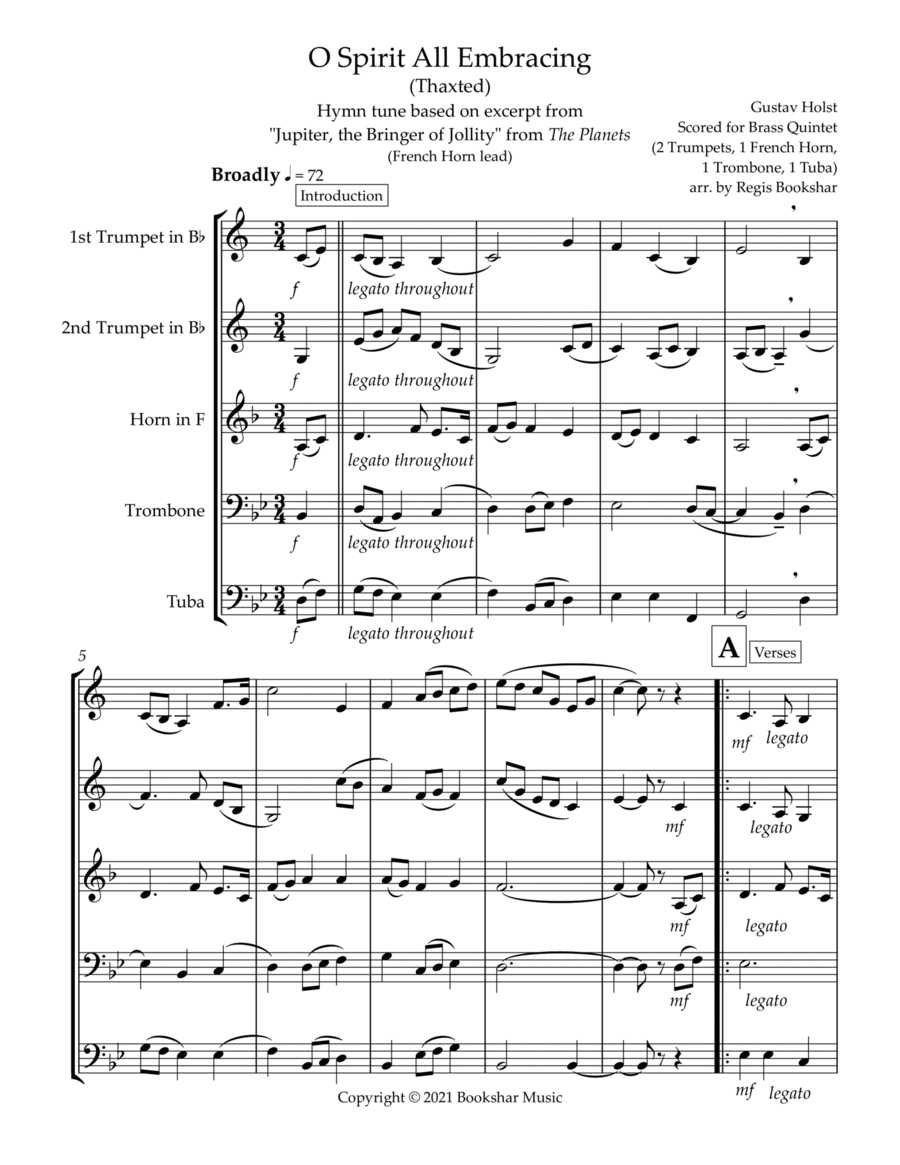
O Spirit All-Embracing (Thaxted) (Bb) (Brass Quintet - 2 Trp, 1 Hrn, 1 Trb, 1 Tuba) (French Horn lea
Quatuor de Cuivres : 2 trompettes, trombone, tuba

$10.00 8.45 € Quatuor de Cuivres : 2 trompettes, trombone, tuba PDF SheetMusicPlus

Saxophone Quintet,Woodwind Ensemble Alto Saxophone,Baritone Saxophone,Tenor Saxophone - Level 3 - Digital Download SKU: A0.813773 Composed by Gustav Holst. Arranged by Regis Bookshar. 20th Century,Contemporary,Sacred,Standards,Wedding. 9 pages. Regis Bookshar #6476685. Published by Regis Bookshar (A0.813773). Thaxted (Bb) (Saxophone Quintet) - Intermediate - Digital Download. This marvelous arrangement of Thaxted, a hymn tune based on the Andante Maestoso section from Jupiter, the Bringer of Jollity from Gustav Holst's The Planets, would be a fabulous addition to any music library and could be performed for church services, especially Weddings and Funerals, but would be appropriate any time during the church year. However, if you are looking to perform this selection for concerts or recitals, I would suggest you look for the arrangement of Jupiter (Andante Maestoso from Jupiter, the Bringer of Jollity from The Planets), also by Regis Bookshar. These arrangements are suitable for high school and college students but professional musicians would also enjoy playing these selections as well. Included are a score and a complete set of parts (9 pages). This selection is one of the many arrangements from The Regis Bookshar Trumpet Ensemble's extensive music library which are being made available for the first time. We have performed the Trumpet Quintet version of this composition quite often for numerous weddings and other special occasions.The Planets, written between 1914 and 1917 by the English composer Gustav Holst, premiered at the Queen's Hall in London, on September 29, 1918 for an invited audience of about 250 people. In the fourth movement, Jupiter, the Bringer of Jollity, Holst portrays Jupiter's supposedly characteristic abundance of life and vitality. Nobility and generosity are allegedly characteristics of those born under Jupiter, and in the slower, middle section marked Andante Maestoso, perhaps the most well-known theme from The Planets (and the theme on which this arrangement is based), Holst provides a broad tune embodying these traits. In 1921, Holst adapted the theme to fit the patriotic poem I Vow to Thee, My Country by Cecil Spring Rice, and was written as a unison song with orchestra. It did not appear as the hymn tune until 1926, when Holst harmonized this melody, named Thaxted, named after the English village where he had lived for many years. Holst's friend Ralph Vaughan Williams included it in Songs of Praise. It has since been performed at numerous occasions, most notably for the wedding of Prince Charles and Diana, Princess of Wales in 1981, and also at the funerals of Princess Diana in 1997, Margaret Thatcher in 2013 and Senator John McCain where it was performed at the Washington National Cathedral on September 1, 2018. In addition to being used as the melody for the solemn, patriotic hymn I Vow to Thee, My Country, other settings of this hymn tune also include O God, Beyond All Praising, by Michael Perry in 1982, O Spirit All Embracing by Delores Dufner in 1995 and We Praise You and Acknowledge You, O God, a paraphrase of the Te Deum Laudemus by Stephen P. Starke in 1999.Regis Bookshar thought that it would be wonderful if other instrumentalists could have the opportunity to play this beautiful melody, so, in addition to the Trumpet Quintet version and this version for a Saxophone Quintet, consisting of 2 Alto Saxophones (one of which has the lead), 2 Tenor Saxophones and 1 Baritone Saxophone, he has made quite a few other arrangements of this selection. There are Quintets readily available for a wide variety of instrumental ensembles. Please take the time to look for other versions of this composition. You may find something else that may also suit your needs. I would also encourage you to search for other arrangements by Regis Bookshar, as well, as there are numerous arrangements in a variety of styles, also available for purchase. You may find something else which might interest you. Please continue to check periodically because new arrangements are added as often as possible. I'm certain that this beautiful arrangement of Thaxted based on the Andante Maestoso section from Jupiter, the Bringer of Jollity from Gustav Holst's.
Thaxted (hymn tune based on excerpt from "Jupiter" from The Planets) (Bb) (Saxophone Quintet - 2 Alt
Quintette de Saxophone: 5 saxophones

$10.00 8.45 € Quintette de Saxophone: 5 saxophones PDF SheetMusicPlus

Choral Choir,Choral (SAT) - Level 3 - Digital Download SKU: A0.1294135 Composed by Colin Kirkpatrick. Christian,Christmas,Contest,Festival. 13 pages. Colin Kirkpatrick Publications #884558. Published by Colin Kirkpatrick Publications (A0.1294135). This is a really lively setting of a colorful text by Danny Alorean. The main theme is in 7/8 time, divided into 2, 2, and 3. It might look a bit daunting to some, but it's easy when counted as 1-2-1-2-1-2-3. Its recommended that singers practise this rhythm first, perhaps by clapping on the off-beats. There’s plenty of contrast in the piece and singers are sure to enjoy the music. It’s scored for SAT choir with keyboard accompaniment. It is thus a useful piece for high school or college choirs that have no bass section. The middle section uses much vocal counterpoint and has almost a waltz feeling to it. Choir members need to be reasonably experienced at singing independent vocal parts. The piano part is of moderate difficulty but could be handled by any competent pianist. This is a new arrangement (as of Seotember 2023) in which the music has been transposed down one tone from the original. This joyful anthem would be a great addition to your Christmas concert or service. The vocal range is as follows: Soprano: C4 - F5; Alto: A3 - D5; Tenor C3 - E4.  (Duration 03:03).
Sing! For a Boy has been Born (SAT choir and piano)
Chorale 3 parties

$3.99 3.37 € Chorale 3 parties PDF SheetMusicPlus

Saxophone Quartet,Woodwind Ensemble Tenor Saxophone - Level 2 - Digital Download SKU: A0.1138458 Composed by Ludwig van Beethoven. Arranged by Ander. Christmas,Classical,Instructional,March,Romantic Period. 14 pages. Woods Only, Arrangements #738794. Published by Woods Only, Arrangements (A0.1138458). This arrangement adapted for tenor saxophone quartet was designed to make its listeners weep with emotion, because the adaptation preserves the original essence of the work, keeping its integrity faithful to what Beethoven wanted to transmit, with only a slight change in tone and addition of harmonic resources in the structure of the arrangement. Even though it is a funeral march, it is well suited for any musical performance occasion, being intended for beginner students who want to immerse themselves in the universe of romantic music, and nothing better than starting with the transitional composer of this period, which also does not prevent professional teachers from using it for recitals, academic presentations or didactic material in their classes as an ensemble practice. Ludwig van Beethoven's Piano Sonata No. 14 in C minor sharp, Op. 27, No. 2, is one of his most popular compositions and was an audience favorite even in his day. Written when Beethoven was 31, the Moonlight Sonata (Mondscheinsonate in German) was composed after he finished some commissioned works, but there is no evidence that he was hired to write this work. It did not receive its nickname until 1832, five years after Beethoven's death. It was the critic Ludwig Rellstab who compared the music to a moonlighting on Lake Lucerne. This comparison was adopted as a nickname for the work. Called Quasi una fantasia by the author - like its companion Op. 27, No. 1 - the piece was completed in 1801 and dedicated the following year to one of the composer's pupils. Beethoven chose to open the sonata with a slow, hypnotic arpeggio movement, the best known of the entire work. The dotted rhythm of its minimal melody evokes the tradition of 'Trauermusik' (funeral music).
Moonlight Sonata by Beethoven for Tenor Sax Quartet
Quatuor de Saxophones: 4 saxophones

$7.99 6.75 € Quatuor de Saxophones: 4 saxophones PDF SheetMusicPlus


Partitions Gratuites
Acheter des Partitions Musicales
Acheter des Partitions Digitales à Imprimer
Acheter des Instruments de Musique

© 2000 - 2026

Accueil - Version intégrale





