EUROPE
6272 articles
USA
0 articles
DIGITAL
13836 articles (à imprimer)
Partitions Digitales
Partitions à imprimer
13836 partitions trouvées


Woodwind Ensemble Bassoon - Level 3 - Digital Download SKU: A0.813792 Composed by Gustav Holst. Arranged by Regis Bookshar. 20th Century,Contemporary,Sacred,Standards,Wedding. 9 pages. Regis Bookshar #6480683. Published by Regis Bookshar (A0.813792). O Spirit All-Embracing (Thaxted) (Bb) (Bassoon Quintet) - Intermediate - Digital Download. This marvelous arrangement of O Spirit All-Embracing, a hymn tune based on the Andante Maestoso section from Jupiter, the Bringer of Jollity from Gustav Holst's The Planets, would be a fabulous addition to any music library and could be performed for church services, especially Weddings and Funerals, but would be appropriate any time during the church year. However, if you are looking to perform this selection for concerts or recitals, I would suggest you look for the arrangement of Jupiter (Andante Maestoso from Jupiter, the Bringer of Jollity from The Planets), also by Regis Bookshar. These arrangements are suitable for high school and college students but professional musicians would also enjoy playing these selections as well. Included are a score and a complete set of parts (9 pages). This selection is one of the many arrangements from The Regis Bookshar Trumpet Ensemble's extensive music library which are being made available for the first time. We have performed the Trumpet Quintet version of this composition quite often for numerous weddings and other special occasions.The Planets, written between 1914 and 1917 by the English composer Gustav Holst, premiered at the Queen's Hall in London, on September 29, 1918 for an invited audience of about 250 people. In the fourth movement, Jupiter, the Bringer of Jollity, Holst portrays Jupiter's supposedly characteristic abundance of life and vitality. Nobility and generosity are allegedly characteristics of those born under Jupiter, and in the slower, middle section marked Andante Maestoso, perhaps the most well-known theme from The Planets (and the theme on which this arrangement is based), Holst provides a broad tune embodying these traits. In 1921, Holst adapted the theme to fit the patriotic poem I Vow to Thee, My Country by Cecil Spring Rice, and was written as a unison song with orchestra. It did not appear as the hymn tune until 1926, when Holst harmonized this melody, named Thaxted, named after the English village where he had lived for many years. Holst's friend Ralph Vaughan Williams included it in Songs of Praise. It has since been performed at numerous occasions, most notably for the wedding of Prince Charles and Diana, Princess of Wales in 1981, and also at the funerals of Princess Diana in 1997, Margaret Thatcher in 2013 and Senator John McCain where it was performed at the Washington National Cathedral on September 1, 2018. In addition to being used as the melody for the solemn, patriotic hymn I Vow to Thee, My Country, other settings of this hymn tune also include O God, Beyond All Praising, by Michael Perry in 1982, O Spirit All-Embracing by Delores Dufner in 1995 and We Praise You and Acknowledge You, O God, a paraphrase of the Te Deum Laudemus by Stephen P. Starke in 1999.Regis Bookshar thought that it would be wonderful if other instrumentalists could have the opportunity to play this beautiful melody, so, in addition to the Trumpet Quintet version and this version for a Bassoon Quintet, he has made quite a few other arrangements of this selection. There are Quintets readily available for a wide variety of instrumental ensembles. Please take the time to look for other versions of this composition. You may find something else that may also suit your needs. I would also encourage you to search for other arrangements by Regis Bookshar, as well, as there are numerous arrangements in a variety of styles, also available for purchase. You may find something else which might interest you. Please continue to check periodically because new arrangements are added as often as possible. I'm certain that this beautiful arrangement of O Spirit All-Embracing based on the Andante Maestoso section from Jupiter, the Bringer of Jollity from Gustav Holst's The Planets, will continue.
O Spirit All-Embracing (Thaxted) (Bb) (Bassoon Quintet)
Ensemble de Bassons

$10.00 8.65 € Ensemble de Bassons PDF SheetMusicPlus

Woodwind Ensemble,Woodwind Quartet Alto Saxophone,Baritone Saxophone,Tenor Saxophone - Level 2 - Digital Download SKU: A0.1293149 Composed by Traditional. Arranged by BRIAN W. COPPING. Classical,Contest,Festival,Historic,Traditional. 12 pages. EMK Music #883783. Published by EMK Music (A0.1293149). Scored for two Altos, Tenor and Baritone Saxophones. There are alternative parts for Altos 3 and 4 so it can be performed by four Alto Saxophones. This is very useful for teachers of groups of like instruments.Dark Eyes, sometimes known as ‘Black Eyes’, has its roots in both The Ukraine and in Russia. Although it was originally known as a ‘Russian- Romani’ folksong, at the beginning of the Twentieth Century, it achieved a much wider international reputation when Italian-born British composer, Adalgiso Ferraris, published a new version in 1910. It was also later sung and recorded by Al Bowlly in 1939. It has also gained some currency as a jazz tune.
DARK EYES – SAXOPHONE QUARTET
Quatuor de Saxophones: 4 saxophones

$14.00 12.12 € Quatuor de Saxophones: 4 saxophones PDF SheetMusicPlus

Instrumental Duet,Keyboard - Level 4 - Digital Download SKU: A0.1497861 Composed by Jenni Roditi. 21st Century,Classical,Contemporary. 26 pages. Jenni Roditi #1074273. Published by Jenni Roditi (A0.1497861). Piano Duo 2 pianos/4 hands. Ritualise, Between the Octaves finally found its identity with the word ritualise. It began as announce, became pronounce, then declare and went as far a pontificate for a title. At that point I realised I was mocking my own music and needed to take it more seriously. Ritualise brought out a meaning to the music that I hadn’t wanted to admit to. It is quite folk-like, in a primal and entrancing kind of way. I can imagine a communal dance for some ceremonial purpose in this music with both public and private elements.Names of all the movements in the suite Between the Octaves in the right order are Initiate, Surrender, Thread, Curve, Encircle, Ritualise, Ignite. The whole suite follows a long line from movement 1 to movement 7. However, individual pieces are well suited to be played alone too. Piano Duo is ideally two Steinway grands, otherwise, whatever is available. An enjoyment of the tensions and relationships generated between the two instruments: grand-upright, upright-electronic keyboard is to be explored as a positive. Each piece creates its own world in the suite and can be part of smaller subgroups taken from the suite, in any combination, but the order of the pieces needs to be maintained if more than one is played. Here is a taste of the background to the musical world of this 53 minute compositional suite. During a reflective time I read the following: The whole philosophy of dharma art (Buddhist art) is that you don't try to be artistic, but you just approach objects as they are, and the message comes through automatically. (Chogyam Trungpa Rinpoche, from 'True Perception The Path of Dharma Art.' Shambhala 2008, p.133.) The 'objects as they are' became the 'octaves as they are'. As the pieces were composed the octaves had a centring and clarifying role that allowed other material to circulate around or play against them. They acted as pivots, repetitions, drones, ostinati, pointillist nodes, pedals, melodic features, struts, harmonic turnpikes, breathing spaces, bass lines: musical imperatives. The octaves called the musical shots most of the time. When the music pulled a semitone up or down and away from the octaves (as it did quite often) it was especially telling in the context of the ringing spaces the octaves were creating. I became interested in the subtle dislocation that two pianos could provide. By dislocation I mean a degree of tension between the natural acoustics of the two instruments in the room and the players idiosyncrasies as musicians.  The whole point of this work was to examine the nature of my syntax, grammar, and compositional thinking. The title demanded one thing above all: what notes am I going to use between these octaves?? My choice of notes was derived in most instances from the tempo, pitch, and rhythm of the initial octaves at the beginning of each piece alongside the individual word titles that I set out to explore as musical images. The audio was developed from Sibelius software, via MIDI to Logic samples of a Steinway grand piano.
RITUALISE, Between the Octaves - A Piano Duo Suite (Movement 6 of 7)
2 Pianos, 4 mains
dislocation I mean a degree of tension between the natural acoustics of the two instruments in the room and the players idiosyncrasies as musicians  The whole point of this work was to examine the nature of my syntax, grammar, and compositional thinking
$20.00 17.31 € 2 Pianos, 4 mains PDF SheetMusicPlus

Horn Quintet - Level 2 - Digital Download SKU: A0.1251246 Composed by Ludwig van Beethoven. Arranged by Ander. 19th Century,Christmas,Classical,March,Romantic Period. 15 pages. Woods Only, Arrangements #845524. Published by Woods Only, Arrangements (A0.1251246). This arrangement adapted for Horn in F quintet was designed to make its listeners weep with emotion, because the adaptation preserves the original essence of the work, keeping its integrity faithful to what Beethoven wanted to transmit, with only a slight change in tone and addition of harmonic resources in the structure of the arrangement. Even though it is a funeral march, it is well suited for any musical performance occasion, being intended for beginner students who want to immerse themselves in the universe of romantic music, and nothing better than starting with the transitional composer of this period, which also does not prevent professional teachers from using it for recitals, academic presentations or didactic material in their classes as an ensemble practice.Ludwig van Beethoven's Piano Sonata No. 14 in C minor sharp, Op. 27, No. 2, is one of his most popular compositions and was an audience favorite even in his day. Written when Beethoven was 31, the Moonlight Sonata (Mondscheinsonate in German) was composed after he finished some commissioned works, but there is no evidence that he was hired to write this work. It did not receive its nickname until 1832, five years after Beethoven's death. It was the critic Ludwig Rellstab who compared the music to a moonlighting on Lake Lucerne. This comparison was adopted as a nickname for the work. Called Quasi una fantasia by the author - like its companion Op. 27, No. 1 - the piece was completed in 1801 and dedicated the following year to one of the composer's pupils. Beethoven chose to open the sonata with a slow, hypnotic arpeggio movement, the best known of the entire work. The dotted rhythm of its minimal melody evokes the tradition of 'Trauermusik' (funeral music).
Moonlight Sonata by Beethoven for French Horn Quintet
Ensemble de Cors

$9.99 8.65 € Ensemble de Cors PDF SheetMusicPlus

Trombone Quartet - Level 3 - Digital Download SKU: A0.1262047 Composed by Ludwig van Beethoven. Arranged by Ander. 19th Century,Christmas,Classical,March,Romantic Period. 13 pages. Woods Only, Arrangements #855103. Published by Woods Only, Arrangements (A0.1262047). This arrangement adapted for trombone quartet was designed to make its listeners weep with emotion, because the adaptation preserves the original essence of the work, keeping its integrity faithful to what Beethoven wanted to transmit, with only a slight change in tone and addition of harmonic resources in the structure of the arrangement. Even though it is a funeral march, it is well suited for any musical performance occasion, being intended for beginner students who want to immerse themselves in the universe of romantic music, and nothing better than starting with the transitional composer of this period, which also does not prevent professional teachers from using it for recitals, academic presentations or didactic material in their classes as an ensemble practice. Ludwig van Beethoven's Piano Sonata No. 14 in C minor sharp, Op. 27, No. 2, is one of his most popular compositions and was an audience favorite even in his day. Written when Beethoven was 31, the Moonlight Sonata (Mondscheinsonate in German) was composed after he finished some commissioned works, but there is no evidence that he was hired to write this work. It did not receive its nickname until 1832, five years after Beethoven's death. It was the critic Ludwig Rellstab who compared the music to a moonlighting on Lake Lucerne. This comparison was adopted as a nickname for the work. Called Quasi una fantasia by the author - like its companion Op. 27, No. 1 - the piece was completed in 1801 and dedicated the following year to one of the composer's pupils. Beethoven chose to open the sonata with a slow, hypnotic arpeggio movement, the best known of the entire work. The dotted rhythm of its minimal melody evokes the tradition of 'Trauermusik' (funeral music).
Moonlight Sonata by Beethoven for Trombone Quartet
Quatuor de cuivres: 4 trombones

$7.99 6.91 € Quatuor de cuivres: 4 trombones PDF SheetMusicPlus

Piano Solo - Level 5 - Digital Download SKU: A0.958689 Composed by Juan Carlos Cortés A. 20th Century,Instructional,Multicultural,Standards,World. Score. 2 pages. Juan Carlos Cortés Aguirre #5721393. Published by Juan Carlos Cortés Aguirre (A0.958689). Serie de 12 composiciones de carácter libre que no pretenden encajar en el estilo ortodoxo y puro del barroco, sino utilizar estos elementos musicales como simples ejercicios lúdicos para delite de quién lo compuso e inquietud de quién lo estudie. Se reitera siempre en todas las composiciones de esta serie, que: Aunque lo parezca, no se trata de emular al gran Juan Sebastián Bach; más bien, al componer en este estilo se rinde un tributo de eterna gratitud y admiración por la majestuosidad y Perfeccion de su obra, como lo han hecho multitud de músicos en el mundo a través de la historia.Series of 12 free-character compositions that do not intend to fit into the orthodox and pure style of the Baroque, but rather use these musical elements as simple playful exercises to delight those who composed it and the concern of those who study it. It is always reiterated in all the compositions in this series, that: Although it may seem so, it is not about emulating the great Juan Sebastián Bach; rather, when composing in this style a tribute of eternal gratitude and admiration for the majesty and Perfection of his work, as many musicians in the world have done throughout history.
Pequeña invención No. 9
Piano seul

$7.99 6.91 € Piano seul PDF SheetMusicPlus

Woodwind Ensemble Clarinet - Level 3 - Digital Download SKU: A0.813707 Composed by Gustav Holst. Arranged by Regis Bookshar. 20th Century,Contemporary,Standards,Wedding. 9 pages. Regis Bookshar #6474529. Published by Regis Bookshar (A0.813707). Jupiter (Andante Maestoso from Jupiter, the Bringer of Jollity from The Planets) (Clarinet Quintet) - Intermediate - Digital Download. This marvelous arrangement of the Andante Maestoso section from Jupiter, the Bringer of Jollity from Gustav Holst's The Planets, would be a fabulous addition to any music library and could be performed for concerts and recitals but if you are considering using this selection for church services in which a congregation may sing along, I would suggest that you look for the arrangements of either I Vow to Thee, My Country, O God, Beyond All Praising, O Spirit All Embracing or Thaxted, also by Regis Bookshar. They are all based on the same excerpt from Jupiter, the Bringer of Jollity from The Planets. These arrangements are suitable for high school and college students but professional musicians would also enjoy playing these selections as well. Included are a score and a complete set of parts (9 pages). This selection is one of the many arrangements from The Regis Bookshar Trumpet Ensemble's extensive music library which are being made available for the first time. We have performed the Trumpet Quintet version of this composition quite often for numerous weddings and other special occasions.The Planets, written between 1914 and 1917 by the English composer Gustav Holst, premiered at the Queen's Hall in London, on September 29, 1918 for an invited audience of about 250 people. In the fourth movement, Jupiter, the Bringer of Jollity, Holst portrays Jupiter's supposedly characteristic abundance of life and vitality. Nobility and generosity are allegedly characteristics of those born under Jupiter, and in the slower, middle section marked Andante Maestoso, perhaps the most well-known theme from The Planets (and the theme on which this arrangement is based), Holst provides a broad tune embodying these traits. In 1921, Holst adapted the theme to fit the patriotic poem I Vow to Thee, My Country by Cecil Spring Rice, and was written as a unison song with orchestra. It did not appear as the hymn tune until 1926, when Holst harmonized this melody, named Thaxted, named after the English village where he had lived for many years. Holst's friend Ralph Vaughan Williams included it in Songs of Praise. It has since been performed at numerous occasions, most notably for the wedding of Prince Charles and Diana, Princess of Wales in 1981, and also at the funerals of Princess Diana in 1997, Margaret Thatcher in 2013 and Senator John McCain where it was performed at the Washington National Cathedral on September 1, 2018. In addition to being used as the melody for the solemn, patriotic hymn I Vow to Thee, My Country, other settings of this hymn tune also include O God, Beyond All Praising, by Michael Perry in 1982, O Spirit All Embracing by Delores Dufner in 1995 and We Praise You and Acknowledge You, O God, a paraphrase of the Te Deum Laudemus by Stephen P. Starke in 1999.Regis Bookshar thought that it would be wonderful if other instrumentalists could have the opportunity to play this beautiful melody, so, in addition to the Trumpet Quintet version and this version for a Clarinet Quintet, he has made quite a few other arrangements of this selection. There are Quintets readily available for a wide variety of instrumental ensembles. Please take the time to look for other versions of this composition. You may find something else that may also suit your needs. I would also encourage you to search for other arrangements by Regis Bookshar, as well, as there are numerous arrangements in a variety of styles, also available for purchase. You may find something else which might interest you. Please continue to check periodically because new arrangements are added as often as possible. I'm certain that this beautiful arrangement of Jupiter based on the Andante Maestoso section from Jupiter, the Bringer of Jollity from Gusta.
Jupiter (Andante Maestoso from "Jupiter, the Bringer of Jollity" from The Planets) (Bb) (Clarinet Qu
Ensemble de Clarinettes

$12.00 10.39 € Ensemble de Clarinettes PDF SheetMusicPlus

Piano Trio,String Ensemble Cello,Piano,Violin - Level 3 - Digital Download SKU: A0.1047340 By Blaze Scheuerman. By Blaze Scheuerman. 20th Century,Classical,Contemporary,Romantic Period. Score and parts. 12 pages. Blaze Scheuerman #651898. Published by Blaze Scheuerman (A0.1047340). An Evening Meal with Royalty 1st Movement is a comic depiction of a royal family that can’t get along. It presents majestic yet one dimensional characters trying to have dinner together. It is inspired by Claude Debussy’s Piano Trio in G Major, third movement. It starts at a palace with a seemingly dramatic royal family getting together for dinner. The problem is that everyone keeps interrupting each other, trying to also assert their dominance. This goes on for sometime until at measure 46, when the sun begins to set in the distance. The royal family is entranced by its beauty and all stop arguing in order to just take it in. Things seem to be alright until measure 73. As soon as the sun sets they all return to their old ways, continually escalating the conversation until it explodes with tension.
An Evening Meal with Royalty - 1st Movement
Piano Trio: piano, violon, violoncelle
Blaze Scheuerman
$5.99 5.18 € Piano Trio: piano, violon, violoncelle PDF SheetMusicPlus

Woodwind Ensemble Flute - Level 3 - Digital Download SKU: A0.813770 Composed by Gustav Holst. Arranged by Regis Bookshar. 20th Century,Contemporary,Sacred,Standards,Wedding. 9 pages. Regis Bookshar #6476679. Published by Regis Bookshar (A0.813770). Thaxted (Bb) (Flute Quintet) - Intermediate - Digital Download. This marvelous arrangement of Thaxted, a hymn tune based on the Andante Maestoso section from Jupiter, the Bringer of Jollity from Gustav Holst's The Planets, would be a fabulous addition to any music library and could be performed for church services, especially Weddings and Funerals, but would be appropriate any time during the church year. However, if you are looking to perform this selection for concerts or recitals, I would suggest you look for the arrangement of Jupiter (Andante Maestoso from Jupiter, the Bringer of Jollity from The Planets), also by Regis Bookshar. These arrangements are suitable for high school and college students but professional musicians would also enjoy playing these selections as well. Included are a score and a complete set of parts (9 pages). This selection is one of the many arrangements from The Regis Bookshar Trumpet Ensemble's extensive music library which are being made available for the first time. We have performed the Trumpet Quintet version of this composition quite often for numerous weddings and other special occasions.The Planets, written between 1914 and 1917 by the English composer Gustav Holst, premiered at the Queen's Hall in London, on September 29, 1918 for an invited audience of about 250 people. In the fourth movement, Jupiter, the Bringer of Jollity, Holst portrays Jupiter's supposedly characteristic abundance of life and vitality. Nobility and generosity are allegedly characteristics of those born under Jupiter, and in the slower, middle section marked Andante Maestoso, perhaps the most well-known theme from The Planets (and the theme on which this arrangement is based), Holst provides a broad tune embodying these traits. In 1921, Holst adapted the theme to fit the patriotic poem I Vow to Thee, My Country by Cecil Spring Rice, and was written as a unison song with orchestra. It did not appear as the hymn tune until 1926, when Holst harmonized this melody, named Thaxted, named after the English village where he had lived for many years. Holst's friend Ralph Vaughan Williams included it in Songs of Praise. It has since been performed at numerous occasions, most notably for the wedding of Prince Charles and Diana, Princess of Wales in 1981, and also at the funerals of Princess Diana in 1997, Margaret Thatcher in 2013 and Senator John McCain where it was performed at the Washington National Cathedral on September 1, 2018. In addition to being used as the melody for the solemn, patriotic hymn I Vow to Thee, My Country, other settings of this hymn tune also include O God, Beyond All Praising, by Michael Perry in 1982, O Spirit All Embracing by Delores Dufner in 1995 and We Praise You and Acknowledge You, O God, a paraphrase of the Te Deum Laudemus by Stephen P. Starke in 1999.Regis Bookshar thought that it would be wonderful if other instrumentalists could have the opportunity to play this beautiful melody, so, in addition to the Trumpet Quintet version and this version for a Flute Quintet, he has made quite a few other arrangements of this selection. There are Quintets readily available for a wide variety of instrumental ensembles. Please take the time to look for other versions of this composition. You may find something else that may also suit your needs. I would also encourage you to search for other arrangements by Regis Bookshar, as well, as there are numerous arrangements in a variety of styles, also available for purchase. You may find something else which might interest you. Please continue to check periodically because new arrangements are added as often as possible. I'm certain that this beautiful arrangement of Thaxted based on the Andante Maestoso section from Jupiter, the Bringer of Jollity from Gustav Holst's The Planets, will continue to entertain both performers and audiences alike for years to come.
Thaxted (hymn tune based on excerpt from "Jupiter" from The Planets) (Bb) (Flute Quintet)
Quintette de Flûte : 5 flûtes

$10.00 8.65 € Quintette de Flûte : 5 flûtes PDF SheetMusicPlus

Full Orchestra - Level 4 - Digital Download SKU: A0.869677 Composed by Thomas Oboe Lee. 20th Century,Contemporary,Romantic Period. Score and parts. 147 pages. Thomas Oboe Lee #5968133. Published by Thomas Oboe Lee (A0.869677). Conceptually it all began a year ago when I came upon a book edited by Jonathan Safran Foer, A Convergence of Birds: Original Fiction and Poetry Inspired by the Work of Joseph Cornell. It is a beautiful book for the mind and the eyes: imaginative short stories and poetry alongside magnificently rendered color-plate reproductions of several Joseph Cornell box constructions. The book led me to a biography by Deborah Solomon, Utopia Parkway, and the germ of a symphonic work for Joseph Cornell was born.Symphony No. 5 ... Utopia Parkway is in five movements.I. Allegro marcato 3708 Utopia Parkway, Flushing, NYII. Lento The Enchanted Wanderer ... for Hedy LaMarr, 1941III. Avian scherzo Habitat Group for a Shooting Gallery, 1943IV. Allegro ... à la Can-can A Pantry Ballet ... for Jacques Offenbach, 1942 V. Moderato Apotheosis: Mary Baker Eddy, Christian ScientistJoseph Cornell lived most of his life with his mother and brother Robert at 3807 Utopia Parkway, Flushing, NY. The first movement, Allegro marcato, is a musical rendition of Joseph’s daily commute into Manhattan where he frequently visited dime stores, junk shops, used book stores, the New City Public Library, art galleries, movie houses and restaurants like Bickford’s and Schraft’s.The Enchanted Wanderer is a collage work on paper by Joseph Cornell – a tribute to Hedy Lamarr. Hollywood fascinated Cornell. He made several box constructions as tributes to movie stars like Lauren Bacall, Jennifer Jones, Greta Garbo, Audrey Hepburn, etc.Avian scherzo. Many of Cornell’s boxes featured cutout pictures of parakeets, parrots and cockatoos. Habitat Group for a Shooting Gallery is an especially evocative box of his aviary series. There are four birds in it, amidst other odds and ends. A number is attached to each one. There is a crack in the glass encasement – as if hit by a bullet. Blood splatters from the head of one of the birds. . In between the shooting gallery music, there is a Trio: a requiem for the dead cockatoo.Allegro ... à la Can-can. Cornell attended the ballet fervently. He made many box constructions inspired by ballet dancers: Fanny Cerrito, Marie Taglioni, Tamara Toumanova, Zizi Jeanmaire, Allegra Kent, etc. A Pantry Ballet for Jacques Offenbach is a very funny box with five red plastic lobsters in tutus. I provided a polka as background music. This movement is dedicated to Allegra Kent – a friend and confidante of Cornell.Joseph Cornell was an active member of the Christian Science Church for all of his adult life. He attended services regularly, and taught Sunday-school classes. For a while he even worked as an attendant in a Christian Science Reading Room in Great Neck, NY. In the Christian Science Hymnal I found several hymns written by the founder, Mary Baker Eddy, set to music by a number of different composers. I wrote a new tune to her hymn, Shepherd, show me how to go. The last movement, Apotheosis, is a theme and variations on this tune. It begins like a singing congregation, and it ends with the opening of Heaven’s doors – for Joseph, of course.Audio link: https://thomasoboelee.bandcamp.com/album/symphony-no-5-utopia-parkway-2003
Symphony No. 5 ... Utopia Parkway (2003) full score
Orchestre

$9.99 8.65 € Orchestre PDF SheetMusicPlus

Choral Choir (SATB) - Level 4 - Digital Download SKU: A0.1009750 Composed by Hilmar Leujes. Christian,Gospel,Jazz,Pop,Spiritual. Octavo. 5 pages. Hilmar Leujes #2025755. Published by Hilmar Leujes (A0.1009750). A spiritual song in four part harmony, but you could also use the soprano line and chords to perform it as a normal song. In the audio file I have used strings instead of vocals to emphasize the harmony. The Light Is You No one here knows who you are No one knows your name No one likes the things that you like No one plays your game No one tells you everything And knows just what to say No one asks you what you want And no one finds a way No one finds a way And it’s overflowing When you think of all that’s going for you And it keeps on growing Knowing there is someone to adore You open up ever so slightly Let a tiny light wade through Nurse it till it shines so brightly That you find the light in you You will find the light is you No one here knows who you are No one takes the blame No one’s standing here before you No one be my name No one is my name.
The Light Is You
Chorale SATB

$4.99 4.32 € Chorale SATB PDF SheetMusicPlus

Bass Clarinet,Instrumental Duet - Level 2 - Digital Download SKU: A0.1151927 Composed by Ludwig van Beethoven. Arranged by Ander. Christmas,Classical,Instructional,March,Romantic Period. 9 pages. Woods Only, Arrangements #752133. Published by Woods Only, Arrangements (A0.1151927). This arrangement adapted for low clarinet duo was designed to make its listeners weep with emotion, because the adaptation preserves the original essence of the work, keeping its integrity faithful to what Beethoven wanted to transmit, with only a slight change in tone and addition of harmonic resources in the structure of the arrangement. Even though it is a funeral march, it is well suited for any musical performance occasion, being intended for beginner students who want to immerse themselves in the universe of romantic music, and nothing better than starting with the transitional composer of this period, which also does not prevent professional teachers from using it for recitals, academic presentations or didactic material in their classes as an ensemble practice. Ludwig van Beethoven's Piano Sonata No. 14 in C minor sharp, Op. 27, No. 2, is one of his most popular compositions and was an audience favorite even in his day. Written when Beethoven was 31, the Moonlight Sonata (Mondscheinsonate in German) was composed after he finished some commissioned works, but there is no evidence that he was hired to write this work. It did not receive its nickname until 1832, five years after Beethoven's death. It was the critic Ludwig Rellstab who compared the music to a moonlighting on Lake Lucerne. This comparison was adopted as a nickname for the work. Called Quasi una fantasia by the author - like its companion Op. 27, No. 1 - the piece was completed in 1801 and dedicated the following year to one of the composer's pupils. Beethoven chose to open the sonata with a slow, hypnotic arpeggio movement, the best known of the entire work. The dotted rhythm of its minimal melody evokes the tradition of 'Trauermusik' (funeral music).
Moonlight Sonata by Beethoven for Low Clarinet Duet
2 Flûte à bec (duo)

$3.99 3.45 € 2 Flûte à bec (duo) PDF SheetMusicPlus

Brass Ensemble Horn,Trombone,Trumpet,Tuba - Level 3 - Digital Download SKU: A0.813674 Composed by Gustav Holst. Arranged by Regis Bookshar. 20th Century,Contemporary,Multicultural,Standards,Wedding,World. Score and parts. 9 pages. Regis Bookshar #6473843. Published by Regis Bookshar (A0.813674). I Vow to Thee, My Country (Thaxted) (Bb) (Brass Quintet) - Intermediate - Digital Download. This marvelous arrangement of I Vow to Thee, My Country, a hymn tune based on the Andante Maestoso section from Jupiter, the Bringer of Jollity from Gustav Holst's The Planets, would be a fabulous addition to any music library and could be performed for church services, especially Weddings and Funerals, but would be appropriate any time during the church year. However, if you are looking to perform this selection for concerts or recitals, I would suggest you look for the arrangement of Jupiter (Andante Maestoso from Jupiter, the Bringer of Jollity from The Planets), also by Regis Bookshar. These arrangements are suitable for high school and college students but professional musicians would also enjoy playing these selections as well. Included are a score and a complete set of parts (9 pages). This selection is one of the many arrangements from The Regis Bookshar Trumpet Ensemble's extensive music library which are being made available for the first time. We have performed the Trumpet Quintet version of this composition quite often for numerous weddings and other special occasions.The Planets, written between 1914 and 1917 by the English composer Gustav Holst, premiered at the Queen's Hall in London, on September 29, 1918 for an invited audience of about 250 people. In the fourth movement, Jupiter, the Bringer of Jollity, Holst portrays Jupiter's supposedly characteristic abundance of life and vitality. Nobility and generosity are allegedly characteristics of those born under Jupiter, and in the slower, middle section marked Andante Maestoso, perhaps the most well-known theme from The Planets (and the theme on which this arrangement is based), Holst provides a broad tune embodying these traits. In 1921, Holst adapted the theme to fit the patriotic poem I Vow to Thee, My Country by Cecil Spring Rice, and was written as a unison song with orchestra. It did not appear as the hymn tune until 1926, when Holst harmonized this melody, named Thaxted, named after the English village where he had lived for many years. Holst's friend Ralph Vaughan Williams included it in Songs of Praise. It has since been performed at numerous occasions, most notably for the wedding of Prince Charles and Diana, Princess of Wales in 1981, and also at the funerals of Princess Diana in 1997, Margaret Thatcher in 2013 and Senator John McCain where it was performed at the Washington National Cathedral on September 1, 2018. In addition to being used as the melody for the solemn, patriotic hymn I Vow to Thee, My Country, other settings of this hymn tune also include O God, Beyond All Praising, by Michael Perry in 1982, O Spirit All Embracing by Delores Dufner in 1995 and We Praise You and Acknowledge You, O God, a paraphrase of the Te Deum Laudemus by Stephen P. Starke in 1999.Regis Bookshar thought that it would be wonderful if other instrumentalists could have the opportunity to play this beautiful melody, so, in addition to the Trumpet Quintet version and this version for a Brass Quintet, consisting of 2 Trumpets, 1 French Horn, 1 Trombone (which has the lead) and 1 Tuba, he has made quite a few other arrangements of this selection. There are Quintets readily available for a wide variety of instrumental ensembles. Please take the time to look for other versions of this composition. You may find something else that may also suit your needs. I would also encourage you to search for other arrangements by Regis Bookshar, as well, as there are numerous arrangements in a variety of styles, also available for purchase. You may find something else which might interest you. Please continue to check periodically because new arrangements are added as often as possible. I'm certain that this beautiful arrangement of I Vow to Thee, My Country based on the Andante Maestoso section from Jupiter, the Brin.
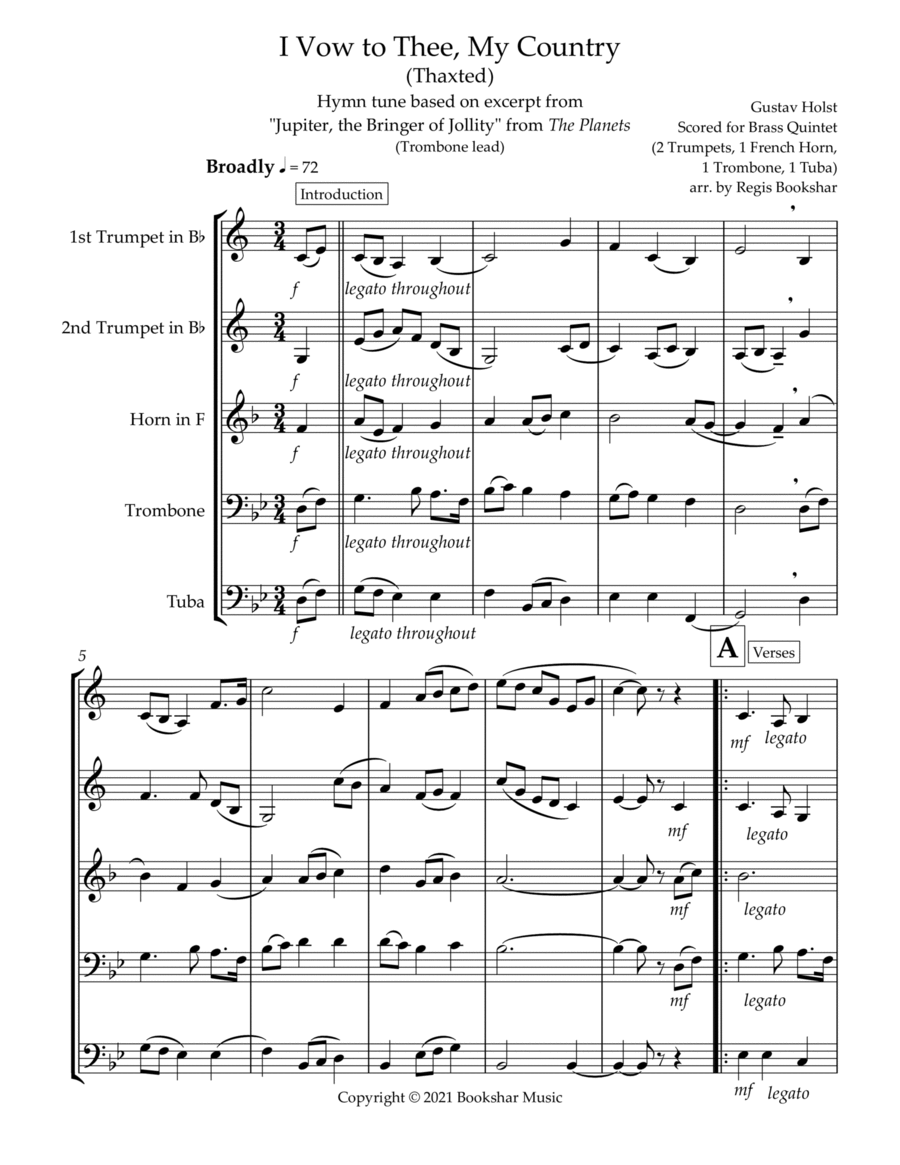
I Vow to Thee, My Country (Thaxted) (Bb) (Brass Quintet - 2 Trp, 1 Hrn, 1 Trb, 1 Tuba) (Trombone lea
Quatuor de Cuivres : 2 trompettes, trombone, tuba

$10.00 8.65 € Quatuor de Cuivres : 2 trompettes, trombone, tuba PDF SheetMusicPlus

Alto Saxophone,Instrumental Duet,Tenor Saxophone - Level 2 - Digital Download SKU: A0.1151949 Composed by Ludwig van Beethoven. Arranged by Ander. Christmas,Classical,Instructional,March,Romantic Period. 9 pages. Woods Only, Arrangements #752156. Published by Woods Only, Arrangements (A0.1151949). This arrangement adapted for sax duo was designed to make its listeners weep with emotion, because the adaptation preserves the original essence of the work, keeping its integrity faithful to what Beethoven wanted to transmit, with only a slight change in tone and addition of harmonic resources in the structure of the arrangement. Even though it is a funeral march, it is well suited for any musical performance occasion, being intended for beginner students who want to immerse themselves in the universe of romantic music, and nothing better than starting with the transitional composer of this period, which also does not prevent professional teachers from using it for recitals, academic presentations or didactic material in their classes as an ensemble practice. Ludwig van Beethoven's Piano Sonata No. 14 in C minor sharp, Op. 27, No. 2, is one of his most popular compositions and was an audience favorite even in his day. Written when Beethoven was 31, the Moonlight Sonata (Mondscheinsonate in German) was composed after he finished some commissioned works, but there is no evidence that he was hired to write this work. It did not receive its nickname until 1832, five years after Beethoven's death. It was the critic Ludwig Rellstab who compared the music to a moonlighting on Lake Lucerne. This comparison was adopted as a nickname for the work. Called Quasi una fantasia by the author - like its companion Op. 27, No. 1 - the piece was completed in 1801 and dedicated the following year to one of the composer's pupils. Beethoven chose to open the sonata with a slow, hypnotic arpeggio movement, the best known of the entire work. The dotted rhythm of its minimal melody evokes the tradition of 'Trauermusik' (funeral music).
Moonlight Sonata by Beethoven for Saxophone Duet
2 Saxophones (duo)

$3.99 3.45 € 2 Saxophones (duo) PDF SheetMusicPlus


Partitions Gratuites
Acheter des Partitions Musicales
Acheter des Partitions Digitales à Imprimer
Acheter des Instruments de Musique

© 2000 - 2026

Accueil - Version intégrale





