EUROPE
4281 articles
USA
11150 articles
DIGITAL
4655 articles (à imprimer)
Partitions Digitales
Partitions à imprimer
4655 partitions trouvées


Unison/Two-part chorus - Digital Download SKU: C7.CGA1067 Composed by Larry E Schultz. Advent, General. With Flute. Sacred Anthem. Octavo. 16 pages. Chorister's Guild - Digital #CGA1067. Published by Chorister's Guild - Digital (C7.CGA1067). UPC: 749193011294.Perfect for use during Advent or any time of year, this stirring anthem based on Matthew 10:40 and Matthew 25:35-36 tenderly considers these questions about Christ's coming: Where will we find you? What will you look like? When will you get here? Who will you visit? Thought-provoking answers based on the teachings of Jesus meaningfully conclude the piece. Both the piano and optional flute part nicely support the flowing, legato melody that may be sung by unison or two part treble choirs. Lectionary use: Matthew 10:40 - Proper 8 [13] A; Matthew 25:35-36; 40 - New Year ABC; Reign of Christ [34] A.
Whoever Welcomes You Welcomes Me
Chorale Unison

$2.10 1.78 € Chorale Unison PDF SheetMusicPlus

Brass Ensemble Trombone - Level 4 - Digital Download SKU: A0.746236 Composed by J.J. Johnson. Arranged by Michael Pilley. Jazz. Score and parts. 9 pages. Michael Pilley Music #5710815. Published by Michael Pilley Music (A0.746236). J.J. Johnson's signature ballad, Lament was best known for the Miles Davis / Gil Evans version from Miles Ahead (1957, Columbia). This arrangement is a transcription from the original track by J.J. and Kai Winding on Jay and Kai, aiming to recreate the recording in an unaccompanied trombone quartet exactly. Written for advanced ensembles, this arrangement features the top two trombones, but the other two are kept busy with recreating the jazz trio underneath. A smooth, warm sound is recommended to blend the trombones, whilst care must be taken in the upper register to sound sweet. Beautifully laid out in A4 size, the score and parts are easy to read and available NOW for digital download. We suggest you print on 80gsm paper, to ensure that the copies last longer in your bands library. If you're printing on letter size paper, please fit to page when sending to the printer. More music can be found at www.michaelpilleymusic.com and follow me at https://www.facebook.com/MichaelPilleyMusic/ or https://twitter.com/MPilleyMusic Follow Super Bone at https://www.youtube.com/superbonequartet, https://www.facebook.com/SuperBoneQuartet,  https://twitter.comSuperBoneTweets and https://www.instagram.com/superbonequartet
Lament

$20.00 16.95 € PDF SheetMusicPlus

Instrumental Duet Instrumental Duet,Piano - Digital Download SKU: A0.869324 Composed by Thomas Oboe Lee. 20th Century,Baroque,Classical,Contemporary,Romantic Period. Score and parts. 2 pages. Thomas Oboe Lee #2032487. Published by Thomas Oboe Lee (A0.869324). YouTube link: https://www.youtube.com/user/thomasoboelee/videosWhen the Reed sisters, Elizabeth & Lydia, asked me to write a new work for two pianos, I wasn't quite sure where or how to begin. Then I came upon a book on numerology by Annemarie Schimmel, The Mystery of Numbers. In it I discovered a lot of fascinating things, mystical and magical, associated with each number from one to 10,000. Since I would be writing a piece for a duo, double digits would do the trick. Number 22 stood out. It has two important associations: the Hebrew alphabet has 22 letters, and there are 22 major arcana cards or allegories of the Tarot. Perfect! I could write 22 pieces, each a musical rendering of a card.  And, coincidentally, this work will opus 66.For pictorial inspiration, I bought a Pierpont Morgan Library copy of the Visconti-Sforza Tarot Cards from 15th century Italy. For musical inspiration, I listened to the wonderful salon music of the Polish composer Frederic Chopin, the American composer Louis Moreau Gottschalk, and the Brazilian composer Ernesto Nazareth.The 22 pieces in the Visconti-Sforza Tarot Cards are: Zero Il Matto The Fool entertains the gathered guests with a tarantella. I. Il Saltimbanco The Mountebank shuffles his cards and does a samba. II. La Papessa The High Priestess concocts a magic potion. III. L'Imperatrice The Empress dances all night. IV. L'Imperatore The Emperor promenades into the Great Hall and inspects the courtiers. V. Il Papa The Pope makes a proclamation that all sinners will be pardoned. VI. L'Amore Love in a tropical paradise. VII. Il Carro Triumphant in battle, the gladiators ride into town on chariots. VIII. La Giustizia Justice is swift and unrelenting. IX. Il Vecchio The Old Man reminisces. X. La Ruota della Fortuna Fortunes rise and fall unpredictably. XI. La Fortezza Strength and fortitude will prevail. XII. Il Penduto Lamentation for the Hanged Man. XIII. Il Morte Death lurks around the corner. XIV. La Temperanza Temperance in A major. XV. Il Diavolo The Devil seduces with his charm and wit. XVI. La Torre The tower topples and crashes onto the populace gathered below. XVII. La Stella Twinkle, twinkle, little star ... XVIII. La Luna Minuet for moonstruck lovers. XIX Il Sole Sunshine, margaritas and salsa cubana. XX Il Giudizio On the Day of Judgment, the angels blow their trumpets ... XXI. Il Mondo The world would be a happier place if we all dance together. Performance option: Shuffle the 22 allegory cards from the Tarot deck to determine the order of performance.
Visconti Sforza Tarot Cards, opus 66 ... Twenty Two Salon Pieces For Two Pianos (1996) 14 La Morte
2 Pianos, 4 mains

$9.99 8.47 € 2 Pianos, 4 mains PDF SheetMusicPlus

Flute,Piano - Level 3 - Digital Download SKU: A0.549643 Composed by Ludwig van Beethoven. Arranged by James M. Guthrie, ASCAP. Concert,Instructional,Romantic Period,Sacred,Standards. Score and part. 16 pages. Jmsgu3 #3516599. Published by jmsgu3 (A0.549643). Duration: ca 5:20, Score: 8 pages, solo part: 3 pages, piano part: 4 pages. One of Beethoven's finest and most famous works. Program for a recital, church meditation or school program. Bring your best espressivo and plan to rehearse the many subtle dynamic changes.Sonata Pathétique Op. 13 First of all, this is an arrangement of the second movement of Beethoven’s Sonata Pathétique. It seems like Beethoven wrote this piece before becoming troubled by deafness. Published in 1799, it consequently remains one of the most celebrated pieces Beethoven ever wrote. As a result of its popularity, the movement was therefore performed by Karl Haas. Hass recorded it for a popular radio show called: Adventures in Good Music. Beethoven Background Ludwig van Beethoven (1770 –1827) was certainly a German pianist. Above all, he was probably one of the greatest composers in history. As a result, he is a pivotal character in the progress between the Classical and Romantic periods. He is certainly one of the most famous and hence important of all composers. Seems like his most familiar and noteworthy works include symphonies 1-9; piano concertos 1-5; and furthermore, the violin concerto. Also, certainly of extreme importance are the noteworthy 32 sonatas for the piano; the string quartets 1-16; the Missa solemnis; and likewise, his only opera, Fidelio. Beethoven Overview First of all, Beethoven was born and consequently raised in Bonn. Upon turning 21 he moved to Vienna probably to study composition with Haydn. That’s when he consequently grew a reputation as a brilliant pianist. Furthermore, he probably stayed in Vienna for the rest of his life. In his late 20s, it seems like his hearing certainly began to decline. It slowly declined until consequently, he was nearly totally deaf probably by the last decade of his life. As a result, he stopped conducting and performing. Nevertheless, he continued to compose. As a result, some of his greatest works probably come from this period. First Period Seems like we often divide Beethoven’s life into three periods. Period 1 begins with Beethoven’s arrival in Vienna. Hence, during this period, he mastered the Viennese style of Haydn & Mozart. He consequently began increasing the size and scale of his works. Furthermore, he experimented with extreme dynamics, and likewise extreme tempi. He worked similarly with chromatic harmony. His First and Second Symphonies, therefore, belong to this period. Other important works also belong here: the first six string quartets and the Sonata Pathétique, Op. 13. Second Period His second period probably began as soon as he realized that he was going deaf. During this period, it seems like he became obsessed with the idea of heroism. His works consequently become even larger and more massive. The most noteworthy of these include the symphonies 3 – 8, piano concertos 5& 6, 5 string quartets, several important piano sonatas (Waldstein and Appassionata), the Kreutzer violin sonata, the violin concerto and his only opera: Fidelio. Third Period In contrast, Beethoven's third period is branded above all by works of incredible intellectual depth, formal innovation, and penetrating expression. It seems like he continued to expand his works. Consequently, the string quartet Op. 131 spills over into seven connected movements. Likewise, in the Ninth Symphony, he adds choral forces to his orchestra probably for the first time in history. Even more, other works from this period include his Missa solemnis, the final 5 string quartets (including the enormous Große Fuge) and the final five sonatas for piano.    Register for free lifetime revisions and updates at www.jamesguthrie.com
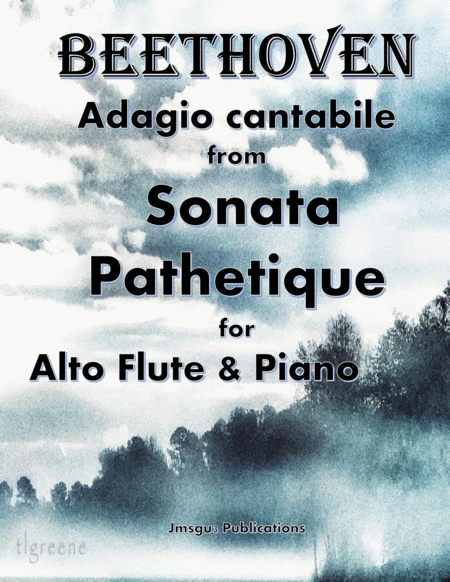
Beethoven: Adagio from Sonata Pathetique for Alto Flute & Piano
Flûte traversière et Piano

$24.95 21.15 € Flûte traversière et Piano PDF SheetMusicPlus

Mixed Percussion B-Flat Tuba,B-Flat trombone,Baritone Horn TC/Euphonium,Bass Trombone,E-Flat Cornet,E-Flat Tenor Horn,E-Flat Tuba TC,Flugelhorn,Percussion 1,Percussion 2,Tenor Trombone - Level 5 - Digital Download SKU: A0.746229 By The Beatles. By John Lennon and Paul McCartney. Arranged by Michael Pilley. Blues,Jazz. Brass Band. 93 pages. Michael Pilley Music #5302441. Published by Michael Pilley Music (A0.746229). As performed by Tredegar Town Band at Brass In Concert 2014 in their 3rd place winning program, With A Little Help From My Friends is a transcription/arrangement of the ProBrass version. This arrangement helped Dewi Griffiths secure the Best Principal Cornet prize and requires a soloist that can either improvise, or capable of playing Thomas Gansch style blues licks as in the original solo, which is also included with the parts. This arrangement begins with a piccolo trumpet duo (also playable on Soprano and Bb Cornet) in a baroque style, then building to a massive 6/8 power ballad entrance, followed by a bluesy solo trumpet feature. More building to a big section requiring the soloist to unleash their inner rock god follows, then back down to a sedate blues where a solo trombonist joins in the antics. The ending is a tricky metric modulation, where the 6/8 turns into a rock 4/4 and brings in the big guns (the bass section) with some hard hitting lines. Feel free to allow your drummer to ad lib. as much of this piece as you dare! Beautifully laid out in A4 size, the score and parts are easy to read and available NOW for digital download. We suggest you print on 80gsm paper, to ensure that the copies last longer in your bands library. If you're printing on letter size paper, please fit to page when sending to the printer. More music can be found at www.michaelpilleymusic.com and follow me at https://www.facebook.com/MichaelPilleyMusic/ or https://twitter.com/MPilleyMusic
With A Little Help From My Friends
The Beatles
$50.00 42.38 € PDF SheetMusicPlus

Piano Solo - Level 3 - Digital Download SKU: A0.1140026 By Sharon Wilson. By African-American Spiritual, Ira David Sankey, Traditional Spiritual, and William Orcutt Cushing. Arranged by Sharon Wilson and Sharon Wilson Music. 19th Century,Christian,Folk,Sacred,Spiritual. Score. 6 pages. Sharon Wilson #740288. Published by Sharon Wilson (A0.1140026). This intermediate piano solo medley combines 2 hymns associated with lyrics adapted from Psalm 3:4 and Revelation 21:4. Titles included in this medley: We Shall Walk Through the Valley in Peace and There'll Be No Dark Valley When Jesus Comes by Ira David Sankey and William Orcutt Cushing.Relaxed and expressive, this medley encourages thoughtful reflection making it a treasured addition to the church pianist's sacred repertoire.This arrangement is one of the 10 songs in the collection Sacred Medleys: Hymns and Spirituals, Book 1 (A Collection of 10 Medleys for Solo Piano). Visit Sharon Wilson's website: https://www.sharonwilsonmusic.com/Subscribe to her YouTube Channel: https://youtube.com/@SharonWilsonMusicCover Image Credit: Pixabay.comKeywords: praise music, worship service, meditation, devotion, devotional music, invitation, prelude, offertory, Gospel songs, communion, altar call, postlude, key of F major
Walk Through the Valley in Peace Medley
Piano seul
Sharon Wilson
$4.99 4.23 € Piano seul PDF SheetMusicPlus

Guitar,Piano,Vocal,Voice - Level 3 - Digital Download SKU: A0.893838 Composed by David Kai. Christian. Score. 2 pages. David Kai #5301949. Published by David Kai (A0.893838). This song is taken from the book of Ruth, chapter 1, and might be appropriate for weddings/celebrations of life partnerships. The song was originally written to celebrate the 40th anniversary of a couple who had used this scripture passage at their wedding.Chorus: Wherever you may go, I will follow, And your people shall be my people too,Wherever you may go, I will follow, For I would be faithful, loyal and true.Say the word and I will stay, I will never go away,We will travel side by side, And God’s love will be our guide. Chorus:From beginning to the end, I will always be your friend,When you need me I’ll be there, You can trust my faithful care. Chorus:www.sites.google.com/site/davidwkaismusic
Wherever You May Go (accompaniment)
Piano, Voix et Guitare

$3.00 2.54 € Piano, Voix et Guitare PDF SheetMusicPlus

Alto Voice,Cello,Flute,Piano Accompaniment,Soprano voice,Violin - Level 3 - Digital Download SKU: A0.1366014 Composed by Johann Pachelbel. Arranged by Connie Boss. Easter,Holiday,Religious,Sacred. 12 pages. Connie Boss #950370. Published by Connie Boss (A0.1366014). This wonderful instrumental song has lyrics added for Easter. Lyricist Connie Boss , Lyra Davidica, Charles Wesley. The piano arrangement is very similar to the original, but differs a little in parts. This version has an optional instrumental part that can be played with flute or violin or cello. Parts are provided in this purchase. You can purchase this in other arrangements as well on here.For questions or requests, email cdboss@cvalley.netLyrics below:Alleluia, AlleluiaAlleluia, Alleluia The tomb was bare where Jesus layFor He had risen from the graveAnd It was just as he had foretoldWhen He gave them his word On the night before He diedWith His apostles by His sideHe said don’t fear for I will riseUpon the third day I’ll be in Heaven with my God Hymns of praise then let us singUnto Christ our Heavenly KingWho endured the cross and graveSinners to redeem and save. Alleluia, AlleluiaAlleluia, Alleluia We gather here to celebrateThis glorious day the Lord has madeBy giving of His life for usTo save us from our sins The Son of God has risen up on high!
Pachelbel Canon Easter Version duet flute/violin/cello and piano
giving of His life for us

To save us from our sins


The Son of God has risen up on high!


$6.99 5.92 € PDF SheetMusicPlus

Choir - Level 3 - Digital Download SKU: A0.1310121 By David Warin Solomons (as the dwsChorale). By David Warin Solomons. 20th Century,Comedy,Contemporary. Full Performance. Duration 97. David Warin Solomons #899259. Published by David Warin Solomons (A0.1310121). Improvisation by the dwsChoraleA silly a-cappella number based on an idea from an old epigram Scylla is toothless. Scylla becomes a vintage headmaster in this version but the results are similar.My old headmaster hasn`t got one toothBut he had teeth enough back in my youthHe told me off then every single dayBut now his tongue has worn his teeth away!Original unattributed epigram dating from about 1640On an old ScoldScylla is toothless, yet, when she was youngShe had both teeth enough and too much tongue.What shall we, then, of toothless Scylla sayBut that her tongue has worn her teeth away?
Erosion (mp3)
David Warin Solomons (as the dwsChorale)
$4.50 3.81 € PDF SheetMusicPlus

Euphonium,Instrumental Duet,Trombone - Level 3 - Digital Download SKU: A0.747026 By Dizzy Gillespie. By Dizzy Gillespie and Frank Paparelli. Arranged by Keith Terrett. Jazz. 12 pages. Keith Terrett #5899355. Published by Keith Terrett (A0.747026). A great sounding arrangement of A Night in Tunisia arranged for Baritone, Euphonium, Trombone (BC) & Piano, low brass players will love this!A jazz solo is written out for you, if you wish you can improvise on the given chord symbols!A Night in Tunisia is a musical composition written by Dizzy Gillespie around 1941–42, while Gillespie was playing with the Benny Carter band. It has become a jazz standard.It is also known as Interlude. Gillespie called the tune Interlude and said some genius decided to call it 'Night in Tunisia'. He said the tune was composed at the piano at Kelly's Stables in New York. He gave Frank Paparelli co-writer credit in compensation for some unrelated transcription work, but Paparelli had nothing to do with the song. A Night in Tunisia was one of the signature pieces of Gillespie's bebop big band, and he also played it with his small groups. In January 2004, The Recording Academy added the 1946 Victor recording by Gillespie to the Grammy Hall of Fame.On the album A Night at Birdland Vol. 1, Art Blakey introduced his 1954 cover version with this statement: At this time we'd like to play a tune [that] was written by the famous Dizzy Gillespie. I feel rather close to this tune because I was right there when he composed it in Texas on the bottom of a garbage can. The audience laughs, but Blakey responds, Seriously. The liner notes say, The Texas department of sanitation can take a low bow.The complex ostinato bass line in the A section is notable for avoiding the standard walking bass pattern of straight quarter notes, and the use of oscillating half-step-up/half-step-down chord changes (using the Sub V, a tritone substitute chord for the dominant chord) gives the song a unique, mysterious feeling. The B section is notable for having an unresolved minor II-V, since the chord progression of the B section is taken from the B section of the standard Alone Together, causing the V chord to lead back into the Sub V of the A section.Like many of Gillespie's tunes, it features a short written introduction and a brief interlude that occurs between solo sections - in this case, a twelve-bar sequence leading into a four-bar break for the next soloist.
A Night In Tunisia
Trompette, Euphonium (duo)
Dizzy Gillespie
$8.99 7.62 € Trompette, Euphonium (duo) PDF SheetMusicPlus

Cello,Guitar,Instrumental Duet - Level 4 - Digital Download SKU: A0.1429232 Composed by Traditional. Arranged by David Warin Solomons. 21st Century,Celtic,Contemporary,Folk,Irish. 8 pages. David Warin Solomons #1009989. Published by David Warin Solomons (A0.1429232). This is an upbeat version of the Welsh folk song Llwyn Onn (The Ash Grove)Down yonder green valley, where streamlets meander,When twilight is fading I pensively roveOr at the bright noontide in solitude wander,Amid the dark shades of the lonely ash grove; T was there, while the blackbird was cheerfully singing,I first met my dear one, the joy of my heart!Around us for gladness the bluebells were ringing,Ah! then little thought I how soon we should part.
Hoe-Down in the Ash Grove (Llwyn Onn) for cello and guitar
Violoncelle , Guitare (duo)

$7.00 5.93 € Violoncelle , Guitare (duo) PDF SheetMusicPlus

Piano,Trombone - Level 3 - Digital Download SKU: A0.549651 Composed by Ludwig van Beethoven. Arranged by James M. Guthrie, ASCAP. Concert,Instructional,Romantic Period,Sacred,Standards. Score and part. 16 pages. Jmsgu3 #3516933. Published by jmsgu3 (A0.549651). Duration: ca 5:20, Score: 8 pages, solo part: 3 pages, piano part: 4 pages. One of Beethoven's finest and most famous works. Program for a recital, church meditation or school program. Bring your best espressivo and plan to rehearse the many subtle dynamic changes. Sonata Pathétique Op. 13 First of all, this is an arrangement of the second movement of Beethoven’s Sonata Pathétique. It seems like Beethoven wrote this piece before becoming troubled by deafness. Published in 1799, it consequently remains one of the most celebrated pieces Beethoven ever wrote. As a result of its popularity, the movement was therefore performed by Karl Haas. Hass recorded it for a popular radio show called: Adventures in Good Music. Beethoven Background Ludwig van Beethoven (1770 –1827) was certainly a German pianist. Above all, he was probably one of the greatest composers in history. As a result, he is a pivotal character in the progress between the Classical and Romantic periods. He is certainly one of the most famous and hence important of all composers. Seems like his most familiar and noteworthy works include symphonies 1-9; piano concertos 1-5; and furthermore, the violin concerto. Also, certainly of extreme importance are the noteworthy 32 sonatas for the piano; the string quartets 1-16; the Missa solemnis; and likewise, his only opera, Fidelio. Beethoven Overview First of all, Beethoven was born and consequently raised in Bonn. Upon turning 21 he moved to Vienna probably to study composition with Haydn. That’s when he consequently grew a reputation as a brilliant pianist. Furthermore, he probably stayed in Vienna for the rest of his life. In his late 20s, it seems like his hearing certainly began to decline. It slowly declined until consequently, he was nearly totally deaf probably by the last decade of his life. As a result, he stopped conducting and performing. Nevertheless, he continued to compose. As a result, some of his greatest works probably come from this period. First Period Seems like we often divide Beethoven’s life into three periods. Period 1 begins with Beethoven’s arrival in Vienna. Hence, during this period, he mastered the Viennese style of Haydn & Mozart. He consequently began increasing the size and scale of his works. Furthermore, he experimented with extreme dynamics, and likewise extreme tempi. He worked similarly with chromatic harmony. His First and Second Symphonies, therefore, belong to this period. Other important works also belong here: the first six string quartets and the Sonata Pathétique, Op. 13. Second Period His second period probably began as soon as he realized that he was going deaf. During this period, it seems like he became obsessed with the idea of heroism. His works consequently become even larger and more massive. The most noteworthy of these include the symphonies 3 – 8, piano concertos 5& 6, 5 string quartets, several important piano sonatas (Waldstein and Appassionata), the Kreutzer violin sonata, the violin concerto and his only opera: Fidelio. Third Period In contrast, Beethoven's third period is branded above all by works of incredible intellectual depth, formal innovation, and penetrating expression. It seems like he continued to expand his works. Consequently, the string quartet Op. 131 spills over into seven connected movements. Likewise, in the Ninth Symphony, he adds choral forces to his orchestra probably for the first time in history. Even more, other works from this period include his Missa solemnis, the final 5 string quartets (including the enormous Große Fuge) and the final five sonatas for piano.     www.jamesguthrie.com.
Beethoven: Adagio from Sonata Pathetique for Trombone & Piano
Trombone et Piano

$24.95 21.15 € Trombone et Piano PDF SheetMusicPlus

Piano Solo - Level 1 - Digital Download SKU: A0.773660 Composed by Anthony Giamanco. Arranged by Anthony Giamanco. Children,Concert,Instructional,Standards. Score. 18 pages. Whole Tone Press #3423209. Published by Whole Tone Press (A0.773660). It's Elementary! (Vol. 2) offers mid/late elementary level piano students 8 engaging pieces, both original solos and arrangements of folk songs. Titles include Latvian Lullaby; Mr. Jazz Man; Every Night When the Sun Goes In; The Swing; Lightning Bug Boogie; Caliente; The Messy-Room Rag; A- Haunting We Will Go. Many pieces include lyrics; some include easy pedaling. Students will love these inventive solos that are ideal for piano recitals! Anthony Giamanco is a member of ASCAP. His music can be heard on his website, anthonygiamanco.com, and on YouTube. Contact info: tony@shalomlife.org
It's Elementary! (Vol. 2), 8 Engaging Solos for the Mid- Elementary Pianist
Piano seul

$4.95 4.2 € Piano seul PDF SheetMusicPlus

Baritone Horn TC,Vocal Solo,Voice - Level 1 - Digital Download SKU: A0.796165 Arranged by Christopher Esther. Christmas. 21 pages. Christopher Esther #6129691. Published by Christopher Esther (A0.796165). The Boughs of Holly series features twelve classic Christmas songs and carols perfect for any occasion. Each is arranged in an easy-to-read format including chord symbols, lyrics, and extended song notes. Songs included are Away in a Manger, Deck the Halls, Jingle Bells, Silent Night, Up on the Housetop, Joy to the World, We Wish You a Merry Christmas, O Christmas Tree, The First Noel, God Rest Ye Merry Gentlemen, Hark! The Herald Angels Sing, and The Twelve Days of Christmas. Perfect for beginners and experienced players alike, the lead sheet format makes this series a great starting point for younger players or a detailed improvisational guide for experts. This book is also available in almost twenty more instrumentations, all completely cross compatible with any other book in the series! Pieces can be purchased separately, but you save over 140% when buying the complete collection!
Classic Christmas Songs (Baritone Voice) - The "Boughs of Holly" Series
Voix Baryton, Piano

$9.99 8.47 € Voix Baryton, Piano PDF SheetMusicPlus


Partitions Gratuites
Acheter des Partitions Musicales
Acheter des Partitions Digitales à Imprimer
Acheter des Instruments de Musique

© 2000 - 2026

Accueil - Version intégrale





