EUROPE
4281 articles
USA
11150 articles
DIGITAL
4655 articles (à imprimer)
Partitions Digitales
Partitions à imprimer
4655 partitions trouvées


Alto Saxophone,Piano - Level 3 - Digital Download SKU: A0.549639 Composed by Ludwig van Beethoven. Arranged by James M. Guthrie, ASCAP. Concert,Instructional,Romantic Period,Sacred,Standards. Score and part. 16 pages. Jmsgu3 #3516567. Published by jmsgu3 (A0.549639). Duration: ca 5:20, Score: 8 pages, solo part: 3 pages, piano part: 4 pages.One of Beethoven's finest and most famous works. Program for a recital, church meditation or school program.Bring your best espressivo and plan to rehearse the many subtle dynamic changes.Sonata Pathétique Op. 13 First of all, this is an arrangement of the second movement of Beethoven’s Sonata Pathétique. It seems like Beethoven wrote this piece before becoming troubled by deafness. Published in 1799, it consequently remains one of the most celebrated pieces Beethoven ever wrote. As a result of its popularity, the movement was therefore performed by Karl Haas. Hass recorded it for a popular radio show called: Adventures in Good Music. Beethoven Background Ludwig van Beethoven (1770 –1827) was certainly a German pianist. Above all, he was probably one of the greatest composers in history. As a result, he is a pivotal character in the progress between the Classical and Romantic periods. He is certainly one of the most famous and hence important of all composers. Seems like his most familiar and noteworthy works include symphonies 1-9; piano concertos 1-5; and furthermore, the violin concerto. Also, certainly of extreme importance are the noteworthy 32 sonatas for the piano; the string quartets 1-16; the Missa solemnis; and likewise, his only opera, Fidelio. Beethoven Overview First of all, Beethoven was born and consequently raised in Bonn. Upon turning 21 he moved to Vienna probably to study composition with Haydn. That’s when he consequently grew a reputation as a brilliant pianist. Furthermore, he probably stayed in Vienna for the rest of his life. In his late 20s, it seems like his hearing certainly began to decline. It slowly declined until consequently, he was nearly totally deaf probably by the last decade of his life. As a result, he stopped conducting and performing. Nevertheless, he continued to compose. As a result, some of his greatest works probably come from this period. First Period Seems like we often divide Beethoven’s life into three periods. Period 1 begins with Beethoven’s arrival in Vienna. Hence, during this period, he mastered the Viennese style of Haydn & Mozart. He consequently began increasing the size and scale of his works. Furthermore, he experimented with extreme dynamics, and likewise extreme tempi. He worked similarly with chromatic harmony. His First and Second Symphonies, therefore, belong to this period. Other important works also belong here: the first six string quartets and the Sonata Pathétique, Op. 13. Second Period His second period probably began as soon as he realized that he was going deaf. During this period, it seems like he became obsessed with the idea of heroism. His works consequently become even larger and more massive. The most noteworthy of these include the symphonies 3 – 8, piano concertos 5& 6, 5 string quartets, several important piano sonatas (Waldstein and Appassionata), the Kreutzer violin sonata, the violin concerto and his only opera: Fidelio. Third Period In contrast, Beethoven's third period is branded above all by works of incredible intellectual depth, formal innovation, and penetrating expression. It seems like he continued to expand his works. Consequently, the string quartet Op. 131 spills over into seven connected movements. Likewise, in the Ninth Symphony, he adds choral forces to his orchestra probably for the first time in history. Even more, other works from this period include his Missa solemnis, the final 5 string quartets (including the enormous Große Fuge) and the final five sonatas for piano.    Register for free lifetime revisions and updates at www.jamesguthrie.co.
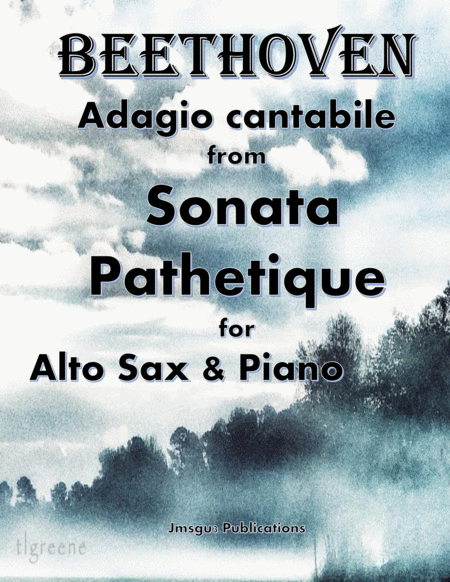
Beethoven: Adagio from Sonata Pathetique for Alto Sax & Piano
Saxophone Alto et Piano

$24.95 21.11 € Saxophone Alto et Piano PDF SheetMusicPlus

Concert Band - Digital Download SKU: AX.00-PC-0014550_WPTBETC (wp) E-flat Tuba T.C.. Composed by Robert Sheldon. Instructional. World Part. 1 pages. Alfred Music - Digital Sheet Music #00-PC-0014550_wpTBETC. Published by Alfred Music - Digital Sheet Music (AX.00-PC-0014550_WPTBETC). UPC: 038081394732.This gentle piece reminds us of the wistful and whimsical feelings we have when looking into a snow globe. The soaring melodies and colorful accompaniments recall the warm memories of friends and family during the holiday season. Snow Globe is sure to provide a special moment for your audience on your young band's next holiday program. (2:09) This title is available in SmartMusic. Correlates to Sound Innovations for Concert Band, Book 1 Level 6.
Snow Globe: (wp) E-flat Tuba T.C.
Orchestre d'harmonie

$3.00 2.54 € Orchestre d'harmonie PDF SheetMusicPlus

Solo, SSAA choir, and piano, with optional strings - Moderately Easy - Digital Download SKU: MQ.56-0020-E Composed by Howard Goodall. Instrument parts. 11 pages. MorningStar Music Publishers - Digital Sheet Music #56-0020-E. Published by MorningStar Music Publishers - Digital Sheet Music (MQ.56-0020-E). English.For SSAA voices with a soloist (to which voices add gradually,) the text is as if someone is speaking to their long-dead ancestors. They granted a gift of life and hope for those who came after. Their “names and faiths survive.†And just as those in the past were faced with decisions and made them for the benefit of those who follow, we now have the same responsibility. The music is mostly in unison and remains on one staff even when it divides into multiple parts (which it does in only 14 of the 89 measures). This is a singable piece with an easy but supportive piano part, which could be useful for many ensembles in many situations.
A Song of Hope (Downloadable)

$3.15 2.66 € PDF SheetMusicPlus

Full Orchestra - Level 3 - Digital Download SKU: A0.976734 Composed by Robert Myers. 20th Century,Christmas,Contemporary. Score and parts. 99 pages. WheatMyer Music #6496769. Published by WheatMyer Music (A0.976734). CONJUNCTION interprets the convergence of Jupiter and Saturn near the end of the year 2020 as a celestial metaphor for the good news of Christ's birth in a replay of the Star of Bethlehem. Hence, its subtitle of The Christmas Star of 2020. The music, along with narration from selected Old and New Testament scriptures, delivers a message of hope amid the turmoil and chaos of current times.It's written for smaller concert bands hungry for challenging music. Ample cues and doubling allow for flexible instrumentation while mixed meters, varying tempos and textures, and interesting solo lines provide opportunities for strong players to shine. CONJUNCTION is also available with strings for orchestra.PROGRAM NOTES:2020 is widely characterized for its maladies: murders, burning cities, riots, a pandemic, economic shocks, and political turmoil. For some of us, it also held personal tragedy such as my brother’s passing from COVID. But, 2020 also brought a sign of hope, namely the celestial phenomenon known as the Great Conjunction of 2020. For earth-bound observers, this was the closest approach of Jupiter and Saturn in almost 400 years as they appeared to almost touch in the early evening sky to produce the most brilliant evening star of our lifetimes. The occurrence of the event in November-December neatly coincided with the Advent season, peaking just before Christmas Day. One could hardly fail to note the parallels with the Christmas star of Matthew’s gospel which gave the conjunction its alternate name, the Christmas Star of 2020. Thus, this star spoke, to those with ears to hear, the same message the prophet Isaiah wrote about the coming Messiah, The people that walked in darkness have seen a great light. This star thus served to remind us that the LORD has not rejected us; He will show His favor again; His love has not vanished; His promises have not failed; He has not forgotten to be merciful or compassionate; and we are called to remember His mighty deeds (Psalm 77). CONJUNCTION: The Christmas Star of 2020 is inspired by these particulars.For the music, I looked to Gustav Holst’s The Planets for themes that would portray Jupiter and Saturn’s pas de deux. I selected several motives from the corresponding movements mixed and matched in sometimes easily recognized quotations and other times in heavily camouflaged derivations. An exuberant polyphonic passage recaps themes from both Jupiter and Saturn when the music resolves from uncertainty into hopefulness. While Holst’s motives provide CONJUNCTION’s foundation I also used Handel’s Messiah for transitory and climactic material. You will hear his The people who walked in darkness have seen a great light in transitions and a short trombone solo. And a re-harmonization of the opening line from For unto us a child is born brings the music to a joyous climax.Although the music stands firmly on its own, I elected to incorporate some narrative to make the musical sentiment explicit. In a commentary on 2020’s grim events, I took adaptations of Habakkuk 1:2-4 and 2 Tim 3:1-4 and set them over Saturn’s plodding and ominous harmonies. Contrasting replies shimmer with hope as the narration melds Isaiah 9:2 and Luke 1:78-79 over another Saturn motive set against pitch sets from Jupiter’s main hymn theme. Still, it’s the music that tells the story of the Christmas Star of 2020.Please visit my website for a complete score preview: https://wheatmyermusic.com/conjunction-the-christmas-star-of-2020I feel somewhat guilty making claim to this music as almost all the building blocks are taken from other composers. But the end result is neither a medley, nor an arrangement, rather it is something clearly new, so I call it my own with deep respect to those giants on whose shoulders I stand.Robert MyersS.D.G.
CONJUNCTION: The Christmas Star of 2020
Orchestre

$95.00 80.37 € Orchestre PDF SheetMusicPlus

Brass Ensemble - Level 4 - Digital Download SKU: A0.1123447 Composed by Nathan Grocholski. Classical,Contemporary. Score and parts. 65 pages. Nathan Grocholski #724258. Published by Nathan Grocholski (A0.1123447). The basis of this piece was centered around the complex emotions of cats in which we observe in our every day lives. With regards to this piece especially, there were three cats that I based this composition on, and their names are Storm, Zany and Tremor. Each miniature is a representation of a certain type of emotion that each of these cats is known for expressing. The first movement is for my favorite cat, Storm, and is titled, “Precious Storm.†Going back to my earliest memories of writing songs, I re-translated an old tune that I used to sing into a brass quintet miniature and dedicated to him, for he is the best cat. The second miniature is titled, “Mouse on a String,†and is supposed to portray the same energy that one would see from a cat in chase of a toy mouse being constantly propelled around the air from one end of a string, which is one of Storm’s favorite things to do. The third movement is called “Zany the Scaredy-Cat,†which is exactly the type of cat that Zany is. Always fearful and skittish, Zany sneaks around the house to avoid human contact at all costs. The fourth movement is titled “You Stuck, Zany?†This is named after a short video clip in which Zany finds herself stuck in the fireplace and struggling to get out. Once she frees herself, she runs away as fast as she can. The fifth movement is called “Passive-Aggressive Tremor†for the final cat, Tremor. Tremor likes to instigate conflicts with the other cats, but once the tension arises, he backs away, which can also be heard within the intense build ups and anti-climatic drops within the music as well. Finally, the sixth movement is called, “King Tremor,†in which is the boldest sounding of all the pieces, for when it does come to conflict, it is usually Tremor who comes out on top, outsmarting the other two cats.
The Duality of Cats
Ensemble de cuivres

$5.00 4.23 € Ensemble de cuivres PDF SheetMusicPlus

Instrumental Duet Instrumental Duet,Piano - Digital Download SKU: A0.869320 Composed by Thomas Oboe Lee. 20th Century,Baroque,Classical,Contemporary,Romantic Period. Score and parts. 5 pages. Thomas Oboe Lee #2032481. Published by Thomas Oboe Lee (A0.869320). YouTube link: https://www.youtube.com/user/thomasoboelee/videosWhen the Reed sisters, Elizabeth & Lydia, asked me to write a new work for two pianos, I wasn't quite sure where or how to begin. Then I came upon a book on numerology by Annemarie Schimmel, The Mystery of Numbers. In it I discovered a lot of fascinating things, mystical and magical, associated with each number from one to 10,000. Since I would be writing a piece for a duo, double digits would do the trick. Number 22 stood out. It has two important associations: the Hebrew alphabet has 22 letters, and there are 22 major arcana cards or allegories of the Tarot. Perfect! I could write 22 pieces, each a musical rendering of a card.  And, coincidentally, this work will opus 66.For pictorial inspiration, I bought a Pierpont Morgan Library copy of the Visconti-Sforza Tarot Cards from 15th century Italy. For musical inspiration, I listened to the wonderful salon music of the Polish composer Frederic Chopin, the American composer Louis Moreau Gottschalk, and the Brazilian composer Ernesto Nazareth.The 22 pieces in the Visconti-Sforza Tarot Cards are: Zero Il Matto The Fool entertains the gathered guests with a tarantella. I. Il Saltimbanco The Mountebank shuffles his cards and does a samba. II. La Papessa The High Priestess concocts a magic potion. III. L'Imperatrice The Empress dances all night. IV. L'Imperatore The Emperor promenades into the Great Hall and inspects the courtiers. V. Il Papa The Pope makes a proclamation that all sinners will be pardoned. VI. L'Amore Love in a tropical paradise. VII. Il Carro Triumphant in battle, the gladiators ride into town on chariots. VIII. La Giustizia Justice is swift and unrelenting. IX. Il Vecchio The Old Man reminisces. X. La Ruota della Fortuna Fortunes rise and fall unpredictably. XI. La Fortezza Strength and fortitude will prevail. XII. Il Penduto Lamentation for the Hanged Man. XIII. Il Morte Death lurks around the corner. XIV. La Temperanza Temperance in A major. XV. Il Diavolo The Devil seduces with his charm and wit. XVI. La Torre The tower topples and crashes onto the populace gathered below. XVII. La Stella Twinkle, twinkle, little star ... XVIII. La Luna Minuet for moonstruck lovers. XIX Il Sole Sunshine, margaritas and salsa cubana. XX Il Giudizio On the Day of Judgment, the angels blow their trumpets ... XXI. Il Mondo The world would be a happier place if we all dance together. Performance option: Shuffle the 22 allegory cards from the Tarot deck to determine the order of performance.
Visconti Sforza Tarot Cards, opus 66 ... Twenty Two Salon Pieces For Two Pianos (1996) 09 La Giustiz
2 Pianos, 4 mains

$9.99 8.45 € 2 Pianos, 4 mains PDF SheetMusicPlus

Instrumental Duet Instrumental Duet,Piano - Digital Download SKU: A0.869319 Composed by Thomas Oboe Lee. 20th Century,Baroque,Classical,Contemporary,Romantic Period. Score and parts. 5 pages. Thomas Oboe Lee #2032489. Published by Thomas Oboe Lee (A0.869319). YouTube link: https://www.youtube.com/user/thomasoboelee/videosWhen the Reed sisters, Elizabeth & Lydia, asked me to write a new work for two pianos, I wasn't quite sure where or how to begin. Then I came upon a book on numerology by Annemarie Schimmel, The Mystery of Numbers. In it I discovered a lot of fascinating things, mystical and magical, associated with each number from one to 10,000. Since I would be writing a piece for a duo, double digits would do the trick. Number 22 stood out. It has two important associations: the Hebrew alphabet has 22 letters, and there are 22 major arcana cards or allegories of the Tarot. Perfect! I could write 22 pieces, each a musical rendering of a card.  And, coincidentally, this work will opus 66.For pictorial inspiration, I bought a Pierpont Morgan Library copy of the Visconti-Sforza Tarot Cards from 15th century Italy. For musical inspiration, I listened to the wonderful salon music of the Polish composer Frederic Chopin, the American composer Louis Moreau Gottschalk, and the Brazilian composer Ernesto Nazareth.The 22 pieces in the Visconti-Sforza Tarot Cards are: Zero Il Matto The Fool entertains the gathered guests with a tarantella. I. Il Saltimbanco The Mountebank shuffles his cards and does a samba. II. La Papessa The High Priestess concocts a magic potion. III. L'Imperatrice The Empress dances all night. IV. L'Imperatore The Emperor promenades into the Great Hall and inspects the courtiers. V. Il Papa The Pope makes a proclamation that all sinners will be pardoned. VI. L'Amore Love in a tropical paradise. VII. Il Carro Triumphant in battle, the gladiators ride into town on chariots. VIII. La Giustizia Justice is swift and unrelenting. IX. Il Vecchio The Old Man reminisces. X. La Ruota della Fortuna Fortunes rise and fall unpredictably. XI. La Fortezza Strength and fortitude will prevail. XII. Il Penduto Lamentation for the Hanged Man. XIII. Il Morte Death lurks around the corner. XIV. La Temperanza Temperance in A major. XV. Il Diavolo The Devil seduces with his charm and wit. XVI. La Torre The tower topples and crashes onto the populace gathered below. XVII. La Stella Twinkle, twinkle, little star ... XVIII. La Luna Minuet for moonstruck lovers. XIX Il Sole Sunshine, margaritas and salsa cubana. XX Il Giudizio On the Day of Judgment, the angels blow their trumpets ... XXI. Il Mondo The world would be a happier place if we all dance together. Performance option: Shuffle the 22 allegory cards from the Tarot deck to determine the order of performance.
Visconti Sforza Tarot Cards, opus 66 ... Twenty Two Salon Pieces For Two Pianos (1996) 08 Il Carro
2 Pianos, 4 mains

$9.99 8.45 € 2 Pianos, 4 mains PDF SheetMusicPlus

Clarinet Trio,Woodwind Ensemble Clarinet - Level 3 - Digital Download SKU: A0.1202419 By Masakazu YAMAMOTO. By Traditional / English folk song. Arranged by Masakazu YAMAMOTO. Christmas,Folk,Multicultural,Pop,Traditional,World. 9 pages. Motch Music #801111. Published by Motch Music (A0.1202419). This arrangement is for clarinet trio. When you purchase it, you get full score and each part score.Arrangement of the English folk song Green Sleeves, with an indifferent sense of tempo. Also, the harmony of jazz that matches the song is used abundantly.Please sing the flow of 4 bars carefully and aim for a cool and fashionable performance.(arr. Masakazu YAMAMOTO)[Instrumentation] Clarinet in Bb 1 Clarinet in Bb 2 Clarinet in Bb 3 Works For Ensemble Original Composition (Sheet Music Plus / Sheet Music Direct)​ Arrangement (Sheet Music Plus / Sheet Music Direct)→Christmas Arrangement (Sheet Music Plus / Sheet Music Direct) ----------------------------------------------------- Motch Music All Sheet Music (Sheet Music Plus / Sheet Music Direct)I have a wide selection of sheet music for various instruments such as piano, ensemble, and concert band. From light and enjoyable pieces to concert-level compositions, we cover a wide range of repertoire. I also provide a rich collection of audio preview.In addition to original compositions and unique arrangements, a lot of text on music analysis is well-received. Please take a look below for more information!Motch Music Web Pagehttps://www.masakazuyamamoto.com/english  
Greensleeves [Clarinet Trio]
3 Clarinettes (trio)
Masakazu YAMAMOTO
$16.50 13.96 € 3 Clarinettes (trio) PDF SheetMusicPlus

Jazz Ensemble Jazz Ensemble - Level 3 - Digital Download SKU: A0.746235 By Stevie Wonder. By Richard Rodgers. Arranged by Michael Pilley. Jazz. Score and parts. 77 pages. Michael Pilley Music #5453455. Published by Michael Pilley Music (A0.746235). The first track on The Temptations in a Mellow Mood, an album released as a crossover to white audiences, this classic Rodgers & Hammerstein tune is a great example of The Temptations close harmony skills. This is an arrangement for Big Band with Solo Male Vocal and TTBB, playable by intermediate ensembles and transcribed note for note from the recording. Starting in a Latin style reminiscent of Manteca, this arrangement is mainly in a big band swing style and briefly transitions to a jazz waltz in the middle section. Due to the vocals being featured, the horns are used sparsely and there are few sections where extended rehearsal is needed. Although the album itself doesn't break down who arranged this initially, it more than likely is an Oliver Nelson creation. Beautifully laid out in A4 size, the score and parts are easy to read and available NOW for digital download. We suggest you print on 80gsm paper, to ensure that the copies last longer in your bands library. If you're printing on letter size paper, please fit to page when sending to the printer. More music can be found at www.michaelpilleymusic.com and follow me at https://www.facebook.com/MichaelPilleyMusic/ or https://twitter.com/MPilleyMusic
Hello, Young Lovers
Ensemble Jazz
Stevie Wonder
$50.00 42.3 € Ensemble Jazz PDF SheetMusicPlus

Oboe,Piano - Level 3 - Digital Download SKU: A0.1449268 Composed by Traditional. Arranged by David Warin Solomons. Multicultural,Traditional,World. Score and part. 6 pages. David Warin Solomons #1029041. Published by David Warin Solomons (A0.1449268). This is an upbeat version of the Welsh folk song Llwyn Onn (The Ash Grove)Down yonder green valley, where streamlets meander,When twilight is fading I pensively roveOr at the bright noontide in solitude wander,Amid the dark shades of the lonely ash grove; T was there, while the blackbird was cheerfully singing,I first met my dear one, the joy of my heart!Around us for gladness the bluebells were ringing,Ah! then little thought I how soon we should part.The pdf file contains score and parts.
Hoe-down in the Ash Grove (after Llwyn Onn) for oboe and piano
Hautbois, Piano (duo)

$5.50 4.65 € Hautbois, Piano (duo) PDF SheetMusicPlus

Instrumental Duet Alto Saxophone,Instrumental Duet,Tenor Saxophone - Level 3 - Digital Download SKU: A0.588423 Composed by David McKeown. Concert,Latin,Standards,World. Score and parts. 7 pages. David McKeown #5741741. Published by David McKeown (A0.588423). Mambo de Maya is an exciting original composition by David McKeown, arranged as a duet for one Alto and one tenor Saxophone.This duet is based on the fast, traditional Latin style of Mambo that emerged in Cuba in the 1930s. Later, when Mambo and its dance steps spread to Mexico and New York, hugely successful band leaders like Perez Prado and Tito Puente borrowed ideas from Big-Band Jazz and produced the bold and brassy sound we associate with Mambo today.If you play to an intermediate standard and upwards, then you and your audience will enjoy this piece. The steady Mambo bell rhythm is implied throughout, and following the precise articulation in the score will help convey the style. Melodies are clearly articulated and played with passion. Mambo de Maya has a performance time of around two and a half minutes at full tempo. You can listen to a full performance the Clarinet version of this duet by following the YouTube link above.There are many more top quality arrangements and compositions by David McKeown for you to browse at http://www.sheetmusicplus.com/publishers/david-mckeown/6203 
Mambo de Maya, for Alto and Tenor Saxophone Duet
2 Saxophones (duo)

$3.99 3.38 € 2 Saxophones (duo) PDF SheetMusicPlus

String Quartet String Quartet - Digital Download SKU: A0.548632 Composed by Gruber. Arranged by James M. Guthrie, ASCAP. Christmas. 7 pages. Jmsgu3 #3400587. Published by jmsgu3 (A0.548632). Silent Night arranged for string quartet with a re-harmonized final verse. Silent Night Origins Father Joseph Mohr wrote the lyrics for a new Christmas Carol. He wanted the new carol for his Christmas Eve Mass. With only a couple of hours until the service, He asked organist and schoolteacher Franz Gruber to write a melody and simple accompaniment to accompany the lyrics. The result is probably the most famous Christmas carols – Silent Night. First Performance Perhaps because the organ was undergoing repairs or to ensure the accompaniment was easy enough, Mohr asked Gruber to write it for the guitar. Mohr played the guitar, and Mohr and Gruber gave the world premiere performance at the Christmas Eve Mass in 1818 at St. Nicholas Church in Oberndorf in Salzburg. Original Score Eventually, the original score became lost, and Mohr's name was largely forgotten.  Though the public initially recognized Gruber as the composer, many people began rumors that a more famous composer was responsible over time. Thus, they floated the names of Haydn, Mozart, and even Beethoven. Authorities eventually settled the matter when a manuscript in Mohr’s handwriting turned up in 1820. Consequently, we learn that Mohr wrote the lyrics in 1816, and Gruber composed the melody in 1818. Popularity Nonetheless, Silent Night is still very popular. Singers have performed this song in nearly every genre and multiple languages. Perhaps the most famous version is the one Bing Crosby crafted. This version is the third best-selling physical single recording in the history of recorded music. This recording was released in 1935 and sold at least 30 million copies. Only two songs have ever sold more. Elton John released Candle in the Wind 1997 and sold 33 million copies. The record for most copies ever sold goes to Bing Crosby. He released White Christmas in 1942 and sold 50 million physical copies.      
Silent Night for String Quartet
Quatuor à cordes: 2 violons, alto, violoncelle

$32.95 27.88 € Quatuor à cordes: 2 violons, alto, violoncelle PDF SheetMusicPlus

Soprano Saxophone Duet Soprano Saxophone - Level 2 - Digital Download SKU: A0.588029 Composed by Various. Arranged by David McKeown. Christian,Praise & Worship,Sacred,Standards. Score. 18 pages. David McKeown #5292867. Published by David McKeown (A0.588029). 16 Favourite Hymns Vol.2 for Soprano Saxophone Duet is a beautiful collection of your best-loved traditional hymns. They are arranged simply in the most suitable range and keys for two Soprano Saxophones.The hymns are in alphabetical order and are as follows·    Hail to the Lord’s Anointed,(Ellacombe)·    He who would Valiant Be, (Monk’s Gate)·    Holiness by Faith in Jesus, (Rousseau)·    How Sweet the Name, (Lloyd)·     I Vow to Thee My Country, (Thaxted)·     I Will Sing the Wondrous Story, (Hyfrodol)·    Just a Closer Walk with Thee, (Closer Walk)·    The King of Love, (Dominus Regit Me)·    The Lord’s My Shepherd, (Crimond)·    Love Divine, (Austrian Hymn, Haydn)·    Nearer My God to Thee, (Bethany)·    Oh Love that will not Let Me Go, (St Margaret)·    Purer Yet Purer, (Lyndhurst)·    Shall We Gather by the River,·    There is a Green Hill, (Horsley)·    When I Survey the Wondrous Cross, (Rockingham)Volume 1 contains another 16 hymns arranged in the same way and is available via my home page at http://www.sheetmusicplus.com/publishers/david-mckeown/6203 
16 Favourite Hymns Vol.2 for Soprano Saxophone Duet
2 Saxophones (duo)

$8.40 7.11 € 2 Saxophones (duo) PDF SheetMusicPlus

Piano Solo - Level 3 - Digital Download SKU: A0.1096204 Composed by Johann Pachelbel. Arranged by James M. Guthrie. Baroque,Classical,Standards,Traditional,Wedding. Score. 4 pages. Jmsgu3 #700167. Published by jmsgu3 (A0.1096204). Score: 4 pages. Duration: 2:27. The famous Pachelbel Canon arranged for Solo Piano. A great choice for weddings & receptions! Pachelbel's Canon Pachelbel's Canon is, in fact, the traditional title for a composition by the German composer Johann Pachelbel. Other names for the work include namely: Canon and Gigue for 3 violins and basso continuo, Canon and Gigue in D, and of course Canon in D. We do not know when or why in particular it was written. The oldest copy is surprisingly from the 19th century. It is important to realize that it was a common routine for organists to practice improvisation on the chord progression underlying the canon. Pachelbel originally scored the Canon notably for three violins and continuo. He also in fact paired the Canon with a gigue. The movements are homotonal, to clarify, both are in the key of D major. History In due time, Pachelbel's Canon went out of style and remained in virtual oblivion for centuries. The Jean-François Paillard chamber orchestra, however, recorded an arrangement of it in 1968. As a result, it gained approval. Many ensembles began likewise to record the piece in the 1970s and by the 1980s became ubiquitous as background music. From the 1970s to the early 2000s, pop songs correspondingly used elements of the piece. The chord progression, in particular, was used this way. Also, since the 1980s, it has been not only wildly popular for weddings, but also for funeral ceremonies in the USA and Europe. Pachelbel Background Johann Pachelbel (1653 –1706) was a German composer, as well as an organist. He was furthermore instrumental in bringing the south German organ school to its apex. He wrote a large body of music, both sacred and, equally important, secular. In particular, he uniquely helped develop the chorale prelude and fugue. For this, he has, in fact, earned a rightful place in the company of the most significant composers of the mid-Baroque period. Works Pachelbel's music was certainly popular. With this in mind, he also consequently had many pupils. His music expressly developed into a model for south German composers. Nowadays, Pachelbel is most famous, particularly for the Canon in D, as well as the F minor Chaconne, the Toccata in E minor, and of course the Hexachordum Apollinis, a set of variations for the keyboard. Influences Johann Jakob Froberger and Johann Caspar Kerll were south German composers who significantly influenced Pachelbel. Furthermore, he was especially influenced by Italians such as Frescobaldi and Poglietti. He frequently preferred an articulate, simple contrapuntal style that highlighted clarity. His music is markedly less extravagant and harmonically adventurous than that of Dieterich Buxtehude. However, as a point often overlooked, like Buxtehude, Pachelbel experimented with different instrumental combinations in his chamber music. Legacy All in all, Pachelbel was most famous as a composer for the keyboard. He composed over two hundred pieces specifically for the instrument. Pachelbel was also surprisingly a prolific composer of vocal music. All in all, about a hundred vocal works survive, including 40 or so large-scale works.
Pachelbel: Canon in D for Solo Piano
Piano seul

$32.95 27.88 € Piano seul PDF SheetMusicPlus


Partitions Gratuites
Acheter des Partitions Musicales
Acheter des Partitions Digitales à Imprimer
Acheter des Instruments de Musique

© 2000 - 2026

Accueil - Version intégrale





