EUROPE
7352 articles
USA
0 articles
DIGITAL
57410 articles (à imprimer)
Partitions Digitales
Partitions à imprimer
57410 partitions trouvées


Piano Solo - Level 4 - Digital Download SKU: A0.1364149 Composed by Grant Horsley. Classical,Comedy,Contemporary,Contest,Festival,Film/TV. Score. 9 pages. Grant Horsley #948462. Published by Grant Horsley (A0.1364149). The Court Jester is intended as a descriptive piece. The Jester was a member of the household of a nobleman or a monarch employed to entertain guests during royal court. Jesters were also traveling performers who entertained common folk at fairs and town markets, and the discipline continues into the modern day, where jesters perform at historical-themed events.This piece is in ternary form. The outer sections are to represent the general clowning around and playing pranks as a mischievous Jester does. The middle section by contrast is more lyrical to demonstrate a softer side to the personality, however this quickly transcends back to the final section where jokes, pranks and laughs have their way! It should be performed very briskly and lightly to capture the overall feel of the piece.it is 4.00 minutes in length- Set at Advanced Intermediate level, The whole score is on the youtube link for you to assess suitability.A great addition to the repertoire.
The Court Jester. Original for Solo Piano.
Piano seul

$5.00 4.35 € Piano seul PDF SheetMusicPlus

String Ensemble Cello - Level 5 - Digital Download SKU: A0.876552 Composed by Ludwig van Beethoven. Arranged by Joe Procopio. Classical,Romantic Period. Score and parts. 13 pages. JoeCopio Music LLC #2101599. Published by JoeCopio Music LLC (A0.876552). THE BEETHOVEN DUETS FOR VIOLONCELLO By Joe Procopio The Beethoven Duets by Joe Procopio is a collection of duets that artist -composer Joe Procopio has adapted and arranged from the 9 Scherzi found in Ludwig van Beethovenâ??s 9 Symphonies. These duets are unique. They can be performed as a duet for Cello I and Cello II and as a Cello ensemble in groups of 2, 4, 6, 8, etc. Each Scherzo is published for many other orchestral instruments. They are published individually for each instrument; in a Three Volume Collection with 3 Scherzi in each volume; and in a Complete Collection containing all three volumes. Volume One has Scherzo No.1, Scherzo No. 2 and Scherzo No.3. Volume Two has Scherzo No.4, Scherzo No 5 and Scherzo No.6. Volume Three has Scherzo No.7, Scherzo No.8 and Scherzo No.9. The Complete Collection has all 3 Volumes for each instrument with all 9 Scherzi. Whatâ??s more they will soon be published in the Procopio PlayAlong Music Program. This is an exclusive MP3 music audio program personally designed and developed in which Player 1 plays along with a music audio track for Player 2. To be sure, The Beethoven Scherzi Duets for Violoncello are a marvel of Beethovenâ??s skill with sections reaching the sublime. It is my deep felt personal belief that these Scherzi will bring you great pleasure and long lasting satisfaction. Joe Procopio AN INTRODUCTION TO THE BEETHOVEN DUETS By Joe Procopio Because of the complexities, range and sonorities inherent in all of the Beethoven Symphonies, it may seem impossible to transcribe any one movement as a duet that is true to the composer. Nevertheless, I believe these duets contain the heart, soul and essence of Beethovenâ??s melodies, rhythms and expressions; even though these works are tiny when they are compared to the Masterâ??s great musical creations which have no equal. In fact, there is no comparison. However, my sincere hope is that since I have rendered some of Beethovenâ??s music as duets, his music is now more readily available to all permitting a greater number of musicians and all the people who hear their performances to come to know and love a bit of the worldâ??s most valuable, breathtaking and beautiful music. In truth, Beethovenâ??s music has stood the test of time. He astonished people in his day whenever he performed his music or had his music played. He still does today. To be sure, his music has enhanced and enriched the lives of many of us for over 200 years. In performing and listening to these Scherzi you will find the whole of each work a marvel of Beethovenâ??s skill with sections reaching the sublime. Few composers have been able to write down on paper music of such incredible beauty that it reflects the awesome splendor of Godâ??s creation. What comes to mind immediately is Beethovenâ??s Pastoral Symphony No. 6. It has been said, that much of his music mirrors not only the magnificence of Godâ??s creation but also the radiance of God the Creator himself. In any event, this music is simply amazing and awe-inspiring. A joy to listen to and to play. I know and can safely say without any hesitation or reservations that this collection will bring you much enjoyment.
THE BEETHOVEN DUETS FOR CELLO SCHERZO NO 8
2 Violoncelles (duo)
Joe Procopio The Beethoven Duets by Joe Procopio is a collection of duets that artist -composer Joe Procopio has adapted and arranged from the 9 Scherzi found in Ludwig van Beethovenâ??s 9 Symphonies These duets are unique
$9.99 8.7 € 2 Violoncelles (duo) PDF SheetMusicPlus

Alto Saxophone,Piano - Level 4 - Digital Download SKU: A0.549727 Composed by Gabriel Faure. Arranged by James M. Guthrie, ASCAP. Contemporary,Multicultural,Romantic Period,Standards,World. Score and part. 22 pages. Jmsgu3 #3531403. Published by jmsgu3 (A0.549727). Duration: ca. 7:00, Score: 12 pages, solo part: 2 pages, piano: 7 pages. An epic choice for a recital or funeral. Fauré Background: In the first place, Gabriel Fauré 1845 –1924) was a famous French composer, musician, and educator. Furthermore, his musical ideas influenced numerous 20th-century composers. Therefore, historians regard him as one of the leading French composers of his time. Famous Works: Among his most famous compositions, by and large, are the Pavane, Elegie (op. 24), Requiem, Sicilienne, Nocturnes for piano and the songs Après un rêve and Clair de lune. Inasmuch as his early works are well-known and relatively easy to perform, Faure’s music seems to have become gradually more difficult during his later life. In other words, his later works are somewhat esoteric and complex. Early Home Life: Fauré was in fact born into a well-cultivated family. His aptitude for music became particularly clear early on - when he was still a boy. Under these circumstances, his parents sent him to a music institution in Paris. Consequently, the training he received there prepared him for a career as a church organist and choirmaster. Middle Life: It is important to realize that Fauré studied music composition with the French musical mastermind Camille Saint-Saëns, who became his lifelong friend. Fauré eventually graduated from college and earned a living as an organist and educator. During this period, he had, on the whole, little time to compose. He consequently became more successful in his middle age, becoming organist of the Église de la Madeleine and director of the Paris Conservatoire. However, he still needed time on balance for composing. Therefore, given these points, he withdrew to the countryside during the summer to focus on composing. Later Life: Fauré was, in the final analysis, recognized in France as the foremost French composer of his time. The French government held a national musical tribute particularly for him in Paris. The French President notably headed the ceremony. Elsewhere, on the contrary, Fauré's music was slow to become accepted, except of course, in England. Legacy: Historians often describe Fauré's music in general as a transition between the end of Romanticism and the beginning of modernism. As an illustration, when Fauré was born, Chopin was still composing. However, by the time of Fauré's death, jazz and atonal music, in particular, had come to fruition. Fauré, by all means, suffered from increasing deafness in his later years. Some musicologists believe this to be indeed the cause of the esoteric nature of Faure’s final works.
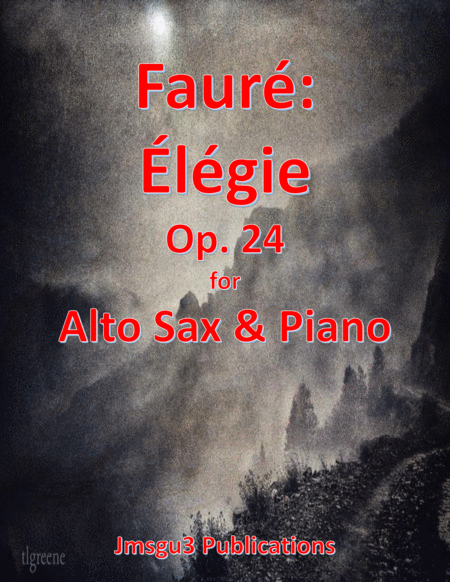
Fauré: Élégie Op. 24 for Alto Sax & Piano
Saxophone Alto et Piano

$32.95 28.69 € Saxophone Alto et Piano PDF SheetMusicPlus

Bassoon,Clarinet,Double Bass,Flute,Horn,Oboe - Level 4 - Digital Download SKU: A0.1335055 Composed by Erik Satie. Arranged by Ray Thompson. 20th Century,Chamber. 22 pages. RayThompsonMusic #920917. Published by RayThompsonMusic (A0.1335055). Satie: Parade - Final & Suite au Prélude de rideau rougeArranged wind dectet/bass (double wind quintet)The concluding music for Erik Satie's Ballet Parade.Other movements from Parade are available.Background info:Parade is a ballet choreographed by Leonide Massine, with music by Erik Satie and a one-act scenario by Jean Cocteau. The ballet was composed in 1916–17 for Sergei Diaghilev's Ballets Russes. The ballet premiered on Friday, May 18, 1917, at the Théâtre du Châtelet in Paris, with costumes and sets designed by Pablo Picasso, choreography by Léonide Massine (who danced), and the orchestra conducted by Ernest Ansermet.The ballet was remarkable for several reasons. It was the first collaboration between Satie and Picasso, and also the first time either of them had worked on a ballet, thus making it the first time either collaborated with Diaghilev and the Ballets Russes.The plot of Parade incorporated and was inspired by popular entertainments of the period, such as Parisian music-halls and American silent-films.Much of the settings used in Parade's plot occurred outside of the formal Parisian theater, depicting the streets of Paris.The plot reproduces various elements of everyday life such as the music hall and fairground.Before Parade, the use of popular entertainment materials was considered unsuitable for the elite world of the ballet.The plot of Parade composed by Cocteau includes the failed attempt of a troupe of performers to attract audience members to view their show.Some of Picasso's Cubist costumes were in solid cardboard, allowing the dancers only a minimum of movement.The score contained several noise-making instruments (typewriter, foghorn, an assortment of milk bottles, pistol, and so on), which had been added by Cocteau (somewhat to the dismay of Satie).It is supposedthat such additions by Cocteau showed his eagerness to create a succès de scandale, comparable to that of Igor Stravinsky's Le Sacre du Printemps which had been premiered by the Ballets Russes some years before, and caused no less scandal.Although Parade was quite revolutionary, bringing common street entertainments to the elite, being scorned by audiences and being praised by critics,nonetheless many years later Stravinsky could still pride himself in never having been topped in the matter of succès de scandale.The ragtime contained in Parade would later be adapted for piano solo and attained considerable success as a separate piano piece.The finale is a rapid ragtime dance in which the whole cast [makes] a last desperate attempt to lure the audience in to see their showI have omitted the  percussion in my arrangement of the finale.The premiere of the ballet resulted in a number of scandals. One faction of the audience booed, hissed, and was very unruly, nearly causing a riot before they were drowned out by enthusiastic applause.Many of their objections were focused on Picasso's cubist design, which was met with cries of sale boche.Arranged wind dectet/bass (double wind quintet).
Satie: Parade - Final & Suite au Prélude de rideau rouge - wind dectet

$14.95 13.02 € PDF SheetMusicPlus

B-Flat Clarinet,Piano - Level 4 - Digital Download SKU: A0.549728 Composed by Gabriel Faure. Arranged by James M. Guthrie, ASCAP. Contemporary,Multicultural,Romantic Period,Standards,World. Score and part. 22 pages. Jmsgu3 #3531397. Published by jmsgu3 (A0.549728). Duration: ca. 7:00, Score: 12 pages, solo part: 2 pages, piano: 7 pages. An epic choice for a recital or funeral. Fauré Background: In the first place, Gabriel Fauré 1845 –1924) was a famous French composer, musician, and educator. Furthermore, his musical ideas influenced numerous 20th-century composers. Therefore, historians regard him as one of the leading French composers of his time. Famous Works: Among his most famous compositions, by and large, are the Pavane, Elegie (op. 24), Requiem, Sicilienne, Nocturnes for piano and the songs Après un rêve and Clair de lune. Inasmuch as his early works are well-known and relatively easy to perform, Faure’s music seems to have become gradually more difficult during his later life. In other words, his later works are somewhat esoteric and complex. Early Home Life: Fauré was in fact born into a well-cultivated family. His aptitude for music became particularly clear early on - when he was still a boy. Under these circumstances, his parents sent him to a music institution in Paris. Consequently, the training he received there prepared him for a career as a church organist and choirmaster. Middle Life: It is important to realize that Fauré studied music composition with the French musical mastermind Camille Saint-Saëns, who became his lifelong friend. Fauré eventually graduated from college and earned a living as an organist and educator. During this period, he had, on the whole, little time to compose. He consequently became more successful in his middle age, becoming organist of the Église de la Madeleine and director of the Paris Conservatoire. However, he still needed time on balance for composing. Therefore, given these points, he withdrew to the countryside during the summer to focus on composing. Later Life: Fauré was, in the final analysis, recognized in France as the foremost French composer of his time. The French government held a national musical tribute particularly for him in Paris. The French President notably headed the ceremony. Elsewhere, on the contrary, Fauré's music was slow to become accepted, except of course, in England. Legacy: Historians often describe Fauré's music in general as a transition between the end of Romanticism and the beginning of modernism. As an illustration, when Fauré was born, Chopin was still composing. However, by the time of Fauré's death, jazz and atonal music, in particular, had come to fruition. Fauré, by all means, suffered from increasing deafness in his later years. Some musicologists believe this to be indeed the cause of the esoteric nature of Faure’s final works.
Fauré: Élégie Op. 24 for Clarinet & Piano
Clarinette et Piano

$32.95 28.69 € Clarinette et Piano PDF SheetMusicPlus

Instrumental Solo,Piano,Vibraphone - Level 3 - Digital Download SKU: A0.925592 By Kris Allen. By Bill Withers. Arranged by Roman Wagner. Jazz,Pop. Score and individual part. 3 pages. Swetlana Paul #5873369. Published by Swetlana Paul (A0.925592). The soul classic 'Ain't no Sunshine' by Bill Withers, who passed away recently. Arranged for vibraphone and piano. Includes an optional improvisation section for vibraphone. Duration: 00:03:30. Intermediate level, suitable for students as well as for performers. The arrangement stays close to the original, thereby interpreting each section of the song creatively, underlining it's characteristic longing, sentimental vibe. Instead of the vibraphone playing the melody and the piano accompanying throughout the whole piece, the melody switches between the two instruments.
Ain't No Sunshine
Violon et Piano
Kris Allen
$4.99 4.35 € Violon et Piano PDF SheetMusicPlus

Woodwind Ensemble - Level 5 - Digital Download SKU: A0.1073231 Composed by An-lun Huang. 20th Century,Classical,Contemporary,Multicultural,Traditional,World. 33 pages. DoReMi Edition #677495. Published by DoReMi Edition (A0.1073231). Chinese Rhapsody No.3 was composed e in Toronto, Canada , 1988. Huang dedicated the piece to the Canadian Saxophonist Paul Brodie who premiered it in Parry sound of Ontario in the same year. Written in Saibei Folk Style, the music is divided into 5 movements without stop. As usual, Huang didn‘t use any folk song . But the typical taste of Huang’s “Zhang Jia Kou[張家å£] accent†is pretty easy to be identified. With the concert virtuosity, the 1st movement is composed as an emotional Cadenza which expresses the profound affections to the land of Saibei. Using the same Alto Sax., the lyric 2nd movement is followed by a folk dance, the 3rd movement. Chang to a Soprano Saxophone, the 4th movement is sound like a dreamy nocturne which is interrupted by the percussions of the fiery 5th movement. The whole Rhapsody ends on a climax of the Chinese Northern west “wind and percussion “styleâ€. Brodie found more than 300 trills in this piece. Perhaps this is the key to perform the music in real Chinese style. Huang has composed 5 versions of these pieces for different ensembles: saxophone solo with piano, or strings, or winds/brasses, or Chinese traditional orchestra, or symphony orchestra. The attached mp3 was performed by the German saxophonist Jurgen Demmler with pianist Peter Grabinger in 1996. Duration: 20’.
CHINESE RHAPSODY No.3 For Saxophone and Wind Orchestra (with Arpa) Op.46(1988) [Score] - Score Only

$19.99 17.41 € PDF SheetMusicPlus

Easy Piano - Level 1 - Digital Download SKU: A0.1365277 By Stephanie Beatriz. By Lin-Manuel Miranda. Arranged by Jen Smith Lanthier. 21st Century,Broadway,Contemporary,Film/TV,Musical/Show,Pop. Score. 3 pages. Ocean Tails Music #949597. Published by Ocean Tails Music (A0.1365277). Waiting On A Miracle performed by Stephanie Beatriz is a hit song from the 2021 Walt Disney Animation Studios’ animated film Encanto. This arrangement of Lin-Manuel Miranda’s Columbian waltz-inspired gem is written for Easy (Levels 2-3) Solo Piano. It is written one whole step lower to give elementary players a gentler set of keys that remains as close to the original as possible. The compound time signature is retained but simplified to allow for easier reading. The left hand features mostly single notes with a few solid and broken triads. The right hand recreates the original vocal melody using single notes and minimal syncopation. This piece is perfect for elementary students who are fans of Encanto, the music of Lin-Manuel Miranda, and wonderfully emotional Disney movie songs. Guitar chords included.
Waiting On A Miracle
Piano Facile
Stephanie Beatriz
$4.99 4.35 € Piano Facile PDF SheetMusicPlus

Large Ensemble Bassoon,Clarinet,Double Bass,Flute,Horn,Oboe,Percussion - Level 3 - Digital Download SKU: A0.555864 Composed by Edmund Angerer - ascribed variously to Joseph Haydn, Leopold Mozart, Michael Haydn, and Wolfgang Amadeus Mozart and Johann Rainprechter. Arranged by Ray Thompson. Children,Christmas,Classical,Standards. Score and parts. 52 pages. RayThompsonMusic #6047585. Published by RayThompsonMusic (A0.555864). This work was long reputed to be the work of Joseph Haydn, but later scholarship suggested that it was actually written by Leopold Mozart. Its authorship is still disputed, however, and other composers have been proposed as the symphony's true author, including Joseph Haydn's younger brother Michael Haydn, who purportedly contributed movements to the work.Recent research on a newly found manuscript suggests the Austrian Benedictine monk Edmund Angerer (1740–1794) to be the author. If Angerer's manuscript (from 1765, entitled Berchtolds-Gaden Musick) is the original, the Toy Symphony was originally written not in G but rather in C. These findings, however, are disputed among scholars. There is reason to believe that the true composer will likely never be known, in whole or in part, given its confused origins and the paucity of related manuscript sources.Even without a name attached to it, the piece has become a mainstay for children's shows and Christmastime concerts. Each of its three movements features the sounds of actual toys and instruments that sound like they came straight from Geppetto's workshop. The piece calls for a toy trumpet, ratchet, nightingale, cuckoo, drum, and triangle. ( A quail makes it’s only appearance in the 2nd movement.Noisemakers rattle throughout the first of its three movements. The cuckoo and trumpet  call out mischievously during the minuetto of the second movement , and a quail joins the nightingale in the trio. In the short third mvt which is played 3 times, they all play again, each repeat faster than the previous one.The presence of the toy instruments make this a fun piece for children to play, especially when there are also some toys waiting under the tree.My arrangement is based on the Kinder-Symphonie attributed to Leopold Mozart. It is scored in C.it is in 3 mvts and is arranged for double wind quintet, bass and toy percussion.i have distributed the original strings around the woodwind, and composed original classical horn parts.Sometimes known as Children’s Symphony.
Kinder- Symphonie (Toy Symphony): Composer: Unknown - symphonic wind/percussion

$19.95 17.37 € PDF SheetMusicPlus

Woodwind Ensemble,Woodwind Quartet Alto Saxophone,Baritone Saxophone,Soprano Saxophone,Tenor Saxophone - Level 5 - Digital Download SKU: A0.876457 Composed by Ludwig van Beethoven. Arranged by Joe Procopio. Classical,Romantic Period. 12 pages. JoeCopio Music LLC #1900825. Published by JoeCopio Music LLC (A0.876457). THE BEETHOVEN DUETS By Joe Procopio The Beethoven Duets by Joe Procopio is a collection of duets that artist -composer Joe Procopio has adapted and arranged from the 9 Scherzi found in Ludwig van Beethoven’s 9 Symphonies. These duets are the first of their kind in history making them noteworthy, unique and valuable. Each Scherzo is published not only for Saxophone but also for many other orchestral instruments. They are published individually for each instrument; in a Three Volume Collection with 3 Scherzi in each volume; and in a Complete Collection containing all three volumes. They are also available as a CD. Volume One has Scherzo No.1, Scherzo No. 2 and Scherzo No.3. Volume Two has Scherzo No.4, Scherzo No 5 and Scherzo No.6. Volume Three has Scherzo No.7, Scherzo No.8 and Scherzo No.9. The Complete Collection has all 3 Volumes for each instrument with all 9 Scherzi. What’s more they will soon be published in the Procopio PlayAlong Music Program. This is an exclusive MP3 music audio program personally designed and developed in which Player 1 plays along with a music audio track for Player 2. To be sure, The Beethoven Scherzi Duets for Saxophone are a marvel of Beethoven’s skill with sections reaching the sublime. It is my deep felt personal belief that these Scherzi will bring you great pleasure and long lasting satisfaction. Joe Procopio AN INTRODUCTION TO THE BEETHOVEN DUETS By Joe Procopio Because of the complexities, range and sonorities inherent in all of the Beethoven Symphonies, it may seem impossible to transcribe any one movement as a duet that is true to the composer. Nevertheless, I believe these duets contain the heart, soul and essence of Beethoven’s melodies, rhythms and expressions; even though these works are tiny when they are compared to the Master’s great musical creations which have no equal. In fact, there is no comparison. However, my sincere hope is that since I have rendered some of Beethoven’s music as duets, his music is now more readily available to all permitting a greater number of musicians and all the people who hear their performances to come to know and love a bit of the world’s most valuable, breathtaking and beautiful music. In truth, Beethoven’s music has stood the test of time. He astonished people in his day whenever he performed his music or had his music played. He still does today. To be sure, his music has enhanced and enriched the lives of many of us for over 200 years. In performing and listening to these Scherzi you will find the whole of each work a marvel of Beethoven’s skill with sections reaching the sublime. Few composers have been able to write down on paper music of such incredible beauty that it reflects the awesome splendor of God’s creation. What comes to mind immediately is Beethoven’s Pastoral Symphony No. 6. It has been said, that much of his music mirrors not only the magnificence of God’s creation but also the radiance of God the Creator himself. In any event, this music is simply amazing and awe-inspiring. A joy to listen to and to play. I know and can safely say without any hesitation or reservations that this collection will bring you much enjoyment.
The Beethoven Duets For Saxophone Scherzo No. 2
Quatuor de Saxophones: 4 saxophones
Joe Procopio The Beethoven Duets by Joe Procopio is a collection of duets that artist -composer Joe Procopio has adapted and arranged from the 9 Scherzi found in Ludwig van Beethoven’s 9 Symphonies These duets are the first of their kind in history making them noteworthy, unique and valuable
$9.99 8.7 € Quatuor de Saxophones: 4 saxophones PDF SheetMusicPlus

String Ensemble Cello - Level 5 - Digital Download SKU: A0.876553 Composed by Ludwig van Beethoven. Arranged by Joe Procopio. Classical,Romantic Period. Score and parts. 43 pages. JoeCopio Music LLC #2101603. Published by JoeCopio Music LLC (A0.876553). THE BEETHOVEN DUETS FOR VIOLONCELLO By Joe Procopio The Beethoven Duets by Joe Procopio is a collection of duets that artist -composer Joe Procopio has adapted and arranged from the 9 Scherzi found in Ludwig van Beethoven’s 9 Symphonies. These duets are unique. They can be performed as a duet for Cello I and Cello II and as a Cello ensemble in groups of 2, 4, 6, 8, etc. Each Scherzo is published for many other orchestral instruments. They are published individually for each instrument; in a Three Volume Collection with 3 Scherzi in each volume; and in a Complete Collection containing all three volumes. Volume One has Scherzo No.1, Scherzo No. 2 and Scherzo No.3. Volume Two has Scherzo No.4, Scherzo No 5 and Scherzo No.6. Volume Three has Scherzo No.7, Scherzo No.8 and Scherzo No.9. The Complete Collection has all 3 Volumes for each instrument with all 9 Scherzi. What’s more they will soon be published in the Procopio PlayAlong Music Program. This is an exclusive MP3 music audio program personally designed and developed in which Player 1 plays along with a music audio track for Player 2. To be sure, The Beethoven Scherzi Duets for Violoncello are a marvel of Beethoven’s skill with sections reaching the sublime. It is my deep felt personal belief that these Scherzi will bring you great pleasure and long lasting satisfaction. Joe Procopio AN INTRODUCTION TO THE BEETHOVEN DUETS By Joe Procopio Because of the complexities, range and sonorities inherent in all of the Beethoven Symphonies, it may seem impossible to transcribe any one movement as a duet that is true to the composer. Nevertheless, I believe these duets contain the heart, soul and essence of Beethoven’s melodies, rhythms and expressions; even though these works are tiny when they are compared to the Master’s great musical creations which have no equal. In fact, there is no comparison. However, my sincere hope is that since I have rendered some of Beethoven’s music as duets, his music is now more readily available to all permitting a greater number of musicians and all the people who hear their performances to come to know and love a bit of the world’s most valuable, breathtaking and beautiful music. In truth, Beethoven’s music has stood the test of time. He astonished people in his day whenever he performed his music or had his music played. He still does today. To be sure, his music has enhanced and enriched the lives of many of us for over 200 years. In performing and listening to these Scherzi you will find the whole of each work a marvel of Beethoven’s skill with sections reaching the sublime. Few composers have been able to write down on paper music of such incredible beauty that it reflects the awesome splendor of God’s creation. What comes to mind immediately is Beethoven’s Pastoral Symphony No. 6. It has been said, that much of his music mirrors not only the magnificence of God’s creation but also the radiance of God the Creator himself. In any event, this music is simply amazing and awe-inspiring. A joy to listen to and to play. I know and can safely say without any hesitation or reservations that this collection will bring you much enjoyment.
THE BEETHOVEN DUETS FOR CELLO VOLUME 1 SCHERZI 1, 2 and 3
Joe Procopio The Beethoven Duets by Joe Procopio is a collection of duets that artist -composer Joe Procopio has adapted and arranged from the 9 Scherzi found in Ludwig van Beethoven’s 9 Symphonies These duets are unique
$19.98 17.4 € PDF SheetMusicPlus

Flute,Piano - Level 4 - Digital Download SKU: A0.796697 By Coldplay. By Chris Martin, Guy Berryman, Jonny Buckland, and Will Champion. Arranged by Gary D. Belshaw (ASCAP). Rock. Score and part. 16 pages. DR GARY D BELSHAW #3663549. Published by DR GARY D BELSHAW (A0.796697). 2018 Holiday Contest Entry.What could be more in the holiday spirit than this Coldplay song about someone who can't believe she's gone? Get yourself into the true holiday spirit, celebrating those Christmas lights. Bring this music to any holiday social or civic event, recital, or concert. Explore the whole range of the instrument, and of the season. Good breath control and solid articulation will help folks stay with you. Follow us on Twitter. Like this song on our Facebook page. Your reviews here in Sheet Music Plus are also incredibly valuable to us.
Christmas Lights
Flûte traversière et Piano
Coldplay
$6.99 6.09 € Flûte traversière et Piano PDF SheetMusicPlus

Mixed Percussion B-Flat Tuba,B-Flat trombone,Baritone Horn TC/Euphonium,Bass Trombone,E-Flat Cornet,E-Flat Tenor Horn,E-Flat Tuba TC,Flugelhorn,Percussion 1,Percussion 2,Tenor Trombone - Level 5 - Digital Download SKU: A0.985299 By Jon Schmidt. By Jon Schmidt and Jordan Schmidt. Arranged by David Holt. Contemporary. Brass Band. 87 pages. David Holt #5871437. Published by David Holt (A0.985299). This driving swing arrangement of Ding Dong, Merrily on High is based on a piano piece by John Schmitt, of The Piano Guys. It is in a lopsided 10/8 time signature and features the whole cornet section, who each have individual parts.North Pole Express has been designed to be played with the cornets standing in two choirs around the band. Two suggested seating plans are included, which will make the most of the featured instruments.This piece features solo passages for principal cornet and soprano, as well as fanfare sections where only cornets are playing. The soprano cornet solo is particularly challenging, so a slightly easier alternative version is included.Trombone parts in alternate clefs are provided, as well as optional additional cornet parts for large bands.
North Pole Express
Jon Schmidt
$50.00 43.54 € PDF SheetMusicPlus


Partitions Gratuites
Acheter des Partitions Musicales
Acheter des Partitions Digitales à Imprimer
Acheter des Instruments de Musique

© 2000 - 2026

Accueil - Version intégrale





