EUROPE
7352 articles
USA
0 articles
DIGITAL
57410 articles (à imprimer)
Partitions Digitales
Partitions à imprimer
57410 partitions trouvées


Bassoon Solo - Level 5 - Digital Download SKU: A0.876515 Composed by Ludwig van Beethoven. Arranged by Joe Procopio. Classical,Romantic Period. Individual part. 10 pages. JoeCopio Music LLC #1920687. Published by JoeCopio Music LLC (A0.876515). THE BEETHOVEN DUETS By Joe Procopio The Beethoven Duets by Joe Procopio is a collection of duets that artist -composer Joe Procopio has adapted and arranged from the 9 Scherzi found in Ludwig van Beethoven’s 9 Symphonies. These duets are the first of their kind in history making them noteworthy, unique and valuable. Each Scherzo is published not only for Bassoon but also for many other orchestral instruments. They are published individually for each instrument; in a Three Volume Collection with 3 Scherzi in each volume; and in a Complete Collection containing all three volumes. They are also available as a CD. Volume One has Scherzo No.1, Scherzo No. 2 and Scherzo No.3. Volume Two has Scherzo No.4, Scherzo No 5 and Scherzo No.6. Volume Three has Scherzo No.7, Scherzo No.8 and Scherzo No.9. The Complete Collection has all 3 Volumes for each instrument with all 9 Scherzi. What’s more they will soon be published in the Procopio PlayAlong Music Program. This is an exclusive MP3 music audio program personally designed and developed in which Player 1 plays along with a music audio track for Player 2. To be sure, The Beethoven Scherzi Duets for Bassoon are a marvel of Beethoven’s skill with sections reaching the sublime. It is my deep felt personal belief that these Scherzi will bring you great pleasure and long lasting satisfaction. Joe Procopio AN INTRODUCTION TO THE BEETHOVEN DUETS By Joe Procopio Because of the complexities, range and sonorities inherent in all of the Beethoven Symphonies, it may seem impossible to transcribe any one movement as a duet that is true to the composer. Nevertheless, I believe these duets contain the heart, soul and essence of Beethoven’s melodies, rhythms and expressions; even though these works are tiny when they are compared to the Master’s great musical creations which have no equal. In fact, there is no comparison. However, my sincere hope is that since I have rendered some of Beethoven’s music as duets, his music is now more readily available to all permitting a greater number of musicians and all the people who hear their performances to come to know and love a bit of the world’s most valuable, breathtaking and beautiful music. In truth, Beethoven’s music has stood the test of time. He astonished people in his day whenever he performed his music or had his music played. He still does today. To be sure, his music has enhanced and enriched the lives of many of us for over 200 years. In performing and listening to these Scherzi you will find the whole of each work a marvel of Beethoven’s skill with sections reaching the sublime. Few composers have been able to write down on paper music of such incredible beauty that it reflects the awesome splendor of God’s creation. What comes to mind immediately is Beethoven’s Pastoral Symphony No. 6. It has been said, that much of his music mirrors not only the magnificence of God’s creation but also the radiance of God the Creator himself. In any event, this music is simply amazing and awe-inspiring. A joy to listen to and to play. I know and can safely say without any hesitation or reservations that this collection will bring you much enjoyment.
The Beethoven Duets For Bassoon Scherzo No. 8
Basson
Joe Procopio The Beethoven Duets by Joe Procopio is a collection of duets that artist -composer Joe Procopio has adapted and arranged from the 9 Scherzi found in Ludwig van Beethoven’s 9 Symphonies These duets are the first of their kind in history making them noteworthy, unique and valuable
$9.99 8.7 € Basson PDF SheetMusicPlus

Choral Choir (SSAA) - Level 2 - Digital Download SKU: A0.856166 By Miley Cyrus. By Robert Hazard. Arranged by Liz Garnett. Pop. Octavo. 5 pages. Liz Garnett #3868607. Published by Liz Garnett (A0.856166). This song was originally written and recorded in 1979 by Robert Hazard, who presented it from a male point of view, but it was made famous by Cyndi Lauper in 1983/4. Lauper tweaked the lyrics to turn it into a celebration of both female pleasure and female autonomy, and in doing so overturned the stereotypes of feminism of the era - becoming the voice of girl power for the generation before the Spice Girls.Lauper has reworked the song into two subsequent versions, but this arrangement is based firmly on the 1980s version. It was written for a series of one-day workshops, and so was designed to combine musical interest for people spending a whole day singing it with ease of learning to allow participants to focus on performance elements beyond the notes.The arrangement is notated in the traditional clefs for women's barbershop: treble and bass alta (i.e. sung an octave higher than written).Vocal Ranges:Tenor: E4 – E5Lead: A3 – C#4Bari: A3- B4Bass: E3 – E4www.HelpingYouHarmonise.com
Girls Just Want To Have Fun
Chorale SSAA
Miley Cyrus
$1.99 1.73 € Chorale SSAA PDF SheetMusicPlus

Bassoon,Clarinet,Double Bass,Flute,Mallet Percussion,Multi-Percussion,Oboe/English Horn - Level 4 - Digital Download SKU: A0.1296860 Composed by Erik Satie. Arranged by Ray Thompson. 20th Century,Chamber,Comedy. 40 pages. RayThompsonMusic #887010. Published by RayThompsonMusic (A0.1296860). Arranged double wind quintet/bass and optional percussion.Background info:Parade is a ballet choreographed by Leonide Massine, with music by Erik Satie and a one-act scenario by Jean Cocteau. The ballet was composed in 1916–17 for Sergei Diaghilev's Ballets Russes. The ballet premiered on Friday, May 18, 1917, at the Théâtre du Châtelet in Paris, with costumes and sets designed by Pablo Picasso, choreography by Léonide Massine (who danced), and the orchestra conducted by Ernest Ansermet.The ballet was remarkable for several reasons. It was the first collaboration between Satie and Picasso, and also the first time either of them had worked on a ballet, thus making it the first time either collaborated with Diaghilev and the Ballets Russes.The plot of Parade incorporated and was inspired by popular entertainments of the period, such as Parisian music-halls and American silent-films.Much of the settings used in Parade's plot occurred outside of the formal Parisian theater, depicting the streets of Paris.The plot reproduces various elements of everyday life such as the music hall and fairground.Before Parade, the use of popular entertainment materials was considered unsuitable for the elite world of the ballet.The plot of Parade composed by Cocteau includes the failed attempt of a troupe of performers to attract audience members to view their show.Some of Picasso's Cubist costumes were in solid cardboard, allowing the dancers only a minimum of movement.The score contained several noise-making instruments (typewriter, foghorn, an assortment of bottles, pistol, and so on), which had been added by Cocteau (somewhat to the dismay of Satie).It is supposedthat such additions by Cocteau showed his eagerness to create a succès de scandale, comparable to that of Igor Stravinsky's Le Sacre du Printemps which had been premiered by the Ballets Russes some years before, and caused no less scandal.Although Parade was quite revolutionary, bringing common street entertainments to the elite, being scorned by audiences and being praised by critics,nonetheless many years later Stravinsky could still pride himself in never having been topped in the matter of succès de scandale.The ragtime contained in Parade would later be adapted for piano solo and attained considerable success as a separate piano piece.The finale is a rapid ragtime dance in which the whole cast [makes] a last desperate attempt to lure the audience in to see their showThe premiere of the ballet resulted in a number of scandals. One faction of the audience booed, hissed, and was very unruly, nearly causing a riot before they were drowned out by enthusiastic applause.Many of their objections were focused on Picasso's cubist design, which was met with cries of sale boche.Acrobates (Acrobats) is no 3 in the ballet, and includes some of the odd percussion : sirens and a bottle phone, in addition to normal orchestral perc.The piece can be performed without percussion....but the percussion gives it an extra something!!
Satie: Parade III.Acrobates (Acrobats) - wind dectet/bass (with optional percussion)

$19.95 17.37 € PDF SheetMusicPlus

Concert Band - Level 4 - Digital Download SKU: A0.1021849 Composed by Julius Fucik. Arranged by Albert Schwarzmann. Romantic Period. Score and parts. 132 pages. Edition Schwalbe #6643353. Published by Edition Schwalbe (A0.1021849). Julius FuÄík (1872 - 1916) was a famous Austrian-Hungarian military bandmaster, who composed more than 400 pieces during his short lifetime. First of all he was known as a king of marches: His Florentiner March and Entry of the Gladiators had worldwide success, but also some of his overtures and waltzes became very popular. His concert march Under the Admiral's Flag was composed in 1911and had its first performance, when the Austrian-Hungarian battleship Viribus unitis premiered its launching in the former Austrian military habour of Pula in Istria. This arrangement keeps the key of the symphony orchestra version, while most band arrangements transpose a whole tone lower. This transcription was commissioned by Wind Philharmonic Mozarteum Salzburg and first performed conducted by Hansjoerg Angerer at their 2014 New Year's Concert on January 6th in Salzburg, Austria. A live recording of this piece is included on the CD Eine musikalische Reise UMR65, Barcode 9120007612141 available at https://naxosdirekt.de/items/eine-musikalische-reise-557962 .For details see also: https://www.blaeserphilharmonie-mozarteum.at/
Unter der Admiralsflagge (Under the Admiral's Flag) Concert March op. 82 by Julius FuÄik
Orchestre d'harmonie

$88.00 76.63 € Orchestre d'harmonie PDF SheetMusicPlus

Woodwind Ensemble,Woodwind Quartet Alto Saxophone,Baritone Saxophone,Soprano Saxophone,Tenor Saxophone - Level 5 - Digital Download SKU: A0.876461 Composed by Ludwig van Beethoven. Arranged by Joe Procopio. Classical,Romantic Period. 15 pages. JoeCopio Music LLC #1900833. Published by JoeCopio Music LLC (A0.876461). THE BEETHOVEN DUETS By Joe Procopio The Beethoven Duets by Joe Procopio is a collection of duets that artist -composer Joe Procopio has adapted and arranged from the 9 Scherzi found in Ludwig van Beethoven’s 9 Symphonies. These duets are the first of their kind in history making them noteworthy, unique and valuable. Each Scherzo is published not only for Saxophone but also for many other orchestral instruments. They are published individually for each instrument; in a Three Volume Collection with 3 Scherzi in each volume; and in a Complete Collection containing all three volumes. They are also available as a CD. Volume One has Scherzo No.1, Scherzo No. 2 and Scherzo No.3. Volume Two has Scherzo No.4, Scherzo No 5 and Scherzo No.6. Volume Three has Scherzo No.7, Scherzo No.8 and Scherzo No.9. The Complete Collection has all 3 Volumes for each instrument with all 9 Scherzi. What’s more they will soon be published in the Procopio PlayAlong Music Program. This is an exclusive MP3 music audio program personally designed and developed in which Player 1 plays along with a music audio track for Player 2. To be sure, The Beethoven Scherzi Duets for Saxophone are a marvel of Beethoven’s skill with sections reaching the sublime. It is my deep felt personal belief that these Scherzi will bring you great pleasure and long lasting satisfaction. Joe Procopio AN INTRODUCTION TO THE BEETHOVEN DUETS By Joe Procopio Because of the complexities, range and sonorities inherent in all of the Beethoven Symphonies, it may seem impossible to transcribe any one movement as a duet that is true to the composer. Nevertheless, I believe these duets contain the heart, soul and essence of Beethoven’s melodies, rhythms and expressions; even though these works are tiny when they are compared to the Master’s great musical creations which have no equal. In fact, there is no comparison. However, my sincere hope is that since I have rendered some of Beethoven’s music as duets, his music is now more readily available to all permitting a greater number of musicians and all the people who hear their performances to come to know and love a bit of the world’s most valuable, breathtaking and beautiful music. In truth, Beethoven’s music has stood the test of time. He astonished people in his day whenever he performed his music or had his music played. He still does today. To be sure, his music has enhanced and enriched the lives of many of us for over 200 years. In performing and listening to these Scherzi you will find the whole of each work a marvel of Beethoven’s skill with sections reaching the sublime. Few composers have been able to write down on paper music of such incredible beauty that it reflects the awesome splendor of God’s creation. What comes to mind immediately is Beethoven’s Pastoral Symphony No. 6. It has been said, that much of his music mirrors not only the magnificence of God’s creation but also the radiance of God the Creator himself. In any event, this music is simply amazing and awe-inspiring. A joy to listen to and to play. I know and can safely say without any hesitation or reservations that this collection will bring you much enjoyment.
The Beethoven Duets For Saxophone Scherzo No. 6
Quatuor de Saxophones: 4 saxophones
Joe Procopio The Beethoven Duets by Joe Procopio is a collection of duets that artist -composer Joe Procopio has adapted and arranged from the 9 Scherzi found in Ludwig van Beethoven’s 9 Symphonies These duets are the first of their kind in history making them noteworthy, unique and valuable
$9.99 8.7 € Quatuor de Saxophones: 4 saxophones PDF SheetMusicPlus

Full Orchestra - Level 5 - Digital Download SKU: A0.1373704 Composed by Chris Knapp. 21st Century,Classical,Contemporary. 52 pages. Chris Knapp #958094. Published by Chris Knapp (A0.1373704). Kabuki pieces takes influence and inspiration from Japanese Kabuki theatre productions. In this work, the main aspects of Kabuki theatre are explored through the 'deconstructed' Orchestra. Kabuki theatre employs the principles of jo-ha-kyu which helps sets the pace for a dramatic play. Jo-ha-kyustates that a play should start slow, get quicker and end fast. Kabuki employs this technique over a series of 5 acts, hence this composition uses 5 movements and the pace of the work as a whole speeds up as it moves through.1. Introduction - Like with all good pieces of theatre, the first act sets the scene and establishes characters. In this compositon, the scene is set by the Cello accompanied by a selection of percussion (a characteristic trait of Kabuki theatre).2. Battle #1 - In Kabuki theatre there are always a number of battles, these usually occur during the 2nd and 4th acts. This composition similarly mimics the chaos of a battle and features the Woodwind section.3. Tragedy - During the 3rd act, a Tragedy or emotional event usually occurs, thus this composition hopes to mirror that with an emotional outpouring of melodic ideas introducing the Brass.4. Battle #2 - In the 2nd battle of this work, the feature is placed more on the Xylophone who takes a solo role and sets out a frantic tune which provides the basis for a Fugue of sorts picked up by the Strings.5. Conclusion - The conclusion to most Kabuki plays are satisfying and short, this is mirrored by the very brief conclusion to this work.
Kabuki Pieces, Op. 20
Orchestre

$35.99 31.34 € Orchestre PDF SheetMusicPlus

Choral Choir (SATB) - Level 3 - Digital Download SKU: A0.904846 Composed by Keith Armstead and Martin Nystrom. Arranged by A. Mazzer editing by Marco Borsoi. Christian,Gospel,Pop,Sacred. Octavo. 21 pages. Marco Borsoi #3432511. Published by Marco Borsoi (A0.904846). The two pieces, which are composed in a Medley, are As the Deer and Hallelujah, Oh Lord we praise your name. They belong, the first to the repertoire of white religious music, generally called Christian Music, which is characterized by a clear influence of the Country and Pop genre and the other to the repertoire of Gospel Music, Afro-American religious music, born in the Christian-Methodist churches in the '30s. The author of As the Deer is Martin J. Nystrom, American composer who, based on a simple and very effective chord progression, resumes the beginning of Psalm 42: As the deer pants for streams of water, so my soul pants for you, my God ... (Psalm 42, 1-2) The author of Hallelujah, Oh Lord we praise your name is Keith Armstead, minister of music at King George Church of God in King George, VA. The song, with a typical Gospel atmosphere, is characterized by the solo vs. chorus mode, that is to say a short singing phrase performed by a single singer (in this arrangement performed by sopranos) alternates the response of the whole choir. The song is included in the album You can count on Jesus, produced by Armstead and published in 2003.
As the Deer / Hallelujah medley SATB + Piano (complete score + single parts)
Chorale SATB

$10.99 9.57 € Chorale SATB PDF SheetMusicPlus

Piano,Trombone - Level 4 - Digital Download SKU: A0.796704 By Coldplay. By Chris Martin, Guy Berryman, Jonny Buckland, and Will Champion. Arranged by Gary D. Belshaw (ASCAP). Rock. Score and part. 16 pages. DR GARY D BELSHAW #3663715. Published by DR GARY D BELSHAW (A0.796704). 2018 Holiday Contest Entry.What could be more in the holiday spirit than this Coldplay song about someone who can't believe she's gone? Get yourself into the true holiday spirit, celebrating those Christmas lights. Bring this music to any holiday social or civic event, recital, or concert. Explore the whole range of the instrument, and of the season. Good breath control and solid articulation will help folks stay with you. Follow us on Twitter. Like this song on our Facebook page. Your reviews here in Sheet Music Plus are also incredibly valuable to us.
Christmas Lights
Trombone et Piano
Coldplay
$6.99 6.09 € Trombone et Piano PDF SheetMusicPlus

Piano,Viola - Level 4 - Digital Download SKU: A0.549724 Composed by Gabriel Faure. Arranged by James M. Guthrie, ASCAP. Contemporary,Multicultural,Romantic Period,Standards,World. Score and part. 22 pages. Jmsgu3 #3531351. Published by jmsgu3 (A0.549724). Duration: ca. 7:00, Score: 12 pages, solo part: 2 pages, piano: 7 pages. An epic choice for a recital or funeral. Fauré Background: In the first place, Gabriel Fauré 1845 –1924) was a famous French composer, musician, and educator. Furthermore, his musical ideas influenced numerous 20th-century composers. Therefore, historians regard him as one of the leading French composers of his time. Famous Works: Among his most famous compositions, by and large, are the Pavane, Elegie (op. 24), Requiem, Sicilienne, Nocturnes for piano and the songs Après un rêve and Clair de lune. Inasmuch as his early works are well-known and relatively easy to perform, Faure’s music seems to have become gradually more difficult during his later life. In other words, his later works are somewhat esoteric and complex. Early Home Life: Fauré was in fact born into a well-cultivated family. His aptitude for music became particularly clear early on - when he was still a boy. Under these circumstances, his parents sent him to a music institution in Paris. Consequently, the training he received there prepared him for a career as a church organist and choirmaster. Middle Life: It is important to realize that Fauré studied music composition with the French musical mastermind Camille Saint-Saëns, who became his lifelong friend. Fauré eventually graduated from college and earned a living as an organist and educator. During this period, he had, on the whole, little time to compose. He consequently became more successful in his middle age, becoming organist of the Église de la Madeleine and director of the Paris Conservatoire. However, he still needed time on balance for composing. Therefore, given these points, he withdrew to the countryside during the summer to focus on composing. Later Life: Fauré was, in the final analysis, recognized in France as the foremost French composer of his time. The French government held a national musical tribute particularly for him in Paris. The French President notably headed the ceremony. Elsewhere, on the contrary, Fauré's music was slow to become accepted, except of course, in England. Legacy: Historians often describe Fauré's music in general as a transition between the end of Romanticism and the beginning of modernism. As an illustration, when Fauré was born, Chopin was still composing. However, by the time of Fauré's death, jazz and atonal music, in particular, had come to fruition. Fauré, by all means, suffered from increasing deafness in his later years. Some musicologists believe this to be indeed the cause of the esoteric nature of Faure’s final works.
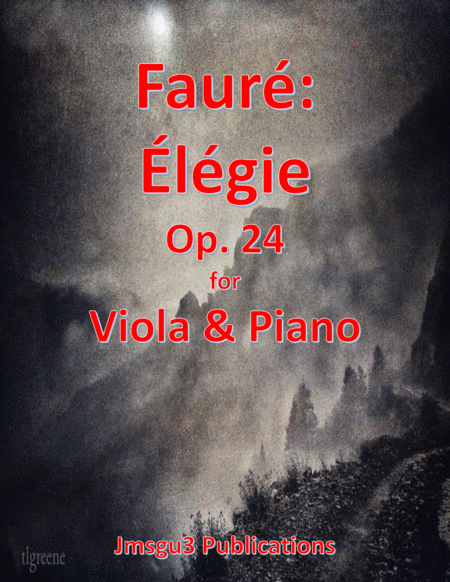
Fauré: Élégie Op. 24 for Viola & Piano
Alto, Piano

$32.95 28.69 € Alto, Piano PDF SheetMusicPlus

Full Orchestra - Level 4 - Digital Download SKU: A0.869351 Composed by Thomas Oboe Lee. 20th Century,Baroque,Classical,Contemporary,Romantic Period. Score and parts. 81 pages. Thomas Oboe Lee #15869. Published by Thomas Oboe Lee (A0.869351). Instrumentation: 3232-4331-timp-2perc-strings. When I received the invitation from Jonathan Cohler to write a Concerto for Orchestra for the Brockton Symphony, I immediately thought of all the composers who wrote works inspired by Bartok’s seminal work of the same title: Roger Sessions, Elliott Carter, Michael Tippett, Witold Lutoslawski, Joan Tower and, most recently, Jennifer Higdon. My Concerto for Orchestra, opus 111, is in five movements. It will be heard without pause between movements. I. Largo … Misterioso! II. Allegro con moto … Evidence!!! III. Adagio … Epistrophy! IV. Andante … In Walked Bud! V. Presto … Rhythm-a-ning!!! My initial idea for the Concerto was contrast - contrast between the timbres and colors that the various sections in an orchestra provide. For example, the woodwinds would provide a sharp contrast against the brass; the percussion section against the strings, etc. I also was interested in writing a work where each movement would flow into the next without pause – thus providing another form of contrast, that of tempi and mood change. A third form of contrast would be the different styles and forms of music that I would come up with. And I had a lot of fun conjuring up the many possible scenarios and orchestral tableaux. I actually started with the second movement: the Allegro con moto. I wanted something that had a nice surging quality that the whole orchestra could jump into. When I finished that, I thought perhaps it would be too intense for the opening of the work. I thought, maybe I should begin with something slower, more brooding in nature before the explosive stuff. I noticed that Carter’s Concerto began with a slow Introduction. It had a title: Misterioso. Being an avid fan of Thelonious Monk, aka Thelonious Sphere Monk, Misterioso brought to mind a Monk composition of the same title. That epiphany gave me the idea of naming each of the five movements after a Monk tune. Monk’s Misterioso is a blues with an insistent theme of 8th note patterns of rising 6ths; which has nothing to do with my first movement. My Misterioso features a solo for the bass clarinet in the midst of a shimmering atmosphere that is punctuated by accents in the bass. They are both mysterious, but divergently opposed in mood and substance. Monk’s Evidence is a tune with jabs and punches, irregularly placed within the measure – not unlike what I did in the second movement. This movement is perhaps the most Monk-ish of all. Monk’s Epistrophy is a tune constructed with a four-note pattern that is angular and twisted. I wrote a solemn brass choir movement that is an epistle in nature, a sermon of sorts. The title of Monk’s In Walked Bud refers, of course, to the amazing pianist Bud Powell. I took the word walk and translated it into an andante. What resulted was a silly, but jolly movement featuring the woodwinds. I wanted to end the work with a fast and furious finale. Inspired by the word rhythm in Monk’s Rhythm-a-ning, I began the last movement with a solo for the percussion section – timpani, tom-toms, bass drum!!! The orchestra eventually joins in the mayhem, breaking into a scherzo-like frenzy. It ends with a big bang!!! Enjoy!!!Audio link: https://thomasoboelee.bandcamp.com/album/concerto-for-orchestra-opus-111-2005
Concerto for Orchestra, opus 111 (2005, rev. 2010)
Orchestre

$9.99 8.7 € Orchestre PDF SheetMusicPlus

Mixed Percussion B-Flat Tuba,B-Flat trombone,Baritone Horn TC/Euphonium,Bass Trombone,E-Flat Cornet,E-Flat Tenor Horn,E-Flat Tuba TC,Flugelhorn,Percussion 1,Percussion 2,Tenor Trombone - Level 4 - Digital Download SKU: A0.547528 By Bruno Mars. By Bruno Mars, Charles Wilson, Devon Gallaspy, Jeff Bhasker, Lonnie Simmons, Mark Ronson, Nicholaus Williams, Philip Lawrence, Robert Wilson, Ronnie Wilson, and Rudolph Taylor. Arranged by Mark Harrison. Pop. Brass Band. 32 pages. Mark Harrison #157250. Published by Mark Harrison (A0.547528). Uptown Funk is a funk-pop, soul, boogie, disco-pop and Minneapolis sound track. It has a spirit akin to the 1980s-era funk music. Its lyrics address fashion, self-love and traditional masculine bravado, performed in a sing-rapping style filled with metaphors, arrogance, charisma, and fun. Upon its release, the single received generally positive reviews from critics, who praised the instrumental, style and influences of the track. It has become a staple in any DJ/Wedding/Night Club setlist, and is a favourite around the whole world! - British Style Brass Band - Bass Clef parts available on request.
Uptown Funk
Bruno Mars
$49.99 43.53 € PDF SheetMusicPlus

Full Orchestra - Level 3 - Digital Download SKU: A0.940130 Composed by Christian James Jesse. Contemporary,Video Game. Score and parts. 24 pages. Christian James Jesse #6668901. Published by Christian James Jesse (A0.940130). You are a knight, who is on a quest by order of the King. You arrive at a desolate cave with orders to kill a vile monster that slumbers within. After what seems like hours, you reach the bottom of the abyss. Nothing is there. A sigh of disappointment exits your body, but when you decide to turn back and exit the cave, an eerie feeling trails down your spine. Something was stalking you, waiting, and watching your every move. Your whole body begins to shake, as your shadow is overcome by the towering beast behind you. Your fight begins…*Winner of the 2017 UWO Spring Concerto Competition* Premiered by: University of Wisconsin Oshkosh's University Symphony Orchestra (May 4th, 2017)Conductor: Dr. Dylan Chmura-MooreScoring:3.2.2.1 | 2.2.3.1 | Timpani | 5 Percussion | Piano | Harp | Strings
Into the Depths - Conductor's Score - Score Only
Orchestre

$20.00 17.42 € Orchestre PDF SheetMusicPlus


Partitions Gratuites
Acheter des Partitions Musicales
Acheter des Partitions Digitales à Imprimer
Acheter des Instruments de Musique

© 2000 - 2026

Accueil - Version intégrale





