EUROPE
1184 articles
USA
6902 articles
DIGITAL
7822 articles (à imprimer)
Partitions Digitales
Partitions à imprimer
7822 partitions trouvées


Piano Solo - Level 3 - Digital Download SKU: A0.998556 Composed by Julie Mandel. Contemporary. Score. 5 pages. Joopie Music #3533899. Published by Joopie Music (A0.998556). INTERVALS : 24 Works for Piano by Julie MandelA musician friend of mine once told me that her favorite songs were those that began with the jump of an octave. Like Somewhere Over The Rainbow. It got me to thinking about how the first two notes of any piece of music really set up what will follow. That octave jump, that interval, is only one of twenty-four possible intervals in a one-octave scale. That is to say, there are twenty-four different intervals with which to begin a piece of music. I have written these twenty-four pieces with the idea of having the first two notes of each of them start with a different interval.I’m delighted that pianists are starting to perform them in concert, and all 24 have been recorded by Hadassah Guttmann. The recording is widely available for purchase and download.Writing them has been like a series of adventures, each of which begins by taking the first two steps - and then discovering where they will lead. I hope you enjoy playing them as much as I enjoyed writing them.Julie Mandel, composerwww.juliemandel.com
INTERVALS: 24 Works for Piano - 10. A Fourth Down
Piano seul

$4.00 3.44 € Piano seul PDF SheetMusicPlus

SATB Chorus, opt. Cello - Digital Download SKU: C6.841090 Composed by Marty Parks. Communion, Lent, Holy Week, General, Eastertide, Christian. MP3. Celebrating Grace - Digital #841090. Published by Celebrating Grace - Digital (C6.841090). Marty Parks explores the attributes and work of Christ in this moving choral piece. In an almost hymn-like fashion, each stanza is filled with lush part-writing and theologically-rich statements. A contrasting middle section explores the sacrifice Christ made when leaving heaven and becoming our Savior. A third hymn-like stanza returns, followed by beautiful choral writing to finish the piece. This piece is appropriate for communion, or any celebration of the gospel message. Optional cello part included.
Glorious the Mystery of Christ (Split Track MP3)
Chorale SATB

$9.99 8.58 € Chorale SATB PDF SheetMusicPlus

Jazz Ensemble - Digital Download SKU: AX.00-PC-0014297_T4 4th B-flat Trumpet. Composed by Benny Carter. Instructional. Part. 4 pages. Alfred Music - Digital Sheet Music #00-PC-0014297_T4. Published by Alfred Music - Digital Sheet Music (AX.00-PC-0014297_T4). UPC: 038081331973.Symphony In Riffs is Benny Carter's most famous piece. Originally composed and arranged in the 1930's for 4 reeds and 5 brass, Benny re-scored this version for a larger band some 50 years later. Benny was known for his idiomatic saxophone writing and this chart is a great example of that. Just when you think that the soli chorus at D is as good as his saxophone writing can get, he modulates and tops it with the brilliant new section at I. This is a transitional piece between the pre-swing of the 1920s and the mid-1930s swing.
Symphony in Riffs: 4th B-flat Trumpet
Trompette (partie séparée)

$3.00 2.58 € Trompette (partie séparée) PDF SheetMusicPlus

Choral Choir (TTBB) - Level 3 - Digital Download SKU: A0.1012286 Composed by Chris Kamerling, James Kane Bradley. Arranged by Phantom K Music. A Cappella,Folk. Octavo. 16 pages. Phantom K Music #6331773. Published by Phantom K Music (A0.1012286). Wayfaring Stranger is an American folk song that is initially presented here in its most simple form of an a cappella single voice line. The arrangement slowly builds throughout the piece culminating in 3-part harmony before being scaled back to a monophonic vocal line again. Remembering that this is a folk song, the text should be sung in a simple, innocent style. While writing this piece, we often thought about picturing the countryside of youth. The text deals with one of the most personal things in one's life and that is the subject of life after death. We really hope you enjoy performing this piece as much as we did writing it.
Wayfaring Stranger - Male Chorus TTB
Chorale TTBB

$2.50 2.15 € Chorale TTBB PDF SheetMusicPlus

SATB chorus, opt. Brass, opt. Congregation - Digital Download SKU: C6.836062 Arranged by Patti Drennan. Christian, Easter, Congregation. MP3. Celebrating Grace - Digital #836062. Published by Celebrating Grace - Digital (C6.836062). Patti Drennan's arrangement for choir and optional congregation will be the highlight of your Resurrection celebrations! Congregation joins the choir on verses one and two with fanfare-like accompaniment supporting the intuitive vocal writing. The choir introduces a colorful harmonization on the third stanza. After a rousing key change, the congregation rejoins the choir for the last stanza and sopranos can soar on an optional descant. This festive concertato finishes with an exciting choral, Alleluia! Amen! A brass orchestration for Trumpets 1-3, Horn in F, Trombones 1-3, Tuba, Percussion 1&2, and Keyboard/Rhythm is available separately. Minimum purchase of 10 copies on digital download anthems.rennan's arrangement for choir and optional congregation will be the highlight of your Resurrection celebrations! Congregation joins the choir on verses one and two with fanfare-like accompaniment supporting the intuitive vocal writing. The choir introduces a colorful harmonization on the third stanza. After a rousing key change, the congregation rejoins the choir for the last stanza and sopranos can soar on an optional descant. This festive concertato finishes with an exciting choral, Alleluia! Amen! A brass orchestration for Trumpets 1-3, Trombones 1-3, Tuba, Percussion 1&2, and Keyboard/Rhythm is available separately. Minimum purchase of 10 copies on digital download anthems.
That Easter Day with Joy Was Bright (Demo MP3)
Chorale TTBB

$1.99 1.71 € Chorale TTBB PDF SheetMusicPlus

Baritone Saxophone,Piano - Level 1 - Digital Download SKU: A0.548713 Composed by Martin Luther. Arranged by James M. Guthrie, ASCAP. Easter,Instructional,Standards. Score and part. 4 pages. Jmsgu3 #3411737. Published by jmsgu3 (A0.548713). Out of the Depths I Cry to You by Martin Luther. The first verses feature modified counterpoint and harmony proceeding at quarter = 82. The final verse is reharmonized for maximum dramatic effect at a more contemplative tempo such as quarter = 64. Features the entire range of the instrument. Very powerful selection for Lent or Easter. Duration (3 verses) 3:05, 36 ms. Score: 3 pg. Solo part: 1 pg. The piano reads from the score. Out of the Depths Aus tiefer Not schrei ich zu dir (From deep affliction I cry out to you), is, of course, a hymn composed by Martin Luther. Moreover, Luther also wrote the lyrics, essentially a paraphrase of Psalm 130. First published in 1524, it is also one of eight songs in the original Lutheran hymnal. It appears likewise in many hymnals and in different translations. The lyrics furthermore stimulated compositions from the Renaissance to the contemporary. Consequently, composers such as Johann Sebastian Bach built an entire chorale cantata on it. Other composers similarly contributed pieces, such as Felix Mendelssohn and Max Reger. Luther Background Martin Luther, (1483 –1546) was a German professor of theology, composer, priest, and moreover, an influential character in the Protestant Reformation. Luther had a momentous impact on church and society due to his contributions to the musical arts. He wanted to disseminate the gospel among mankind and with this intention thought that the best way to do that was through music. Influence It is important to realize that other musicians, and their descendants, were encouraged by Luther’s songs and wrote their own hymns. Luther, to be sure, had a thorough musical education. For example, he knew secular and sacred songs from an early age. He, in particular, played the lute well and sang in the monastery when he was a monk. That is to say, music was an essential part of his life. He in fact first began writing songs in 1523, sometimes writing the melody as well as the lyrics. Luther was certainly able to evaluate the composers of his time. He thought especially highly of Josquin des and Ludwig Senfl. He was also acquainted, with this in mind, with other composers and their works. Legacy The Lutheran musical ethos soon covered all of Germany and later significantly fashioned Protestant musical culture. Heinrich Schütz and Johann Sebastian Bach are the most compelling evidence of this Protestant musical culture. Additionally, as a point often overlooked, the pedal organ, first refined in northern Germany, became universally prevalent. As a matter of fact, Dieterich Buxtehude established a regular evening organ concert series in Lübeck. Another key point is that this concert series, in turn, spread North German Musical ideas worldwide. Luther was especially convinced that music is a beautiful and exclusive offering of the divine.
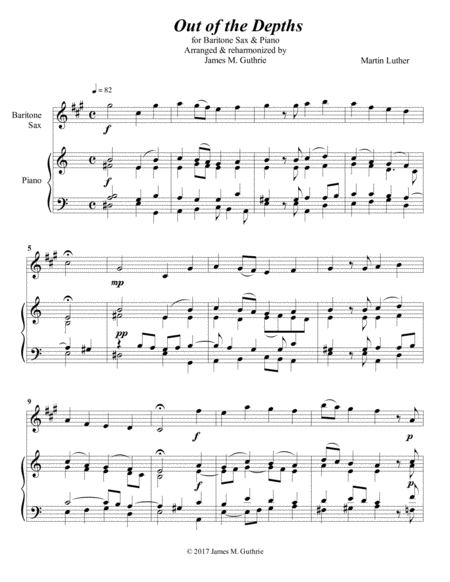
Luther: Out of the Depths for Baritone Sax & Piano
Saxophone Baryton, Piano

$24.95 21.43 € Saxophone Baryton, Piano PDF SheetMusicPlus

Piano Solo - Digital Download SKU: A0.1014883 Composed by Damien Gauci. 20th Century,Contemporary. Score. 2 pages. Damien Gauci #4783383. Published by Damien Gauci (A0.1014883). This piece was inspired by Chopin's pieces 'Nocturne in C# Minor' and Prelude Op. 28, No. 4. The solemn, singing melody in the right hand is meant to be played as marked, 'cantabile'. This, along with the left hand slow moving arpeggios with some harmonious and dissonant parts creates a reflective, peaceful mood. Whilst writing this piece I wanted to focus on writing a piece in binary form, as the second half of the piece shows. I still tried to keep the melodic melody in the right hand, but the left changes to a waltz like accompaniment. If I were to write this piece again, I may have explored the first part for much longer and made a nice transition into the second part. As for now, this is my last piece which I have composed at an earlier time. I am now going to start working on some new fresh pieces, focusing on certain aspects of music. Thanks again, Damien.
Lento in C# minor
Piano seul

$1.99 1.71 € Piano seul PDF SheetMusicPlus

Piano Solo - Level 5 - Digital Download SKU: A0.1216197 By Brian Golden. By Brian Golden. Arranged by Brian Golden. Classical,Contemporary. Score. 4 pages. Brian Golden #812808. Published by Brian Golden (A0.1216197). Prelude 12 in Bb Minor Dorian from 24 Preludes for the Piano in Major and Minor Modes by composer Brian Golden   The creative concept in writing these preludes is to provide a link to past preludes written for the keyboard, and in particular to the works of J.S. Bach and Frederic Chopin, whose works stand as essential repertoire for any student of the piano.  Using Bach’s and Chopin’s examples, my goal was to compose in all twenty-four keys, yet offer my own variation on the progression of key signatures – Bach’s being a pattern of major to parallel minor progressing chromatically through all keys, and Chopin’s a pattern of major to relative minor keys progressing clockwise through the circle of fifths.  In order to expand my harmonic and melodic possibilities, I have included the modal keys rather than only the major and harmonic minor keys, and have chosen to work counterclockwise through the circle of fifths, which is a more natural harmonic progression.  Therefore, all major preludes resolve from one to another V-I, as well as do all the minor preludes.    While there are seven modal scales, I decided to leave out the locrian modes for the following reasons.  First, due to the diminished fifth, the locrian mode cannot be thought of as either major nor minor.  Second, the locrian mode did not have a relative key to pair with, since there were no other keys with the identical characteristic notes.    In creating the key architecture, I determined that there was only one solution to pairing major and relative minor scales based on a shared parent key and characteristic note - ionian/aolian, mixolydian/phrygian and lydian/dorian.  This specific order of modal scales is the only order that would enable composing in all twelve key signatures.  Finally, the inspiration for each prelude came from playing through several other preludes in the same keys - mostly by Bach and Chopin - and letting their themes and styles influence me in the writing of my own.YouTube Link https://youtu.be/xb4E0I-vJek.
Prelude 12 in Bb Minor Dorian
Piano seul
Brian Golden
$5.99 5.15 € Piano seul PDF SheetMusicPlus

Piano Solo - Level 3 - Digital Download SKU: A0.1425802 By Damien Gauci. By Damien Gauci. Contemporary,New Age. Score. 5 pages. Damien Gauci #1006562. Published by Damien Gauci (A0.1425802). I had a lot of fun writing this piece. The idea came from one of my composition friends from my time at University. He enjoyed writing a lot of anime style music - especially using the anime chord progression which is what I use in the composition. I didn’t want to the piece to sound too much like an anime opening so I did alter the chord progression a little here and there just to make it’s own thing.I am quite happy with how this piece turned out though, the chord progression does provide for some really nice and smooth voice-leading which makes the whole composition more seamless. There are a few different melodies in this piece although I did try to use the one melody and create the other ones based off of that. That is a skill I’m still working on and it really pays off when it’s done well.
Fragrance
Piano seul
Damien Gauci
$1.99 1.71 € Piano seul PDF SheetMusicPlus

Brass Ensemble Horn,Trombone,Trumpet,Tuba - Level 2 - Digital Download SKU: A0.802647 By Bee Gees. By Barry Gibb, Maurice Gibb, and Robin Gibb. Arranged by Peet du Toit. Dance,Disco. Score and parts. 23 pages. Peet du Toit #6197563. Published by Peet du Toit (A0.802647). I've Gotta Get a Message to You is a song by the Bee Gees. Released as a single on 7 September 1968, it was their second number-one single on the UK Singles Chart and their first US Top 10 hit.The song is about a man who, awaiting his execution in the electric chair, begs the prison chaplain to pass a final message on to his wife. Robin Gibb, who wrote the lyrics, said that the man's crime was the murder of his wife's lover, though the lyrics do not explicitly allude to the identity of the victim. Robin said, This is about a prisoner on Death Row who only has a few hours to live. He wants the prison chaplain to pass on a final message to his wife. There's a certain urgency about it. Myself and Barry wrote it. It's a bit like writing a script. Sometimes you can sit there for three hours with your guitar and nothing will happen. Then in the last ten minutes something will spark. The song was written with Percy Sledge in mind to record it. Sledge did record it in February 1970 but Atlantic did not issue his version in the United States at the time.Barry recalled, In those days, the lyrics were almost pretty well done on the spot. I don't remember the fundamentals on how the lyrics were formed, except that we were writing about a guy on death row. That was it.Robin adds:It was like acting, you see, we said, let's pretend that somebody, his life is on the line, somebody's going to the chair. What would be going through their mind? Let's not make it doom and gloom but sort of an appeal to the person he loves. Because right now that's all he cares about. Regardless of whether he's done a bad thing, he is a human being, and he's sending out this last message. There's someone out there whom he loves. It's a torch song, but within a very sort of theatrical sense. Not sort of abstract, but definitely somebody in a very bad situation whose life is going to end. What would they be saying, you know? This is it: 'Gotta get a message to you, hold on.Revive this hit on your brass instruments and enjoy!
I've Gotta Get A Message To You
Quatuor de Cuivres : 2 trompettes, trombone, tuba
Bee Gees
$17.00 14.6 € Quatuor de Cuivres : 2 trompettes, trombone, tuba PDF SheetMusicPlus

Piano Solo - Level 4 - Digital Download SKU: A0.1292493 By Brian Golden. By Brian Golden. Arranged by Brian Golden. Classical,Contemporary. Score. 2 pages. Brian Golden #883006. Published by Brian Golden (A0.1292493). Prelude 19 in A Major Ionian from 24 Preludes for the Piano in Major and Minor Modes by composer Brian Golden   The creative concept in writing these preludes is to provide a link to past preludes written for the keyboard, and in particular to the works of J.S. Bach and Frederic Chopin, whose works stand as essential repertoire for any student of the piano.  Using Bach’s and Chopin’s examples, my goal was to compose in all twenty-four keys, yet offer my own variation on the progression of key signatures – Bach’s being a pattern of major to parallel minor progressing chromatically through all keys, and Chopin’s a pattern of major to relative minor keys progressing clockwise through the circle of fifths.  In order to expand my harmonic and melodic possibilities, I have included the modal keys rather than only the major and harmonic minor keys, and have chosen to work counterclockwise through the circle of fifths, which is a more natural harmonic progression.  Therefore, all major preludes resolve from one to another V-I, as well as do all the minor preludes.    While there are seven modal scales, I decided to leave out the locrian modes for the following reasons.  First, due to the diminished fifth, the locrian mode cannot be thought of as either major nor minor.  Second, the locrian mode did not have a relative key to pair with, since there were no other keys with the identical characteristic notes.    In creating the key architecture, I determined that there was only one solution to pairing major and relative minor scales based on a shared parent key and characteristic note - ionian/aolian, mixolydian/phrygian and lydian/dorian.  This specific order of modal scales is the only order that would enable composing in all twelve key signatures.  Finally, the inspiration for each prelude came from playing through several other preludes in the same keys - mostly by Bach and Chopin - and letting their themes and styles influence me in the writing of my own.
Prelude 19 in A Major Ionian
Piano seul
Brian Golden
$5.99 5.15 € Piano seul PDF SheetMusicPlus

Piano Solo - Digital Download SKU: A0.742388 Composed by Ede Poldini. Arranged by Arte Nova Music Lab. Children,Concert,Romantic Period,World. Score. 3 pages. Arte Nova Music Lab #3001375. Published by Arte Nova Music Lab (A0.742388). Ede Poldini (13 June 1869 – 28 June 1957) was a Hungarian composer of the late romantic / early modern period. Famous in Hungary for writing many operas, he became internationally famous when Fritz Kreisler transcribed his piano piece La poupée valsante for violin.Poldini studied with István Tomka in Budapest and with Eusebius Mandyczewski in Vienna. In 1908 he settled in Switzerland, writing two of his more famous operas: The Vagabond and the Princess (1903) and Wedding in Carnival Time(1924). These were both produced in London, the latter under the title Love Adrift. Himfy was produced in 1938 in Budapest.Poldini is best known for his miniature piano pieces, such as La poupée valsante, given wider audience in Fritz Kreisler's transcription, Arlequinades, Morceaux pittoresques, Episodes à la cour, Images, and Moments musicaux. Marionettes were seven piano pieces that he later orchestrated.His one-act opera Der Vagabund und die Prinzessin was given 14 times in Dresden in 1916/17 under Fritz Reiner with a cast including Ludwig Ermold, Minnie Nast, Georg Zottmayr and Richard Tauber.He died in Vevey, Switzerland in 1957, aged 88. Taken from https://en.wikipedia.org/wiki/Ede_Poldini
The Merry Mandarin - Piano
Piano seul

$10.00 8.59 € Piano seul PDF SheetMusicPlus

Jazz Ensemble - Digital Download SKU: AX.00-PC-0014297_TX1 B-flat Tenor Saxophone. Composed by Benny Carter. Instructional. Part. 4 pages. Alfred Music - Digital Sheet Music #00-PC-0014297_TX1. Published by Alfred Music - Digital Sheet Music (AX.00-PC-0014297_TX1). UPC: 038081331973.Symphony In Riffs is Benny Carter's most famous piece. Originally composed and arranged in the 1930's for 4 reeds and 5 brass, Benny re-scored this version for a larger band some 50 years later. Benny was known for his idiomatic saxophone writing and this chart is a great example of that. Just when you think that the soli chorus at D is as good as his saxophone writing can get, he modulates and tops it with the brilliant new section at I. This is a transitional piece between the pre-swing of the 1920s and the mid-1930s swing.
Symphony in Riffs: B-flat Tenor Saxophone
Saxophone (partie séparée)

$3.00 2.58 € Saxophone (partie séparée) PDF SheetMusicPlus

Piano Solo - Level 3 - Digital Download SKU: A0.998551 Composed by Julie Mandel. Contemporary. Score. 7 pages. Joopie Music #3533887. Published by Joopie Music (A0.998551). INTERVALS : 24 Works for Piano by Julie MandelA musician friend of mine once told me that her favorite songs were those that began with the jump of an octave. Like Somewhere Over The Rainbow. It got me to thinking about how the first two notes of any piece of music really set up what will follow. That octave jump, that interval, is only one of twenty-four possible intervals in a one-octave scale. That is to say, there are twenty-four different intervals with which to begin a piece of music. I have written these twenty-four pieces with the idea of having the first two notes of each of them start with a different interval.I’m delighted that pianists are starting to perform them in concert, and all 24 have been recorded by Hadassah Guttmann. The recording is widely available for purchase and download.Writing them has been like a series of adventures, each of which begins by taking the first two steps - and then discovering where they will lead. I hope you enjoy playing them as much as I enjoyed writing them.Julie Mandel, composerwww.juliemandel.com
INTERVALS: 24 Works for Piano - 4. A Whole Step Down
Piano seul

$4.00 3.44 € Piano seul PDF SheetMusicPlus


Partitions Gratuites
Acheter des Partitions Musicales
Acheter des Partitions Digitales à Imprimer
Acheter des Instruments de Musique

© 2000 - 2026

Accueil - Version intégrale





