EUROPE
4988 articles
USA
0 articles
DIGITAL
29059 articles (à imprimer)
Partitions Digitales
Partitions à imprimer
29059 partitions trouvées


Piano - Level 1 - Digital Download SKU: A0.1473897 Composed by Sarah Fawcett. Classical,Instructional. Score (Chords/Lyrics). 23 pages. Songburd Music #1051618. Published by Songburd Music (A0.1473897). Some of you may know that there are numerous benefits to playing music for your baby both in utero and after birth, and one aim of these lullabies is to enhance your and your baby’s special journey through a shared, intimate musical experience.These lullabies can be played by anyone with some basic piano or guitar skills. They came about at the request of some of my adult piano students, particularly pregnant mothers, new mothers, grandmothers, and grandfathers seeking something easy to play, preferably with chord symbols, for their newborns and young children.And so, these seven lullabies came into being. They are simple to play. Some of you may choose to use the chord symbols to create the chords on the piano or guitar rather than the notated accompaniment and add the tune while playing to your little ones. Others may prefer to use the full accompaniment. Elder siblings, significant others, family friends, and relatives also enjoy playing and sharing these songs.I hope you enjoy playing and singing them and that they will become enduring memories of these special times in your shared lives. They are dedicated to the youngest members of my family and come with my warmest wishes.
Lullaby Suite
Piano seul

$19.99 17.3 € Piano seul PDF SheetMusicPlus

Choir,Guitar,Piano - Digital Download SKU: A0.1069491 Composed by Joanna Mills. Children,Christian,Christmas,Sacred. Accompaniment. Duration 648. Joanna Mills Music #4890469. Published by Joanna Mills Music (A0.1069491). This charming, original musical retells the Christmas Story through the eyes of the angels and reminds us to always trust in God. In That’s How the Story Goes, the archangels Michael and Raphael are hosting a heavenly campfire, and all the youngest angels want to hear the Christmas Story. Happy to oblige, the other archangels take turns telling their parts of the story. Gabriel tells of visiting Mary, Uriel tells of visiting Joseph, Sealtiel & Jehudiel tell of their visit to the shepherds, and Barachiel tells of visiting the three wise men in their dreams to warn them about King Herod. That’s How the Story Goes features five original songs written and arranged for school-aged children by Joanna Mills. The songs are all set in an accessible range for young children, and feature simple tunes which are easy to learn. This mp3 contains piano accompaniment tracks for all 5 songs for use in rehearsals or performances. 
That's How the Story Goes - A Christmas Musical for Children

$9.99 8.65 € PDF SheetMusicPlus

Concert Band - Level 1 - Digital Download SKU: A0.1047521 By Kyle L. McKinzey. By Kyle L. McKinzey. Contest,Festival. Score and parts. 39 pages. KyleMac Music #652069. Published by KyleMac Music (A0.1047521). Marching In The Dark (Grade 1) is not your standard young band march. It has a modal melody and harmony but is easily playable and enjoyable melodies, where all sections get to shine.  Wind parts are playable by 1st-year players. Ranges are generally within the first 6 notes. Upper WW is mostly in unison with an occasional 2nd Clarinet split. Lower WW/Brass is mostly in unison as well. Trombones occasionally separates for harmonic depth and easier positions. The Trumpet split is like the Clarinet in that it is rare and used for harmonic support and lower range for the youngest players. Percussion parts are more “advancedâ€, but still easily performed using fewer players and simplified parts provided.  WOODWINDS - Fl, Ob, Bsn, Clar(2), BC, AS, TS, BS. BRASS - Trpt(2), Hn, Tbn, Euph, Tu (Low BR/WW mostly unison) PERCUSSION- Bells, Xylophone, SD, BD, Tenor Drum, Timp, Cr. Cym., Tamb. Triangle.
Marching In The Dark
Orchestre d'harmonie
Kyle L McKinzey
$25.00 21.64 € Orchestre d'harmonie PDF SheetMusicPlus

Concert Band - Level 1 - Digital Download SKU: A0.998361 Composed by Aaron Fonzi. Contemporary,Standards. Score and parts. 101 pages. Aaron Fonzi #6089967. Published by Aaron Fonzi (A0.998361).      Composed in honor of women's history month, First Symphony for Beginning Band is a unique piece that depicts four important women throughout our history. Movement 1 depicts the harrowing tale of Sojourner Truth's escape from slavery. She went on to become one of the most influential abolitionists in history- both an icon for racial justice and women's rights.The second movement depicts the innocence of a young Malala, who stood up against the Taliban's exclusion of women's rights to education. At the age of 15, she was shot in the head three times on a school bus as she was on her way home. Miraculously, she survived and went on to win a Nobel Peace Prize (she is the youngest person to ever earn this prestigious award. Still alive today, Malala is currently studying at Oxford and runs the Malala Fund, which advocates for quality education for all girls.      Movement 3 captures the energy, cunning and adventurous nature of Amelia Earhart. She was the first woman to fly the Atlantic, and her disappearance is one of the greatest mysteries of our time. Rehearsal D represents her flight over the open seas and Rehearsal E depicts the unresolved tragedy of her disappearance. Finally, the 4th movement honors the only person to win Nobel Prizes in two separate sciences, Marie Curie. Her scientific, methodical approach to exploration and discovery are depicted here via the fragmented eighth note motifs and methodical percussion writing.      I hope your students will enjoy the catchy hooks and melodies, and I hope that this piece can serve as a valuable reminder of the infinite capacity of the human spirit. Most importantly, may we continue to strive to make this world a better place for all! Onward, Aaron Fonzi.
First Symphony for Beginning Band
Orchestre d'harmonie

$25.00 21.64 € Orchestre d'harmonie PDF SheetMusicPlus

String Orchestra - Level 4 - Digital Download SKU: A0.922639 Composed by Johann Strauss Jr. Arranged by Aaron Meier. Romantic Period,World. Score and parts. 1 pages. Aaron Meier #5792379. Published by Aaron Meier (A0.922639). Original by Johann Strauss II Reduction to String Orchestra by Aaron Meier Part: Double Bass True to the original work by Strauss, this reduction for string orchestra features the ornaments and mystical writing that defines Strauss' polkas. There are optional percussion parts to be added at the discretion of the ensemble, however even without percussion the ensemble will sound full (the percussion acts as an ornament). Difficulty: Intermediate-advanced - advanced (best-suited for advanced student ensembles) --- Performance Notes: • Approximate length: 3:30 minutes • 1st Violins: In m. 1, trill a half step from a Dâ™­ to a Dâ™®  • 2nd Violins:  - At m. 42, divide players by 3, with 2 players playing line A and the remaining player playing line B  - At m. 72-75, emphasize the Eâ™­ in the div. • Snare Drum: The buzz roll needs to be quieter than how it is played in the midi recording (*see YouTube link ↓) History: The Olga-Polka itself owed its creation to a Russian royal wedding which took place in St. Petersburg on 28 August 1857. On that day, amid accompanying splendour, the music-loving Grand Duke Michail Nikolaievich (1832-1909), youngest brother of Tsar Alexander II, married Princess Caecilie of Baden (1839-91), daughter of Archduke Leopold of Baden. Johann Strauss, who at that time was giving a summer season of concerts in nearby Pavlovsk, used the opportunity occasioned by the event to enhance his already enviable popularity with the Russian royal family and composed the Caecilien-Polka in honour of the lovely young bride. Indeed, it is clear from a letter which Johann wrote in late July 1857 to Carl Haslinger, his publisher in Vienna, that the new polka had been prepared well in advance of the wedding (the fair copy of the full orchestral score made for the publisher's engraver is dated 9 August) and was enjoying success even before the royal couple's official engagement on 16August 1857. Sometime after performing the Caecilien-Polka in Pavlovsk, Johann despatched the work to the Austrian capital where his brother Josef conducted its Viennese première, together with that of Johann's waltz Telegraphische Depeschen (op. 195, Volume 28), at his own benefit concert in the Volksgartenon Sunday 18 October 1857. The Wiener Allgemeine Theaterzeitung (16.10.1857) remarked that both works have caused a sensation in St. Petersburg and are truly genial Viennese sounds full of verve and melody. Since tradition demanded that the German Princess Caecilie adopt a Russian name - Olga Feodorovna - before her marriage, so Johann's Caecilien-Polka also underwent a change of identity. On 8 December 1857 Carl Haslinger announced the publication of Strauss's Olga-Polka, on the title page of which is the inscription: Dedicated to her Imperial Highness Grand Duchess Olga, née Princess of Baden. It was under this title, too, that Johann himself first conducted the work in Vienna at a concert in the Volksgarten on 1 November 1857, shortly after his return from Russia. Reporting on this event, the Wiener Allgemeine Theaterzeitung (3.11.1857) observed: The 'Olga-Polka' is a most delightful, fragrant musical bouquet, full of fine, gracious rhythms. [excerpted from NAXOS Records] Kemp, Peter. Program Notes - About this Recording. NAXOS, 1993, www.naxos.com/mainsite/blurbs_reviews.asp?item_code=8.223232&catNum=223232&filetype=About%20.......... Accessed 5 June 2020. Resources: • Visit.
Olga-Polka, Op. 196 (arr. for string orchestra): Double Bass
Orchestre à Cordes

$3.99 3.45 € Orchestre à Cordes PDF SheetMusicPlus

Large Ensemble French Horn,Piano - Level 3 - Digital Download SKU: A0.818349 By Stephen R Dalrymple. By Joseph Gilmore & William Bradbury. Arranged by Stephen R Dalrymple (Dalrymple Designs). Sacred. Score and part. 59 pages. Stephen R Dalrymple #6359211. Published by Stephen R Dalrymple (A0.818349). He Leadeth Me – arranged for French Horn & Piano by Stephen R Dalrymple ♫ He Leadeth Me by Joseph H. Gilmore (lyrics 1862) & William B. Bradbury (music 1864) ♫ arranged for French Horn solo by Stephen R Dalrymple ♫ transcribed for flute, clarinet, trumpet, euphonium, violin, and cello by the arranger ♫ sequenced by the arranger ♫ music © 2011, 2021 Stephen R Dalrymple ♫ recording ℗ 2021 Stephen R Dalrymple ♫ presentation © 2021 Stephen R Dalrymple ♫ Joseph Gilmore told the story of the writing of these lyrics, “As a young man who recently had been graduated from Brown University and Newton Theological Institution, I was supplying for a couple of Sundays the pulpit of the First Baptist Church in Philadelphia. At the midweek service, on the 26th of March,1862, I set out to give the people an exposition of the 23rd Psalm… I did not get further than the words ‘He Leadeth Me.’ Those words took hold of me as they had never done before, and I saw them in a significance and wondrous beauty of which I had never dreamed. It was the darkest hour of the Civil War. … ♫ This arrangement was written for my youngest daughter, Willa. ♫ This .pdf file includes 16 score choices • Full Score for French Horn and Piano letter size • Letter size parts for Flute, Clarinet, Trumpet, Euphonium (or trombone), Violin, and Cello, • Full Score small page format for performing from a 10 inch tablet for flute and piano and • the same solo parts for 10 inch tablet. tablet ♫ Tell your computer which pages you want to print. There are programs online that will allow you to split pdf files so that you can choose the correct part of the pdf for your tablet.
He Leadeth Me
Stephen R Dalrymple
$4.50 3.89 € PDF SheetMusicPlus

Chamber Music, Orchestra Alto Saxophone Solo (part) Violins (6 parts) Violins 2 (6 parts) Violas (4 parts) Cellos (3 parts) - Grade 3 - Digital Download SKU: FX.FX071682 Composed by Arnaud Meier. Original Composition. Classical. Score and Set of Parts. FLEX Editions - Digital Sheet Music #FX071682. Published by FLEX Editions - Digital Sheet Music (FX.FX071682). Trois Soeurs describes a portrait of three young sisters, each with its own character. The eldest is sulky, the second is joyful and the youngest is playful. These characters are transmitted musically in different ways. The sulkiness of the eldest is characterized by languishing third, the joy of the second by a waltz in C major and the playful character of the latter by a faster movement. - Arnaud Meier ; Instruments: Alto Saxophone Solo (1 part) Violins 1 (6 parts) Violins 2 (6 parts) Violas (4 parts) Cellos (3 parts); Difficuly Level: Grade 3; Duration: 4 minutes 10 seconds; Musical Style: Classical; Category: Original Composition; Composer: Arnaud Meier;.
Trois Soeurs

$21.95 19 € PDF SheetMusicPlus

Piano Solo - Level 5 - Digital Download SKU: A0.1110965 Composed by Adrienne Inglis (ASCAP). 20th Century,Classical,Historic,Multicultural,World. Score. 24 pages. Adrienne Inglis (ASCAP) #713232. Published by Adrienne Inglis (ASCAP) (A0.1110965). Colorful, challenging piano solo traces an Ojibwe family’s harrowing journey by canoe down the Brule River and across Lake Superior to safety Canoe (2022) by Adrienne Inglis (ASCAP) For solo piano Duration 9:22 Difficulty 5 advanced Canoe (2022) by Adrienne Inglis (ASCAP), commissioned by Dr. Joseph Choi for solo piano, tells a harrowing story through music of the composer’s Ojibwe ancestor, Wabegiah, and her three young children. Wabegiah grew up at Upper Lake St. Croix in Wisconsin, married the French trader Mr. Couture, and had three children. Mr. Couture died suddenly just as the tensions with the Sioux became quite threatening. To protect her children from being killed by the Sioux, she took them on the long journey in a birch bark canoe down the Brule River and along the coast of Lake Superior all the way to Sault Ste. Marie. As you would expect, much of the music represents water, but it also captures moments during their flight. Loud dissonant chords mark Mr. Couture’s death and Wabegiah’s grief. The unsettling fear motive in Locrian mode predominates as they begin to flee. As they head away from danger, the courage theme follows them downstream. In a dissonant conversation with an Ojibwe man on the Brule River, he refused to give the hungry travelers food, but told them to continue to the river’s mouth to find Wabegiah’s aunt and uncle. The restful and nourishing family time on the shores of Lake Superior allows for variations on the family theme, playful, sleepy, and reflecting on the coming of autumn. With the courage theme as the subject, a fugue tracks their difficult passage across Lake Superior to the safety of Sault Ste. Marie. Recounted by Eliza Morrison, a daughter from Wabegiah’s second marriage, this journey took place in the early 1830s. The three children were born in 1828, 1829, and 1830. The youngest of the children was Angelique, the composer’s great great grandmother.
Canoe for solo piano
Piano seul

$9.99 8.65 € Piano seul PDF SheetMusicPlus

Chamber Orchestra - Level 4 - Digital Download SKU: A0.922640 Composed by Johann Strauss Jr. Arranged by Aaron Meier. Romantic Period,World. Score and parts. 1 pages. Aaron Meier #5792381. Published by Aaron Meier (A0.922640). Original by Johann Strauss II Reduction to String Orchestra by Aaron Meier Part: *Optional Percussion (snare drum, triangle, cymbals) True to the original work by Strauss, this reduction for string orchestra features the ornaments and mystical writing that defines Strauss' polkas. There are optional percussion parts to be added at the discretion of the ensemble, however even without percussion the ensemble will sound full (the percussion acts as an ornament). Difficulty: Intermediate-advanced - advanced (best-suited for advanced student ensembles) --- Performance Notes: • Approximate length: 3:30 minutes • 1st Violins: In m. 1, trill a half step from a Dâ™­ to a Dâ™®  • 2nd Violins:  - At m. 42, divide players by 3, with 2 players playing line A and the remaining player playing line B  - At m. 72-75, emphasize the Eâ™­ in the div. • Snare Drum: The buzz roll needs to be quieter than how it is played in the midi recording (*see YouTube link ↓) History: The Olga-Polka itself owed its creation to a Russian royal wedding which took place in St. Petersburg on 28 August 1857. On that day, amid accompanying splendour, the music-loving Grand Duke Michail Nikolaievich (1832-1909), youngest brother of Tsar Alexander II, married Princess Caecilie of Baden (1839-91), daughter of Archduke Leopold of Baden. Johann Strauss, who at that time was giving a summer season of concerts in nearby Pavlovsk, used the opportunity occasioned by the event to enhance his already enviable popularity with the Russian royal family and composed the Caecilien-Polka in honour of the lovely young bride. Indeed, it is clear from a letter which Johann wrote in late July 1857 to Carl Haslinger, his publisher in Vienna, that the new polka had been prepared well in advance of the wedding (the fair copy of the full orchestral score made for the publisher's engraver is dated 9 August) and was enjoying success even before the royal couple's official engagement on 16August 1857. Sometime after performing the Caecilien-Polka in Pavlovsk, Johann despatched the work to the Austrian capital where his brother Josef conducted its Viennese première, together with that of Johann's waltz Telegraphische Depeschen (op. 195, Volume 28), at his own benefit concert in the Volksgartenon Sunday 18 October 1857. The Wiener Allgemeine Theaterzeitung (16.10.1857) remarked that both works have caused a sensation in St. Petersburg and are truly genial Viennese sounds full of verve and melody. Since tradition demanded that the German Princess Caecilie adopt a Russian name - Olga Feodorovna - before her marriage, so Johann's Caecilien-Polka also underwent a change of identity. On 8 December 1857 Carl Haslinger announced the publication of Strauss's Olga-Polka, on the title page of which is the inscription: Dedicated to her Imperial Highness Grand Duchess Olga, née Princess of Baden. It was under this title, too, that Johann himself first conducted the work in Vienna at a concert in the Volksgarten on 1 November 1857, shortly after his return from Russia. Reporting on this event, the Wiener Allgemeine Theaterzeitung (3.11.1857) observed: The 'Olga-Polka' is a most delightful, fragrant musical bouquet, full of fine, gracious rhythms. [excerpted from NAXOS Records] Kemp, Peter. Program Notes - About this Recording. NAXOS, 1993, www.naxos.com/mainsite/blurbs_reviews.asp?item_code=8.223232&catNum=223232&filetype=About%20.......... Accessed 5 June 2020.
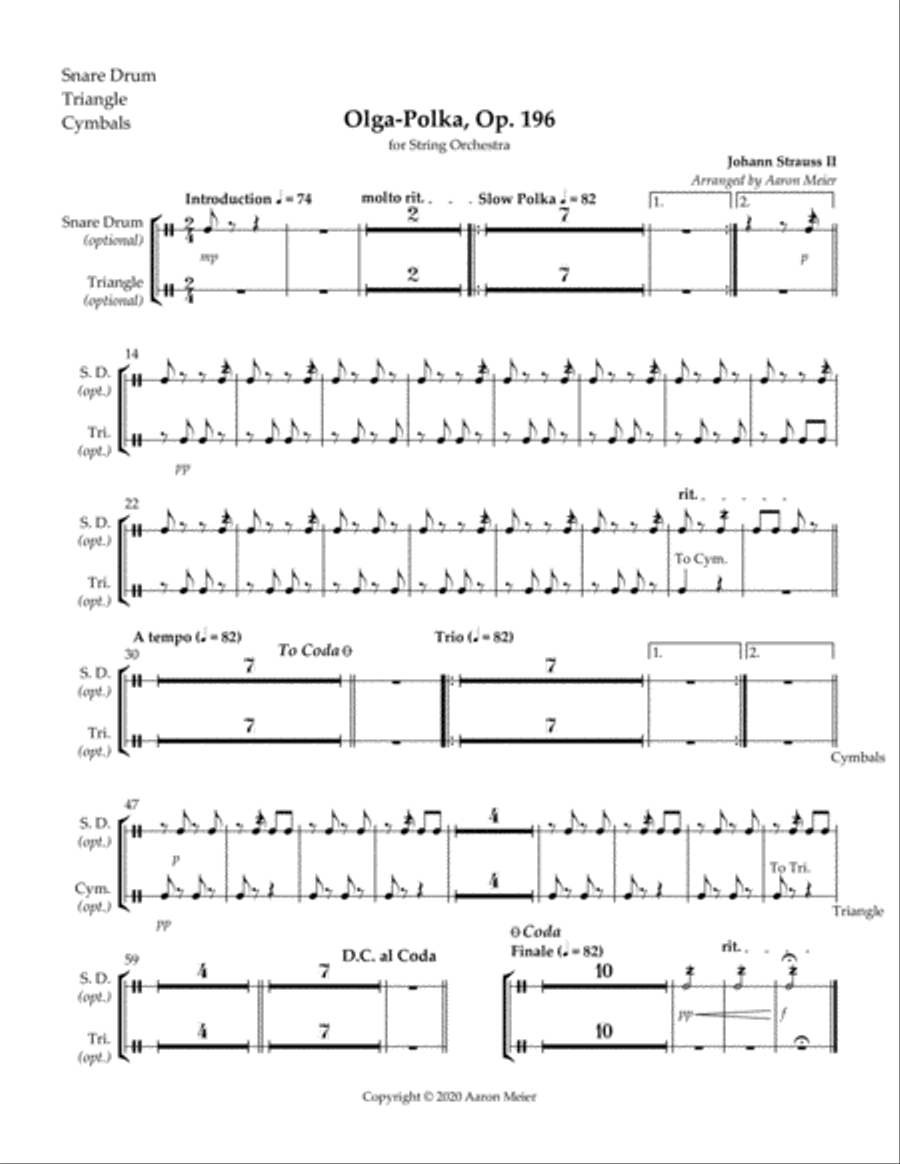
Olga-Polka, Op. 196 (arr. for string orchestra): Optional Percussion
Orchestre de chambre

$3.99 3.45 € Orchestre de chambre PDF SheetMusicPlus

String Orchestra - Level 4 - Digital Download SKU: A0.922634 Composed by Johann Strauss Jr. Arranged by Aaron Meier. Romantic Period,World. Score and parts. 1 pages. Aaron Meier #5792359. Published by Aaron Meier (A0.922634). Original by Johann Strauss II Reduction to String Orchestra by Aaron Meier Part: Violin I True to the original work by Strauss, this reduction for string orchestra features the ornaments and mystical writing that defines Strauss' polkas. There are optional percussion parts to be added at the discretion of the ensemble, however even without percussion the ensemble will sound full (the percussion acts as an ornament). Difficulty: Intermediate-advanced - advanced (best-suited for advanced student ensembles) --- Performance Notes: • Approximate length: 3:30 minutes • 1st Violins: In m. 1, trill a half step from a Dâ™­ to a Dâ™®  • 2nd Violins:  - At m. 42, divide players by 3, with 2 players playing line A and the remaining player playing line B  - At m. 72-75, emphasize the Eâ™­ in the div. • Snare Drum: The buzz roll needs to be quieter than how it is played in the midi recording (*see YouTube link ↓) History: The Olga-Polka itself owed its creation to a Russian royal wedding which took place in St. Petersburg on 28 August 1857. On that day, amid accompanying splendour, the music-loving Grand Duke Michail Nikolaievich (1832-1909), youngest brother of Tsar Alexander II, married Princess Caecilie of Baden (1839-91), daughter of Archduke Leopold of Baden. Johann Strauss, who at that time was giving a summer season of concerts in nearby Pavlovsk, used the opportunity occasioned by the event to enhance his already enviable popularity with the Russian royal family and composed the Caecilien-Polka in honour of the lovely young bride. Indeed, it is clear from a letter which Johann wrote in late July 1857 to Carl Haslinger, his publisher in Vienna, that the new polka had been prepared well in advance of the wedding (the fair copy of the full orchestral score made for the publisher's engraver is dated 9 August) and was enjoying success even before the royal couple's official engagement on 16August 1857. Sometime after performing the Caecilien-Polka in Pavlovsk, Johann despatched the work to the Austrian capital where his brother Josef conducted its Viennese première, together with that of Johann's waltz Telegraphische Depeschen (op. 195, Volume 28), at his own benefit concert in the Volksgartenon Sunday 18 October 1857. The Wiener Allgemeine Theaterzeitung (16.10.1857) remarked that both works have caused a sensation in St. Petersburg and are truly genial Viennese sounds full of verve and melody. Since tradition demanded that the German Princess Caecilie adopt a Russian name - Olga Feodorovna - before her marriage, so Johann's Caecilien-Polka also underwent a change of identity. On 8 December 1857 Carl Haslinger announced the publication of Strauss's Olga-Polka, on the title page of which is the inscription: Dedicated to her Imperial Highness Grand Duchess Olga, née Princess of Baden. It was under this title, too, that Johann himself first conducted the work in Vienna at a concert in the Volksgarten on 1 November 1857, shortly after his return from Russia. Reporting on this event, the Wiener Allgemeine Theaterzeitung (3.11.1857) observed: The 'Olga-Polka' is a most delightful, fragrant musical bouquet, full of fine, gracious rhythms. [excerpted from NAXOS Records] Kemp, Peter. Program Notes - About this Recording. NAXOS, 1993, www.naxos.com/mainsite/blurbs_reviews.asp?item_code=8.223232&catNum=223232&filetype=About%20.......... Accessed 5 June 2020. Resources: • Visit
Olga-Polka, Op. 196 (arr. for string orchestra): Violin I
Orchestre à Cordes

$3.99 3.45 € Orchestre à Cordes PDF SheetMusicPlus

Choral Choir (2-Part) - Level 1 - Digital Download SKU: A0.805210 By Joanna Mills. By Joanna Mills. Arranged by Joanna Mills. Broadway,Children,Christmas,Holiday,Musical/Show,Sacred. Octavo. 76 pages. Joanna Mills Music #412247. Published by Joanna Mills Music (A0.805210). This charming, original musical pageant retells the Christmas Story through the eyes of the angels and reminds us to always trust in God. In That’s How the Story Goes, the archangels Michael and Raphael are hosting a heavenly campfire, and all the youngest angels want to hear the Christmas Story. Happy to oblige, the other archangels take turns telling their parts of the story. Gabriel tells of visiting Mary, Uriel tells of visiting Joseph, Sealtiel & Jehudiel tell of their visit to the shepherds, and Barachiel tells of visiting the three wise men in their dreams to warn them about King Herod. The musical features a simple script with minimal memorization which allows for maximum flexibility with age-range, cast size, and rehearsal time-- the longer, adapted scripture readings may be read from a book or binder. Each part of the story is followed by an original song sung by the entire cast. Costumes, sets, and props are also minimal, and there are no scene changes, which allow this show to be staged in any space, including traditional church sanctuaries. Approximate performance time 30 minutes That’s How the Story Goes features five original songs written and arranged for school-aged children by Joanna Mills. The songs are all set in an accessible range for young children, and feature simple tunes which are easy to learn. This package contains two versions of each song; an easy unison version (with optional easy descant or counterpoint harmonies on the final chorus), and a 2-part choir version, which features simple, easy-to-learn harmonies. This allows you to mix and match your arrangements to suit the abilities of your singers and your rehearsal time constraints. For those students who do not read music, the lyrics are included in the script. The piano accompaniments are at an intermediate level and guitar chords are included, which allows older youth to participate as musicians (or allows experienced accompanists to learn them quickly). This complete package contains: • Director’s notes – including suggestions for staging and casting • List of props and costumes • Five songs with the following arrangements provided for each song: o Unison lyric sheets included in the script (for children who do not read music) o Unison Choir arrangement with piano accompaniment and guitar chords o 2-Part Choir arrangement with piano accompaniment and guitar chords visit www.joannamills.ca for more savings and free offers.
That's How the Story Goes - A Christmas Musical for Children
Chorale 2 parties
Joanna Mills
$4.99 4.32 € Chorale 2 parties PDF SheetMusicPlus

String Orchestra - Level 4 - Digital Download SKU: A0.922636 Composed by Johann Strauss Jr. Arranged by Aaron Meier. Romantic Period,World. Score and parts. 1 pages. Aaron Meier #5792367. Published by Aaron Meier (A0.922636). Original by Johann Strauss II Reduction to String Orchestra by Aaron Meier Part: Violin II True to the original work by Strauss, this reduction for string orchestra features the ornaments and mystical writing that defines Strauss' polkas. There are optional percussion parts to be added at the discretion of the ensemble, however even without percussion the ensemble will sound full (the percussion acts as an ornament). Difficulty: Intermediate-advanced - advanced (best-suited for advanced student ensembles) --- Performance Notes: • Approximate length: 3:30 minutes • 1st Violins: In m. 1, trill a half step from a Dâ™­ to a Dâ™®  • 2nd Violins:  - At m. 42, divide players by 3, with 2 players playing line A and the remaining player playing line B  - At m. 72-75, emphasize the Eâ™­ in the div. • Snare Drum: The buzz roll needs to be quieter than how it is played in the midi recording (*see YouTube link ↓) History: The Olga-Polka itself owed its creation to a Russian royal wedding which took place in St. Petersburg on 28 August 1857. On that day, amid accompanying splendour, the music-loving Grand Duke Michail Nikolaievich (1832-1909), youngest brother of Tsar Alexander II, married Princess Caecilie of Baden (1839-91), daughter of Archduke Leopold of Baden. Johann Strauss, who at that time was giving a summer season of concerts in nearby Pavlovsk, used the opportunity occasioned by the event to enhance his already enviable popularity with the Russian royal family and composed the Caecilien-Polka in honour of the lovely young bride. Indeed, it is clear from a letter which Johann wrote in late July 1857 to Carl Haslinger, his publisher in Vienna, that the new polka had been prepared well in advance of the wedding (the fair copy of the full orchestral score made for the publisher's engraver is dated 9 August) and was enjoying success even before the royal couple's official engagement on 16August 1857. Sometime after performing the Caecilien-Polka in Pavlovsk, Johann despatched the work to the Austrian capital where his brother Josef conducted its Viennese première, together with that of Johann's waltz Telegraphische Depeschen (op. 195, Volume 28), at his own benefit concert in the Volksgartenon Sunday 18 October 1857. The Wiener Allgemeine Theaterzeitung (16.10.1857) remarked that both works have caused a sensation in St. Petersburg and are truly genial Viennese sounds full of verve and melody. Since tradition demanded that the German Princess Caecilie adopt a Russian name - Olga Feodorovna - before her marriage, so Johann's Caecilien-Polka also underwent a change of identity. On 8 December 1857 Carl Haslinger announced the publication of Strauss's Olga-Polka, on the title page of which is the inscription: Dedicated to her Imperial Highness Grand Duchess Olga, née Princess of Baden. It was under this title, too, that Johann himself first conducted the work in Vienna at a concert in the Volksgarten on 1 November 1857, shortly after his return from Russia. Reporting on this event, the Wiener Allgemeine Theaterzeitung (3.11.1857) observed: The 'Olga-Polka' is a most delightful, fragrant musical bouquet, full of fine, gracious rhythms. [excerpted from NAXOS Records] Kemp, Peter. Program Notes - About this Recording. NAXOS, 1993, www.naxos.com/mainsite/blurbs_reviews.asp?item_code=8.223232&catNum=223232&filetype=About%20.......... Accessed 5 June 2020. Resources: • Visit

Olga-Polka, Op. 196 (arr. for string orchestra): Violin II
Orchestre à Cordes

$3.99 3.45 € Orchestre à Cordes PDF SheetMusicPlus


Partitions Gratuites
Acheter des Partitions Musicales
Acheter des Partitions Digitales à Imprimer
Acheter des Instruments de Musique

© 2000 - 2026

Accueil - Version intégrale




