EUROPE
113756 articles
USA
109742 articles
DIGITAL
186741 articles (à imprimer)
Partitions Digitales
Partitions à imprimer
186741 partitions trouvées


String Ensemble,String Trio Cello - Level 3 - Digital Download SKU: A0.552065 Composed by Johann Pachelbel. Arranged by James M. Guthrie. Baroque,Instructional,Standards,Wedding. Score and parts. 16 pages. Jmsgu3 #6105689. Published by jmsgu3 (A0.552065). Score: 9 pagesDuration: 2:40. The famous Pachelbel Canon arranged for Piano Trio. A great choice for weddings & receptions! Pachelbel's Canon Pachelbel's Canon is, in fact, the traditional title for a composition by the German composer Johann Pachelbel. Other names for the work include namely: Canon and Gigue for 3 violins and basso continuo, Canon and Gigue in D, and of course Canon in D. We do not know when or why in particular it was written. The oldest copy is surprisingly from the 19th century. It is important to realize that it was a common routine for organists to practice improvisation on the chord progression underlying the canon. Pachelbel originally scored the Canon notably for three violins and continuo. He also in fact paired the Canon with a gigue. The movements are homotonal, to clarify, both are in the key of D major. History In due time, Pachelbel's Canon went out of style and remained in virtual oblivion for centuries. The Jean-François Paillard chamber orchestra, however, recorded an arrangement of it in 1968. As a result, it gained approval. Many ensembles began likewise to record the piece in the 1970s and by the 1980s became ubiquitous as background music. From the 1970s to the early 2000s, pop songs correspondingly used elements of the piece. The chord progression, in particular, was used this way. Also, since the 1980s, it has been not only wildly popular for weddings, but also for funeral ceremonies in the USA and Europe. Pachelbel Background Johann Pachelbel (1653 –1706) was a German composer, as well as an organist. He was furthermore instrumental in bringing the south German organ school to its apex. He wrote a large body of music, both sacred and, equally important, secular. In particular, he uniquely helped develop the chorale prelude and fugue. For this, he has, in fact, earned a rightful place in the company of the most significant composers of the mid-Baroque period. Works Pachelbel's music was certainly popular. With this in mind, he also consequently had many pupils. His music expressly developed into a model for south German composers. Nowadays, Pachelbel is most famous, particularly for the Canon in D, as well as the F minor Chaconne, the Toccata in E minor, and of course the Hexachordum Apollinis, a set of variations for the keyboard. Influences Johann Jakob Froberger and Johann Caspar Kerll were south German composers who significantly influenced Pachelbel. Furthermore, he was especially influenced by Italians such as Frescobaldi and Poglietti. He frequently preferred an articulate, simple contrapuntal style that highlighted clarity. His music is markedly less extravagant and harmonically adventurous than that of Dieterich Buxtehude. However, as a point often overlooked, like Buxtehude, Pachelbel experimented with different instrumental combinations in his chamber music. Legacy All in all, Pachelbel was most famous as a composer for the keyboard. He composed over two hundred pieces specifically for the instrument. Pachelbel was also surprisingly a prolific composer of vocal music. All in all, about a hundred vocal works survive, including 40 or so large-scale works.
Pachelbel: Canon in D for Piano Trio
Trio à Cordes: 3 violoncelles

$36.95 31.71 € Trio à Cordes: 3 violoncelles PDF SheetMusicPlus

Organ,Trumpet - Level 3 - Digital Download SKU: A0.1000578 Composed by Dietrich Buxtehude (1637-1707). Arranged by Matthias Eckart - Edition Ensemble Akzente. Baroque. 25 pages. Matthias Eckart #6347541. Published by Matthias Eckart (A0.1000578). Fanfare & Chorus from cantata „Ihr lieben Christen, freut euch nun from Dietrich Buxtehude (1637-1707) is a powerful baroque piece for three trumpets and organ (timpani ad lib.). Trumpet parts in Bb, C, D and A are included. A virtuoso piece for concerts in three different keys Bb, C and D.Fanfare & Chorus aus der Kantate „Ihr lieben Christen, freut euch nun von Dietrich Buxtehude (1637-1707) ist ein kraftvolles Barockstück für drei Trompeten und Orgel (Pauken ad lib.). Trompetenstimmen in B, C, D und A sind vorhanden. Ein virtuoses Stück für Konzerte in drei unterschiedlichen Tonarten B-, C- und D-Dur..
Fanfare & Chorus from „Ihr lieben Christen, freut euch nun" Version in Bb, C & D - arrangement for
Orgue, Trompette (duo)

$17.00 14.59 € Orgue, Trompette (duo) PDF SheetMusicPlus

Organ,Trumpet - Level 3 - Digital Download SKU: A0.1000582 Composed by Dietrich Buxtehude (1637-1707). Arranged by Matthias Eckart - Edition Ensemble Akzente. Baroque. 22 pages. Matthias Eckart #6349665. Published by Matthias Eckart (A0.1000582). Fanfare & Chorus from cantata „Ihr lieben Christen, freut euch nun from Dietrich Buxtehude (1637-1707) is a powerful baroque piece for two trumpets and organ (timpani ad lib.). Trumpet parts in Bb, C, D and A are included. A virtuoso piece for concerts in three different keys Bb, C and D.Fanfare & Chorus aus der Kantate „Ihr lieben Christen, freut euch nun von Dietrich Buxtehude (1637-1707) ist ein kraftvolles Barockstück für zwei Trompeten und Orgel (Pauken ad lib.). Trompetenstimmen in B, C, D und A sind vorhanden. Ein virtuoses Stück für Konzerte in drei unterschiedlichen Tonarten B-, C- und D-Dur..
Fanfare & Chorus from „Ihr lieben Christen, freut euch nun" Version in Bb, C & D - arrangement for
Orgue, Trompette (duo)

$17.00 14.59 € Orgue, Trompette (duo) PDF SheetMusicPlus

Piano Solo - Level 3 - Digital Download SKU: A0.1096204 Composed by Johann Pachelbel. Arranged by James M. Guthrie. Baroque,Classical,Standards,Traditional,Wedding. Score. 4 pages. Jmsgu3 #700167. Published by jmsgu3 (A0.1096204). Score: 4 pages. Duration: 2:27. The famous Pachelbel Canon arranged for Solo Piano. A great choice for weddings & receptions! Pachelbel's Canon Pachelbel's Canon is, in fact, the traditional title for a composition by the German composer Johann Pachelbel. Other names for the work include namely: Canon and Gigue for 3 violins and basso continuo, Canon and Gigue in D, and of course Canon in D. We do not know when or why in particular it was written. The oldest copy is surprisingly from the 19th century. It is important to realize that it was a common routine for organists to practice improvisation on the chord progression underlying the canon. Pachelbel originally scored the Canon notably for three violins and continuo. He also in fact paired the Canon with a gigue. The movements are homotonal, to clarify, both are in the key of D major. History In due time, Pachelbel's Canon went out of style and remained in virtual oblivion for centuries. The Jean-François Paillard chamber orchestra, however, recorded an arrangement of it in 1968. As a result, it gained approval. Many ensembles began likewise to record the piece in the 1970s and by the 1980s became ubiquitous as background music. From the 1970s to the early 2000s, pop songs correspondingly used elements of the piece. The chord progression, in particular, was used this way. Also, since the 1980s, it has been not only wildly popular for weddings, but also for funeral ceremonies in the USA and Europe. Pachelbel Background Johann Pachelbel (1653 –1706) was a German composer, as well as an organist. He was furthermore instrumental in bringing the south German organ school to its apex. He wrote a large body of music, both sacred and, equally important, secular. In particular, he uniquely helped develop the chorale prelude and fugue. For this, he has, in fact, earned a rightful place in the company of the most significant composers of the mid-Baroque period. Works Pachelbel's music was certainly popular. With this in mind, he also consequently had many pupils. His music expressly developed into a model for south German composers. Nowadays, Pachelbel is most famous, particularly for the Canon in D, as well as the F minor Chaconne, the Toccata in E minor, and of course the Hexachordum Apollinis, a set of variations for the keyboard. Influences Johann Jakob Froberger and Johann Caspar Kerll were south German composers who significantly influenced Pachelbel. Furthermore, he was especially influenced by Italians such as Frescobaldi and Poglietti. He frequently preferred an articulate, simple contrapuntal style that highlighted clarity. His music is markedly less extravagant and harmonically adventurous than that of Dieterich Buxtehude. However, as a point often overlooked, like Buxtehude, Pachelbel experimented with different instrumental combinations in his chamber music. Legacy All in all, Pachelbel was most famous as a composer for the keyboard. He composed over two hundred pieces specifically for the instrument. Pachelbel was also surprisingly a prolific composer of vocal music. All in all, about a hundred vocal works survive, including 40 or so large-scale works.
Pachelbel: Canon in D for Solo Piano
Piano seul

$32.95 28.27 € Piano seul PDF SheetMusicPlus

Flute (oboe, violin) and basso continuo - intermediate - Digital Download SKU: S9.Q6991 Composed by Antonio Vivaldi. This edition: Sheet music. Il Flauto traverso. Die Fassung in D-Dur überzeugt durch ihre optimale Lage, die dem Soloinstrument mehr Leuchtkraft gibt. Sorgfältig edierte Erstausgabe mit Einführungstext. Downloadable. Schott Music - Digital #Q6991. Published by Schott Music - Digital (S9.Q6991). Key: D major.First edition based on a Dresden manuscript of Pisendel. Up until now, the sonata has been available in G major only, which is kept in the archives of the Berliner Liedertafel. As a result of more recent research, Prof. Nikolaus Delius managed to find a copy of the Sonata in D major made by Pisendel which is can be found in the Sächsische Landesbibliothek Dresden, and he ascribed the work to Vivaldi. The version in D major is convincing because of its ideal register which gives the solo instrument more intensity and brilliance. A carefully edited first edition with introductory text.
Sonata D major

$16.99 14.58 € PDF SheetMusicPlus

Piano,Vocal,Voice - Level 5 - Digital Download SKU: A0.1475998 By Sergei Rachmaninoff. By Sergei Rachmaninoff. Arranged by Russian for Singers. 19th Century,20th Century,Classical,Opera,Romantic Period. Score. 7 pages. Natalia Melnik #1053564. Published by Natalia Melnik (A0.1475998). S.Rachmaninoff ???????? ???? / Vesenniye Vody / Spring Waters  ?p 14 No 11Poem by F.TyutchevLower key (D-flat major)Range:D?4 (A?3 - optional) - G#5 (Soprano, Mezzo-Soprano)D?3 (A?2 - optional) - G#4 (Tenor)FREE DOWNLOAD! A quick and comprehensive tutorial on Russian phonetics:https://www.russian4singers.com/russian-diction-for-singers-1 FULL SONG PACK including Diction score (sheet music with IPA phonetics and translations), Diction audio guide, Music coaching audio guide (Voice line + piano line), Rehearsal backing track (Piano line only) https://www.russian4singers.com/product-page-2/s-rachmaninoff-spring-waters-op-14-n11-lower-key-d-flat-maj-full-packWe are offering a range of Russian diction coaching services:- individual coaching- group webinars- lectures on Russian Music Literature for singers?Please visit our website for more information https://www.russian4singers.com/bookingPlease SUBSCRIBE to Russian for Singers YouTube Channel and watch the free diction guide https://youtu.be/2w143pxe-JU?si=BQQAuqcpaK_Whp1b
RACHMANINOFF: Spring Waters Op.14 N11 Low key (D-flat maj). DICTION SCORE with IPA and translation
Piano, Voix
Sergei Rachmaninoff
$8.50 7.29 € Piano, Voix PDF SheetMusicPlus

Piano and voice - Digital Download SKU: LV.17563 Composed by J. Whitaker. Courtship & love--symbols. Lester S. Levy Collection. 2 pages. Published by Johns Hopkins University Sheridan Libraries (LV.17563). Fancy Dipp'd Her Pen In Dew. Written by C. Dibden, Esqr.; Composed by J. Whitaker. Published [n.d.] by Carr's Music Store, 78 1/2 Baltimore St. in Baltimore. Composition of strophic with chorus with piano and voice instrumentation. Subject headings for this piece include Courtship & love--symbols. First line reads Fancy dipp'd her Pen in Dew, Distill'd from leaves from leaves of gayest Flowers.. About The Lester S. Levy CollectionThe Lester S. Levy Collection of Sheet Music consists of over 29,000 pieces of American popular music. Donated to Johns Hopkins University Sheridan Libraries, the collection's strength is its thorough documentation of nineteenth-century American through popular music. This sheet music has been provided by Project Gado, a San Francisco Bay Area startup whose mission is to digitize and share the world's visual history.WARNING: These titles are provided as historical documents. Language and concepts within reflect the opinions and values of the time and may be offensive to some.
Fancy Dipp'd Her Pen In Dew
Piano, Voix

$5.99 5.14 € Piano, Voix PDF SheetMusicPlus

Easy Piano - Level 2 - Digital Download SKU: A0.1272797 By Antonio Vivaldi. By Antonio Vivaldi. Arranged by Darek. Baroque,Classical,Early Music. Score. 2 pages. Darek #864994. Published by Darek (A0.1272797). Gloria in D Major (EASY PIANO) I. Gloria in Excelsis Deo (RV 589) [Antonio Vivaldi]Simplified arrangement for pianists of Gloria in D Major I. Gloria in Excelsis Deo (RV 589) by Antonio Vivaldi. Easy version for pianists | Easy piano arrangement | Beginner Version | Easy Piano Sheet Music For Beginners | Classical Period | Baroque Music | Arrangement for Beginners | Piano | Keyboard |  For Novice Pianists. Included: Fingering, Dynamics, Articulations and video YouTube tutorial.  Embark on a heavenly musical journey with my handpicked selection of easy piano sheet music, perfectly tailored for beginner pianists. Immerse yourself in the majestic Gloria in D Major - Gloria in Excelsis Deo (RV 589) by Antonio Vivaldi, a true gem from the Baroque era. Experience the joy of playing this glorious masterpiece with my sheet music, thoughtfully prepared with fingering, articulation, and detailed dynamics markings, ensuring a seamless learning experience for aspiring pianists. Embrace the uplifting and celebratory spirit of the Gloria as you effortlessly master each note. To elevate your musical journey, I offer a valuable YouTube tutorial video, providing expert guidance and insights to refine your performance and capture the essence of Vivaldi's genius. Whether you're a novice seeking an enchanting challenge or an enthusiast eager to expand your repertoire, this easy-level arrangement is perfect for all piano enthusiasts. Embrace the magic of Vivaldi's Gloria and transport yourself to the captivating era of Baroque music. Keywords: easy piano sheet music, beginner pianists, Gloria in D Major, Gloria in Excelsis Deo, RV 589, Antonio Vivaldi, Baroque era, fingering, articulation, dynamics, YouTube tutorial, piano, notes, music, musicians, song, uplifting, classical music, genius, celebratory, repertoire, melodies.
Gloria in D Major (EASY PIANO) I. Gloria in Excelsis Deo (RV 589) [Antonio Vivaldi]
Piano Facile
Antonio Vivaldi
$3.00 2.57 € Piano Facile PDF SheetMusicPlus

Easy Piano - Level 2 - Digital Download SKU: A0.1272794 By Antonio Vivaldi. By Antonio Vivaldi. Arranged by Darek. Baroque,Classical,Early Music. Score. 2 pages. Darek #864991. Published by Darek (A0.1272794). Concerto for Lute, 2 Violins and Continuo in D Major (EASY PIANO) II. Largo (RV 93) [Antonio Vivaldi]Simplified arrangement for pianists of Concerto for Lute, 2 Violins and Continuo in D Major II. Largo (RV 93) by Antonio Vivaldi. Easy version for pianists | Easy piano arrangement | Beginner Version | Easy Piano Sheet Music For Beginners | Classical Period | Baroque Music | Arrangement for Beginners | Piano | Keyboard |  For Novice Pianists. Included: Fingering, Dynamics, Articulations and video YouTube tutorial.  Indulge in the enchanting world of classical music with my thoughtfully selected collection of easy piano sheet music, tailor-made for beginner pianists. Immerse yourself in the serene beauty of Concerto for Lute, 2 Violins and Continuo in D Major (RV 93) by Antonio Vivaldi, a captivating gem from the Baroque era. Experience the joy of playing this concerto with my sheet music, complete with fingering, articulation, and detailed dynamics markings, ensuring a seamless learning experience for aspiring pianists. Embrace the expressive and tender spirit of the Largo as you effortlessly master each note. To enrich your musical journey, I offer a valuable YouTube tutorial video, providing expert guidance and insights to refine your performance and capture the essence of Vivaldi's genius. Whether you're a novice seeking a delightful challenge or an enthusiast eager to expand your repertoire, this easy-level arrangement is perfect for all piano lovers. Embrace the magic of Vivaldi's Concerto and transport yourself to the captivating era of Baroque music. Keywords: easy piano sheet music, beginner pianists, Concerto for Lute, 2 Violins, D Major, Largo, RV 93, Antonio Vivaldi, Baroque era, fingering, articulation, dynamics, YouTube tutorial, piano, notes, music, musicians, song, expressive, classical music, genius, harmonious, repertoire, melodies.
Concerto for Lute, 2 Violins and Continuo in D Major (EASY PIANO) II. Largo (RV 93) [Antonio Vivaldi
Piano Facile
Antonio Vivaldi
$3.00 2.57 € Piano Facile PDF SheetMusicPlus

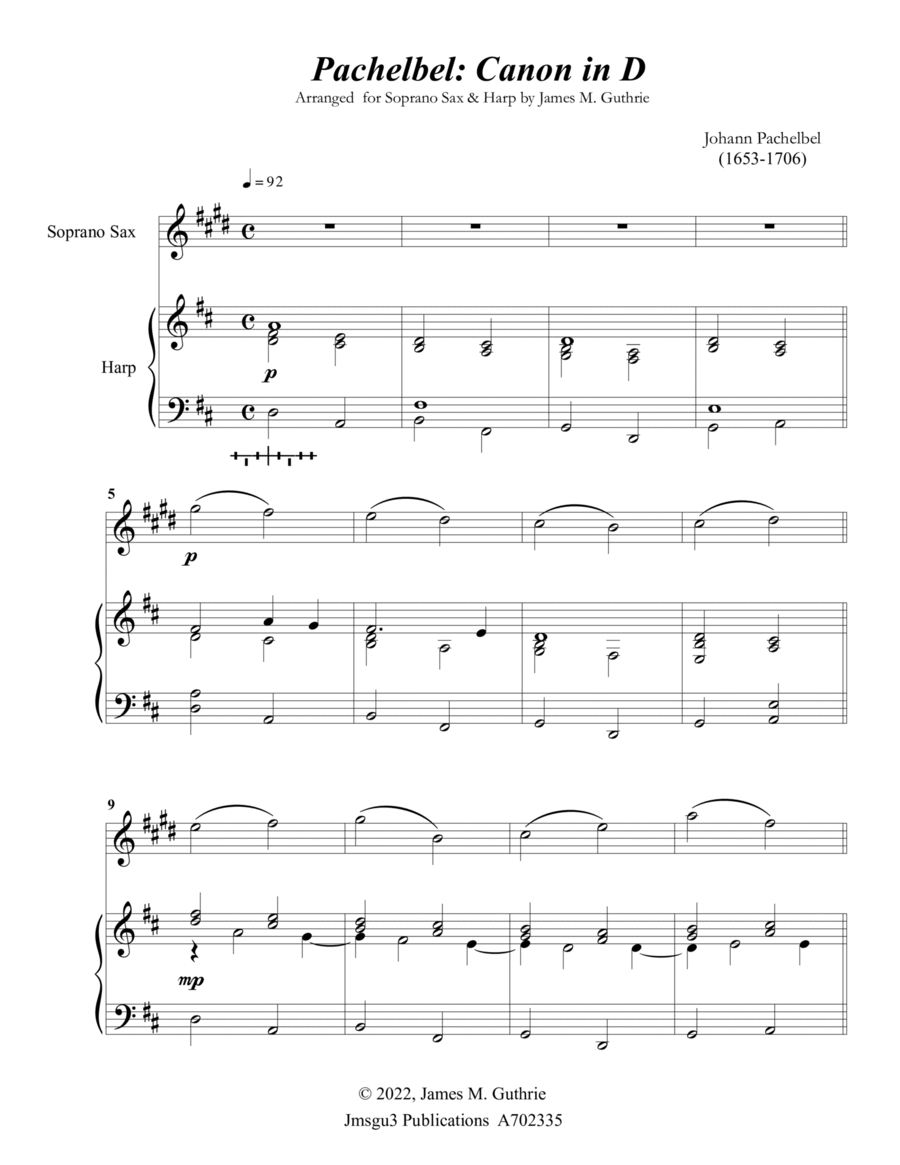
Instrumental Duet Harp,Instrumental Duet,Tenor Saxophone - Level 2 - Digital Download SKU: A0.1098484 Composed by Johann Pachelbel. Arranged by James M. Guthrie. Baroque,Classical,Standards,Traditional,Wedding. Score and parts. 11 pages. Jmsgu3 #702340. Published by jmsgu3 (A0.1098484). Score: 6 pages. Duration: ca. 2:30. The famous Pachelbel Canon arranged for Tenor Sax & Harp. A great choice for weddings & receptions! Pachelbel's Canon Pachelbel's Canon is, in fact, the traditional title for a composition by the German composer Johann Pachelbel. Other names for the work include namely: Canon and Gigue for 3 violins and basso continuo, Canon and Gigue in D, and of course Canon in D. We do not know when or why in particular it was written. The oldest copy is surprisingly from the 19th century. It is important to realize that it was a common routine for organists to practice improvisation on the chord progression underlying the canon. Pachelbel originally scored the Canon notably for three violins and continuo. He also in fact paired the Canon with a gigue. The movements are homotonal, to clarify, both are in the key of D major. History In due time, Pachelbel's Canon went out of style and remained in virtual oblivion for centuries. The Jean-François Paillard chamber orchestra, however, recorded an arrangement of it in 1968. As a result, it gained approval. Many ensembles began likewise to record the piece in the 1970s and by the 1980s became ubiquitous as background music. From the 1970s to the early 2000s, pop songs correspondingly used elements of the piece. The chord progression, in particular, was used this way. Also, since the 1980s, it has been not only wildly popular for weddings, but also for funeral ceremonies in the USA and Europe. Pachelbel Background Johann Pachelbel (1653 –1706) was a German composer, as well as an organist. He was furthermore instrumental in bringing the south German organ school to its apex. He wrote a large body of music, both sacred and, equally important, secular. In particular, he uniquely helped develop the chorale prelude and fugue. For this, he has, in fact, earned a rightful place in the company of the most significant composers of the mid-Baroque period. Works Pachelbel's music was certainly popular. With this in mind, he also consequently had many pupils. His music expressly developed into a model for south German composers. Nowadays, Pachelbel is most famous, particularly for the Canon in D, as well as the F minor Chaconne, the Toccata in E minor, and of course the Hexachordum Apollinis, a set of variations for the keyboard. Influences Johann Jakob Froberger and Johann Caspar Kerll were south German composers who significantly influenced Pachelbel. Furthermore, he was especially influenced by Italians such as Frescobaldi and Poglietti. He frequently preferred an articulate, simple contrapuntal style that highlighted clarity. His music is markedly less extravagant and harmonically adventurous than that of Dieterich Buxtehude. However, as a point often overlooked, like Buxtehude, Pachelbel experimented with different instrumental combinations in his chamber music. Legacy All in all, Pachelbel was most famous as a composer for the keyboard. He composed over two hundred pieces specifically for the instrument. Pachelbel was also surprisingly a prolific composer of vocal music. All in all, about a hundred vocal works survive, including 40 or so large-scale works.

Pachelbel: Canon in D for Tenor Sax & Harp

$32.95 28.27 € PDF SheetMusicPlus

Flute Duet Flute - Level 3 - Digital Download SKU: A0.1490331 Composed by Allesandro Marcello. Arranged by Kan Saito / Japan Duo Notes. Baroque,Classical,Early Music,Film/TV. Score. 2 pages. Japan Duo Notes #1067171. Published by Japan Duo Notes (A0.1490331). Adagio (from Oboe Concerto in D minor, S.Z. 799) by Alessandro Marcello – Flute Duet ArrangementDescription:Experience the hauntingly beautiful Adagio from Alessandro Marcello’s Oboe Concerto in D minor, S.Z. 799 with this exquisite flute duet arrangement. This Adagio is renowned for its lyrical grace and expressive depth, showcasing Marcello’s masterful ability to convey emotion through melodic lines. Arranged for two flutes, this version captures the essence of the original oboe concerto, offering a new and enchanting way to enjoy this Baroque classic.Key Features:Composer: Alessandro MarcelloArrangement: Flute DuetDifficulty Level: Intermediate to AdvancedFormat: Digital Sheet Music PDFPages: Score: 2 pagesThis flute duet arrangement of the Adagio preserves the elegant melodies and rich harmonic textures of Marcello’s original composition, allowing flutists to explore the piece’s profound beauty and lyrical character. Ideal for concert performances, recitals, and chamber music settings, this arrangement provides a refined and evocative addition to any flute repertoire.Why Choose This Arrangement?Authentic Adaptation: Maintains the lyrical and emotional qualities of Marcello’s original Adagio, thoughtfully arranged for two flutes.Versatile Performance Piece: Suitable for a variety of settings, including formal recitals, chamber music concerts, and intimate gatherings.Musically Rewarding: Designed for intermediate to advanced flutists, offering a blend of technical challenge and expressive opportunity.Elevate your flute repertoire with this beautifully crafted arrangement of Alessandro Marcello’s Adagio from the Oboe Concerto in D minor. It’s an ideal choice for flutists who appreciate Baroque elegance and wish to perform a timeless work with a fresh, elegant twist.Keywords: Alessandro Marcello, Adagio, Oboe Concerto in D minor, S.Z. 799, flute duet, flute sheet music, Marcello arrangements, Baroque music, flute ensemble, intermediate flute music, advanced flute duet, classical music, concert flute duet, recital music.
Adagio (Oboe Concerto in D minor, S.Z799) / A. Marcello
2 Flûtes traversières (duo)

$4.99 4.28 € 2 Flûtes traversières (duo) PDF SheetMusicPlus


Partitions Gratuites
Acheter des Partitions Musicales
Acheter des Partitions Digitales à Imprimer
Acheter des Instruments de Musique

© 2000 - 2026

Accueil - Version intégrale




