EUROPE
84184 articles
USA
33344 articles
DIGITAL
249 articles (à imprimer)
Partitions Digitales
Partitions à imprimer
249 partitions trouvées

1 ....61 76 91 106 121 ....241

Piano Solo - Level 4 - Digital Download SKU: A0.958778 Composed by Alberto Hilario Mastracusa - Luis Rafael Caruso. Arranged by Juan Carlos Cortés A. Concert,Standards,Traditional,World. Score. 2 pages. Juan Carlos Cortés Aguirre #6872021. Published by Juan Carlos Cortés Aguirre (A0.958778). Transcripción para Piano Solo por: JUAN CARLOS CORTÉS A. De la Milonga La Fulana por los compositores: Alberto Hilario Mastracusa - Luis Rafael CarusoBasado en la versión vocaizada por el cantor Floreal Ruíz acompañado por la Orquesta Típica del maestro José Basso.La Fulana MilongaPor: Alberto MastraIntroducción:Tal vez, por ser afortunado en el quererno he sido desconfiao pa' la mujer,siempre supe entreverarme sin complicarmey al fin largué.La fui de mozo vivo y rompedormientras duró el jueguito ligador,pero la última fulana...me adelantó el reloj.La vi pasar y me enredéen la armonía de su andar¡Qué monumento el churro aquel!¡Qué calidad! Nunca creí, ¡pobre de mí!que esa fulana fuera mi fin.Cuando mi orgullo de varónentró el en juego de plantonesy de ruegos que ella lo esquivaba así.¡Que no puedo! ¡Que quién sabe!¡Que esta noche! ¡Que mañana!La cuestión que la fulana,me dio el dulce y lo mordí.Interludio:Ya ven, que aquel mocito taura y rompedorhoy es un convencido yugador, bien calladitoy conforme con su uniforme de changador.La vida es puro grupo y nada más,hay que vivir en serio y laburar, y buscar a la fulana...que a uno lo haga cambiar.La vi pasar y me enredé en la armonía de su andar¡Qué monumento el churro aquel!¡Qué calidad! Nunca creí, ¡pobre de mí!que esa fulana fuera mi fin.Cuando mi orgullo de varónentró el en juego de plantonesy de ruegos que ella lo esquivaba así.¡Que no puedo! ¡Que quién sabe!¡Que esta noche! ¡Que mañana!La cuestión que la fulana,me dio el dulce y lo mordí.
La fulana.Milonga Alberto Hilario Mastracusa - Luis Rafael Caruso
Piano seul

$7.99 6.76 € Piano seul PDF SheetMusicPlus

Pierre Garnier : Ceux qu'on était
Voix seule
Téléchargez la partition Chant Ceux qu'on était de Pierre Garnier. Partition pour Avec acc…
5.99 € Voix seule PDF Tomplay

Piano,Violin - Level 1 - Digital Download SKU: A0.1264997 Composed by Bastien Chevalley. 19th Century,20th Century,Chamber,Classical,Romantic Period. 2 pages. Bastien Chevalley #857838. Published by Bastien Chevalley (A0.1264997). I'm delighted to present my latest composition, the fruit of my growing passion for the violin! Just three weeks ago, I began this incredible musical adventure, discovering the subtleties of this fascinating instrument. Oh, how I love it already, despite the challenges it presents! Despite my short experience, I already had an irrepressible urge to create music. And so was born this original composition, based on just three modest notes on the violin. However, thanks to a more elaborate piano accompaniment, the piece comes to life and acquires a more captivating musical interest.********************************************************************************************************************Je suis ravi de vous présenter ma toute nouvelle composition, fruit de ma passion grandissante pour le violon ! Il y a tout juste trois semaines, j'ai entamé cette incroyable aventure musicale en découvrant les subtilités de cet instrument fascinant. Oh, que je l'adore déjà, malgré les défis qu'il m'impose ! Malgré ma courte expérience, j'ai déjà une envie irrépressible de créer de la musique. C'est ainsi qu'est née cette composition originale, basée sur seulement trois modestes notes au violon. Cependant, grâce à un accompagnement plus élaboré au piano, la pièce prend vie et acquiert un intérêt musical plus captivant.
La barque sur l'eau
Violon et Piano

$5.00 4.23 € Violon et Piano PDF SheetMusicPlus

Piano,Violin - Level 4 - Digital Download SKU: A0.534583 Composed by Claude Debussy/Robert Orledge. 20th Century,Concert,Romantic Period,Standards. 21 pages. Musik Fabrik Music Publishing #4727479. Published by Musik Fabrik Music Publishing (A0.534583). Preface:In the early 1890s, Debussy composed the opening of a lyrical piece in E major for violin and piano, perhaps as a shorter companion piece for the violin Nocturne he was planning for the Belgian violinist Eugène Ysaÿe. After Debussy’s death in 1918, his second wife Emma often gave away sketch pages to performers or composers as memorials to her beloved husband , and this particular page was given to the Cuban born pianist and composer Joaquin Nin (1879-1949). It came up for sale in the catalogue of the British antiquarian dealer Lisa Cox in 2010 and although it might possibly be an early song for contralto and piano, the more dynamic idea in bar 12 strongly suggests the violin, especially as it begins on an open D string. Moreover, there is no text and in pieces of this length, Debussy usually wrote at least one word in, if only to remind himself where he had got to in any song. So my starting point was a complete 12-bar melody gently undulating in the violin’s lowest register over a sensual accompaniment, rising to a climax in bar 12 and giving me a contrasting idea that I could use as a link between sections and in the cadenza. As the B section (bars 14-26) derives directly from Debussy’s opening theme by metamorphosis, my own additions were restricted to the central section (bars 27-57) - comprising a new scherzando idea (C) and the more lyrical D (bars 36-46). C returns at bar 47, followed by the opening sections in reverse order, so that the Sérénade begins and ends with Debussy’s material and is cast in arch form (ABCDCBA). Robert OrledgeBrighton, 19 June 2019Robert Orledge was born in Bath in 1948 and educated at Clare College, Cambridge, where he gained his doctorate for his study of the composer Charles KÅ“chlin in 1973.   Between 1971 and 1991 He rose from Lecturer to Professor in the Music Department of the University of Liverpool, publishing books on Gabriel Fauré, Claude Debussy, Charles KÅ“chlin and Erik Satie, as well as numerous articles, editions and reviews.   As a historical musicologist, Professor Orledge specialized in the way composers composed, ,and since taking early retirement in 2004, he has concentrated on completing and orchestrating Debussy’s unfinished works, and especially his theatre projects. His completion of Debussy’s opera The Fall of the House of Usher (1908-17) was successfully premiered at the Bregenz Opera Festival in Austria in August 2006 and has since been performed in America, Portugal Germany and Holland, as well as being broadcast throughout Europe. A DVD of the Bregenz premier is available on Capriccio 93517, produced by Phylida Lloyd and conducted by Lawrence Foster. His completion of the Chinese ballet No-ja-li ou Le Palais du Silence (1914) was also premiered in 2006 in Los Angeles and other completions include La Saulaie and the Nocturne and Poème for violin and orchestra as well as Debussy’s other Poe opera Le Diable dans le Beffroi.Préface en français : Au debut des années 1890, Debussy a composé le debut d’une pièce lyrique en Mi majeur pour violon et piano, peut-être pour accompagner la Nocturne pour violon que Debussy a destinée pour le violoniste belge Eugène Ysaÿe. Après la morte de Debussy en 1918, sa deuxième femme Emma avait l’habitude d’offrir ses pages d’esquisses aux intérpètes et compositeurs en souvenir de son regreté mari. Cette page d’esquisse a été offerte aux compositeur et pianiste cubain Joaquin Nin (1879-1949). Cette page a été mise en vente dans la catalogue de l’antiquaire britannique Lisa Cox en 2010 et malgré que cette esquisse est peut-être le début d‘une mélodie pour contralto et piano, l‘idée dynamique dans la douzième mesure suggère la violon, surtout qu‘elle commence sur la.
Claude Debussy: Sérénade for violin and piano
Violon et Piano

$12.95 10.95 € Violon et Piano PDF SheetMusicPlus

Piano,Vocal,Voice - Level 3 - Digital Download SKU: A0.1431831 By Duo Solare - Beidenegl. By Juan Maria Solare. 20th Century,Classical,Contemporary,Latin,Singer/Songwriter. Score. 13 pages. Juan Maria Solare #1012324. Published by Juan Maria Solare (A0.1431831). Canción para voz media/grave y piano.Música de Juan María Solare, texto de Luis Alposta (usado con autorización)A UNA SOMBRA DEL 1500 (la de Benvenuto Cellini)En la ciudad en que la flor del lirioes emblema y el Arno la atraviesa,creo ver una inmensa fortalezaconcebida entre el arte y el delirio.Allí perdió el infierno su secretoy Boccaccio escribió el Decamerón.Y sabe Dios al pie de qué balcónPetrarca a Laura le leyó un soneto.Es en esa ciudad, cuando oscurece,que sobre el Ponte Vecchio me parecever entre sombras la crispada mano.Pero el día me vuelve a la certeza.El buril o el cincel ya no interesay hay un puñal que está aguardando en vano.Luis Alposta - Florencia, 1975Canción compuesta en Worpswede y Bremen en mayo de 2011. El estreno estuvo a cargo de Moxi Beidenegl (mezzosoprano) y Juan María Solare (piano) el viernes 24 de junio de 2011 en la fiesta de apertura del Salon en Hamburgo; y el sábado 25 de junio de 2011 en la festividad 20 aniversario de las Falkenried-Terrassen en Hamburgo. Otras ejecuciones por los mismos intérpretes: 11 de septiembre de 2011 en el Foyer del Teatro Goethe en Bremen, el 3 de noviembre de 2011 en el Festival Eigenarten en Hamburgo (Goldbekhaus) y en multitud de otros escenarios. Grabada por ambos intérpretes en marzo 2014, grabación publicada en el EP Otro lugar, otro tango (2017), Otro lugar, otro tango
A una sombra del 1500 (la de Benvenuto Cellini)
Piano, Voix
Duo Solare - Beidenegl
$3.00 2.54 € Piano, Voix PDF SheetMusicPlus

Vocal Solo,Voice - Level 1 - Digital Download SKU: A0.1450888 By Giacomo Leopardi (poet). By ?rthvr. 21st Century,A Cappella,Classical,Contemporary. 2 pages. Arthur #1030337. Published by Arthur (A0.1450888). A setting of the poem L'infinito by Giacomo Leopardi, for solo mezzo-soprano or choir upper voice (without any accompaniment). Ambitus: B?3 - E?5. You can transpose the piece.If you would like to perform the piece publicly (live concert or internet), please contact me.Here you can find the audio recording of this piece for download:https://arthvr000.bandcamp.com/album/vocal-music-poetry-settingsPoem text:Sempre caro mi fu quest’ermo colle,e questa siepe, che da tanta partedell’ultimo orizzonte il guardo esclude.Ma sedendo e mirando, interminatispazi di là da quella, e sovrumanisilenzi, e profondissima quïeteio nel pensier mi fingo; ove per pocoil cor non si spaura. E come il ventoodo stormir tra queste piante, io quelloinfinito silenzio a questa vocevo comparando: e mi sovvien l’eterno,e le morte stagioni, e la presentee viva, e il suon di lei. Così tra questaimmensità s’annega il pensier mio:e il naufragar m’è dolce in questo mare.
L'infinito
Giacomo Leopardi (poet)
$2.99 2.53 € PDF SheetMusicPlus

String Quartet Cello,String Quartet,Viola,Violin - Level 2 - Digital Download SKU: A0.1176600 Composed by Jose Luis Armenteros Sanchez and Pablo Herrero Ibarz. Arranged by Luis Turina and Nonamé Música. 20th Century,Classical,Latin,Multicultural,Wedding,World. Score and parts. 9 pages. Nonamé Música #776677. Published by Nonamé Música (A0.1176600). (English below) (De Wikipedia) Venezuela es una canción popular venezolana, con letra y música de [...] Los Relámpagos  [...]. La popularidad y el sentimiento que evoca en los venezolanos es tal, que se la considera el cuarto himno de Venezuela, [tras] el Himno Nacional, «Alma llanera» y «Conticinio, del venezolano, Laudelino Mejías»...Con los millones de venezolanos que hay emigrados por todo el mundo, era casi un crimen no tener esta canción disponible para ellos. Novios y novias lloran por igual al entrar en sus bodas escuchando estos acordes, invitados cantando y abrazándose... Toca mucho el corazón.Mientras el cello hace casi un continuo, viola y violines se van alternando la melodía, con multitud de contratemas, adornos, segundas voces y contrapuntos. Una gozada tocarla, muy sencilla además. Cuidado con el calderón del cambio de tono.Arreglo en una página por instrumento para facilitar su interpretación al aire libre. Arcos, matices y letras de ensayo para poder hacer una buena lectura a primera vista. Más arreglos de Nonamé en nuestro canal: Nonamé Música.(From Wikipedia) Venezuela is a popular Venezuelan song, with lyrics and music by [...] Los Relámpagos [...]. The popularity and sentiment it evokes in Venezuelans is such that it is considered the fourth anthem from Venezuela, [after] the National Anthem, Alma llanera and Conticinio, from the Venezuelan, Laudelino Mejías...With millions of Venezuelans emigrating all over the world, it was almost a crime not to have this song available to them. Grooms and brides alike cry when they enter their weddings listening to these chords, guests singing and hugging each other... It really touches the heart.While the cello plays almost a continuum, the viola and violins alternate the melody, with a multitude of counter-themes, ornaments, second voices and counterpoints. A joy to play it, very simple as well. Beware of the calderón of the change of tone.Arrangement on one page per instrument to facilitate outdoor performance. Bowings, dynamics and rehearsal letters to be able to make a good sightreading. More Nonamé arrangements on our channel: Noname Música.Letra/Lyrics Llevo tu luz y tu aroma en mi pielY el cuatro en el corazónLlevo en mi sangre la espuma del marY tu horizonte en mis ojosNo envidio el vuelo ni el nido al turpialSoy como el viento en la miezSiento el caribe como a una mujerSoy así, ¿qué voy a hacer?Soy desierto, selva, nieve y volcánY al andar dejo una estelaDel rumor del llano en una canciónQue me desvela La mujer que quiero tiene que serCorazón, fuego y espuelasCon la piel tostada como una florDe VenezuelaCon tu paisaje y mis sueños me iréPor esos mundos de DiosY tus recuerdos al atardecerMe harán más corto el caminoEntre tus playas quedó mi niñezTendida al viento y al solY esa nostalgia que sube a mi vozSin querer se hizo canciónDe los montes quiero la inmensidadY del río la acuarelaY de ti los hijos que sembraránNuevas estrellasY si un día tengo que naufragarY el tifón rompe mis velasEnterrad mi cuerpo cerca del marEn Venezuela
Venezuela
Quatuor à cordes: 2 violons, alto, violoncelle

$17.99 15.21 € Quatuor à cordes: 2 violons, alto, violoncelle PDF SheetMusicPlus

Piano Solo - Level 3 - Digital Download SKU: A0.958736 Composed by Manuel María Flores y Antonio Tormo. Arranged by Juan Carlos Cortés A. Concert,Holiday,Love,Standards,World. Score. 2 pages. Juan Carlos Cortés Aguirre #6117929. Published by Juan Carlos Cortés Aguirre (A0.958736). Transcripción para Piano Solo por:JUAN CARLOS CORTÉS A. Basado en la versión original del compositor Antonio Tormo y su grupo de guitarras. ...Amémonos, una bella poesía romántica de este extraordinario creador mexicano (Manuel María Flores), fue musicalizada por Antonio Tormo en 1948, convirtiéndose en el vals Dos que se Aman, tal vez una de las más bellas piezas del género, con la particularidad que autor y compositor, jamás se conocieron, ya que ni siquiera fueron contemporáneos....La letra de este vals es del compositor mejicano Manuel María Flores (el mismo autor de Dos que se aman). Antonio Tormo, usando el seudónimo Mburucuyá, registró la música en SADAIC como recopilación y arreglo, porque era una antigua composición mendocina que no estaba registrada. Los versos originales de Amémonos comprenden doce cuartetas, pero Tormo las redujo primero a seis y luego agregó una séptima, que es la versión presentada aquí. En SADAIC también está registrada una recopilación de Carlos Montbrun Ocampo y otra de Alfredo Gobbi, ambas con letra de Manuel María Flores, probablemente con arreglos diferentes.Texto:Amémonos.Vals por: Manuel María Flores y Antonio TormoIntroducción:Buscaba mi alma, con afán tu alma,buscaba yo, la virgen que mi frente,tocaba con su labio dulcemente,en el febril insomnio del amor.Buscaba yo, la mujer pálida y bella,que en sueños me visita desde niño,para partir, con ella mi cariño,para partir con ella mi dolor.Como en la sacra soledad del templo,sin ver a Dios, se siente su presencia,yo presentí en el mundo tu existencia,y como a Dios, sin verte, te adoré.Interludio:No preguntaba, ni sabía tu nombre,¿en dónde iba a encontrarlo? lo ignoraba,pero tu alma cerca de mi alma estaba,mas bién presentimiento que ilusión.Amémonos mi bien que en este mundodonde lágrimas tantas se derraman,las que vierten quizás los que se amantienen un no se qué de bendición.Amar... es empapar... el pensamiento,en la fragancia del Edén perdido,amar, amar es llevar herido,con un dardo celeste el corazón.Es tocar los dinteles de la gloria,es ver tus ojos, es escuchar tu acento,es en el alma llevar el firmamento,y es morir a tus pies... de adoración.
Amémonos. Vals por: Manuel María Flores y Antonio Tormo
Piano seul

$7.99 6.76 € Piano seul PDF SheetMusicPlus

Concert Band - Level 3 - Digital Download SKU: A0.770383 Composed by Louis-Philippe Laurendeau. Arranged by Ivan Marini. 20th Century,Contest,Festival,Folk,Holiday,Patriotic. Score and parts. 26 pages. Www.dalsegno.eu #4579941. Published by www.dalsegno.eu (A0.770383). (en/fr)Galop (march-like dance) composed by Canadian L.P. Laurendeau and arranged for modern band by Ivan Marini.The title refers to the automobile mania that swept in the USA and Canada during the first years of the 20th century.Grade 2 1/2, suitable for smaller ensembles and marching bands too.Galop (danse rapide) composé par le Québécois L.P. Laurendeau et adapté pour la moderne orchestre d'harmonie par Ivan Marini.Le titre fait référence à la manie automobile qui a balayé les États-Unis et le Canada au cours des premières années du XXe siècle.Grade 2 1/2, convenant aussi aux petits ensembes et aux défilées.Full Score and Condensed Score.Card size Parts for:Piccolo, Flute 1+2, Oboe (or Soprano Sax)Clarinet 1+2, Bass Clarinet, Alto Sax 1+2, Tenor Sax, Baritone SaxBb Trumpet 1+2+3, F/Eb Horn 1+2, Trombone 1+2+3Euphonium BC (also Bassoon) and TC, TubaTimpani, Bells, Percussion (SD, BD, Cym.)Other arrangements, missing parts or custom settings available at simply request.Duration: ca. 2'15'' minutes, 26 pages. Feel free to contact me at info@dalsegno.eu for any other setting!Please, check my other works at www.sheetmusicplus.com/publishers/3025323or visit www.dalsegno.eu
Automania - Galop / March - L.P. Laurendeau for Concert or Marching Band
Orchestre d'harmonie

$9.99 8.45 € Orchestre d'harmonie PDF SheetMusicPlus

Guitar - Intermediate - Digital Download SKU: ZY.DO-1522 Composed by Francis Bebey. Arranged by Ingrid Riollot. Score. 5 pages. Les Editions Doberman-Yppan (digital) #DO 1522. Published by Les Editions Doberman-Yppan (digital) (ZY.DO-1522). Francis Bebey est né à Douala en juillet 1929, dans une grande famille où son père, pasteur, luttait pour nourrir ses enfants. Mais Francis a eu l'opportunité d'aller à l'école. Admirant son frère aîné, Marcel Eyidi Bebey, il s'est éduqué, s'est distingué, et a finalement reçu une bourse pour passer son baccalauréat en France.Nous approchions de la fin des années 1950 lorsqu'il est arrivé à La Rochelle. Plus que jamais, dans cette France où les Africains étaient regardés avec curiosité, condescendance ou dédain, Francis s'appuyait sur ses ressources intellectuelles. Travailleur assidu, il a obtenu son baccalauréat, puis s'est installé à Paris où il a commencé des études d'anglais à la Sorbonne. Un jour, il a su ce qui l'attirait vraiment : il voulait faire de la radio. Francis a appris son métier en France et aux Ã?tats-Unis.Après avoir travaillé quelques années comme reporter, il a été embauché en 1961 en tant que fonctionnaire international au Département de l'information de l'UNESCO.Parallèlement, Francis a toujours été attiré par la création musicale. Son activité diurne très sérieuse ne l'empêchait pas de fréquenter les clubs de jazz le soir. Ã? Paris, le jazz, la musique à la mode à cette époque, mais aussi la rumba et la salsa l'attiraient. Il collectionnait les disques et assistait à de nombreux concerts. Avec son complice Manu Dibango, Francis montait sur scène et jouait de la musique.Francis aimait la musique classique depuis son enfance. Il avait grandi en écoutant les cantates et les oratorios de Bach ou Handel que son père chantait au temple. Il s'est passionné pour la guitare, impressionné par les maîtres espagnols et sud-américains, et a décidé d'apprendre à jouer de l'instrument lui-même.Il a commencé à composer des pièces pour guitare, mêlant les diverses influences qui le traversaient avec la musique traditionnelle africaine qu'il portait en lui depuis son enfance. Son approche a captivé le directeur du Centre culturel américain (alors situé dans le quartier de Saint-Germain à Paris), qui lui a offert l'opportunité de se produire devant un public. Francis y a donné son premier récital de guitare (1963) devant un public hypnotisé. Son premier album solo est sorti peu de temps après.Progressivement, Francis est devenu reconnu comme musicien et compositeur. Plusieurs albums de l'ambassadeur africain de la guitare, comme le décrivait la presse, sont sortis. Il a également écrit des livres, au point que sa carrière artistique est devenue difficile à concilier avec sa carrière de fonctionnaire. En 1974, même s'il était devenu le directeur général chargé de la musique à l'UNESCO, il a fait le saut audacieux et a démissionné de cette prestigieuse institution pour se consacrer aux trois activités qui l'intéressaient : la musique, la littérature et le journalisme.Il a exploré le patrimoine musical traditionnel du continent africain, notamment à travers le piano à pouce sanza et la musique polyphonique des pygmées d'Afrique centrale, ou en chantant dans sa langue maternelle et en composant des chansons humoristiques en français !Le succès a suivi. Francis Bebey a parcouru le monde : de la France au Brésil, du Cameroun à la Suède, de l'Allemagne aux Caraïbes, ou du Maroc au Japon... la liste des pays où il a été invité à se produire, à donner des conférences ou à rencontrer des lecteurs est très longue. En plus de la reconnaissance publique, il bénéficiait de la reconnaissance de ses collègues musiciens, tels que le guitariste John Williams ou le Vénézuélien Antonio Lauro, qui l'ont invité à faire partie du jury d'un concours de guitare classique à Caracas.Sa vie était le voyage d'un pionnier africain, un homme enraciné dans son patrimoine culturel et portant un message de partage et d'espoir pour le monde. Son originalité continue de résonner dans le monde entier depuis son décès à la fin du mois de mai 2001.Francis Bebey was born in Douala in July 1929, into a large family where his father, a pastor, struggled to feed his children. But Francis had the opportunity to go to school. Admiring his elder brother, Marcel Eyidi Bebey, he educated himself, distinguished himself, and eventually received a scholarship to go and take his baccalaureate in France.We approached the end of the 1950s when he arrived in La Rochelle. More than ever, in this France where Africans were looked at with curiosity, condescension, or disdain, Francis relied on his intellectual resources. A diligent worker, he obtained his Baccalaureate, then moved to Paris where he started English studies at the Sorbonne. One day, he knew what truly attracted him: he wanted to do radio. Francis learned his craft in France and in the USA.After working for a few years as a reporter, he was hired in 1961 as an international civil servant in the UNESCO Information Department.In parallel, Francis had always been drawn to musical creation. His very serious daytime activity didnâ??t prevent him from frequenting jazz clubs in the evenings. In Paris, the Jazz, the trendy music of that time, but also rumba and salsa attracted him. He collected records and attended numerous concerts. With his accomplice Manu Dibango, Francis took the stage and played music.Francis liked classical music since his childhood. He grew up listening to the cantatas and oratorios of Bach or Handel that his father had sung in the temple. He became passionate about the guitar, impressed by the Spanish and South American masters, and decided to learn to strum the instrument himself.He started composing guitar pieces, blending the various influences that flow through him with the traditional African music he had carried within since childhood. His approach captivated the director of the American Cultural Center (then located in the Saint-Germain neighborhood of Paris), who offered him the opportunity to perform in front of an audience. Francis gave his first guitar recital there (1963) in front of a mesmerized audience. His first solo album was released shortly thereafter.Gradually, Francis became recognized as a musician and composer. Several albums of the African guitar ambassador, as described by the press, were released. He also wrote books, to the point that his artistic career became challenging to reconcile with his career as a civil servant. In 1974, even though he had become the General Manager in charge of music at UNESCO, he took the bold leap and resigned from this prestigious institution to dedicated himself to the three activities that interested him: music, literature, and journalism. He explored the traditional musical heritage of the African continent, notably through the thumb piano sanza, and the polyphonic music of the Central African pygmies, or singing in his native language and composing humoristic songs in French!Success followed. Francis Bebey traveled the world: from France to Brazil, Cameroon to Sweden, Germany to the Carribean, or Morocco to Japan... the list of countries where he was invited to perform, gives lectures, or meets readers is very long. In addition to public recognition, he enjoyed the recognition of his fellow musicians, such as guitarist John Williams or Venezuelan Antonio Lauro, who invited him to be a part of the jury for a classical guitar competition in Caracas.His life was the journey of an African pioneer, a man rooted in his cultural heritage and carrying a message of sharing and hope for the world. His originality continues to vibrate around the world since his passing at the end of May 2001.
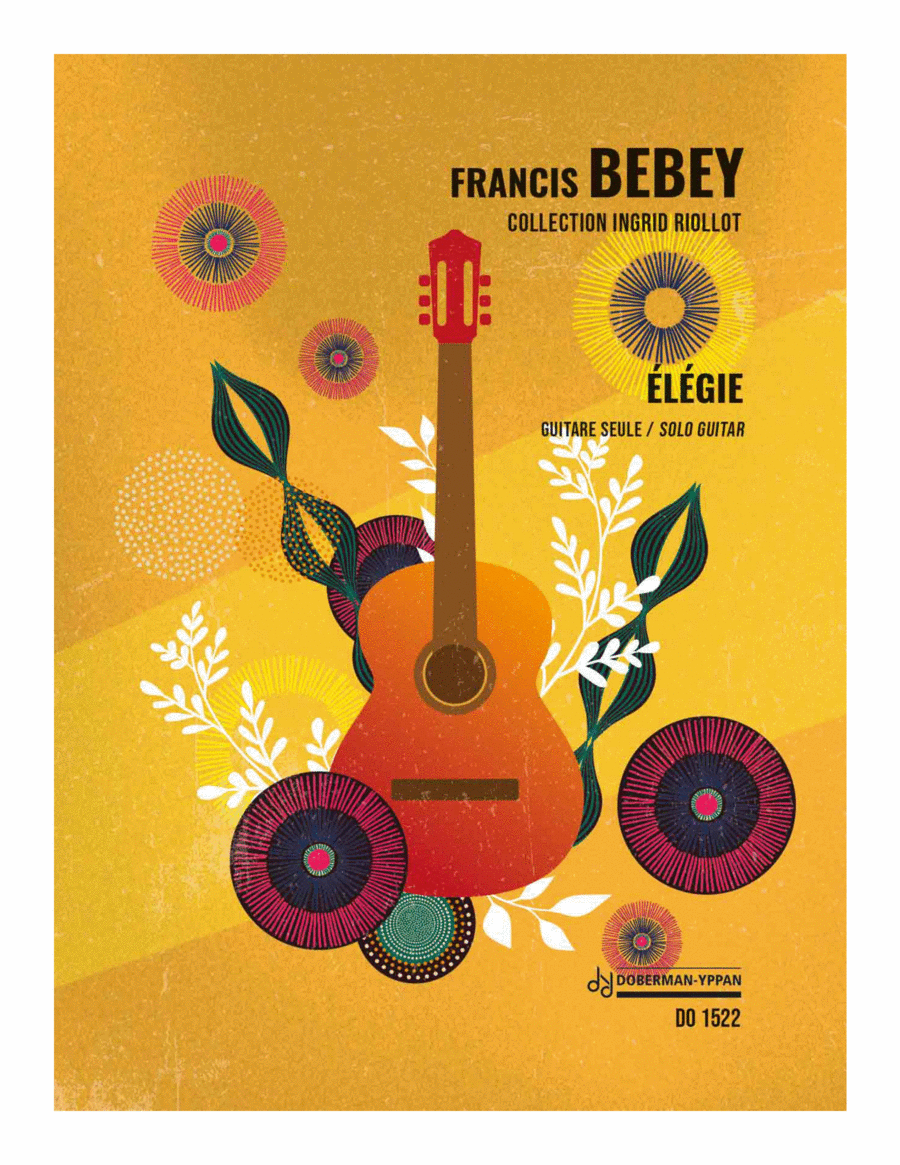
Élégie
Guitare

$3.95 3.34 € Guitare PDF SheetMusicPlus

Piano Solo - Level 5 - Digital Download SKU: A0.958788 Composed by Lionel Félix Corbalán (Carlos Acosta). Arranged by Juan Carlos Cortés A. 20th Century,Concert,Standards,Traditional,World. Score. 3 pages. Juan Carlos Cortés Aguirre #6872661. Published by Juan Carlos Cortés Aguirre (A0.958788). Transcripción para Piano Solo por:JUAN CARLOS CORTÉS A.Basado en la versión grabada por la orquesta de Juan D´Arienzo con la voz de Alberto Echagüe.DOS DEDOSLetra y música: Carlos Acosta (Lionel Félix Corbalán)Grabado por la orquesta de Juan D´Arienzo con la voz de Alberto Echagüe.INTRODUCCIÓN:Te apodaron el dos dedos de purrete,Porque dicen los muchachos que al nacer, de inmediato rechazás…Ese chupete… Con dos dedos, te supiste entretener.Mi consejo es no confiar en este coso, Que también puede afanar a tu mujer,Si es capaz de sacarle a un circo un oso,Y batirte, que lo hace sin querer.¡Dos dedos!... Sos junao por el taquero, no sos un simple ratero,Sos un punga, que valés... Y dicen...Que hasta tiemblan las vitrolas, porque sacás las chirolas,Por las ranuras que ves. ¡Dos dedos!, Sos el rey de los afanos,si te cortaran las manos, Vos afanás con los pies...¡Huy, qué clase...! Tenés pa´ tirar la lanza, si con dos dedos te alcanza,¿Para qué querés los diez?INTERLUDIO:Has nacido con el arte del choreo Y tu record no lo pueden igualar.Porque pienso, que si esto no lo veo, Les diría, que han querido exagerar.Y aunque crean que esto es pura fantasía, A cualquiera yo le puedo demostrar,Que este coso no se queda ya, en la vida, Si dos dedos, ha podido asegurar.
Dos dedos. Tango por: Lionel Félix Corbalán (Carlos Acosta)
Piano seul

$7.99 6.76 € Piano seul PDF SheetMusicPlus


1 ....61 76 91 106 121 ....241


Partitions Gratuites
Acheter des Partitions Musicales
Acheter des Partitions Digitales à Imprimer
Acheter des Instruments de Musique

© 2000 - 2026

Accueil - Version intégrale





