EUROPE
9603 articles
USA
0 articles
DIGITAL
228473 articles (à imprimer)
Partitions Digitales
Partitions à imprimer
228473 partitions trouvées


2 Pianos,4 Hands,Piano Duet - Level 3 - Digital Download SKU: A0.1455795 By Sharon Wilson. By Charles Wesley, Fanny J. Crosby, John Bacchus Dykes, Luther B. Bridgers, Reginald Heber, William H. Doane, and William J. Kirkpatrick. Arranged by Sharon Wilson. 19th Century,Christian,Easter,Praise & Worship,Sacred. Score. 61 pages. Sharon Wilson #1034892. Published by Sharon Wilson (A0.1455795). This collection contains 5 favorite praise hymns arranged as PIANO DUETS (for 2 Pianos, 4 Hands). These arrangements are straight-forward and suitable for intermediate pianists. An optional repeat is provided for some songs in case a longer selection is desired. These cheerful, uplifting arrangements are a welcome addition to the piano repertoire for intermediate students and suitable for performances in a church setting (prelude, offertory, postlude).PIANO 1 and PIANO 2 alternate leading with the melody throughout each song, making these arrangements fun and equally challenging for both players while adding variety for the listeners. For each song there is a combined score (Grand Staff) with both piano parts on each page plus an alternate format with each piano part on separate pages (PIANO 1 and PIANO 2). Each song is also available separately with accompanying preview pages and audio samples. The audio sample plays one verse of And Can It Be? and the YouTube video features To God Be the Glory.Song titles included in this collection: And Can It Be?He Keeps Me SingingHoly, Holy, HolyRedeemed, How I Love to Proclaim ItTo God Be the GloryVisit Sharon Wilson's website: https://www.SharonWilsonMusic.com/Subscribe to her YouTube Channel: https://youtube.com/@SharonWilsonMusic
Hymns of Praise for Two Pianos (A Collection of 5 Piano Duets for 2 Pianos, 4 Hands)
2 Pianos, 4 mains
Sharon Wilson
$15.00 13.06 € 2 Pianos, 4 mains PDF SheetMusicPlus

1 Piano,4 Hands,Piano Duet - Level 3 - Digital Download SKU: A0.1488797 By Sharon Wilson. By Asahel Nettleton, Charles C. Converse, Daniel B. Towner, Edwin O. Excell, Folk Song, Joseph M. Scriven, Traditional, and Traditional Spiritual. Arranged by Sharon Wilson. 19th Century,Christian,Lent,Sacred,Spiritual. Score. 71 pages. Sharon Wilson #1065648. Published by Sharon Wilson (A0.1488797). This collection contains 5 inspiring worship hymns arranged as PIANO DUETS (for 1 Piano, 4 Hands). These arrangements are straight-forward and suitable for intermediate pianists. From bright and festive to flowing and contemplative, these arrangements are a welcome addition to the piano repertoire for intermediate students and suitable for performances in a church setting (prelude, offertory, postlude). The PRIMO and SECONDO parts alternate leading with the melody throughout each song, making these arrangements fun and equally challenging for both players while adding variety for the listeners. For each song there is a combined score (Grand Staff) with both piano parts on each page plus an alternate format with each piano part on separate pages (PRIMO and SECONDO). Each song is also available separately with accompanying preview pages and audio samples. Song titles included in this collection: Come, Thou Fount of Every BlessingLet It Shine Medley (Jesus Bids Us Shine with This Little Light of Mine)Marvelous Grace (Grace Greater Than Our Sin)There Is a FountainWhat a Friend We Have in JesusVisit Sharon Wilson's website: https://www.SharonWilsonMusic.com/Subscribe to her YouTube Channel: https://youtube.com/@SharonWilsonMusic
Piano Duets: Hymns for Worship, Book 2 (A Collection of 5 Piano Duets ~ 1 Piano, 4 Hands)
1 Piano, 4 mains
Sharon Wilson
$15.00 13.06 € 1 Piano, 4 mains PDF SheetMusicPlus

Chamber Orchestra - Level 4 - Digital Download SKU: A0.597235 By George Frideric Handel. By George Frideric Handel. Arranged by Flávio Régis Cunha. Baroque,Contest,Easter,Festival,Film/TV,Sacred. Score and Parts. 46 pages. Flavio Regis Cunha #4602725. Published by Flavio Regis Cunha (A0.597235). Händel: The Trumpet Shall Sound for Trumpet, Strings, Bass Solo and Harpsichord (D major Version)The trumpet shall sound Are you looking for a beautiful and exciting piece of music perfect to perform in a church, school or professional orchestra? Look no further!   Introducing 'The Trumpet Shall Sound' composed by Georg Friedrich Händel. This transcendent, multi-instrumental work will leave your audience awe-struck! Get the full sheet music arrangement, designed to be performed with Bassoon, Trumpet in Bb, Bass Solo, Harpsichord and Strings in D major.   Experience this masterpiece the way it was intended - bring it to life in concert field! Perfect for churches, schools and orchestras. Download 'The Trumpet Shall Sound' now and make your performance extra special!The Air for bass The trumpet shall sound, marked Pomposo, ma non allegro, is a da capo aria. In the work's only instrumental solo, the trumpet provides motifs which the bass picks up. In and we shall be changed, the word changed is treated in inventive ever-changing melismas of up to six measures. In the middle section, the word immortality is expressed in a lively melisma of first eight, then nine measures.Advanced Intermediate.Format: A446 pagesFull Score and Orchestral PartsBb Major version:  https://www.sheetmusicplus.com/title/hndel-the-trumpet-shall-sound-for-bassoon-trumpet-in-bb-bass-solo-harpsichord-and-strings-digital-sheet-music/22572767?aff_id=728965
Händel: Basss Aria "The Trumpet Shall Sound" for Bass Solo and Chamber Orchestra (D major Version)
Orchestre de chambre
George Frideric Handel
$18.99 16.54 € Orchestre de chambre PDF SheetMusicPlus

Alto Saxophone,Piano - Level 5 - Digital Download SKU: A0.755072 Composed by Sy Brandon. 20th Century,Contemporary. Score and part. 50 pages. Sy Brandon #3366105. Published by Sy Brandon (A0.755072). Concertino was composed during 2009 at the request of Dr. Andy Wen and premiered by him at the Region 4 NASA Conference in April 2011. This piano reduction of the band parts was completed in 2011. The work is in three movements. The first movement is in an abbreviated sonata form in a spirited Vivace tempo. The first theme group consists more of motives rather than an actual theme and is characterized by interplay between the soloist and the band. The second theme group has a lyrical saxophone line over a staccato bass line. The development begins quietly with the treatment of a syncopated idea from the second theme using a trio of solo saxophone, timpani and euphonium. After further development, a variant of the first theme group returns. The recapitulation consists only of first theme group ideas before ending with a brief coda. The second and third movements are performed with out pause between them. While the first movement was created during 2009, the second and third movements are a reworking of an earlier work by the composer for alto saxophone and piano soloists with orchestra. A rubato Lento theme containing many triplets that is accompanied by lush harmony begins the second movement. It is followed by a more scale-wise melody that is treated contrapuntally. Both these ideas develop during the movement leading to a strong climax before returning to a quiet conclusion. The third movement is an Allegro, once again with a rhythmic opening idea that changes meter often, and a more lyrical second idea with scale-wise passages as counterpoint. The development of these ideas leads to a cadenza for the solo saxophonist, followed by a coda that brings the composition to a rousing conclusion.
Concertino for Alto Saxophone and Piano
Saxophone Alto et Piano

$14.99 13.05 € Saxophone Alto et Piano PDF SheetMusicPlus

Concert Band - Level 5 - Digital Download SKU: A0.755114 Composed by Sy Brandon. 20th Century,Concert,Contemporary. Score and parts. 177 pages. Sy Brandon #3392241. Published by Sy Brandon (A0.755114). Concertino was composed during 2009 at the request of Dr. Andy Wen and premiered by him at the Region 4 NASA Conference in April 2011. The work is in three movements. The first movement is in an abbreviated sonata form in a spirited Vivace tempo. The first theme group consists more of motives rather than an actual theme and is characterized by interplay between the soloist and the band. The second theme group has a lyrical saxophone line over a staccato bass line. The development begins quietly with the treatment of a syncopated idea from the second theme using a trio of solo saxophone, timpani and euphonium. After further development, a variant of the first theme group returns. The recapitulation consists only of first theme group ideas before ending with a brief coda. The second and third movements are performed with out pause between them. While the first movement was created during 2009, the second and third movements are a reworking of an earlier work by the composer for alto saxophone and piano soloists with orchestra. A rubato Lento theme containing many triplets that is accompanied by lush harmony begins the second movement. It is followed by a more scale-wise melody that is treated contrapuntally. Both these ideas develop during the movement leading to a strong climax before returning to a quiet conclusion. The third movement is an Allegro, once again with a rhythmic opening idea that changes meter often, and a more lyrical second idea with scale-wise passages as counterpoint. The development of these ideas leads to a cadenza for the solo saxophonist, followed by a coda that brings the composition to a rousing conclusion. The score prints on legal size paper and the parts on letter.
Concertino for Alto Saxophone and Band
Orchestre d'harmonie

$39.99 34.82 € Orchestre d'harmonie PDF SheetMusicPlus

Cello,Flute,Instrumental Duet - Level 1 - Digital Download SKU: A0.1359406 By L. v. Beethoven. By Ludwig van Beethoven. Arranged by Arezzo Music. Chamber,Children,Classical,Romantic Period,Traditional. 3 pages. Arezzo Music #943870. Published by Arezzo Music (A0.1359406). Beethoven op.80 choral fantasy theme Flute and Cellofor beginnersThe sheet music for Beethoven's Op. 80 Choral Fantasy Theme adapted for Flute and cello is a fantastic choice for beginners looking to delve into the works of this iconic composer. The Choral Fantasy is known for its grand and majestic themes, and this arrangement maintains the essence of Beethoven's composition while catering to the capabilities of Flute and cello players at the beginner level. The Flute carries the soaring melodies with clarity, while the cello provides a supportive foundation, creating a harmonious blend between the two instruments. This sheet music offers a gateway for beginners to explore the genius of Beethoven in a format that is approachable and enjoyable. It's an exciting introduction to one of Beethoven's compelling works, making classical music accessible to Flute and cello players at the early stages of their musical journey. beethoven op.80 choral fantasy theme Flute and Cellofor beginners 
beethoven op.80 choral fantasy theme Flute and Cello for beginners
Flûte, Violoncelle
L v
$3.99 3.47 € Flûte, Violoncelle PDF SheetMusicPlus

Piano SKU: HL.310364 Arranged by Fred Bock. Piano. Fred Bock Publications. Easter, General Worship, Sacred. 40 pages. Fred Bock Music Company #BG0951. Published by Fred Bock Music Company (HL.310364). ISBN 9781934596180. UPC: 073999384321. 9.0x12.0x0.118 inches.Fred Bock Piano Favorites for Easter includes his best piano settings for preludes, postludes, offertories, and can be effectively used for Maundy Thursday/Good Friday/Lenten communion services as well as for the triumphant Easter Day. Twelve titles include popular favorites of the season: Because He Lives * Lift High the Cross * We Shall Behold Him * The Easter Song (Hear the Bells Ringing) * All Hail, King Jesus * Were You There? * The Old Rugged Cross * I've Just Seen Jesus * and four others.
Fred Bock Piano Favorites for Easter
Piano seul

$12.95 11.28 € Piano seul PDF SheetMusicPlus

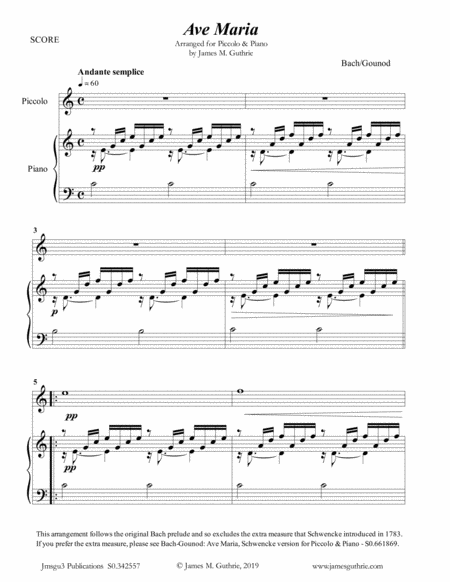
Instrumental Solo,Piano,Piccolo - Level 2 - Digital Download SKU: A0.549362 Composed by Bach-Gounod. Arranged by James M. Guthrie, ASCAP. Christmas,Contemporary,Easter,Wedding. Score and individual part. 12 pages. Jmsgu3 #3490121. Published by jmsgu3 (A0.549362). This arrangement follows the original Bach prelude and so excludes the extra measure that Schwencke introduced in 1783. If you prefer the extra measure, please see Bach-Gounod: Ave Maria, Schwencke version for Piccolo & Piano - S0.661869. The convenient 1st & 2nd endings provide an option for extended performance with minimal page turns for the accompanist. The duration with repeat is about 4:50. Score: 6 pages. Solo part: 1 page, piano part: 4 pages. Based on Prelude #1 in C Major from the Well-Tempered Clavier, Book 1. Well suited for church meditations or school programs or recital encores. Ave Maria Ave Maria is a Catholic prayer that consequently asks for the mother of Jesus (Mary) to intercede. Charles Gounod composed a famous version of the Ave Maria. He was a French Romantic composer who overlaid a new melody on an existing Bach chord progression. The progression is from Bach’s Prelude No. 1 from Well-Tempered Clavier I. This version, as well as Schubert’s version, have become essential items at weddings, masses, and funerals. Bach Overview First of all, Johann Sebastian Bach is maybe the greatest composer in music history. Certainly, he was prolific. As a result, everyone has heard of his works. Furthermore, these works number well over a thousand. It seems like people are probably most familiar with instrumental works such as the Brandenburg Concertos, and the Goldberg Variations. But, similarly famous are such noteworthy works as the Well-Tempered Clavier, the Musical Offering, and the Art of Fugue. Seems like his most famous vocal works include the most noteworthy Mass in B Minor. Also, most noteworthy, though, are the St. John Passion, and certainly the Christmas Oratorio.  History Bach came from a long line of musicians and above all, composers. Consequently, he, first of all, pursued a career as a church organist. So as a result, he gained employment in various Protestant churches in Germany. For a while, he worked as a court musician in Weimar and Köthen. Here he probably developed his organ style and likewise his chamber music style. Eventually, he gained an appointment as Cantor of St. Thomas in Leipzig. Here he worked until difficulties with his employer ultimately drove him away. The King of Poland finally appointed him as court composer.  Style It seems like Bach created an engaging new international style. He synthesized elements of the most noteworthy European music ideas into his new style. Even more, this new style was probably his synthesis of European musical rhythm and form. Furthermore, he demonstrated a complete mastery of counterpoint and motivic development. His sense of harmonic organization probably propelled him to the top. Revival               Mendelssohn conducted a Bach revival in the nineteenth century. His effort probably helped to re-familiarize the public with the magnitude of Bach’s works. During this period, scholars published many noteworthy Bach biographies. Moreover, Wolfgang Schmieder published the BWV (Bach Werke Verzeichnis). As a result, this is now the official catalog of his entire artistic output. The BWV number allows us to locate a work in the catalog. Sometimes scholars will simply use an S (Schmieder) as an abbreviation for BWV.  
Bach-Gounod: Ave Maria for Piccolo & Piano

$32.95 28.69 € PDF SheetMusicPlus

Piano,Tenor Saxophone - Level 2 - Digital Download SKU: A0.549367 Composed by Bach-Gounod. Arranged by James M. Guthrie, ASCAP. Christmas,Contemporary,Easter,Wedding. Score and part. 12 pages. Jmsgu3 #3490159. Published by jmsgu3 (A0.549367). This arrangement follows the original Bach prelude and so excludes the extra measure that Schwencke introduced in 1783. If you prefer the extra measure, please see Bach-Gounod: Ave Maria, Schwencke version for Tenor Sax & Piano - S0.662027. The convenient 1st & 2nd endings provide an option for extended performance with minimal page turns for the accompanist. The duration with repeat is about 4:50. Score: 6 pages. Solo part: 1 page, piano part: 4 pages. Based on Prelude #1 in C Major from the Well-Tempered Clavier, Book 1. Well suited for church meditations or school programs or recital encores. Ave Maria Ave Maria is a Catholic prayer that consequently asks for the mother of Jesus (Mary) to intercede. Charles Gounod composed a famous version of the Ave Maria. He was a French Romantic composer who overlaid a new melody on an existing Bach chord progression. The progression is from Bach’s Prelude No. 1 from Well-Tempered Clavier I. This version, as well as Schubert’s version, have become essential items at weddings, masses, and funerals. Bach Overview First of all, Johann Sebastian Bach is maybe the greatest composer in music history. Certainly, he was prolific. As a result, everyone has heard of his works. Furthermore, these works number well over a thousand. It seems like people are probably most familiar with instrumental works such as the Brandenburg Concertos, and the Goldberg Variations. But, similarly famous are such noteworthy works as the Well-Tempered Clavier, the Musical Offering, and the Art of Fugue. Seems like his most famous vocal works include the most noteworthy Mass in B Minor. Also, most noteworthy, though, are the St. John Passion, and certainly the Christmas Oratorio.  History Bach came from a long line of musicians and above all, composers. Consequently, he, first of all, pursued a career as a church organist. So as a result, he gained employment in various Protestant churches in Germany. For a while, he worked as a court musician in Weimar and Köthen. Here he probably developed his organ style and likewise his chamber music style. Eventually, he gained an appointment as Cantor of St. Thomas in Leipzig. Here he worked until difficulties with his employer ultimately drove him away. The King of Poland finally appointed him as court composer.  Style It seems like Bach created an engaging new international style. He synthesized elements of the most noteworthy European music ideas into his new style. Even more, this new style was probably his synthesis of European musical rhythm and form. Furthermore, he demonstrated a complete mastery of counterpoint and motivic development. His sense of harmonic organization probably propelled him to the top. Revival               Mendelssohn conducted a Bach revival in the nineteenth century. His effort probably helped to re-familiarize the public with the magnitude of Bach’s works. During this period, scholars published many noteworthy Bach biographies. Moreover, Wolfgang Schmieder published the BWV (Bach Werke Verzeichnis). As a result, this is now the official catalog of his entire artistic output. The BWV number allows us to locate a work in the catalog. Sometimes scholars will simply use an S (Schmieder) as an abbreviation for BWV.  
Bach-Gounod: Ave Maria for Tenor Sax & Piano
Saxophone Tenor et Piano

$32.95 28.69 € Saxophone Tenor et Piano PDF SheetMusicPlus

E-Flat Clarinet,Piano - Level 2 - Digital Download SKU: A0.549357 Composed by Bach-Gounod. Arranged by James M. Guthrie, ASCAP. Christmas,Contemporary,Easter,Wedding. Score and part. 11 pages. Jmsgu3 #3490029. Published by jmsgu3 (A0.549357). This arrangement follows the original Bach prelude and so excludes the extra measure that Schwencke introduced in 1783. If you prefer the extra measure, please see Bach-Gounod: Ave Maria, Schwencke version for Alto Clarinet & Piano, S0.661759. The convenient 1st & 2nd endings provide an option for extended performance with minimal page turns for the accompanist. The duration with repeat is about 4:50. Score: 6 pages. Solo part: 1 page, piano part: 4 pages. Based on Prelude #1 in C Major from the Well-Tempered Clavier, Book 1. Well suited for church meditations or school programs or recital encores. Ave Maria Ave Maria is a Catholic prayer that consequently asks for the mother of Jesus (Mary) to intercede. Charles Gounod composed a famous version of the Ave Maria. He was a French Romantic composer who overlaid a new melody on an existing Bach chord progression. The progression is from Bach’s Prelude No. 1 from Well-Tempered Clavier I. This version, as well as Schubert’s version, have become essential items at weddings, masses, and funerals. Bach Overview First of all, Johann Sebastian Bach is maybe the greatest composer in music history. Certainly, he was prolific. As a result, everyone has heard of his works. Furthermore, these works number well over a thousand. It seems like people are probably most familiar with instrumental works such as the Brandenburg Concertos, and the Goldberg Variations. But, similarly famous are such noteworthy works as the Well-Tempered Clavier, the Musical Offering, and the Art of Fugue. Seems like his most famous vocal works include the most noteworthy Mass in B Minor. Also, most noteworthy, though, are the St. John Passion, and certainly the Christmas Oratorio.  History Bach came from a long line of musicians and above all, composers. Consequently, he, first of all, pursued a career as a church organist. So as a result, he gained employment in various Protestant churches in Germany. For a while, he worked as a court musician in Weimar and Köthen. Here he probably developed his organ style and likewise his chamber music style. Eventually, he gained an appointment as Cantor of St. Thomas in Leipzig. Here he worked until difficulties with his employer ultimately drove him away. The King of Poland finally appointed him as court composer.  Style It seems like Bach created a fascinating new international style. He synthesized elements of the most noteworthy European music ideas into his new style. Even more, this new style was probably his synthesis of European musical rhythm and form. Furthermore, he demonstrated a complete mastery of counterpoint and motivic development. His sense of harmonic organization probably propelled him to the top. Revival               Mendelssohn conducted a Bach revival in the nineteenth century. His effort probably helped to re-familiarize the public with the magnitude of Bach’s works. During this period, scholars published many noteworthy Bach biographies. Moreover, Wolfgang Schmieder published the BWV (Bach Werke Verzeichnis). As a result, this is now the official catalog of his entire artistic output. The BWV number allows us to locate a work in the catalog. Sometimes scholars will simply use an S (Schmieder) as an abbreviation for BWV.  
Bach-Gounod: Ave Maria for Alto Clarinet & Piano
Clarinette

$32.95 28.69 € Clarinette PDF SheetMusicPlus

Piano,Soprano Saxophone - Level 2 - Digital Download SKU: A0.549366 Composed by Bach-Gounod. Arranged by James M. Guthrie, ASCAP. Christmas,Contemporary,Easter,Wedding. Score and part. 14 pages. Jmsgu3 #3490157. Published by jmsgu3 (A0.549366). This arrangement follows the original Bach prelude and so excludes the extra measure that Schwencke introduced in 1783. If you prefer the extra measure, please see Bach-Gounod: Ave Maria, Schwencke version for Soprano Sax & Piano - S0.661999. The convenient 1st & 2nd endings provide an option for extended performance with minimal page turns for the accompanist. The duration with repeat is about 4:50. Score: 6 pages. Solo part: 1 page, piano part: 4 pages. Based on Prelude #1 in C Major from the Well-Tempered Clavier, Book 1. Well suited for church meditations or school programs or recital encores. Ave Maria Ave Maria is a Catholic prayer that consequently asks for the mother of Jesus (Mary) to intercede. Charles Gounod composed a famous version of the Ave Maria. He was a French Romantic composer who overlaid a new melody on an existing Bach chord progression. The progression is from Bach’s Prelude No. 1 from Well-Tempered Clavier I. This version, as well as Schubert’s version, have become essential items at weddings, masses, and funerals. Bach Overview First of all, Johann Sebastian Bach is maybe the greatest composer in music history. Certainly, he was prolific. As a result, everyone has heard of his works. Furthermore, these works number well over a thousand. It seems like people are probably most familiar with instrumental works such as the Brandenburg Concertos, and the Goldberg Variations. But, similarly famous are such noteworthy works as the Well-Tempered Clavier, the Musical Offering, and the Art of Fugue. Seems like his most famous vocal works include the most noteworthy Mass in B Minor. Also, most noteworthy, though, are the St. John Passion, and certainly the Christmas Oratorio.  History Bach came from a long line of musicians and above all, composers. Consequently, he, first of all, pursued a career as a church organist. So as a result, he gained employment in various Protestant churches in Germany. For a while, he worked as a court musician in Weimar and Köthen. Here he probably developed his organ style and likewise his chamber music style. Eventually, he gained an appointment as Cantor of St. Thomas in Leipzig. Here he worked until difficulties with his employer ultimately drove him away. The King of Poland finally appointed him as court composer.  Style It seems like Bach created an engaging new international style. He synthesized elements of the most noteworthy European music ideas into his new style. Even more, this new style was probably his synthesis of European musical rhythm and form. Furthermore, he demonstrated a complete mastery of counterpoint and motivic development. His sense of harmonic organization probably propelled him to the top. Revival               Mendelssohn conducted a Bach revival in the nineteenth century. His effort probably helped to re-familiarize the public with the magnitude of Bach’s works. During this period, scholars published many noteworthy Bach biographies. Moreover, Wolfgang Schmieder published the BWV (Bach Werke Verzeichnis). As a result, this is now the official catalog of his entire artistic output. The BWV number allows us to locate a work in the catalog. Sometimes scholars will simply use an S (Schmieder) as an abbreviation for BWV.  
Bach-Gounod: Ave Maria for Soprano Sax & Piano
Saxophone Soprano et Piano

$32.95 28.69 € Saxophone Soprano et Piano PDF SheetMusicPlus

French Horn,Piano - Level 2 - Digital Download SKU: A0.549371 Composed by Bach-Gounod. Arranged by James M. Guthrie, ASCAP. Christmas,Contemporary,Easter,Wedding. Score and part. 11 pages. Jmsgu3 #3491319. Published by jmsgu3 (A0.549371). This arrangement follows the original Bach prelude and so excludes the extra measure that Schwencke introduced in 1783. If you prefer the extra measure, please see Bach-Gounod: Ave Maria, Schwencke version for French Horn & Piano, S0.661839 . The convenient 1st & 2nd endings provide an option for extended performance with minimal page turns for the accompanist. The duration with repeat is about 4:50. Score: 6 pages. Solo part: 1 page, piano part: 4 pages. Based on Prelude #1 in C Major from the Well-Tempered Clavier, Book 1. Well suited for church meditations or school programs or recital encores. Ave Maria Ave Maria is a Catholic prayer that consequently asks for the mother of Jesus (Mary) to intercede. Charles Gounod composed a famous version of the Ave Maria. He was a French Romantic composer who overlaid a new melody on an existing Bach chord progression. The progression is from Bach’s Prelude No. 1 from Well-Tempered Clavier I. This version, as well as Schubert’s version, have become essential items at weddings, masses, and funerals. Bach Overview First of all, Johann Sebastian Bach is maybe the greatest composer in music history. Certainly, he was prolific. As a result, everyone has heard of his works. Furthermore, these works number well over a thousand. It seems like people are probably most familiar with instrumental works such as the Brandenburg Concertos, and the Goldberg Variations. But, similarly famous are such noteworthy works as the Well-Tempered Clavier, the Musical Offering, and the Art of Fugue. Seems like his most famous vocal works include the most noteworthy Mass in B Minor. Also, most noteworthy, though, are the St. John Passion, and certainly the Christmas Oratorio.  History Bach came from a long line of musicians and above all, composers. Consequently, he, first of all, pursued a career as a church organist. So as a result, he gained employment in various Protestant churches in Germany. For a while, he worked as a court musician in Weimar and Köthen. Here he probably developed his organ style and likewise his chamber music style. Eventually, he gained an appointment as Cantor of St. Thomas in Leipzig. Here he worked until difficulties with his employer ultimately drove him away. The King of Poland finally appointed him as court composer.  Style It seems like Bach created an engaging new international style. He synthesized elements of the most noteworthy European music ideas into his new style. Even more, this new style was probably his synthesis of European musical rhythm and form. Furthermore, he demonstrated a complete mastery of counterpoint and motivic development. His sense of harmonic organization probably propelled him to the top. Revival               Mendelssohn conducted a Bach revival in the nineteenth century. His effort probably helped to re-familiarize the public with the magnitude of Bach’s works. During this period, scholars published many noteworthy Bach biographies. Moreover, Wolfgang Schmieder published the BWV (Bach Werke Verzeichnis). As a result, this is now the official catalog of his entire artistic output. The BWV number allows us to locate a work in the catalog. Sometimes scholars will simply use an S (Schmieder) as an abbreviation for BWV.  
Bach-Gounod: Ave Maria for French Horn & Piano
Cor et Piano

$32.95 28.69 € Cor et Piano PDF SheetMusicPlus

Oboe,Piano - Level 2 - Digital Download SKU: A0.549359 Composed by Bach-Gounod. Arranged by James M. Guthrie, ASCAP. Christmas,Contemporary,Easter,Wedding. Score and part. 11 pages. Jmsgu3 #3490099. Published by jmsgu3 (A0.549359). This arrangement follows the original Bach prelude and so excludes the extra measure that Schwencke introduced in 1783. If you prefer the extra measure, please see Bach-Gounod: Ave Maria, Schwencke version for Oboe & Piano - S0.661853. The convenient 1st & 2nd endings provide an option for extended performance with minimal page turns for the accompanist. The duration with repeat is about 4:50. Score: 6 pages. Solo part: 1 page, piano part: 4 pages. Based on Prelude #1 in C Major from the Well-Tempered Clavier, Book 1. Well suited for church meditations or school programs or recital encores. Ave Maria Ave Maria is a Catholic prayer that consequently asks for the mother of Jesus (Mary) to intercede. Charles Gounod composed a famous version of the Ave Maria. He was a French Romantic composer who overlaid a new melody on an existing Bach chord progression. The progression is from Bach’s Prelude No. 1 from Well-Tempered Clavier I. This version, as well as Schubert’s version, have become essential items at weddings, masses, and funerals. Bach Overview First of all, Johann Sebastian Bach is maybe the greatest composer in music history. Certainly, he was prolific. As a result, everyone has heard of his works. Furthermore, these works number well over a thousand. It seems like people are probably most familiar with instrumental works such as the Brandenburg Concertos, and the Goldberg Variations. But, similarly famous are such noteworthy works as the Well-Tempered Clavier, the Musical Offering, and the Art of Fugue. Seems like his most famous vocal works include the most noteworthy Mass in B Minor. Also, most noteworthy, though, are the St. John Passion, and certainly the Christmas Oratorio.  History Bach came from a long line of musicians and above all, composers. Consequently, he, first of all, pursued a career as a church organist. So as a result, he gained employment in various Protestant churches in Germany. For a while, he worked as a court musician in Weimar and Köthen. Here he probably developed his organ style and likewise his chamber music style. Eventually, he gained an appointment as Cantor of St. Thomas in Leipzig. Here he worked until difficulties with his employer ultimately drove him away. The King of Poland finally appointed him as court composer.  Style It seems like Bach created an engaging new international style. He synthesized elements of the most noteworthy European music ideas into his new style. Even more, this new style was probably his synthesis of European musical rhythm and form. Furthermore, he demonstrated a complete mastery of counterpoint and motivic development. His sense of harmonic organization probably propelled him to the top. Revival               Mendelssohn conducted a Bach revival in the nineteenth century. His effort probably helped to re-familiarize the public with the magnitude of Bach’s works. During this period, scholars published many noteworthy Bach biographies. Moreover, Wolfgang Schmieder published the BWV (Bach Werke Verzeichnis). As a result, this is now the official catalog of his entire artistic output. The BWV number allows us to locate a work in the catalog. Sometimes scholars will simply use an S (Schmieder) as an abbreviation for BWV.  
Bach-Gounod: Ave Maria for Oboe & Piano
Hautbois, Piano (duo)

$32.95 28.69 € Hautbois, Piano (duo) PDF SheetMusicPlus


Partitions Gratuites
Acheter des Partitions Musicales
Acheter des Partitions Digitales à Imprimer
Acheter des Instruments de Musique

© 2000 - 2026

Accueil - Version intégrale