EUROPE
7313 articles
USA
0 articles
DIGITAL
8435 articles (à imprimer)
Partitions Digitales
Partitions à imprimer
8435 partitions trouvées


String Quartet Cello,Double Bass,String Quartet,Viola,Violin - Level 3 - Digital Download SKU: A0.940609 Composed by Frederic Chopin. Arranged by Barry Stinton. 20th Century,Contemporary,Instructional,Romantic Period,Standards. Score and parts. 8 pages. Barry Stinton #3523857. Published by Barry Stinton (A0.940609). Published in the late 1830's, here I have arranged the famous 'Funeral march' By Frederic Chopin.I have arranged this piece for a string quintet as it is a very popular and famous classical romantic piece well known among pianists as the chord prelude.A slow and emotional piece which never loses its touch, I have given it a little revamp for the ending and intro but tried to keep the integrity which makes it so unique. 
Prelude in C minor Op. 28 No. 20
Quatuor à cordes: 2 violons, alto, violoncelle
Frederic Chopin
I have arranged this piece for a string quintet as it is a very popular and famous classical romantic piece well known among pianists as the chord prelude
$1.99 1.73 € Quatuor à cordes: 2 violons, alto, violoncelle PDF SheetMusicPlus

Flute, strings and basso continuo - intermediate to advanced - Digital Download SKU: S9.Q12513 B minor. Composed by Johann Sebastian Bach. This edition: study score. Ernst Eulenburg - Orchestra - Score. Eulenburg Miniature Scores. Downloadable, Study score. Ernst Eulenburg & Co. GmbH - Digital #Q12513. Published by Ernst Eulenburg & Co. GmbH - Digital (S9.Q12513). Key: B minor.From early in the 17th century until the form engaged the interest of Johann Sebastian Bach, various notable German composers - including Rosenmüller, Fischer, Fasch and Telemann - had contributed to the development of the orchestral suite or 'Ouverture', which name betrays its French theatrical origins. From Bach himself only four such suites have come down to us due to the diligence of C.F.Penzel, who was a student at the Thomasschule from 1751, and who made copies of Bach's MSS he found there. Thus, neither the dates nor the order of composition of the suites can be established with any certainty. As to the present suite in B minor, recent criticism suggests that Bach's idiomatic flute writing in this popular suite would, even in 1737 or later, have been considered fashionably up-to-date even in Paris. It has also been suggested that the suite could have been written expressly for Pierre-Gabriel Buffardin, principal flautist of the Dresden Court Orchestra.
Overture (Suite) No. 2

$9.99 8.71 € PDF SheetMusicPlus

Guitar - Level 2 - Digital Download SKU: A0.1156458 Composed by Erik Satie. Arranged by Brian Streckfus. 20th Century,Classical,Romantic Period. Guitar Tab. 7 pages. Brian Streckfus #756776. Published by Brian Streckfus (A0.1156458). IMPORTANT NOTE: You get both tablature version and sheet music version in one 7 page PDF! Hopefully this makes these arrangements all-inclusive for different purposes and skill levels. Also the tab version is meant for Drop D tuning and the sheet music is for standard tuning! Just be careful with your printer settings if you don't want two versions!1. Impressionism French minimalist piece arranged for guitar in Drop D Tuning.2. The composer indications in text are not my recommendations, but the original composer's. 2. Guitar tablature added with circles for half notes and whole notes.3. Measures and time signatures removed to reflect the ethos of the original composer. 4. Engraved to fit on four pages. Many of the lines themselves represent a musical phrase, making my arrangement that much easier to perform musically.  5. Courtesy accidentals added but they just look like regular accidentals. I did this especially because the piece is one gigantic measure and accidental etiquette is hard to follow under those circumstances. 6. Some overly contrived ties removed.This one is a real challenge to engrave because the original composer didn't have bar lines or time signatures. Cool idea but that can cause even the best sheet music programs to glitch out a bit when you have 16/4 hidden time signatures! This especially causes problems with accidentals, and it also causes rhythm problems when multiple voices are happening. As always, I like to try to have notes with upward stems represent the main voice, and downward stems to represent background voices, even though this leads to a bit of messiness with stem collisions. Normally the sheet music shows the rhythm the best, but dare I say the tab actually keeps track of time pretty well since all the voices are condensed into one rhythm line.
Gnossienne No. 3 (Tablature + Sheet Music)
Guitare notes et tablatures

$1.99 1.73 € Guitare notes et tablatures PDF SheetMusicPlus

Solo Guitar - Level 4 - Digital Download SKU: A0.1243618 By Brad Rau. By Erik Satie. Arranged by Brad Rau. 20th Century. Individual part. 3 pages. Brad Rau #838582. Published by Brad Rau (A0.1243618). D'une Manière Très Particulière was originally written for solo piano and has been arranged for solo guitar by Brad Rau.  Fingering suggestions have been added to make it easier to play.  The original piece was notated without measures; however, measures have been added to make learning easier.  The pieces also do not have a key signature. However, it seems to begin in C minor.  It has been transposed to A minor to make it easier to play. This is from a set of pieces Erik Satie wrote in 1897 called Pieces Froides or Cold Pieces.  The first set of pieces is called Airs à faire fuir or Tunes to Make You Run Away.  This movement is called D'une manière très particulière or In a Very Unusual Manner.  In these sets of pieces, Satie writes in the enigmatic he used to compose the Gymnopedies and Gnossienne composed earlier.  This little-known piece is rarely played on guitar but works really well.
Pieces Froides : No. 1. Airs a faire fuir: I. D'une maniere particuliere (In a Very Unusual Manner)
Guitare
Brad Rau
$4.99 4.35 € Guitare PDF SheetMusicPlus

String Orchestra - Level 4 - Digital Download SKU: A0.1183534 Composed by Joseph Bologne, Chevalier de St. Georges. Arranged by Robert Debbaut. Classical,Contest,Festival,Historic,Multicultural,World. 28 pages. ROBERT DEBBAUT #783207. Published by ROBERT DEBBAUT (A0.1183534). How is it that one can be born a slave in French colonial Guadeloupe and rise to be among Paris’ musical giants, to become a colonel in the French Army as well as the frequent dinner guest of princes and potentates? The story of Joseph Bologne, Chevalier de Saint-Georges, is surely an interesting one, even the stuff of which movies are made.Joseph Bologne’s father, Georges Bologne de Saint-Georges was a French planter. Saint-Georges was the name of his plantation. He impregnated Anne, the Senegalese slave of his wife, who bore him a son in 1745. Uncharacteristic of many of these sort of relationships he acknowledged the child was his and gave him his family name. When he was seven Bologne’s father took him to Paris for his education, enrolling him in a boarding school. Two years later he and the child’s mother returned to France and set up housekeeping as a family in Paris’ Saint-Germain-des-Prés district.At age thirteen Joseph’s father enrolled him in the Royal Technical Academy of Fencing and Swordsmanship. He quickly became the finest swordsman in the academy, perhaps in all of Paris. Upon graduation he was made an Officer of the King’s Bodyguard and a chevalier (an honorary knighthood). He went on to serve tours of duty in the French Army during the Seven Years War (1756-1763) and later after the French Revolution, where he was Colonel and commander of an all-Black regiment of the Revolutionary Army. All this in spite of the fact that French law forbade him, a man of African heritage, to become a citizen, to retain his father’s royal title of “Gentleman of the King’s Chamber,†or to marry outside his class.There is limited information about Bologne’s musical training, but he was obviously so well-skilled that Italian violinist-composer Antonio Lolli (1725-1802) wrote two violin concertos for him and French composer François-Joseph Gossec (1734-1829) dedicated his set of String Trios, Op. 9 to Bologne. Lolli may have worked with him on violin technique and Gossec composition, but this may be apocryphal. Bologne played in Gossec’s orchestra, and was later both leader and conductor of the group.As a composer Joseph Bologne was quite prolific, composing six operas, fourteen violin concertos, four symphonies concertantes, and numerous chamber works and songs. His Six String Quartets, Op. 1, Nos. 1-6 date from 1770-1771 and were published by the Paris publishing house of Jean-Georges Sieber (1738-1822) in 1773 (There are a total of 18 quartets: Six Quartets “au goût du jour†[up-to-date] from 1779 and the Opus 14 set of six which date from 1785). The Opus 1 quartets are dedicated to Anne Louis Alexandre de Montmorency (1724-1812), 7th Prince of Robeck (Robecq) and Grand Duke of Spain.The Opus 1 quartets all display a similarity to the Italian opera overtures from earlier in the Eighteenth Century (often called “sinfoniaâ€) in that they have an overall “A-B-A†form with the ‘A’ sections being robust allegros and all ‘B’ sections marked “rondo.†As such, in arranging them for string orchestra it seemed quite natural to rename them “overtures.†Certain liberties were taken by the arranger in order to maintain the integrity of the classic Rondo formula. All six have been arranged in this manner for string orchestra. They vary in length from twelve to almost twenty minutes. If you wish to obtain parts, write to debbaut@gmail.com and pay $42 via venmo or $40 via personal check and they will be sent to you in pdf format.
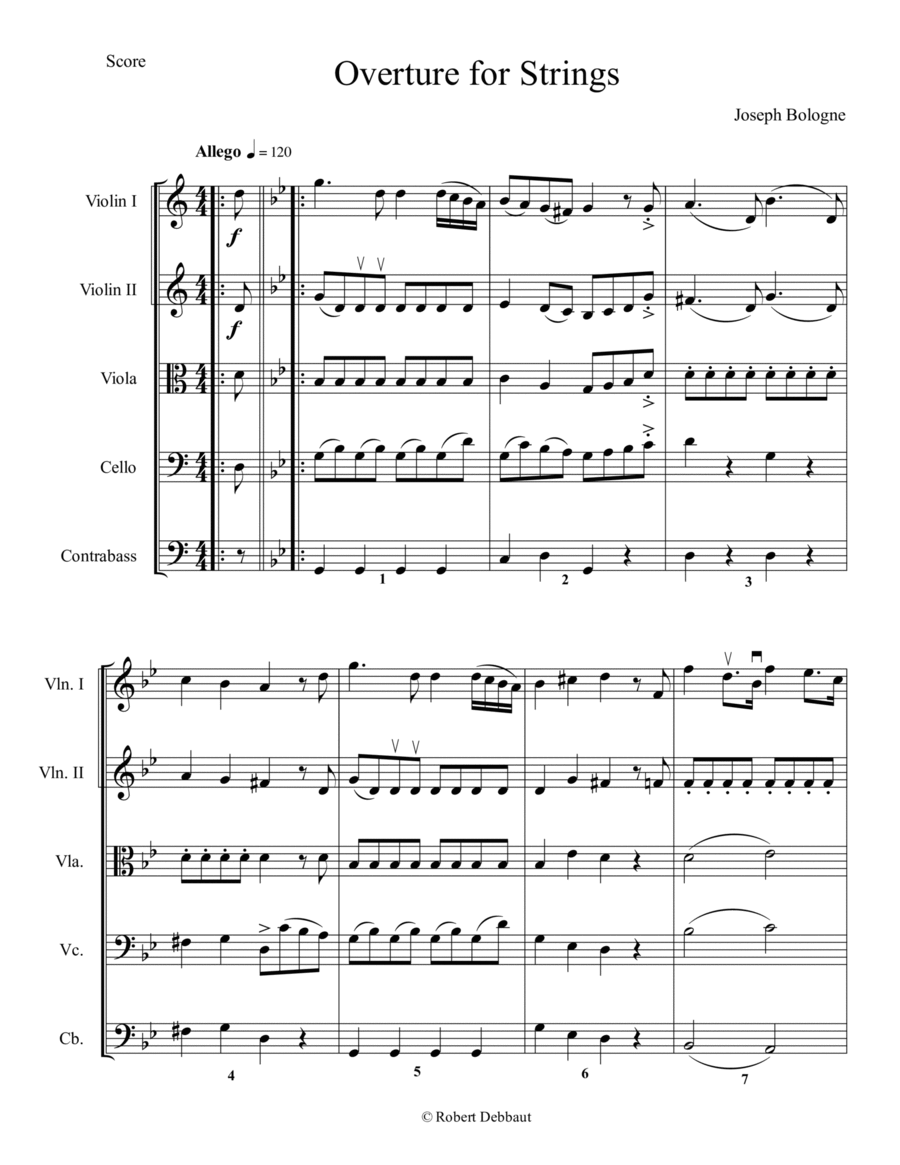
Overture for Strings No. 3 - Score Only
Orchestre à Cordes

$9.99 8.71 € Orchestre à Cordes PDF SheetMusicPlus

String Orchestra - Level 4 - Digital Download SKU: A0.1183533 Composed by Joseph Bologne, Chevalier de St. Georges. Arranged by Robert Debbaut. Classical,Contest,Festival,Historic,Multicultural,World. 43 pages. ROBERT DEBBAUT #783206. Published by ROBERT DEBBAUT (A0.1183533). How is it that one can be born a slave in French colonial Guadeloupe and rise to be among Paris’ musical giants, to become a colonel in the French Army as well as the frequent dinner guest of princes and potentates? The story of Joseph Bologne, Chevalier de Saint-Georges, is surely an interesting one, even the stuff of which movies are made.Joseph Bologne’s father, Georges Bologne de Saint-Georges was a French planter. Saint-Georges was the name of his plantation. He impregnated Anne, the Senegalese slave of his wife, who bore him a son in 1745. Uncharacteristic of many of these sort of relationships he acknowledged the child was his and gave him his family name. When he was seven Bologne’s father took him to Paris for his education, enrolling him in a boarding school. Two years later he and the child’s mother returned to France and set up housekeeping as a family in Paris’ Saint-Germain-des-Prés district.At age thirteen Joseph’s father enrolled him in the Royal Technical Academy of Fencing and Swordsmanship. He quickly became the finest swordsman in the academy, perhaps in all of Paris. Upon graduation he was made an Officer of the King’s Bodyguard and a chevalier (an honorary knighthood). He went on to serve tours of duty in the French Army during the Seven Years War (1756-1763) and later after the French Revolution, where he was Colonel and commander of an all-Black regiment of the Revolutionary Army. All this in spite of the fact that French law forbade him, a man of African heritage, to become a citizen, to retain his father’s royal title of “Gentleman of the King’s Chamber,†or to marry outside his class.There is limited information about Bologne’s musical training, but he was obviously so well-skilled that Italian violinist-composer Antonio Lolli (1725-1802) wrote two violin concertos for him and French composer François-Joseph Gossec (1734-1829) dedicated his set of String Trios, Op. 9 to Bologne. Lolli may have worked with him on violin technique and Gossec composition, but this may be apocryphal. Bologne played in Gossec’s orchestra, and was later both leader and conductor of the group.As a composer Joseph Bologne was quite prolific, composing six operas, fourteen violin concertos, four symphonies concertantes, and numerous chamber works and songs. His Six String Quartets, Op. 1, Nos. 1-6 date from 1770-1771 and were published by the Paris publishing house of Jean-Georges Sieber (1738-1822) in 1773 (There are a total of 18 quartets: Six Quartets “au goût du jour†[up-to-date] from 1779 and the Opus 14 set of six which date from 1785). The Opus 1 quartets are dedicated to Anne Louis Alexandre de Montmorency (1724-1812), 7th Prince of Robeck (Robecq) and Grand Duke of Spain.The Opus 1 quartets all display a similarity to the Italian opera overtures from earlier in the Eighteenth Century (often called “sinfoniaâ€) in that they have an overall “A-B-A†form with the ‘A’ sections being robust allegros and all ‘B’ sections marked “rondo.†As such, in arranging them for string orchestra it seemed quite natural to rename them “overtures.†Certain liberties were taken by the arranger in order to maintain the integrity of the classic Rondo formula. All six have been arranged in this manner for string orchestra. They vary in length from twelve to almost twenty minutes. If you wish to obtain parts, write to debbaut@gmail.com and pay $42 via venmo or $40 via personal check and they will be sent to you in pdf format.
Overture for Strings No. 2 - Score Only
Orchestre à Cordes

$9.99 8.71 € Orchestre à Cordes PDF SheetMusicPlus

Woodwind Ensemble,Woodwind Quartet Bassoon,Clarinet,Flute,Oboe - Level 3 - Digital Download SKU: A0.811702 Composed by Joseph Bodin De Boismortier (1689 - 1755). Arranged by Pat Spence. Baroque,Concert,Standards. 28 pages. Piper Publications #4320129. Published by Piper Publications (A0.811702). The first of six  sonatas for four equal players published ‘avec Privilege du Roi’ in Paris in 1731. They were published as a set of parts for three transverse flutes or violins or other instruments ‘avec la Basse’. There are four movements, all in G minor, Adagio, Presto, Adagio & Allegro.  The only dynamic marking is the ‘Piano’ marked at the end of the last movement. The ornaments  - trills, mordants & grace notes - are all carefully included and further decoration of the parts was not expected in French music of this period unlike in Italian music. However, more experienced players should feel free to add a little more decoration at the final cadences of the slow movements. None of the movements have repeated sections and it is clear from the flow of the music that this is not an omission. Missing slurs have been added (dashed lines) along with a few phrasing suggestions.  The arrangement includes a clarinet which would not have been  available until over 30 years after publication but this arrangement is most likely to be played on modern instruments so it gives a modern woodwind quartet the opportunity to play music of this period in the appropriate style. Players of intermediate ability will enjoy this piece.
BOISMORTIER SONATA IN G MINOR OPUS 34 No. 1 FOR FLUTE, OBOE, CLARINET & BASSOON
Flûte, Hautbois, Clarinette, Basson

$15.00 13.07 € Flûte, Hautbois, Clarinette, Basson PDF SheetMusicPlus

Piano Solo - Level 3 - Digital Download SKU: A0.748652 Composed by Erik Satie. Arranged by Mark Reeves. 20th Century,Film/TV,Wedding. Score. 2 pages. Mark Reeves #35043. Published by Mark Reeves (A0.748652). Erik Satie's Trois Gymnopedies sound so modern that it is hard to believe that they were written way back in 1888. Over the years many editions of these timeless piano gems have been published, yet very few are without inaccuracies and editorial/printing errors. For this new edition, however, the composer's original autographed manuscripts have been used as the initial source material, along with the very first printed editions published in 1888 and 1895. Errors in these first editions have been corrected and Satie's unconventional preference for distributing the notes of chords across both staves has been ignored in favour of grouping the notes together to facilitate chord recognition and performance.
Gymnopedie No. 2
Piano seul

$3.99 3.48 € Piano seul PDF SheetMusicPlus

Violin Duet Violin - Level 2 - Digital Download SKU: A0.1400895 Composed by Frederic Chopin. Arranged by Grant Horsley. Classical,Contest,Festival,Romantic Period,Wedding. 18 pages. Grant Horsley #984113. Published by Grant Horsley (A0.1400895). The most famous Nocturne of all Chopin's arranged here for flute duet and piano. This arrangement has been made simpler by turning it into 3/4 time instead of 12/8- Moving the key signature from E flat to F major. Both instrumental parts are reasonably equal in terms of range (2 octaves) and detail and bowing is left to the performer. I've tried to keep the piano part light and simple for support. The fast melisma type runs in the original have been taken out, and although I have included mordents and trills, these can be optional.I have set it to early intermediate, but the whole score is on the youtube link for you to assess suitability. The piano part is 5 pages, instrumental parts 2- and it is 4 mins 30 in length. Price is for the full score l all parts.Ideal for concerts, recitals, productions, contests as so many people know this wonderful piece.
Chopin's Nocturne op 9 no 2 For Violin Duet and Piano.
2 Violons (duo)

$5.99 5.22 € 2 Violons (duo) PDF SheetMusicPlus

Full Orchestra - Level 5 - Digital Download SKU: A0.1004734 Composed by Adrian Gagiu. 20th Century,Classical. Score and parts. 524 pages. Adrian Gagiu #6631587. Published by Adrian Gagiu (A0.1004734). Fourth Symphony in E flat major Homage to Beethoven (2003, revised 2021), a Neo-Classical symphony based on Beethoven's sketches for his Tenth Symphony, like a speculative reconstruction. In 1822-1827, the fascinating Tenth Symphony (Biamonti 838) was one of Beethoven’s relatively advanced projects, but still it was at the beginning of its elaboration. The material is not quite abundant, and many secondary features in the concept sketches could have been modified, according to his working habits, should he have lived a few years more. For a true reconstruction, the sketches are too scarce, but they are also too good to be left aside and very stimulating for a composer, especially for one whose formation is indebted to Beethoven and who is willing to pay him homage. I have chosen a Neo-Classical idiom, an approach analogous to Stravinsky’s The Fairy’s Kiss (after Tchaikovsky). For such a work, the thorough study of fundamental articles on Beethoven’s projects and sketches (by Barry Cooper, Sieghard Brandenburg, Robert Winter, Martin Staehelin, Nicholas Cook, and Lewis Lockwood) was a necessity. Then, in 2021, the symphony was heavily revised, mainly to make it terser and truer to the sketches and to Classical practices For this symphony, all the thematic material is Beethoven’s, and also the general outline, as much as the latter could be inferred from his sketches. In its revised version, I made use only of the sketches clearly identifiable as intended for the Tenth Symphony and dating from 1822 and later years (most of the themes of its corresponding movements), but also of a few other sketches, most of them contemporary or relatable, unused or intended for other compositions: in the continuation to the second subject group in the first movement, in the second strains of the Presto and of its Trio, and in the transitions and the episodes in the Finale. The symphony has 4 movements and is scored for a normal concert orchestra, including 3 trombones. The revised version makes use also of a contrabassoon, to support the double basses and suggesting a stronger presence of the winds like in the larger scale concerts in the Classical era (usually with doubled winds).Total duration: 34 min. Performing Rights Organization: SOCAN. The mp3 audio clip is a recording of the first movement (Andante-Allegro-Andante).
Symphony No. 4 "Homage to Beethoven", op. 21a, after his sketches for the Tenth Symphony
Orchestre

$49.95 43.53 € Orchestre PDF SheetMusicPlus


Partitions Gratuites
Acheter des Partitions Musicales
Acheter des Partitions Digitales à Imprimer
Acheter des Instruments de Musique

© 2000 - 2026

Accueil - Version intégrale





