EUROPE
307 articles
USA
1258 articles
DIGITAL
10 articles (à imprimer)
Partitions Digitales
Partitions à imprimer
10 partitions trouvées


Flute,Piano - Level 5 - Digital Download SKU: A0.950860 Composed by Moshe Knoll. 20th Century,Contemporary,Folk. Score and part. 97 pages. ArtsAhimsa #5024469. Published by ArtsAhimsa (A0.950860). This is a Sonata Concertante, built on a variety of typically American musical idioms, particularly on pentatonic melodies, and also on a few harmonic and rhythmic patterns from the Pop/Rock styles of the 60' and 70's.There are no quotations of existing material, everything has been through composed, down to the the hymn-style tunes.Far from being a mere nostalgia tour, the different musical elements interact with each other in a dramatic fashion, the very definition of the classical Sonata.
An American Sonata, for Flute and Piano
Flûte traversière et Piano

$40.00 34.17 € Flûte traversière et Piano PDF SheetMusicPlus

Flute,Piano - Level 2 - Digital Download SKU: A0.1021346 Composed by Enoch Chapman. Instructional,World. Score and part. 14 pages. Salvadorian Boy Productions #6064493. Published by Salvadorian Boy Productions (A0.1021346). This is the ORIGINAL COMPOSITION of Etude No. 6 for Native American Flute entitled Roger's Little Jig from composer Enoch Chapman. This Etude focuses on the Lower Hand to reinforce the Performers skills.The focus of this etude is to :* Understand the 3/4 Time Signature in a different Tempo Mark* Understand the Quick Tempo of 1 Beat per Measure* Keep building 8th Note skills using a faster pulseThis piece uses Half Notes, Quarter Notes, Eighth Notes and Quarter Rests to help the performer build their breathing and intonation skills.This piece introduces Dotted Half Note Tempo Marks to increase their musical toolkit.
Etude No. 6 for "A" Flute - Roger's Little Jig
Flûte traversière et Piano

$4.95 4.23 € Flûte traversière et Piano PDF SheetMusicPlus

Flute,Piano - Level 2 - Digital Download SKU: A0.1021349 Composed by Enoch Chapman. Instructional,World. Score and part. 14 pages. Salvadorian Boy Productions #6064505. Published by Salvadorian Boy Productions (A0.1021349). This is the ORIGINAL COMPOSITION of Etude No. 6 for Native American Flute entitled Roger's Little Jig from composer Enoch Chapman. This Etude focuses on the Lower Hand to reinforce the Performers skills.The focus of this etude is to :* Understand the 3/4 Time Signature in a different Tempo Mark* Understand the Quick Tempo of 1 Beat per Measure* Keep building 8th Note skills using a faster pulseThis piece uses Half Notes, Quarter Notes, Eighth Notes and Quarter Rests to help the performer build their breathing and intonation skills.This piece introduces Dotted Half Note Tempo Marks to increase their musical toolkit.
Etude No. 6 for "G" Flute - Roger's Little Jig
Flûte traversière et Piano

$4.95 4.23 € Flûte traversière et Piano PDF SheetMusicPlus

Flute,Piano - Level 3 - Digital Download SKU: A0.573156 Composed by James Michael Stevens. Arranged by James Michael Stevens. 20th Century,New Age,Sacred,Wedding. Score and part. 8 pages. James M Stevens Music ASCAP #4889901. Published by James M Stevens Music ASCAP (A0.573156). This is an original composition for Flute and Piano in a relaxing and ambient style in the key of B flat major. It is the 11th of 12 compositions in Stevens' Quietude series which will feature a different composition in every major scale. There is a separate flute part in the score. The piano part as seen can serve as a stand alone solo. The track as heard is available under Quietude No. 11 Piano Track. James Michael Stevens is prolific composer residing in Nashville, TN and serves as the Music Department Chairman of Welch College.
Quietude No. 11 - Flute & Piano
Flûte traversière et Piano

$6.99 5.97 € Flûte traversière et Piano PDF SheetMusicPlus

Voice and piano (2 songs with violoncello; 1 vocal duet) - Medium - Digital Download SKU: MQ.8491-01E Composed by MeeAe Cecilia Nam and Theodore Gouvy. 5 pages. E. C. Schirmer Music Company - Digital #8491-01E. Published by E. C. Schirmer Music Company - Digital (MQ.8491-01E). French.A French composer, Théodore Gouvy (1819-1898) was one of the most significant composers of 19th Century in Europe. The movement of rediscovering his instrumental music has been increasingly successful in Europe since the 1990s, especially following the birth of L’Institut Gouvy in France. However, his solo vocal music has been waiting to be unveiled to the public. Volume One includes 52 songs of Gouvy.Gouvy traveled widely throughout Europe. He was also a lover of nature. Generally, he spent his winters in Leipzig, but in the summertime, he always returned to Hombourg-Haut, France, to stroll through the woods, to hunt, and to relax. Gouvy was fluent in several languages and had a great appreciation of the Renaissance French Poetry of Pierre de Ronsard whose poetry he had set to music. The fifty-two songs in this volume are largely by Ronsard and other Renaissance poets of La Pléiade.Although Ronsard is approximately 300 years older than Gouvy, they both seem to have the same interest in classical literature, though, admittedly, for different reasons. Celebrated by the French and English courts, Ronsard (1525-1585) was the leader of La Pléiade: a group of seven poets (Joachim Du Bellay (1522-1560), Rémy Belleau (1528-1577), Étienne Jodelle (1532-1573), Pontus de Tyard (1521-1603), Jean–Antoine Baïf (1532-1589), and Jean Daurat (1508-1588), who dedicated their efforts to writing poetry in French rather than in Latin (or Greek) as most of the Romantic poets did. They wished to enrich the French language, and establish a new literature which would be the equal of the other literature of their period, and the equal to poets of the past. French Romantic poetry featured the closeness of the poet to nature, and his ability to communicate with nature by personifying (anthropomorphizing) all of nature’s elements: flowers, the planets, the moon, the breeze, and even the sand upon the shore. As a significant melodist, Gouvy’s treatment of the vocal solo line and his treatment and development of the piano accompaniment places him in the upper echelons as a composer of songs. His diverse cultural life led a rich and significant musical life, interacting with his contemporaries who admired his work, and whom Gouvy knew well, such as Liszt, Brahms, Schumann, Mendelssohn, Berlioz and Gounod. Contents:Six Odes de Ronsard pour ténor et piano, Op. 37 (No. 3 et No. 5 avec violoncelle) Neuf Poésies de Ronsard pour soprano ou ténor et piano, Op. 41 Six Poésies de Ronsard pour soprano ou ténor et piano, Op. 42 Quatre Odes de Ronsard pour baryton et piano, Op. 43 Huit Poésies de Ronsard pour ténor ou soprano et piano, Op. 44 Sept Poésies de Ronsard pour ténor ou soprano et piano, Op. 47.
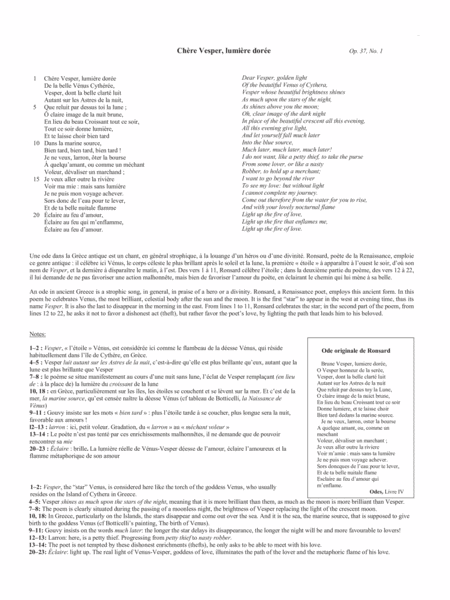
Op. 37, No. 1: Chère Vesper, lumière dorée from Songs of Gouvy, V1 (Downloadable)
Piano, Voix

$3.00 2.56 € Piano, Voix PDF SheetMusicPlus

Voice and piano (2 songs with violoncello; 1 vocal duet) - Medium - Digital Download SKU: MQ.8491-45E Composed by MeeAe Cecilia Nam and Theodore Gouvy. 5 pages. E. C. Schirmer Music Company - Digital #8491-45E. Published by E. C. Schirmer Music Company - Digital (MQ.8491-45E). French.A French composer, Théodore Gouvy (1819-1898) was one of the most significant composers of 19th Century in Europe. The movement of rediscovering his instrumental music has been increasingly successful in Europe since the 1990s, especially following the birth of L’Institut Gouvy in France. However, his solo vocal music has been waiting to be unveiled to the public. Volume One includes 52 songs of Gouvy.Gouvy traveled widely throughout Europe. He was also a lover of nature. Generally, he spent his winters in Leipzig, but in the summertime, he always returned to Hombourg-Haut, France, to stroll through the woods, to hunt, and to relax. Gouvy was fluent in several languages and had a great appreciation of the Renaissance French Poetry of Pierre de Ronsard whose poetry he had set to music. The fifty-two songs in this volume are largely by Ronsard and other Renaissance poets of La Pléiade.Although Ronsard is approximately 300 years older than Gouvy, they both seem to have the same interest in classical literature, though, admittedly, for different reasons. Celebrated by the French and English courts, Ronsard (1525-1585) was the leader of La Pléiade: a group of seven poets (Joachim Du Bellay (1522-1560), Rémy Belleau (1528-1577), Étienne Jodelle (1532-1573), Pontus de Tyard (1521-1603), Jean–Antoine Baïf (1532-1589), and Jean Daurat (1508-1588), who dedicated their efforts to writing poetry in French rather than in Latin (or Greek) as most of the Romantic poets did. They wished to enrich the French language, and establish a new literature which would be the equal of the other literature of their period, and the equal to poets of the past. French Romantic poetry featured the closeness of the poet to nature, and his ability to communicate with nature by personifying (anthropomorphizing) all of nature’s elements: flowers, the planets, the moon, the breeze, and even the sand upon the shore. As a significant melodist, Gouvy’s treatment of the vocal solo line and his treatment and development of the piano accompaniment places him in the upper echelons as a composer of songs. His diverse cultural life led a rich and significant musical life, interacting with his contemporaries who admired his work, and whom Gouvy knew well, such as Liszt, Brahms, Schumann, Mendelssohn, Berlioz and Gounod. Contents:Six Odes de Ronsard pour ténor et piano, Op. 37 (No. 3 et No. 5 avec violoncelle) Neuf Poésies de Ronsard pour soprano ou ténor et piano, Op. 41 Six Poésies de Ronsard pour soprano ou ténor et piano, Op. 42 Quatre Odes de Ronsard pour baryton et piano, Op. 43 Huit Poésies de Ronsard pour ténor ou soprano et piano, Op. 44 Sept Poésies de Ronsard pour ténor ou soprano et piano, Op. 47.
Op. 48, No. 5: Père du doux repos from Songs of Gouvy, V1 (Downloadable)
Piano, Voix

$3.00 2.56 € Piano, Voix PDF SheetMusicPlus

String Quartet String Quartet - Level 5 - Digital Download SKU: A0.938391 Composed by Colin Bayliss. 20th Century,Contemporary. Score and parts. 57 pages. Colin Bayliss #6145. Published by Colin Bayliss (A0.938391). This was written in the summer of 2000 for the Lochrian Ensemble who were beginning to plan the recording of the complete string quartets. In the context of the other string quartets, here there is a reversion to the classical form, thus giving a balance between the classical quartets nos. 1, 2 and 6 and the kaleidoscopic quartets nos. 3, 4 and 5. It is in the conventional four movements:- 1. Allegro - This movement is in single subject sonata form using one figure. There is much use of quasimodal writing, especially using the Lochrian and Superlochrian modes, based both on E and C and the Mixolydian mode on E, giving a sort of tonality in which the constructional remainder notes of the serial row can be used sparingly. The pull towards a tonality of F is therefore established quickly. Each section is rounded off by the metamorphosis of the figure into a sentimental tune, but contrary to expectation, it evolves in the coda into something completely different - the opening of Beethoven's F minor string quartet Op. 95. 2. Scherzo - Wobblefunk and Tango After the last movement's ending has dispelled any seriousness, the stage is set for an outrageous scherzo. After the tango, the wobblefunk section is repeated bar by bar in reverse. Why not? It doesn't make any sense the right way round! Historical note: the term wobblefunk was invented by the composer's son Edmund to describe a type of subdued electronic crossover style music which he had written. In keeping with the family sense of humour, the thought of incorporating such a movement into a serious string quartet appealed to both parties. 3. Adagio - This movement is tonal and melodic, but introduced by a discordant motif which re-appears as if to remind the listener of their own mortality. The movement progresses through the cycle of fifths and then dissolves into a sinister coda related to the notes of the discord. 4. Allegro - This movement can be summed up as accepting life's problems but getting on with enjoying the good things as well - in the spirit of the last movement of Beethoven's string quartet Op.135. Must it be? It must be! Even if it includes a textural fugue! The ending, however, is decidedly not as clear-cut as Beethoven's ....... The Score and Parts are available on this site as separate downloads The sound sample is the third movement - performed by the Lochrian Ensemble The complete 6 string quartets performed by the Lochrian Ensemble are available on itunes: see: http://www.dwsolo.com/colinbayliss/ and - for this 6th quartet: https://itunes.apple.com/us/album/bayliss-string-quartet-no.-6/id573669350.
String Quartet No. 6 (Lochrian) (parts)
Quatuor à cordes: 2 violons, alto, violoncelle

$10.00 8.54 € Quatuor à cordes: 2 violons, alto, violoncelle PDF SheetMusicPlus

String Quartet String Quartet - Level 5 - Digital Download SKU: A0.938389 Composed by Colin Bayliss. 20th Century,Contemporary. Score and parts. 46 pages. Colin Bayliss #6143. Published by Colin Bayliss (A0.938389). This was written in the summer of 2000 for the Lochrian Ensemble who were beginning to plan the recording of the complete string quartets. In the context of the other string quartets, here there is a reversion to the classical form, thus giving a balance between the classical quartets nos. 1, 2 and 6 and the kaleidoscopic quartets nos. 3, 4 and 5. It is in the conventional four movements:- 1. Allegro - This movement is in single subject sonata form using one figure. There is much use of quasimodal writing, especially using the Lochrian and Superlochrian modes, based both on E and C and the Mixolydian mode on E, giving a sort of tonality in which the constructional remainder notes of the serial row can be used sparingly. The pull towards a tonality of F is therefore established quickly. Each section is rounded off by the metamorphosis of the figure into a sentimental tune, but contrary to expectation, it evolves in the coda into something completely different - the opening of Beethoven's F minor string quartet Op. 95. 2. Scherzo - Wobblefunk and Tango After the last movement's ending has dispelled any seriousness, the stage is set for an outrageous scherzo. After the tango, the wobblefunk section is repeated bar by bar in reverse. Why not? It doesn't make any sense the right way round! Historical note: the term wobblefunk was invented by the composer's son Edmund to describe a type of subdued electronic crossover style music which he had written. In keeping with the family sense of humour, the thought of incorporating such a movement into a serious string quartet appealed to both parties. 3. Adagio - This movement is tonal and melodic, but introduced by a discordant motif which re-appears as if to remind the listener of their own mortality. The movement progresses through the cycle of fifths and then dissolves into a sinister coda related to the notes of the discord. 4. Allegro - This movement can be summed up as accepting life's problems but getting on with enjoying the good things as well - in the spirit of the last movement of Beethoven's string quartet Op.135. Must it be? It must be! Even if it includes a textural fugue! The ending, however, is decidedly not as clear-cut as Beethoven's ....... The Score and Parts are available on this site as separate downloads The sound sample is the third movement - performed by the Lochrian Ensemble The complete 6 string quartets performed by the Lochrian Ensemble are available on itunes: see: http://www.dwsolo.com/colinbayliss/ and - for this 6th quartet: https://itunes.apple.com/us/album/bayliss-string-quartet-no.-6/id573669350.
String Quartet No. 6 (Lochrian) (score)
Quatuor à cordes: 2 violons, alto, violoncelle

$8.00 6.83 € Quatuor à cordes: 2 violons, alto, violoncelle PDF SheetMusicPlus

Violin Duet Violin - Level 5 - Digital Download SKU: A0.859934 Composed by Claude Debussy, Claude Joseph Rouget De Lisle, Georges Bizet, and Jacques Offenbach. Arranged by Steven Kruse. 20th Century,Classical,Folk,Romantic Period,World. 25 pages. String Play for All #4766905. Published by String Play for All (A0.859934). I was inspired to create this suite after the horrendous Paris attacks in 2015, to show our solidarity with French, and love for their music. I originally made an arrangement for string orchestra designed to be played by groups on different ability levels.  This arrangement for two violas  is intended for very advanced students, skilled amateurs, or professionals. I have not included any fingerings so as to leave this to the artistic choice of each performer. The arrangement includes seven selections: Bizet’s Carmen and L'Arésienne, Alouette, Frère Jacques, Offenbach’s Can-Can, Debussy’s Clair de Lune and La Marseillaise (French National Anthem) by Claude Joseph Rouget de Lisle. There are also brief quotes from Mahler's Symphony No. 1, Berlioz’s Symphonie Fantastique, and Schumann's Two Grenadiers. The entire suite is approximately eight minutes in length. Score and parts are included. 
French Suite for Two Violas
2 Violons (duo)

$8.99 7.68 € 2 Violons (duo) PDF SheetMusicPlus

Cello Duet Cello - Level 5 - Digital Download SKU: A0.859935 Composed by Claude Debussy, Claude Joseph Rouget De Lisle, Georges Bizet, and Jacques Offenbach. Arranged by Steven Kruse. 20th Century,Classical,Folk,Romantic Period,World. Score. 24 pages. String Play for All #4766907. Published by String Play for All (A0.859935). I was inspired to create this suite after the horrendous Paris attacks in 2015, to show our solidarity with French, and love for their music. I originally made an arrangement for string orchestra designed to be played by groups on different ability levels.  This arrangement for two violas  is intended for very advanced students, skilled amateurs, or professionals. I have not included any fingerings so as to leave this to the artistic choice of each performer. The arrangement includes seven selections: Bizet’s Carmen and L'Arésienne, Alouette, Frère Jacques, Offenbach’s Can-Can, Debussy’s Clair de Lune and La Marseillaise (French National Anthem) by Claude Joseph Rouget de Lisle. There are also brief quotes from Mahler's Symphony No. 1, Berlioz’s Symphonie Fantastique, and Schumann's Two Grenadiers. The entire suite is approximately eight minutes in length. Score and parts are included. 
French Suite for Two Cellos
2 Violoncelles (duo)

$8.99 7.68 € 2 Violoncelles (duo) PDF SheetMusicPlus


Partitions Gratuites
Acheter des Partitions Musicales
Acheter des Partitions Digitales à Imprimer
Acheter des Instruments de Musique

© 2000 - 2026

Accueil - Version intégrale





