EUROPE
1539 articles
USA
0 articles
DIGITAL
519 articles (à imprimer)
Partitions Digitales
Partitions à imprimer
519 partitions trouvées

1 ....301 316 331 346 361 ....511

Alto Saxophone,Piano - Level 2 - Digital Download SKU: A0.549842 Composed by Johann Sebastian Bach. Arranged by James M. Guthrie, ASCAP. Baroque,Concert,Easter,Sacred,Standards. Score and part. 12 pages. Jmsgu3 #3554821. Published by jmsgu3 (A0.549842). Wachet auf, ruft uns die Stimme (Awake, the voice is calling us) from Cantata BWV 140. Duration: ca. 4:00, Score: 6 pages, solo part 1 page, piano part: 4 pages. Program this for church services during the Easter season, or as a recital encore.Wachet auf, ruft uns die Stimme (Awake, the Voice is calling us) also known as: Sleepers Awake Bach composed his church cantata Wachet auf (BWV 140) as part of his second annual cantata cycle covering the entire annual church calendar. It is based on the hymn of the same name by Philipp Nicolai (1599). The hymn text covers the readings for the 27th Sunday after Trinity. Bach designed the cantata in seven movements, setting the stanzas in various forms. Among these forms are the chorale fantasia, the chorale prelude, and a four-part chorale. He casts the new lyrics as recitatives – in a manner similar to the opera. Fourth Movement Bach writes the fourth movement, Zion hört die Wächter singen (Zion hears the watchmen singing), in the style of a chorale prelude with the chorale phrases performed as a strict cantus firmus. The phrases seem to enter at times erratically against the famous lyrical melody. The violins play this melody in unison as a foil against the cantus phrases. The violin melody is so independent and complete that when the cantus melody appears it catches the listener at times totally off-guard. Bach later transcribed this movement for organ (BWV 645). This transcription became No. 1 of the Six Schübler Chorales. Bach Overview First of all, Johann Sebastian Bach is maybe the greatest composer in music history. Certainly, he was prolific. As a result, everyone has heard of his works. Furthermore, these works number well over a thousand. It seems like people are probably most familiar with the instrumental works such as the Brandenburg Concertos, and the Goldberg Variations. But, similarly famous are such noteworthy works as the Well-Tempered Clavier, the Musical Offering, and certainly the Art of Fugue. Seems like his most famous vocal works include the most noteworthy Mass in B Minor. Also, most noteworthy, though, are the St. John Passion, and certainly the Christmas Oratorio.  History Bach came from a long line of musicians and above all, composers. Consequently, he, first of all, pursued a career as a church organist. So as a result, he gained employment in various Protestant churches in Germany. For a while, he worked as a court musician in Weimar and Köthen. Here he probably developed his organ style and likewise his chamber music style. Eventually, he, therefore, gained an appointment as Cantor of St. Thomas in Leipzig. Here he worked until difficulties with his employer ultimately drove him away. The King of Poland finally appointed him as court composer.  Style It seems like Bach created a fascinating new international style. He synthesized elements of the most noteworthy European music ideas into his new style. Even more, this new style was probably his synthesis of European musical rhythm and form. Furthermore, he demonstrated a complete mastery of counterpoint and motivic development. His sense of harmonic organization probably propelled him to the top. Revival                 Mendelssohn conducted a Bach revival in the nineteenth century. His effort probably helped to re-familiarize the public with the magnitude of Bach’s works. During this period, scholars published many noteworthy Bach biographies. Moreover, Wolfgang Schmieder published the BWV (Bach Werke Verzeichnis). As a result, this is now the official catalog of his entire artistic output. The BWV number allows us to locate a work in the catalog. Sometimes scholars will simply use an S (Schmieder) as an abbreviation for BWV.  .
Bach: Wachet auf for Alto Sax & Piano
Saxophone Alto et Piano

$24.95 21.52 € Saxophone Alto et Piano PDF SheetMusicPlus

Small Ensemble Alto Saxophone,Double Bass,Guitar,Piano Accompaniment,Tenor Saxophone - Level 3 - Digital Download SKU: A0.522196 Composed by Colin Kirkpatrick. Concert,Holiday,Jazz,Latin,Patriotic,Wedding. Score and parts. 35 pages. Colin Kirkpatrick Publications #3397237. Published by Colin Kirkpatrick Publications (A0.522196). Three numbers in popular style for two alto saxes and piano (or alto and tenor) with optional part for guitar and/or bass.These pieces are in jazz and Latin styles and are intended for intermediate students. They’re ideal for an end-of-term concert or recital but would be useful for any festive occasion or celebration. The 13-page piano score also includes the saxophone parts. The highest note in the 1st sax part is (written) C6 and that in the 2nd sax part is A6. Both parts avoid low D and C. Five-page parts for the two E flat alto saxophones are provided as well as an optional part for tenor sax, which is exactly the same part as the 2nd saxophone. In the piano parts the improvisation chords are shown only in the 1st alto part purely for the sake of visual tidiness, but they appear in all the saxophone parts so that any participant can offer an improvised solo. The guitar and bass parts are combined and the bass part is similar to the left hand of the piano part. All five parts are presented in a single PDF file. An MP3 file of all the piano accompaniments is also available as a separate item. You can find it here: https://www.sheetmusicplus.com/title/20679812 1. Hit the Town This is an entertaining swinger in the concert key of E flat and 4/4 time. It uses “jazz†eighth notes (quavers) and would be good introduction to playing in a jazz style. The improvisation section can be repeated as often as required. 2. Cool company A slow number in F major in a Latin-American style, this gives the opportunity to practise a soft singing tone-quality. There is one short section for improvising. 3. Freeway Written in 3/4 time in B flat, this jazzy waltz also uses “jazz†eighth notes (quavers) and the improvisation section can be repeated as often as required.
Let's Go! (for saxes and piano)

$6.99 6.03 € PDF SheetMusicPlus

String Quintet Cello,Double Bass,Viola,Violin - Level 1 - Digital Download SKU: A0.1332097 Composed by James Pierpont. Arranged by Gispert. Christmas,Holiday,Traditional. 8 pages. Clara lamonaca #918874. Published by clara lamonaca (A0.1332097). Introducing a joyful musical arrangement that will have everyone singing and ringing in the holiday cheer—Jingle Bells like you've never heard it before! This specially crafted arrangement is tailor-made for beginners, ensuring that even those taking their first steps in music can join in the festive fun.With easy-to-follow notation and a simplified yet vibrant arrangement, this rendition of Jingle Bells is perfect for young musicians, music students, or anyone looking to add a sprinkle of holiday magic to their repertoire. The familiar melody of this classic tune is brought to life with a playful ensemble of instruments, making it a delightful experience for both performers and listeners alike.Whether you're a music teacher searching for a crowd-pleaser for your beginner ensemble or an aspiring musician eager to share the holiday spirit, this arrangement of Jingle Bells is the perfect choice. Capture the essence of the season, spread smiles, and create lasting memories with this beginner-level musical gem.Don't miss the chance to make your holiday celebrations even brighter. Get ready to jingle all the way with this festive and accessible arrangement of Jingle Bells!
Jingle Bells
Quintette à cordes: 2 violons, alto, violoncelle, basse

$6.99 6.03 € Quintette à cordes: 2 violons, alto, violoncelle, basse PDF SheetMusicPlus

Soprano Saxophone Solo - Level 5 - Digital Download SKU: A0.533596 Composed by Carson Cooman. Concert,Contemporary,Folk,Standards. Individual part. 7 pages. Musik Fabrik Music Publishing #3030251. Published by Musik Fabrik Music Publishing (A0.533596). Ancient Airs (2004) for solo soprano saxophone was written for and is dedicated tosaxophonist Paul Wehage. It is in two movements, each with a spirit of ancient airsre-imagined in a modern context. The ancestry of most woodwind instruments as folkinstruments is the inspiration for the work's concept. The piece should always beplayed with a lyrical, singing approach.Beyond the Mountain uses as its basic musical material a simple transformation of amodal melody in D minor. Gradually tones are added borrowed from othermodalities. The opening section is slow and lyrical. The middle section is moreactive -- contrasting the D minor chord tones with the added diminished tones of thefirst section. The final section recalls the material of the opening with a widertransformation.Forgotten Incantation uses a wider modal language than the first movement.Although still generally slow and song-like, it is more energetic. Energetic gesturesinterrupt and drive the song narrative forwards.
Carson Cooman: Ancient Airs (2004) for solo soprano saxophone
Saxophone (partie séparée)

$11.95 10.31 € Saxophone (partie séparée) PDF SheetMusicPlus

Instrumental Duet Bassoon,Instrumental Duet,Piano - Level 2 - Digital Download SKU: A0.549851 Composed by Johann Sebastian Bach. Arranged by James M. Guthrie, ASCAP. Baroque,Concert,Easter,Sacred,Standards. Score and parts. 12 pages. Jmsgu3 #3555069. Published by jmsgu3 (A0.549851). Wachet auf, ruft uns die Stimme (Awake, the voice is calling us) from Cantata BWV 140. Duration: ca. 4:00, Score: 6 pages, solo part 1 page, piano part: 4 pages. Program this for church services during the Easter season, weddings, or as a recital encore.Wachet auf, ruft uns die Stimme (Awake, the Voice is calling us) also known as: Sleepers Awake Bach composed his church cantata Wachet auf (BWV 140) as part of his second annual cantata cycle covering the entire annual church calendar. It is based on the hymn of the same name by Philipp Nicolai (1599). The hymn text covers the readings for the 27th Sunday after Trinity. Bach designed the cantata in seven movements, setting the stanzas in various forms. Among these forms are the chorale fantasia, the chorale prelude, and a four-part chorale. He casts the new lyrics as recitatives – in a manner similar to the opera. Fourth Movement Bach writes the fourth movement, Zion hört die Wächter singen (Zion hears the watchmen singing), in the style of a chorale prelude with the chorale phrases performed as a strict cantus firmus. The phrases seem to enter at times erratically against the famous lyrical melody. The violins play this melody in unison as a foil against the cantus phrases. The violin melody is so independent and complete that when the cantus melody appears it catches the listener at times totally off-guard. Bach later transcribed this movement for organ (BWV 645). This transcription became No. 1 of the Six Schübler Chorales. Bach Overview First of all, Johann Sebastian Bach is maybe the greatest composer in music history. Certainly, he was prolific. As a result, everyone has heard of his works. Furthermore, these works number well over a thousand. It seems like people are probably most familiar with the instrumental works such as the Brandenburg Concertos, and the Goldberg Variations. But, similarly famous are such noteworthy works as the Well-Tempered Clavier, the Musical Offering, and certainly the Art of Fugue. Seems like his most famous vocal works include the most noteworthy Mass in B Minor. Also, most noteworthy, though, are the St. John Passion, and certainly the Christmas Oratorio.  History Bach came from a long line of musicians and above all, composers. Consequently, he, first of all, pursued a career as a church organist. So as a result, he gained employment in various Protestant churches in Germany. For a while, he worked as a court musician in Weimar and Köthen. Here he probably developed his organ style and likewise his chamber music style. Eventually, he, therefore, gained an appointment as Cantor of St. Thomas in Leipzig. Here he worked until difficulties with his employer ultimately drove him away. The King of Poland finally appointed him as court composer.  Style It seems like Bach created a fascinating new international style. He synthesized elements of the most noteworthy European music ideas into his new style. Even more, this new style was probably his synthesis of European musical rhythm and form. Furthermore, he demonstrated a complete mastery of counterpoint and motivic development. His sense of harmonic organization probably propelled him to the top. Revival               Mendelssohn conducted a Bach revival in the nineteenth century. His effort probably helped to re-familiarize the public with the magnitude of Bach’s works. During this period, scholars published many noteworthy Bach biographies. Moreover, Wolfgang Schmieder published the BWV (Bach Werke Verzeichnis). As a result, this is now the official catalog of his entire artistic output. The BWV number allows us to locate a work in the catalog. Sometimes scholars will simply use an S (Schmieder) as an abbreviation for BWV. &n.
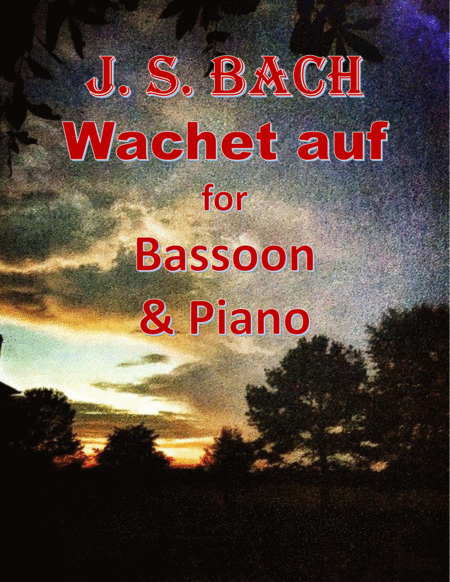
Bach: Wachet auf for Bassoon & Piano
Basson, Piano (duo)

$24.95 21.52 € Basson, Piano (duo) PDF SheetMusicPlus

Small Ensemble Flute,Medium Voice,Piano - Level 4 - Digital Download SKU: A0.532835 Composed by Therese Brenet. 20th Century,Concert,Contemporary,Standards. Score and parts. 39 pages. Musik Fabrik Music Publishing #45421. Published by Musik Fabrik Music Publishing (A0.532835). Thérèse Brenet was attracted to the Chinese poems in La Flûte de Jade by Franz Toussaint. She chose seven of these poems in a contrasting style and assembled them into a single work, striving to create an unusual orchestration which reflects this delicate, fantastic and sensual qualities of these poems. Her orchestration uses a small group of strings which are re-enforced by a harpsichord, a vibraphone, a harp and percussion, often superimposed, which serve to underline the delicate character of the poems. IN addition, she uses all styles of vocal production, from whispered passages to spoken words or screams, and from singing normally to sprechgesang. The work finishes serenely with a long melody in flute upon which the baritone repeats the last phrases of the poem in a long perdendosi. The voice and the flute slowly die away without there being a definite ending to the work, which allow the listener to imagine that the work continues, as in a waking dream. One could imagine hearing the echo of the words whispered by the baritone and the arien and luminous sounds of the flute which has lulled us as a soloist throughout the seven poems of the cycle. The orchestration is for 4 percussion, harp, harpsichord, piano and strings (44221). The piece generally lasts approximately fourteen minutes. The composer has intentionally broken with tradition by using instrumental notation for the vovcal part. This notations gives, in her view, a greater ease of reading when the voice exchanges with the flute. This version for flute, voice and piano is identical, as much as is possible, with the orchestral version, excpet for short segments in the 5th and 7th poems. These differences only affect the flute and piano parts and do not affect the vocal part. The Baritone may therefore use this score for performances with orchestra. The Flutist should use the part included in the orchestral parts for performances with orchestra. This work was first performed at the Villa Medicis during Thérèse Brenet time spend there during her Prix de Rome voyage. It was recorded in 2014 with Kurt Ollmann Baritone, Christel Rayneau, flute and the National Polish Radio Orchestra under the direction of Paul Wehage. The orchestral materials are on rental from the publisher.
Thérèse Brenet: Poème de Jade, seven mélodies on Chinese Poems for baritone, flute solo and orchestr

$22.05 19.02 € PDF SheetMusicPlus

Vocal Duet, Key of C - Digital Download SKU: H1.8999DP Composed by Joseph M. Martin. Piano Accompaniment with Optional Orchestra. Vocal Score. 12 pages. Hope Publishing - Digital #8999DP. Published by Hope Publishing - Digital (H1.8999DP). Original anthem From Joseph Martin here is a gorgeous, lyrical expression of praise and thanksgiving. The memorable melody and personal text build to the familiar quote, If Christ is Lord of heaven and earth, how can I keep from singing? The orchestration, by Stan Pethel, heightens the impact of this deeply felt anthem of gratitude useful for Thanksgiving and general occasions. This top-seller has been newly re-voiced for SAB voices. The Rhythm packet contains parts for Drums and Electric Bass. The Orchestration includes a Conductor's Score and parts for: Electric Bass, Drums, Flute 1 & 2, Oboe, Clarinet 1 & 2, Bassoon, French Horn 1 & 2, Trumpets 1, 2 & 3, Trombones 1 & 2, Bass Trombone/Tuba, Timpani, Percussion 1 & 2, Harp, Violins 1 & 2, Viola, Cello, and Double Bass.
I Thank You, Lord

$7.95 6.86 € PDF SheetMusicPlus

String Quartet Cello,Double Bass,String Quartet,Viola,Violin - Level 3 - Digital Download SKU: A0.973330 By Black Eyed Peas & Shakira. By Albert Mendez, Albert Menendez, Allan Pineda, Brendan Buckley, Jaime Gomez, Jimmy Gomez, Jimmy Luis Gomez, Shakira, Shakira Isabel Ripoll, Tim Mitchell, Timothy C. Mitchell, and William Adams. Arranged by Jose Welligton Sousa de Castro. Film/TV,Multicultural,Pop,World. Score and parts. 10 pages. Jose Welligton Sousa de Castro #6205759. Published by Jose Welligton Sousa de Castro (A0.973330). Elevate your next string orchestra performance with our exclusive arrangement of Girl Like Me by Black Eyed Peas and Shakira, arranged by Welligton Sousa. This energetic and catchy arrangement is written in the key of E minor and is perfect for adding a modern and popular touch to your repertoire. This arrangement showcases the infectious beat and lively melody of the original song. Welligton Sousa's expert arrangement ensures that each section of the orchestra is given a chance to shine, with carefully crafted parts that work together to create a dynamic and exciting sound. This piece is perfect for adding variety to your concert program or as a standout performance at a special event. The arrangement's rhythmic elements, coupled with the unforgettable melodies, are sure to have your audience dancing and singing along. Whether you're looking to impress your audience with a contemporary piece or simply expand your ensemble's repertoire, this sheet music is a must-have. Perfect for concerts, recitals, and wedding performances, this arrangement of Girl Like Me is sure to captivate and energize your audience.
Girl Like Me
Quatuor à cordes: 2 violons, alto, violoncelle
Black Eyed Peas & Shakira
$12.99 11.2 € Quatuor à cordes: 2 violons, alto, violoncelle PDF SheetMusicPlus

Choral Choir,Choral (SAB) - Level 2 - Digital Download SKU: A0.1389251 By Jon Paige. By J. Paul Williams. Arranged by Kenneth Martin. 21st Century,Easter,Instructional,Praise & Worship. 40 pages. Martin Music Editions #972785. Published by Martin Music Editions (A0.1389251). EASTER ALLELUIA!Celebrate the resurrection with 'Easter Alleluia!', an invigorating choral arrangement for SAB singers and piano or organ accompaniment. This exciting rendition, based on the beloved song 'Easter is Here!' by J. Paul Williams and John Paige, now boasts an optional brass quintet accompaniment, adding a bold and boisterous layer to your performance.Perfect for Resurrection Sunday, 'Easter Alleluia!' captures the jubilant spirit of the season, echoing the powerful themes found in the Scriptures (I Corinthians 15:3-5; Job 19:25). The arrangement is designed to be easily learned, making it an ideal opener for your Easter service or concert.The SAB vocal writing of 'Easter Alleluia!' relies prominently on unison singing, breaking into harmonies only on occasion. This makes it a must-sing for choirs with smaller forces, as well as larger ensembles looking for a fresh take on a classic Easter hymn.Despite being crafted for SAB forces, 'Easter Alleluia!' boasts a full and enriching sound that will captivate your audience. Whether you're performing in a church, a concert hall, or any other venue, this arrangement is an essential addition to your Easter repertoire.Don't miss this opportunity to bring the joy and beauty of Easter to life with 'Easter Alleluia!'.
Easter Alleluia! - Fanfare concertante for SAB choir, piano, and brass quintet (opt.)
Chorale 3 parties
Jon Paige
$2.49 2.15 € Chorale 3 parties PDF SheetMusicPlus

Piano,Tenor Saxophone - Level 2 - Digital Download SKU: A0.549845 Composed by Johann Sebastian Bach. Arranged by James M. Guthrie, ASCAP. Baroque,Concert,Easter,Sacred,Standards. Score and part. 12 pages. Jmsgu3 #3554837. Published by jmsgu3 (A0.549845). Wachet auf, ruft uns die Stimme (Awake, the voice is calling us) from Cantata BWV 140. Duration: ca. 4:00, Score: 6 pages, solo part 1 page, piano part: 4 pages. Program this for church services during the Easter season, weddings, or as a recital encore.Wachet auf, ruft uns die Stimme (Awake, the Voice is calling us) also known as: Sleepers Awake Bach composed his church cantata Wachet auf (BWV 140) as part of his second annual cantata cycle covering the entire annual church calendar. It is based on the hymn of the same name by Philipp Nicolai (1599). The hymn text covers the readings for the 27th Sunday after Trinity. Bach designed the cantata in seven movements, setting the stanzas in various forms. Among these forms are the chorale fantasia, the chorale prelude, and a four-part chorale. He casts the new lyrics as recitatives – in a manner similar to the opera. Fourth Movement Bach writes the fourth movement, Zion hört die Wächter singen (Zion hears the watchmen singing), in the style of a chorale prelude with the chorale phrases performed as a strict cantus firmus. The phrases seem to enter at times erratically against the famous lyrical melody. The violins play this melody in unison as a foil against the cantus phrases. The violin melody is so independent and complete that when the cantus melody appears it catches the listener at times totally off-guard. Bach later transcribed this movement for organ (BWV 645). This transcription became No. 1 of the Six Schübler Chorales. Bach Overview First of all, Johann Sebastian Bach is maybe the greatest composer in music history. Certainly, he was prolific. As a result, everyone has heard of his works. Furthermore, these works number well over a thousand. It seems like people are probably most familiar with the instrumental works such as the Brandenburg Concertos, and the Goldberg Variations. But, similarly famous are such noteworthy works as the Well-Tempered Clavier, the Musical Offering, and certainly the Art of Fugue. Seems like his most famous vocal works include the most noteworthy Mass in B Minor. Also, most noteworthy, though, are the St. John Passion, and certainly the Christmas Oratorio.  History Bach came from a long line of musicians and above all, composers. Consequently, he, first of all, pursued a career as a church organist. So as a result, he gained employment in various Protestant churches in Germany. For a while, he worked as a court musician in Weimar and Köthen. Here he probably developed his organ style and likewise his chamber music style. Eventually, he, therefore, gained an appointment as Cantor of St. Thomas in Leipzig. Here he worked until difficulties with his employer ultimately drove him away. The King of Poland finally appointed him as court composer.  Style It seems like Bach created a fascinating new international style. He synthesized elements of the most noteworthy European music ideas into his new style. Even more, this new style was probably his synthesis of European musical rhythm and form. Furthermore, he demonstrated a complete mastery of counterpoint and motivic development. His sense of harmonic organization probably propelled him to the top. Revival               Mendelssohn conducted a Bach revival in the nineteenth century. His effort probably helped to re-familiarize the public with the magnitude of Bach’s works. During this period, scholars published many noteworthy Bach biographies. Moreover, Wolfgang Schmieder published the BWV (Bach Werke Verzeichnis). As a result, this is now the official catalog of his entire artistic output. The BWV number allows us to locate a work in the catalog. Sometimes scholars will simply use an S (Schmieder) as an abbreviation for BWV. &n.
Bach: Wachet auf for Tenor Sax & Piano
Saxophone Tenor et Piano

$24.95 21.52 € Saxophone Tenor et Piano PDF SheetMusicPlus

Strings 2 Pianos,4 Hands,Bass Voice,Digital Keyboard,Double Bass,Drum Set,Drums,Electric Bass Guitar,Electronic Keyboard,Hand Percussion,Harp,Horn,Medium-High Voice,Organ,Piano and Keyboard,Synthesizer,Trombone,Tuba - Digital Download SKU: A0.1165825 By Amphibia Cultural Legacy and Parry P. Gripp. By Amphibia Cultural Legacy and Parry Gripp. Arranged by Amphibia Cultural Legacy. Comedy,Disco,New Age,Pop,Singer/Songwriter. 3 pages. Amphibia Cultural Legacy #766197. Published by Amphibia Cultural Legacy (A0.1165825). The Day After Your Birthday is a fun and catchy tune that has been remixed with additional instruments by Amphibia Cultural Legacy. Originally written by Parry Gripp, this new version of the song gives it a fresh and exciting feel. The added instruments create a more dynamic sound, with listeners tapping their feet and singing.Parry Gripp's original song version was already enjoyable, but the remix takes it to a whole new level. Different instruments, such as drums, guitars, and keyboards, add depth to the melody and give it more energy. The lyrics remain as fun as before, describing waking up after one's birthday party and feeling like they're still celebrating.Overall, Amphibia Cultural Legacy has done an excellent job remixing this track. They have maintained their original charm while adding their unique touch.
The Day After Your Birthday
Amphibia Cultural Legacy and Parry P Gripp
$20.00 17.25 € PDF SheetMusicPlus

Guitar,Piano,Vocal,Voice - Level 2 - Digital Download SKU: A0.741158 Composed by Anne Britt, Gay Tregaskis. Children,Folk,Holiday,Pop. Score. 6 pages. Anne Britt #3381981. Published by Anne Britt (A0.741158). When an acquaintance of mine, Gay Tregaskis, sent me a poem she’d written and told me the story behind it, I was honored to be able to put her beautiful and touching words to music. The story is best told in her own words: When I was expecting my first baby, I wanted an antique rocking chair. I found one listed in the newspaper that said, ‘old, but loved.’ I remember going to look at it with my husband in November. It was old and worn… the seat springs were broken, the fabric was faded and torn. I loved it! We bought it for a forgotten amount and my sweet mother-in-law had it repaired and re-upholstered for my Christmas gift. Our little son was born on January 31st. I spent hours and hours just rocking God’s little miracle. On Mother’s Day that year, I woke up and just began writing. There were only one or two lines I shifted. It felt like all the babes and parents who ever sat in the old chair wanted me and mommies-to-be to understand the precious moments spent rocking and bonding. It still brings tears to my eyes. These words are a gift given to me for my children and all who they touch. Our moments to share pass on fleet feet… especially with our children. Please – if any of my poems can be given forward in song, this is the one I want parents to share and to be impressed to never forget how quickly time passes – to cherish the ‘now.’ If singing our song will give pause for parents to bond, then those souls passed on who visited and inspired this verse will have peace. 6 pages.Visit the composer's website for contact info and some free sheet music downloads: https://annebrittmusic.com/
Old Rocking Chair
Piano, Voix et Guitare

$3.99 3.44 € Piano, Voix et Guitare PDF SheetMusicPlus


1 ....301 316 331 346 361 ....511


Partitions Gratuites
Acheter des Partitions Musicales
Acheter des Partitions Digitales à Imprimer
Acheter des Instruments de Musique

© 2000 - 2026

Accueil - Version intégrale





