EUROPE
1802 articles
USA
0 articles
DIGITAL
8209 articles (à imprimer)
Partitions Digitales
Partitions à imprimer
8209 partitions trouvées


Brass Quartet Trombone,Trumpet,Tuba - Level 3 - Digital Download SKU: A0.1493276 By Genesis. By Mike Rutherford, Peter Gabriel, Phil Collins, Steven Hackett, and Tony Banks. Arranged by Jeff Tincher. Classical,Contemporary,Rock. 52 pages. Jeff Tincher #1069931. Published by Jeff Tincher (A0.1493276). Here is one of the more famous songs by the band Genesis. In the original key from their The Lamb Lies Down On Broadway, this song remained in their live shows until the end. This arrangement includes the live ending from their Seconds Out live double lp. Duration = 5:33. Visit my websites: https://jtp.spread.name/, https://jefftincher.wixsite.com/music, https://www.facebook.com/jefftincherpublishing.
Carpet Crawlers
Quatuor de Cuivres : 2 trompettes, trombone, tuba
Genesis
$12.99 11.28 € Quatuor de Cuivres : 2 trompettes, trombone, tuba PDF SheetMusicPlus

Jazz Combo - Level 3 - Digital Download SKU: A0.1468810 By Elton John & George Michael. By Bernie Taupin and Elton John. Arranged by Tom Mason. Blues,Film/TV,Pop,Rock,Singer/Songwriter. 41 pages. Tom Mason #1046992. Published by Tom Mason (A0.1468810). An arrangement of Elton John & Bernie Taupins classic song for Solo Voice and Backing Band of Piano, Guitar, Bass and Drums which highlights the virtuosity of both Voice and Pianist.From Elton's 1974 Caribou album, it has remained in the repertoire of every serious musician ever since.A fantastic arrangement of this timeless composition, which is a favourite of all.This arrangement contains a Guitar Part which incorporates both Chord symbols and also Tabulature for the tricky moments.
Don't Let The Sun Go Down On Me
Jazz combo
Elton John & George Michael
$24.99 21.7 € Jazz combo PDF SheetMusicPlus

Instrumental Duet Bass Flute,Harp,Instrumental Duet - Digital Download SKU: A0.1098499 Composed by Johann Pachelbel. Arranged by James M. Guthrie. Baroque,Classical,Standards,Traditional,Wedding. Score and parts. 11 pages. Jmsgu3 #702355. Published by jmsgu3 (A0.1098499). Score: 6 pages. Duration: ca. 2:30. The famous Pachelbel Canon arranged for Bass Flute & Harp. A great choice for weddings & receptions! Pachelbel's Canon Pachelbel's Canon is, in fact, the traditional title for a composition by the German composer Johann Pachelbel. Other names for the work include namely: Canon and Gigue for 3 violins and basso continuo, Canon and Gigue in D, and of course Canon in D. We do not know when or why in particular it was written. The oldest copy is surprisingly from the 19th century. It is important to realize that it was a common routine for organists to practice improvisation on the chord progression underlying the canon. Pachelbel originally scored the Canon notably for three violins and continuo. He also in fact paired the Canon with a gigue. The movements are homotonal, to clarify, both are in the key of D major. History In due time, Pachelbel's Canon went out of style and remained in virtual oblivion for centuries. The Jean-François Paillard chamber orchestra, however, recorded an arrangement of it in 1968. As a result, it gained approval. Many ensembles began likewise to record the piece in the 1970s and by the 1980s became ubiquitous as background music. From the 1970s to the early 2000s, pop songs correspondingly used elements of the piece. The chord progression, in particular, was used this way. Also, since the 1980s, it has been not only wildly popular for weddings, but also for funeral ceremonies in the USA and Europe. Pachelbel Background Johann Pachelbel (1653 –1706) was a German composer, as well as an organist. He was furthermore instrumental in bringing the south German organ school to its apex. He wrote a large body of music, both sacred and, equally important, secular. In particular, he uniquely helped develop the chorale prelude and fugue. For this, he has, in fact, earned a rightful place in the company of the most significant composers of the mid-Baroque period. Works Pachelbel's music was certainly popular. With this in mind, he also consequently had many pupils. His music expressly developed into a model for south German composers. Nowadays, Pachelbel is most famous, particularly for the Canon in D, as well as the F minor Chaconne, the Toccata in E minor, and of course the Hexachordum Apollinis, a set of variations for the keyboard. Influences Johann Jakob Froberger and Johann Caspar Kerll were south German composers who significantly influenced Pachelbel. Furthermore, he was especially influenced by Italians such as Frescobaldi and Poglietti. He frequently preferred an articulate, simple contrapuntal style that highlighted clarity. His music is markedly less extravagant and harmonically adventurous than that of Dieterich Buxtehude. However, as a point often overlooked, like Buxtehude, Pachelbel experimented with different instrumental combinations in his chamber music. Legacy All in all, Pachelbel was most famous as a composer for the keyboard. He composed over two hundred pieces specifically for the instrument. Pachelbel was also surprisingly a prolific composer of vocal music. All in all, about a hundred vocal works survive, including 40 or so large-scale works.
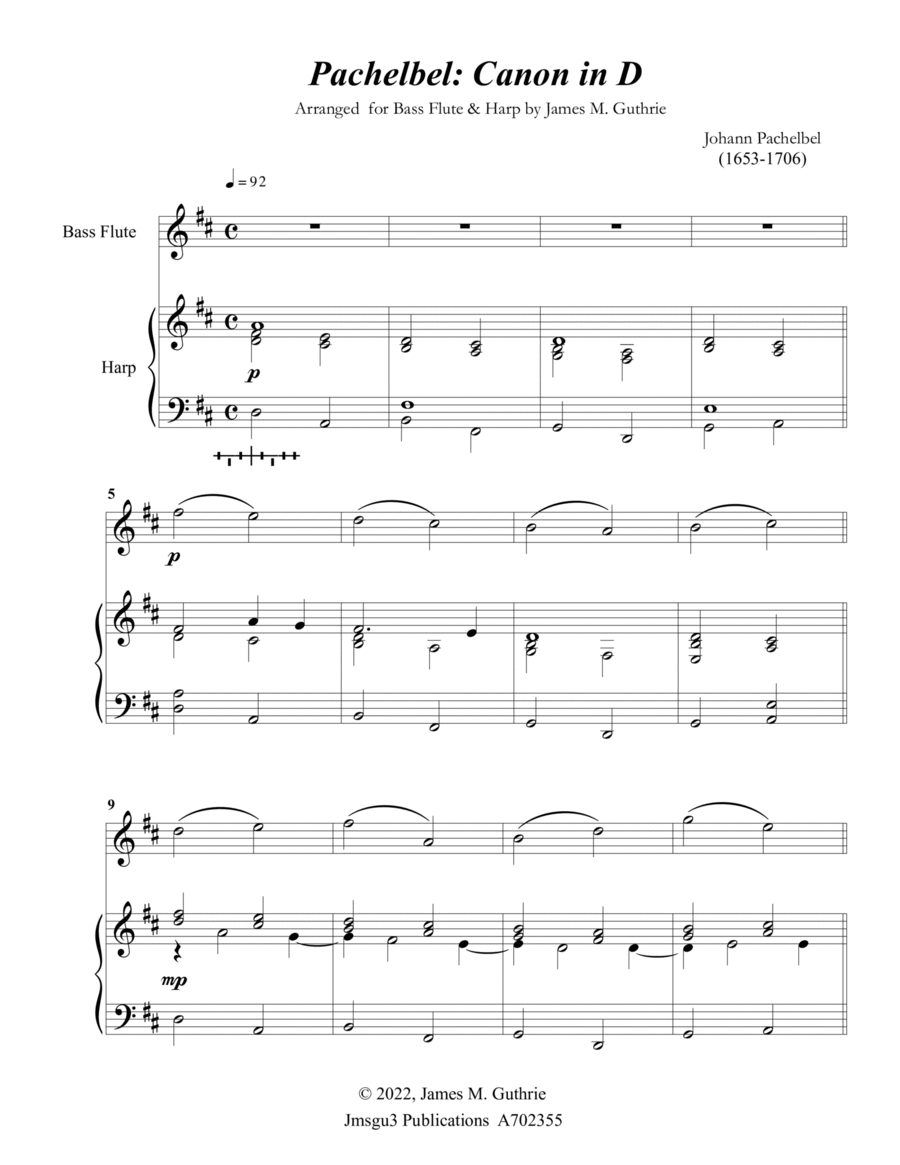
Pachelbel: Canon in D for Bass Flute & Harp
Harpe, Flûte (duo)

$32.95 28.61 € Harpe, Flûte (duo) PDF SheetMusicPlus

Instrumental Duet Flute,Instrumental Duet,Oboe - Level 3 - Digital Download SKU: A0.594103 Composed by Franz Xaver Gruber. Arranged by David McKeown. Blues,Christmas,Praise & Worship,Sacred. Score and parts. 3 pages. David McKeown #6549687. Published by David McKeown (A0.594103). Silent Night is a much-loved Christmas carol. This version is arranged as a duet in a Gospel style for one Flute and one Oboe. Click on the YouTube link above to listen to a full length performance of this arrangement played on Clarinet.The melody of Silent Night was composed by Franz Xaver Gruber in 1918, a setting for the lyrics of a young priest, Joseph Mohr. After flooding had damaged the church organ in Oberdorf, Austria, Mohr asked local schoolmaster, Gruber, to write a Christmas melody to be accompanied by guitar. Silent Night was the result. The carol remained unpublished until 1833, but has since gained huge international popularity. Bing Crosby’s version sold more than 10 million copies and UNESCO has declared the carol an intangible cultural heritageWith a performance time of around two and a half minutes, this version of Silent Night is perfect for seasonal celebrations and concert performances, both formal and informal. The gospel style is a fun, fresh and soulful take on this familiar tune.Silent Night is arranged in a key and range best suited to the instruments. The 9/8 meter may be feel unusual to some, and there is plenty of articulation detail to help deliver an authentic style. The melody is played twice, with a short intro and a bluesy outdo. This arrangement is suitable for players at an intermediate level.
Silent Night, Gospel Style, for Flute and Oboe Duet
Hautbois, Flûte

$3.99 3.46 € Hautbois, Flûte PDF SheetMusicPlus

Level 3 - Digital Download SKU: A0.911345 By Keith Terrett. By Various. Arranged by Keith Terrett. Jazz,Spiritual,Traditional. 43 pages. Keith Terrett #517391. Published by Keith Terrett (A0.911345). Four Early Jazz Classics from the USA for Brass Quintet includes: 1)Little Brown Jug:It was originally a drinking song. It remained well known as a folk song into the early 20th century. Like many songs which make reference to alcohol, it enjoyed new popularity during the Prohibition era. In 1939, bandleader Glenn Miller recorded and broadcast his swing instrumental arrangement of the tune with great success, and the number became one of the best known orchestrations of the American Big Band era. 2)Frankie & Johnny:Frankie and Johnny (sometimes spelled Frankie and Johnnie; also known as Frankie and Albert or just Frankie) is a traditional American popular song. It tells the story of a woman, Frankie, who finds that her man Johnny was making love to another woman and shoots him dead. Frankie is then arrested; in some versions of the song she is also executed. 3)Tin Roof Blues:Tin Roof Blues is a jazz composition by the New Orleans Rhythm Kings first recorded in 1923. It was written by band members Paul Mares, Ben Pollack, Mel Stitzel, George Brunies and Leon Roppolo. The tune has become a jazz standard and is one of the most recorded and often played New Orleans jazz compositions. 4)Battle Hymn of the Republic:The Battle Hymn of the Republic, also known as Mine Eyes Have Seen the Glory outside of the United States, is a song by American writer Julia Ward Howe using the music from the song John Brown’s Body. Howe’s more famous lyrics were written in November 1861, and first published in The Atlantic Monthly in February 1862. The song links the judgment of the wicked at the end of time (Old Testament, Isaiah 63; New Testament, Rev. 19) with the American Civil War. Since that time, it has become an extremely popular and well-known American patriotic song. Arranged here for Brass Quintet, this arrangement is available for most ensembles of your choice, e-mail for other arrangements. An excellent selection for your next concert!
Four Early Jazz Classics for Brass Quintet
Quintette de Cuivres: 2 trompettes, Cor, trombone, tuba
Keith Terrett
$18.00 15.63 € Quintette de Cuivres: 2 trompettes, Cor, trombone, tuba PDF SheetMusicPlus

String Ensemble,String Trio Cello - Level 3 - Digital Download SKU: A0.552065 Composed by Johann Pachelbel. Arranged by James M. Guthrie. Baroque,Instructional,Standards,Wedding. Score and parts. 16 pages. Jmsgu3 #6105689. Published by jmsgu3 (A0.552065). Score: 9 pagesDuration: 2:40. The famous Pachelbel Canon arranged for Piano Trio. A great choice for weddings & receptions! Pachelbel's Canon Pachelbel's Canon is, in fact, the traditional title for a composition by the German composer Johann Pachelbel. Other names for the work include namely: Canon and Gigue for 3 violins and basso continuo, Canon and Gigue in D, and of course Canon in D. We do not know when or why in particular it was written. The oldest copy is surprisingly from the 19th century. It is important to realize that it was a common routine for organists to practice improvisation on the chord progression underlying the canon. Pachelbel originally scored the Canon notably for three violins and continuo. He also in fact paired the Canon with a gigue. The movements are homotonal, to clarify, both are in the key of D major. History In due time, Pachelbel's Canon went out of style and remained in virtual oblivion for centuries. The Jean-François Paillard chamber orchestra, however, recorded an arrangement of it in 1968. As a result, it gained approval. Many ensembles began likewise to record the piece in the 1970s and by the 1980s became ubiquitous as background music. From the 1970s to the early 2000s, pop songs correspondingly used elements of the piece. The chord progression, in particular, was used this way. Also, since the 1980s, it has been not only wildly popular for weddings, but also for funeral ceremonies in the USA and Europe. Pachelbel Background Johann Pachelbel (1653 –1706) was a German composer, as well as an organist. He was furthermore instrumental in bringing the south German organ school to its apex. He wrote a large body of music, both sacred and, equally important, secular. In particular, he uniquely helped develop the chorale prelude and fugue. For this, he has, in fact, earned a rightful place in the company of the most significant composers of the mid-Baroque period. Works Pachelbel's music was certainly popular. With this in mind, he also consequently had many pupils. His music expressly developed into a model for south German composers. Nowadays, Pachelbel is most famous, particularly for the Canon in D, as well as the F minor Chaconne, the Toccata in E minor, and of course the Hexachordum Apollinis, a set of variations for the keyboard. Influences Johann Jakob Froberger and Johann Caspar Kerll were south German composers who significantly influenced Pachelbel. Furthermore, he was especially influenced by Italians such as Frescobaldi and Poglietti. He frequently preferred an articulate, simple contrapuntal style that highlighted clarity. His music is markedly less extravagant and harmonically adventurous than that of Dieterich Buxtehude. However, as a point often overlooked, like Buxtehude, Pachelbel experimented with different instrumental combinations in his chamber music. Legacy All in all, Pachelbel was most famous as a composer for the keyboard. He composed over two hundred pieces specifically for the instrument. Pachelbel was also surprisingly a prolific composer of vocal music. All in all, about a hundred vocal works survive, including 40 or so large-scale works.
Pachelbel: Canon in D for Piano Trio
Trio à Cordes: 3 violoncelles

$36.95 32.08 € Trio à Cordes: 3 violoncelles PDF SheetMusicPlus

Horn,Trombone,Trumpet,Tuba - Level 4 - Digital Download SKU: A0.1158678 Composed by Dr. Daniel N. Thrower. 20th Century,Chamber,Classical,Historic. 30 pages. Https://gildedmusicpress.com/ #758696. Published by https://gildedmusicpress.com/ (A0.1158678). The opening of this 4-minute piece is dance-like, intimating a celebratory mood up front—alone at first, but shared with the ensemble throughout the piece. After much celebration, the piece ends solemnly, as if giving each other final hugs and good-byes. Every Airman has a story to tell. “Farewell Celebration†is part of my story as an Airman musician. It is a fitting farewell to the Heartland of America Band stationed at Offutt Air Force Base in Bellevue, Nebraska, and to the entire American Midwest, as my family and I finalized our plans to uproot for an extraordinary three-year adventure in Asia. Work on this composition began toward the end of July and beginning of August 2021 as a melody with instructions to be the opening of a brass quintet piece, beginning with trumpet alone. It remained in that state until January 2022 when I entered this sketch into the computer to be worked on sporadically along with several other works in progress. When I contracted Covid-19 in July 2022, all of these works and other incipient pieces received attention, but this one more than most others. In the fall, I felt an urgency to complete it as a sentimental gesture of enthusiastic good-byes due to many life changes taking place. In particular, my fourth son, Paul, was departing for two years for Brazil. I was compelled to complete this work before he left on October 17, 2022, which I accomplished the day prior to his departure. In addition to Paul’s farewell, two co-workers with whom I had worked closely in the Air Force brass quintet called “Offutt Brass,†were also moving on with new exciting chapters in their lives. MSgt Ben Kadow, our fantastic trombonist, had received an assignment to move to Germany, leaving us on November 8. And MSgt Ryan Heseltine, our unparalleled French horn player, retired at the end of the year. On top of all that, in September I was given an assignment to move to Japan the following summer. Some farewells are more difficult to endure than others, though all seem to have varied brands of profound emotion. In contrast to saying good-bye to a loved one who passes away, all of these farewells were joyful, albeit poignant. “Farewell Celebration†is dedicated to my son Paul, to my outstanding professional colleagues, Ben Kadow and Ryan Heseltine, and to all our friends and family members who we left behind as we moved to Japan.
Farewell Celebration (for Brass Quintet)
Quintette de Cuivres: 2 trompettes, Cor, trombone, tuba

$24.95 21.66 € Quintette de Cuivres: 2 trompettes, Cor, trombone, tuba PDF SheetMusicPlus

String Quartet Cello,Double Bass,String Quartet,Viola,Violin - Level 3 - Digital Download SKU: A0.1092472 Composed by Francesco Durante. Arranged by Regis Bookshar. Baroque,Instructional,Sacred. Score and parts. 7 pages. Regis Bookshar #696563. Published by Regis Bookshar (A0.1092472). Kyrie - by Francesco Durante; String Quartet – Intermediate – Digital Download. “Kyrieâ€, originally written for a four-part vocal ensemble by Francesco Durante, has now been transcribed, edited and arranged by Regis Bookshar, for a String Quartet, consisting of 1 Violin, 1 Viola, 1 Violoncello and 1 Double Bass. It would be a welcomed addition to any music library. This short composition, which lasts less than two minutes, will provide students with the opportunity to continue to develop good intonation because many of the phrases cadence on a unison note. This selection could be performed for concerts, recitals and church services. It is suitable for high school and college students but professional musicians would also enjoy playing this selection. Included are a score and a complete set of parts (7 pages). This selection is one of the many arrangements from the Regis Bookshar Trumpet Ensemble’s extensive music library which are being made available for the first time. We have performed the Trumpet Quartet version of this composition for many church services, especially funerals, when we were asked to supply something more somber and introspective rather than the louder, more festive music which many people come to expect from a Trumpet Ensemble. Francesco Durante was an Italian composer who was born on March 31, 1684 at Frattamaggiore, in the Kingdom of Naples. At an early age he entered the Conservatorio dei poveri di Gesu Cristo, in Naples, where he received lessons from Gaetano Greco. Later he became a pupil of Alessandro Scarlatti at the Conservatorio di Sant’Onofrio. He is said to have succeeded Scarlatti in 1725 at Sant’Onofrio and to have remained there until 1742, when he succeeded Nicola Porpora as head of the Conservatorio di Santa Maria de Loreto, also in Naples. He held this post for thirteen years, until his death on September 30, 1755. His fame as a teacher was considerable, and, unlike his Neapolitan contemporaries, who attracted international notice with their operas, Francesco Durante achieved recognition through his church music, along with some vocal chamber and instrumental works. His concern was not quantity. A complete collection of Durante’s works, consisting almost exclusively of sacred music, was presented by Gaspare Selveggi, a Neapolitan art collector and music theorist, to the Bibliotheque Nationale in Paris. The imperial library of Vienna also preserves a valuable collection of Durante’s manuscripts. The fact that Durante never composed for the stage brought him an exaggerated reputation as a composer of sacred music. He was considered one of the best church composers of his style and period. In his masses, requiems, litanies and Lamentations, he could provide strong expressive moments, as he does in this “Kyrieâ€. In addition to this arrangement for a String Quartet, Regis Bookshar has also made other arrangements of this selection. There are Quartets readily available for a wide variety of instrumental ensembles. Please take the time to look for other versions of this composition. You may find something else that may also suit your needs. I would also encourage you to search for other arrangements by Regis Bookshar, as well, as there are numerous arrangements in a variety of styles, also available for purchase. You may find something else which might interest you. Please continue to check periodically because new arrangements are being added as often as possible. I’m certain that this beautiful arrangement of Francesco Durante’s “Kyrie†will continue to entertain both performers and audiences alike for years to come.
Kyrie (Durante) (String Quartet - 1 Violin, 1 Viola, 1 Cello, 1 Bass)
Quatuor à cordes: 2 violons, alto, violoncelle

$10.00 8.68 € Quatuor à cordes: 2 violons, alto, violoncelle PDF SheetMusicPlus

Euphonium,Piano - Level 2 - Digital Download SKU: A0.549899 Composed by Johann Pachelbel. Arranged by James M. Guthrie, ASCAP. Baroque,Standards,Wedding. Score and part. 7 pages. Jmsgu3 #3627117. Published by jmsgu3 (A0.549899). BARITONE HORN (T.C.) and PIANO. The famous Pachelbel Canon arranged for Baritone Horn & Piano. Great choice for weddings & receptions! Pachelbel's Canon Pachelbel's Canon is, in fact, the traditional title for a composition by the German composer Johann Pachelbel. Other names for the work include namely: Canon and Gigue for 3 violins and basso continuo, Canon and Gigue in D, and of course Canon in D. We do not know when or why in particular it was written. The oldest copy is surprisingly from the 19th century. It is important to realize that it was a common routine for organists to practice improvisation on the chord progression underlying the canon. Pachelbel originally scored the Canon notably for three violins and continuo. He also in fact paired the Canon with a gigue. The movements are homotonal, to clarify, both are in the key of D major. History In due time, Pachelbel's Canon went out of style and remained in virtual oblivion for centuries. The Jean-François Paillard chamber orchestra, however, recorded an arrangement of it in 1968. As a result, it gained approval.  Many ensembles began likewise to record the piece in the 1970s and by the 1980s became ubiquitous as background music. From the 1970s to the early 2000s, pop songs correspondingly used elements of the piece. The chord progression, in particular, was used this way. Also, since the 1980s, it has been not only wildly popular for weddings, but also for funeral ceremonies in the USA and Europe. Pachelbel Background Johann Pachelbel (1653 –1706) was a German composer, as well as an organist. He was furthermore instrumental in bringing the south German organ school to its apex. He wrote a large body of music, both sacred and, equally important, secular. In particular, he uniquely helped develop the chorale prelude and fugue. For this, he has, in fact, earned a rightful place in the company of the most significant composers of the mid-Baroque period. Works Pachelbel's music was certainly popular. With this in mind, he also consequently had many pupils. His music expressly developed into a model for the south German composers. Nowadays, Pachelbel is most famous particularly for the Canon in D, as well as the F minor Chaconne, the Toccata in E minor, and of course the Hexachordum Apollinis, a set of variations for the keyboard. Influences Johann Jakob Froberger and Johann Caspar Kerll were south German composers who significantly influenced Pachelbel. Furthermore, he was especially influenced by Italians such as Frescobaldi and Poglietti. He frequently preferred an articulate, simple contrapuntal style that highlighted clarity. His music is markedly less extravagant and harmonically adventurous than that of Dieterich Buxtehude. However, as a point often overlooked, like Buxtehude, Pachelbel experimented with different instrumental combinations in his chamber music. LegacyAll in all, Pachelbel was most famous as a composer for the keyboard. He composed over two hundred pieces specifically for the instrument. Pachelbel was also surprisingly a prolific composer of vocal music. All in all, about a hundred vocal works survive, including 40 or so large-scale works.

Pachelbel: Canon for Baritone Horn & Piano
Euphonium, Piano (duo)

$28.95 25.14 € Euphonium, Piano (duo) PDF SheetMusicPlus

Brass Ensemble Horn,Trombone,Trumpet,Tuba - Level 3 - Digital Download SKU: A0.1092443 Composed by Francesco Durante. Arranged by Regis Bookshar. Baroque,Instructional,Sacred. Score and parts. 8 pages. Regis Bookshar #696535. Published by Regis Bookshar (A0.1092443). Kyrie - by Francesco Durante; Brass Quartet – Intermediate – Digital Download. “Kyrieâ€, originally written for a four-part vocal ensemble by Francesco Durante, has now been transcribed, edited and arranged by Regis Bookshar, for a Brass Quartet, consisting of 1 Bb Trumpet, 1 French Horn, 1 Trombone and 1 Tuba. It would be a welcomed addition to any music library. This short composition, which lasts less than two minutes, will provide many students with the opportunity to practice breath control because of its long phrases, and to help them to continue to develop good intonation because many of the phrases cadence on a unison note. This selection could be performed for concerts, recitals and church services. It is suitable for high school and college students but professional musicians would also enjoy playing this selection. Included are a score and a complete set of parts (8 pages). This selection is one of the many arrangements from the Regis Bookshar Trumpet Ensemble’s extensive music library which are being made available for the first time. We have performed the Trumpet Quartet version of this composition for many church services, especially funerals, when we were asked to supply something more somber and introspective rather than the louder, more festive music which many people come to expect from a Trumpet Ensemble. Francesco Durante was an Italian composer who was born on March 31, 1684 at Frattamaggiore, in the Kingdom of Naples. At an early age he entered the Conservatorio dei poveri di Gesu Cristo, in Naples, where he received lessons from Gaetano Greco. Later he became a pupil of Alessandro Scarlatti at the Conservatorio di Sant’Onofrio. He is said to have succeeded Scarlatti in 1725 at Sant’Onofrio and to have remained there until 1742, when he succeeded Nicola Porpora as head of the Conservatorio di Santa Maria de Loreto, also in Naples. He held this post for thirteen years, until his death on September 30, 1755. His fame as a teacher was considerable, and, unlike his Neapolitan contemporaries, who attracted international notice with their operas, Francesco Durante achieved recognition through his church music, along with some vocal chamber and instrumental works. His concern was not quantity. A complete collection of Durante’s works, consisting almost exclusively of sacred music, was presented by Gaspare Selveggi, a Neapolitan art collector and music theorist, to the Bibliotheque Nationale in Paris. The imperial library of Vienna also preserves a valuable collection of Durante’s manuscripts. The fact that Durante never composed for the stage brought him an exaggerated reputation as a composer of sacred music. He was considered one of the best church composers of his style and period. In his masses, requiems, litanies and Lamentations, he could provide strong expressive moments, as he does in this “Kyrieâ€. In addition to this arrangement for a Brass Quartet, Regis Bookshar has also made other arrangements of this selection. There are Quartets readily available for a wide variety of instrumental ensembles. Please take the time to look for other versions of this composition. You may find something else that may also suit your needs. I would also encourage you to search for other arrangements by Regis Bookshar, as well, as there are numerous arrangements in a variety of styles, also available for purchase. You may find something else which might interest you. Please continue to check periodically because new arrangements are being added as often as possible. I’m certain that this beautiful arrangement of Francesco Durante’s “Kyrie†will continue to entertain both performers and audiences alike for years to come.
Kyrie (Durante) (Brass Quartet - 1 Trp, 1 Hrn, 1 Trb, 1 Tuba)
Quatuor de Cuivres : 2 trompettes, trombone, tuba

$10.00 8.68 € Quatuor de Cuivres : 2 trompettes, trombone, tuba PDF SheetMusicPlus

Trombone Duet Trombone - Level 3 - Digital Download SKU: A0.594120 Composed by Franz Xaver Gruber. Arranged by David McKeown. Blues,Christmas,Gospel,Praise & Worship,Sacred. Score. 3 pages. David McKeown #6549725. Published by David McKeown (A0.594120). Silent Night is a much-loved Christmas carol. This version is arranged as a duet in a Gospel style for two Trombones. Click on the YouTube link above to listen to a full length performance of this arrangement played on Clarinet.The melody of Silent Night was composed by Franz Xaver Gruber in 1918, a setting for the lyrics of a young priest, Joseph Mohr. After flooding had damaged the church organ in Oberdorf, Austria, Mohr asked local schoolmaster, Gruber, to write a Christmas melody to be accompanied by guitar. Silent Night was the result. The carol remained unpublished until 1833, but has since gained huge international popularity. Bing Crosby’s version sold more than 10 million copies and UNESCO has declared the carol an intangible cultural heritageWith a performance time of around two and a half minutes, this version of Silent Night is perfect for seasonal celebrations and concert performances, both formal and informal. The gospel style is a fun, fresh and soulful take on this familiar tune.Silent Night is arranged in a key and range best suited to the instruments. The 9/8 meter may be feel unusual to some, and there is plenty of articulation detail to help deliver an authentic style. The melody is played twice, with a short intro and a bluesy outdo. This arrangement is suitable for players at an intermediate level.
Silent Night, Gospel Style, for Trombone Duet
2 Trombones (duo)

$3.99 3.46 € 2 Trombones (duo) PDF SheetMusicPlus

Guitar - Level 2 - Digital Download SKU: A0.1078015 Composed by Trad. Arranged by Calum Wood. Celtic,Folk,Irish,Traditional. Guitar Tab. 1 pages. Calum Wood #682219. Published by Calum Wood (A0.1078015). Introducing Morrison's Jig, a lively and spirited traditional Irish tune that's a joy to play on the guitar. Now available in a beautiful arrangement with TAB and music notation, our version of this classic tune even includes picking directions for extra accuracy.Originally composed in the late 18th century, Morrison's Jig has remained a favorite of musicians and dancers alike for centuries. Its infectious melody and playful rhythms are perfect for lively pub sessions and festive gatherings, and its popularity has only grown with time.Now, you too can learn to play Morrison's Jig on guitar with our easy-to-follow TAB and notation. Our arrangement captures the tune's distinctive phrasing and ornamentation, giving you the tools you need to bring this classic jig to life on your own guitar.Whether you're a beginner or an experienced player, our version of Morrison's Jig is perfect for anyone who loves traditional Irish music. With its lively rhythms, spirited melodies, and detailed picking directions, this arrangement is sure to become a staple of your guitar playing for years to come.So why wait? Order your copy of Morrison's Jig for guitar today and discover the joy of playing one of the most beloved tunes in Irish music history.
Morrison's Jig
Guitare notes et tablatures

$1.99 1.73 € Guitare notes et tablatures PDF SheetMusicPlus

Digital Download SKU: A0.1069428 Composed by Gregorio Allegri. Arranged by Matt Smith. Baroque,Renaissance. Full Performance. Duration 259. Matt Smith #6209673. Published by Matt Smith (A0.1069428). Miserere mei, Deus, Latin for Have mercy on me, O God, is a setting of Psalm 51 (50) by Italian composer Gregorio Allegri. It was composed during the reign of Pope Urban VIII, probably during the 1630s, for use in the Sistine Chapel during matins, as part of the exclusive Tenebrae service on Holy Wednesday and Good Friday of Holy Week.The Tenebrae service where the Miserere would be sung normally began at dusk, hence the name. During the ritual, candles would be extinguished one by one, save for the last candle which remained alight and was then hidden. Allegri envisioned the setting of the Miserere to be the final act within the first lesson of the Tenebrae service.Duration: About 4 1/2 minutesYouTube demo video: https://www.youtube.com/watch?v=za5OPYGBj9QVisit www.mattsmithmusic.co.uk for more!
Miserere Mei Deus by Gregorio Allegri - BRASS QUINTET

$2.99 2.6 € PDF SheetMusicPlus

Small Ensemble Bassoon,Clarinet,Flute,Horn,Oboe - Level 3 - Digital Download SKU: A0.811720 Composed by LUDWIG VAN BEETHOVEN 1770 - 1827. Arranged by Pat Spence. Classical,Concert,Standards,Wedding. Score and parts. 32 pages. Piper Publications #5223783. Published by Piper Publications (A0.811720). Six minuets, each with a Trio in the same key, were composed for piano in 1796 and would have been played for dancing on informal gatherings or for dancing practice for more formal ones. They are arranged for flute, oboe, clarinet in Bb, bassoon and horn in F and today would find a niche at modern social gatherings such as weddings. Players of intermediate standard and above will enjoy them and everyone will recognise No, 2 which became very popular in Beethoven's life time and has remained so ever since.
BEETHOVEN SIX MINUETS FOR WOODWIND QUINTET
Quintette à Vent: flûte, Hautbois, basson, clarinette, Cor

$15.00 13.02 € Quintette à Vent: flûte, Hautbois, basson, clarinette, Cor PDF SheetMusicPlus


Partitions Gratuites
Acheter des Partitions Musicales
Acheter des Partitions Digitales à Imprimer
Acheter des Instruments de Musique

© 2000 - 2026

Accueil - Version intégrale




