EUROPE
6099 articles
USA
0 articles
DIGITAL
12179 articles (à imprimer)
Partitions Digitales
Partitions à imprimer
12179 partitions trouvées


Voice, recorder and percussion - Digital Download SKU: S9.Q23985 Pentatonig. Composed by Carl Orff and Gunild Keetman. This edition: score for voice and/or instruments. Orff-Schulwerk. Downloadable, Vocal and performing score. Op. 1. Schott Music - Digital #Q23985. Published by Schott Music - Digital (S9.Q23985). Welsh.Carl Orff devoted much of his life to the development of a philosophy of Music for Children, based on his belief that music is the natural outcome of speech, rhythm and movement. His ideas and pioneering work have had a major influence on music and dance education throughout the world and today that work continues under the guidance of leading teachers and educators in many countries. The five basic German volumes of Music for Children by Carl Orff and Gunild Keetman were published between 1950 and 1954. Edition have since been published in Bolivia, Brazil, Canada, Czechoslovakia, Denmark, Estonia, France, Ghana, Great Britain (including a special Welsh edition), Greece, Italy, Japan, Korea, Latin-America, the Netherlands, Portugal, Spain, Sweden, Taiwan and the USA. In 1952 the first edition in translation appeared, an English language adaptation by Doreen Hall and Arnold Walter for their Canadian and American students. A few years later, Margaret Murray independently developed a version (1957-1966), essentially to fulfil the needs of United Kingdom teachers. Inevitably the considerable growth of Orff-Schulwerk in the United States led to the publication of the American Edition (1977) to satisfy the requirements of a different educational system and national heritage. Orff-Schulwerk: Music for Children has proved itself to be a stimulating source of material for music teaching. Carl Orff's fundamental educational ideas have revitalized music education in nursery schools, at all levels of primary and secondary education and in special music schools, based on the concepts that: - music, dance and language are inter-related and animated through rhythm. - when children discover, invent, improvise and compose, their experience of music is intensified. These creative activities are complementary to those of interpreting and listening to music. - all who take part are encouraged to contribute, not only vocally but also instrumentally. - the Orff approach to music education is many sided; it is concerned with practical music-making, it provides fundamental experiences and it lays the foundation for a comprehensive musical training. - movement games and activities for body awareness in space, time and flow, lead to movement improvisation and dance forms. - music and dance have been notated in many different ways in history. Various ways of writing down sounds and music, as well as playing from and interpreting different kinds of sources are being explored. Today, countless teachers and institutions are using these ideas. More and more teachers look for ways of invovling their students in active music making. In particular, they seek to challenge their pupils' creativity by the use of music, dance and speech - as media of human expression - as a foundation of all education. A prerequisite for work in Orff-Schulwerk is the artistic and pedagogical training of teachers. The Orff Institute was founded in 1961 as a Department of the 'Mozarteum', in Salzburg, Austria. Training offered includes a four-year diploma course, a two-year post-graduate course, and a one-year-course in English. At the opening of the Orff Institute in Salzburg in 1963, Carl Orff ended his speech with a quotation from Schiller: 'I have done my part, now do yours.' That challenge has been taken up by teachers worldwide. Welsh Edition This volume closely follows the English Volume 1, substituting Welsh for English wherever words are used in speech or song. It should be used in conjunction with the English version, since only the sung and spoken parts are provided.
Argraffiad Cymraeg

$10.99 9.54 € PDF SheetMusicPlus

Voice, recorder and percussion - Digital Download SKU: S9.Q47192 Minor: Drone Bass-Triads. Arranged by Margaret Murray. This edition: score for voice and/or instruments. Songs - Orff Schulwerk - pieces. Orff-Schulwerk. Downloadable, Vocal and performing score. Op. 4. Schott Music - Digital #Q47192. Published by Schott Music - Digital (S9.Q47192). English.Carl Orff devoted much of his life to the development of a philosophy of Music for Children, based on his belief that music is the natural outcome of speech, rhythm and movement. His ideas and pioneering work have had a major influence on music and dance education throughout the world and today that work continues under the guidance of leading teachers and educators in many countries. The five basic German volumes of Music for Children by Carl Orff and Gunild Keetman were published between 1950 and 1954. Editions have since been published in Bolivia, Brazil, Canada, Czechoslovakia, Denmark, Estonia, France, Ghana, Great Britain (including a special Welsh edition), Greece, Italy, Japan, Korea, Latin-America, the Netherlands, Portugal, Spain, Sweden, Taiwan and the USA. In 1952 the first edition in translation appeared an English language adaptation by Doreen Hall and Arnold Walter for their Canadian and American students. A few years later, Margaret Murray independently developed a version (1957-1966), essentially to fulfil the needs of United Kingdom teachers. Inevitably the considerable growth of Orff-Schulwerk in the United States led to the publication of the American Edition (1977) to satisfy the requirements of a different educational system and national heritage. Orff-Schulwerk: Music for Children has proved itself to be a stimulating source of material for music teaching. Carl Orff's fundamental educational ideas have revitalized music education in nursery schools, at all levels of primary and secondary education and in special music schools, based on the concepts that: - music, dance and language are inter-related and animated through rhythm. - when children discover, invent, improvise and compose, their experience of music is intensified. These creative activities are complementary to those of interpreting and listening to music. - all who take part are encouraged to contribute, not only vocally but also instrumentally. - the Orff approach to music education is many sided; it is concerned with practical music-making, it provides fundamental experiences and it lays the foundation for a comprehensive musical training. - movement games and activities for body awareness in space, time and flow, lead to movement improvisation and dance forms. - music and dance have been notated in many different ways in history. Various ways of writing down sounds and music, as well as playing from and interpreting different kinds of sources are being explored. Today, countless teachers and institutions are using these ideas. More and more teachers look for ways of involving their students in active music making. In particular, they seek to challenge their pupils' creativity by the use of music, dance and speech - as media of human expression - as a foundation of all education. A prerequisite for work in Orff-Schulwerk is the artistic and pedagogical training of teachers. The Orff Institute was founded in 1961 as a Department of the 'Mozarteum', in Salzburg, Austria. Training offered includes a four-year diploma course, a two-year post-graduate course, and a one-year-course in English. At the opening of the Orff Institute in Salzburg in 1963, Carl Orff ended his speech with a quotation from Schiller: 'I have done my part, now do yours.' That challenge has been taken up by teachers worldwide. Murray Edition English adaption, with additional material, by Margaret Murray. Besed on, and containing all the rhythmic and instrumental material from the main five volumes of the original German edition. Contents of this fourth volume: Songs and pieces using the full range of the aeolian, dorian and phrygian modes. Accompaniements are founded on drone bass with the later addition of simple chords.
Music for Children

$21.99 19.08 € PDF SheetMusicPlus

Voice, recorder and percussion - Digital Download SKU: S9.Q2433 Minor: Bordun. Composed by Carl Orff and Gunild Keetman. Arranged by Arnold Walter and Doreen Hall. This edition: score for voice and/or instruments. Orff-Schulwerk. Downloadable, Vocal and performing score. Op. 4. Schott Music - Digital #Q2433. Published by Schott Music - Digital (S9.Q2433). English.Carl Orff devoted much of his life to the development of a philosophy of Music for Children, based on his belief that music is the natural outcome of speech, rhythm and movement. His ideas and pioneering work have had a major influence on music and dance education throughout the world and today that work continues under the guidance of leading teachers and educators in many countries. The five basic German volumes of Music for Children by Carl Orff and Gunild Keetman were published between 1950 and 1954. Edition have since been published in Bolivia, Brazil, Canada, Czechoslovakia, Denmark, Estonia, France, Ghana, Great Britain (including a special Welsh edition), Greece, Italy, Japan, Korea, Latin-America, the Netherlands, Portugal, Spain, Sweden, Taiwan and the USA. In 1952 the first edition in translation appeared, an English language adaptation by Doreen Hall and Arnold Walter for their Canadian and American students. A few years later, Margaret Murray independently developed a version (1957-1966), essentially to fulfil the needs of United Kingdom teachers. Inevitably the considerable growth of Orff-Schulwerk in the United States led to the publication of the American Edition (1977) to satisfy the requirements of a different educational system and national heritage. Orff-Schulwerk: Music for Children has proved itself to be a stimulating source of material for music teaching. Carl Orff's fundamental educational ideas have revitalized music education in nursery schools, at all levels of primary and secondary education and in special music schools, based on the concepts that: - music, dance and language are inter-related and animated through rhythm. - when children discover, invent, improvise and compose, their experience of music is intensified. These creative activities are complementary to those of interpreting and listening to music. - all who take part are encouraged to contribute, not only vocally but also instrumentally. - the Orff approach to music education is many sided; it is concerned with practical music-making, it provides fundamental experiences and it lays the foundation for a comprehensive musical training. - movement games and activities for body awareness in space, time and flow, lead to movement improvisation and dance forms. - music and dance have been notated in many different ways in history. Various ways of writing down sounds and music, as well as playing from and interpreting different kinds of sources are being explored. Today, countless teachers and institutions are using these ideas. More and more teachers look for ways of invovling their students in active music making. In particular, they seek to challenge their pupils' creativity by the use of music, dance and speech - as media of human expression - as a foundation of all education. A prerequisite for work in Orff-Schulwerk is the artistic and pedagogical training of teachers. The Orff Institute was founded in 1961 as a Department of the 'Mozarteum', in Salzburg, Austria. Training offered includes a four-year diploma course, a two-year post-graduate course, and a one-year-course in English. At the opening of the Orff Institute in Salzburg in 1963, Carl Orff ended his speech with a quotation from Schiller: 'I have done my part, now do yours.' That challenge has been taken up by teachers worldwide. Hall/Walter Edition Based on Volumes 1, 2 and 4 of the original German Edition musik für Kinder, english adaption with additional material by Doreen Hall and Arnold Walter.
Music for Children

$11.99 10.4 € PDF SheetMusicPlus

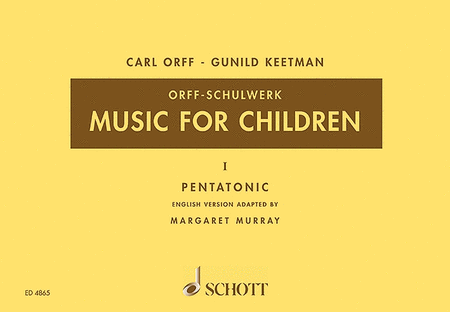
Voice, recorder and percussion - Digital Download SKU: S9.Q42466 Pentatonic. Arranged by Margaret Murray. This edition: score for voice and/or instruments. Orff-Schulwerk - Rhythmusübungen - Kinderreime. Orff-Schulwerk. Downloadable, Vocal and performing score. Op. 1. Schott Music - Digital #Q42466. Published by Schott Music - Digital (S9.Q42466). English.Carl Orff devoted much of his life to the development of a philosophy of Music for Children, based on his belief that music is the natural outcome of speech, rhythm and movement. His ideas and pioneering work have had a major influence on music and dance education throughout the world and today that work continues under the guidance of leading teachers and educators in many countries. The five basic German volumes of Music for Children by Carl Orff and Gunild Keetman were published between 1950 and 1954. Editions have since been published in Bolivia, Brazil, Canada, Czechoslovakia, Denmark, Estonia, France, Ghana, Great Britain (including a special Welsh edition), Greece, Italy, Japan, Korea, Latin-America, the Netherlands, Portugal, Spain, Sweden, Taiwan and the USA. In 1952 the first edition in translation appeared an English language adaptation by Doreen Hall and Arnold Walter for their Canadian and American students. A few years later, Margaret Murray independently developed a version (1957-1966), essentially to fulfil the needs of United Kingdom teachers. Inevitably the considerable growth of Orff-Schulwerk in the United States led to the publication of the American Edition (1977) to satisfy the requirements of a different educational system and national heritage. Orff-Schulwerk: Music for Children has proved itself to be a stimulating source of material for music teaching. Carl Orff's fundamental educational ideas have revitalized music education in nursery schools, at all levels of primary and secondary education and in special music schools, based on the concepts that: - music, dance and language are inter-related and animated through rhythm. - when children discover, invent, improvise and compose, their experience of music is intensified. These creative activities are complementary to those of interpreting and listening to music. - all who take part are encouraged to contribute, not only vocally but also instrumentally. - the Orff approach to music education is many sided; it is concerned with practical music-making, it provides fundamental experiences and it lays the foundation for a comprehensive musical training. - movement games and activities for body awareness in space, time and flow, lead to movement improvisation and dance forms. - music and dance have been notated in many different ways in history. Various ways of writing down sounds and music, as well as playing from and interpreting different kinds of sources are being explored. Today, countless teachers and institutions are using these ideas. More and more teachers look for ways of involving their students in active music making. In particular, they seek to challenge their pupils' creativity by the use of music, dance and speech - as media of human expression - as a foundation of all education. A prerequisite for work in Orff-Schulwerk is the artistic and pedagogical training of teachers. The Orff Institute was founded in 1961 as a Department of the 'Mozarteum', in Salzburg, Austria. Training offered includes a four-year diploma course, a two-year post-graduate course, and a one-year-course in English. At the opening of the Orff Institute in Salzburg in 1963, Carl Orff ended his speech with a quotation from Schiller: 'I have done my part, now do yours.' That challenge has been taken up by teachers worldwide. Murray Edition English adaption, with additional material, by Margaret Murray. Besed on, and containing all the rhythmic and instrumental material from the main five volumes of the original German edition. Contents of this first volume: speech and rhythmic exercises, nursery rhymes, songs, instrumental pieces and melodic exercises using only the five note scale, with instructions and notes. Illustrated.
Music for Children

$21.99 19.08 € PDF SheetMusicPlus

Voice, recorder and percussion - Digital Download SKU: S9.Q25928 Pentatonic. Composed by Carl Orff and Gunild Keetman. Arranged by Arnold Walter and Doreen Hall. This edition: score for voice and/or instruments. Orff-Schulwerk. Downloadable, Vocal and performing score. Op. 1. Schott Music - Digital #Q25928. Published by Schott Music - Digital (S9.Q25928). English.Carl Orff devoted much of his life to the development of a philosophy of Music for Children, based on his belief that music is the natural outcome of speech, rhythm and movement. His ideas and pioneering work have had a major influence on music and dance education throughout the world and today that work continues under the guidance of leading teachers and educators in many countries. The five basic German volumes of Music for Children by Carl Orff and Gunild Keetman were published between 1950 and 1954. Edition have since been published in Bolivia, Brazil, Canada, Czechoslovakia, Denmark, Estonia, France, Ghana, Great Britain (including a special Welsh edition), Greece, Italy, Japan, Korea, Latin-America, the Netherlands, Portugal, Spain, Sweden, Taiwan and the USA. In 1952 the first edition in translation appeared, an English language adaptation by Doreen Hall and Arnold Walter for their Canadian and American students. A few years later, Margaret Murray independently developed a version (1957-1966), essentially to fulfil the needs of United Kingdom teachers. Inevitably the considerable growth of Orff-Schulwerk in the United States led to the publication of the American Edition (1977) to satisfy the requirements of a different educational system and national heritage. Orff-Schulwerk: Music for Children has proved itself to be a stimulating source of material for music teaching. Carl Orff's fundamental educational ideas have revitalized music education in nursery schools, at all levels of primary and secondary education and in special music schools, based on the concepts that: - music, dance and language are inter-related and animated through rhythm. - when children discover, invent, improvise and compose, their experience of music is intensified. These creative activities are complementary to those of interpreting and listening to music. - all who take part are encouraged to contribute, not only vocally but also instrumentally. - the Orff approach to music education is many sided; it is concerned with practical music-making, it provides fundamental experiences and it lays the foundation for a comprehensive musical training. - movement games and activities for body awareness in space, time and flow, lead to movement improvisation and dance forms. - music and dance have been notated in many different ways in history. Various ways of writing down sounds and music, as well as playing from and interpreting different kinds of sources are being explored. Today, countless teachers and institutions are using these ideas. More and more teachers look for ways of invovling their students in active music making. In particular, they seek to challenge their pupils' creativity by the use of music, dance and speech - as media of human expression - as a foundation of all education. A prerequisite for work in Orff-Schulwerk is the artistic and pedagogical training of teachers. The Orff Institute was founded in 1961 as a Department of the 'Mozarteum', in Salzburg, Austria. Training offered includes a four-year diploma course, a two-year post-graduate course, and a one-year-course in English. At the opening of the Orff Institute in Salzburg in 1963, Carl Orff ended his speech with a quotation from Schiller: 'I have done my part, now do yours.' That challenge has been taken up by teachers worldwide. Hall/Walter Edition Based on Volumes 1, 2 and 4 of the original German Edition musik für Kinder, english adaption with additional material by Doreen Hall and Arnold Walter.
Music for Children

$10.99 9.54 € PDF SheetMusicPlus

Voice, recorder and percussion - Digital Download SKU: S9.Q53825 Major: Dominant and Subdominant Triads. Arranged by Margaret Murray. This edition: score for voice and/or instruments. Orchestration - Orff Schulwerk - keys. Orff-Schulwerk. Downloadable, Vocal and performing score. Op. 3. Schott Music - Digital #Q53825. Published by Schott Music - Digital (S9.Q53825). English.Carl Orff devoted much of his life to the development of a philosophy of Music for Children, based on his belief that music is the natural outcome of speech, rhythm and movement. His ideas and pioneering work have had a major influence on music and dance education throughout the world and today that work continues under the guidance of leading teachers and educators in many countries. The five basic German volumes of Music for Children by Carl Orff and Gunild Keetman were published between 1950 and 1954. Editions have since been published in Bolivia, Brazil, Canada, Czechoslovakia, Denmark, Estonia, France, Ghana, Great Britain (including a special Welsh edition), Greece, Italy, Japan, Korea, Latin-America, the Netherlands, Portugal, Spain, Sweden, Taiwan and the USA. In 1952 the first edition in translation appeared an English language adaptation by Doreen Hall and Arnold Walter for their Canadian and American students. A few years later, Margaret Murray independently developed a version (1957-1966), essentially to fulfil the needs of United Kingdom teachers. Inevitably the considerable growth of Orff-Schulwerk in the United States led to the publication of the American Edition (1977) to satisfy the requirements of a different educational system and national heritage. Orff-Schulwerk: Music for Children has proved itself to be a stimulating source of material for music teaching. Carl Orff's fundamental educational ideas have revitalized music education in nursery schools, at all levels of primary and secondary education and in special music schools, based on the concepts that: - music, dance and language are inter-related and animated through rhythm. - when children discover, invent, improvise and compose, their experience of music is intensified. These creative activities are complementary to those of interpreting and listening to music. - all who take part are encouraged to contribute, not only vocally but also instrumentally. - the Orff approach to music education is many sided; it is concerned with practical music-making, it provides fundamental experiences and it lays the foundation for a comprehensive musical training. - movement games and activities for body awareness in space, time and flow, lead to movement improvisation and dance forms. - music and dance have been notated in many different ways in history. Various ways of writing down sounds and music, as well as playing from and interpreting different kinds of sources are being explored. Today, countless teachers and institutions are using these ideas. More and more teachers look for ways of involving their students in active music making. In particular, they seek to challenge their pupils' creativity by the use of music, dance and speech - as media of human expression - as a foundation of all education. A prerequisite for work in Orff-Schulwerk is the artistic and pedagogical training of teachers. The Orff Institute was founded in 1961 as a Department of the 'Mozarteum', in Salzburg, Austria. Training offered includes a four-year diploma course, a two-year post-graduate course, and a one-year-course in English. At the opening of the Orff Institute in Salzburg in 1963, Carl Orff ended his speech with a quotation from Schiller: 'I have done my part, now do yours.' That challenge has been taken up by teachers worldwide. Murray Edition English adaption, with additional material, by Margaret Murray. Besed on, and containing all the rhythmic and instrumental material from the main five volumes of the original German edition. Contents of this third volume: The instrumentation and range of keys are inceased. The settings include the chords on the fourth and fifth notes of the major scale.
Music for Children

$21.99 19.08 € PDF SheetMusicPlus

Piano Solo - Level 3 - Digital Download SKU: A0.1412485 Composed by Antonio Valente (c.1520-1581). Arranged by Thomas Ling. Historic,Instructional,Renaissance. Score. 2 pages. Thomas Swee Chin #994571. Published by Thomas Swee Chin (A0.1412485). The title - 'Lo Ballo Del' Intorcia' means 'The Tourch Dance'. One almost can feel the atmosphere of the Middle Ages in the piece, with the strumming of the lute and the improvisation of the flute on top. The simple accompaniment is certainly dance like in character. It is a piece from Intavolatura de Cimbalo (Harpsichord Tablature) by Antonio Valente, a Neapolitan composer and organist. This collection was published in Naples in 1576. Lo Ballo Del' Intorcia is a lively dance piece typical of the Renaissance period. It's known for its dancelike rhythms, lively melodies, and often features variations and improvisatory passages characteristic of the keyboard music of the time.  Valente's work represents an important contribution to the keyboard repertoire of the late Renaissance, showcasing the vibrant musical scene of Naples during that era.
Lo Ballo Del' Intorcia
Piano seul

$4.80 4.16 € Piano seul PDF SheetMusicPlus

Viola Solo - Level 4 - Digital Download SKU: A0.1291072 Composed by Rocco Di Pietro. 21st Century,Chamber,Classical,Contemporary. Individual part. 11 pages. Rocco Di Pietro #881764. Published by Rocco Di Pietro (A0.1291072). PROLOGUEof the composer’s vision of the work, concerning balletEverything turns to kitsch, even Xenakis. Clowns and Harlequins especially know this. Hencemy little ballet for dancer as a Rigoletto Buffo and solo viola. The ballet should be classicalballet, with tights and tattered Harlequinade tops à la Picasso. Some “modern†dance movements may be interspersed in the “Island†sections, while the “Arabesque†and “Vaudeville†are “classical†at the choreographer's discretion. It may seem singular that the composer has ageneral idea about the movement of the dance, but that is because the work came to him thatway. As a solo concert work, the traveling viola remains, but in concert dress; while the ballet isrenounced.- Rocco Di Pietro.
MIMETIC NOSTALGIAS (2020) From the Room of Useless Memories
Alto seul

$12.00 10.41 € Alto seul PDF SheetMusicPlus

Piano - Digital Download SKU: LV.13609 Lester S. Levy Collection. 2 pages. Published by Johns Hopkins University Sheridan Libraries (LV.13609). No.1. Dearest Mae. Series Celebrated Quadrilles Arranged for the Piano Forte and Danced at all the Fashionable Assemblies. Includes dance instructions. n. Published [n.d.] by E. Ferrett & Co., 40 South 8th St. below Chestnut in Philadelphia. Composition of da capo with piano instrumentation. About The Lester S. Levy CollectionThe Lester S. Levy Collection of Sheet Music consists of over 29,000 pieces of American popular music. Donated to Johns Hopkins University Sheridan Libraries, the collection's strength is its thorough documentation of nineteenth-century American through popular music. This sheet music has been provided by Project Gado, a San Francisco Bay Area startup whose mission is to digitize and share the world's visual history.WARNING: These titles are provided as historical documents. Language and concepts within reflect the opinions and values of the time and may be offensive to some.
Dearest Mae
Piano seul

$5.99 5.2 € Piano seul PDF SheetMusicPlus

Piano Solo - Level 3 - Digital Download SKU: A0.1378329 Composed by Matyas Seiber. Arranged by Thomas Ling. 20th Century,Instructional. Score. 1 pages. Thomas Swee Chin #962952. Published by Thomas Swee Chin (A0.1378329). Mátyás Seiber's Six-Eight from Easy Dances Vol. 2 is a spirited and engaging piece that captures the lively essence of a dance in 6/8 time signature. As part of the Easy Dances series, this composition is tailored to intermediate pianists, offering accessible yet musically rewarding material.The piece unfolds with a buoyant and rhythmic melody, characterized by its jaunty syncopations and energetic pace. Seiber's skillful use of the 6/8 time signature creates a sense of momentum and forward motion, evoking the lively atmosphere of a dance hall.Throughout the piece, Seiber incorporates playful rhythmic patterns and dynamic contrasts, keeping the music vibrant and engaging from start to finish. The melodic lines are catchy and memorable, inviting listeners to tap their feet and sway along with the music.Harmonically, Six-Eight features a blend of traditional tonalities and modern jazz-inflected chords, adding depth and richness to the overall sound. The harmonies provide a colorful backdrop for the melody, enhancing its expressive impact and giving pianists ample opportunity for interpretation and expression.Whether performed as a standalone piece or as part of a set, Six-Eight is sure to delight audiences with its infectious energy and irresistible charm. It is a testament to Seiber's ability to create music that is both accessible and artistically satisfying, making it a welcome addition to any pianist's repertoire.
Six-Eight
Piano seul

$4.80 4.16 € Piano seul PDF SheetMusicPlus

Guitar,Piano,Vocal,Voice - Level 1 - Digital Download SKU: A0.1418270 By Granny Annie. By Sandy Riccardi. Arranged by Richard Riccardi. Broadway,Children,Christian,Instructional,Musical/Show,Traditional. Score. 3 pages. Sandra Riccardi #999524. Published by Sandra Riccardi (A0.1418270). Lyrics by Sandy Riccarditune derived from traditional English children's songThere was a little clamWho lived at the bottom of the seaHe snapped at all the fishAnd then he snapped at me So I said Mr. ClamIf you'll be kind to me, then we could live snappily-ever-after at the bottom of the seaAnd so that Mr. ClamHe said right then to meI snap 'cause I'm a clamthat's who I've got to beIt's just a little danceWith all my friends, you seeAnd we all danced so snappily-ever-after at the bottom of the seasnap snap etc.
The Clam Song
Piano, Voix et Guitare
Granny Annie
$3.99 3.46 € Piano, Voix et Guitare PDF SheetMusicPlus

Woodwind Ensemble,Woodwind Quintet Bassoon,Clarinet,Flute,Horn,Oboe - Level 3 - Digital Download SKU: A0.1302815 Composed by Erik Satie. Arranged by Ray Thompson. 20th Century,Chamber. 10 pages. RayThompsonMusic #892418. Published by RayThompsonMusic (A0.1302815). Satie: Sarabande No.1  Arranged standard wind quintetThe Sarabandes are three dances for solo piano composed in 1887 by Erik Satie. Along with the famous Gymnopédies (1888) they are regarded as his first important works, and the ones upon which his reputation as a harmonic innovator and precursor of modern French music, beginning with Debussy, principally rests. The Sarabandes also played a key role in Satie's belated discovery by his country's musical establishment in the 1910s, setting the stage for his international notoriety.French composer and critic Alexis Roland-Manuel wrote in 1916 that the Sarabandes represented a milestone in the evolution of our music...pieces of an unprecedented harmonic technique, born of an entirely new aesthetic, which create a unique atmosphere, a sonorous magic of complete originality.The sarabande is a dance in triple meter that originated in the Spanish colonies of Central America in the mid-1500s. It had migrated to Europe by the 17th Century, where in France it became a popular slow court dance. Satie's modern reinterpretations consist of three dances with a total duration of roughly 15 minutes:Sarabande No. 1 - A-flat major (This one)Sarabande No. 2 - D-sharp minorSarabande No. 3 - B-flat minorThe melody is shared amongst the top 4 instruments, and the quintet do not play tutti all of the time. This adds more interest and variation to the piece.Enjoy.
Satie: Sarabande No.1 - wind quintet
Quintette à Vent: flûte, Hautbois, basson, clarinette, Cor

$9.95 8.63 € Quintette à Vent: flûte, Hautbois, basson, clarinette, Cor PDF SheetMusicPlus

Brass Ensemble Trumpet - Level 3 - Digital Download SKU: A0.813075 Composed by Traditional French Melodies. Arranged by Regis Bookshar. Christmas,Classical,Instructional,Multicultural,Standards,World. Score and parts. 22 pages. Regis Bookshar #6097387. Published by Regis Bookshar (A0.813075). Trumpet Quintet - Intermediate - Digital Download. This selection, Burgundian Air/March of the Three Kings, has been arranged for 5 Trumpets, by Regis Bookshar and is one of the many arrangements from The Regis Bookshar Trumpet Ensemble's extensive music library which are becoming available for the first time. It would be a great addition to any music library. It incorporates two traditional French melodies into one exciting arrangement, which, I'm certain, will entertain both performers and audiences alike. It is suitable for high school and college students and is perfect for Christmas concerts and church services but could be performed anytime and anywhere. Included are a score and a complete set of parts (22 pages). It begins with a Burgundian Air, played by a solo instrument. The melody is then played by two instruments in harmony before the rest of the ensemble joins in. This is followed by the March of the Three Kings, a Provencal melody (La Marche Des Rois Mages) which dates from the 13th century and recalls the Three Kings of the Christmas story. The peasants probably sang and danced to this tune, even perhaps honoring their own folk heroes, the French dukes, dressed in their shining armor and carrying brilliant banners, as they marched off to the Crusades. Georges Bizet utilized this tune as a farandole, or stately dance, in his incidental music for Alphonse Daudet's play L'Arlesienne (The Girl from Arles). There is a fugal section in which each instrument enters, playing an embellished version of the tune before concluding the arrangement. Also available are other settings of these two Traditional French melodies for a variety of instrumental ensembles as well as numerous other arrangements in a variety of styles. Please feel free to search for other arrangements by Regis Bookshar. You may find something else which might interest you as well. I'm certain that students will enjoy playing this arrangement.
Burgundian Air/March of the Three Kings (F min) (Trumpet Quintet)
Ensemble de Trompettes

$18.00 15.62 € Ensemble de Trompettes PDF SheetMusicPlus

Woodwind Ensemble,Woodwind Quartet - Level 4 - Digital Download SKU: A0.747011 By The Andrews Sisters. By Aloysio Oliveira, Ervin Drake, and Zequinha Abreu. Arranged by Keith Terrett. Classical,Latin,Multicultural,World. 14 pages. Keith Terrett #5869499. Published by Keith Terrett (A0.747011). Arranged for Recorder Quartet  Tico-Tico no fubá (sparrow in the cornmeal, or, literally, rufous-collared sparrow in the cornmeal) is a Brazilian choro song written by Zequinha de Abreu in 1917. A great arrangement for your next performance, sure to be a big hit with your audience!Its original title was Tico-Tico no farelo (sparrow in the bran), but since Brazilian guitarist Américo Jacomino Canhoto (1889–1928) had a work with the same title, Abreu's work was given its present name in 1931, and sometime afterward Aloysio de Oliveira wrote the original Portuguese lyrics.Eros Volusia and her dancers dance to Tico-Tico in 1942 Rio Rita. Ethel Smith performed Tico-Tico onscreen in Bathing Beauty (1944). Carmen Miranda performed Tico-Tico onscreen in Copacabana (1947); It was also featured in the Aquarela do Brasil segment of the Walt Disney film Saludos Amigos (1942) and in Woody Allen's Radio Days (1987).In Quebec the song has been used for several decades in commercials for Sico paint.In season three of Mama's Family episode An Ill Wind, an intoxicated Iola briefly sings the song's chorus before passing out onto a bed.This song can be heard on various episodes of the Belgian Kabouter Wesley cartoon.In season one of Narcos: Mexico, episode 3 (El Padrino), the orchestral version of the song is played by a band during a reception. A biographical movie about Zequinha de Abreu with the same title, Tico-Tico no Fubá was produced in 1952 by the Brazilian film studio Companhia Cinematográfica Vera Cruz, starring Anselmo Duarte as Abreu.The title phrase also features in the lyrics to the song O Pato made famous by João Gilberto.Choro (Portuguese pronunciation: [ˈʃoɾu], cry or lament), also popularly called chorinho (little cry or little lament), is an instrumental Brazilian popular music genre which originated in 19th century Rio de Janeiro. Despite its name, the music often has a fast and happy rhythm. It is characterized by virtuosity, improvisation and subtle modulations, and is full of syncopation and counterpoint. Choro is considered the first characteristically Brazilian genre of urban popular music. The serenaders who play choros are known as chorões.
Tico Tico (tico Tico No Fuba)
Flûte, Hautbois, Clarinette, Basson
The Andrews Sisters
$12.99 11.27 € Flûte, Hautbois, Clarinette, Basson PDF SheetMusicPlus


Partitions Gratuites
Acheter des Partitions Musicales
Acheter des Partitions Digitales à Imprimer
Acheter des Instruments de Musique

© 2000 - 2026

Accueil - Version intégrale





