EUROPE
10097 articles
USA
0 articles
DIGITAL
76684 articles (à imprimer)
Partitions Digitales
Partitions à imprimer
76684 partitions trouvées


Double Bass,String Bass Solo - Level 5 - Digital Download SKU: A0.1018941 Composed by Benjamin Harry Sajo. 20th Century,Contemporary. Individual part. 4 pages. Benjamin Sajo #6072983. Published by Benjamin Sajo (A0.1018941). Fugue: Wear Pearls and Smile is, on the outset, a fast, rambunctious adventure for many voices playing at the same time. It was conceived as a pairing for the equally vivacious second symphony of Ludwig van Beethoven–his 250th birthday is this year–but can stand on its own as one of my hardest, most challenging works to cook up.This piece is dedicated to those forced to appear positive when internally they’re falling apart. The title is inspired by a quote that’s been with me for a while, Why is it that men can be bastards and women must wear pearls and smile? by Lynn Hecht Schafren, the celebrated American jurist famous for campaigning for gender equity in courts. I’m taking the quote out of its initial context, but the power of that quote, for me, exemplifies how hard it is to maintain a sense of emotional decorum and dignity when you’re authentically a hot mess. And what’s more of a musical hot mess than a fugue?There are two realities to this piece. I’ll quote Dmitri Shostakovich, from his autobiography: The rejoicing is forced, created under threat, […] It’s as if someone were beating you with a stick and saying, ‘Your business is rejoicing, your business is rejoicing,’ and you rise, shaky, and go marching off, muttering ‘Our business is rejoicing, our business is rejoicing.’ On the one hand, it is insincere happiness, cloying perhaps. But the other truth, I’ll quote Oscar Hammerstein II, from The King and I: While shivering in my shoes / I strike a careless pose / And whistle a happy tune / And no one ever knows, / I'm afraid. I forced myself, against all impulses of my current being, to forge happiness. This piece, with its origin being a mental puzzle (fugues are puzzles), it became a construct where I could lift myself up and regain a sense of purpose. Therefore, it is invented–out of a literal need to survive–pure, genuine happiness.Future Performances: If you are interested in performing this work, please e-mail me.ABOUT THE COMPOSER: Benjamin Sajo (b. 1988) is a Canadian composer of contemporary classical music, as well as an educator. Since developing a fiercely independent creative voice upon the completion of his studies at Western (2010) and McGill Universities (2013), he continues to find inspiration from the intersection of mythology, art, and nature upon the contemporary human experience. In 2019, he released his premiere album of original music, The Great War Sextet: Canadian War Poetry with Trombone & Strings , with support from the Ontario Arts Council. He is a member of SOCAN and the League of Canadian Composers.
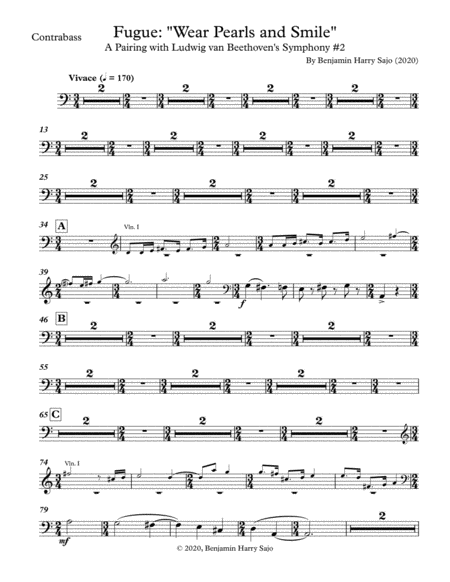
Fugue: "Wear Pearls and Smile" (A Pairing with Beethoven's Symphony #2) - Contrabass
Contre Basse

$3.50 3.03 € Contre Basse PDF SheetMusicPlus

Percussion Solo,Timpani - Level 5 - Digital Download SKU: A0.1018935 Composed by Benjamin Harry Sajo. 20th Century,Contemporary. Individual part. 3 pages. Benjamin Sajo #6072973. Published by Benjamin Sajo (A0.1018935). Fugue: Wear Pearls and Smile is, on the outset, a fast, rambunctious adventure for many voices playing at the same time. It was conceived as a pairing for the equally vivacious second symphony of Ludwig van Beethoven–his 250th birthday is this year–but can stand on its own as one of my hardest, most challenging works to cook up.This piece is dedicated to those forced to appear positive when internally they’re falling apart. The title is inspired by a quote that’s been with me for a while, Why is it that men can be bastards and women must wear pearls and smile? by Lynn Hecht Schafren, the celebrated American jurist famous for campaigning for gender equity in courts. I’m taking the quote out of its initial context, but the power of that quote, for me, exemplifies how hard it is to maintain a sense of emotional decorum and dignity when you’re authentically a hot mess. And what’s more of a musical hot mess than a fugue?There are two realities to this piece. I’ll quote Dmitri Shostakovich, from his autobiography: The rejoicing is forced, created under threat, […] It’s as if someone were beating you with a stick and saying, ‘Your business is rejoicing, your business is rejoicing,’ and you rise, shaky, and go marching off, muttering ‘Our business is rejoicing, our business is rejoicing.’ On the one hand, it is insincere happiness, cloying perhaps. But the other truth, I’ll quote Oscar Hammerstein II, from The King and I: While shivering in my shoes / I strike a careless pose / And whistle a happy tune / And no one ever knows, / I'm afraid. I forced myself, against all impulses of my current being, to forge happiness. This piece, with its origin being a mental puzzle (fugues are puzzles), it became a construct where I could lift myself up and regain a sense of purpose. Therefore, it is invented–out of a literal need to survive–pure, genuine happiness.Future Performances: If you are interested in performing this work, please e-mail me.ABOUT THE COMPOSER: Benjamin Sajo (b. 1988) is a Canadian composer of contemporary classical music, as well as an educator. Since developing a fiercely independent creative voice upon the completion of his studies at Western (2010) and McGill Universities (2013), he continues to find inspiration from the intersection of mythology, art, and nature upon the contemporary human experience. In 2019, he released his premiere album of original music, The Great War Sextet: Canadian War Poetry with Trombone & Strings , with support from the Ontario Arts Council. He is a member of SOCAN and the League of Canadian Composers.
Fugue: "Wear Pearls and Smile" (A Pairing with Beethoven's Symphony #2) - Timpani

$3.50 3.03 € PDF SheetMusicPlus

Trumpet Solo - Level 5 - Digital Download SKU: A0.1018934 Composed by Benjamin Harry Sajo. 20th Century,Contemporary. Individual part. 3 pages. Benjamin Sajo #6072971. Published by Benjamin Sajo (A0.1018934). Fugue: Wear Pearls and Smile is, on the outset, a fast, rambunctious adventure for many voices playing at the same time. It was conceived as a pairing for the equally vivacious second symphony of Ludwig van Beethoven–his 250th birthday is this year–but can stand on its own as one of my hardest, most challenging works to cook up.This piece is dedicated to those forced to appear positive when internally they’re falling apart. The title is inspired by a quote that’s been with me for a while, Why is it that men can be bastards and women must wear pearls and smile? by Lynn Hecht Schafren, the celebrated American jurist famous for campaigning for gender equity in courts. I’m taking the quote out of its initial context, but the power of that quote, for me, exemplifies how hard it is to maintain a sense of emotional decorum and dignity when you’re authentically a hot mess. And what’s more of a musical hot mess than a fugue?There are two realities to this piece. I’ll quote Dmitri Shostakovich, from his autobiography: The rejoicing is forced, created under threat, […] It’s as if someone were beating you with a stick and saying, ‘Your business is rejoicing, your business is rejoicing,’ and you rise, shaky, and go marching off, muttering ‘Our business is rejoicing, our business is rejoicing.’ On the one hand, it is insincere happiness, cloying perhaps. But the other truth, I’ll quote Oscar Hammerstein II, from The King and I: While shivering in my shoes / I strike a careless pose / And whistle a happy tune / And no one ever knows, / I'm afraid. I forced myself, against all impulses of my current being, to forge happiness. This piece, with its origin being a mental puzzle (fugues are puzzles), it became a construct where I could lift myself up and regain a sense of purpose. Therefore, it is invented–out of a literal need to survive–pure, genuine happiness.Future Performances: If you are interested in performing this work, please e-mail me.ABOUT THE COMPOSER: Benjamin Sajo (b. 1988) is a Canadian composer of contemporary classical music, as well as an educator. Since developing a fiercely independent creative voice upon the completion of his studies at Western (2010) and McGill Universities (2013), he continues to find inspiration from the intersection of mythology, art, and nature upon the contemporary human experience. In 2019, he released his premiere album of original music, The Great War Sextet: Canadian War Poetry with Trombone & Strings , with support from the Ontario Arts Council. He is a member of SOCAN and the League of Canadian Composers.

Fugue: "Wear Pearls and Smile" (A Pairing with Beethoven's Symphony #2) - Trumpet in C 2
Trompette

$3.50 3.03 € Trompette PDF SheetMusicPlus

Violin Solo - Level 5 - Digital Download SKU: A0.1018937 Composed by Benjamin Harry Sajo. 20th Century,Contemporary. 5 pages. Benjamin Sajo #6072975. Published by Benjamin Sajo (A0.1018937). Fugue: Wear Pearls and Smile is, on the outset, a fast, rambunctious adventure for many voices playing at the same time. It was conceived as a pairing for the equally vivacious second symphony of Ludwig van Beethoven–his 250th birthday is this year–but can stand on its own as one of my hardest, most challenging works to cook up.This piece is dedicated to those forced to appear positive when internally they’re falling apart. The title is inspired by a quote that’s been with me for a while, Why is it that men can be bastards and women must wear pearls and smile? by Lynn Hecht Schafren, the celebrated American jurist famous for campaigning for gender equity in courts. I’m taking the quote out of its initial context, but the power of that quote, for me, exemplifies how hard it is to maintain a sense of emotional decorum and dignity when you’re authentically a hot mess. And what’s more of a musical hot mess than a fugue?There are two realities to this piece. I’ll quote Dmitri Shostakovich, from his autobiography: The rejoicing is forced, created under threat, […] It’s as if someone were beating you with a stick and saying, ‘Your business is rejoicing, your business is rejoicing,’ and you rise, shaky, and go marching off, muttering ‘Our business is rejoicing, our business is rejoicing.’ On the one hand, it is insincere happiness, cloying perhaps. But the other truth, I’ll quote Oscar Hammerstein II, from The King and I: While shivering in my shoes / I strike a careless pose / And whistle a happy tune / And no one ever knows, / I'm afraid. I forced myself, against all impulses of my current being, to forge happiness. This piece, with its origin being a mental puzzle (fugues are puzzles), it became a construct where I could lift myself up and regain a sense of purpose. Therefore, it is invented–out of a literal need to survive–pure, genuine happiness.Future Performances: If you are interested in performing this work, please e-mail me.ABOUT THE COMPOSER: Benjamin Sajo (b. 1988) is a Canadian composer of contemporary classical music, as well as an educator. Since developing a fiercely independent creative voice upon the completion of his studies at Western (2010) and McGill Universities (2013), he continues to find inspiration from the intersection of mythology, art, and nature upon the contemporary human experience. In 2019, he released his premiere album of original music, The Great War Sextet: Canadian War Poetry with Trombone & Strings , with support from the Ontario Arts Council. He is a member of SOCAN and the League of Canadian Composers.

Fugue: "Wear Pearls and Smile" (A Pairing with Beethoven's Symphony #2) - Violin I
Violon

$3.50 3.03 € Violon PDF SheetMusicPlus

Clarinet Solo - Level 5 - Digital Download SKU: A0.1018927 Composed by Benjamin Harry Sajo. 20th Century,Contemporary. Individual part. 5 pages. Benjamin Sajo #6072957. Published by Benjamin Sajo (A0.1018927). Fugue: Wear Pearls and Smile is, on the outset, a fast, rambunctious adventure for many voices playing at the same time. It was conceived as a pairing for the equally vivacious second symphony of Ludwig van Beethoven–his 250th birthday is this year–but can stand on its own as one of my hardest, most challenging works to cook up.This piece is dedicated to those forced to appear positive when internally they’re falling apart. The title is inspired by a quote that’s been with me for a while, Why is it that men can be bastards and women must wear pearls and smile? by Lynn Hecht Schafren, the celebrated American jurist famous for campaigning for gender equity in courts. I’m taking the quote out of its initial context, but the power of that quote, for me, exemplifies how hard it is to maintain a sense of emotional decorum and dignity when you’re authentically a hot mess. And what’s more of a musical hot mess than a fugue?There are two realities to this piece. I’ll quote Dmitri Shostakovich, from his autobiography: The rejoicing is forced, created under threat, […] It’s as if someone were beating you with a stick and saying, ‘Your business is rejoicing, your business is rejoicing,’ and you rise, shaky, and go marching off, muttering ‘Our business is rejoicing, our business is rejoicing.’ On the one hand, it is insincere happiness, cloying perhaps. But the other truth, I’ll quote Oscar Hammerstein II, from The King and I: While shivering in my shoes / I strike a careless pose / And whistle a happy tune / And no one ever knows, / I'm afraid. I forced myself, against all impulses of my current being, to forge happiness. This piece, with its origin being a mental puzzle (fugues are puzzles), it became a construct where I could lift myself up and regain a sense of purpose. Therefore, it is invented–out of a literal need to survive–pure, genuine happiness.Future Performances: If you are interested in performing this work, please e-mail me.ABOUT THE COMPOSER: Benjamin Sajo (b. 1988) is a Canadian composer of contemporary classical music, as well as an educator. Since developing a fiercely independent creative voice upon the completion of his studies at Western (2010) and McGill Universities (2013), he continues to find inspiration from the intersection of mythology, art, and nature upon the contemporary human experience. In 2019, he released his premiere album of original music, The Great War Sextet: Canadian War Poetry with Trombone & Strings , with support from the Ontario Arts Council. He is a member of SOCAN and the League of Canadian Composers.

Fugue: "Wear Pearls and Smile" (A Pairing with Beethoven's Symphony #2) - Clarinet 1
Clarinette

$3.50 3.03 € Clarinette PDF SheetMusicPlus

Viola Solo - Level 5 - Digital Download SKU: A0.1018938 Composed by Benjamin Harry Sajo. 20th Century,Contemporary. Individual part. 5 pages. Benjamin Sajo #6072979. Published by Benjamin Sajo (A0.1018938). Fugue: Wear Pearls and Smile is, on the outset, a fast, rambunctious adventure for many voices playing at the same time. It was conceived as a pairing for the equally vivacious second symphony of Ludwig van Beethoven–his 250th birthday is this year–but can stand on its own as one of my hardest, most challenging works to cook up.This piece is dedicated to those forced to appear positive when internally they’re falling apart. The title is inspired by a quote that’s been with me for a while, Why is it that men can be bastards and women must wear pearls and smile? by Lynn Hecht Schafren, the celebrated American jurist famous for campaigning for gender equity in courts. I’m taking the quote out of its initial context, but the power of that quote, for me, exemplifies how hard it is to maintain a sense of emotional decorum and dignity when you’re authentically a hot mess. And what’s more of a musical hot mess than a fugue?There are two realities to this piece. I’ll quote Dmitri Shostakovich, from his autobiography: The rejoicing is forced, created under threat, […] It’s as if someone were beating you with a stick and saying, ‘Your business is rejoicing, your business is rejoicing,’ and you rise, shaky, and go marching off, muttering ‘Our business is rejoicing, our business is rejoicing.’ On the one hand, it is insincere happiness, cloying perhaps. But the other truth, I’ll quote Oscar Hammerstein II, from The King and I: While shivering in my shoes / I strike a careless pose / And whistle a happy tune / And no one ever knows, / I'm afraid. I forced myself, against all impulses of my current being, to forge happiness. This piece, with its origin being a mental puzzle (fugues are puzzles), it became a construct where I could lift myself up and regain a sense of purpose. Therefore, it is invented–out of a literal need to survive–pure, genuine happiness.Future Performances: If you are interested in performing this work, please e-mail me.ABOUT THE COMPOSER: Benjamin Sajo (b. 1988) is a Canadian composer of contemporary classical music, as well as an educator. Since developing a fiercely independent creative voice upon the completion of his studies at Western (2010) and McGill Universities (2013), he continues to find inspiration from the intersection of mythology, art, and nature upon the contemporary human experience. In 2019, he released his premiere album of original music, The Great War Sextet: Canadian War Poetry with Trombone & Strings , with support from the Ontario Arts Council. He is a member of SOCAN and the League of Canadian Composers.

Fugue: "Wear Pearls and Smile" (A Pairing with Beethoven's Symphony #2) - Viola
Alto seul

$3.50 3.03 € Alto seul PDF SheetMusicPlus

Trumpet Solo - Level 5 - Digital Download SKU: A0.1018933 Composed by Benjamin Harry Sajo. 20th Century,Contemporary. Individual part. 3 pages. Benjamin Sajo #6072969. Published by Benjamin Sajo (A0.1018933). Fugue: Wear Pearls and Smile is, on the outset, a fast, rambunctious adventure for many voices playing at the same time. It was conceived as a pairing for the equally vivacious second symphony of Ludwig van Beethoven–his 250th birthday is this year–but can stand on its own as one of my hardest, most challenging works to cook up.This piece is dedicated to those forced to appear positive when internally they’re falling apart. The title is inspired by a quote that’s been with me for a while, Why is it that men can be bastards and women must wear pearls and smile? by Lynn Hecht Schafren, the celebrated American jurist famous for campaigning for gender equity in courts. I’m taking the quote out of its initial context, but the power of that quote, for me, exemplifies how hard it is to maintain a sense of emotional decorum and dignity when you’re authentically a hot mess. And what’s more of a musical hot mess than a fugue?There are two realities to this piece. I’ll quote Dmitri Shostakovich, from his autobiography: The rejoicing is forced, created under threat, […] It’s as if someone were beating you with a stick and saying, ‘Your business is rejoicing, your business is rejoicing,’ and you rise, shaky, and go marching off, muttering ‘Our business is rejoicing, our business is rejoicing.’ On the one hand, it is insincere happiness, cloying perhaps. But the other truth, I’ll quote Oscar Hammerstein II, from The King and I: While shivering in my shoes / I strike a careless pose / And whistle a happy tune / And no one ever knows, / I'm afraid. I forced myself, against all impulses of my current being, to forge happiness. This piece, with its origin being a mental puzzle (fugues are puzzles), it became a construct where I could lift myself up and regain a sense of purpose. Therefore, it is invented–out of a literal need to survive–pure, genuine happiness.Future Performances: If you are interested in performing this work, please e-mail me.ABOUT THE COMPOSER: Benjamin Sajo (b. 1988) is a Canadian composer of contemporary classical music, as well as an educator. Since developing a fiercely independent creative voice upon the completion of his studies at Western (2010) and McGill Universities (2013), he continues to find inspiration from the intersection of mythology, art, and nature upon the contemporary human experience. In 2019, he released his premiere album of original music, The Great War Sextet: Canadian War Poetry with Trombone & Strings , with support from the Ontario Arts Council. He is a member of SOCAN and the League of Canadian Composers.

Fugue: "Wear Pearls and Smile" (A Pairing with Beethoven's Symphony #2) - Trumpet in C 1
Trompette

$3.50 3.03 € Trompette PDF SheetMusicPlus

Piano and voice - Digital Download SKU: LV.22537 Composed by Chauncey Haines. Campaigns & battles, Soldiers, Firearms, Forts & fortifications, Machine guns, World War I, George Washington, Lafayette, Patriotism. Lester S. Levy Collection. 3 pages. Published by Johns Hopkins University Sheridan Libraries (LV.22537). Every Boy's a Hero in This War Today. Words by Myles McCarthy. Music by Chauncey Haines. Published 1918 by Ed. J. Small, 423 Grosse Bldg. in Los Angeles. Composition of strophic with chorus with piano and voice instrumentation. Subject headings for this piece include Campaigns & battles, Soldiers, Firearms, Forts & fortifications, Machine guns, World War I, George Washington, Lafayette, Patriotism. First line reads While the mighty hosts above are cheering, and hist'ry's in the making now on earth.. About The Lester S. Levy CollectionThe Lester S. Levy Collection of Sheet Music consists of over 29,000 pieces of American popular music. Donated to Johns Hopkins University Sheridan Libraries, the collection's strength is its thorough documentation of nineteenth-century American through popular music. This sheet music has been provided by Project Gado, a San Francisco Bay Area startup whose mission is to digitize and share the world's visual history.WARNING: These titles are provided as historical documents. Language and concepts within reflect the opinions and values of the time and may be offensive to some.
Every Boy's a Hero in This War Today
Piano, Voix

$5.99 5.18 € Piano, Voix PDF SheetMusicPlus

Piano - Digital Download SKU: AX.00-PS-0015736 Composed by Howard Shore. Pop/Rock. 3 pages. Alfred Music - Digital Sheet Music #00-PS-0015736. Published by Alfred Music - Digital Sheet Music (AX.00-PS-0015736). ISBN 9780739099995. UPC: 038081465074.Academy Award-winner Howard Shore is best known for his elegant and eclectic film scores, including the soundtracks for Peter Jackson's The Lord of the Rings and The Hobbit trilogies. This collection features faithful arrangements of some of the best known titles by this brilliant composer. Titles: Birthday March (Big) * Brooklyn Heights 3 (Gangs of New York) * Calliope (Big) * Catania * Coeur Volant (Hugo) * Dead Ringers (Main Title) (Dead Ringers) * The Dream (from the opera The Fly) * Dreaming of Bag End (The Hobbit: An Unexpected Journey) * The Dwarf Lords (The Hobbit: An Unexpected Journey) * Eclipse (All Yours) (The Twilight Saga: Eclipse) * The End of All Things (The Lord of the Rings: The Return of the King) * Erebor (The Hobbit: An Unexpected Journey) * Jacob's Theme (The Twilight Saga: Eclipse) * Love Will Find Out the Way (Spider) * Miss Spielrein (A Dangerous Method) * Piano Four * Portrait of Edie (A History of Violence) * Portrait of John Doe (Se7en) * Richard, Duke of York (Looking for Richard) * The Shape of Rage (The Brood) * The Thief (Hugo) * Your Flesh (from the opera The Fly) * Zoltar (Big).
Jacob's Theme
Piano seul

$3.99 3.45 € Piano seul PDF SheetMusicPlus

Concert Band - Level 3 - Digital Download SKU: A0.1031499 Composed by Dan Dickerman. Contemporary,Jewish. Score and parts. 44 pages. True Indie Media #3424827. Published by True Indie Media (A0.1031499). Bringing folk melodies into modern repertoire has a long tradition, with many iconic works simultaneously celebrating and preserving melodies which might otherwise have been lost to history. Here we have the opportunity to celebrate and preserve a melody just as it starts to find its way in the musical world. By the time Debbie Friedman died in January 2011, just shy of her 60th birthday, she had created a large collection of music loved throughout the world’s Jewish community. She embodied the idea that each generation has a responsibility to contribute to the canon of sacred music, and her settings of liturgical texts have been sung regularly for decades. Her setting of Mi Shebeirach, the prayer for healing, is likely her most familiar tune, but Shalom Aleichem is a beautiful capstone to her legacy. It was in an early stage at the time of her death, having shared the melody among a few groups. This melody has since been sung worldwide, beginning with Friedman’s own memorial and the following Sabbath of Song (Shabbat Shira), and it has begun to take its rightful place in the liturgical canon. The music here is ordered as it would be sung: starting with a presentation of the chorus theme by clarinets in SATB choir voicing, with more of the band joining-in with each repetition of the theme or chorus. The melody and countermelodies move among the different sections until the full band has taken up the tune while the euphonium, horn, and clarinet weave a contrapuntal line through it. Slowly, the joy of the full band is stripped away, exposing the more solemn sound of a brass choir, juxtaposing the joy brought to so many by Ms. Friedman during her life with a quiet reflection at its end. 
Chorale on Friedman's Shalom Aleichem
Orchestre d'harmonie
the time Debbie Friedman died in January 2011, just shy of her 60th birthday, she had created a large collection of music loved throughout the world’s Jewish community She embodied the idea that each generation has a responsibility to contribute to the canon of sacred music, and her settings of liturgical texts have been sung regularly for decades
$54.00 46.73 € Orchestre d'harmonie PDF SheetMusicPlus

Piano and voice - Digital Download SKU: LV.22143 Composed by Henry Cromwell. Courtship, Love, Homecomings, Soldiers, Civil War--Union, Celebrations. Lester S. Levy Collection. 4 pages. Published by Johns Hopkins University Sheridan Libraries (LV.22143). He is Coming Home Today. Song & Chorus. Words by Lilly Lovette. Music by Henry Cromwell. Published 1864 by G.D. Russell & Company, 126 Tremont, Opposite Park St. in Boston. Composition of strophic with chorus with piano and voice instrumentation. Subject headings for this piece include Courtship, Love, Homecomings, Soldiers, Civil War--Union, Celebrations. First line reads Yes, he's coming home, my darling, from the field where fiery Mars holds his carnival.. About The Lester S. Levy CollectionThe Lester S. Levy Collection of Sheet Music consists of over 29,000 pieces of American popular music. Donated to Johns Hopkins University Sheridan Libraries, the collection's strength is its thorough documentation of nineteenth-century American through popular music. This sheet music has been provided by Project Gado, a San Francisco Bay Area startup whose mission is to digitize and share the world's visual history.WARNING: These titles are provided as historical documents. Language and concepts within reflect the opinions and values of the time and may be offensive to some.
He is Coming Home Today. Song & Chorus
Piano, Voix

$5.99 5.18 € Piano, Voix PDF SheetMusicPlus

SATB choir, flute and piano (ad lib.) - Moderately Difficult - Digital Download SKU: MQ.7540-E Composed by Derek Healey. Instrument part. 9 pages. E. C. Schirmer Music Company - Digital #7540-E. Published by E. C. Schirmer Music Company - Digital (MQ.7540-E). English.These songs are dedicated to William Osborne. The title Three Sacred Songs: was given to these pieces rather than the more usual terms anthem or motet because of the strongly secular presence in the texts. The songs were written over a period of some eighteen months. The Shepherd Lad was finished on February 29, 2008. The Round Day and Magdalene’s Song were completed in Brooklyn on June 11, 2009, the music having been originally sketched-out on Christmas Day and Boxing Day 2008, at Putnam Valley, New York. In the first song, The Round Day, the singer hears the voice of the Blessed Virgin Mary as she sings to the glory of God throughout the day. The text was written on June 7, 2008. In The Shepherd Lad, the Spanish mystic Saint John of the Cross describes a shepherd lad’s (Jesus’s) love for a shepherdess (the Church) and how another (the Devil) tempted his love away. Heartbroken, the shepherd climbed a tree, “And threw wide his arms in sweetest charity, Since by His Shepherdess He was forsaken.†The original Spanish text was translated and adapted into Villanelle form by the composer in early December 2004. The text of Magdalene’s Song describes the feelings of a mystic, or a devotee of Jesus, inspired by the fresh beauty, grace and power of the Lord of creation. The main body of the text is given to a soprano solo. The text was written on April 27, 2008. These sacred songs were conceived as being performed either as a set or individually. The composer had secular ensembles in mind, such as college or concert choruses, but these songs may, of course, also be performed in a liturgical setting. The accompanying flute provides introductions, interludes and codas throughout the set and, on a few occasions, plays with the voices. The piano part is ad lib. (optional).
Three Sacred Songs: 1. The Round Day (Downloadable)
Chorale SATB

$1.95 1.69 € Chorale SATB PDF SheetMusicPlus

Easy Piano - Level 2 - Digital Download SKU: A0.912125 Composed by Robert Lowry, Charles Wesley. Arranged by Ginny Saltzman. Easter. Score. 7 pages. Ginny's House of Music #4286925. Published by Ginny's House of Music (A0.912125). *Low in the Grave He Lay and Christ the Lord is Risen Today - Two favorite hymns sung all over the world on Easter Morning in churches everywhere. Arranged for the Late Elementary-Early Intermediate Level Piano Student, in the Key of C , with easy to play bass chords - C,F,G7,D, and Am - lyrics, and guitar chords. Low in the Grave He Lay would particularly be an excellent interval study as it uses repetitively many 2nd, 3rd, 4th, 5th and 6th intervalsLow in the Grave He Lay - Robert Lowry, Christ the Lord Is Risen Today - Charles Wesley.
Low in the Grave He Lay (Christ Arose) and Christ the Lord Is Risen Today - Two Beautiful Easter Hym
Piano Facile

$4.99 4.32 € Piano Facile PDF SheetMusicPlus


Partitions Gratuites
Acheter des Partitions Musicales
Acheter des Partitions Digitales à Imprimer
Acheter des Instruments de Musique

© 2000 - 2026

Accueil - Version intégrale
