EUROPE
365 articles
USA
0 articles
DIGITAL
500 articles (à imprimer)
Partitions Digitales
Partitions à imprimer
500 partitions trouvées

1 ....271 286 301 316 331 ....496

Piano and voice - Digital Download SKU: LV.1827 Composed by F. Kinlock. Courtship, Love, Distress. Lester S. Levy Collection. 2 pages. Published by Johns Hopkins University Sheridan Libraries (LV.1827). I Defy Thee To Forget. Words by W. Gilmore Simms, Esq. Music by F. Kinlock. Published [n.d.] by Firth & Hall, 1 Franklin Square in New York. Composition of strophic with piano and voice instrumentation. Subject headings for this piece include Courtship, Love, Distress. First line reads They have torn us apart but by those angel eyes and the sweet glance they gave when first we met.. About The Lester S. Levy CollectionThe Lester S. Levy Collection of Sheet Music consists of over 29,000 pieces of American popular music. Donated to Johns Hopkins University Sheridan Libraries, the collection's strength is its thorough documentation of nineteenth-century American through popular music. This sheet music has been provided by Project Gado, a San Francisco Bay Area startup whose mission is to digitize and share the world's visual history.WARNING: These titles are provided as historical documents. Language and concepts within reflect the opinions and values of the time and may be offensive to some.
I Defy Thee To Forget
Piano, Voix

$5.99 5.22 € Piano, Voix PDF SheetMusicPlus

Piano and voice - Digital Download SKU: LV.22730 Composed by Henry Clay Work. Flags, Civil War--Union, Patriotism. Lester S. Levy Collection. 3 pages. Published by Johns Hopkins University Sheridan Libraries (LV.22730). Song of a Thousand Years. Solo and Chorus. Words and Music by Henry C. Work. Published 1863 by Root & Cady, 95 Clark St. in Chicago. Composition of strophic with chorus with piano and voice instrumentation. Subject headings for this piece include Flags, Civil War--Union, Patriotism. First line reads Lift up your eyes, desponding freemen! Fling to the winds your needless fear!.. About The Lester S. Levy CollectionThe Lester S. Levy Collection of Sheet Music consists of over 29,000 pieces of American popular music. Donated to Johns Hopkins University Sheridan Libraries, the collection's strength is its thorough documentation of nineteenth-century American through popular music. This sheet music has been provided by Project Gado, a San Francisco Bay Area startup whose mission is to digitize and share the world's visual history.WARNING: These titles are provided as historical documents. Language and concepts within reflect the opinions and values of the time and may be offensive to some.
Song of a Thousand Years. Solo and Chorus
Piano, Voix

$5.99 5.22 € Piano, Voix PDF SheetMusicPlus

Piano and voice - Digital Download SKU: LV.14820 Composed by Harry C. Wyatt. Women, Courtship & love, Good-byes. Lester S. Levy Collection. 4 pages. Published by Johns Hopkins University Sheridan Libraries (LV.14820). Sweet Roses Will Bloom Again. Song and Chorus. Words and Music by Harry C. Wyatt. Published 1884 by Thos. P.I. Magoun in Bath, Maine. Composition of strophic with chorus with piano and voice instrumentation. Subject headings for this piece include Women, Courtship & love, Good-byes. First line reads Oh, darling, though we're parted, And tears oft dim your eyes.. About The Lester S. Levy CollectionThe Lester S. Levy Collection of Sheet Music consists of over 29,000 pieces of American popular music. Donated to Johns Hopkins University Sheridan Libraries, the collection's strength is its thorough documentation of nineteenth-century American through popular music. This sheet music has been provided by Project Gado, a San Francisco Bay Area startup whose mission is to digitize and share the world's visual history.WARNING: These titles are provided as historical documents. Language and concepts within reflect the opinions and values of the time and may be offensive to some.
Sweet Roses Will Bloom Again. Song and Chorus
Piano, Voix

$5.99 5.22 € Piano, Voix PDF SheetMusicPlus

Piano and voice - Digital Download SKU: LV.1886 Composed by John Stevenson. Courtship, Love. Lester S. Levy Collection. 2 pages. Published by Johns Hopkins University Sheridan Libraries (LV.1886). Love Has Been There. The Words by Thomas Bayly, Esqr. The Music by Sir John Stevenson, Mus. Doc. Published [n.d.] by John G. Klemm in Philadelphia. Composition of strophic with chorus with piano and voice instrumentation. Subject headings for this piece include Courtship, Love. First line reads Love has been there, those dark eyes speak of sad and hopeless hours.. About The Lester S. Levy CollectionThe Lester S. Levy Collection of Sheet Music consists of over 29,000 pieces of American popular music. Donated to Johns Hopkins University Sheridan Libraries, the collection's strength is its thorough documentation of nineteenth-century American through popular music. This sheet music has been provided by Project Gado, a San Francisco Bay Area startup whose mission is to digitize and share the world's visual history.WARNING: These titles are provided as historical documents. Language and concepts within reflect the opinions and values of the time and may be offensive to some.
Love Has Been There
Piano, Voix

$5.99 5.22 € Piano, Voix PDF SheetMusicPlus

Piano and voice - Digital Download SKU: LV.21738 Composed by Irving Berlin. Caricatures, Cannonballs, War, Patriotism, Courtship & love, Farewells. Lester S. Levy Collection. 6 pages. Published by Johns Hopkins University Sheridan Libraries (LV.21738). The Ragtime Soldier Man. Words and Music By Irving Berlin. Published 1912 by Ted Snyder Co., 112 West 38 St. in New York. Composition of strophic with chorus with piano and voice instrumentation. Subject headings for this piece include Caricatures, Cannonballs, War, Patriotism, Courtship & love, Farewells. First line reads My lovin' baby, my lovin' baby, you better dry your eyes and don't be grievin'.. About The Lester S. Levy CollectionThe Lester S. Levy Collection of Sheet Music consists of over 29,000 pieces of American popular music. Donated to Johns Hopkins University Sheridan Libraries, the collection's strength is its thorough documentation of nineteenth-century American through popular music. This sheet music has been provided by Project Gado, a San Francisco Bay Area startup whose mission is to digitize and share the world's visual history.WARNING: These titles are provided as historical documents. Language and concepts within reflect the opinions and values of the time and may be offensive to some.
The Ragtime Soldier Man
Piano, Voix
Irving Berlin Published 1912 by Ted Snyder Co
$5.99 5.22 € Piano, Voix PDF SheetMusicPlus

Piano and voice (solo and SATB chorus) - Digital Download SKU: LV.3658 Composed by H.P. Danks. Portraits, Courtship, Love. Lester S. Levy Collection. 4 pages. Published by Johns Hopkins University Sheridan Libraries (LV.3658). Carrie With the Golden Hair. Words by Geo. W. Elliott. Music by H.P. Danks. Published 1868 by J.L. Peters, 198 Broadway in New York. Composition of strophic with chorus with piano and voice (solo and satb chorus) instrumentation. Subject headings for this piece include Portraits, Courtship, Love. First line reads Sweet Carrie's eyes are like the light of stars that bless the quiet night.. About The Lester S. Levy CollectionThe Lester S. Levy Collection of Sheet Music consists of over 29,000 pieces of American popular music. Donated to Johns Hopkins University Sheridan Libraries, the collection's strength is its thorough documentation of nineteenth-century American through popular music. This sheet music has been provided by Project Gado, a San Francisco Bay Area startup whose mission is to digitize and share the world's visual history.WARNING: These titles are provided as historical documents. Language and concepts within reflect the opinions and values of the time and may be offensive to some.
Carrie With the Golden Hair
Chorale SATB

$5.99 5.22 € Chorale SATB PDF SheetMusicPlus

Guitar,Piano,Vocal,Voice - Level 1 - Digital Download SKU: A0.1198476 Composed by KATHLEEN HOLYOAK. Christian,Praise & Worship,Religious,Sacred. Score. 5 pages. Kathleen Holyoak #797592. Published by Kathleen Holyoak (A0.1198476). Listen to the Spirit, an original SATB title appropriate for church or any sacred devotional.  Follow words by gifted and award-winning lyricist, Gary Croxall:Open your ears that ye may hearand your heart to understand.Open your eyes and turn to  God,for ye shall see His hand.He will not leave you comfortless,His precious Son divineAsks God to shed the Spirit's lighton meek, enquiring minds.  Come now and learnof Christ the Lord;find access to God's pow'r.Search scriptures pure revealed to man;pray daily and each hour.The Spirit testifies of truthinstilling peace sublime.He will protect and guide the soulswho seek eternal  life.Listen to the Spirit.The things He speaks are true.The messenger of Godunfolds deep mysteries to view.Like a fire burning,He dwells within the heart.From faithful souls who heed His voice,He never shall depart.He guides us to the iron rodand leads our souls to God, to God.
Listen to the Spirit for SATB Choir
Piano, Voix

$2.49 2.17 € Piano, Voix PDF SheetMusicPlus

Piano,Vocal,Voice - Level 3 - Digital Download SKU: A0.1196962 By André Alberto Santos. By Giacomo Puccini. Arranged by André Alberto Santos. Film/TV,Holiday,Opera,Romantic Period,Wedding. Score. 4 pages. Soul - Musical Creations #796122. Published by Soul - Musical Creations (A0.1196962). Are you a fan of classical music and looking for a beautiful piece to add to your repertoire? Look no further than Puccini's O Mio Babbino Caro.This timeless aria, featured in Puccini's opera Gianni Schicchi, is a heartbreaking melody that will bring tears to your eyes. The romantic melody is sure to captivate any audience and leave them wanting more.By purchasing the digital version of the score in PDF, you will have the convenience of printing it in the comfort of your home and keeping it forever on your computer or tablet.Don't miss your chance to own this beloved piece in an arrangement specially written for your instrument. Add O Mio Babbino Caro to your collection today and experience the beauty and emotion of Puccini's masterpiece.
O Mio Babbino Caro (Puccini) LEAD SHEET with chords
Piano, Voix
André Alberto Santos
$3.99 3.48 € Piano, Voix PDF SheetMusicPlus

Trumpet Solo - Level 4 - Digital Download SKU: A0.1018953 Composed by Benjamin Harry Sajo. 20th Century,Contemporary. Individual part. 1 pages. Benjamin Sajo #6078693. Published by Benjamin Sajo (A0.1018953). Programme Notes: This composition was written to be considered for pairing alongside Ludwig van Beethoven’s Symphony #3, the Eroica, but can stand on its own virtues as an intense and slow meditation on heroism. The music is like a boiling pot on the stove that’s just began to overflow its bubbles. The first part of the title, kommos, is a Classical Greek term from Attic dramaturgy, literally meaning striking but specifically referring to beating oneself up during lamentation--ripping at the hair, gouging out the eyes--like Oedipus--slapping the forehead, and other acts amid moments of extreme emotional turmoil. For example, from Aeschylus's play Agamemnon, a character bewails: Apollo, Apollo! God of the Ways, my destroyer! For you have destroyed me-and utterly [...]What is this fresh woe [...]what monstrous, monstrous horror, beyond love's enduring, beyond all remedy? And help stands far away! We can easily imagine physical accompaniment to the script; rather than bottling up the pain, the hero lets it all explosively come out.  â€ƒThe second part of the title, When the world moved on, is an epigraph taken from American author Stephen King’s The Dark Tower epic. The primary setting of the novel, a world similar in many ways to our own, is experiencing a dark age where the glorious past is all but a distant memory and all good things are referred to wistfully as occurring, When the world moved on. Yet, the main protagonist, Roland, the last gunslinger, emphasizes that it is not just a figure of speech, but the literal distances between destinations have increased, the positions of the stars have changed, as well as the occurrence of other unnatural phenomena. The world has become a gulf of isolation from all corners. Taken together, this piece is a lamentation for when the world moved on. Truly completed on Yom Kippur during the Covid-19 Pandemic, being unable to fast or go to synagogue, this is my atonement.About the Composer: Benjamin Sajo (b. 1988) is a Canadian composer of contemporary classical music, as well as an educator. Since developing a fiercely independent creative voice upon the completion of his studies at Western (2010) and McGill Universities (2013), he continues to find inspiration from the intersection of mythology, art, and nature upon the contemporary human experience. In 2019, he released his premiere album of original music, The Great War Sextet: Canadian War Poetry with Trombone & Strings, with support from the Ontario Arts Council. He is a member of SOCAN and the League of Canadian Composers.
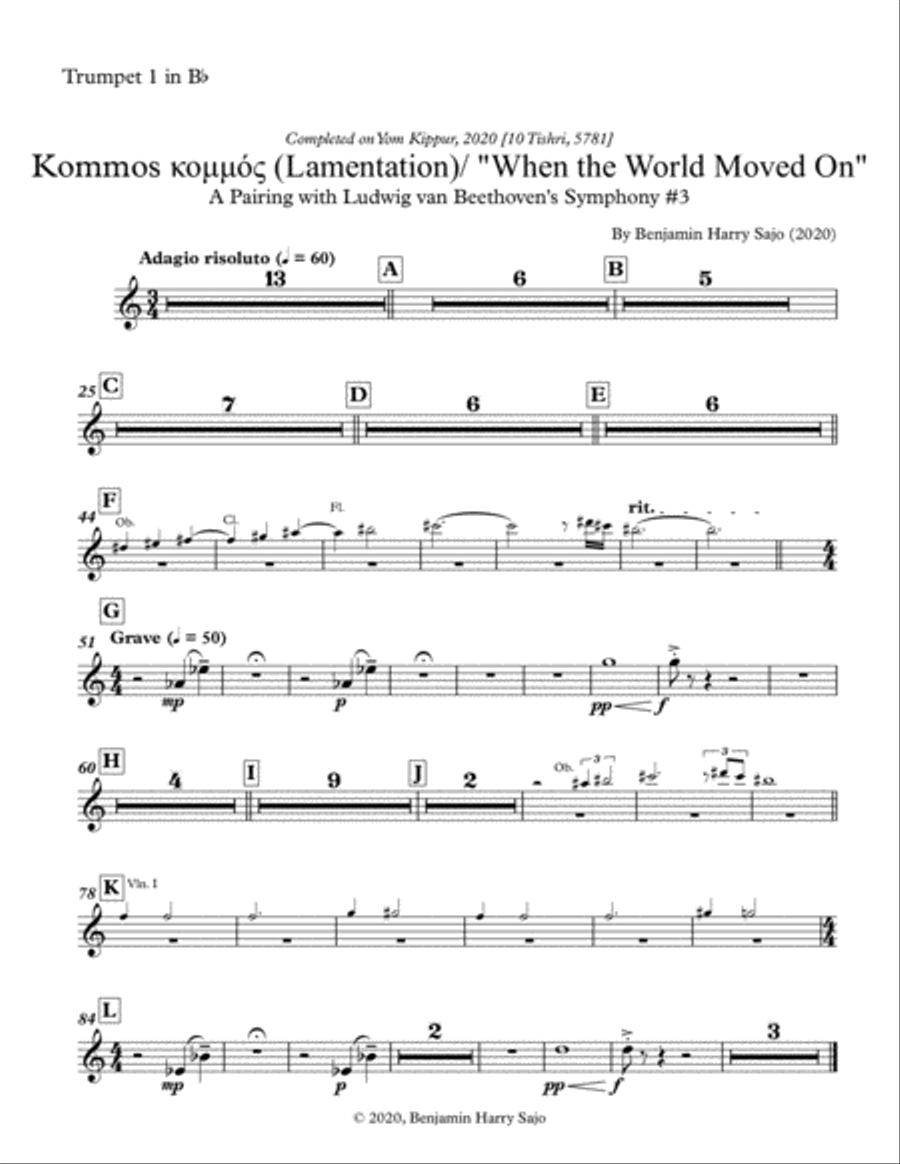
Kommos (Lamentation) / "When the World Moved On" - Trumpet 1 in Bb
Trompette (partie séparée)

$3.50 3.05 € Trompette (partie séparée) PDF SheetMusicPlus

Viola Solo - Level 4 - Digital Download SKU: A0.1018957 Composed by Benjamin Harry Sajo. 20th Century,Contemporary. Individual part. 2 pages. Benjamin Sajo #6078711. Published by Benjamin Sajo (A0.1018957). Programme Notes: This composition was written to be considered for pairing alongside Ludwig van Beethoven’s Symphony #3, the Eroica, but can stand on its own virtues as an intense and slow meditation on heroism. The music is like a boiling pot on the stove that’s just began to overflow its bubbles. The first part of the title, kommos, is a Classical Greek term from Attic dramaturgy, literally meaning striking but specifically referring to beating oneself up during lamentation--ripping at the hair, gouging out the eyes--like Oedipus--slapping the forehead, and other acts amid moments of extreme emotional turmoil. For example, from Aeschylus's play Agamemnon, a character bewails: Apollo, Apollo! God of the Ways, my destroyer! For you have destroyed me-and utterly [...]What is this fresh woe [...]what monstrous, monstrous horror, beyond love's enduring, beyond all remedy? And help stands far away! We can easily imagine physical accompaniment to the script; rather than bottling up the pain, the hero lets it all explosively come out.  â€ƒThe second part of the title, When the world moved on, is an epigraph taken from American author Stephen King’s The Dark Tower epic. The primary setting of the novel, a world similar in many ways to our own, is experiencing a dark age where the glorious past is all but a distant memory and all good things are referred to wistfully as occurring, When the world moved on. Yet, the main protagonist, Roland, the last gunslinger, emphasizes that it is not just a figure of speech, but the literal distances between destinations have increased, the positions of the stars have changed, as well as the occurrence of other unnatural phenomena. The world has become a gulf of isolation from all corners. Taken together, this piece is a lamentation for when the world moved on. Truly completed on Yom Kippur during the Covid-19 Pandemic, being unable to fast or go to synagogue, this is my atonement.About the Composer: Benjamin Sajo (b. 1988) is a Canadian composer of contemporary classical music, as well as an educator. Since developing a fiercely independent creative voice upon the completion of his studies at Western (2010) and McGill Universities (2013), he continues to find inspiration from the intersection of mythology, art, and nature upon the contemporary human experience. In 2019, he released his premiere album of original music, The Great War Sextet: Canadian War Poetry with Trombone & Strings, with support from the Ontario Arts Council. He is a member of SOCAN and the League of Canadian Composers.
Kommos (Lamentation) / "When the World Moved On" - Viola
Alto (partie séparée)

$3.50 3.05 € Alto (partie séparée) PDF SheetMusicPlus

Flute Solo - Level 4 - Digital Download SKU: A0.1018943 Composed by Benjamin Harry Sajo. 20th Century,Contemporary. Individual part. 1 pages. Benjamin Sajo #6078667. Published by Benjamin Sajo (A0.1018943). Programme Notes: This composition was written to be considered for pairing alongside Ludwig van Beethoven’s Symphony #3, the Eroica, but can stand on its own virtues as an intense and slow meditation on heroism. The music is like a boiling pot on the stove that’s just began to overflow its bubbles. The first part of the title, kommos, is a Classical Greek term from Attic dramaturgy, literally meaning striking but specifically referring to beating oneself up during lamentation--ripping at the hair, gouging out the eyes--like Oedipus--slapping the forehead, and other acts amid moments of extreme emotional turmoil. For example, from Aeschylus's play Agamemnon, a character bewails: Apollo, Apollo! God of the Ways, my destroyer! For you have destroyed me-and utterly [...]What is this fresh woe [...]what monstrous, monstrous horror, beyond love's enduring, beyond all remedy? And help stands far away! We can easily imagine physical accompaniment to the script; rather than bottling up the pain, the hero lets it all explosively come out.  â€ƒThe second part of the title, When the world moved on, is an epigraph taken from American author Stephen King’s The Dark Tower epic. The primary setting of the novel, a world similar in many ways to our own, is experiencing a dark age where the glorious past is all but a distant memory and all good things are referred to wistfully as occurring, When the world moved on. Yet, the main protagonist, Roland, the last gunslinger, emphasizes that it is not just a figure of speech, but the literal distances between destinations have increased, the positions of the stars have changed, as well as the occurrence of other unnatural phenomena. The world has become a gulf of isolation from all corners. Taken together, this piece is a lamentation for when the world moved on. Truly completed on Yom Kippur during the Covid-19 Pandemic, being unable to fast or go to synagogue, this is my atonement.About the Composer: Benjamin Sajo (b. 1988) is a Canadian composer of contemporary classical music, as well as an educator. Since developing a fiercely independent creative voice upon the completion of his studies at Western (2010) and McGill Universities (2013), he continues to find inspiration from the intersection of mythology, art, and nature upon the contemporary human experience. In 2019, he released his premiere album of original music, The Great War Sextet: Canadian War Poetry with Trombone & Strings, with support from the Ontario Arts Council. He is a member of SOCAN and the League of Canadian Composers.

Kommos (Lamentation) / "When the World Moved On" - Flute 2
Flute (partie séparée)

$3.50 3.05 € Flute (partie séparée) PDF SheetMusicPlus

Trumpet Solo - Level 4 - Digital Download SKU: A0.1018952 Composed by Benjamin Harry Sajo. 20th Century,Contemporary. Individual part. 1 pages. Benjamin Sajo #6078695. Published by Benjamin Sajo (A0.1018952). Programme Notes: This composition was written to be considered for pairing alongside Ludwig van Beethoven’s Symphony #3, the Eroica, but can stand on its own virtues as an intense and slow meditation on heroism. The music is like a boiling pot on the stove that’s just began to overflow its bubbles. The first part of the title, kommos, is a Classical Greek term from Attic dramaturgy, literally meaning striking but specifically referring to beating oneself up during lamentation--ripping at the hair, gouging out the eyes--like Oedipus--slapping the forehead, and other acts amid moments of extreme emotional turmoil. For example, from Aeschylus's play Agamemnon, a character bewails: Apollo, Apollo! God of the Ways, my destroyer! For you have destroyed me-and utterly [...]What is this fresh woe [...]what monstrous, monstrous horror, beyond love's enduring, beyond all remedy? And help stands far away! We can easily imagine physical accompaniment to the script; rather than bottling up the pain, the hero lets it all explosively come out.  â€ƒThe second part of the title, When the world moved on, is an epigraph taken from American author Stephen King’s The Dark Tower epic. The primary setting of the novel, a world similar in many ways to our own, is experiencing a dark age where the glorious past is all but a distant memory and all good things are referred to wistfully as occurring, When the world moved on. Yet, the main protagonist, Roland, the last gunslinger, emphasizes that it is not just a figure of speech, but the literal distances between destinations have increased, the positions of the stars have changed, as well as the occurrence of other unnatural phenomena. The world has become a gulf of isolation from all corners. Taken together, this piece is a lamentation for when the world moved on. Truly completed on Yom Kippur during the Covid-19 Pandemic, being unable to fast or go to synagogue, this is my atonement.About the Composer: Benjamin Sajo (b. 1988) is a Canadian composer of contemporary classical music, as well as an educator. Since developing a fiercely independent creative voice upon the completion of his studies at Western (2010) and McGill Universities (2013), he continues to find inspiration from the intersection of mythology, art, and nature upon the contemporary human experience. In 2019, he released his premiere album of original music, The Great War Sextet: Canadian War Poetry with Trombone & Strings, with support from the Ontario Arts Council. He is a member of SOCAN and the League of Canadian Composers.

Kommos (Lamentation) / "When the World Moved On" - Trumpet 2 in Bb
Trompette (partie séparée)

$3.50 3.05 € Trompette (partie séparée) PDF SheetMusicPlus

Oboe Solo - Level 4 - Digital Download SKU: A0.1018944 Composed by Benjamin Harry Sajo. 20th Century,Contemporary. Individual part. 1 pages. Benjamin Sajo #6078671. Published by Benjamin Sajo (A0.1018944). Programme Notes: This composition was written to be considered for pairing alongside Ludwig van Beethoven’s Symphony #3, the Eroica, but can stand on its own virtues as an intense and slow meditation on heroism. The music is like a boiling pot on the stove that’s just began to overflow its bubbles. The first part of the title, kommos, is a Classical Greek term from Attic dramaturgy, literally meaning striking but specifically referring to beating oneself up during lamentation--ripping at the hair, gouging out the eyes--like Oedipus--slapping the forehead, and other acts amid moments of extreme emotional turmoil. For example, from Aeschylus's play Agamemnon, a character bewails: Apollo, Apollo! God of the Ways, my destroyer! For you have destroyed me-and utterly [...]What is this fresh woe [...]what monstrous, monstrous horror, beyond love's enduring, beyond all remedy? And help stands far away! We can easily imagine physical accompaniment to the script; rather than bottling up the pain, the hero lets it all explosively come out.  â€ƒThe second part of the title, When the world moved on, is an epigraph taken from American author Stephen King’s The Dark Tower epic. The primary setting of the novel, a world similar in many ways to our own, is experiencing a dark age where the glorious past is all but a distant memory and all good things are referred to wistfully as occurring, When the world moved on. Yet, the main protagonist, Roland, the last gunslinger, emphasizes that it is not just a figure of speech, but the literal distances between destinations have increased, the positions of the stars have changed, as well as the occurrence of other unnatural phenomena. The world has become a gulf of isolation from all corners. Taken together, this piece is a lamentation for when the world moved on. Truly completed on Yom Kippur during the Covid-19 Pandemic, being unable to fast or go to synagogue, this is my atonement.About the Composer: Benjamin Sajo (b. 1988) is a Canadian composer of contemporary classical music, as well as an educator. Since developing a fiercely independent creative voice upon the completion of his studies at Western (2010) and McGill Universities (2013), he continues to find inspiration from the intersection of mythology, art, and nature upon the contemporary human experience. In 2019, he released his premiere album of original music, The Great War Sextet: Canadian War Poetry with Trombone & Strings, with support from the Ontario Arts Council. He is a member of SOCAN and the League of Canadian Composers.

Kommos (Lamentation) / "When the World Moved On" - Oboe 1
Hautbois (partie séparée)

$3.50 3.05 € Hautbois (partie séparée) PDF SheetMusicPlus

Oboe Solo - Level 3 - Digital Download SKU: A0.1018945 Composed by Benjamin Harry Sajo. 20th Century,Contemporary. Individual part. 1 pages. Benjamin Sajo #6078673. Published by Benjamin Sajo (A0.1018945). Programme Notes: This composition was written to be considered for pairing alongside Ludwig van Beethoven’s Symphony #3, the Eroica, but can stand on its own virtues as an intense and slow meditation on heroism. The music is like a boiling pot on the stove that’s just began to overflow its bubbles. The first part of the title, kommos, is a Classical Greek term from Attic dramaturgy, literally meaning striking but specifically referring to beating oneself up during lamentation--ripping at the hair, gouging out the eyes--like Oedipus--slapping the forehead, and other acts amid moments of extreme emotional turmoil. For example, from Aeschylus's play Agamemnon, a character bewails: Apollo, Apollo! God of the Ways, my destroyer! For you have destroyed me-and utterly [...]What is this fresh woe [...]what monstrous, monstrous horror, beyond love's enduring, beyond all remedy? And help stands far away! We can easily imagine physical accompaniment to the script; rather than bottling up the pain, the hero lets it all explosively come out.  â€ƒThe second part of the title, When the world moved on, is an epigraph taken from American author Stephen King’s The Dark Tower epic. The primary setting of the novel, a world similar in many ways to our own, is experiencing a dark age where the glorious past is all but a distant memory and all good things are referred to wistfully as occurring, When the world moved on. Yet, the main protagonist, Roland, the last gunslinger, emphasizes that it is not just a figure of speech, but the literal distances between destinations have increased, the positions of the stars have changed, as well as the occurrence of other unnatural phenomena. The world has become a gulf of isolation from all corners. Taken together, this piece is a lamentation for when the world moved on. Truly completed on Yom Kippur during the Covid-19 Pandemic, being unable to fast or go to synagogue, this is my atonement.About the Composer: Benjamin Sajo (b. 1988) is a Canadian composer of contemporary classical music, as well as an educator. Since developing a fiercely independent creative voice upon the completion of his studies at Western (2010) and McGill Universities (2013), he continues to find inspiration from the intersection of mythology, art, and nature upon the contemporary human experience. In 2019, he released his premiere album of original music, The Great War Sextet: Canadian War Poetry with Trombone & Strings, with support from the Ontario Arts Council. He is a member of SOCAN and the League of Canadian Composers.

Kommos (Lamentation) / "When the World Moved On" - Oboe 2
Hautbois (partie séparée)

$3.50 3.05 € Hautbois (partie séparée) PDF SheetMusicPlus


1 ....271 286 301 316 331 ....496


Partitions Gratuites
Acheter des Partitions Musicales
Acheter des Partitions Digitales à Imprimer
Acheter des Instruments de Musique

© 2000 - 2026

Accueil - Version intégrale

