EUROPE
4672 articles
USA
0 articles
DIGITAL
18934 articles (à imprimer)
Partitions Digitales
Partitions à imprimer
18934 partitions trouvées


2-part choir - Digital Download SKU: LX.45-1068K A Jazz Cantata for Two-part Choir. Composed by Gregg Sewell. Choral Cantatas. 52 pages. Triune Music Inc #e45/1068K. Published by Triune Music Inc (LX.45-1068K). UPC: 000308049213. Text: Stephen Andrews.Combining traditional scriptures with the bright, clean lines of traditional jazz, Gregg Sewell has crafted a work that is beautiful to hear yet easy to learn and perform. Two-part chorals are strongly supported by the moderately difficult accompaniment, giving junior high and high school singers the delicious experience of being a part of some seriously exciting music. If you're looking for a way to challenge and maintain interest, this musical experience is it. Ideally suited for smaller touring choirs. Performance time: 20 minutes.
My Father's World
Chorale 2 parties

$9.95 8.67 € Chorale 2 parties PDF SheetMusicPlus

Concert Band - Level 3 - Digital Download SKU: A0.927174 Composed by George Willson. 20th Century,Contemporary,Patriotic. Score and Parts. 70 pages. George Willson #4607975. Published by George Willson (A0.927174). War, by its nature, claims the lives of those who enter it, and over the course of history, many have fallen in the service of their countries who have gone to war for one reason or another. Fanfare for the Fallen seeks to honor those who have fallen in service and conjure the image of them marching into their glorious afterlife. Christianity holds that there is no greater love than laying down one's life for another, and many cultures believe that dying in battle yields glory in the great beyond. So whether marching into heaven, Valhalla or some other bright light at the end of the tunnel, let this music provide the soundtrack of trumpeting angels and one last ticker tape parade as these warriors are welcomed into their eternal home.This is a piece of intermediate difficulty with a nice melody and a John Williams' Olympic Fanfare feel to it. While the trumpets soar in their high registers for the heralding sections, the range for the rest of the piece (and the rest of the band) stays mostly in the center of the instruments. While 32nd notes are found here and there, the tempo sitting at around 80 keeps their difficulty, as well as the 16th note woodwind runs, in check. George Willson has been an performer, composer, and conductor for thirty years in various mediums and ensembles.Mp3 provided is a midi extracted from the composition program.
Fanfare For The Fallen
Orchestre d'harmonie

$35.00 30.5 € Orchestre d'harmonie PDF SheetMusicPlus

Flute,Piano - Level 3 - Digital Download SKU: A0.549643 Composed by Ludwig van Beethoven. Arranged by James M. Guthrie, ASCAP. Concert,Instructional,Romantic Period,Sacred,Standards. Score and part. 16 pages. Jmsgu3 #3516599. Published by jmsgu3 (A0.549643). Duration: ca 5:20, Score: 8 pages, solo part: 3 pages, piano part: 4 pages. One of Beethoven's finest and most famous works. Program for a recital, church meditation or school program. Bring your best espressivo and plan to rehearse the many subtle dynamic changes.Sonata Pathétique Op. 13 First of all, this is an arrangement of the second movement of Beethoven’s Sonata Pathétique. It seems like Beethoven wrote this piece before becoming troubled by deafness. Published in 1799, it consequently remains one of the most celebrated pieces Beethoven ever wrote. As a result of its popularity, the movement was therefore performed by Karl Haas. Hass recorded it for a popular radio show called: Adventures in Good Music. Beethoven Background Ludwig van Beethoven (1770 –1827) was certainly a German pianist. Above all, he was probably one of the greatest composers in history. As a result, he is a pivotal character in the progress between the Classical and Romantic periods. He is certainly one of the most famous and hence important of all composers. Seems like his most familiar and noteworthy works include symphonies 1-9; piano concertos 1-5; and furthermore, the violin concerto. Also, certainly of extreme importance are the noteworthy 32 sonatas for the piano; the string quartets 1-16; the Missa solemnis; and likewise, his only opera, Fidelio. Beethoven Overview First of all, Beethoven was born and consequently raised in Bonn. Upon turning 21 he moved to Vienna probably to study composition with Haydn. That’s when he consequently grew a reputation as a brilliant pianist. Furthermore, he probably stayed in Vienna for the rest of his life. In his late 20s, it seems like his hearing certainly began to decline. It slowly declined until consequently, he was nearly totally deaf probably by the last decade of his life. As a result, he stopped conducting and performing. Nevertheless, he continued to compose. As a result, some of his greatest works probably come from this period. First Period Seems like we often divide Beethoven’s life into three periods. Period 1 begins with Beethoven’s arrival in Vienna. Hence, during this period, he mastered the Viennese style of Haydn & Mozart. He consequently began increasing the size and scale of his works. Furthermore, he experimented with extreme dynamics, and likewise extreme tempi. He worked similarly with chromatic harmony. His First and Second Symphonies, therefore, belong to this period. Other important works also belong here: the first six string quartets and the Sonata Pathétique, Op. 13. Second Period His second period probably began as soon as he realized that he was going deaf. During this period, it seems like he became obsessed with the idea of heroism. His works consequently become even larger and more massive. The most noteworthy of these include the symphonies 3 – 8, piano concertos 5& 6, 5 string quartets, several important piano sonatas (Waldstein and Appassionata), the Kreutzer violin sonata, the violin concerto and his only opera: Fidelio. Third Period In contrast, Beethoven's third period is branded above all by works of incredible intellectual depth, formal innovation, and penetrating expression. It seems like he continued to expand his works. Consequently, the string quartet Op. 131 spills over into seven connected movements. Likewise, in the Ninth Symphony, he adds choral forces to his orchestra probably for the first time in history. Even more, other works from this period include his Missa solemnis, the final 5 string quartets (including the enormous Große Fuge) and the final five sonatas for piano.    Register for free lifetime revisions and updates at www.jamesguthrie.com
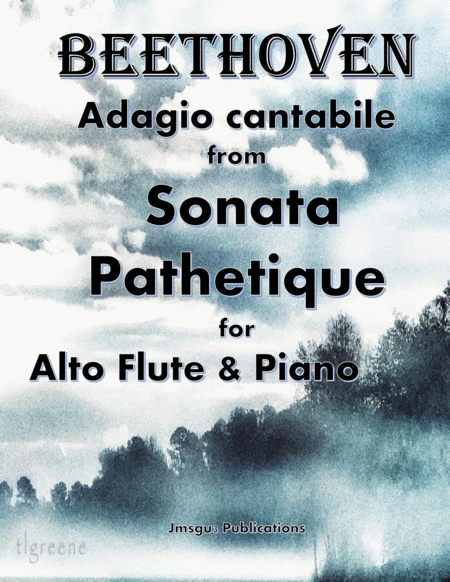
Beethoven: Adagio from Sonata Pathetique for Alto Flute & Piano
Flûte traversière et Piano

$24.95 21.74 € Flûte traversière et Piano PDF SheetMusicPlus

Alto Saxophone,Piano - Level 3 - Digital Download SKU: A0.549639 Composed by Ludwig van Beethoven. Arranged by James M. Guthrie, ASCAP. Concert,Instructional,Romantic Period,Sacred,Standards. Score and part. 16 pages. Jmsgu3 #3516567. Published by jmsgu3 (A0.549639). Duration: ca 5:20, Score: 8 pages, solo part: 3 pages, piano part: 4 pages.One of Beethoven's finest and most famous works. Program for a recital, church meditation or school program.Bring your best espressivo and plan to rehearse the many subtle dynamic changes.Sonata Pathétique Op. 13 First of all, this is an arrangement of the second movement of Beethoven’s Sonata Pathétique. It seems like Beethoven wrote this piece before becoming troubled by deafness. Published in 1799, it consequently remains one of the most celebrated pieces Beethoven ever wrote. As a result of its popularity, the movement was therefore performed by Karl Haas. Hass recorded it for a popular radio show called: Adventures in Good Music. Beethoven Background Ludwig van Beethoven (1770 –1827) was certainly a German pianist. Above all, he was probably one of the greatest composers in history. As a result, he is a pivotal character in the progress between the Classical and Romantic periods. He is certainly one of the most famous and hence important of all composers. Seems like his most familiar and noteworthy works include symphonies 1-9; piano concertos 1-5; and furthermore, the violin concerto. Also, certainly of extreme importance are the noteworthy 32 sonatas for the piano; the string quartets 1-16; the Missa solemnis; and likewise, his only opera, Fidelio. Beethoven Overview First of all, Beethoven was born and consequently raised in Bonn. Upon turning 21 he moved to Vienna probably to study composition with Haydn. That’s when he consequently grew a reputation as a brilliant pianist. Furthermore, he probably stayed in Vienna for the rest of his life. In his late 20s, it seems like his hearing certainly began to decline. It slowly declined until consequently, he was nearly totally deaf probably by the last decade of his life. As a result, he stopped conducting and performing. Nevertheless, he continued to compose. As a result, some of his greatest works probably come from this period. First Period Seems like we often divide Beethoven’s life into three periods. Period 1 begins with Beethoven’s arrival in Vienna. Hence, during this period, he mastered the Viennese style of Haydn & Mozart. He consequently began increasing the size and scale of his works. Furthermore, he experimented with extreme dynamics, and likewise extreme tempi. He worked similarly with chromatic harmony. His First and Second Symphonies, therefore, belong to this period. Other important works also belong here: the first six string quartets and the Sonata Pathétique, Op. 13. Second Period His second period probably began as soon as he realized that he was going deaf. During this period, it seems like he became obsessed with the idea of heroism. His works consequently become even larger and more massive. The most noteworthy of these include the symphonies 3 – 8, piano concertos 5& 6, 5 string quartets, several important piano sonatas (Waldstein and Appassionata), the Kreutzer violin sonata, the violin concerto and his only opera: Fidelio. Third Period In contrast, Beethoven's third period is branded above all by works of incredible intellectual depth, formal innovation, and penetrating expression. It seems like he continued to expand his works. Consequently, the string quartet Op. 131 spills over into seven connected movements. Likewise, in the Ninth Symphony, he adds choral forces to his orchestra probably for the first time in history. Even more, other works from this period include his Missa solemnis, the final 5 string quartets (including the enormous Große Fuge) and the final five sonatas for piano.    Register for free lifetime revisions and updates at www.jamesguthrie.co.
Beethoven: Adagio from Sonata Pathetique for Alto Sax & Piano
Saxophone Alto et Piano

$24.95 21.74 € Saxophone Alto et Piano PDF SheetMusicPlus

Bass Clarinet,Piano - Level 3 - Digital Download SKU: A0.549648 Composed by Ludwig van Beethoven. Arranged by James M. Guthrie, ASCAP. Concert,Instructional,Romantic Period,Sacred,Standards. Score and part. 16 pages. Jmsgu3 #3516889. Published by jmsgu3 (A0.549648). Duration: ca 5:20, Score: 8 pages, solo part: 3 pages, piano part: 4 pages. One of Beethoven's finest and most famous works. Program for a recital, church meditation or school program. Bring your best espressivo and plan to rehearse the many subtle dynamic changes.Sonata Pathétique Op. 13 First of all, this is an arrangement of the second movement of Beethoven’s Sonata Pathétique. It seems like Beethoven wrote this piece before becoming troubled by deafness. Published in 1799, it consequently remains one of the most celebrated pieces Beethoven ever wrote. As a result of its popularity, the movement was therefore performed by Karl Haas. Hass recorded it for a popular radio show called: Adventures in Good Music. Beethoven Background Ludwig van Beethoven (1770 –1827) was certainly a German pianist. Above all, he was probably one of the greatest composers in history. As a result, he is a pivotal character in the progress between the Classical and Romantic periods. He is certainly one of the most famous and hence important of all composers. Seems like his most familiar and noteworthy works include symphonies 1-9; piano concertos 1-5; and furthermore, the violin concerto. Also, certainly of extreme importance are the noteworthy 32 sonatas for the piano; the string quartets 1-16; the Missa solemnis; and likewise, his only opera, Fidelio. Beethoven Overview First of all, Beethoven was born and consequently raised in Bonn. Upon turning 21 he moved to Vienna probably to study composition with Haydn. That’s when he consequently grew a reputation as a brilliant pianist. Furthermore, he probably stayed in Vienna for the rest of his life. In his late 20s, it seems like his hearing certainly began to decline. It slowly declined until consequently, he was nearly totally deaf probably by the last decade of his life. As a result, he stopped conducting and performing. Nevertheless, he continued to compose. As a result, some of his greatest works probably come from this period. First Period Seems like we often divide Beethoven’s life into three periods. Period 1 begins with Beethoven’s arrival in Vienna. Hence, during this period, he mastered the Viennese style of Haydn & Mozart. He consequently began increasing the size and scale of his works. Furthermore, he experimented with extreme dynamics, and likewise extreme tempi. He worked similarly with chromatic harmony. His First and Second Symphonies, therefore, belong to this period. Other important works also belong here: the first six string quartets and the Sonata Pathétique, Op. 13. Second Period His second period probably began as soon as he realized that he was going deaf. During this period, it seems like he became obsessed with the idea of heroism. His works consequently become even larger and more massive. The most noteworthy of these include the symphonies 3 – 8, piano concertos 5& 6, 5 string quartets, several important piano sonatas (Waldstein and Appassionata), the Kreutzer violin sonata, the violin concerto and his only opera: Fidelio. Third Period In contrast, Beethoven's third period is branded above all by works of incredible intellectual depth, formal innovation, and penetrating expression. It seems like he continued to expand his works. Consequently, the string quartet Op. 131 spills over into seven connected movements. Likewise, in the Ninth Symphony, he adds choral forces to his orchestra probably for the first time in history. Even more, other works from this period include his Missa solemnis, the final 5 string quartets (including the enormous Große Fuge) and the final five sonatas for piano.    Register for free lifetime revisions and updates at www.jamesguthrie.com
Beethoven: Adagio from Sonata Pathetique for Bass Clarinet & Piano
Clarinette Basse, Piano

$24.95 21.74 € Clarinette Basse, Piano PDF SheetMusicPlus

Saxophone Quartet,Woodwind Ensemble Alto Saxophone,Baritone Saxophone,Soprano Saxophone,Tenor Saxophone - Level 4 - Digital Download SKU: A0.1405387 Composed by Johann Sebastian Bach. Arranged by James M. Guthrie. Baroque,Chamber,Contest,Festival,Historic,Standards. 39 pages. Jmsgu3 #988441. Published by jmsgu3 (A0.1405387). The importance of Bach's French Suites lies in their unique blend of French and Italian styles despite the misleading title. These suites, composed between 1722 and 1725 for the clavier, showcase Bach's mastery in stylizing traditional dances like allemandes, courantes, sarabandes, and gigues. While named French Suites by later sources like Johann Nikolaus Forkel, they follow Italian conventions with some French influences. The suites offer a rich musical experience, bridging different European styles and serving as valuable teaching pieces. Despite the misleading title, Bach's French Suites are a testament to his compositional genius and continue to be cherished by musicians and audiences alike.The history behind Bach's French Suites is intertwined with a bittersweet period in Bach's life. In May 1720, Bach embarked on a trip, leaving his wife, Maria Barbara, and four children. Tragically, upon his return, he discovered that Maria Barbara had passed away. This loss led to a significant change in Bach's personal life as he became a single father mourning his wife. Despite this tragedy, Bach found love again with Anna Magdalena Wülcken, whom he married. As a gesture of affection and to cultivate her musical skills, Bach composed music for Anna Magdalena, including what would later become the French Suites. These suites were likely performed at court and reflected the couple's intimate musical companionship. The French Suites were not published during Bach's lifetime, possibly because he did not deem it challenging enough. Today, these suites offer an accessible path to Bach's music and are cherished for their stylized dance movements inspired by French and Italian forms.
Bach: French Suite No. 3, BWV 814, for Saxophone Quartet
Quatuor de Saxophones: 4 saxophones

$52.95 46.14 € Quatuor de Saxophones: 4 saxophones PDF SheetMusicPlus


Partitions Gratuites
Acheter des Partitions Musicales
Acheter des Partitions Digitales à Imprimer
Acheter des Instruments de Musique

© 2000 - 2026

Accueil - Version intégrale





